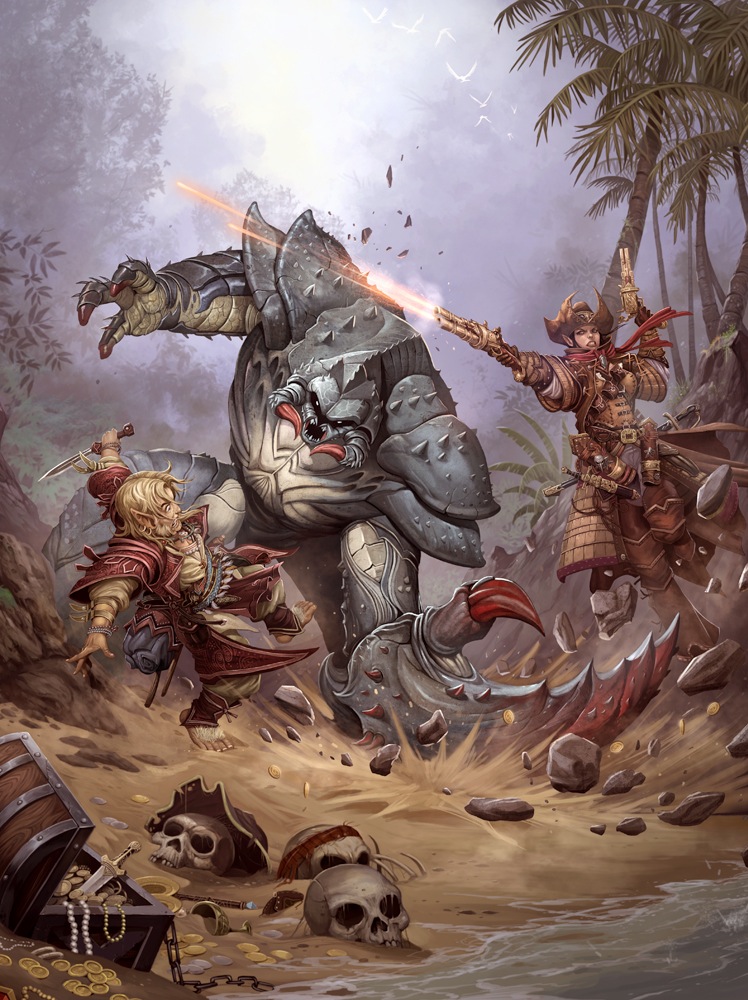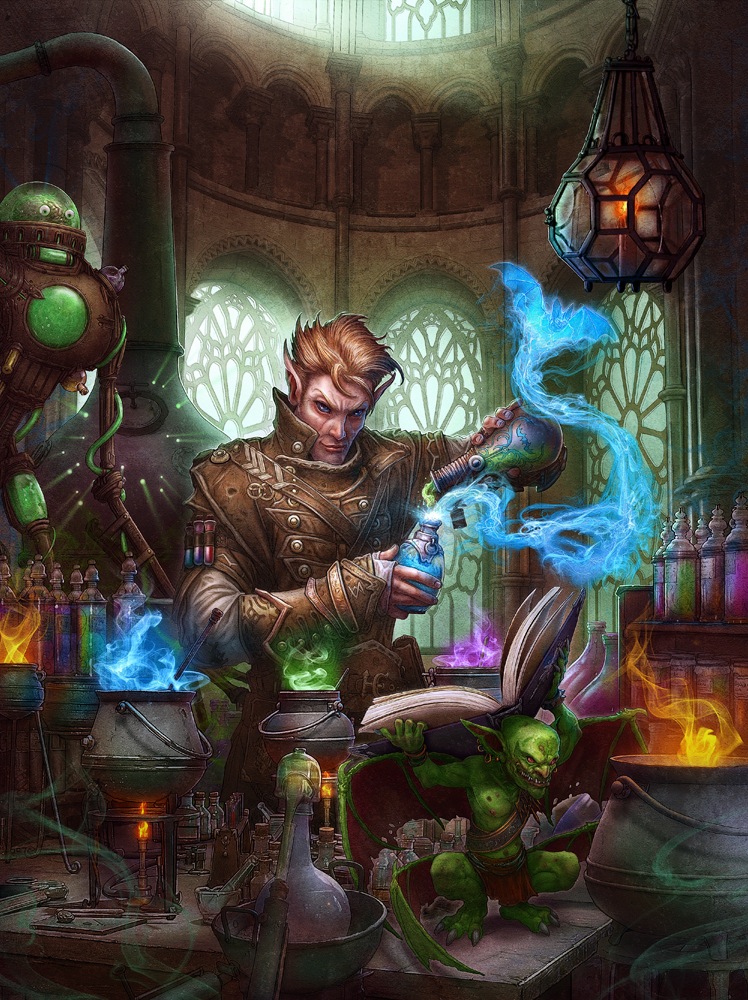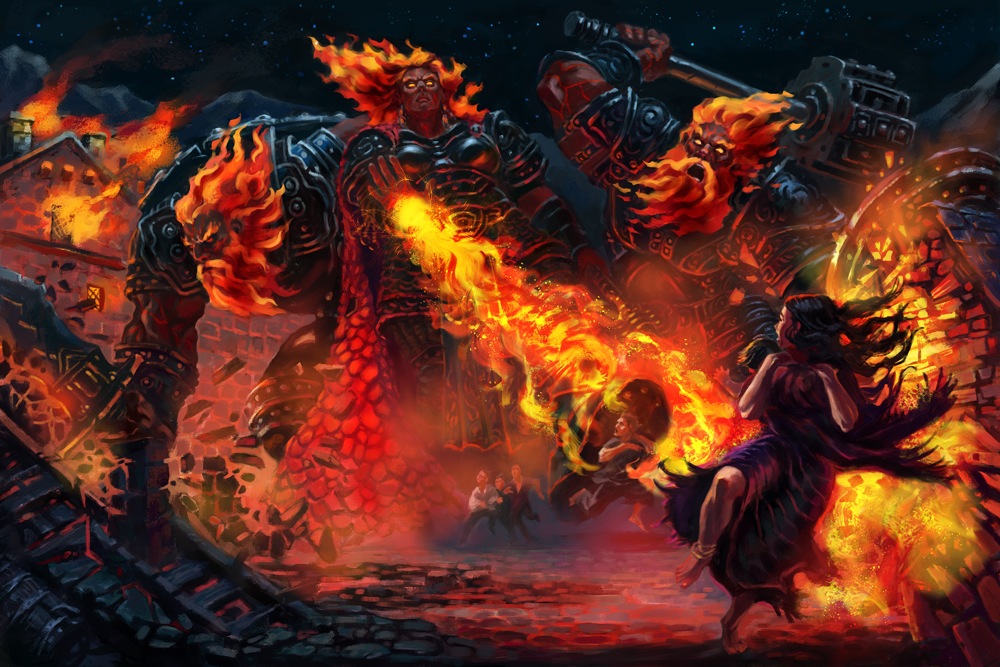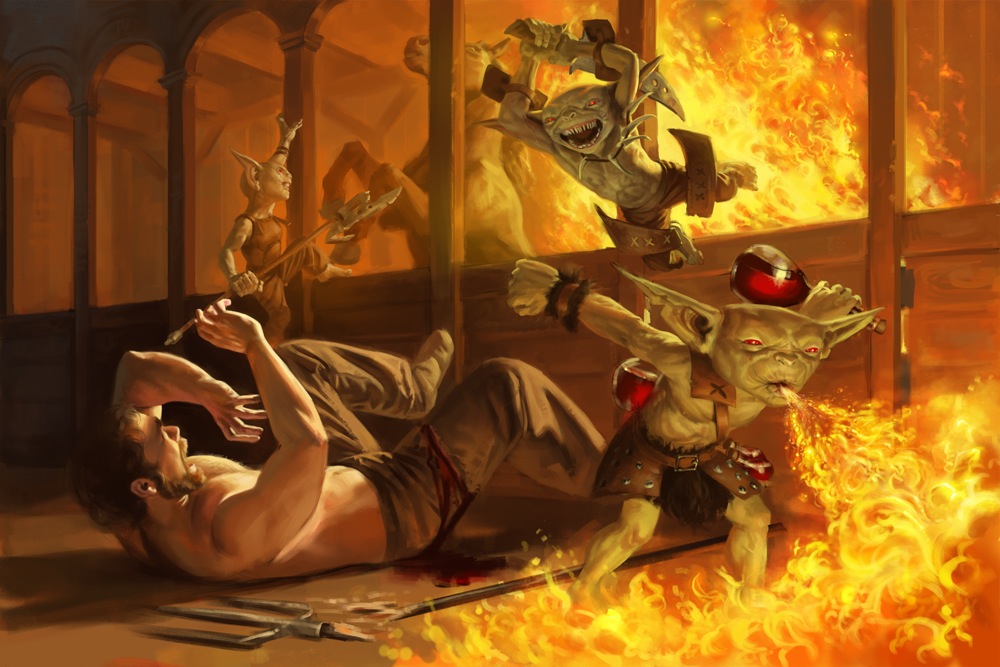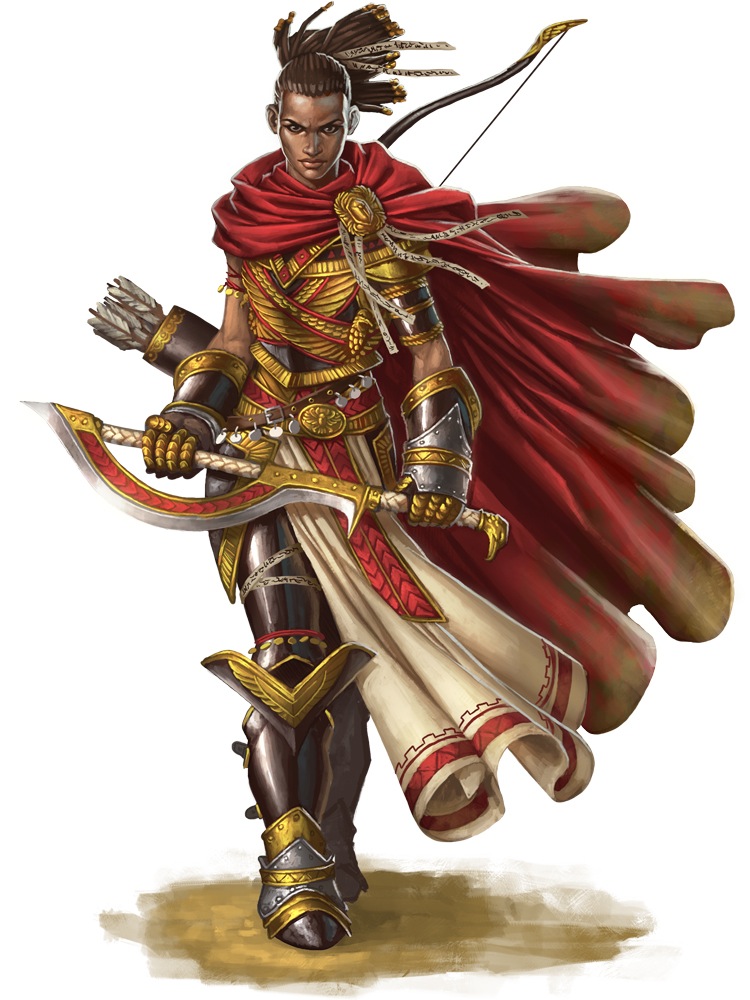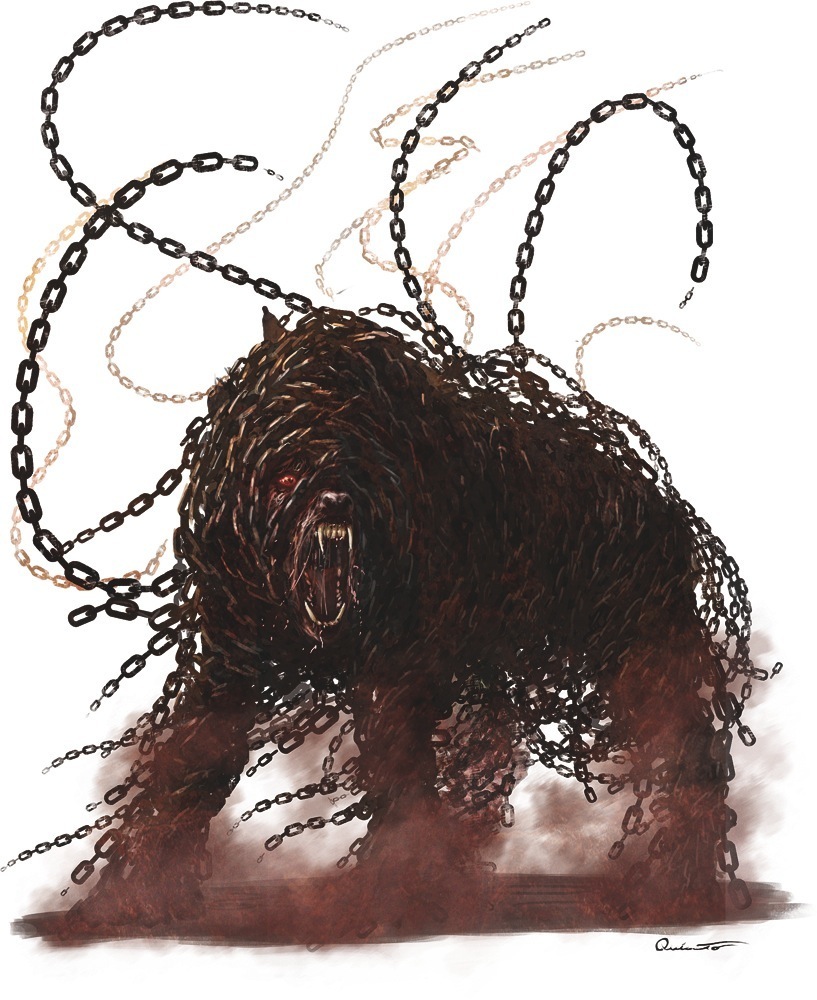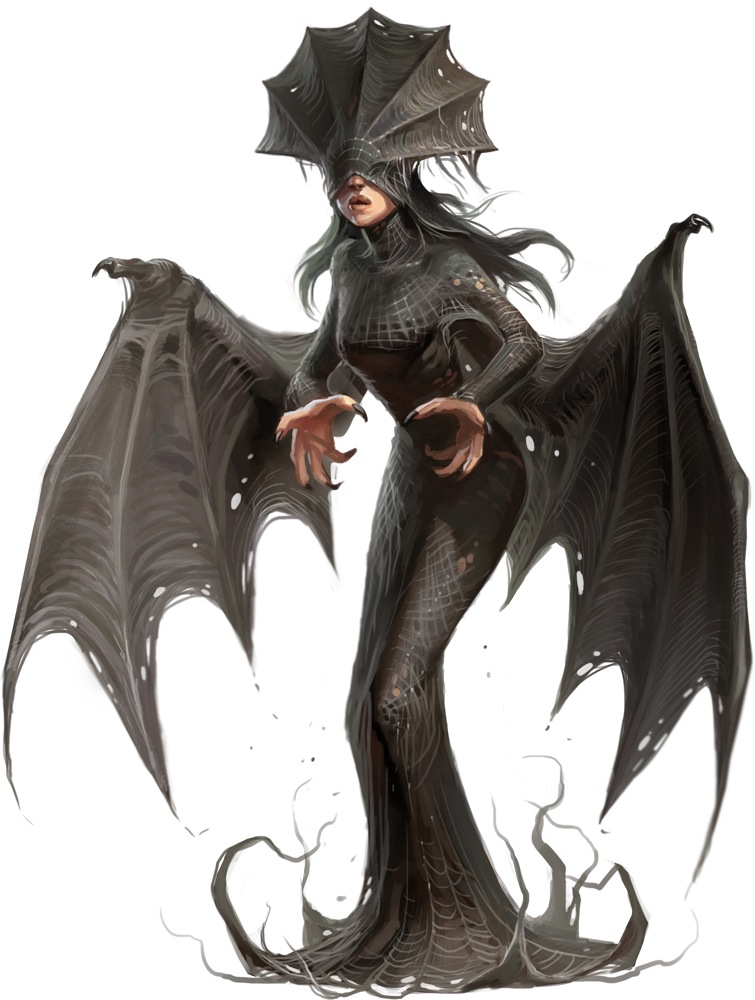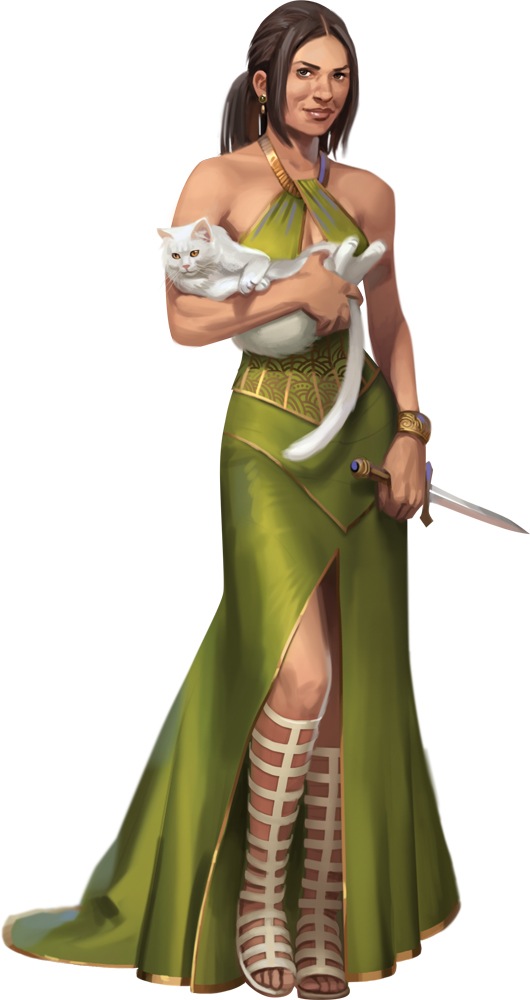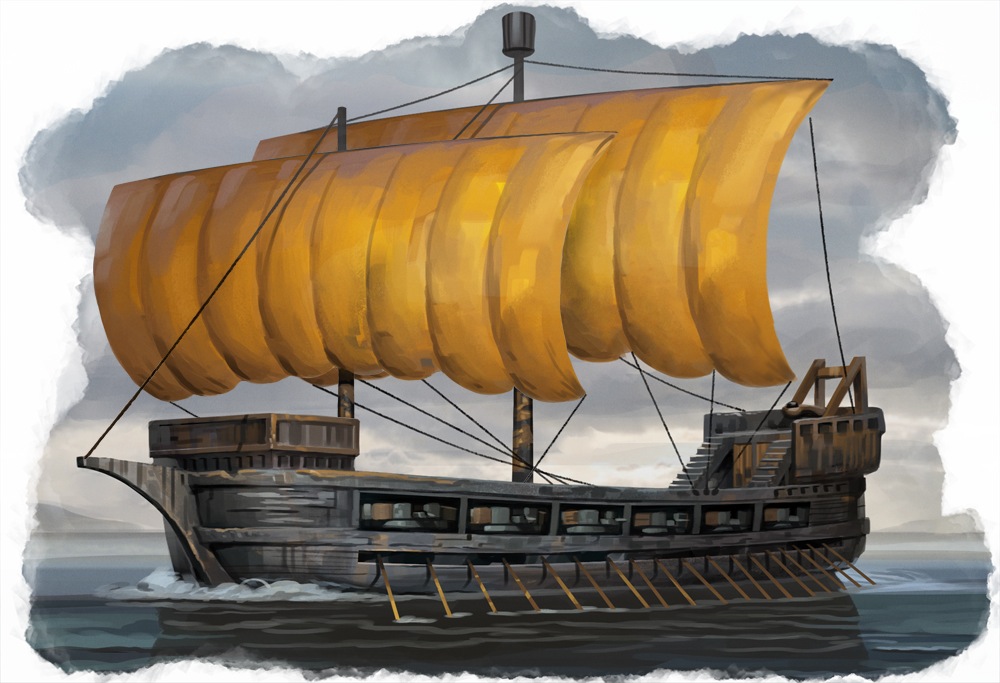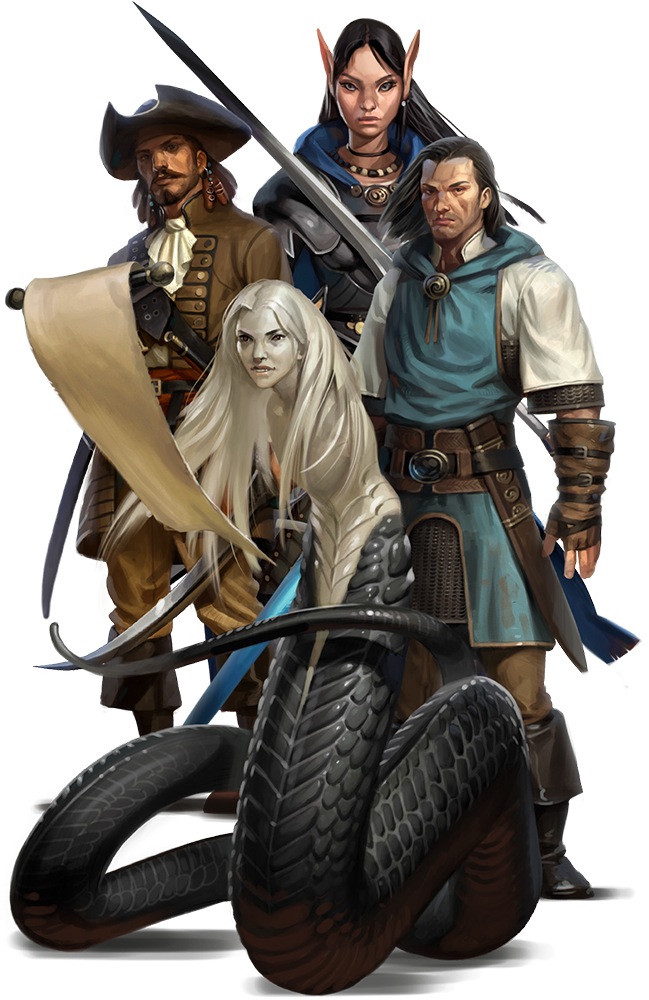

Black sails tore out of the moonless night, all but invisible as the corsair Stargazer swooped down on her prey. Even as the merchant galleon's crew recognized the danger, three ballistae cracked in perfect unison, and their steel heads bit into the planks of the ship's hull.
Stargazer
by Chris A. Jackson
Chapter One: Venomous Friends
Black sails tore out of the moonless night, all but invisible as the corsair Stargazer swooped down on her prey. Even as the merchant galleon's crew recognized the danger, three ballistae cracked in perfect unison, and their steel heads bit into the planks of the ship's hull.
"Haul!" bellowed a voice, and Stargazer's capstan spun, hauling in the lines affixed to the ballistae bolts, pulling the two ships together.
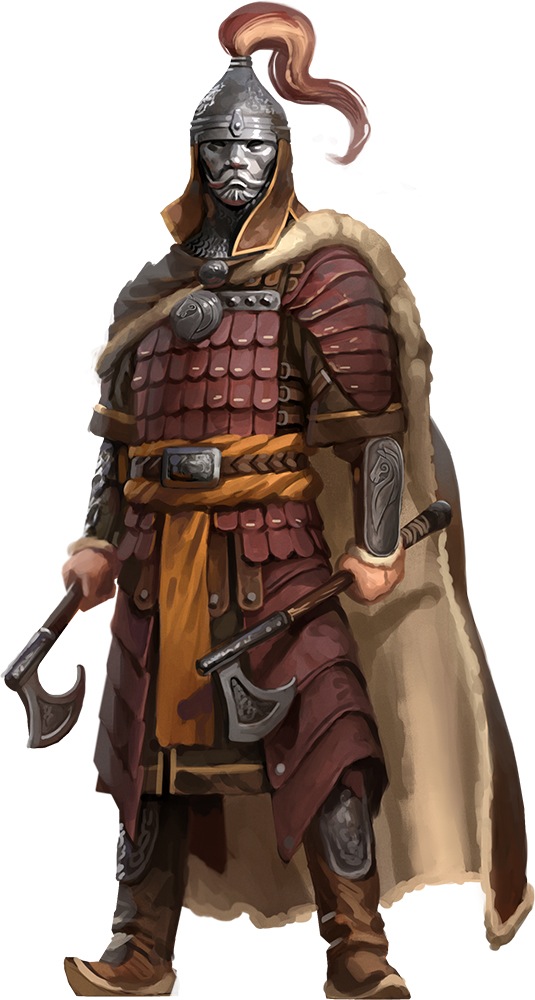
The two hulls met with a crack, and thirty seasoned pirates leapt aboard the merchant ship in a wave of curses and flashing steel. One stout sailor swung a boathook, cracking a burly pirate across the face. The pirate responded with an anatomically impossible epithet and a sweeping blow of his heavy axe that clove the sailor's skull like an overripe melon. The captain and crew of the Golden Griffin dropped their weapons and backed against the windward rail, pleading for mercy, hands raised.
"Bosun Grogul!" The voice cut through the night like a knife, staying the burly pirate's hand as he raised his axe above the merchant captain's head. "Stand down! Secure their weapons and start your search!"
"Aye, Captain!" The half-orc pirate spat blood onto the deck. He glanced over his shoulder at his captain standing on Stargazer's rail, and the rage in his eyes dimmed. "Search party with me! You others, secure this rabble!"
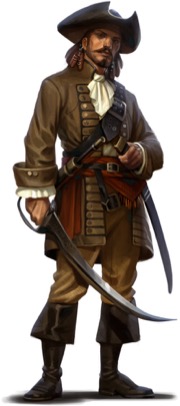
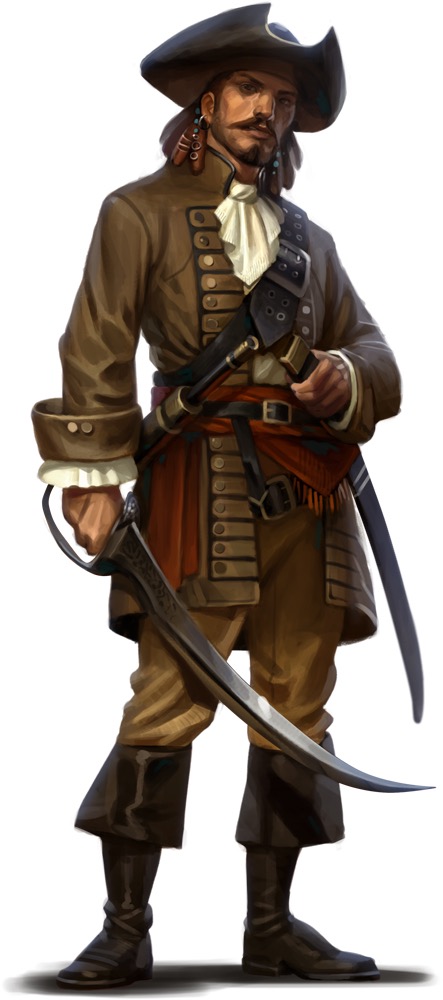
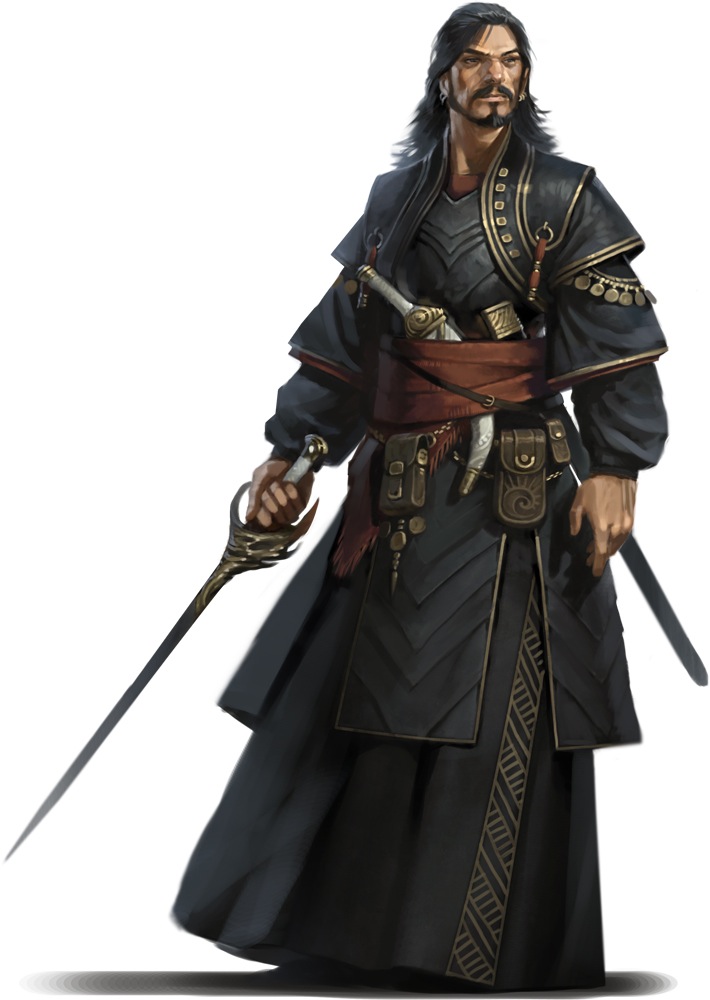
Captain Torius Vin stepped onto the deck of the merchant galleon with the preternatural agility of a born seaman, one hand on the silver hilt of the cutlass at his hip. His confident swagger was that of a man walking across a street instead of a lurching deck as he stepped over the corpse of the dead sailor and confronted the captain of the Golden Griffin.
"Where is it, Captain Wayland?" He stroked his carefully groomed goatee, dark eyes narrowed.
"Where's what?" The merchant captain's voice sounded harsh with fear. "You're nothing but a damned pirate!"
Torius grinned—he expected fear from his conquests, but not defiance—and drew his cutlass. The flat of the blade slapped the captain's cheek, the edge coming to rest beneath the man's ear. "A pirate I am, Captain, and I may even be damned one day. But not today, and not by the likes of you! If you hand over the coffer you're delivering to Benrahi Ekhan of Azir, I'll spare the lives of you and your crew. If you lie to me again, I'll feed you to the adaro a piece at a time—your right ear first."
"Bugger yourself, pirate!" the captain spat. "You'll kill us all anyway. You vermin have no honor!"
Torius' wrist stiffened, and the razor edge of his cutlass drew a bead of blood from the captain's ear. "Have it your way," he said, but a soft voice from behind him stayed his hand.
"My captain!" There was a rustle of scales against wood. "I can help, if you'll allow me."
"Celeste!" Torius lowered his sword and glanced over his shoulder to see... nothing. "Is there time?"
"There's always time, Captain Vin. It's what we do with it that matters." The voice was as hauntingly beautiful as the night sky. "In this moment of it, I can find what you seek."
"Then by all means proceed, my dear." Torius stepped back.
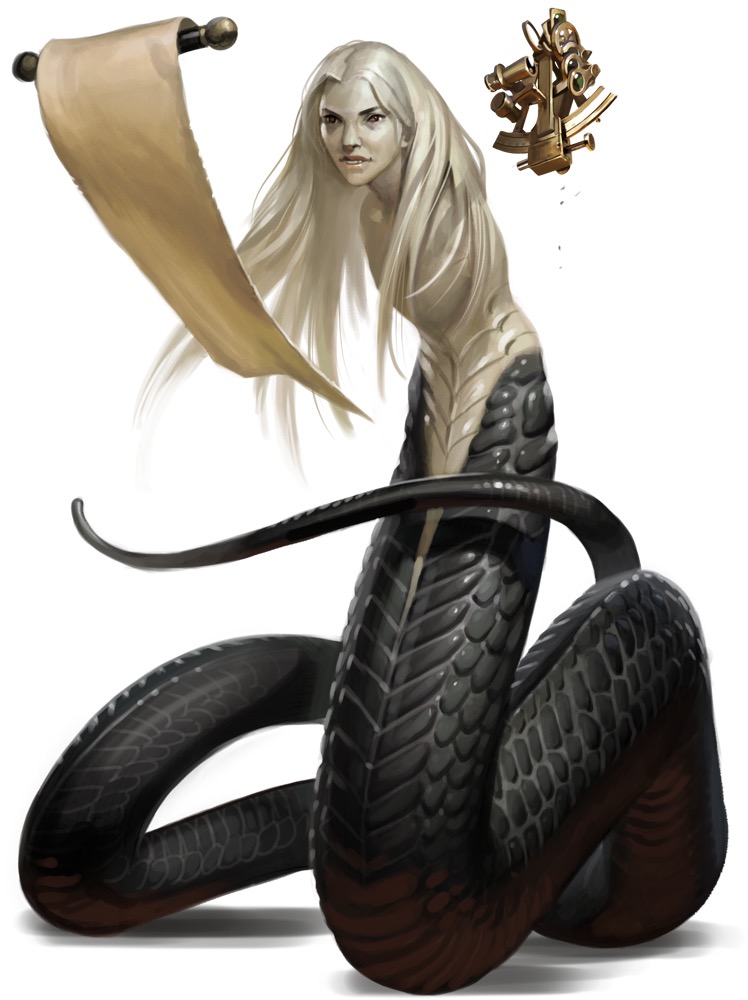
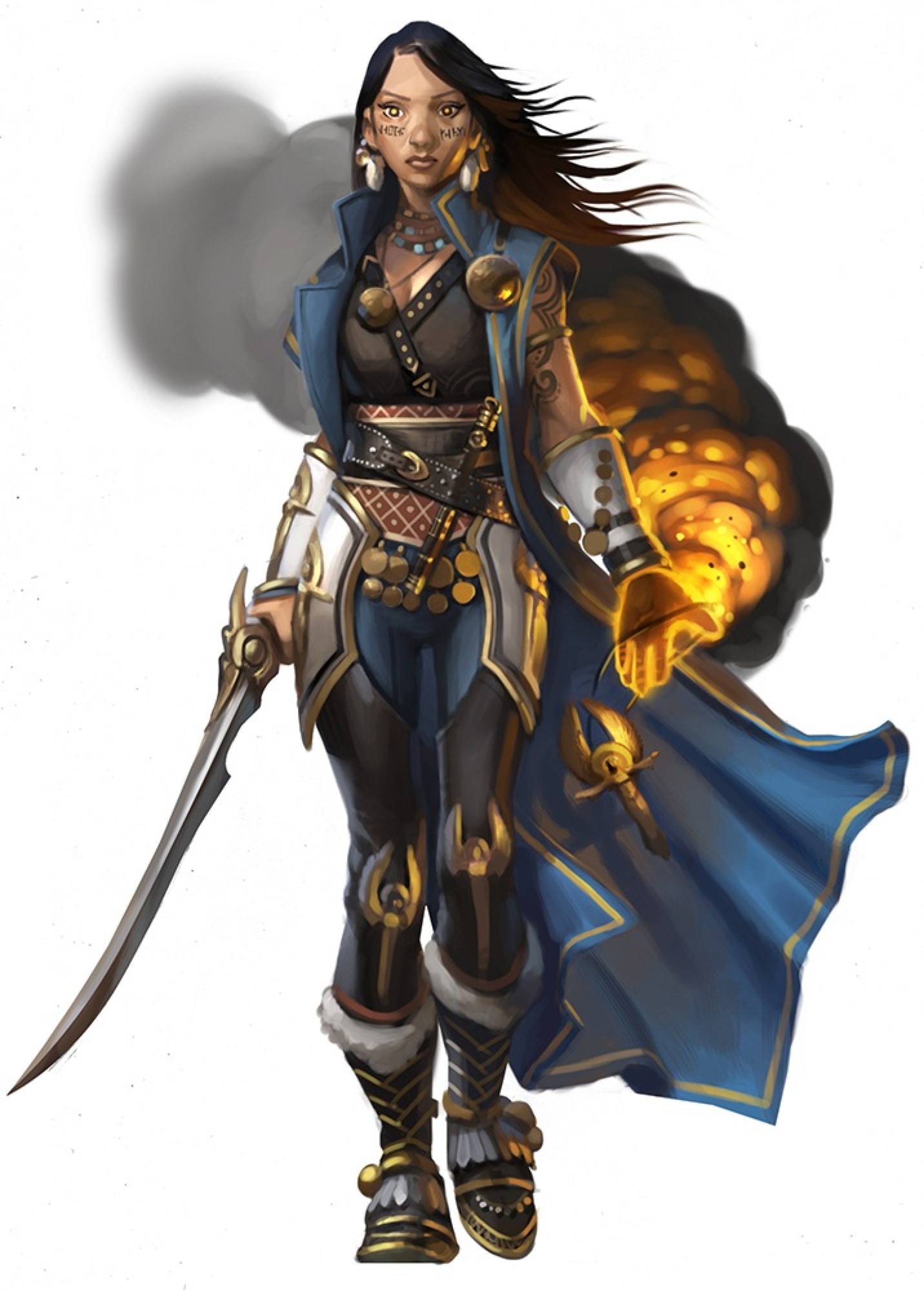
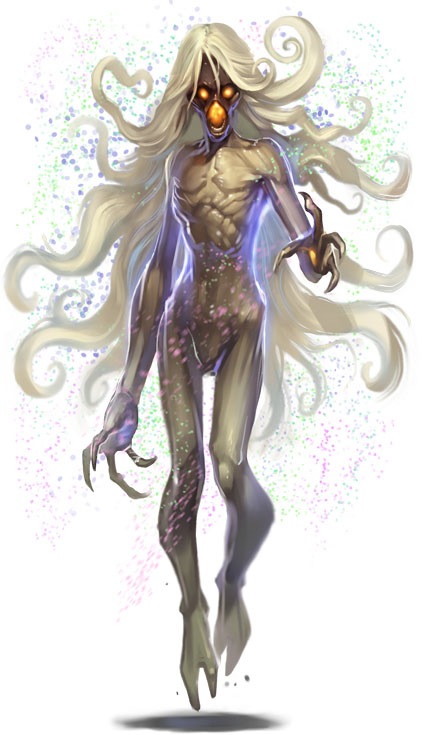
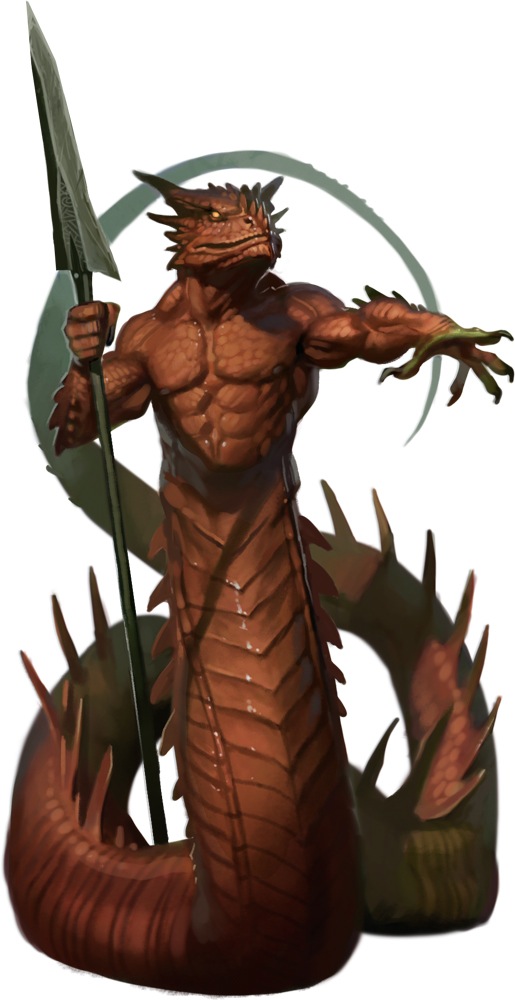
Undulating coils of starlight flowed over the conjoined rails of the two ships as a huge serpent with the head of a woman materialized from invisibility. The white waves of her hair glowed in the starlight as she slithered to Torius's side, then smiled, her fangs glistening with venom. Torius stifled a chuckle at the gasps of horror from the Golden Griffin's captain and crew; where they saw a monster, he saw magnificence.
"Captain Wayland," she hissed as she bent close to the man's sweaty face. Torius heard the whisper of her quietly murmured spell. "If not to save your own life, then for the lives of your crew: tell me where you have hidden the coffer destined for Benrahi Ekhan."
The man paled nearly to the naga's alabaster hue, swallowed, then answered. "In a secret compartment under the chart table in my quarters. This is the key." He fumbled a heavy brass key from a pocket, and it floated out of his grasp and into Torius's hand.
"Mister Caliel!" Torius tossed the key to his first mate. "Get that coffer, double quick! Time is of the essence!"
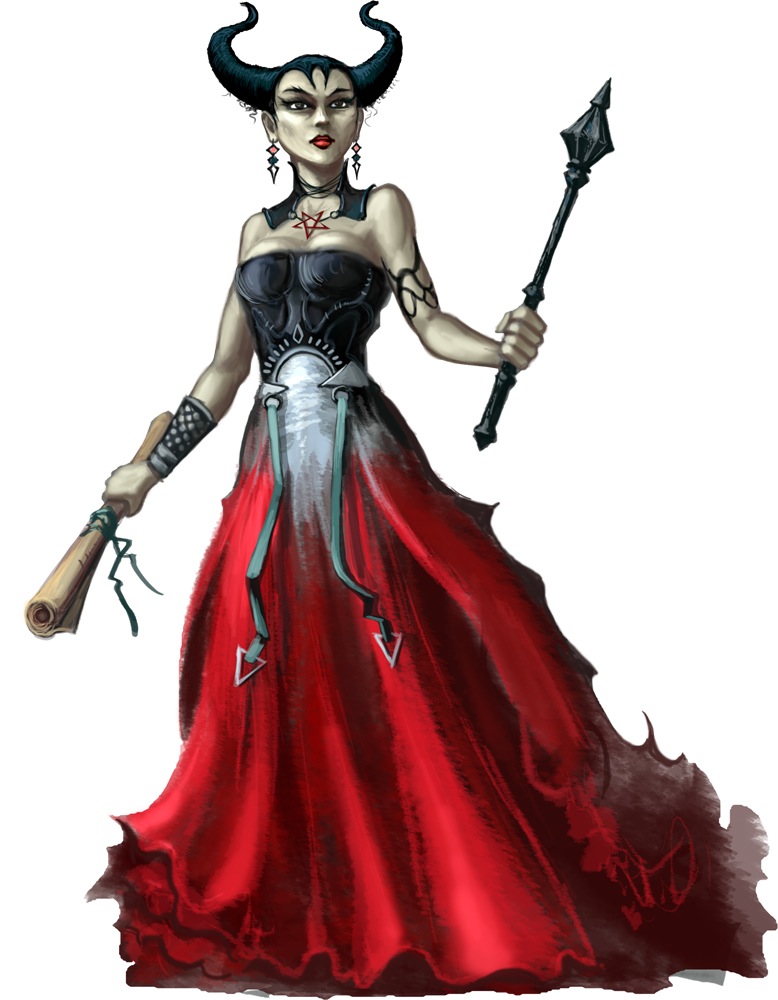
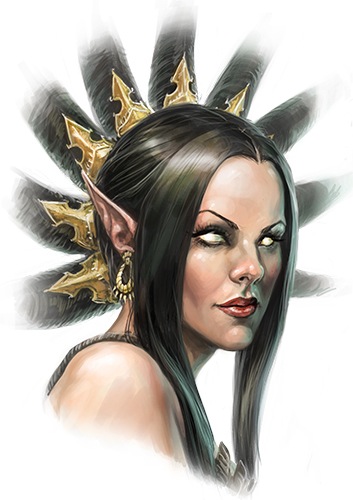
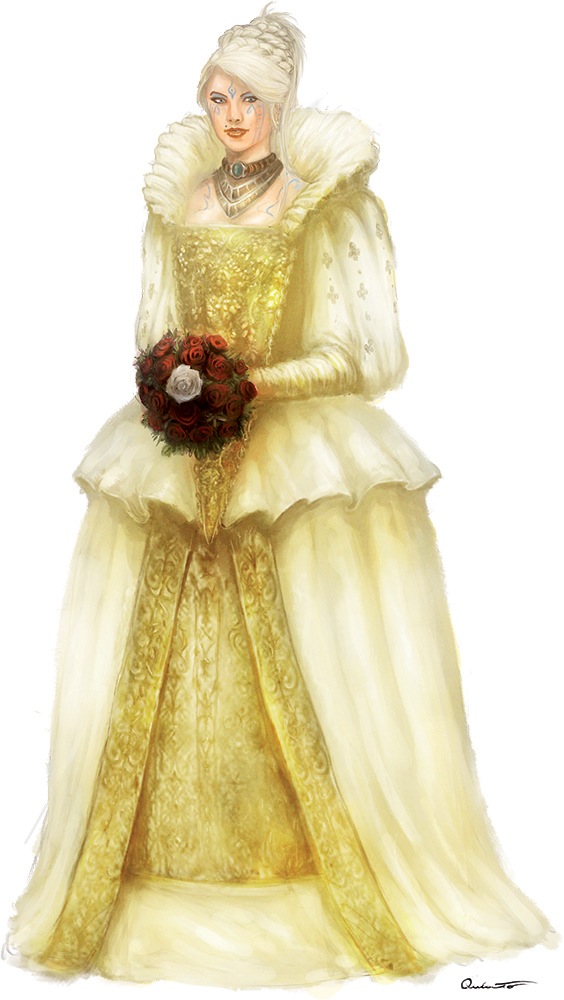
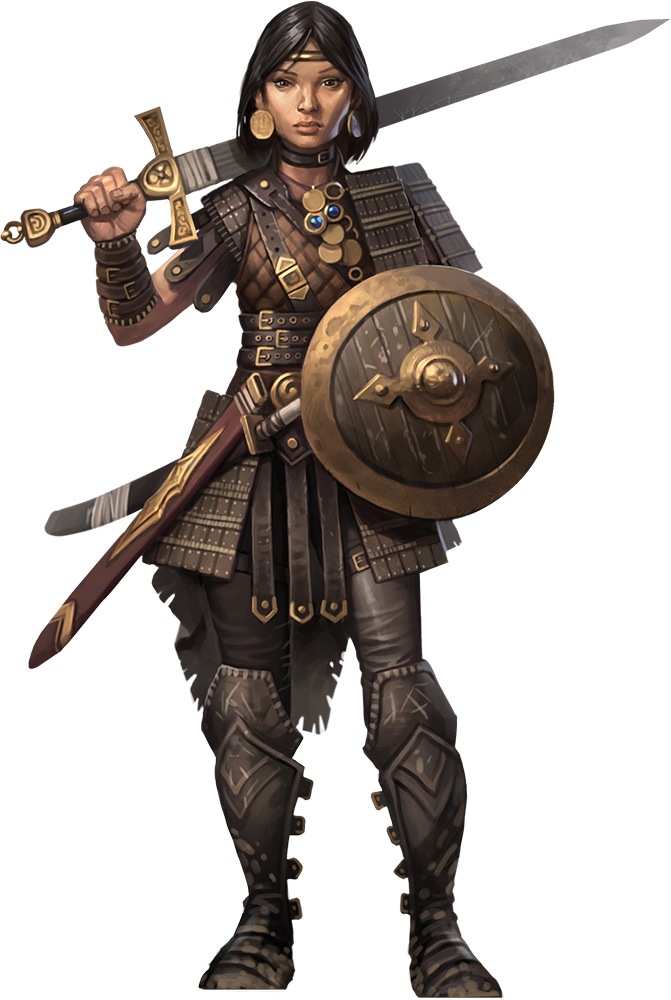
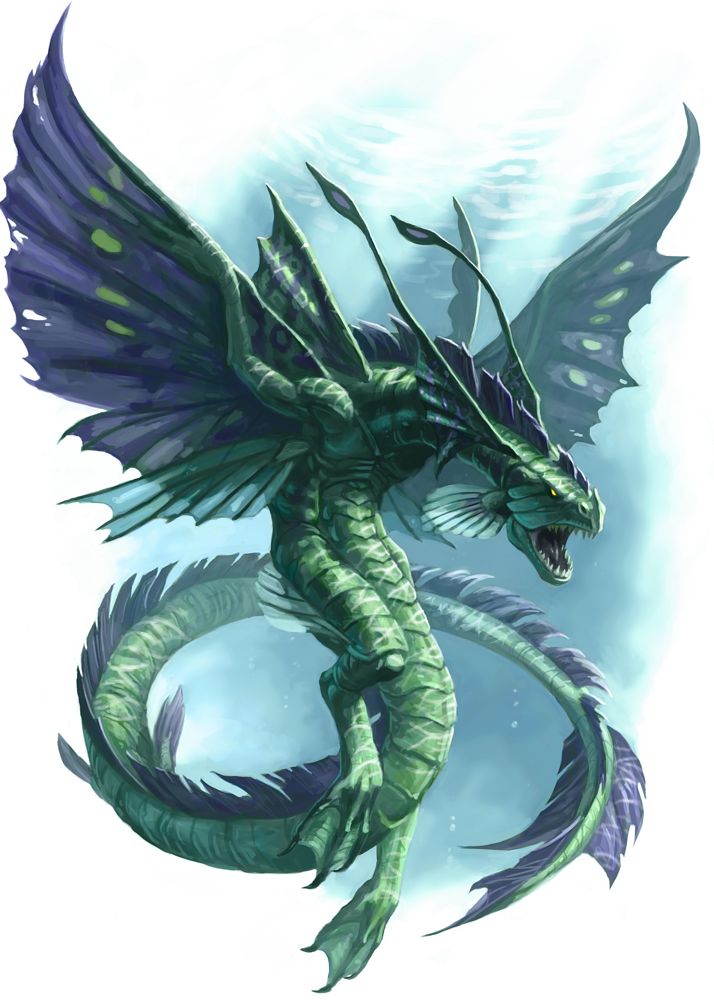
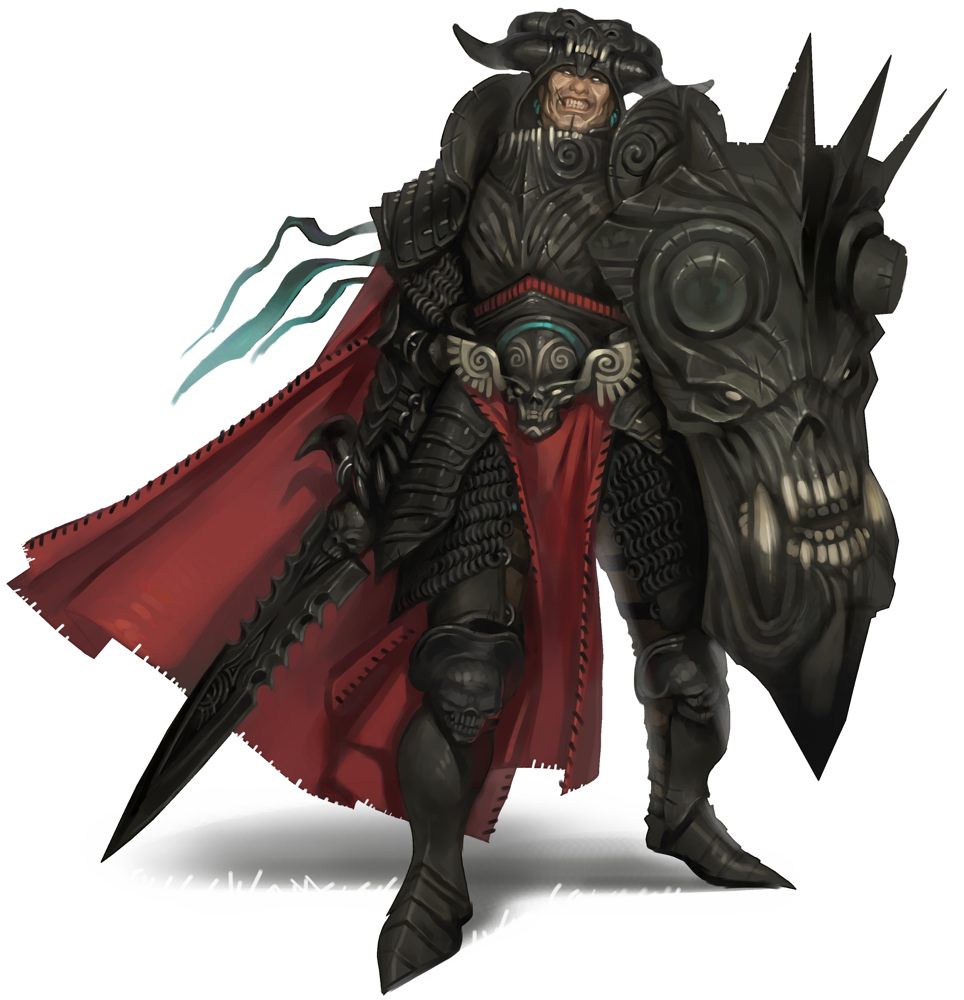
Celeste is an exceptional woman—in many senses.
"Aye, sir!" The tall man, a half-elf by the gentle point of his ears, gathered two men and hurried aft.
"Celeste," Torius said more quietly, "best go below now. Thank you for your help."
"Who am I to argue with the stars, my captain?" Her lips curved in a knowing smile. "I await you in your cabin." She slithered away with astonishing alacrity, gone by the time Torius turned back to the captain of the Golden Griffin.
"Now, Captain, there are two possible outcomes to this night's events, and only one ends with you still breathing." He reached into his jacket pocket and withdrew a large, flat bottle. "Outcome one is that you and your crew each take a single draught from this bottle, and forget the last half-hour of your lives. Outcome two is that you all die, right now."
"That's a choice?" the captain scoffed, his defiance returning.
"Life or death? Yes, I do believe that is a choice, Captain." A door slammed, and Torius turned to see Caliel with a small metal coffer, while his two companions hefted much larger bundles of finery. He grinned. Pirates will be pirates, he thought, then turned back to the captain. "Choose now—live or die. Quickly! If you delay, your choices get cut in half." He tapped the side of the man's neck with his cutlass.
The captain cursed, but took the bottle, removed the cork and tilted it into his mouth, then passed it to the next man in line. Torius watched carefully, making sure each sailor took a mouthful of the precious potion and swallowed. It had cost him plenty, but he gauged it worth the lives of fifteen men, given that he'd already taken from them a prize fifty times the potion's value. When the last man in line drank, he took the bottle back and smiled; the captain's eyes were already glassy with forgetfulness.
"Bosun Grogul! Anyone else aboard?"
"No, sir! Searched from stem to stern."
"Good! We're leaving. Gather your men and get aboard Stargazer."
"Aye, Captain!" The boatswain and his men, burdened with more armfuls of carefully selected spoils, returned to the corsair.
"Farewell, Captain." Torius gave a fluid salute that ended with his cutlass snapping into the scabbard at his hip. He leapt to the rail of his ship and doffed his hat in a sweeping bow as his men cast off and the ships parted. "May we do business again soon!"
As Stargazer heeled away, black sails vanishing into the cloak of night, Torius strode through his grinning crew of pirates and shouted down the open main hatchway. "All secure below, Snick?"
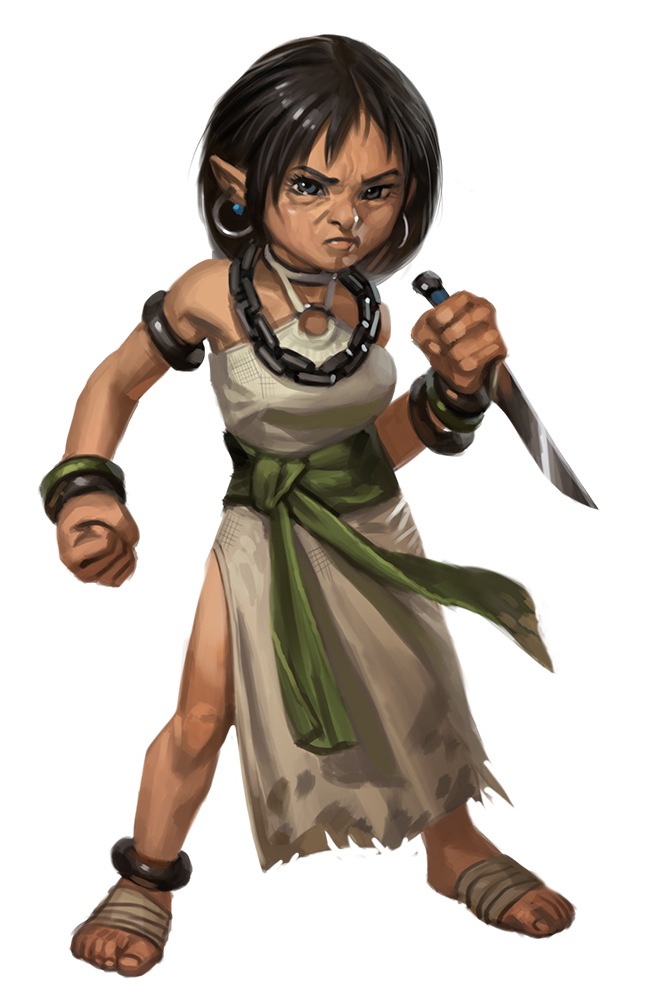
"Secure as a half-orc's virginity, Captain!" a high-pitched feminine voice called back up.
The joke elicited a round of giddy laughter from the crew, and a growl from the bosun, which was probably what the gnome was aiming for. Others, however, seemed in a less humorous mood.
"Besmara's boots, Captain, that was close," Caliel grumbled. "You put a lot of faith in that wizard's concoction, expecting it to keep our identity a secret."
"Aye, we could'a took her like a cheap doxy, Captain," Grogul said as he wiped his gore-streaked axe with a rag. "Dead men don't talk, and it would'a saved the cost of that potion and gained us a hold full of fine Qadiran silk."
The bosun's boldness loosened the tongues of some of the other crew, and Torius heard a rush of dark muttering. He shook his head dismissively.
"The potion was crafted by a priest, actually, Caliel, and I tested it personally. Besides, this way we're free to plunder the Golden Griffin at a later date. Set course for Katapesh, and don't spare the canvas. I want twenty miles between us and the Golden Griffin before sunrise!" Torius pointed to the coffer. "Grogul, bring that to my cabin. Now. It's worth more than a dozen holds full of the finest silks in Golarion."
"Aye, sir!" The boatswain scooped up the coffer and followed.
In Torius's dimly lit cabin, they were greeted by the disconcerting sight of several navigational instruments, including an elaborate astrolabe, floating about the sinuous coils of Stargazer's navigator. She lay beneath the open skylight, but turned from her celestial observations as they entered, the tip of her tail twitching in delight.
"My Captain, I see that we're underway. I'll take my instruments up to the quarterdeck presently to get a proper fix and plot our course. Ah, Grogul, you bear the coffer of Gods' Tears." She cocked her head in concern. "And you're injured."
"Bah! Just a bloody lip, Miss Celeste." The half-orc put the box down and nodded. "I'll leave you to yer snake charmin', Captain." He ducked out of the cabin with a tusky grin.
"Pass the word for Snick to come by when she's through mothering the ballistae, Grogul. I'll need her to open this thing."
"Aye, sir." The door clicked closed.
"You take a great risk in this endeavor, Torius." Celeste turned to the astrolabe, rotating the discs more accurately with her magic than most could with two hands. "Such a valuable prize will not go unmissed."
"Not such a great risk, Celeste. The Sword of Man himself would thank me for keeping such a relic out of Rahadoum. The Gods' Tears will vanish in the markets of Katapesh, and there'll be no trail leading back to us." He unbuckled his sword and hung it on a peg near his bunk. "Which was another reason for the potion. Better to obliterate their memories than kill the crew of the Golden Griffin. Contrary to what Grogul thinks, dead men do occasionally talk."
He stepped to where Celeste lay coiled, her torso swaying easily with the roll of the ship as she gazed at a particularly bright star through her telescope. A stylus on the chart table scratched down a series of numbers. Beneath the charts lay several scrolls, mostly zodiacs of various cultures and lengthy scholars' notes of celestial observations. He stood next to her and stared up at the star-filled sky; this far from the lights of any city, they were so clear he felt as if he could reach out and touch them.
"It's a beautiful night." He brushed a hand through her silvery hair.
"Isn't it?" The tip of her tail shuddered as she turned to him. "And speaking of potions."
A thin drawer beneath the chart table opened and a small vial floated out. The stopper twisted free and she quaffed the contents in a single gulp. Her shape shifted with the potion's magic, her tail morphing into two long legs, two pale arms sprouting from supple shoulders. In the time it took him to draw a deep breath, she stood before him as a tall, willowy human woman with skin the luster of pearl and eyes of midnight, her face and hair unchanged. He reached for a cloak and draped it over her shoulders, though she was unabashed by her lack of raiment. Her fingers fumbled with the buttons of his shirt, unaccustomed as she was to having digits.
"Celeste, Snick will be coming by to open the coffer any minute."
"And the potion will only last a few minutes also." With a glance from her, the door's bolt clicked closed. "Time enough."
"Oh, hell," he murmured as her hands explored beneath his shirt.
"Besides," she breathed, nuzzling his neck, "it's been far too long since I've had arms to hold you."
He felt the prick of her fangs, then the familiar rush of weakness from her venom and the odd euphoria that accompanied it. He knew the weakness would fade quickly; he'd become accustomed to Celeste's venom. In fact, he'd become quite fond of it... and her.
"And legs," he reminded her. "Don't forget your legs..."
Neither of them noticed the soft click at the door, or the shadow that passed below the lintel.
Coming Next Week: Pirate problems in Chapter Two of Chris A. Jackson's "Stargazer."
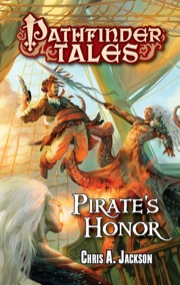
Read more about Torius, Celeste, and the crew of the Stargazer in the new Pathfinder Tales novel Pirate's Honor, available now!
Chris A. Jackson is the author of the Scimitar Seas nautical fantasy series, which has won sequential gold medal awards for fantasy from ForeWord Reviews, as well as Weapon of Flesh, Deathmask, A Soul for Tsing, and the Cornerstones Trilogy. He lives with his wife on a sailboat in the Caribbean. For samples of his work, his blog, and his convention schedule, visit jaxbooks.com.
The release of Pathfinder Roleplaying Game: Ultimate Campaign is getting ever closer. Whether it's kingdom-building or leading an army, starting a business or crafting magic items, Ultimate Campaign is for all of the adventures that take place outside of the dungeon. The pages of the newest Pathfinder Roleplaying Game hardcover provide all kinds of useful information for your campaign, but many fantastic illustrations are contained within! Check some of them out!
Ultimate Campaign Art Preview!
Tuesday, May 7, 2013
The release of Pathfinder Roleplaying Game: Ultimate Campaign is getting ever closer. Whether it's kingdom-building or leading an army, starting a business or crafting magic items, Ultimate Campaign is for all of the adventures that take place outside of the dungeon. The pages of the newest Pathfinder Roleplaying Game hardcover provide all kinds of useful information for your campaign, but many fantastic illustrations are contained within! Check some of them out!
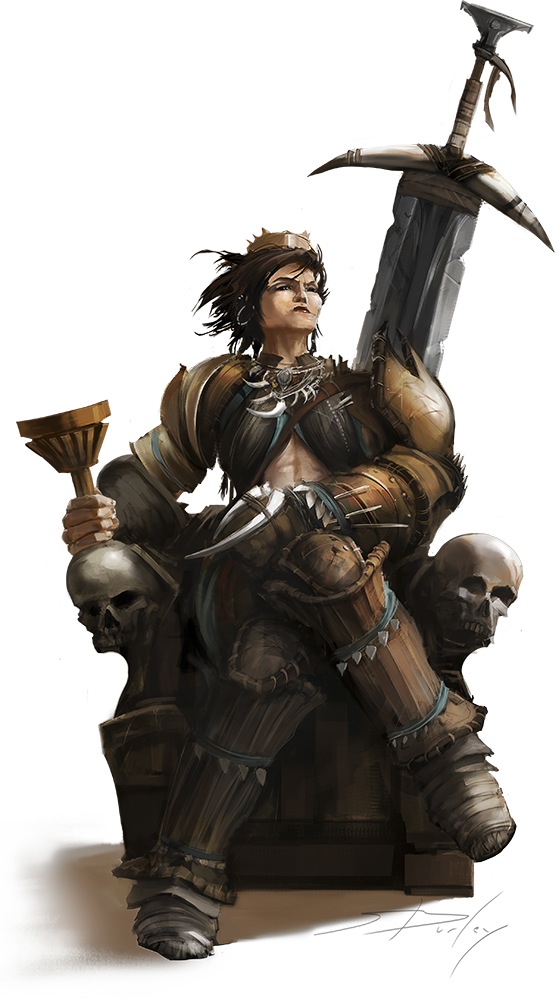
Being a ruler has many responsibilities, but also many rewards.
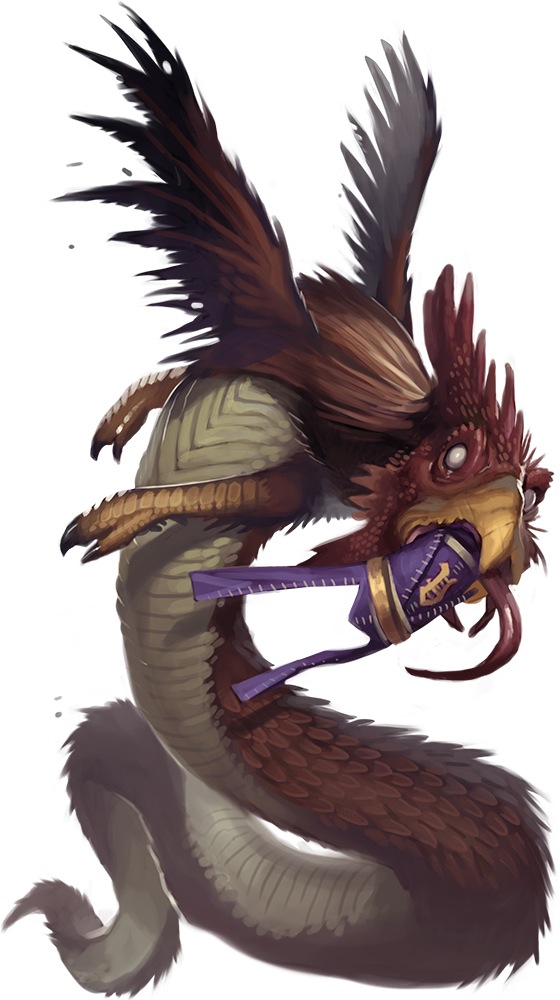
Eidolons and other companion creatures are more fun when treated as a separate character rather than an obedient stat block.
Retraining rules allow you to replace a feat, change an ability score increase, or improve your hit points.
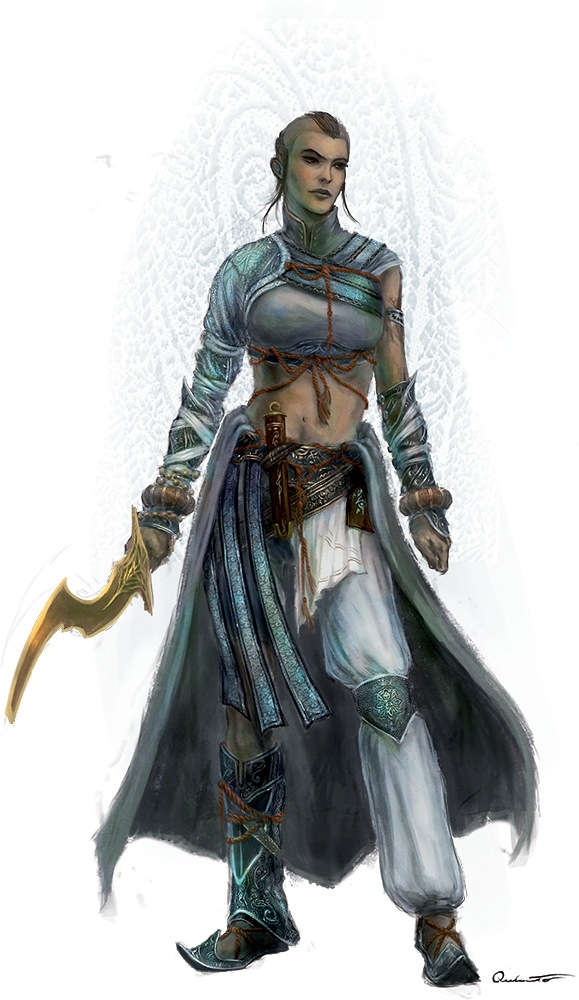
The quest to find a missing family member is a driving force for many heroes.
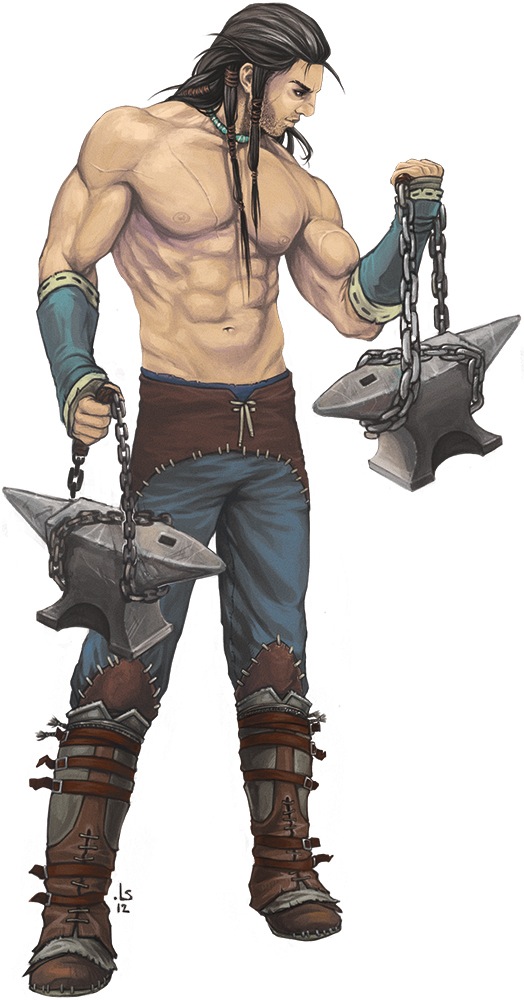
The section on marriage talks about how a spouse (or any relationship) can be an ally or an adversary.
Illustrations by Sam Burley, Eric Belisle, Lydia Schuchmann, and Maichol Quinto
Kingdom-building rules allow PCs to control their own country—or be the power behind the throne.
Followers, apprentices, and similar companions can be positive or negative plot hooks for a PC.
A character's lineage is a chain of characters linking a PC to the history of the campaign setting.
Illustrations by Denman Rooke, Jim Nelson, and Grafit Studio
New Pathfinder Society Rewards for Reading Pathfinder Tales!
Fans of Paizo's Pathfinder Tales line of fiction set in the Pathfinder campaign setting have likely noticed that it's been a few months since we released a Pathfinder Society Chronicle sheet for the novels released as part of this line. For those who have been holding their breath to get an in-character benefit for reading Liar's Blade or Pirate's Honor, the wait is finally over! With the release of today's Chronicle sheet, we're changing up the way Pathfinder Tales boons work.
New Pathfinder Society Rewards for Reading Pathfinder Tales!
Monday, May 6, 2013
Fans of Paizo's Pathfinder Tales line of fiction set in the Pathfinder campaign setting have likely noticed that it's been a few months since we released a Pathfinder Society Chronicle sheet for the novels released as part of this line. For those who have been holding their breath to get an in-character benefit for reading Liar's Blade or Pirate's Honor, the wait is finally over! With the release of today's Chronicle sheet, we're changing up the way Pathfinder Tales boons work.
Illustrations by Eric Belisle
This Chronicle sheet is actually a Chronicle sheet for four different Pathfinder Tales titles: Liar's Blade, Pirate's Honor, The Wizard's Mask, and King of Chaos. Now, back when we began sanctioning Pathfinder Tales novels for Pathfinder Society credit during Season 2, a player received a Chronicle sheet for each Pathfinder Tales book he brought to a Pathfinder Society game, which was subsequently signed by a GM and applied to one of the player's PCs. Now, a player needs print this Chronicle sheet only once, and bring it to a sanctioned Pathfinder Society event along with a printed or digital copy of one or more of the four novels included on the sheet (digital copies must be legally obtained and possess a watermark indicating such). The GM should initial the Chronicle sheet for the associated books, indicating that the player has access to the book, and hopefully that she has read it.
Any time thereafter, the player may use the initialed boon for any of her PCs. Once used, the box to the left of the boon should be checked to indicate such.
A player who collects GM initials for all four books on a given Chronicle sheet can select one of the four boons to become a permanent bonus for one of her PCs. At this time, only that PC can use the boon, though any unused one-time boons still on the sheet can still be used by other PCs.
You may note that this Chronicle sheet is called "Pathfinder Tales, Volume IV." That's because it contains the boons for the fourth distinct set of four Pathfinder Tales novels. In the coming months, we'll be replacing the existing Chronicle sheets for the entire Pathfinder Tales line to utilize this format, and anyone who's already received initialed versions of the Chronicle sheets for Queen of Thorns, The Worldwound Gambit, and Death's Heretic (all 12 of them, in fact), can get an initial in the associated box on the compiled Chronicle sheet.
As if that weren't enough, we also plan to tie in at least one scenario per season to each novel released during that season. It's too late in the process to do so for these four books, but starting with Stalking the Beast in October, we'll have a scenario set in the same region as every new Pathfinder Tales novel, or otherwise thematically linked to them if not set in the same geographical area. This will allow us to tailor the boons on the Chronicle sheets to directly apply to a situation one of the reader's PCs may be in around the time they're reading the book.
So download the Pathfinder Tales Chronicle sheet below and grab your copy of Liar's Blade or Pirate's Honor. In the coming months, you'll be able to "fill your BINGO card" with the release of The Wizard's Mask and King of Chaos. It's never too late to sign up for a Pathfinder Tales subscription so you never miss a volume of the exciting fiction line!
Let us know what you think of the new format for these tie-in Chronicle sheets and the prospect of directly-linked Pathfinder Society scenarios down the road. We're always looking for community feedback and for new ways to improve the campaign.
In just about three weeks or so, you should be seeing Ultimate Campaign arrive in mailboxes and on store shelves. In anticipation of the release of this 256-page hardcover, each week we are offering up a preview of what you will find inside.
Ultimate Campaign: I Could Use Some Downtime
Thursday, May 2, 2013
In just about three weeks or so, you should be seeing Ultimate Campaign arrive in mailboxes and on store shelves. In anticipation of the release of this 256-page hardcover, each week we are offering up a preview of what you will find inside.
Last week, we took a look at Chapter 1, which includes a mountain of tables for helping you determine your character's backstory. This week, we are moving on to Chapter 2, which is focused entirely on downtime. Heroes don't spend every waking moment plundering tombs and fighting evils. (If they did, they would reach 20th level before their next birthday.) The downtime system helps you plan the time your character spends between adventures.
This versatile system allows a character to undertake a number of different tasks to improve himself or build his standing within the town he lives in. Need to swap out a feat? The downtime system lets you do that. Want to train up your hit points because you rolled poorly last time you gained a level? It's in there too. Have you always wanted to open up your own tavern, or thieves guild, or wizard academy? The downtime system has extensive rules for building a business or guild.
Using this system you can spend the time between adventures earning various types of currencies and spending those currencies to get the business, home, or fortress you've always wanted. Structures and organizations are built in pieces, buying each room and group individually so that you can get exactly what you want! Check out a few of the rooms you can build.
Illustration by Eric Belisle
Ballroom
Earnings gp or Influence +10 Benefit bonus on Perform checks Create 19 Goods, 19 Labor (760 gp); Time 40 days Size 40-60 squares Upgrades To Auditorium; Upgrades From Common Room
This large open room is intended for dances, receptions, and other elaborate events. The superior acoustics and decor grant a +2 bonus on all Perform checks made in this room.
Bar
Earnings gp or Influence +10 Benefit bonus on Diplomacy checks to gather information Create 6 Goods, 1 Influence, 5 Labor (250 gp); Time 16 days Size 10-20 squares
A Bar stores a selection of drinks and includes a counter for preparing them. After spending an hour with local people in this room, for the next 24 hours you gain a +1 bonus on Diplomacy checks you make to gather information in the settlement.
Bath
Earnings gp or Influence +3 Benefit bonus on Fortitude saves against disease Create 3 Goods, 1 Influence, 2 Labor (130 gp); Time 8 days Size 3-6 squares Upgrade From Sauna
A Bath contains a single large bathtub or multiple smaller basins, along with a stove for heating water. After spending 1 hour in this room, you gain a +2 bonus on your next ongoing Fortitude save against disease.
That's all for this week. Next week we will delve into the systems for GMs to add to their campaigns!
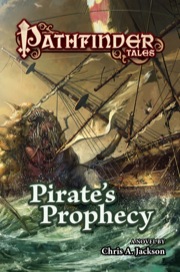
In Pirate's Honor, notorious pirate captain Torius Vin makes a living raiding wealthy merchant ships with his crew of loyal buccaneers. Few things matter more to Captain Torius than ill-gotten gold—but one of those is Celeste, his beautiful lunar naga navigator. When a crafty courtesan offers the pirate crew a chance at the heist of a lifetime, it's time for both man and naga to hoist the black flag and lead the Stargazer's crew to fame and fortune. But will stealing the legendary Star of Thumen chart the corsairs a course to untold riches—or send them all to a watery grave?
Pirate's Honor Sample Chapter
Wednesday, May 1, 2013
In Pirate's Honor, notorious pirate captain Torius Vin makes a living raiding wealthy merchant ships with his crew of loyal buccaneers. Few things matter more to Captain Torius than ill-gotten gold—but one of those is Celeste, his beautiful lunar naga navigator. When a crafty courtesan offers the pirate crew a chance at the heist of a lifetime, it's time for both man and naga to hoist the black flag and lead the Stargazer's crew to fame and fortune. But will stealing the legendary Star of Thumen chart the corsairs a course to untold riches—or send them all to a watery grave?
Chapter One: Stars Never Lie
Scales rustled across the hardwood deck of the corsair Stargazer as she plied the moonlit waters of the Obari Ocean. The crew of the ship had heard the sound many times before, especially on nights when the sky hung overhead like a black silk tapestry strewn with diamonds. This was her time, and they knew better than to bother her when her attention was on the heavens.
Celeste squinted through her sextant at the bright planet Triaxus, also known as the Wanderer, which had just entered the constellation of the Sea Wraith. That boded well, and she manipulated the stylus to scratch down the planet's angle to the horizon. Glancing at the neat array of hour- and minute-glasses—calibrated that very evening at the precise moment of sunset—she noted the exact time. She took another sighting, this one of the rising moon, and the stylus scratched down another pair of numbers. Lowering the sextant, Celeste performed the calculations to determine the ship's latitude and longitude. With a flick of magic so familiar that she barely had to think of the spell, she floated her plotting tools out of their leather case, rolled out the chart of the Jalmeray coast, and meticulously plotted their position.
"Well?" a gravelly voice asked as the stylus scratched an "X" on the chart and wrote down the time.
Celeste's tail gave an involuntary flick of annoyance at the interruption, but she stifled her natural response to rise on her coils and hiss. Most of the crew members were more cautious about interrupting the lunar naga during her reading of the stars, but Stargazer's half-orc bosun was an incautious fellow. Besides, he was just doing his job. They were sailing in dangerous waters, and he needed to know their position.
"You may turn to zero-eight-zero degrees, Grogul, or as close to that heading as the wind will allow." Celeste put away her instruments and folded the case closed against the salt air. "We're beyond Jalmeray's southern reefs, and can begin our approach of Kaina Katakka's south coast."
"Good!" Grogul turned away without a word of thanks, as usual, and started barking orders to the crew.
Stargazer turned to windward, her sails trimmed smartly, and began the slow beat to the northeast. When they settled on their new heading, Celeste noted the set of the stars against the foremast and yards; if they started to drift off course, she would know.
Though she had two hours until she needed to take another celestial fix on their position, Celeste retrieved her sextant once again and recorded the elevations of several more planets. She then traded the sextant for a finely wrought telescope and observed the heavenly bodies more closely. She noted every detail—every angle, rotation, and position of every moon—and carefully scratched them into her logbook. These observations had nothing to do with celestial navigation, but with the science of astrology: the intricate song of the heavens and its interaction with the events and beings of this world.
Tonight, she was concerned with the stars' attitude regarding one particular being: Torius Vin, captain of the Stargazer.
With the harmonies of the planets and constellations singing in her mind, and all the numerical data she needed to interpret them, she consulted her astrological texts. This was the hard part; the stars never lied, but interpretation of their message was often fraught with uncertainty. She knew Torius's astrological signature—the position of every celestial body of significance at the moment of his birth—and she had just observed the current state of the cosmos. How these two interacted was the puzzle she had to solve.
Nothing of significance had changed since her previous reading: The planet Liavara, the Dreamer, still traversed the constellation of the Lantern Bearer, Torius's birth sign. The Wanderer would soon cross the constellation of the Key, the symbol of Abadar, the god of wealth. The planet Castrovel was ascending into the Lantern Bearer, denoting desire, lust, love, or life. The reading seemed straightforward; Torius's dreams, his desire for wealth, would be realized.
Celeste crooked a smile and bent to the chart. If the prophecy still held, then so did their course. Her readings of the other planets—Eox, the Dead, traversing the Wagon, beneath the constellation of the Throne—had pointed to the long-dead indigenous peoples of the island nation of Jalmeray. Those who had not perished or been enslaved when the great Vudrani maharajah Khiben-Sald introduced his foreign gods and elemental creatures to the island had fled to Kaina Katakka. There they had lived for a time, until the governance of Jalmeray fell into the hands of the Arclords. Wanting no potentially rebellious natives so near, the Arclords had exterminated the entire population, leaving Kaina Katakka a devastated ruin.
That was their destination.
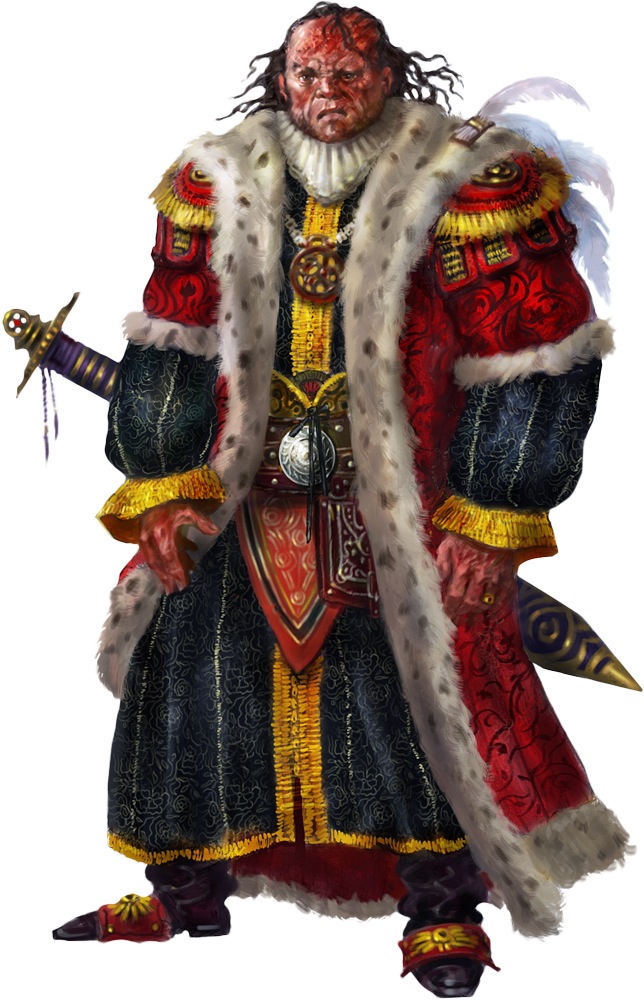
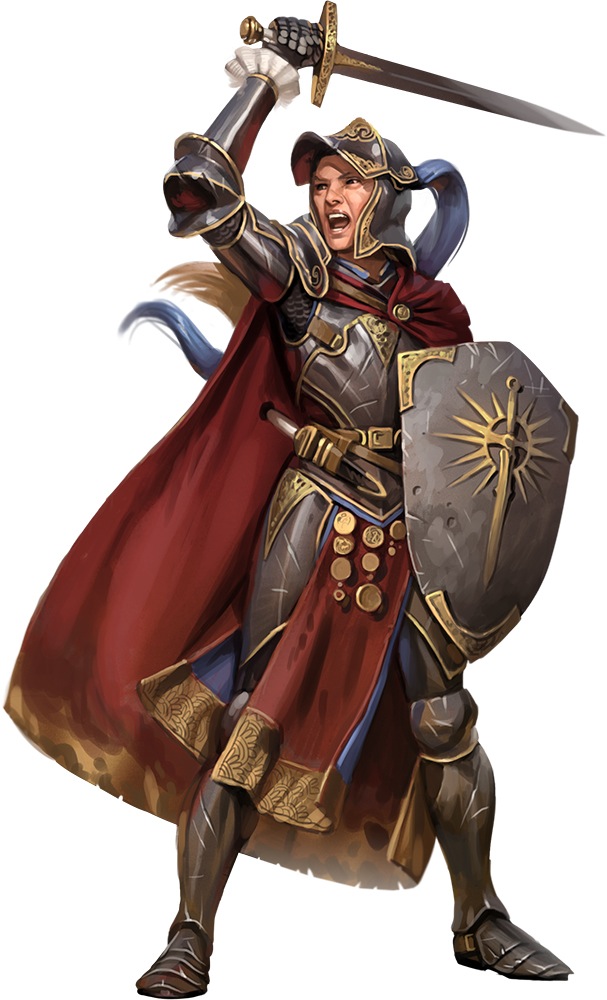
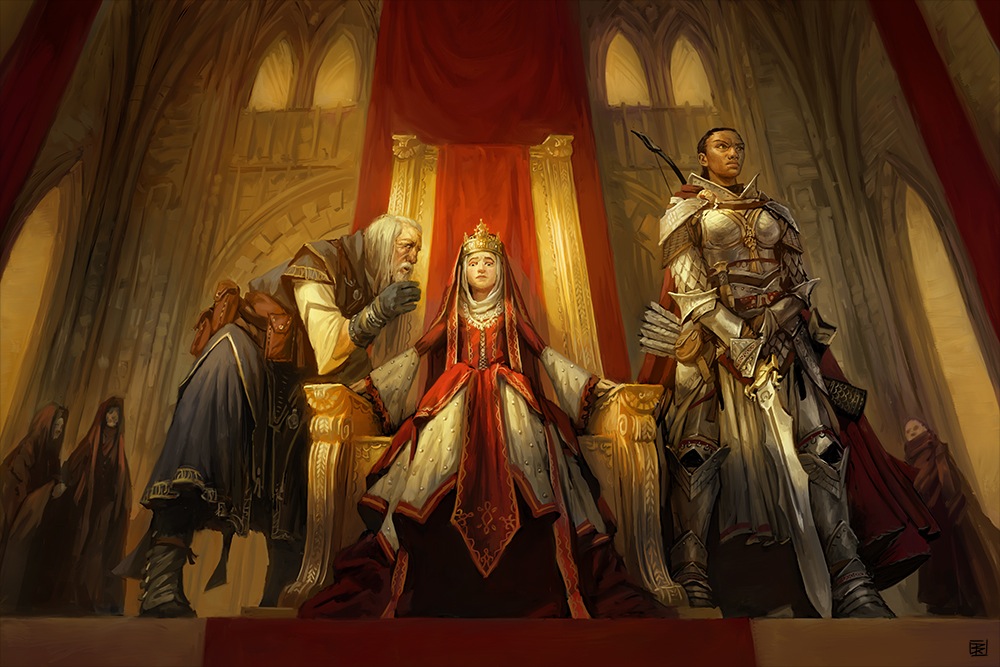
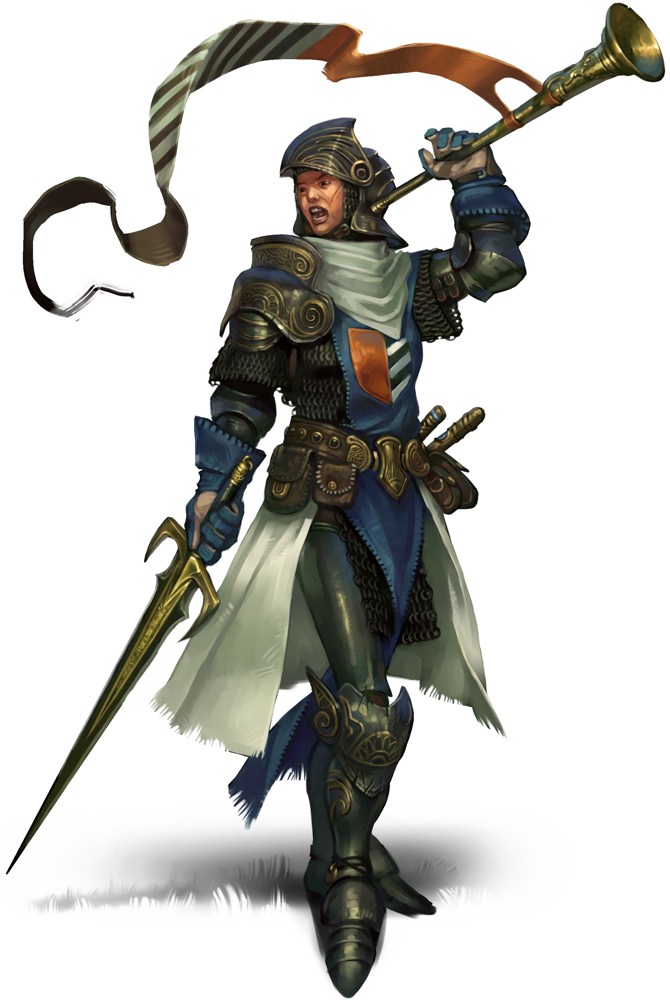
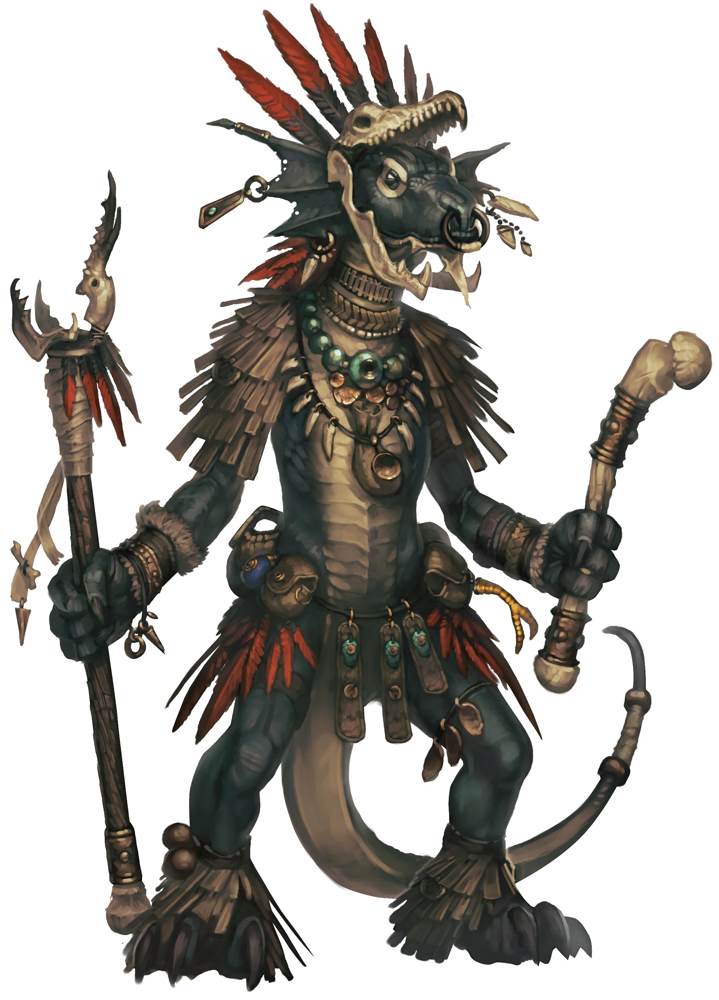
Torius knows that a captain is only as good as his crew.
Destiny resides in the stars, she thought, closing her texts and stowing them. She gazed up into the endless tapestry of the cosmos and sighed with pleasure. Out here, far from land, the veil of the heavens shone so clearly that it seemed close enough to touch. Here under the stars—aboard a pirate ship, of all places—she had found her own dreams' desire: a home. These people trusted her, relied upon her expertise and appreciated her talent in reading the secrets of the firmament. She belonged. She was loved.
Celeste swayed with the easy motion of the ship, reveling in a peaceful night under the stars, her favorite place in the world. Her mind drifted, and she contemplated her other favorite place. A smile touched her pale lips, and her forked tongue flicked out to scent the night air. There it was, that heady fragrance of leather, spice, and human, as signature as his stellar harmonic.
Torius Vin ...
The ship's bell chimed, interrupting her thoughts. Eight notes in two-stroke pairs, which meant the watch change. As if her thoughts had conjured him from the air, she heard his approach, his soft leather boots brushing the deck with a faint whisk not unlike that of her own scales. She did not turn, but waited, knowing how he would greet her, longing for that familiar touch.
"Celeste," he said, his voice singing the song of the heavens in her mind as his hand ran through her alabaster hair.
"My captain." She turned and smiled at him, her coils shuddering in an involuntary shiver of delight.
"Are we on course?" He glanced at the chart on the deck.
She scanned the stars and nodded. "There's a slight northerly set to the current, but we're not far off the plot line. I'll take another fix to confirm my calculations, but we should reach Kaina Katakka's coast before dawn. We will reach the cove by late morning."
"Good." His fingers slipped from her hair and he left her to make his rounds of Stargazer's quarterdeck, checking the hundreds of details that kept the ship running smoothly. She neither knew nor cared much about these details. Her milieu was above, while his was here—his ship, his crew, canvas and wood, steel and rope, lives dependent on his every decision. She might chart their destiny, but he sailed it. He returned to her and asked quietly, "So, you're sure about this?"
She smiled at him again. In front of his crew, he was always decisive and confident; only with her did he let down his guard and expose his uncertainties. "The stars never lie, my captain."
"I know, but the truth they tell is often only clear in hindsight."
"Torius," she said, brushing against his shoulder, "the prophecy is clear; your dreams and desires for wealth will be realized here."
"Good, because I've been dreaming of gold a lot lately. A pirate's got to eat, after all. After our last little problem, money's been hard to come by." He turned away and began to pace the quarterdeck, his hands clenched firmly behind his back. She watched, admiring the preternatural grace that made his movements so fluid, almost serpentine, even on the rolling deck of a ship.
The problem he mentioned had cost them virtually their entire stake, including the profits of their last successful job. She slithered to his side and whispered, "Don't worry."
He laughed quietly, running his hand slowly through her hair again. "Telling the captain of a ship not to worry is like telling the desert not to be dry or the ocean not to be wet, Celeste. Until we get a solid stake again, enough to pay the crew and provision the ship properly, I'm going to worry."
"Very well, my captain," she said, leaning in to nuzzle his neck. That was another reason she loved him: he might be a pirate, but he truly cared about his people. He cared about her. She turned to her navigational instruments once again and floated the sextant up to her eye. "You worry, and I will consult the stars."
∗ ∗ ∗
Torius squinted into the glare as the island's barren coast coalesced from the thinning morning mists. As always, Celeste's navigation was flawless. She had already retired to his cabin for the day, so he would have to compliment her later. He just hoped her astrological prophecy was as accurate.
"This cove got a name, Captain?" Grogul asked, as the brigantine eased slowly nearer under reefed topsails alone.
Torius glanced up at the half-orc; he was taller by a wide hand and probably outweighed the captain by half, but Torius knew that he was more than the brute he appeared to be. Grogul was a fine bosun, a skilled sailor, and a good tactician, even if he did disdain the more esoteric points of seamanship. More than anything, Grogul was solid, dependable, and unfailingly loyal. The captain wouldn't trade him for a half-dozen fancy, rapier-wielding swashbucklers.
"Not on the chart." Torius scanned the rocky beach with his spyglass. There were no visible signs that the place had ever been inhabited. "Used to be a village or town or something here. Seems way back when Nex gave Jalmeray to the Vudrani, the indigenous population hightailed it and came here. Then the Arclords blasted the entire island to cinders." He wasn't about to tell Grogul the rumors that the island was haunted.
"And they brought their treasures with 'em?" Grogul squinted skeptically at Torius as he ran a thumbnail down the gleaming edge of his axe. "Just waitin' in a big pile for us to pick up?"
"That's what we're here to find out. More likely to find a smuggler's stash or some such."
"As long as it spends, I'm not picky, sir." Grogul knew as well as anyone the dire straits they were in when it came to ready cash.
Torius pointed to the northeast corner of the sheltered cove. "Drop a stern kedge and bring her in close there. The tide's on the rise, so drop the bow anchor when there's a fathom under her keel, and keep her hove short. Oh, and have Snick get her babies ready, just in case we have to dissuade any pursuit."
"Aye, Captain!" Grogul grinned. "You want me to tell her she's in command while we're ashore, since we're short a first mate?"
"Sure. It'll make her day." Torius smiled, knowing his gnome engineer would revel in her authority, short-lived though it might be, driving the crew crazy with all manner of inane orders. Snick was an invaluable member of the crew; she kept the ship functioning and her babies—the twelve beautifully crafted ballistae nestled below the deck—working perfectly. But she wasn't much of a sailor. "Launch the boats when we're anchored. I'll be in my cabin."
"Aye, sir."
Despite the daylight outside, Torius's cabin was as dark as midnight, with black curtains drawn tight over the transom windows and a shade pulled over the skylight. Celeste lay coiled on her collection of thick pillows and rugs, only the waves of her white hair visible in the gloom. He moved silently to his bunk and lit a lamp, keeping the flame low. His sword, a beautiful silver-hilted cutlass, hung from a peg. He lifted it down and clipped it to his belt, then pulled a brace of knives from a drawer. He clipped the long fighting dagger with a sword-catching crosspiece to the other side of his belt, and slid the heavy throwing knife into his boot. He retrieved a couple of his standard surprises, trinkets and potions that could distract an enemy or save a life if they ran into trouble, and tucked them away. One last adjustment of his belt and a glance in the mirror—just to make sure that his mustache and goatee were trimmed and combed properly and his hat had just the right rakish tilt—and he was ready.
"Be careful, my captain," Celeste said as he reached for the door's brass handle.
"Don't worry, my love." He gave her an easy smile. "This is the fun part."
Her tail twitched, but she settled back down without another word. He left her there in the dark and joined Grogul on deck. The longboats were bobbing beside the ship, the shore party armed and ready. He regarded them professionally and grinned his approval—all proven pirates, men and women he'd trust with his life, and who trusted him with theirs.
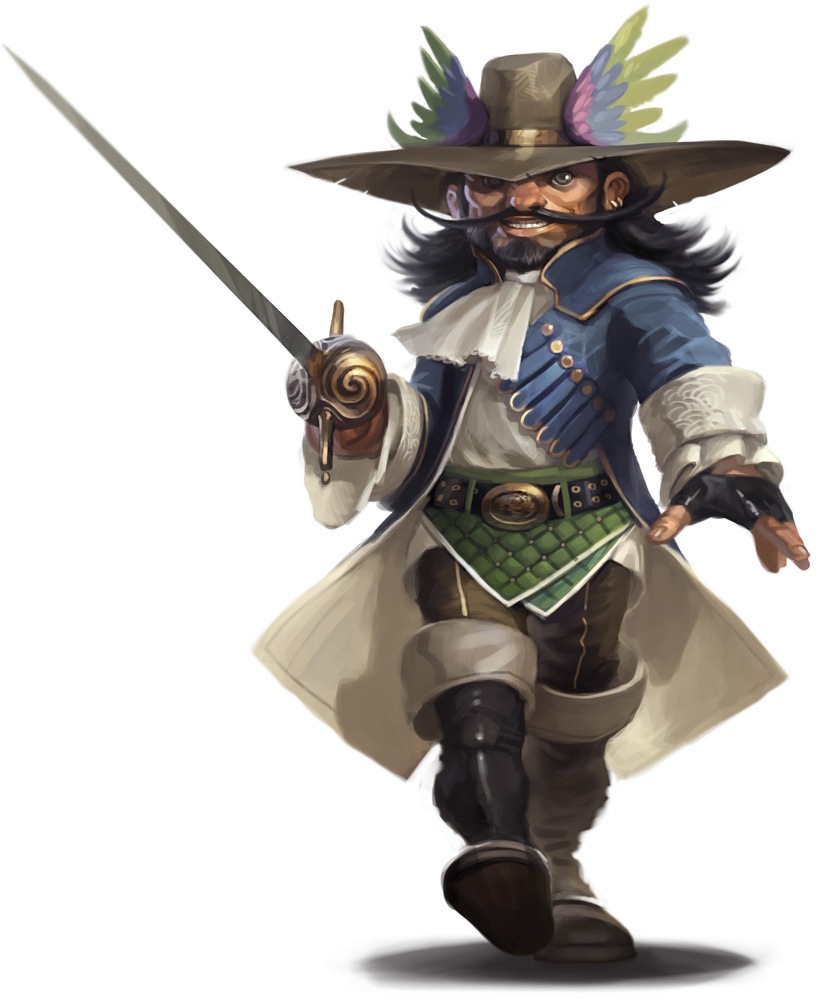
"Don't worry about the ship while you're gone, Captain!" a sprightly voice called from the quarterdeck. He looked up to see Snick standing with her slim legs splayed wide, her tiny hands on her narrow hips. She wore a brilliant red tricorne hat that clashed horribly with her sea-green hair, and a short cutlass at her belt. She snapped him an exaggerated salute. "I'll keep an eye on things for you!"
"Just keep your babies manned, Snick," he ordered, "and if anything that's not us tries to come aboard my ship, kill it."
"Consider said beastie killed, Captain!"
"Good!" He turned to Grogul. "Let's go."
"Man the boats, you scrags!" The crew leapt to comply, swarming down the boarding nets into the boats.
They rowed ashore in silence, stowing their oars when the boats' keels grated onto the rocky beach. Several sailors splashed into the surf to pull the boats higher. Torius, exerting his captain's prerogative, waited until he could vault ashore off the prow without getting his boots wet. The last thing he wanted was to squish when he walked if they were going to do much exploring. Grogul assigned four pirates with heavy crossbows to watch the boats, and joined his captain as the dozen others worked their way to higher ground.
"You sure about this, Captain?" He kept his voice low, his squinted eyes scanning the rocky, vine-strewn cliffs. "Don't look like much."
"As sure as I've ever been about one of Celeste's prophecies." Torius gave the half-orc a grin.
"And how sure is that?" Grogul's dubious gaze turned to him; he was never easily put off by Torius's assurances.
"We'll find something here, Grogul." He clapped the half-orc's meaty shoulder. "As for my dreams' desire for wealth ..." He looked around skeptically at the devastated landscape. "I don't think the Arclords left enough to satisfy all of my—"
A strange, musical trill split the sultry air, drawing everyone's attention. Swords rasped free of scabbards, and Torius found his hand on the hilt of his cutlass.
"Whassat?" asked one of the pirates, pointing to the foliage-covered cliff face. "It's comin' from up there!"
"This way!" another said, pointing to an overgrown path.
A number of the pirates started forward, eager to find the source of the call, but Torius called them back with a harsh, "Hold fast there! Nobody goes blundering off!"
Three of them stopped in their tracks at the command, but several others just kept climbing up the brush-strewn hillside, not even looking back at their captain.
That's not good, Torius thought. They're trained better than that.
"Grogul! Come on!" He drew his cutlass and hurried after them. "The rest of you, form up and follow. Quickly now!"
Luckily, Torius and Grogul were less hindered by the overgrowth than the pirates breaking trail. The captain's group scrambled up, dislodging dry vines, loose rocks, and a cascade of leaves, reaching the top just as the errant pirates hacked away a thick veil of foliage covering a gaping cave mouth. Grogul's huge hand closed on a shoulder and he jerked one woman back before she could venture inside. Torius and the others did likewise, pulling their friends away. All the while, the strange trilling call continued from within. One man twisted out of his mate's grasp and dashed into the darkness.
"Epok! No!" Torius shouted, too late.
The trilling call fell silent, and a sharp crack and a loud thump echoed from within. The pirates who had struggled to enter the cave stopped and looked at one another, their eyes wide with bewilderment. Torius shivered with an unknown fear. Something was wrong; none of his crew were so green that they would go charging into a dark cave like that.
"Don't like this, Captain." Grogul moved to the side of the cave entrance. Torius did likewise and motioned his pirates to split into two squads, one with Grogul and one with himself. He could see now that the arching mouth of the cavern had been fashioned with stonecutting tools, though it was so ancient and cracked that it had begun to look as rugged as a natural cave.
"Neither do I." Torius peered into the darkness. "Who's got the torches?"
Indistinct murmuring was the only answer he got. Grogul looked abashed—or as abashed as the half-orc ever looked, which wasn't much.
"Didn't know we'd be spelunking, Captain."
"Well, we'll probably have enough light from the cave mouth." Torius knew it was no good to chastise the bosun now, but later ...He had another means to light their way if it got too dark, but torches were good for more than light. "Can you see anything in there, Grogul?"
"Nope. Too much light out here." The half-orc shaded his eyes and shook his head. "Maybe once we're inside.
"Epok?" Torius called. He listened for a reply, for a hint that his man was still alive, for anything. He heard a faint scratch that might have been a foot on stone, then nothing. "This stinks like ..." Then he realized that he could detect something, but not with his ears. The distinct scent of rotten meat wafted out from within.
Torius snapped his fingers to get Grogul's attention and, with simple hand signals, outlined a cautious strategy; Grogul would proceed inside with his troop, their backs against one wall, while Torius did the same down the other. Both would keep a sharp eye out for traps or an ambush. Once inside, they would reassess the situation.
They moved slowly, checking every step as they were swallowed up by the cave's darkness. Grogul was the first to call a halt, his sharp eyes penetrating the gloom far easier than the humans'.
"Ssst! Captain!" he called in a stage whisper. "I think we found Epok."
"Gozreh's guts!" Torius swore as his eyes became accustomed to the gloom. Epok stood before them, one hand still clutching his cutlass, while the other gripped one of the wrist-thick bamboo spikes that had impaled him. A wide frame studded with sharpened stakes had swung down from above, propelled by a heavy stone counterweight. It spanned the entire tunnel, and would have killed or maimed several of his crew had they ventured inside with the unlucky Epok.
"There," Torius said, pointing to the thin trip cord that had released the deadly trap.
"Aye, and he wasn't the first." Grogul gestured with his axe at the skeletal remnants of several other unfortunate trespassers. There were at least half a dozen of them scattered along the sides of the corridor beyond the trap, still wearing the tatters of their long-decayed clothing and clutching rusted weapons.
"Well, we're not going to join the club. Come on, and everyone watch your step!" Torius advanced, cutlass thrust before him.
They edged past the trap, flattening themselves against the rough-hewn wall to pass. Grogul had to nudge the thing to fit his thick torso through the gap, causing Epok's gape-mouthed corpse to sag on the spikes. Torius swallowed hard. Epok had been a solid pirate. Passing the frame, he noticed the condition of the device; though not green, the bamboo was far from old. The island wasn't as deserted as he'd expected.
When the last of his squad had passed, they formed up again, advancing slowly. Enough light trickled in from the cave mouth to show that the tunnel widened ahead. Then their rear guard gave a startled gasp and cried out.
"Captain! Epok! He's not dead!"
"What?" Torius turned, his free hand reaching for the curative potion he'd brought from the ship. Torius knew death when he saw it, and Epok had looked as dead as dead gets. But true to the pirate's claim, Epok was moving, struggling to free himself of the murderous spikes thrust through his chest. Judri, the tall Mwangi woman who had called out, moved to help her comrade. "Wait!"
Epok's hand lashed out to grab her tunic, while his other lifted his cutlass to strike. Judri gaped in shock as the sword thrust through the bamboo frame, ill-aimed but accurate enough to pierce her shoulder. Her scream echoed around the cavern as Epok drew his weapon back for another strike.
Torius dashed back, sword raised, but Grogul beat him there. The bosun's heavy axe smashed through Epok's arm, the bamboo frame, and into the animated corpse's torso. Judri stumbled back, but the zombie—Torius could no longer think of it as Epok—wasn't through yet. It thrust clumsily at Grogul, the cutlass scoring a line on the half-orc's arm. Grogul growled a curse, snatched its wrist and bent the arm over the frame until the elbow joint popped and bent backward. He wrenched his axe free and severed the other arm with a chop. The zombie still fought to free itself, but literally disarmed, its struggles were futile.
Torius went to Judri. The wound was deep, and right in the shoulder joint. It was hardly mortal, but would ruin her sword arm for good if it wasn't tended properly. He flipped the stopper from the bottle and pressed it to her lips. "Drink!"
Judri complied and the wound in her shoulder closed immediately. Then her eyes widened and she pointed behind Torius. "Captain!"
"We got trouble, Captain," Grogul growled, reaching down to hoist the injured woman to her feet.
Not three feet away, the bony remnants of the trap's previous victims twitched and clawed their way to their feet, their rusted swords and axes clutched in fleshless fingers.
"Defensive formation! Now!" Torius flicked up Judri's fallen cutlass with the toe of his boot, caught it and put the hilt in her hand. "Everyone! And watch your backs!"
The veteran pirates formed a double row in close formation, half facing the scrabbling skeletons, the other half guarding against the darkness of the corridor behind them. This way, Torius figured, they could defeat the skeletons and then face whatever menace might await them farther down the corridor without worrying about a threat at their backs. At least, that was the theory.
At the first clash of blades, however, theory and practice diverged as the moaning wail of new assailants echoed in the dark behind them.
"Damn but this is a pretty trap!" Torius said between clenched teeth. "I'm going to have a few terse words for Celeste when we get back to the ship."
"If we get back, you mean." Grogul deflected a skeleton's axe, then smashed his attacker to shards with a powerful overhead chop. He glanced toward the dim corridor behind them, wrinkled his nose, and spat. "Zombies. Lots of 'em. Gods, I hate zombies."
"Gozreh's guts!" Torius parried a blade and gave a deft twist. The fine cutlass snicked through the skeleton's forearm like a piece of kindling, but the monster raked him with its free hand, leaving bloody trails down his forearm. The crewman to his left smashed a boarding axe down through its skull, and it toppled. At least they were fragile. He spared a glance over his shoulder and saw the crowd of zombies shambling out of the darkness. Some were armed and some weren't, but their eyes gleamed with the maniacal, hungry look shared by all undead. "This is not my dream's desire!"
"Unless you've been havin' some pretty weird dreams," Grogul agreed, hacking down another skeleton.
"Not even in my nightmares would I desire this!" Torius parried and slashed low, severing his opponent's spine just below the empty rib cage. The skeleton went down, but still managed to clutch at his legs. "Forward! Take down the skeletons before we have to fight on both sides!"
The pirates focused their attacks, smashing with a vengeance at their bony adversaries in an effort to beat them down before the shambling zombies arrived. Already Torius could hear the slow scuff of rotting feet against the stone floor and smell the rank stench of decaying flesh.
Finally, the last skeleton fell under a flurry of blades and the pirates turned to face their new foes. Aside from a few scratches and one shallow cut, they were all hale and ready. Torius and Grogul pushed through to stand in the front of their double line.
"Now we'll see what's what!" Grogul said with a tusky grin, swinging his axe from a center position where he could do the most damage.
"Watch our flanks!" Torius ordered. "And aim for their joints. Take them down, then finish them on the ground!"
He tensed, listening to the muttered curses of his crew. They knew there was no retreat. The trap grating was as effective as a portcullis; if they tried to squeeze past while being mauled by the zombies, people would die, and if Epok's sudden animation was any clue, each fallen pirate meant a new foe. Their only hope was to find whatever had animated the dead and destroy it.
"Ready!" he yelled, brandishing his cutlass.
"Aye, Captain!" his crew cried out, and Torius felt his heart lift.
"All right! On my word!" The undead shambled relentlessly forward. "Now!"
The pirates lunged as one, their blades cleaving the zombies with a predictably sickening result. Putrid flesh spattered the floor and walls of the corridor, and the stone underfoot quickly became slick with the foul suppuration that seeped from their wounds. Several of the undead went down, but others swung their rusted weapons or grappled and clawed at the pirates.
Torius slashed, aiming for their joints, trying to sever the limbs that reached for him. He had just downed one zombie and turned to the next when everything suddenly went black, as if someone had rolled a huge boulder across the cavern's mouth.
"Back!" Torius commanded, disengaging from his opponent and fighting to maintain his orientation. "Everyone step back!"
One step, then two, and he could see again. A wall of darkness so thick Torius doubted he could swing his blade through it loomed before them, but the zombies emerged unimpeded from the black, sloughing forward, their clawlike hands outstretched. Then, to Torius's horror, the darkness advanced with them.
"Gotta take out whatever's doin' that!" Grogul suggested, hefting his axe. "If they pin us against that grating, we're meat!"
"We'll have to run it." Torius looked at his crew, gauging their morale. By their dubious faces, he knew they couldn't do it, not with any hope of getting through. But someone had to. "You and me, Grogul! The rest of you, form a defensive line. If we don't win through, get back to the ship."
The pirates shouted, "Aye, sir!" in unison; they'd stand as long as they could.
Coming Next Week: A brand new, standalone prequel story featuring the piratical adventures of Torius, Celeste, and the rest of the Stargazer's crew!
Chris A. Jackson is the author of the Scimitar Seas nautical fantasy series, which has won sequential gold medal awards for fantasy from ForeWord Reviews, as well as Weapon of Flesh, Deathmask, A Soul for Tsing, and the Cornerstones Trilogy. He lives with his wife on a sailboat in the Caribbean. For samples of his work, his blog, and his convention schedule, visit jaxbooks.com.
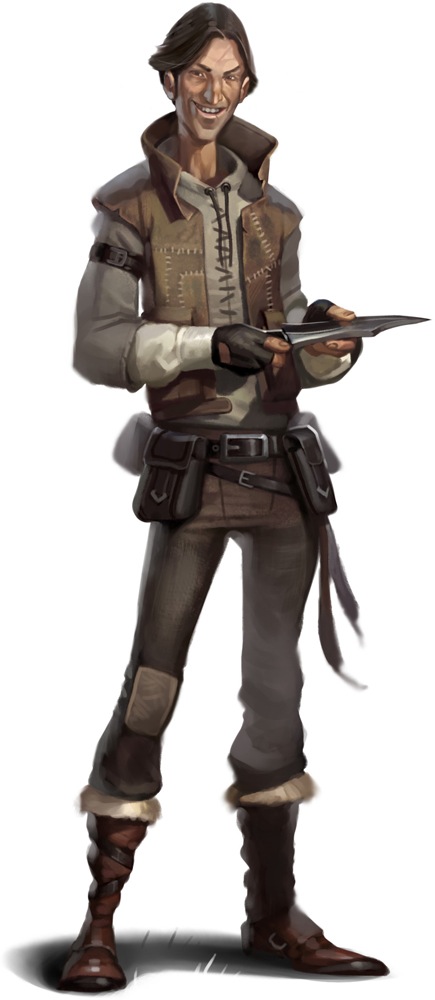
Rodrick—pragmatist, opportunist, and occasional outright thief—groaned and tried to sit up, but only managed to half-lean against the wall of a lightless cavern. His head had felt like this many times before, but usually only after a night of drinking and wenching. His memories of the prior hours were fuzzy, but they didn't involve taverns and winsome (or buxom, or both; he wasn't picky) maids.
Bastard, Sword
by Tim Pratt
Chapter One: Ill Met by Torchlight
Rodrick—pragmatist, opportunist, and occasional outright thief—groaned and tried to sit up, but only managed to half-lean against the wall of a lightless cavern. His head had felt like this many times before, but usually only after a night of drinking and wenching. His memories of the prior hours were fuzzy, but they didn't involve taverns and winsome (or buxom, or both; he wasn't picky) maids.
Images bobbed in his mind like rotting apples in a pond. A body, crushed in a trap. A man with a weaselly narrow face and a pack full of potions. A creature that looked like a beautiful woman from one side, and a gnarled, hollowed-out tree from the other. A room full of shattered treasure chests, and a suit of ancient black armor, and a distressingly large hole in the back wall—
Then he remembered. Sneaking into a barrow rumored to be full of treasure, accompanied by a fool named Simeon who'd gotten himself killed in a trap before they were even well begun. Disabling traps and killing a monster, assisted by a treacherous alchemist named Alaeron. They'd had a small disagreement about how to proceed, and so the alchemist had drugged Rodrick, knocking him unconscious and leaving him here to die.
Or, more accurately, to wake up with a headache.
Rodrick patted his pockets and discovered that all of his knives were gone, even the ones in his boots. No surprise, really, since his boots were also gone. The alchemist had stolen his shoes. That was nicer than stabbing Rodrick in the neck, admittedly, but still quite rude.
Now he sat slumped on a sloping hill, in a dark cavern that stank of something rank and reptilian, which Alaeron had claimed was a linnorm—a great slumbering beast that wasn't exactly the same as a dragon, but close enough. This barrow of treasures plundered from the North had included a linnorm egg, which had, at some point, hatched and grown to full size. The beast had smashed through the tomb wall into a system of caves and constructed a lair there, complete with a hoard made from the gold and gems and magical geegaws Rodrick had come to steal.
The linnorm had been the source of Rodrick's disagreement with the alchemist. Rodrick had advocated sneaking into the linnorm's cave and stealing everything, while Alaeron had favored running away and living to loot another day. Rodrick had insisted on his course of action, using a sword to advance his argument, and Alaeron had replied with a potion.
Rodrick began to crawl up the slope, quietly, toward the hole in the wall. There should have been torches lit in there. Either they'd burned out, or Alaeron had doused them when he left.
Having groped his way back into the mostly-empty treasure room, Rodrick crawled without success along the floor, looking for the lantern. No luck—the alchemist had taken it—but he did find an unlit torch, and he still had his flint and steel, at least. He got the torch lit and breathed a shaky sigh of relief as light blossomed in the dark.
After lighting the other torches on the walls, he sat in a carved wooden throne and considered his options. He was tempted to pursue Alaeron and exact revenge, but there was a more pressing concern: acquisition.
The most important thing was the sword. The alchemist had used a potion of darkvision to look over the sleeping linnorm and its hoard, and had claimed to see a sword, so that was promising. Rodrick had spun a tale for the alchemist about discovering the existence of this barrow and deciding to pillage it with his friend Simeon, but that was only partly true. Rodrick had actually been hired by a wealthy collector to break into this place and retrieve the sword, rumored to be an artifact of great power. Anything else he could steal was his to keep, in addition to a hefty payment in coinage.
Returning to Manius without the sword wasn't really an option if Rodrick wanted to keep his head. He could flee, with the collector's up-front payment in his pockets—but no, damn it, Alaeron had stolen his coin purse too—and probably escape any unpleasant consequences by changing his name again and heading south.
Escape was tempting. He was no dragon-slayer, even if linnorms weren't exactly dragons. But the treasure... the treasure was even more tempting.
He sighed, rose, lifted a torch from its sconce, and slowly approached the hole in the wall. He stepped through carefully, the torch held out in front of him.
The light immediately returned to him, shining from a shimmering lake of golden coins and glimmering jewels. As always, the sight of large quantities of wealth took his breath away. Alas, he could also see the pale scaled belly of something immense coiled atop the hoard. He'd hesitated to bring light into this chamber before, for fear of waking the beast, but then he'd had an alchemist on hand, with potions that would let them see in the dark. Circumstances had changed, and necessity demanded a certain amount of risk.
He crept down the slope, to the more-or-less level bottom of the chamber, just a few feet from the outlying spill of gold and gems. In this case, being barefoot was actually a boon—his footing was more sure, and he could move through the coins far less noisily. Rodrick mostly watched his feet, carefully sliding coins aside to find secure footing underneath, but occasionally he glanced up and saw more and more of the linnorm revealed. The thing was large enough that he couldn't apprehend it as a whole—it seemed serpentine, wrapped around and around itself. At least its head wasn't visible. Alaeron had said the creatures could hibernate for centuries, so Rodrick hoped a little torchlight wouldn't serve to wake it up.
His circle of light continued to advance. At last, it touched the hilt and first foot or so of a longsword's blade. Unfortunately, the remainder of the sword was firmly wedged beneath the linnorm itself, both resting atop a bed of coins. Perhaps if Rodrick undermined the coins—
"Do you mind?" The voice was deep, faintly annoyed, and slightly muffled, as if the speaker were wrapped in a blanket.
Rodrick froze. "I... beg your pardon?" he whispered.
The voice didn't bother to whisper. "As well you should. Do I come creeping into your bedchamber at night and shine a light in your face? Well?"
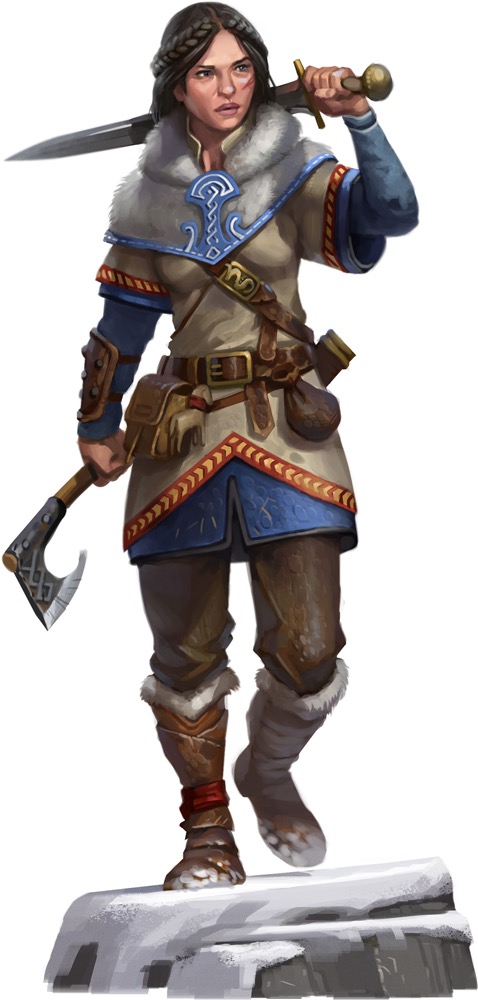
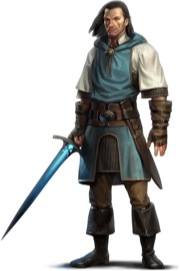
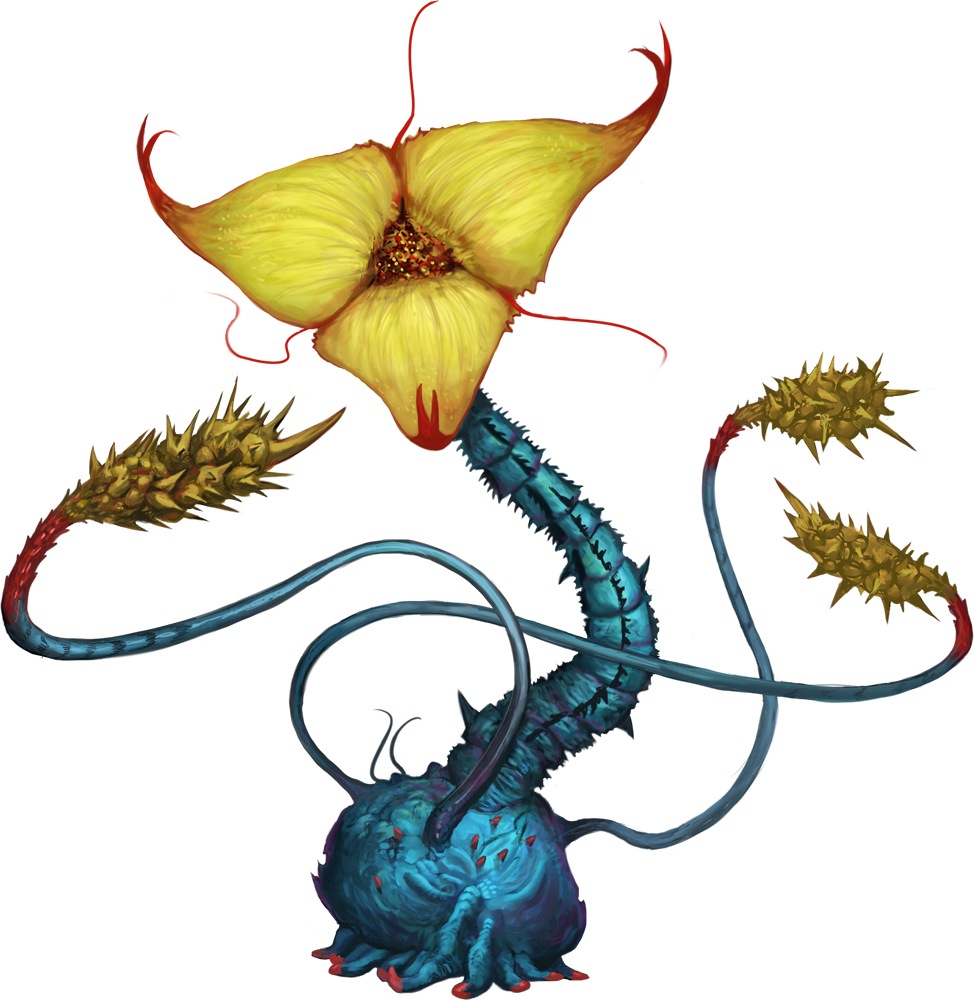
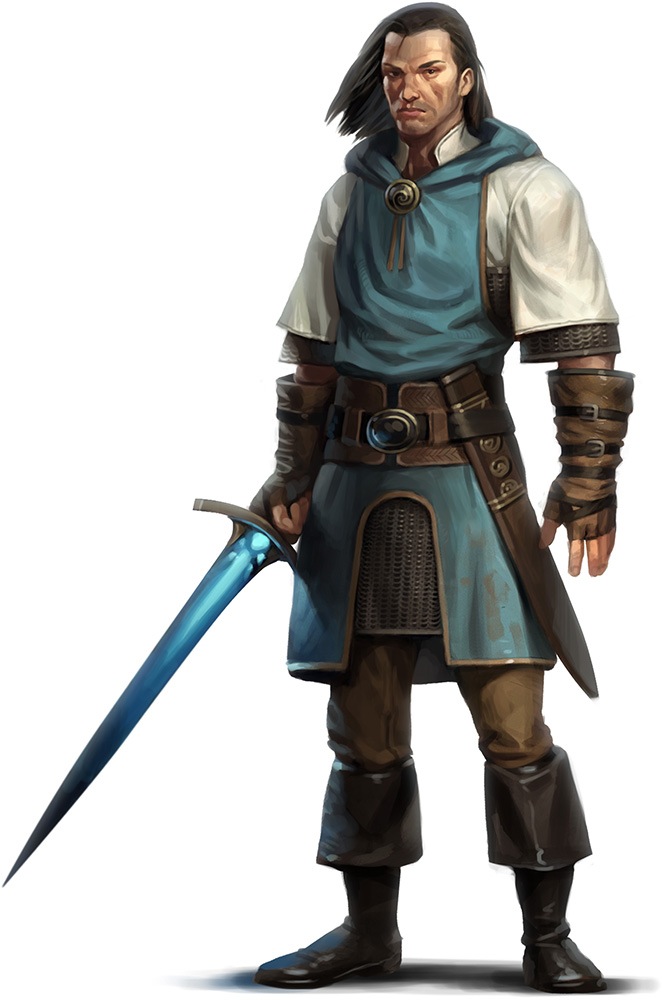
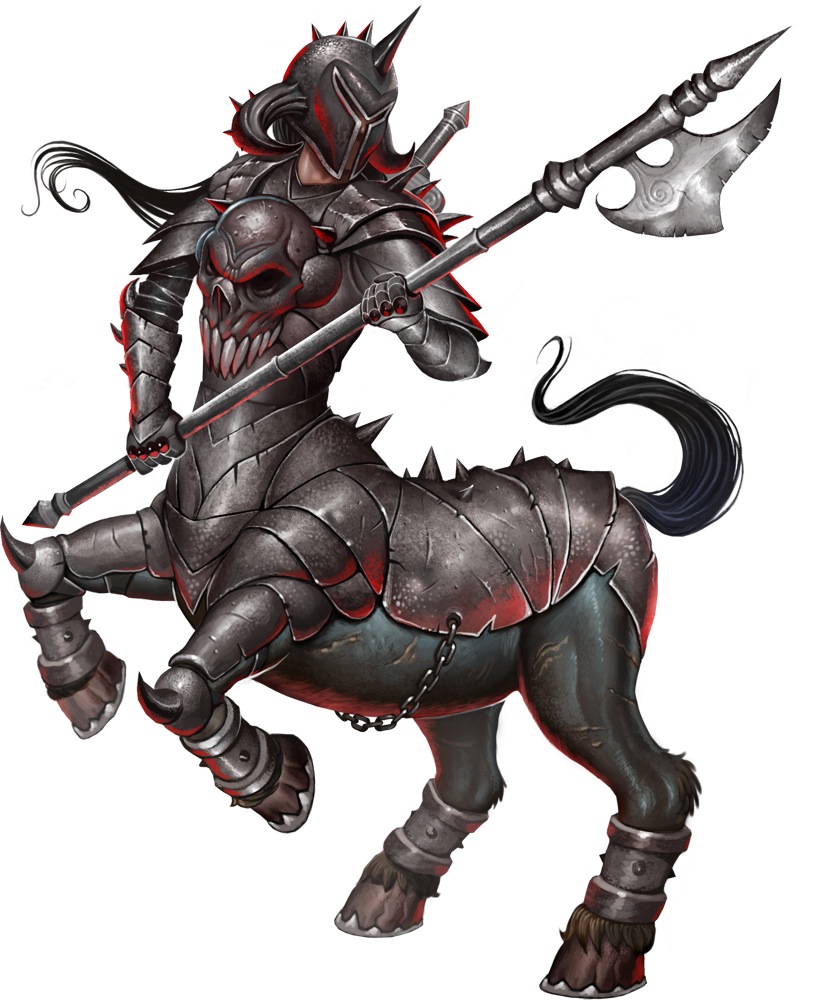
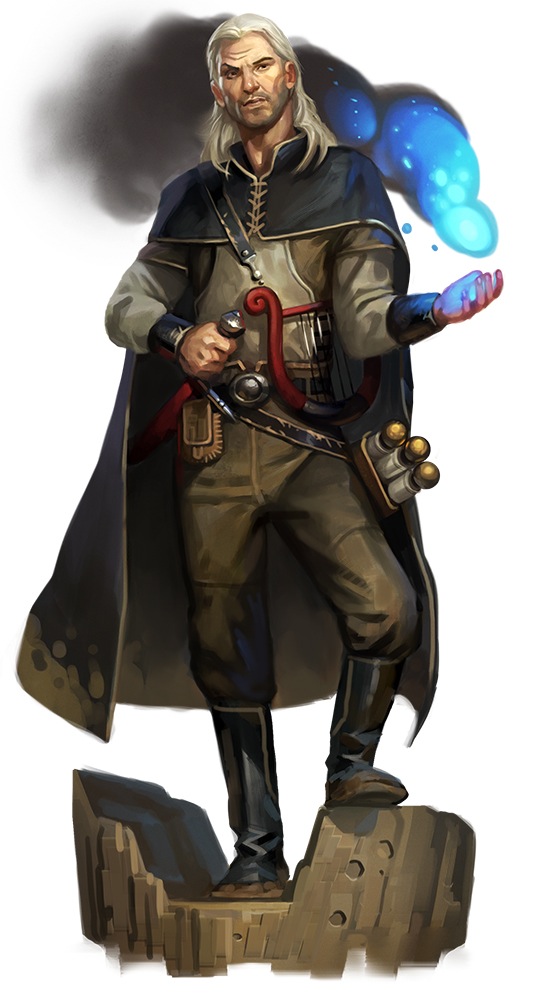
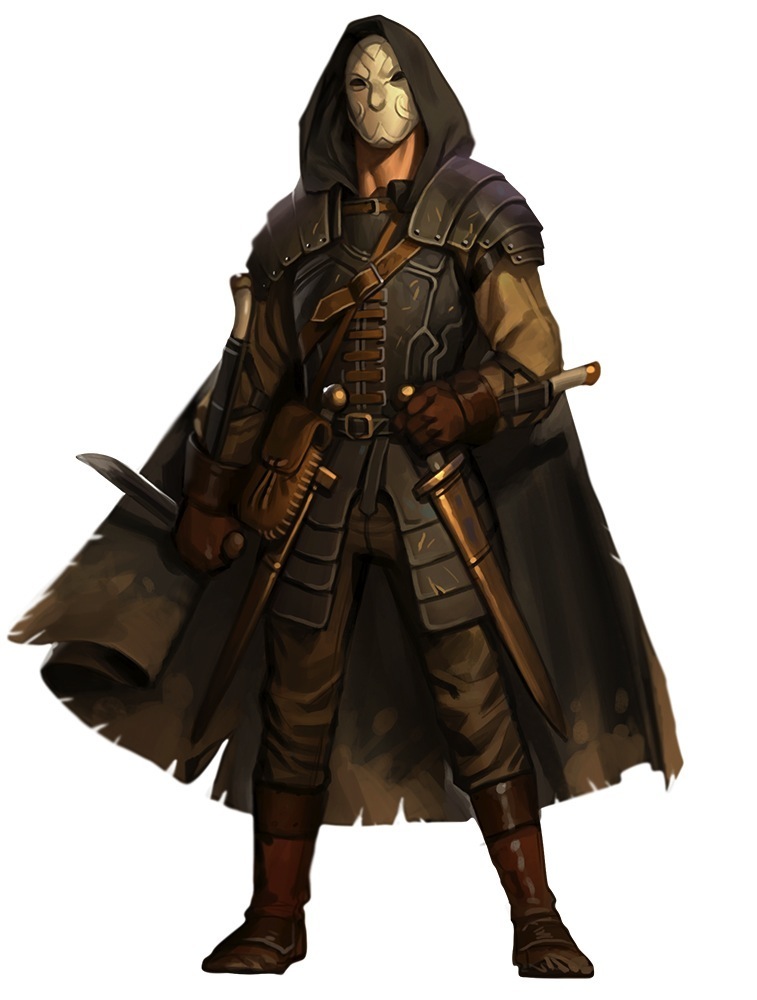
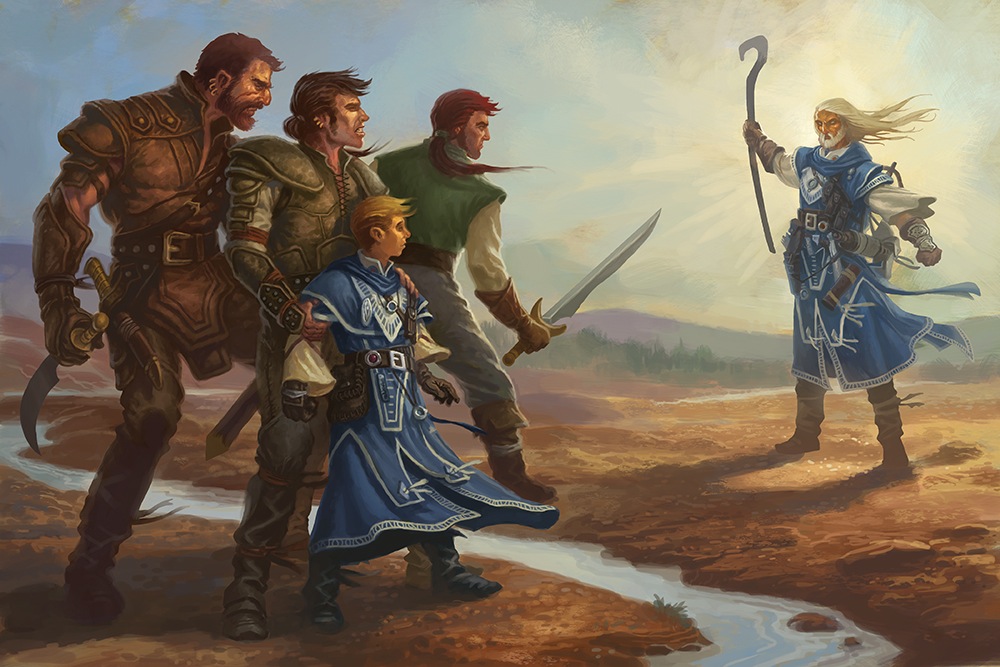
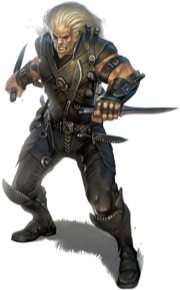
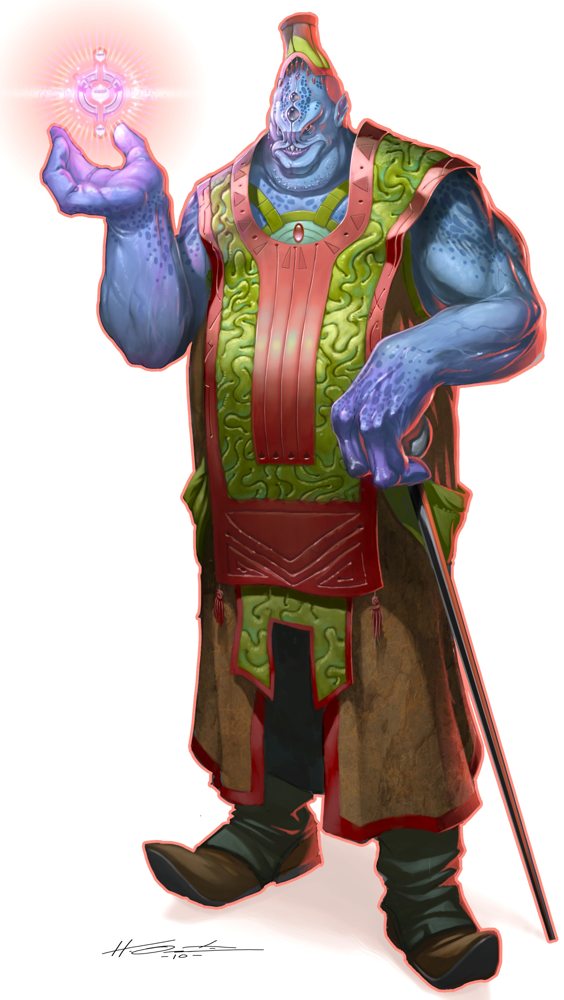
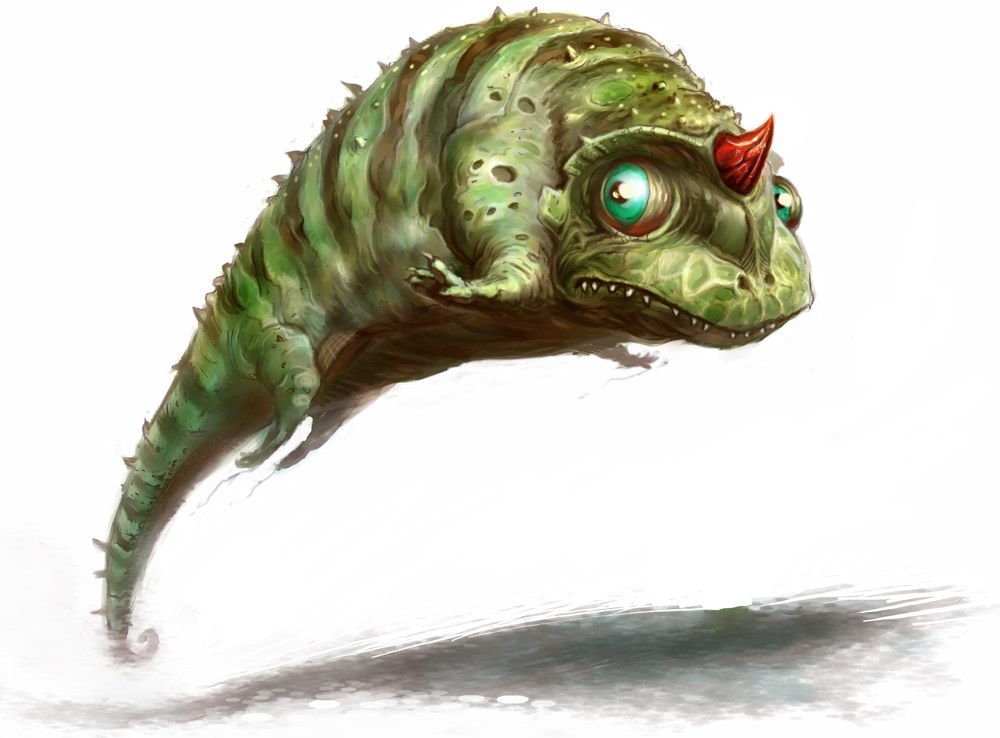
Rodrick is cunning, but that doesn't make him wise.
"Uh, who is this speaking?"
"Me," the voice replied unhelpfully. "What are you doing in here? In case you haven't noticed, there's a linnorm sleeping a few feet from your face. You wouldn't enjoy waking it up. If it even rolls over in its sleep you'll be crushed by its coils. The thing must be sixty feet long."
"I'd love to discuss my motivations, but I'd like to know who I'm talking to—"
"I'm the sword, idiot," the sword said. "Call me Hrym, if you must call me something."
"Ah." Rodrick closed his eyes, but only briefly. "The sword. Of course. I'd heard rumors that you could speak, but I didn't entirely believe them."
"I'm a rare breed," Hrym said. His voice was muffled—presumably because he was jammed beneath several tons of sleeping monster. "Who're you?"
"Rodrick. An adventurer."
"Stay here too long and you're sure to have an adventure, though it's likely to be your last. Why don't you have any shoes on?"
"I had a disagreement with a, ah, fellow adventurer, and he stole them."
"Mmm. There's a pair of boots there, about a foot to your right."
Rodrick turned his head slightly and moved the torch. A pair of pale blue boots were indeed jumbled in with the gold and gems. "Are they magical?"
"No," Hrym said, the sarcasm unmistakable. "They're perfectly ordinary boots, sealed up in a warlord's barrow with all his other treasures."
"Ah. Do you know how they're magical?"
"They let you walk on water, if I recall," Hrym said.
Rodrick sighed. "Hardly helpful in my current circumstances."
"They are also quite functional as ordinary boots."
"A fair point." Rodrick slid over the gold, wincing as a small cascade of coins tinkled and chimed together. He stuck the torch down in the heap of gold—a bit like shoving a stick into sand—to free his hands, tied the laces of the boots together, and hung them around his neck like an unwieldy scarf.
"Most people wear those on their feet," Hrym said. "But I'm sure your bold new fashion will soon be all the rage. Away with you, adventurer! I doubt the linnorm will notice the absence of the boots—they were just sort of swept along with the rest of the treasure. As long as you don't try to remove anything shiny from the hoard, you can probably escape."
Rodrick thought of the gems and rings he'd already dropped into his pockets along the way and decided to pretend he hadn't heard that last part. "The boots are nice, but I'd rather hoped to leave with a bit more."
"Don't be greedy," Hrym said. "It's unseemly in a human. Why, think of the money you could make ferrying people across rivers. You've got nice broad shoulders and strong arms—you could probably carry two, maybe three people at a time. If they didn't have any luggage."
"Sword—Hrym—I'm here to rescue you."
"Rescue," the sword said. "Rescue? Would you ask me to rescue you from a brothel or a barroom?"
Rodrick frowned. "I suppose it depends on the circumstances—"
"I love it here, human. Do you know my fondest aspiration in this world? It's to sleep on a bed of gold. And do you know what I'm doing just this very moment? Sleeping on a bed of gold! Or I was sleeping, until you shone a light in my face."
"You don't have a face."
"And you don't have a very good grasp of metaphor. Fine, then, you shone a light on my hilt—"
"Which I assume would be less akin to your face and more akin to your—"
"My point," the sword said, loudly, "is that I don't need to be rescued. What you really mean is 'stolen.' Now go away before I wake the linnorm."
Rodrick considered. Stealing a sword should have been a lot simpler than this. But the sword had a mind—of sorts—which meant that it could be manipulated. And Rodrick was far better at manipulation than he was a burglary.
"Suit yourself," he said. "My client will be disappointed."
"Oh, to know I caused the disappointment of some human I've never met or heard of, how will I stand the pain? Now, go. This beast is hibernating, but I have ways of stirring it into consciousness very quickly."
"All right, fine. You're missing out, though. I mean, you call this a pile of gold? Pfft."
"Pfft?" Hrym said. "These are the all the riches acquired by the warrior Brant, slayer of beasts and men, despoiler of vaults—"
"Oh, I mean, it's alright," Rodrick said. "I wouldn't mind having this lot in my house, certainly. But my employer doesn't pillage. He invests. He owns half of Andoran, including the banks, and he believes in keeping a ready supply of coin on hand. There's a basement in his house that's so full of gold and gems that he has ten clerks working full-time just to inventory it all, and they can't keep up with the fresh cartloads of coins that arrive every day. He loves money, but more than that, he's a collector of rare and precious magical items and relics. You, of course, are one of the most rare and precious in the world—"
"This is true," Hrym said.
"—and he desires greatly to add you to his collection. Why, he's paying me more gold than I see here just to deliver you to him! Hrym, you could rest in a place of pride atop a mound of treasure that makes this look like the dregs of a drunkard's coinpurse after a holiday. Or you can stay wedged under the ass of a monster, if you prefer."
"Hmmm," Hrym said. "If this is a trick, you'll regret it. I have powers beyond mere speech."
"I'm sure you do," Rodrick said. "Shall we?"
"Very well. Draw me forth. But slowly, so I don't slice the beast."
Rodrick moved toward the sword, grasped the hilt, and gently drew out the blade. The linnorm didn't so much as shift—it might have been carved of stone.
Hrym's blade was dazzling. It was made not of steel, but rather of some bluish-white crystal, gleaming like a faceted diamond in the torchlight. The substance resembled nothing so much as—
"Ice," Rodrick whispered. "I'd heard you were a blade of living ice, but I didn't know what that meant."
"You still don't," Hrym said. "Now go, quickly."
Rodrick held Hrym aloft and carefully worked his way down the slope, moving in a low crouch, away from the light of the torch. He paused halfway down, spying what looked like a silver bell as big as a man's head, half-buried in coins. "Is that—is that the bell that summons blizzards?" he whispered. "I heard there was such a thing here."
"Oh, probably," Hrym said.
"I can carry that too," Rodrick said, and moved carefully sideways.
"I wouldn't do that." Hrym said.
"In that respect, we differ." Rodrick reached for the bell, brushing away coins with his free hand, and grasped the ring at the top. He lifted the bell up, carefully, slowly—
And as it came free from the heap of gold, the clapper struck a deep, low note so loud it brought back Rodrick's headache in full force. An icy wind suddenly blew through the cavern, and the great coils of the linnorm began to move.
Coming Next Week: The perils of waking a linnorm in Chapter Two of Tim Pratt's "Bastard, Sword"!
Tim Pratt is the author of the Pathfinder Tales novelsLiar's BladeandCity of the Fallen Sky, as well as the short story "A Tomb of Winter's Plunder." His writing has won a Hugo Award, a Rhysling Award, and an Emperor Norton Award, as well as been nominated for Nebula, Mythopoeic, World Fantasy, and Stoker Awards. His stories have appeared in anthologies such as The Best American Short Stories and The Year's Best Fantasy and Horror, as well as two short story collections of his own. His non-Pathfinder novels include the contemporary fantasies The Strange Adventures of Rangergirl and Briarpatch; the Forgotten Realms novel Venom in Her Veins; and seven books in the Marla Mason urban fantasy series (as T. A. Pratt). He edited the anthology Sympathy for the Devil, and Rags & Bones with Melissa Marr. His books and stories have been translated into French, Czech, Dutch, Russian, Greek, Korean, Spanish, German, and several other languages.
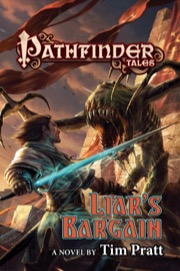
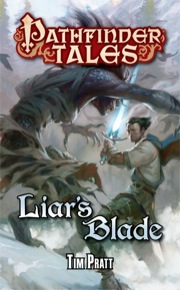
In Liar's Blade, Rodrick is handsome, charming, quick-witted—and totally devoid of morals. Fortunately for him, his best friend Hrym—a talking sword with a blade of living ice—is just as single-minded when it comes to acquiring gold. The pair prefer to win their money by tricking those less deserving of it—which is to say, everyone else—while expending as little effort as possible. Yet when a mysterious patron offers them a lucrative job far to the north, the dastardly duo may find themselves in over their heads (or hilts)....
Liar's Blade Sample Chapter
Wednesday, February 27, 2013
In Liar's Blade, Rodrick is handsome, charming, quick-witted—and totally devoid of morals. Fortunately for him, his best friend Hrym—a talking sword with a blade of living ice—is just as single-minded when it comes to acquiring gold. The pair prefer to win their money by tricking those less deserving of it—which is to say, everyone else—while expending as little effort as possible. Yet when a mysterious patron offers them a lucrative job far to the north, the dastardly duo may find themselves in over their heads (or hilts)....
Chapter One: Two Sought Employment
Why would anyone want to meet at a circle of standing stones?" Rodrick leaned against one of the mossy monoliths and gazed up at the darkening sky. "Who wants to talk business out in the woods? I prefer taverns for this sort of thing. Taverns are traditional. It's easy to get a drink in them. Also, I live above one. Very convenient."
"Our mysterious prospective employer obviously doesn't want to be seen in public with you," Hrym said from behind Rodrick, voice muffled. "I can't say I blame him."
"Possibly he doesn't want to be seen at all." Rodrick rubbed the faint scratches on his cheek where one of the tavern wenches had raked him with her fingernails yesterday. He'd only made a suggestion—and he'd even offered a fair price. How was he to know she was a newlywed who took her vows seriously? At least she was married to a milkwater shopkeeper and not one of Tymon's countless over-muscled gladiators, or Rodrick might have faced more serious injury. "Maybe he's a fugitive from justice or something. We do have some history of working with criminals."
"Besides one another, you mean?" Hrym said. "And anyway, what justice? We're in the River Kingdoms. In Tymon, no less, where most arguments are settled by the parties mutually agreeing to beat each other bloody. But suppose it is some rank villain. Would you turn down the job?"
"I might. I'm an honest man now, Hrym—at least on this side of the border. And at this point in time. As far as anyone knows. It's easier to make a profit off a dishonest man, true. But you have to admit, this is a suspicious way to organize things, luring me out here all alone. Present company excepted." Rodrick was relatively comfortable with his position, standing with his back against a great huge block of stone, with sightlines as clear as he could get in the forest. At least no one would be able to stab him in the kidneys. But there were still too many shadows gathering for his liking. "Picking the lock and leaving a note on my pillow. Telling me to come here at dusk if I'd like to make some money. And leaving me that little bag of gold as, what, an incentive? A deposit? A retainer?"
"Lovely gold," Hrym said dreamily. "Just pile it up and let me sleep on it, I'll be happy as happy can be."
"Yes, I know. You have such simple tastes. I still say we should have just taken the bag of coin and scampered off. I'm tired of Tymon. The only reason I stayed around after we lost all those bets at the arena was because we were too poor to travel in style. But we've got a bit of money now—"
"Yes, but if we leave, we'll miss out on making more gold," Hrym said, practical as always. "It's not like we have any other prospects for gainful or illicit employment at the moment, and that little purse won't last long. Not with the way you run through money. You spent the last of our savings on the second-prettiest wench in the tavern, you may recall."
"The first prettiest was unavailable," Rodrick said absently. "But, look, don't you think anyone stupid enough to give me a bag of money in advance is, by definition, too stupid to work for? Trusting my reliability doesn't say much for their judgment."
"Or they could be stupid enough for us to make a lot of money off them," Hrym said.
Rodrick pondered. "Fair point. "
A moment later, the underbrush rustled, and a figure stepped forward from the shadows. Not quite short enough to be a halfling or dwarf, but definitely on the small side for a human, draped in a bulky cloak that seemed to hint at some concealed deformity—a hump, perhaps, or an off-center surplus head. The cloak was made of good fabric, though, dark green and richly embroidered along the edges with peculiar spiral patterns in dark blue thread.
"I am Zaqen," the figure said, voice pitched high enough that Rodrick guessed the speaker was female, though it was hard to be sure. "You are Rodrick, of Andoran?"
"I'm from all over," Rodrick said. "And I'm pleased to meet you." He gave her one of his more roguish smiles, because it never hurts to be charming.
Zaqen giggled, and Rodrick's smile slipped a notch. People who giggled for no reason worried him.
"Is it true," she said, "that those who hire you also hire ...your sword?"
"A warrior isn't much good without his sword." In truth, despite the rumors he'd caused to be spread throughout the region, Rodrick wasn't much of a fighter. He preferred to stab people from concealment if stabbing was called for—but one had to keep up appearances.
Zaqen sidled closer. "Yes, but ...you have a special sword?"
"Special is a good word for me," Hrym said. "Also ‘amazing' and ‘wonderful' and ‘amazingly wonderful'—"
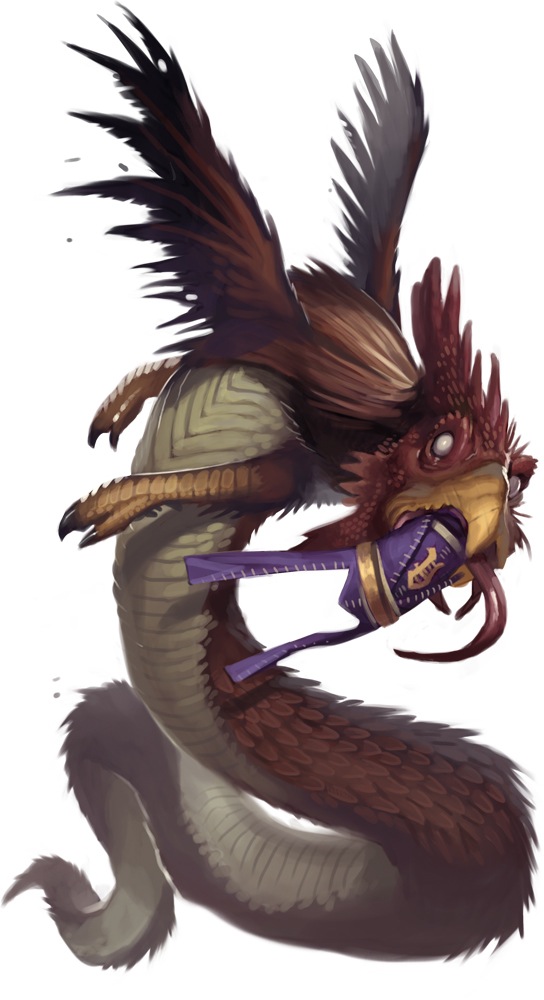
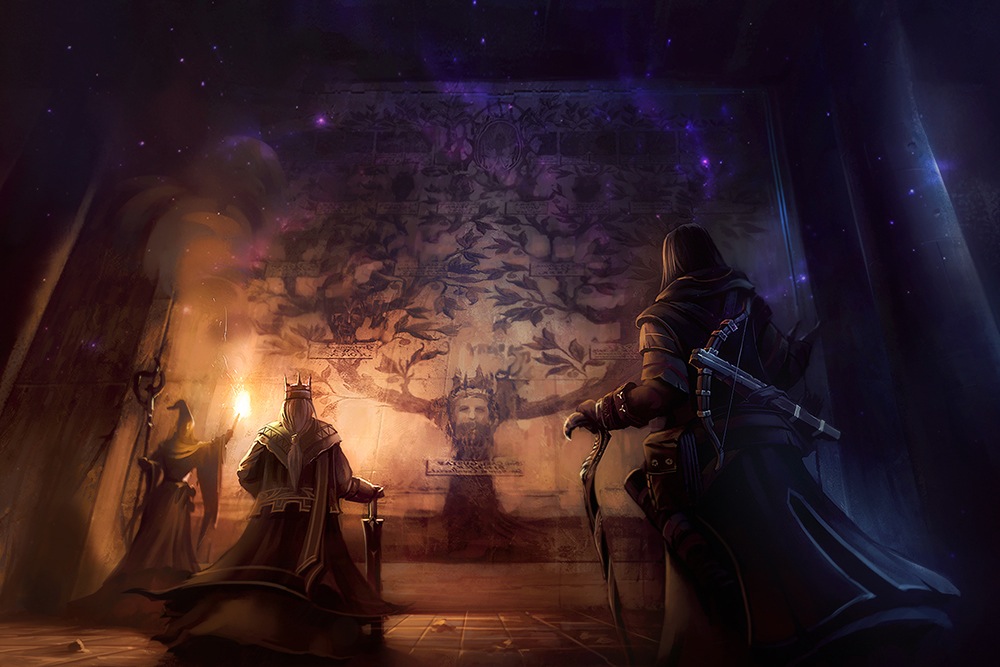
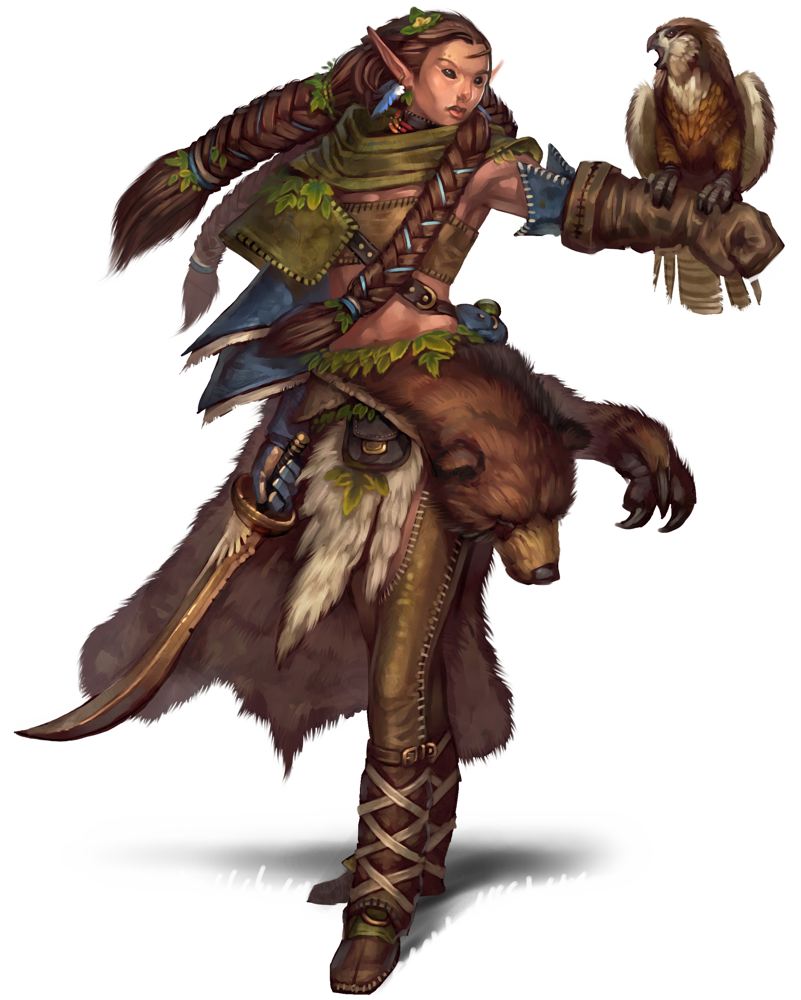
There must be more to Zaqen than meets the eye.
"The sword talks!" Zaqen said. "How marvelous. I'd assumed that was an exaggeration." She craned her head, trying to get a glimpse of the magical weapon sheathed on Rodrick's back.
"I am no it," Hrym said. "‘He' would be better, or any honorifics you choose."
"Apologies, O mighty blade," Zaqen said, her tone deeply amused.
Rodrick sighed. Of course she'd heard about the sword. The only people who wanted Rodrick for himself alone in recent years were magistrates, city guards, and the occasional irate spouse.
"May I see it—I mean, him?" Zaqen scuttled a few steps closer, almost obscenely eager.
"Yes, let me out of this sheath," Hrym demanded. "I can't see anything."
"Your senses are magical," Rodrick said. "It's not as if you have eyes. I don't understand how a leather scabbard can possibly impede your vision." But he stepped away from the standing stone, reached over his right shoulder, grasped the hilt of the longsword, and drew Hrym smoothly from his scabbard, holding him aloft to sparkle in the ...well, twilight. Noonday sun would have been more dramatic.
Hrym was looking especially radiant tonight, though: a blade of living ice nearly four feet long, transparently crystalline at the impossibly sharp edges shading to milky white inward, and on through to a shimmering blue at the center, with steam rising in smoky tendrils from all along his length in the humid air.
"There," Rodrick said. "Meet Hrym, my partner. If this was all some elaborate ruse to lure me out here to steal my sword, you might wish to reconsider. The last person who picked up Hrym without permission lost half his arm to frostbite."
"Though if you offered me sufficient coin, say enough to fill the empty hollow of a medium-sized drained lake—" Hrym said.
"Hush, you," Rodrick said.
"No." Zaqen was suddenly businesslike. "I am not here to steal your blade. I am here to invite you to join me, and my patron, on a sacred quest."
"A quest!" Hrym said. For a sentient sword of living ice with no tongue, mouth, or even vocal cords, his voice was remarkably human. Hrym sounded like an old man who'd spent several decades running a shop that never offered credit, smoking a clay pipe on a porch and pontificating, and teaching his nephews dirty jokes. "I love quests. A sacred one, no less."
"A quest," Rodrick repeated, and sighed. "Well. It's not as if anyone's ever died horribly on one of those. Where is this patron of yours?"
"My master is busy with devotional matters. He is a very holy man."
"A holy man?" Now Rodrick did frown. "What variety of holy? The kind who disapproves of gambling and drinking, or the kind who likes sacrificing innocent virgins on altars of black stone, or ...?"
"The very wealthy kind of holy," Zaqen said. "And he has no interest in your morality, or lack thereof. As long as you can protect and aid us on our journey, he will be pleased, and you will be generously rewarded."
"And as for the other thing, you're hardly a virgin," Hrym said. "So let your mind rest easy on that point."
"Let's have a few details," Rodrick said. "Or even broad outlines. Where are we going, why are we going there, who's trying to kill us along the way, and what are you offering to pay?"
"We are going to Brevoy." Zaqen lifted her face to look at Hrym, still shining in the dusk. Her face was entirely human, though not particularly pretty: snub nose, thin lips, eyes of two different colors, one blue and one green—and the eyes looking in just slightly different directions, lending her gaze a fishlike quality. "To the very edge of any map you're likely to have seen. We seek a sacred artifact of great power, locked away for millennia. No one in particular is trying to kill us, but the River Kingdoms are dangerous places, and parts of Brevoy are little better. And, of course, where there are great treasures, there are often powerful guards, and other interested parties seeking the same prize ...My master and I are not without resources, but neither of us is particularly skilled with weapons, and simply having a strong man with a long blade in our party will act as a deterrent against many common bandits—"
"He asked about payment," Hrym said. "That's the one part I actually care about, so don't forget to address it, please."
Zaqen cocked her head, doubtless wondering—as many had before—what a magical sword could possibly want with gold. "My master is traditional. We will pay all expenses, of course. If you help us reach our goal, Rodrick, we offer your weight in gold as reward." She paused. "Or an equivalent value in gems, treasure, property, or a promissory note drawn on a leading bank of Absalom."
"His current weight in gold, or his weight at the end of the journey?" Hrym said sharply.
Zaqen blinked. "Excellent question. Astute. Forward-thinking. Let's say ...at the end of the journey?"
"Hmm," Hrym said. "I don't like it. Long overland journeys tend to cause weight loss. But he's hardly stout now, so I think we can do better. You'd better start eating richer foods, Rodrick. I want you so fat you can't sit on a horse by the time we reach Brevoy."
"Those terms are acceptable," Rodrick said calmly. His weight in treasure? That would be enough to fill a nice chest for Hrym to use as a bed, with plenty left over for Rodrick to live in the manner to which he devoutly hoped to become accustomed. And then there was the artifact she'd mentioned—surely that would be worth a bit of coin to the right buyer.
"What's the artifact?" Hrym asked. Rodrick suppressed a wince. Hrym had a bad habit of tipping their hand.
"It is a holy relic," Zaqen said. "Of no intrinsic value, and worthless to anyone but my master's particular sect."
Rodrick nodded. "I understand." Maybe what she said was even true. But if this holy man's cult could pay a man's weight in gold just for a chaperone, what would they pay in ransom for the relic itself?
"When do we leave?" Hrym said.
"Meet us here tomorrow," Zaqen said. "Two hours before twilight."
Rodrick frowned. "You want to travel by night?"
She shrugged, one shoulder dipping lower than the other. "My master sets the schedule. I gather there is a place to camp some two hours from here, where he wishes to spend the night."
"Who pays the coin calls the tune." Rodrick bowed. "I'll see you then."
Zaqen disappeared back into the underbrush, walking with a strange, hitching gait, but with surprising speed.
"Well then," Rodrick said. "I suppose that's settled. Let's head back to the Bloodied Flail and spend our advance money."
"You'd better keep enough gold to scatter over the bottom of a drawer in our rooms," Hrym said. "I don't intend to sleep on bare wood again."
"Sleep! As if you sleep." Rodrick slipped away from the standing stones, working his way along the old footpath in the direction of Tymon. The woods right around the city weren't especially dangerous—because of the gladiatorial arena, Tymon had the highest concentration of heavily armed warriors in the River Kingdoms, and they were all obliged to provide a certain amount of civil defense—but there were always bandits with no sense of self-preservation and skulking agents from the neighboring country of Razmiran, which coveted the wealth of Tymon. The value of caution was a lesson Rodrick had learned long ago. Though the exact lesson was more like, "Be cautious when no one is watching; if you want to impress someone, be ostentatiously bold, if the odds favor success."
Rodrick wasn't a coward, but he found that getting in too many fights tended to make his muscles hurt, which detracted from his enjoyment of sex, sleep, and other sensual pleasures.
They made it back to the main road without encountering thieves, thugs, spies, or mad wild beasts. Alive and walking with coins jingling in his pocket—what a pleasant sensation. Hrym was back in his sheath, keeping quiet. People tended to notice talking swords made of living ice. They gaped, or plotted to steal said magical sword, or just asked far too many tedious questions, so Hrym seldom spoke in public. There was also the element of surprise to consider. Discovering that your enemy was armed with another enemy had given many an opponent pause over the years.
Rodrick stopped by the gates to greet Chumley, the night guard he'd befriended on his first day in the city. That was one of Rodrick's little rules: if at all possible, get on friendly terms with the fellows capable of opening a gate and letting you slip out unnoticed in the middle of the night. The guard helped him tie Hrym's hilt to the scabbard with a bit of rough twine. In Tymon, ordinary people had to bind up their weapons or leave them with the guards while they were inside the walls, while full-fledged gladiators could use bare daggers for jewelry if they liked.
Rodrick strolled through the gate, nodding at the few familiar faces he saw, especially the heavily scarred ones. These were not people you wanted to have for enemies.
Most of the wooden and stone shops along the central thoroughfare were still open, though soon only the bars and betting parlors would be doing business. Off in the distance, the roughly palatial Champion's Fortress loomed above almost all the other buildings, overshadowed only by the Arena of Aroden, by far the largest structure in town. Rodrick had gone to a couple of the fights there—the ones he'd bet on most heavily—but his seats were so terrible he'd barely been able to see anything except the head of his "sure thing" rolling off across the sand at the match's conclusion. Blood sports weren't really his preferred game. Give him a nice bit of back-alley gambling instead, especially if he could provide the dice.
"Aroden." Rodrick paused to gaze at the arena. "Some god he turned out to be. Greatest scam ever perpetrated, don't you think? He claimed he was going to come back from the heavens and deliver us all from evil, and when the time came, he was a no-show. How many times have I pulled the same trick at an inn? ‘Oh, I'll come back tonight and settle my bill.' Ha! Of course, they say Aroden died, which is a fairly good reason to miss an appointment, as these things go."
"I met Aroden once." Hrym voice was low and muffled.
Rodrick frowned. "What? The Aroden? Didn't he stroll away from our mortal plane ten thousand years ago?"
Hrym was silent for a moment. "Maybe I'm thinking of someone else," the sword mumbled. "You humans all start to look the same after a while."
Rodrick shook his head. "He was Azlanti—the last Azlanti. I doubt he looked much like the rest of us—"
"Bipedal. One head, with hair on it. Two arms. Close enough."
Rodrick snorted. It was often impossible to tell if Hrym was boasting, lying, deluded, or genuinely ancient. Even the sword himself often seemed unsure of his true history. But what mattered now was their future. If they were off on a long, harsh journey tomorrow, they'd better enjoy tonight.
Their current home was a room above the Bloodied Flail, close enough to the arena to hear the screams of the crowd if the wind was right. Despite the tavern's name, and the sign bearing an image of a multi-headed whip dripping crimson paint, the Flail wasn't a particularly violent or rough tavern. That was just the aesthetic in Tymon, the city of gladiators: blood, weapons, severed heads dangling by their hair, and so forth. For all that the place was founded on blood, it was one of the more polite places Rodrick had spent time. Something about the fact that every third person you met was a seasoned arena fighter bristling with weapons prompted people to mind their manners.
Rodrick kicked the mud off his boots before pushing through into the Flail's common room—the owner had given him the rough side of her tongue the first time he tracked in muck, and he believed in staying on good terms with one's landlady, at least until it came time to skip out on the final bill.
It was only just nightfall, so the place wasn't too full yet, and he got a spot next to the bar. The prettiest waitress, Sonya—the one he'd propositioned, getting a slap complete with fingernails for his trouble—narrowed her eyes at him and disappeared into the back, but Sweet Jill approached with a smile and poured him a mug of beer. He took a sip and smacked his lips. "Much obliged. Have I told you how your hair reminds me of the embers of—"
"Save it." She kept smiling, but he saw now that her eyes were serious. "Flirt with me tomorrow, if you're still alive."
Rodrick raised one eyebrow in what he knew to be a charming and suggestive way. "Unless you're planning to ride me to death—"
"It's Sonya," she said. "She didn't like the way you talked to her."
"I suppose I could apologize, though I can't imagine why her feelings should be hurt. I would hardly seek the company of a woman who wasn't beautiful and exceptional and amazing, present company most definitely included, so really it was a compliment when I asked—"
"You're from out of town." Jill sounded sad, which was worrisome. "You didn't know any better. I tried to tell her that, but she's still upset. Most of our patrons know better than to try and have it off with her."
"I didn't know she was married," Rodrick said. "Let alone newly married. I would have held my tongue if I'd realized." Not entirely true, but he would have approached things differently. "Why are we talking about such tedious things when I have a bag of gold and—"
"You should probably leave town." She tried to nudge him off his barstool with her hip.
"But why? Her husband is a fine man, I have no doubt, but he runs a shop, and it's not even something frightening like a weapon shop or a butcher shop. It's a general goods store. The man isn't likely going to challenge me to a—"
"No," said a voice from behind him, a deep bass rumble full of amusement. "But her brother might."
Coming Next Week: Tim Pratt brings us an all-new prequel story unveiling how Rodrick and Hrym first met and joined forces!
Tim Pratt is the author of the Pathfinder Tales novels Liar's Blade and City of the Fallen Sky, as well as the short story "A Tomb of Winter's Plunder." His writing has won a Hugo Award, a Rhysling Award, and an Emperor Norton Award, as well as been nominated for Nebula, Mythopoeic, World Fantasy, and Stoker Awards. His stories have appeared in anthologies such as The Best American Short Stories and The Year's Best Fantasy and Horror, as well as two short story collections of his own. His non-Pathfinder novels include the contemporary fantasies The Strange Adventures of Rangergirl and Briarpatch; the Forgotten Realms novel Venom in Her Veins; and seven books in the Marla Mason urban fantasy series (as T. A. Pratt). He edited the anthology Sympathy for the Devil, and Rags & Bones with Melissa Marr. His books and stories have been translated into French, Czech, Dutch, Russian, Greek, Korean, Spanish, German, and several other languages.
The wind blowing in Kagur's face smelled of rot. She started running, and the soft earth, boggy with the coming of summer, sucked at her feet. Her five companions ran as well.
In Red Rune Canyon
by Richard Lee Byers
Chapter One: A Difference of Opinion
The wind blowing in Kagur's face smelled of rot. She started running, and the soft earth, boggy with the coming of summer, sucked at her feet. Her five companions ran as well.
Eovath soon pulled ahead of everyone else. Like her, the blue-skinned frost giant was still growing, but he was already taller than any human tribe member, with longer legs and a longer stride.
He slowed down, though, when the several bodies on the ground came into view. It was too late to help them, and prudent to advance with caution in case their killers were still lurking about.
They didn't seem to be, though, which left Kagur free to inspect the corpses. The shredded flesh, glazed eyes, and flies that buzzed up into the air at her approach forced her to swallow away the stinging taste of bile.
Her squeamishness made her scowl. Like any Kellid warrior, she'd seen violent death before, and only one of the dead folk here had been a Blacklion like Eovath and herself. But they'd all become friendly since setting forth to hunt from a gathering of half a dozen tribes.
Borog straightened up from his examination of one of the corpses. A member of the Eagleclaw tribe, he was the oldest surviving member of the hunting party, with deep lines etched in his sun-bronzed face, pouches under his dark eyes, and white hairs speckling a close-cropped black beard. "Like the others," he said.
They'd all heard tales of other hunters encountering the same grisly end. They just hadn't let it deter them from roaming the prairie themselves. No true Kellid allowed fear to rule her, and even had it been otherwise, a tribe that didn't hunt wouldn't eat.
"Not all the others," Eovath said. His adolescent voice broke on the second word, but even then it was as deep as most men's.
Borog frowned. "How so?"
"The way I heard it," the frost giant said, "the first band of hunters fell dead without a mark on them. It was the latter ones that were torn apart."
The Eagleclaw warrior snorted. "And what does that tell you? That the first incident was something different than the slaughters that have happened since."
"Maybe not," Kagur said. Turning, she counted the corpses. "Supposedly, every band, including that first one, had one member carried off. And one of our own is missing: Dron."
Those who try to protect Kagur would be better off protecting themselves.
One of the other hunters hurriedly checked Kagur's body count with the aid of a jabbing finger. Another touched the beaten silver good-luck charm hanging around her neck.
"All right," Borog growled, "maybe the same thing did kill the first party. At this point, what does it matter?"
"It doesn't," Kagur said. "What matters is picking up the trail." Studying the ground, she prowled away from the corpses, and after a moment, her companions followed her lead.
She hoped it would be easy to find tracks in the mucky earth, and bent blades among the new grass, and in fact, it was only a short time before Eovath called out: "Here! The sign isn't clear enough to tell what the killers are. But they came from the northeast and headed back that way, too."
"Let's see," Borog said. He stalked to where Eovath was standing, squatted to study the sign, then grunted in a way that suggested he agreed with the giant's reading.
"Let's move out," Kagur said, striding closer to the other two.
"No," Borog replied. "Red Rune Canyon is northeast."
Kagur blinked. That particular fact had momentarily eluded her. And while she'd only heard rumors about strange deaths on the tundra since the start of summer, she'd listened to tales about Red Rune Canyon her whole life. Every Kellid knew the place was cursed.
But in the present circumstances, that didn't matter. "We have to rescue Dron."
"Dron's dead," said Zorek, a lanky Eagleclaw of about Kagur's age. Blood had trickled out of his sleeve to stain the back of his hand. Several days previously, a ground sloth had clawed his forearm, and he picked at the scabby gash when no one was watching to slow the healing and make an impressive scar.
"You don't know that," Kagur said. "If the attackers wanted him dead, they could have killed him on the spot like they did everybody else. You don't know they really came from Red Rune Canyon, either."
"They could just be orc raiders out of the Hold of Belkzen," Eovath rumbled.
Borog shook his head. "Smell the rot in the air. Our friends haven't lain dead long enough to stink like that. That's the smell of the unnatural things that killed them."
Kagur scowled. "Maybe, but it doesn't change anything. Dron still needs rescuing, and our dead need avenging."
Borog took a breath. "Look around. There are fewer of us than there were of those who lost their lives already, and you, Zorek, and the giant are young and green. How do you expect to win where a stronger band of warriors already lost?"
"We can make a plan when we know more."
"Here's the plan," Borog said. "We'll return to our tribes, and the chiefs will decide what to do next. Maybe they'll decide to hunt and fight the killers properly, and you can ask permission to join the war party."
"By then, Dron will likely be dead or tortured."
"But you'll be alive, and Jorn Blacklion won't start a feud with the Eagleclaws because I let his idiot daughter come to harm."
"It's not for you to decide what the 'idiot daughter' will do," Kagur said. "You're not my chief, and I'm going after Dron even if nobody else does."
"No," said Borog, "you aren't."
If his voice changed, his eyes shifted, or his hand gestured to give a signal, Kagur didn't notice in a conscious way. But the rest of the hunters had drifted up behind her to listen to the conversation, and suddenly instinct screamed that they were reaching for her.
She tried to spring forward, but hands grabbed her forearms and held her back. She stamped on a foot and snapped her head backward into someone's teeth and jaw. That loosened the grips restraining her, and she wrenched herself free and spun around.
Spreading out to flank her, her three assailants came after her. Backing away, she reflexively reached for her longsword, and they faltered, as well they might. Young as she was, she was skilled with a blade, and they knew it.
But, her anger notwithstanding, she knew drawing a weapon would be stupid. She didn't want to kill folk from friendly tribes, especially when, as they saw it, they were only trying to stop her from coming to harm.
She hitched her foot, faking another step backward, and when they advanced, she threw herself at them. She punched Zorek in the solar plexus and made the breath whoosh out of him, but then her other two opponents grabbed her. One kicked her left foot out from underneath her, and they dumped her onto the ground.
Kagur thrashed but couldn't break their holds. Panting, Zorek came up behind them with a length of rawhide in his hands.
A big blue hand caught him by the shoulder and flung him aside. Then Eovath bashed the other hunters away from her with two sweeps of his fist.
Grateful as she was for the help, Kagur winced. Eovath was stronger than any human, and he hadn't held back.
Fortunately, her assailants weren't seriously hurt, as they demonstrated by scrambling back to their feet. Unfortunately, they too deemed that the confrontation had escalated from a scuffle to a deadly serious fight, and they snatched for the weapons slung from their belts.
Eovath lunged, caught Zorek before he could ready his axe, and heaved him into the air by his throat and arm. The lanky Eagleclaw's face turned red, and he made gurgling sounds.
Borog hefted a javelin. The upper edge of the leaf-shaped steel point glinted in the morning sunlight. "Let him go."
"You might kill me," Eovath said, his yellow eyes gleaming like the spear point, "but not fast enough to keep me from killing your kinsman. One shake snaps his spine. One squeeze crushes his windpipe."
"No!" cried Kagur, leaping to her feet. "I mean, no to both of you! Borog, what's the sense of killing us to keep us from risking our lives?"
"I never threatened to kill you," Borog replied without taking his eyes off Eovath. "Only the slave."
She put her hand on her sword hilt. "Eovath is my brother, and if you hurt him, you'd better kill me."
Borog's jaw tightened. "Fine. Go. Your father must know what a stubborn fool you are. Maybe he won't blame me."
Eovath sneered and tossed Zorek away.
Once Kagur and the giant were on the trail and sure their erstwhile companions weren't following, she asked, "What were you going to do if they called your bluff?"
The giant smiled a crooked smile. "What makes you think I was bluffing?"
"You wouldn't really kill friends of the Blacklions."
"They didn't seem much like friends when they jumped you."
Still, she doubted their father would have approved. But if Kagur and Eovath had offended the Eagleclaws, Jorn Blacklion would make amends with gracious words and gifts. Meanwhile, his daughter and foster son had a hunt to complete. She paused to inspect the ground before them, then pointed at the clearest track she'd found so far: the unmistakable impression of a boot.
Eovath nodded. "You were right. Dron isn't dead. In fact, he's fit enough for his captors to march him along."
For a moment, Kagur was certain that was the way of it. Then she noticed additional tracks a couple paces farther along. "I hope so. But look here. The 'captors' were wearing boots, too."
Eovath grunted. "Then maybe they are orc raiders, despite the putrid smell. Or Kellids turned bandit."
Kagur looked up at him. "You sound disappointed."
"Haven't you ever been curious to see a ghost or a demon?"
"I suppose. Is that why you agreed we should come after Dron?"
"I agreed because no one should be dragged off into slavery."
Kagur frowned. "You're not a slave, despite what Borog said. No Blacklion thinks of you that way. Not anymore. Not for a long while."
The frost giant shrugged his massive shoulders. "We should keep moving."
They did, loping across windswept tundra and past ponds surrounded by patches of yellow-green moss and stunted diamond-leaf willows. When the trail led near ripe red bearberries, they gobbled some and picked more for later. Gray-white hawks with crimson beaks floated in the sky, and wild mammoths trumpeted in the west.
Animals grew scarcer, though, as the terrain became hillier and the trackers drew near to Red Rune Canyon. By the time the sun was sinking toward the western horizon, and the notch between two stony walls came into view, Eovath and Kagur were the only moving, breathing things in sight.
"It's nearly dark," Eovath said. "We could camp here and head in come morning."
Kagur shook her head. "Let's cover as much ground as we can."
Unfortunately, that wasn't a great deal more, for when, peering about for lurking orcs and other dangers, they prowled into the mouth of the canyon, they found it was already twilight inside. They had to stop not long thereafter lest they risk losing the trail.
They camped beside the creek that ran down the center of the gorge and supped on more bearberries and bison jerky. Kagur had swamp tealeaves in her pack as well, but it would be foolish to build a fire to brew a beverage. Someone or something might spot the light. So far, however, Red Rune Canyon had done nothing to justify its sinister reputation.
Later, when Eovath was on watch and sleep continued to evade her despite the day's exertions, Kagur came to a decision. "It's just orcs. Orcs bold and cunning enough to hole up where humans are afraid to go."
"What about the rotten smell?" Eovath replied.
"How many clean orcs have you fought?"
"What about the first hunting party, slain without a mark on them?"
"I don't know, but—"
Eovath suddenly peered farther down the canyon. "Something's there."
Coming Next Week: The dark secrets of Red Rune Canyon in Chapter Two!
Enjoying this story? Check out the further adventures of Kagur and Eovath in Called to Darkness, available now!
Richard Lee Byers is the author of more than thirty novels, including the Pathfinder Tales novel Called to Darkness (also starring Kagur and Eovath) and the first book in R. A. Salvatore's War of the Spider Queen series. In addition, he's also the co-creator of the critically acclaimed young adult series The Nightmare Club, and the author of a new urban fantasy series beginning with the novel Blind God's Bluff. He's written one previous Pathfinder Tales web fiction story, "Lord of Penance".
We joke about gamers at conventions who want to tell you about their characters. Most of the time it's perfectly okay, but there's always that one guy who follows you into the bathroom talking about his +5 Holy Avenger. Dude. It's not all right.
Dave Gross: Stat Up My Characters!
Saturday, December 15, 2012
Illustrations by Eric Belisle
We joke about gamers at conventions who want to tell you about their characters. Most of the time it's perfectly okay, but there's always that one guy who follows you into the bathroom talking about his +5 Holy Avenger. Dude. It's not all right.
As a long-time gamer, I sympathize with the desire to tell others about your paladin. Hell, in the Pathfinder Tales novels I'm basically telling you about my characters. Maybe it's time to turn the tables... with a twist.
When Prince of Wolves came out in 2010, James Sutter wrote a good article describing Radovan for Kobold Quarterly. I tease him that Charisma shouldn't be Radovan's dump stat, but I can't complain unless I stat him out myself.
But I won't. Or at least, I won't show those stats.
My secret is that with Hero Lab I have created character sheets for the important characters for all of my Pathfinder Tales novels. They're a big help when I deal with spell battles, but they also provide inspiration for action scenes. Can the game version of Radovan catch a knife thrown at him? I looked it up. Totally legit!
While I don't want to reveal any "official" stats to preserve the mystery of the characters, there's no reason you can't show us your version.
How would you stat up Radovan and Jeggare? How about Azra or Malena from Prince of Wolves? Burning Cloud Devil would be a challenge, as would Jade Tiger and all of the kami Arnisant meets in Master of Devils. Perhaps the most fun would be statting out Caladrel, Fimbulthicket, Kemeili, and Oparal from Queen of Thorns. And don't forget Ellasif and Declan from Winter Witch! I'm not sure Elaine or I ever did stats for them.
Post your character stats for any of my Pathfinder Tales characters in this blog's comments by January 2, 2013. With a little help from the Paizo editorial team, I'll choose three favorites to receive a signed copy of Queen of Thorns and a Radovan miniature.
What do you say? You've got my full attention. Tell me about my characters.
UPDATE: Additionally, each of the three winners will receive a free copy of Hero Lab from Lone Wolf Development. If the winner already owns Hero Lab, you’ll be able to select up to $20 worth of add-on packages for Hero Lab. The contest has also been extended to January 2, 2013.
... Queen of Thorns Sample Chapter Scavenger Hunt!Wednesday, October 31, 2012 ... It's Halloween, and in the spirit of going door-to-door looking for treats, we've decided to do something a little unusual for the release of the new Pathfinder Tales novel Queen of Thorns. Instead of offering a single sample chapter, we've spread the first four chapters across four prominent fantasy and gaming websites, giving you a free sneak preview of the first 70 pages of the book! Here to talk a little bit...
Queen of Thorns Sample Chapter Scavenger Hunt!
Wednesday, October 31, 2012
It's Halloween, and in the spirit of going door-to-door looking for treats, we've decided to do something a little unusual for the release of the new Pathfinder Tales novel Queen of Thorns. Instead of offering a single sample chapter, we've spread the first four chapters across four prominent fantasy and gaming websites, giving you a free sneak preview of the first 70 pages of the book! Here to talk a little bit about the project is the author himself, Dave Gross:
To give people a taste of the Pathfinder Tales novel line, Paizo's fiction editor solicits short prequels for the web fiction page. These stories allow us authors to show a glimpse of what happens to our heroes between books. I appreciate the opportunity to go darker or funnier or just a little different from the novels while showcasing the same protagonists.
I love them.
Paizo also posts chapter excerpts from the novels, often from the middle of the book, with glorious full-color artwork.
I hate them.
Well, I love that Paizo is showing off beautiful art and a sample chapter, but why is it never Chapter One? That drives me crazy! I wrote the chapters in order, damn it, and I think the first one is a pretty good introduction to the story. Why can't that be the excerpt?
So I complain, as anyone who's read my editor's blog knows all too well. And he responds with perfectly reasonable-sounding explanations like, "We wanted to show off some action, because we like your fight scenes." (That's a dirty trick, the appeasa-flatter.) Or maybe he'll say, "We loved this character and wanted an excuse to commission a painting of her." (I loved her too, so I'm thwarted.)
But, damn it! I still want everyone to read Chapter One (and Two and Three) before Chapter Four. And so I keep complaining, and my editor keeps posting lists of things authors should never say to editors, and so it goes.
But something different happened this time. I don't know, maybe my editor was just tired, or maybe the stars were right. I suspect the enlistment of publicity impresario Jaym Gates might have been a factor. The result is that you can follow the links from blackgate.com to flamesrising.com to sfsignal.com and finally to paizo.com (below) to read Chapters One, Two, Three, and Four of Queen of Thorns.
If you like what you read, I hope you'll buy a copy of the book. And if you like that, I hope you'll tell everyone you know to buy one, too.
In the meantime, let's thank our hosts at all the participating websites, as well as Jaym Gates and my long-suffering editor, James Sutter, for making this happen.
I promise not to complain for the rest of the week.
About This Chapter
After Prince of Wolves and Master of Devils, in which the boys spend much of their time on separate journeys, for Queen of Thorns I wanted a plot closer to a classical quest fantasy with a group of heroes. You know, like a Fellowship or a Ring of Companions or something like that. So in Chapter Four, Count Jeggare assembles a party that leaves Radovan wishing he'd stayed in Rivendell. I mean, Iadara.
Jokes aside, Kyonin is only superficially similar to Middle-earth. In addition to the fey creatures infesting the woods and the horde of demons threatening from the south, the Fierani Forest is full of half-forgotten archaeological sites, some concealing arcane or cosmological mysteries. What could be more exciting to a Pathfinder like Count Jeggare? Although, as things turn out, the expedition into the Fierani Forest might reveal as many secrets of Radovan's infernal heritage as of Varian's long-absent father.
Chapter Four: The Fierani Forest
Somebody was making a hell of a racket, and not just in my nightmare. I'd been having a lot of those lately. I shook off the terrors, sat up, and rubbed sand out of my eyes.
Desna smiled. Nobody was getting murdered outside of dreamland. Arnisant just had Fumblewhatsit backed up against the campfire.
"Call off your animal! Great glens and gardens, he'll eat me in one bite!" The gnome wasn't tall enough to hold the skillet out of reach. He protected it with his body, but the hound's big jaws shook his confidence.
"Arni, get over here!"
The dog bounded and sat beside me, a long rope of drool running from his jaws.
The gnome scowled at Arni and set the skillet back on the fire. Fat black sausages sizzled in the pan.
"You all right, Fim?"
"Fimbulthicket," he winced as he pressed a hand to hip. "And I'm fine, thanks for asking. Dodging a hungry dog is nothing new, I'm sorry to say."
"Where's the boss?"
The gnome tilted his head in the direction of the brook. His baggy eyes told me the boss had kept him up late, as he had our last couple of nights in Omesta, quizzing him about his old man. It didn't help that we'd slept this last night in the forest just outside the elf and gnome city. The boss said it was supposed to get us prepared for the upcoming journey.
It was going to take a lot more than one night's camping to toughen up the gnome, who winced every time he moved. He probably hadn't spent a night out of a soft bed since he'd last seen Variel. That was around the time the boss was born, and I still had trouble thinking of him as working on a hundred years old.
I didn't mind sleeping on the ground so much as the fiends tearing through my dreams. I couldn't blame it on last night's supper, which had been pretty plain fare after all the rich elven goodies back in Iadara. No, I had a pretty good idea where my nightmares came from. They didn't come from the things I'd eaten. They came from the things I'd done.
As I pulled on my boots, the back of my neck itched. I looked around, saw nothing. Listening, I heard the sizzling meat on the fire, the water from the brook, and birdsong from the trees, but nothing out of order. Still, it felt like somebody was watching me.
I shook out my blanket and made a cloud of gray dog hair. No wonder I'd dreamed about wrestling a demon-bear. Whenever I slept near the boss, Arni waited for him to fall asleep before moving from the foot of his bunk to steal my covers, the big mooch.
The starknife rested behind the pack. I'd carried it with me ever since we'd left Ustalav. Even all the time I tramped through Tian Xia in a devil's body, I kept it near. A few times I'd had to use it to kill, but that's not why Azra gave it to me. Despite swearing to Bishop Senir that I'd never go back to Ustalav, I wondered sometimes whether Azra was waiting for me to return her knife and seal the offer she'd made me.
It was a stupid thing to think about. I wrapped the starknife in my blanket and stuffed them both into my pack.
I fetched my jacket off the tree where I'd hung it. It looked no worse for the dunking I'd taken back in Iadara. Most of my scrapes and bruises had healed, too. While the night I spent with Kemeili was fun, I was glad it was behind me. There'd been a time I'd have felt different. Maybe the problem was I'd spent a year stuck in a body nobody could love. Or maybe I'd had my fill of rough stuff for one lifetime.
My spurs slid into their elbow slots as I shrugged on the jacket. I rolled my shoulders to feel the slack hidden under the overlapping strips of red leather. It was the best jacket I'd ever had, and I liked feeling my tools close to hand. If I slapped my arms just so, razor-sharp blades filled my fingers. Even in a tight spot, it was easy to slip a rake or probe out of a hidden pocket.
I snagged a couple sausages from the skillet, juggling them as the fat dripped down my fingers. It was time I learned to be more careful around hot things.
Arnisant followed me out of camp. When I paused, he sat at my side and gave me a pitiful look.
I broke a sausage in half and held it up. "You stay off my bed. Got it?"
The Arnisant Falls started flowing. Before he could drown in his own puddle of drool, I dropped the sausage. He made it disappear and looked to me for more. I finished mine before I let him have the other half of his. Otherwise he'd harry me all the way to the brook.
We found the boss in the middle of the stream. He stood on a stone, his pose telling me he was halfway through the Thirty-Six Forms he'd learned from the masters of Dragon Temple. I'd learned the same exercises from a less reputable source. No surprise, the boss still practiced the Forms, and I had to admit he was a lot better at them than I was. Still, I made better use of them up close and personal.
I hopped onto a nearby stone and joined him. Usually we didn't go for more than a minute before he started pointing out my mistakes. This time he didn't say a word. We just let our bodies flow through the motions.
We finished and began again. As we Gathered the Sun and did Crane Steps Forth, I caught a movement out of the corner of my eye. The elf ranger Caladrel crouched on a branch overhanging the brook. He watched until we finished the second routine.
The boss looked at Caladrel. An unspoken message passed between them, and the elf dropped as light as a leaf to the ground. He set aside his bow and quiver, slipped the long elven curveblade off his back. Facing us, he imitated our movements as we did it all again.
By the time we reached Tip the Leaf, I knew he was one hell of a quick learner.
"Immaculate," the boss said when we were done. "Have you studied?"
Caladrel shook his head. "I practiced Willow-Oak calisthenics while training for the rangers. Your exercise seems to have a similar purpose."
They collected their weapons, and Arni and I followed them back to the campsite. Caladrel and the boss were the same height, a good five inches taller than me. As they locked step, the boss fell into the ranger's rolling gait. As long as I'd known him, he was a natural mimic, even when he wasn't trying.
It was good to see the boss in his long coat with the riffle scrolls slung around his chest. The Shadowless Sword hanging from his hip should have looked all wrong with his Chelish clothes, but somehow its black-and-gold lacquered scabbard seemed to fit in just perfect. When he drew the blade, it moved as swiftly as his Chelish rapier ever had. Swifter, even. He said that's how it got its name, because it moved too fast for the sun to throw a shadow behind it.
The one difference I noticed in the count lately was that he'd lost that little bit of gray in his hair. I couldn't tell whether he was using dye or magic, but it was only a matter of time before I caught him at it. He was getting old, even for a half-elf, but he hid it pretty good.
"Prince Amarandlon sent me to aid in your search," said Caladrel. He saw the boss's eyes narrow, same as me. "He explained that the expedition is under your command. I welcome the opportunity to learn from you."
The boss nodded, but he was preening on the inside. He likes having his toes kissed. I guess that can't be helped, when you're born into the richest family in the richest country in the world. "The prince's message said I should expect two others."
"Maybe Faunra?" I'd hoped to find that doe-eyed ranger in Omesta while the boss and Fimbulthicket planned our excursion, but the gnomes told me she'd flown back to Iadara. I made up for my disappointment by catching up on the sleep I'd lost with Kemeili.
The boss gave me a look, but Caladrel smiled. He was turning out to be a regular guy, despite the toe-kissing.
"I'm afraid not," said the elf. "I'm here for the rangers. The others will represent other concerns. Doubtless one will be the queen's creature."
The boss's eyebrow rose a bit. Otherwise he masked his suspicion pretty good.
"That reminds me," Caladrel said, rummaging in his pack. "I bring a gift from Prince Amarandlon."
"Your master has been most generous to me," said the boss.
"Actually, the gift is for your associate."
The boss masked his disappointment pretty bad.
Caladrel pulled out a dirt-colored cloth and handed it to me. It was light as a handkerchief, but I let it fall open and saw it was a full cloak with a hood.
"Thanks," I said, trying to sound polite. "But it's not really my style."
"Your red leathers stand out against the forest," said Caladrel. "With scouts from the Witchbole venturing ever closer, stealth is our first line of defense."
"It's kind of warm to wear a cloak, don't you think?"
"Try it on."
The boss gave me the look, so I threw the cloak over my shoulders. The hem fell just above the top of my boots, covering up my red jacket and pants. It wasn't too warm after all.
"Much better," said Caladrel. "Now you aren't visible from a mile away."
"Thanks." Maybe it'd get caught in a briar patch. Maybe a breeze would blow it into a ravine. I revised my wish list for Lady Luck.
Back at the camp, the gnome with the goofy name rolled his eyes when he saw we'd brought company for breakfast. When the boss told him to expect two more, he shuffled over to his pack and dug out more sausages. Grumbling as he rubbed his wrists, he said, "I hope they bring more provisions."
"It would appear one has," said Caladrel.
A tall figure came out of the forest. Mirror-bright armor glinted out from beneath a hooded elven cloak like mine. The warrior's backpack was twice the size of mine, and it came with a barn door of a shield and a rafter of a sword.
The newcomer dropped the pack. Pulling back the hood, she revealed herself as the Forlorn woman who'd slugged me at the queen's party.
"Desna weeps." Sometimes I forget and say it out loud.
Caladrel coughed. "Count Jeggare, allow me to introduce Oparal, paladin of Iomedae."
"Your Excellency." She made a stiff Chelish bow.
Oparal can certainly handle herself in a fight.
The boss barely nodded, reminding her of the pecking order. With a sly smile, he said, "I believe you are already acquainted with my bodyguard, Radovan."
The black pupils of her steel-colored eyes slid toward me. Her nostrils flared. Her expression was almost comical except for the fact that my jaw still ached. Otherwise, I would have tipped her a wink to show I wasn't scared.
I wasn't. Not much, anyway.
"Hungry?" asked the gnome.
"Yes," said Oparal. "Our owl only just arrived."
At a nod from the boss, Oparal went to sit beside the fire. I made the "let's talk" sign. Caladrel caught the hint and joined the others at the fire while the boss and I strolled out of earshot.
"You sure this is a good idea? I mean, seriously—a paladin?"
"We could wish for no better ally if we encounter demons in the forest."
"We don't need one of these holy avengers. They make me nervous. You don't like them either. Besides, we've handled fiends before."
"I never said I don't like paladins. As for demons, you and I have only ever faced one or two at a time, usually with the Egorian Watch only a shout away."
"You're forgetting Iron Mountain."
"I forget nothing," he said. "Those were devils. And you were on their side."
He had to remind me of that. "I couldn't help it."
"All I am saying is that the circumstances are different."
"You weren't the one that ogress clobbered."
"I was not the one who offended her."
"Thanks for the sympathy."
The boss looked past me. That sly smile found its way back onto his face. "Perhaps our last companion will be more to your liking."
I turned to see her approach. Under an elven cloak she wore black-and-yellow leathers—wasp colors. A coiled whip hung at her back, pushing up her cloak like the bustle of a ball gown.
Kemeili planted a fist on her hip and smiled at me. "You didn't think I'd let you get away that easily, did you?"
∗ ∗ ∗
Caladrel paused and raised a hand. He lowered it, palm-down. We all crouched low. Even Arnisant lay down without needing to be told. Clever boy.
Whatever the ranger spotted, I was glad to set down my overstuffed pack. The boss kept his books in his satchel, but I was the one hauling around the rest, including his tent. At least he had all his little scrolls and widgets in his coat and bandolier.
Caladrel beckoned the boss forward. I went with him.
We peered through some bushes at a mob of demons ambling through the forest. They wore the bodies of elves, some of them in scraps of ranger leathers, but there was no mistaking them for real elves. They jiggled with every step, glutted with something wriggling inside them. I counted seventeen of the damned things.
"Vermleks," whispered Caladrel.
"I will lead the attack," said Oparal, who'd joined us without an invitation. She shrugged off her pack and set her shield on an arm as thick as mine. Traced in gold on the shield's face was the image of a winged, eagle-headed woman.
"No," said the boss. "There are too many for us simply to rush in."
"The count is right," said Caladrel.
"But we are less than half a day from Omesta," said Kemeili, who I hadn't even heard creep up on us. "They have never come so close before."
"They have, and more often than you might think," said Caladrel. "But we are charged with protecting the queen's guest. You take your duty seriously, don't you, Oparal?"
"I—" Oparal looked at the boss and me. "I do."
"Then wait. With your permission, Count Jeggare ...?"
The boss gave him the nod, and Caladrel drew an arrow from his quiver. I could have sworn the fletching moved itself into his fingers, like the container was handing it to him. He nocked the arrow. On its tip was a lump that looked like a plant bulb.
The boss whispered to Oparal. "Caladrel knows the forest. We will follow his lead."
"Of course, Excellency."
"In the field, call me Varian."
I didn't like having a cloak on me, even if it didn't make me too hot. I dropped it on the ground. As an afterthought, I shrugged off my jacket, too. Oparal looked at me like I was stupid. Maybe she was right, but I didn't want demon gore all over my new leathers.
Caladrel popped up and back down so quick that I noticed the sound of his bow only after I realized he was moving. The demons heard it, and some of them looked back in our direction. A few stared so hard I felt like they were looking straight at me. I moved real quiet-like, and their elven eyes followed me.
Past the demons, the arrow hit the ground with a squelching sound. That got the attention of all the demons. Wailing, they rushed toward the arrow, shoving each other to reach it first.
"The scent drives them mad," Caladrel whispered. He pointed through the brush at a pair of demons ripping hunks of meat off each other. Caladrel nodded up toward the forest canopy. "It also attracts help."
At first it looked like cones were dropping from the high branches, but there were no pines around. The "cones" were fist-sized wasps.
"Well done, Caladrel," said Kemeili.
The demons noticed nothing but what was between them and the scent. The wasps swarmed over them. For a few moments, the demons didn't seem to notice. Then one began screaming and slapping at its elven body. Its head swelled and darkened. An instant later, it burst open like a rotten melon. A liver-colored worm's head burst out through its gaping neck, squealing as it squirmed free of its wasp-stung body.
"Now?" Oparal had her hand on her sword.
"Let them weary themselves," said Caladrel.
An impatient growl rumbled in Oparal's chest. She sounded like Arnisant when he spied a cat. She was spoiling for a fight.
Six or seven of the demons raised their stolen hands above their heads, gurgling unholy prayers. The air around them congealed. The wasps fell to the ground while the demons crushed the insects in a frenzy of slaps and stomps.
"Now," said the boss.
By the time I realized Caladrel had stood, he'd unleashed three or four arrows. One jutted from the chest of a vermlek, blood spurting through its hollow shaft.
Oparal charged the demons. Her sword struck quick as lightning and blazed twice as bright. Two demons came up behind her, black energy surrounding their hands as they reached for her. The boss riffled a scroll, and two gray bolts of magic struck each vermlek in the face. They howled and clutched their eyes as Oparal whipped her sword around and opened their bellies. Bloody worms as thick as my arm poured out of the wounds. Below each thick head, the worms split into four long tails, the tails further tipped with nests of countless tiny tentacles. The abandoned elf bodies slumped to the ground.
The boss tucked his expended scroll back into his bandolier. I stayed close in case one of the worms went for him. Arni did the same, barking as a worm shot quick as a snake past Oparal. The hound jumped in front of the boss, but the demon didn't go for the count.
It raised a dripping tail and pointed straight at me. In the squealing tongue of demons, it called out to its wormy buddies. Their heads swiveled in my direction. They rushed me.
I tensed, deciding whether to stand or dodge.
With a crack, Kemeili's whip caught the first vermlek by one of its wormy tails. The demon struggled to get free, but the curved flaps of the whip held it tight. Kemeili pulled it off course, giving me all the room I needed.
I planted the big knife a couple of feet below the worm's five-jawed mouth. Dark blood sprayed up as I pulled out the blade, but the demon barely grunted at the wound. Maybe that's not where it kept its heart.
Or maybe vermleks don't need hearts.
It rammed its head against my ribs, knocking the breath out of me. Arnisant's jaws caught the worm just below its head. The hound shook once, twice, and the third time tore away a mass of ruined flesh and six inches of bloody windpipe.
Turns out vermleks do need windpipes.
We left it flopping on the ground and turned to stop the next one coming toward me. None even came close.
Caladrel and the boss each put down another one with their swords. The ranger's big two-hander moved so fast that all I could see was its red blur. It hummed as it moved, louder when it touched a demon. In the instant it was out of its sheath, the boss's Shadowless Sword was damned near invisible. It looked as if everywhere he pointed his hand, some magic power tore wounds in the demons' flesh.
Oparal cut the legs out from under two vermleks trying to break away. As the worms escaped their host bodies, she chopped them into pieces.
Kemeili twisted the handle of her whip. Three long, wicked barbs grew from its tip. She lashed a vermlek across the belly, revealing the worm inside. With another stroke, she tore it out of its shelter. I filled it with darts from my jacket sleeves. It flopped a few times and lay still.
It was over before I'd worked up a good lather. I thought about how the vermleks had looked at me, then I began to sweat.
Oparal looked at me herself, eyes narrowing. The white light of her sword began fading. She raised it up and chopped the head off another demon.
Caladrel joined her in the beheadings. The closer his sword came to the vermleks, the more it glowed like blood on a lantern pane. As the demons died, so did the glow.
The boss had been right. It was good to have a couple demon slayers with us. I only hoped they didn't mistake me for one of the bad guys.
Kemeili wiped the gore off her whip while the gnome looked us over for injuries. A gnome-sized whirlwind floated just above the grass behind him, but it hadn't left his side during the battle. He didn't find any wounds on us. "Not even a scratch!"
Good thing, I thought as I fetched my jacket. Otherwise I'd have felt pretty silly setting aside what little armor I had. I promised myself not to do that again, even if it meant getting a little slime on my leathers.
"Don't sound so disappointed," Kemeili said to the gnome. "Or maybe next time just help us fight them."
He waved away her complaint. "I've seen scum like these a dozen times before. I knew you could handle them. They're boring."
The boss knelt to examine the dead demons. I counted time in my head until he broke out his sketchbook. Fourteen seconds—a new record.
Kemeili shot me a silent question. What is he doing?
I could have told her that the boss is a student of everything, but the truth is he likes weird stuff best. For instance, he calls himself a botanist—a fancy word for "gardener"—but the plants he likes most are the freaks like those whispering lilies he used to give his Pathfinder agents. They could plant one wherever they were, talk into the flower, and their words would come through lily's twin in the boss's greenhouse.
I could have told her that, but I didn't want to lead her on. If she'd finagled her way into the group because she couldn't get enough of me, well, who could blame her? On the other hand, it was way too convenient. If the queen had sent Oparal, that left the temple to send Kemeili. And while the Calistrians were bunches of fun with their temple baths and prostitutes, guile and revenge weren't high on my list of good times.
Kemeili waited for an answer until I shrugged and turned away, pretending to concentrate on cleaning the gore off my knife. Once the boss decided we had to bury the elven bodies and burn their demon hosts, I kept busy enough to avoid her for the rest of the afternoon.
After we finished, we hustled east until the boss called a halt at dusk.
It was about time, I figured, since I was carrying twice as much gear as anybody except the paladin, and I'd decided she was half giant.
Actually, she didn't look half bad. I liked how the sunlight made her black hair shine almost blue, but she never cracked a smile, especially when she saw me looking back at her.
The gnome dropped his pack. It hit the ground with a heavy thump. I grabbed the strap and hefted it. It was almost too much to lift in one hand.
"Hey, Thick. How do you haul so much?"
"Fimbulthicket," he corrected me, but then he smiled. He'd shaken off his morning grump, but he still winced as if every move brought out a bad ache in his bones. "I imbued myself with the might of an ant."
"An ant?"
"Proportionately, they are far more powerful than we gnomes. Even stronger than you humans."
He called me human, so I liked him a little better, despite his stupid name. "So you cast a spell?"
He nodded.
"You got to teach the boss that one." I touched my own aching back. It'd be worth one of his riffle scrolls to lighten my load.
The gnome shook his head. "It's not some arcane formula, but rather my connection to the Green that lends me power."
"I get it. You're more like a cleric than a wizard. But the boss is a clever guy. Maybe he could figure out a way to do with his scrolls what you do with your Green."
"Perhaps." The gnome shrugged, then brightened. "If he did, it would certainly be the first time that I ever heard of such a thing."
The boss doled out chores, and no one seemed to mind his giving orders. Caladrel made a fire as Kemeili skinned the hares he'd shot while he scouted ahead during our hike. She was good with a knife, as I knew better than most.
"Hey, boss. I could use a little help with that thing over there."
He glanced at Kemeili and back at me. We walked off far enough that I figured the elves wouldn't overhear us.
"I'm starting to think it's a bad idea to take Kemeili with us."
"She is an official representative of the temple of Calistria," he said. "You realize they are the most influential sect in Kyonin?"
"Yeah, yeah." He'd given me the long lesson before we'd arrived, and I could list the names of all the elf gods. I liked that they worshiped Lady Luck, same as me and the boss, but their favorite was Calistria, the Savored Sting. "I'm just saying I don't think she's here for the right reason. Even if she was, she's going to be a distraction."
"She is important not only to the success of our mission but to the continued goodwill of her temple, the court, and the queen herself."
"Sure, but—"
"Just keep her happy," he said. "That should not be too onerous. Or have you lost your touch with the ladies?"
"Lost my—? Hey, now. You know that's not a problem."
"I hear quite a few wild boasts, but when we face a situation that requires a certain subtle—"
"Fine."
"Fine?"
"Fine, I'll keep her happy."
"Excellent," he said, turning to go back to the others. He paused and added, "Just not near camp. Show some discretion."
The boss and Oparal went off to fetch water, talking as they went. I had his tent set up and his gear stowed inside by the time they returned with filled canteens and waterskins.
I stretched out Arnisant's supper by giving him a little at a time rather than throwing him a whole hare. By the time it was gone, he didn't even give me the starving dog routine. He just settled down at the boss's feet.
"What other varieties of fiend might we face?" the boss asked Caladrel.
"The list is endless," said Caladrel. "The vermlek are the least of them. I have fought over a dozen kinds, but many others lurk in Tanglebriar or await summons from the Abyss."
"This is why I returned to Kyonin," said Oparal. "To wipe this filth from our land."
Caladrel raised his leather tankard in salute. "May you touch the Brightness."
"A laudable goal," said the boss. "But I would be as glad to avoid them as to slaughter them. Our mission is to find Variel Morgethai."
"We are all here to help you find your father, Varian," said Kemeili. He usually told people to call him by his given name 'in the field,' as he put it. Still, I didn't like the way she said it. Maybe he would have to be the one to keep her happy. That thought was more annoying than I'd expected it to be.
"Are we certain he still lives?" said Oparal. "No one has seen him for almost a century."
"I would know if he had died," said the gnome. He rubbed his knuckles. "I would feel it."
The boss shot him a curious look. It was a weird thing to say. From the way everyone else looked away, I wasn't the only one who thought so.
The gnome picked up on it too. "I would feel it in the Green. Variel has always been a strong presence in the land."
Everybody nodded as if that explained everything, but it still killed the conversation.
Caladrel and Oparal discussed the best ways to kill demons. Lightning and poison were useless. Fire, frost, and acid weren't so good either, but that mattered more to the boss, who had to pick the right spells to write in his riffle scrolls. Since I'd had the big knife whammied in Goka, I was all set to slice off a hunk of demon.
As we banked the fire and got ready to sleep, I caught another of those looks from Kemeili. It was weird how she could look like a girl one moment—complete with a baby-doll voice that shouldn't have done it for me but, to be honest, kind of did—and then turn her head in the firelight to become all woman.
Well, maybe part tiger, too.
Sleep is what I wanted, and Kemeili looked like she had more than cuddles on her mind. I rolled up the elven cloak and shook out my jacket, trying to make it clear that I was ready for sleep.
"What's that?" said Oparal. She sat on a fallen log beside the fire, her big sword across her knees. "That image on your jacket."
I held it up, showing off the phoenix on the back. "Phoenix. Big flaming bird. They got them over in Tian Xia."
"Did you see one?"
"Yeah. Once. Kind of."
Oparal tilted her head to the side, obviously not buying my story.
"I had this jacket made to remind me of all the fights I had in Tian Xia. That's a land on the other side of the—"
"I know what Tian Xia is."
"Well, long story short, I got into a few tussles over there. Each of these pictures is kind of my souvenir."
"Trophies of your kills?"
I didn't like her tone. It didn't matter to me what god she wore on her shield. She had no business judging me. Still, I wasn't about to back down just because she wore shiny armor. "I didn't kill them all," I said. "Just the ones who got in my face with their righteous attitudes."
"That's no phoenix." She held up her shield to show off the bird-woman—which now that I looked closer, did bear some suspicious similarities to the symbol on my jacket. Not the same, but close enough to make me wonder what the artist had known. "It was someone bearing the symbol of my order, wasn't it?"
"Nah," I said. "It was a whole other country. Different gods and everything."
Oparal reached into a belt pouch and brought out a little jar. She opened it and dipped in a finger before drawing a little sun on her brow, across her lips, and on the armor over her heart. "Tell me again who you killed," she said. "I will know if you lie."
"That's enough," said the boss.
"So you know what he did?" said Oparal.
He didn't know, because I hadn't told him. The moment he hesitated to answer, Oparal knew it too.
"There were two of them," I said. "Well, one woman in two bodies. I think one of them was a paladin. I wasn't looking for a fight, but they were. This phoenix on my jacket, that's what was left of them afterward."
Oparal's eyes widened. No doubt she was surprised I'd told the truth.
"Like I said, I wasn't the one looking for a fight."
"You killed a paladin!" She dropped her jar of holy balm and drew her sword an inch from its sheath. It lit up the trees around us.
"Put that away," said Caladrel. "They can see that light in Razmiran."
When Oparal didn't move, the boss snapped, "Sheathe your weapon, or return to Iadara and tell the queen we have no use for you."
Oparal shoved the blade back into place, but her eyes never left my face. I folded the jacket so nobody else could see the phoenix or any of the other figures carved into its leather. Eventually I turned away from Oparal and walked out of camp, half-hoping the boss or Arni would follow. But they didn't.
I found a cozy spot just within range of the fire's light and sat down. What pissed me off about Oparal wasn't that she'd made me admit what I did. I didn't give a good damn what she thought. I just didn't like thinking about the people I'd killed. Most of them had it coming—killers themselves, or worse. Others came looking to kill me, and I shouldn't have felt a bit bad about killing them first.
But this phoenix paladin, when she'd found me, she thought she'd found a devil. A monster, not a man. I tried telling her otherwise, but she wouldn't listen. So I could say I hadn't killed her. She'd killed herself.
But that was a lie, and I knew it. The truth was that I beat her before I killed her. I could have walked away. Well, run away. But I could have got away—that was the point. I could have got away and left her there alive.
But that's not what I did.
Shoving the jacket under my head for a pillow, I lay down alone. When sleep finally caught up with me, it brought me nightmares about the people who hadn't had it coming.
... Pathfinder Society in France Monday, September 24, 2012 ... Illustration by Eric BelisleUsually, I try to spread out international Pathfinder Society blogs to every 3–4 weeks. However, with one sitting in my inbox, I didn’t want to just hold onto it for a month. I had the pleasure of meeting Venture-Captain Karim Majeri at PaizoCon UK in July. Not only did I meet him, but I was able to GM a game for him and several other international Venture-Captains and Venture-Lieutenants. I will just...
Pathfinder Society in France
Monday, September 24, 2012
Illustration by Eric Belisle
Usually, I try to spread out international Pathfinder Society blogs to every 3–4 weeks. However, with one sitting in my inbox, I didn’t want to just hold onto it for a month. I had the pleasure of meeting Venture-Captain Karim Majeri at PaizoCon UK in July. Not only did I meet him, but I was able to GM a game for him and several other international Venture-Captains and Venture-Lieutenants. I will just say that it was a very entertaining session of #3–25: Storming the Diamond Gate. The Pathfinder Society organization in France is lucky in that they are one of the three international regions that have Pathfinder RPG books translated into their native language. This allows us to provide convention prize support with French Pathfinder books. Karim was also kind enough to bring me several French Pathfinder books, and the French Core Rulebook sits in my collection as one of my favorite pieces.
Karim also is supported by Venture-Lieutenant Benoit Gros in Geneva, Switzerland. I also met Benoit at PaizoCon UK, and between them, I suspect we will see significant growth in France in the coming year.
Without further ado, I present to you Karim’s report on Pathfinder France.
I’m Karim Majeri, the Venture-Captain for France and surrounding French-speaking countries. I started to play Pathfinder RPG with the Beta version, while at the same time running a Rise of the Runelord Adventure Path campaign. Besides serving as a Venture-Captain for Pathfinder Society Organized Play, I am also president of the Ligue Ludique, an association that promotes RPGs, in particular D&D and Pathfinder. The organization is based in Paris. We are currently coordinating more than 150 events per year, including large conventions that include Comic Con Paris, Monde du Jeu, Paris est Ludique, MayCon, and LudikXPerience (our own convention).
The first Pathfinder Society event hosted in France was several years ago. Past Pathfinder Society Campaign Coordinator Joshua Frost attended an event in Lyon in the summer of 2010. Since that game day, we have hosted numerous full Saturdays with many players in Lyon and in Paris.
We are currently running many demos and campaigns in different shops in Paris, including my own shop, La Carte Chance, located in the northern district of Paris. I have taken the lead and recruited and trained quite a few new GMs on how to run Pathfinder Society games. I’ve also created a dedicated webpage in French for French players who want to start playing Pathfinder Society.
Here in France, we have a strong community of fans and you can find out much information from different sources. Of course, we have the Ligue Ludique website mentioned above, but we also have Pathfinder-FR (with a wiki, a forum and a lot of other information); PSOP, a website that collects your sessions and characters’ info; and finally the Black-Book Editions website, which is the French editor for Pathfinder RPG books.
The largest events in France and French-speaking countries to play Pathfinder Society are Comic Con in Paris the first week of July, Octogones in October in Lyon, Festival en Jeu in Belgium, and Imaginaire at the end of November in Paris. There are also other conventions and you can stay updated on future dates and information at the French PFS website or on the Paizo event page here at paizo.com.
The next step for growing Pathfinder Society in France is to find some Venture-Lieutenants throughout different regions in France. My hope is they will help promote the game and find new GMs for Pathfinder Society. I have found quite a few players and GMs that are very motivated, including my new Venture-Lieutenant, Benoit Gros, in Switzerland. I’m currently recruiting for Venture-Lieutenants in or around Lyon, Rennes, Lille, Bordeaux, Marseille, and Strasbourg. If you live in or around any of those regions, please contact me at webmaster@ligueludique.fr.
Last, but not the least, after Paizo Con UK (organized by UK Venture-Captain Dave Harrison and Venture-Lieutenant Rob Silk), I have been highly motivated to organize a PaizoCon France in Paris. The idea is to gather and welcome all the players in Europe together in Paris. That’s my new project and I am working with BBE to plan it for the end of August or beginning of September 2013. Thanks again to Dave and Rob for the great time had at PaizoCon UK and the inspiration for a PaizoCon France.
Thank you to Karim and Benoit for kickstarting an awesome Pathfinder Society organization in France. I look forward to the additions of new Venture-Captains and Venture-Lieutenants in other regions of France and watching Pathfinder Society spread like wildfire. Keep up the awesome work!
Mike Brock Pathfinder Society Campaign Coordinator
... In the Event of My Untimely Demiseby Robin D. Laws ... Chapter One: The Dead ClientNo, said the wizard Iskola, pointing a polished fingernail toward her half-sister, Luma. Not you. ... Luma sank further into her characteristic shoulder-slump. Though older than Iskola, she looked younger. She owed her callow appearance, at least in part, to the elven blood which her five siblings, children of her father and stepmother, did not share. Together, her lithe frame, wide eyes, and boyish figure...
In the Event of My Untimely Demise
by Robin D. Laws
Chapter One: The Dead Client
"No," said the wizard Iskola, pointing a polished fingernail toward her half-sister, Luma. "Not you."
Luma sank further into her characteristic shoulder-slump. Though older than Iskola, she looked younger. She owed her callow appearance, at least in part, to the elven blood which her five siblings, children of her father and stepmother, did not share. Together, her lithe frame, wide eyes, and boyish figure conspired to hang about her neck an unshakable air of adolescence. Her siblings, who were also her teammates, had learned—or perhaps been taught, by her unkempt red hair, her shrinking posture, her downcast gaze—to treat her not as a woman, but as the runt of the litter. It was her own damn fault, but that realization had so far not helped her one whit in altering the way they regarded her.
Iskola, her black-clad body a thin and twisted reed, towered over Luma. Her headpiece, a complex of lacquered, intertwining loops constructed from her own raven hair, magnified the imperious effect. A stiff laced collar and dark fingerless gloves, also of lace, completed the outre look the city of Magnimar relished in its highborn magicians.
Luma forced herself into a rigid posture. "We're to guard a gem from thieves, and you want to leave behind the mind-reader?"
Iskola sighed. "No one wants a mind-reader, and you'd be best to stop describing yourself as such. Go back to calling yourself a streetseer if you must. Or citywalker. Or cobblestone druid. Those are all strange enough."
"I wasn't proposing to introduce myself, period."
Iskola's hand flitted out, as if tempted to seize one of Luma's stray hanks of hair and tuck it back into place. She aborted the gesture, locking hands behind her narrow waist. "When Lord Vetillus hires Magnimar's most expensive city warriors to stand sentry at his soiree, we are as much a signal of his prestige as is the Bandu Emerald. Were any of his guests to so much as infer that one of us was busy trawling their innermost mental wanderings, we would be failing our duty."
"And giving cause for a refund." Arrus, the squad's swordsman and Iskola's twin, squared his broad shoulders and jutted his blocky chin.
"Honestly, Luma." Iskola bustled in her whickering skirt toward the squad room door. "When people learn you perform the magic of the streets, they assume you were born on them. Until you learn to present yourself as a scion of a founding house, simple wisdom forces us to exclude you from certain missions."
Luma scanned the others for flickers of sympathy. Eibadon, the family ecclesiast, settled his jowly features into an imperturbable dullness. Ulisa, robed master of the unarmed fighting arts, held fast to her serenity, even as a yellow moth flitted around her shaved head. Only Ontor—top-knotted, leather-clad—let a glimmer of feeling hint across his long and hawkish face.
"Mouse," he said, "Think of it as being excused from an evening of apocalyptic boredom."
"Read one of your books," Arrus said, and departed, carrying the others in his wake.
Luma followed him into the manor hallway, hung with portraits of each Lord Derexhi, from its legendary founding warrior Aitin to her father, Randred. Next to the painting of a heroic, virile Randred stood the real man, his brow creased, his beard now gray and wild.
"Let them go," he said, voice feather-soft. Father and daughter watched the rest of the squad troop down the stuccoed hallway. "Ontor may have been right. About the boredom of that assignment."
"Listening in, I see."
Dimples broke across the old warrior's face. "The successful man of arms pays close heed to his forces. Doubly so when they're his children." He patted her shoulder. "What say we show them up, and give you a juicy task?"
Luma rarely gets the respect she deserves.
Randred guided her to the library, where he poured her a goblet of Riverspire red and topped up his own to match.
Luma sipped. The wine was subtle and deep, with a caky finish. "Juicy, you say?"
"Well..." Randred eased into his favorite chair. "No doubt I exaggerate. But you'll be working for a dead man. That's a novelty, at least."
Luma perched on the arm of his chair. "Who's the dead man, and what am I to do for him?"
Randred reached over to a side table for a contract inscribed on a sheet of vellum. "The client's name is—or was—Aruhal. A retired explorer of some kind. One with enemies, apparently. Several years ago, he placed a standing order for us to perform an investigation for him, to be triggered in, quote, "the event of my untimely demise," unquote. We are to ascertain if his death was natural or not. Further instructions apply if we find he was in fact murdered."
"Which are?"
"An agent of House Derexhi is to secure the funerary urn containing his ashes and place it in front of his killer."
∗∗∗
As Luma stepped out onto the Derexhi House portico, the citysong came to her, its manifold voices rushing to fill her mystic awareness. Its harmonies manifested not only sounds, transmitted through magical connection to her mind's ear, but accompanying sensations as well. The dominant notes were those of her own neighborhood and present location, the Marble District. Among them she sensed the whispering tread of servants' slippers, steam rising from laundry kettles, the barbed laughter of wits and gossips, and the old-fashioned spiced perfumes of its wealthy matrons.
Underneath these rang distant melodies from other quarters of her beloved city. Clanking counting-house coins in Naos percussed against the scratching quills of Capital District scribes. Waves lapped against Dockway piers, dueting with the tapping chisels of the Golemworks. Soldiers drilled in Arvensoar Plaza, their grunts and footfalls joining the wafting strains of cornets and tambourines from raucous Lowcleft. The hunger of Rag's End wretches crashed against the excess of Alabaster's gourmands. Priests doubted, thieves shared their takes with beggars, and whores fell in love. Below all of these thrummed the ancient bass drone of the Irespan, the great and ruined stone bridge said to house a legion of monsters within its hollow depths.
Together the contradictions somehow made a whole—the city Luma loved, and which loved her in turn. Periodically, it proved its affections with a gift, a new trick it would teach her. A polyglot town of foreign traders, it showed her the key to understanding any language. It had taught her to borrow the jumpings of its spiders, to mantle herself in morning fog, and to always find her way.
Luma needed no such magic to reach her destination. She strode the Boulevard of Messengers, passing gilded carriages and brocaded bravos atop high-strung white steeds. On the Way of Arches, an honor guard of bleached statues loomed, dwarfing her and the city functionaries in their ink-stained tunics. Buyers and sellers choked the Avenue of Honors, and then she was turning down smaller streets, weaving through alleys with no markers to proclaim their names, led only by her flawless recollection of the city. At last the map in her head told her that she'd reached Barrel Way—Aruhal's address as of five years ago, when he'd paid for the services she would now render.
It was a common enough scene. Here huddled residences of Magnimar's striving class—the merchants, burghers, and brokers who fattened the city treasury and sought approval from old families like the Vetilluses, the Scarnettis, and indeed, the Derexhi. Built tall and thin, the buildings adjoined, as if uniting for support. Small plots of land in front of each served as battlegrounds for a competition of decoration. Tiny gardens overflowing with tangled, exotic flowers encroached on sparer arrangements of rocks and statues.
Luma was about to stop a hustling fat-purse in an ermine-trimmed cloak to ask where Aruhal lived when she spotted windows draped with black mourning bunting. The house that went with them hunkered like a poor relation next to its well-kept neighbors. Paint peeled from the trim. Oilskin stood in for several windowpanes. Instead of a garden or collection of stone figures, its front yard boasted only broken paving stones.
Unlatching and swinging open the rust-kissed iron gate, Luma made her way to the door. Its knocker twigged her curiosity. A metallic ring about a foot and a half in diameter, it was formed with an unusual precision. Beveled outer edges had been dulled with a file, scratching the ring's smooth surface, and Luma guessed that they had once been razor-sharp. Clearly, knocking on doors had not been the object's original purpose. Luma used it anyway.
After some shuffling from inside the house, the door opened a crack. Luma saw a fraction of a pale face peering out at her. The eye, like hers, was enlarged compared to a full-blooded human, but still showed a white sclera, as a full elf's would not.
Its owner spoke in a husky rasp. "What is it?"
Luma adopted her most authoritative posture, aped from her brother Arrus. "I am Luma, of House Derexhi. May I come in?"
The Derexhi and their retainers were not official lawkeepers, but because Magnimar employed few of these, citizens sometimes treated them as such. If Luma were lucky, this woman would take the cue, overlooking the ‘quasi' in their quasi-official status.
She didn't. "What for?"
"Your husband hired us for a job."
"My husband's dead."
"That's why I'm here. If you let me in, I'll explain."
"I don't know." The woman, Luma saw, wasn't so much looking at her as past her, into the street.
"You appear anxious."
"My husband had enemies."
"That's what I'm here for. To protect you." This was not so much a lie, Luma consoled herself, as something that might turn out to be true, depending.
The door swung open; Luma slipped inside.
The house smelled of yeast and cinnamon. Flour spotted an apron slung around the woman's waist. Sweat glistened on her brow, sticking loose strains of white-blond hair to her prominent forehead. Her lips joined together in a worried bow, exposing a slight overbite. Though scarcely a judge of feminine allure, Luma reckoned that these were the sorts of imperfections that would attract rather than repel male assessment. Her beauty had a wildness about it, but it was beauty all the same.
The widow gestured Luma toward a sitting room. Luma rejected a scuffed chair in favor of a divan, tufts of batting poking through tears in its upholstery. "I know your husband's name, but not yours," she started.
"Seriza." The woman stood wavering in the middle of the room, feet planted on a worn boarskin rug. "You said Aruhal hired you?"
Luma nodded. "Five years ago. You said he had enemies. Apparently he worried that one of them would do him in. So he paid us to investigate his death."
She parted the black bunting to peer out a window. "Then you're not here to protect me at all."
"Why is that?"
"He wasn't done in. It was pleurisy."
Luma craned to try to see what Seriza was looking at, but the angle was wrong. "If he died of natural causes, why are you so fearful?"
Seriza ducked down behind a cabinet.
A loud report came from the hallway, followed by the splintering of wood and then a louder thump. Luma leapt from the divan, fingers plunging into the soft leather pouch she wore at her hip—her trickbag, containing the objects she needed to work her street magic.
A florid-cheeked dwarf clad in heavy battle gear stood in the ruins of the shattered door. He stepped into the sitting room, brandishing a jagged war-axe.
"Where is it?" he demanded.
Coming Next Week: Old friends and enemies in Magnimar in Chapter Two of Robin Laws' "In the Event of My Untimely Demise."
If you like this story, consider picking up the further adventures of Luma and her family in Robin D. Laws' Blood of the City!
Robin D. Laws is the author of the Pathfinder Tales novels Blood of the City and The Worldwound Gambit, as well as the Pathfinder's Journals for the Serpent's Skull Adventure Path and the Skull & Shackles Adventure Path. In addition, he's written six other novels; various short stories, web serials, and comic books; and a long list of roleplaying game products. His novels include Pierced Heart, The Rough and the Smooth, and the Angelika Fleischer series for the Black Library. Robin created the classic RPG Feng Shui and such recent titles as Mutant City Blues, Skulduggery, and the newly redesigned HeroQuest 2. Those interested in learning more about Robin are advised to check out his blog.
Blood of the City Sample Chapter Wednesday, August 8, 2012 ... by Robin D. Laws ... In Blood of the City, Luma Derexhi is a cobblestone druid, a spellcaster who fights alongside her siblings as Magnimar's most infamous and wealthy mercenary company. Yet despite being the oldest child, Luma gets little respect—perhaps due to her half-elven heritage. When a job gone wrong lands Luma in the fearsome prison called the Hells, everything she knows to be true begins to fall apart, leaving her to...
Blood of the City Sample Chapter
Wednesday, August 8, 2012
by Robin D. Laws
In Blood of the City, Luma Derexhi is a cobblestone druid, a spellcaster who fights alongside her siblings as Magnimar's most infamous and wealthy mercenary company. Yet despite being the oldest child, Luma gets little respect—perhaps due to her half-elven heritage. When a job gone wrong lands Luma in the fearsome prison called the Hells, everything she knows to be true begins to fall apart, leaving her to unravel a bloody web of lies and politics if she wants to survive...
Chapter Ten: Triodea
Arrus had been sitting on the grand staircase's lower steps, and jumped to his feet as Bhax and another of the servants hauled open the foyer doors. For a moment, Luma thought he might come down to wrap his arms around her. When he reached her, stopped short, and put his hands on hips, she saw the absurdity of her assumption.
"What are you smiling at?" he asked.
"I'm not," Luma answered, realizing that she was, a little. Trying not to smirk made it worse.
Iskola tried to steer her around him. "Let it rest, Arrus ..."
"Rest? We can hash this out here, or in the squad room, but we have to— Luma, what did you tell him?"
"Nothing."
"Did you genuinely say nothing, or did you banter with him and trip yourself up?"
"There was nothing to say. He thinks one of you ordered me to murder Khonderian, and that I did so, on behest of a client."
"So you didn't do as I told you."
"When we got there," said Iskola, "we found Grobaras on the verge of apoplexy. From that, I judge Luma's performance more than adequate. Now let her wash up."
Arrus paced. "So did you succeed in drawing him out?"
"Someone saw me following Khonderian," said Luma. "That's all he has."
"And how did you let yourself be seen?"
"Can't say," Luma shrugged. "It's tough enough doing a one-person tail and not having your target see you. I don't recall being made, but then I wouldn't, would I?"
"You're awfully impertinent, given the cost of this failure."
"Maybe compared to the threat of a golem sawing my limbs off, being second-guessed by you isn't so terrifying."
Arrus stopped pacing. "What's that supposed to mean?"
"The mouse has a point," Iskola said.
Arrus wheeled on her. "You're her defender now?"
"Arrus, calm yourself."
"I don't need to be defended," Luma blurted. "I didn't fail. An operation threw a wheel. Happens all the time. To each and every one of us. It's how you recover that counts. And I recovered fine."
"Don't shriek at us, Luma," Arrus said.
"No, I'm going to say this and you're going to listen. I resign as family scapegoat. No longer will I accept this."
"Accept what?"
"You know very well. I comported myself perfectly in there. Same as you would have. I even have a lead."
"A lead?" Arrus asked.
"This thing, it has something to do with golems."
"What do you mean?"
"I don't know yet, I sense it ...the lord-mayor has a golem bodyguard, there's a golem uprising in Bridgeward ...it hasn't come together yet in my head, but it's all part of the same complex melody ..."
Arrus threw up his hands. "I'm sure that will hold up at the Justice Court. You hear the city sing to you ..."
Luma pointed at Iskola. "My magic is as real as hers. That's exactly what I mean. You're constantly denigrating me. All of you, but you more than everyone, Arrus. Because I let you. Well, this is my notice to the lot of you. Starting today, it stops."
Arrus turned to Iskola. "And I'm the one who has to calm himself?"
"Let's all of us pause for breath," Iskola responded. "This is what Grobaras wants. For us to turn on each other."
"Who hired us to track Khonderian?" Luma asked her.
Iskola passed her outer cloak to Bhax, who bore it away to the garderobe. "As soon as it's possible, I'll tell you. You have my word."
Luma pursued her out of the foyer and into the ballroom. The floor squeaked under her feet. "That's not good enough."
"It will have to be," Iskola answered.
Luma grabbed her and pulled her around. "I'm the one they're fixing to stick up on the gibbet!"
Iskola pulled her arm away. "I'll talk to the client. It will take some persuading."
"I don't care what you tell the client."
"Certain of our patrons find you an uneasy presence."
"What's that supposed to mean?"
"You're spooky. You lurk. You think the city talks to you."
"It does."
"And nobody likes a girl who can steal their thoughts."
Luma stormed up the steps, headed for her father's room. This time, Yandine was nowhere in sight. Silently she turned the latch and peeked in. Her father sat propped against the head of his bed, a ledger in his lap. With a jittering finger he followed its entries. If he'd heard the argument through his chamber's thick walls, he betrayed no sign of it.
She slipped inside. "Father," she said.
Randred's features lit up. "You're back," he said. His expression clouded. "They mistreated you."
Shaking her head, Luma sat on the mattress' edge and wrapped her arms around him. He smelled of camphor. "Iskola showed up with political reinforcements before that could happen."
"Then that unpaid mission I upbraided Iskola for has more than justified itself," he said. "I owe her an apology."
"I am grateful for it," Luma said.
Before she could go on, Randred insisted on knowing all that had happened: in the coach, at the prison, before Grobaras. Luma's efforts to quickly summarize events fell before his frequent interjections. She gave him every detail.
"We've won the merest respite," he said, when he had wrung it all from her. "Grobaras believes he has you. He has always disliked us, as he does any force in the city outside of his control. Only the true killer, delivered to him on a platter, will move him from his assumption. No one will do this for us."
"Indeed," Luma said.
"But you must confine yourself here and let the others take point. Anything you do might be construed as cause to seize you again. And then all the Urtilia Scarnettis in Magnimar won't save you from the torturer's slab."
"Father, Grobaras doesn't just want me. It's all of us. He kept asking whether it was you who ordered Khonderian's murder, or Iskola. Whichever of us goes out will be exposed."
"But you most of all, Mouse."
"We need someone who can sneak, who can pry open loose lips. Ontor can't do it alone."
"Then I'll pull in dirt-sorters from other squads." He clutched his side.
"You're unwell," she said.
"It's nothing."
She considered telling him that she knew. And she would, soon. One battle at a time, she told herself. "I would never question your authority, Father."
He gave her a wan smile. "Which means you're about to."
Luma clutched his hand. It was cold. "I've come to a decision. If I'm belittled around here, it's my doing. I'm a Derexhi, and an adult. Older than them. As capable as any of them. The only way to earn their respect is by standing up to them. Starting now."
"Starting with what?"
"Iskola wants me off the streets, too. I'll be defying that order. If it means defying yours, too ..."
Randred dropped the ledger to the floor and held her. "Belay what I just said. I was talking nonsense. I've been suffering a touch of the rheum and it's fuddled my head. Of course you must act. Whatever the others say. This is Magnimar. No one here will give you respect if you fear to seize it."
Luma broke the embrace. "It is also Derexhi House. Where the same maxim applies."
Informing no one, Luma left early in the morning for the Triodea. She walked along the Avenue of Hours, where the warm winds of early spring came out to greet her. Gulls circled overhead; she felt their hunger and greed. Thinning clouds skidded through the sky, transforming it from gray to blue. In these signs—well, except for the gulls, gulls were a constant and didn't mean anything—she chose to find an omen. Her standing up for herself, and behaving like a woman instead of a girl, would be good for all. They would kick and complain; to adjust one's thinking is never pleasant or easy. When all the fuss was over, they would see the advantage in adding a full, equal partner to the squad. They would trust her better, and she, them. To fight without trust is to invite defeat.
As she trekked on, the sun rose higher. Traffic trickled on the avenue, then grew thicker. She passed ox-sellers, laborers, gilded carriages, bird-catchers, chimney sweeps, and a flag-draped cart carrying a troupe of traveling players. She ducked a wandering fortune-teller, warned a carter that a wheel was coming off, and stole a pickpocket's purse when he tried to take hers. Its contents she doled out to child beggars and blind men.
By the time the Avenue of Hours opened into the plaza housing the Triodea, the citysong had reached a peak, high and clear. Nowhere to Luma's senses was its sublimity purer than here. Mid-morning sun shone on the tripartite structure. It intensified on the long, white hangar of the Grand Stage and dulled on the gray surface of the adjoining concert hall. Bright-breasted birds gathered atop the reaching awning of the rooftop stage. The plaza, called the Starsilver, glittered beneath Luma's feet. In place of cobblestones, it was surfaced by tiles inlaid with pieces of reflective abalone shell. A well-scrubbed work crew took its unhurried time searching out broken tiles. When they found one in need of replacement, they gathered around in murmured colloquy. After prolonged contemplation, the crew leader nodded to an aide, who dipped a brush into a pot of soluble red paint, hunched down, and encircled the offending tile.
She strode over to them, greeting the crew captain by name: "Mordh!"
"Luma," he answered.
Luma passed around the last of the coins she'd taken from the pickpocket, which the tilemen pocketed without comment.
"Aren't you s'posed to be in the Hells?" Mordh asked.
"I like to think otherwise." She kept up with the crew as it resumed its hunt for faulty tiles. Luma spotted a cracked one before they did. They gathered around to peer at it. "You know a gnome named Noole? He frequents the performance halls. Fancies himself a poet."
"I never asked him his name," said Mordh, "but a fellow matching that description comes 'round now and again, to practice his quatrains on us."
"And cadge coins," added another of the tilemen, a tall man who wore his thinning hair close to the scalp.
"That too," said Mordh. "I prefer that to the verses."
"No," argued a gaunt third tileman, "the poems is good."
"Seen him lately?"
Mordh pointed across the plaza, to the doorway of one of the taverns installed in the Grand Stage's right flank. "Went in there an hour ago, thereabouts."
Luma left them with a wave of thanks. The gaunt tileman squatted to paint a red circle around the tile she'd pointed out. She wended her unobtrusive way through the plaza's sprawling foot traffic. At the tavern entrance, she held herself so that she seemed to be gazing up at the rooftop stage. In fact, she spotted Noole at a corner table, a flagon at his left elbow and a piece of vellum stretched out before him. He held his pen at an abstracted angle. She eased into the tavern.
The gnome spotted her and bolted. His table toppled, taking tankard, inkwell, pen, and poem with it. He dashed for the kitchen entrance. Luma followed. As she passed through the swinging doors, a jar hurtled at her head. She ducked; it hit the wall behind her, shattering. A cloud of flour puffed out from it. Now coated in white powder, Luma sprinted for Noole, who dove out a service door into the Grand Hall. The tavern's cook, swearing in the dwarven language, hurtled at her, waving his butcher's knife. She drew her sickle and smacked it out of his hand. The knife flew end over end before splashing into a pot of hot oil. Scalding droplets rained on the cook; Luma was already through the door.
Noole fled with surprising speed through the concert hall's plush lobby. He'd knocked a lantern from its sconce; panicked servants rushed to douse its flames before they spread. Luma sped past them. Her hand thrust into her pouch of spell objects, now replenished. Each of the vial tops had its own distinct texture, allowing her to quickly find the one with the cricket leg. She reached into the citysong for the sound of the chirping, jumping bugs, and pilfered a touch of their magic.
Luma jumped, and the city propelled her into the air. She grazed the dripping crystals of the great hall's chandeliers, leaving them rocking and tinkling. Breathing deep, she braced for the coming landing.
Her outstretched feet struck Noole in the back. She rolled, hitting the pedestal of a statue to a long-dead contralto. She made her way up, watching Noole as he rose and drew a rapier. Her own weapon lay on the rug a few feet away; she'd dropped it to avoid cutting herself as she landed. Feigning dismay, she let him come at her midsection. The thin sword jabbed skillfully at her. With equal aplomb, she evaded the thrust. Continuing the motion, she snatched up her sickle and dove at her opponent. He kept her at bay with a feint of his blade. They circled one another, Luma leaving ghostings of flour wherever she stepped.
"I can't guess what you want with me," the gnome said, "but I want nothing to do with you."
"Drop your weapon and I'll explain," Luma answered.
He held it out as if ready to let it go, then lunged. The blade caught Luma on the side of the neck. It hurt, but she could tell the wound was only superficial. She swiped at his legs with her sickle; he hopped back with flamboyant ease. Adopting a perfect fencing stance, he waited for her to come at him.
His moves so far revealed one fighting style disguised as another. Noole added flourishes to what was, at its core, a cautious waiting game of precisely timed blows. He was waiting for Luma to make a mistake he could capitalize on. In this, and in his general deftness and quick reactions, he favored an approach to combat that was also Luma's. One patient, calculating scrapper faced another.
This could go on all day.
"What was your business with Khonderian?" Luma asked.
"That name is naught but a distant wisp of fading recollection."
She faked a strike; he didn't fall for it. "Set aside your perfumed words, poet."
"It reflects ill on you, to say ‘poet' like it's an insult." He faked a strike; she didn't fall for it.
"I saw him pay you off in Bridgeward, on the street of taverns. What for?"
"Surely you've mistaken me for another gnome of equal handsomeness."
White light filled the lobby. Luma glanced back to see what had changed, at the same time anticipating and deflecting an expected blow. She caught the gnome's rapier in the crook of her sickle and twisted it from his hand.
Workmen had opened one of the large entry doors to toss out the still-smoking rug. Luma decided on a stratagem. She shouted with inarticulate, feigned bloodlust and came at the gnome with apparent recklessness. Noole sidestepped her; she pretended to trip and fall into the wall, her sickle lodging in its flocked surface.
If the gnome turned out to be more interested in finishing her than in escaping, this would prove a terrible error.
But Luma was right: he took the opportunity not to strike at her, but to scoop up his rapier and sprint for the open doors.
This gave her the time and distance she needed to call on another of the city's boons. She attuned herself to the crunch of pebbles and grains of sand underfoot. She called to bits of gravel strewn on rooftops and trapped in their eaves. Through the citysong she plucked stones from the soles of boots. All of these she gathered together in an enfolding, spiraling wind.
Noole is always the center of attention.
As Noole reached the threshold, a thick hail of stone and gravel did too. It struck him in the chest and face, sending him back on his heels. Stunned, he tottered and fell. Luma, who was already running, jumped on him, a foot on his emptied sword-hand and the curve of her sickle around his throat.
"I can kill you, or buy you a drink," she said. "Which will it be?"
He twitched his mustache at her. "It's not yet noon. So I'll stick to ale."
The daytime house manager, kitted in a uniform of rich green and velvet, hovered warily nearby. Luma handed him Noole's sword, daggers, and throwing knives. "You're going to hold on to these while the gentleman and I repair for private conversation," she told the manager, who gulped in frightened assent. She removed Noole's ensorceled rings, which substituted for armor, and handed those over, too.
To her surprise, she found no burglar's kit on his person. From his way of fighting, she'd pegged him as a footpad. Judging from his accoutrements, the gnome was instead a swordsman—plain, though hardly simple.
"We'll return for these shortly," she told the manager. "If all goes well." Later she'd return to the tavern where her chase had wreaked havoc and arrange for payment of damages. For the moment, she escorted Noole across the plaza to a rival establishment, the Sock and Buskin. Around a central table, actors half-heartedly recited lines, committing them to memory.
Noole winced. "Not The Inconstant Nymph again! What a chestnut!" He cupped his hand theatrically to the side of his mouth and shouted, "Stage something new for once!"
The eldest of the actors, who held himself with an impresario's authority, stood up. "Cleave to your sonnets, hack!"
Noole wandered toward their table. "You're not playing Donatio, surely. That part is thirty years too young for you."
The impresario threw Noole the tines. Luma took Noole by the arm and led him to a corner table.
Luma took the bench, leaving Noole the chair, where his back would be exposed to the room. The gnome settled in. "A hail of stones. Never seen that one before."
"Need I repeat the question?"
"You're not the one they say murdered old Khonderian, are you?"
Luma felt herself bridle.
Noole's eyes glittered. "You are, you are. Well, I daresay you don't seem the murdering type. Else you'd have opened my throat too."
The barmaid, whose blasé demeanor and overly painted face led Luma to think of her as a disappointed ex-actress, ambled to their table.
"I'll have a pint of Old Asmodeus, and so will she," said Noole. "And your cured meat plate, and your cheese plate, and shall we say the pickle assortment?" He cracked his fingers together.
"No drink for me," said Luma.
"Have you had the Old Asmodeus?" Noole asked.
"No."
"Then she'll take the half-pint and at least taste it," Noole told the barmaid, who shuffled off.
Luma leaned in. "I suppose I should ask if you killed Khonderian."
"Me? Why would I?"
"What was he paying you for?"
Noole sighed. "The life of a versifier can be at times a chancy one. Yet for all its material deprivations, I am blessed with the chance to ascend and descend the social ladder. Oft times in the same afternoon. Along the way, one picks up scraps—sometimes a fine duck rillette, sometimes a pregnant rumor. "
"You were his informant."
"I prefer gossip. The other sounds impersonal."
"And what intelligence earned you that clinking purse the other night?"
The barmaid made her way over, carrying the first of the food plates. Noole rubbed his hands together. "I am no gentleman poet. To keep a roof over my head, I must at times resort to the unconventional."
"You were squatting in a Qadiran trader's house in Grand Arch."
He popped a chunk of blue cheese into his mouth. "If only I had a critic who followed me as avidly as you, my peach." He frowned. "Don't blush, child. I mean nothing by it."
"Don't call me child."
"At Grand Arch, did you happen to notice any skulky characters about?"
"Across the way from you."
"Yes. A small troop of highly armed men and women, their every furtive glance broadcasting ill intent. I crept over there one night, as I am wont to do. They spoke with Korvosan accents. Alas, I heard little of their discourse. They did have a map of the city up on the wall. Stuck there with a dagger. A breach of squatter's etiquette, I must say."
Luma nibbled absently on a piece of cured boar. "And that's all you told Khonderian?"
"He wanted me to do some more creeping about. I left that open as a possibility."
"But never followed through?"
"The muse led me elsewhere." He shoved the tankard, which she hadn't touched, toward her. "Try it. Strongly hopped, with a hint of persimmon."
She took a grudging sip. "Why go to the head of the lord-mayor's bodyguard? Why not the lord justice?"
"My tittle-tattle is of a political nature, chiefly, and of little interest to the law." He drained the last of his ale. "Also, Khonderian paid well. The city guard can scarcely afford blade polish."
"And you have no guess as to why Khonderian was killed?"
He gestured to the barmaid for another Old Asmodeus. "It can't have anything to do with me. Speaking of which, his departure leaves a gaping void in my future earnings. Surely you Derexhi could stand to enlarge your network of informants."
"We cultivate unpaid sources."
"Then I venture to say you're missing a trick." With one swipe he cleared the meat plate of its olives. "Let's talk advance."
Luma stood. "Let's go get your weapons back to you."
"My second tankard hasn't arrived. Listen, I hate to argue from need. I can impose on dear old Lady Khedre for a week or so in her servant's quarters, but do so hesitantly. Ours is an association that wilts under the heat of prolonged proximity. Khonderian's payment was not so generous as you may have assumed ..."
Luma paid the barmaid. "Drink up, gnome. I'll tell the manager he's free to give you your sword when you come to ask for it."
Coming Next Week: A brand new, standalone story featuring Luma and her family!
Robin D. Laws is the author of the Pathfinder Tales novels Blood of the City and The Worldwound Gambit, as well as the Pathfinder's Journals for the Serpent's Skull Adventure Path and the Skull & Shackles Adventure Path. In addition, he's written six other novels; various short stories, web serials, and comic books; and a long list of roleplaying game products. His novels include Pierced Heart, The Rough and the Smooth, and the Angelika Fleischer series for the Black Library. Robin created the classic RPG Feng Shui and such recent titles as Mutant City Blues, Skulduggery, and the newly redesigned HeroQuest 2. Those interested in learning more about Robin are advised to check out his blog.
Pathfinder Battles Preview: Shine On, You Crazy Diamond
Pathfinder Battles Preview: Shine On, You Crazy Diamond Friday, July 13, 2012First off, did you know that our first set of Pathfinder Battles minis, Heroes & Monsters, was just nominated as the Best Miniatures Product of the year for this year's Gen Con/EN World ENnie Awards? We're enormously proud of such a strong showing with our very first set, and given the leaps and bounds of improvement on sculpts, painting, and packaging we've experienced since then, I'm very excited to see how the...
Pathfinder Battles Preview: Shine On, You Crazy Diamond
Friday, July 13, 2012
First off, did you know that our first set of Pathfinder Battles minis, Heroes & Monsters, was just nominated as the Best Miniatures Product of the year for this year's Gen Con/EN World ENnie Awards? We're enormously proud of such a strong showing with our very first set, and given the leaps and bounds of improvement on sculpts, painting, and packaging we've experienced since then, I'm very excited to see how the Rise of the Runelords set does at next year's awards!
But in order to complete production on the Rise of the Runelords set, we had to get every miniature just right. And there was one little bastard in the set who seemed to elude our efforts until—quite literally—the very last few minutes of the pre-production process.
Illustration by Eric Belisle
There he is, the final miniature to be revealed in the Rise of the Runelords set. The Shining Child. He's a kind of glowy outsider from the edges of the multiverse, summoned by the ancient wizards of Thassilon to do their bidding in the era of the Runelords' dominion. This creature has been a favorite here in the office since we introduced it way back in Pathfinder Adventure Path #4, and we always knew we wanted to make a miniature of it.
The creature's first appearance, by artist Jonathan Wayshak, was absolutely gorgeous, but also enormously abstract and literally impossible to sculpt into a three-dimensional miniature (that's the thing about those light-based outsiders, you know). When we included the Shining Child in Bestiary 2, we asked artist Eric Belisle to create a more physical version of the creature, still infused with eerie light effects and still otherworldly and spooky. His image is the one posted above, and it's become the definitive "look" for the shining children in the meantime.
So when we sat down to create the list of figures we wanted in the Rise of the Runelords set to support the new Rise of the Runelords Adventure Path Anniversary Edition, we gleefully added the Shining Child to the list. After all, we'd been working with WizKids to add several miniatures with clear plastic effects in the set, and since this guy was translucent and composed of living light, he would be the perfect candidate!
It would be easy!
I've subsequently learned that nothing is truly easy when it comes to making little plastic men, especially when you get into weird plastic effects. In the months that followed our decision to include the Shining Child in our set, he rapidly became the most difficult figure from a production perspective.
For starters, the Shining Child is size Small, making him a bit more difficult to sculpt than some of the larger figures. That turned out to not be such a big problem, as WizKids has great sculptors. The initial sculpt, which has since vanished into the dark depths of my email in-box, sailed through approvals without a single comment. It looked great.
Then we started trying to figure out how to paint it, and the real trouble began. Take another look at that image. The guy's clearly kind of transparent, so we figured we'd start with a fully clear plastic base. We needed some purple highlights, and some splatters of yellow or gold paint to sell the light effects, but that ought to be simple enough, right? Oh yeah, and it had to look like light was coming out of the creature's eyes and mouth. No problem, right?
In an email entitled "Shining Child, the Bane of My Existence," WizKids' production manager sent along these three "options" from the factory, based on our original paint step specifications:
Yeah, not so great. You can see the hint of the awesome sculpt in these images, but the clear effect was really making it difficult to pick out details. WizKids did their best with an opalescent paint effect on the creature's hair, but I knew no one would be happy with this miniature, because both the WizKids production team and I weren't happy with the miniature. Also, it didn't look enough like the art to really sell it as a Shining Child.
So we went back to the drawing board, from a color point of view. Taking a look at Belisle's original art, we realized that he had done a great job simulating a clear figure by starting with a white base. So we sent word to the factory. Any chance you can try that?
Well, they tried, anyway.
At this point I could see we were headed in the right direction, but still a good distance from the finish line. For starters, the figure looked like it had been dipped in White Out, and the face had actually taken a step backward. I knew this was to be a common miniature in the set, but I wanted to make sure it wasn't also hideously ugly, so I sent WizKids back to the drawing board.
At this point, the WizKids production manager got so fed up trying to filter our painting instructions to the factory that he sat down with a bunch of "blank" figures and simply started painting them himself. He rapidly turned around a control figure that came closest to the mark of everything we had tried so far when he sent me this picture:
I thought it looked much better, but needed to see it in person. As you've probably noticed comparing our blog photos to the final miniatures, sometimes pictures don't really do a figure justice. Sometimes, you've just got to hold the figure in your hand to properly judge it. Happily (and by a sort of cosmic coincidence), WizKids' production manager happens to live about 10 minutes from my apartment, so nearing the last day we could possibly fix this without trainwrecking the schedule for the set, he stopped by my place for a quick review of his personally finished paint master.
I thought it looked great in person, and at long last gave him the go-ahead to put the figure into production.
The end result is a Shining Child that actually looks like a Shining Child. A figure that utilizes the clear plastic while still possessing depth. It honestly turned out to be one of my favorite figures in the entire set.
But holy moley, it was a pain in the ass to make, so I wanted to save it for last so I could tell you the whole, gory story.
Thanks, Shining Child. You proved that sometimes, it's the best children who come in last.
Next week, we'll begin our tour of the very next Pathfinder Battles set: The Shattered Star!
... Strategic Redesigns: Bestiary Box Preview Tuesday, July 10, 2012 When planning for the Bestiary Box, we knew there were a few monsters that needed new art. They either didn’t fit in the pawn format, they were monster variants, or they were just missing art. There were also a handful of monsters that just deserved new art. ... Sure, the old art was suitable for the Pathfinder RPG Bestiary, but we knew that sometimes it’s good to shake things up and do them over. There are many reasons to...
Strategic Redesigns: Bestiary Box Preview
Tuesday, July 10, 2012
When planning for the Bestiary Box, we knew there were a few monsters that needed new art. They either didn’t fit in the pawn format, they were monster variants, or they were just missing art. There were also a handful of monsters that just deserved new art.
Sure, the old art was suitable for the Pathfinder RPG Bestiary, but we knew that sometimes it’s good to shake things up and do them over. There are many reasons to do this: It adds value to the box. We knew that you would want new art because... well... new art is flipping cool. Sometimes our ideas about the monster in question have evolved, and we wanted to express that evolution graphically. Other times we just thought we could do better.
For our last Bestiary Box preview, we thought we would share these somewhat random shots of new pawn art. This isn’t all of the new art in the box, but it gives you a good idea of some of the cool new renderings you’ll find when you get your paws on this exciting product.
... Misery's Mirrorby Liane Merciel ... Chapter One: A Death in NisrochI need a favor, Ascaros whispered, stopping before Isiem's library table. ... Of course you do, Isiem murmured back, unsurprised. He did not lift his head from the scroll he was copying. ... Once, he and Ascaros had been friends. As children in the village of Crosspine, they had been almost brothers. That friendship had survived the early years of their tutelage in the Dusk Hall of Pangolais... but only the early years....
Misery's Mirror
by Liane Merciel
Chapter One: A Death in Nisroch
"I need a favor," Ascaros whispered, stopping before Isiem's library table.
"Of course you do," Isiem murmured back, unsurprised. He did not lift his head from the scroll he was copying.
Once, he and Ascaros had been friends. As children in the village of Crosspine, they had been almost brothers. That friendship had survived the early years of their tutelage in the Dusk Hall of Pangolais... but only the early years. The isolating influence of Zon-Kuthon's faith and the weight of their respective sins of survival had pushed them apart. Now, as they neared the end of their time as students, that childhood friendship seemed nearly as distant as childhood itself.
The last time they had spoken seriously, almost two years ago, it had been Isiem who asked a favor of Ascaros. His friend had refused him then, Isiem reflected. It was tempting to do the same in turn.
But there was real fear in Ascaros's voice, under his Nidalese reserve, and Isiem had never been one to abandon his friends—even old friends, even strained ones—in times of need.
Besides, he was curious. What could be so important that it would drive Ascaros to this desperate attempt at reconciliation?
Isiem put his pen aside and looked up. Ascaros was still standing before his table, unmoving. His left arm, wrapped from fingers to elbow in white linen, rested useless in a sling, as it had for years; his right hand gripped the incense-filled Osirian staff he used to mask the odor from that ruined arm. The dim silver magelights of the Dusk Hall's library made it difficult to read Ascaros's expression, but Isiem would not have expected to see much anyway. No Nidalese worth his name let pain show on his face.
"What do you need?" he asked.
Ascaros ran his good hand through his dark, curly hair. In Crosspine that hair had been a rich russet, but years of living under the shadow of Pangolais had drained the ruddy warmth from the boy's locks. Now his hair was almost black, with only the barest hint of red remaining. Compared to some of the other changes the Dusk Hall had wrought in them, Ascaros's hair was a small thing, but Isiem's eye was often drawn back to it. They were not who they had been, either of them.
"Not here," Ascaros said after a long hesitation. He glanced down the hushed rows of shelves. "Can we talk in your room?"
"If you like," Isiem said. He was due to begin an apprenticeship with a Chelish wizard soon, but his new mistress had not yet come to claim him, so he still had student's quarters in the Dusk Hall. Although small and spare, they offered more privacy than the library did.
He stood, closed his scroll case, and led the way back to his room.
With the door locked behind them, Ascaros relaxed. He leaned the silver staff against Isiem's wall and sank into a black iron chair, leaning into its spike-filigreed back as if the thorny metal were a silk cushion. Eyes closed, he said: "I'm going to Nisroch."
"Nisroch?" Isiem echoed. "Why?"
"Misanthe. My aunt. The one who served in the Midnight Guard. She... died." Ascaros rubbed his dead arm through its wrappings. "I don't have many details, but it happened in Nisroch, two days past. The Dusk Hall wants me to investigate."
"Why you?" Isiem asked quietly.
"Because she was my aunt, I suppose." Ascaros shrugged. "And because I am a student here, and they have some measure of control over me. Misanthe had several objects of value, and I imagine the Dusk Hall intends to claim them. I am her last living relative—or the last with any standing, which amounts to the same—so if I do not object..."
"Will you object?"
Isiem no longer puts much stock in friendship.
"I don't even know what she had." Ascaros pursed his lips unhappily. "An enchanted staff, a silver necklace. I remember a black mirror, too. It might have been a nightglass."
"Yes, that could cause trouble," Isiem murmured. Nightglasses were powerful tools, and dangerous ones. An apprentice with a nightglass could summon shadowbeasts that would strike fear into a master wizard's heart. The Dusk Hall held the largest collection of nightglasses in Nidal, and it coveted more. It was not difficult to believe that their superiors would send a student to retrieve one—even from that student's dead kin.
Whether the Dusk Hall had any legitimate claim to the glass almost didn't matter. The Hall wanted it. Ascaros would therefore have to retrieve it, or risk facing their masters' wrath. After years of seeing the scars that their teachers inflicted for far lesser transgressions, Isiem doubted his friend would be eager to disobey.
"When do you leave?" he asked.
Ascaros raised his head and looked at him. "Tomorrow. I am allowed one companion. One of the masters offered, but... I would feel better if I had a friend. Will you come?"
"Of course," Isiem said.
∗∗∗
Black and swollen and slow, the Usk River poured from the hinterlands of Nidal into the sea. It carried the shadowcallers' vessel from the Uskwood to the coast, and it bore them past the massive, rust-streaked Rivergate that filtered incoming traffic. At the Rivergate their documents were checked three times, their identities questioned, every parcel in their belongings opened and examined—but all of it was done in under twenty minutes. Nisroch saw more merchants and travelers than any other city in Nidal, and its sternly efficient officials kept its traffic moving.
Isiem's first impression of the city, as their boat passed through the rain-swept walls, was of towering gloom. Nisroch was known as the Maw of Shadow, and while it did not have Pangolais's black trees to cast its inhabitants into an eternal twilight, its dense gray storm clouds had much the same effect. He wondered whether the hand of Zon-Kuthon kept those massed clouds hanging over the city; surely no natural storm would linger so long.
Spires and mausoleums crowded the banks of the city's wealthy northern quarters, throwing jagged shadows across the river. To the south, the city's laborers and commoners lived in smaller homes of basalt and dark wood. Two immense bridges, their wet black stone carved into lovingly detailed depictions of tormented petitioners, connected the halves of the city. Rainwater cascaded down the bridges' sides in shivering cascades, drenching the boats that passed below.
High above the Nisrochi nobles' silver-edged towers and iron-gated mansions, the Cathedral of Bone loomed. Sixty feet high and raised even higher on an artificial hill of stepped stone, the cathedral was a gleaming white pearl in a grim black city. It was built entirely of human bone—and the building, legend claimed, was never done. Squinting through the rain, Isiem thought he could make out a lattice of scaffolding clinging to the west side. Somewhere nearby, he knew, Kuthite torturers would be stripping more bones from victims' bodies and washing them in acid to cleanse them for the faith.
"We'll go there first," Ascaros said. "We must report to the Over-Diocesan and be formally welcomed into the city."
"And if we don't?"
"It isn't a choice."
Ascaros's prediction proved correct. No sooner had their boat docked than five Nisrochi officials approached them on the pier. Three wore the harbormaster's silver pin over their plain black robes. Two wore the spiked chain of Zon-Kuthon.
"We welcome you to Nisroch," one of the Kuthites said. She was a short, round woman, her fingernails gnawed to uneven stubs. Her eyebrows were plucked completely bald, an affectation that Isiem had noticed among several of the harbor officials as well.
The other Kuthite was a man. He seemed younger than his companion, or perhaps merely subservient to her. His eyebrows, too, were plucked bare, and his head was shaved clean—a look that did not flatter his bumpy scalp or pallid gray complexion. Although he was not fat, the skin of his jowls hung around his chin in loose, sagging folds. He carried himself hunched inward, as if perpetually cringing away from the unseen blows of fate.
Isiem disliked him instantly. But the shadowcaller kept his manner neutral as he replied: "We are grateful for your welcome."
"The Over-Diocesan invites you to pay your respects at the Cathedral," the woman said.
"We are honored to accept," Ascaros said.
"I'll have your belongings brought up shortly," the boat's captain called behind them as his passengers departed. Neither the shadowcallers nor the Kuthite clerics acknowledged his words as they crossed the rain-slick pier. All knew the captain would have been badly beaten if he had failed to observe the proper courtesies. Impoliteness was not tolerated in Nidal, least of all impoliteness to one's betters.
It was a thought that loomed large in Isiem's mind as they approached the Cathedral of Bone. A single steep, narrow staircase led to the cathedral, slicing through the immense stone steps that supported the macabre edifice.
Small shrines flanked the stairs, each attended by one to three black-clad Kuthite dedicants and an equal number of petitioners offering themselves up for a show of piety in pain. The oldest of the shrines were built entirely of human bone; the newer and poorer ones still had animal bones woven into their walls.
The suffering that took place within those shrines was voluntary—mostly—but the screams and whimpers echoed in Isiem's ears as he walked past, keeping his gaze fixed on the church's doors so he would not have to see. Iron pincers, liars' masks, thumbscrews, salt knives, branding by frost and fire... and those were the tortures people chose to undergo. There were worse things in the dungeons under the Dusk Hall, and Isiem did not doubt that there were worse yet in the depths of the cathedral. The ascent was a pointed reminder of what a breach of etiquette could cost.
It was not the Over-Diocesan who met them at the cathedral's ornate bone doors, however, but a younger priestess wrapped in a clanking mantle of chains. Deep red scratches covered every inch of her skin except for her face, creating the impression of a flayed undead creature wearing a perfect porcelain mask.
"You will be Ascaros of the Dusk Hall," she said. "Your companion?"
"Isiem, also of the Dusk Hall." Ascaros inclined his head slightly over his folded hands. Beside him, Isiem did the same. "We thank you for your welcome, but we are eager to begin our work."
"Yes. Of course. The death of Misanthe." The cleric raised her bald eyebrows. "A member of the Midnight Guard, was she not? Remind me, please: what is the Dusk Hall's interest in that?"
"She was a Midnight Guard," Ascaros said. "But she was also one of our masters. Assignment to the Midnight Guard is temporary; membership in the Dusk Hall is not. She had finished her assignment in Cheliax and was on her way back to us when she died. And," he added, as though it were an afterthought, "she was my aunt."
The priestess dismissed that bit of information with a grunt. "I suppose the Dusk Hall does have some stake in it, then. Very well. She died while clearing the Hovels. The vermin were fighting back this time, so we asked if she would assist our own efforts. She kindly agreed to assist us. Unfortunately, it seems the vermin had a nastier bite than she realized."
"My aunt was slain by... paupers?" Ascaros sounded strangled.
"Calling them paupers would be kinder than they deserve. They are wretches. Human filth. They cling to our city like barnacles to a ship, and like barnacles, they must be scraped off." The priestess shrugged. "In any case, you are welcome to go to the Hovels if you like, although no guard can be spared for you. You may also collect her belongings. They are being held in storage at the cathedral. Voraic will show you the way." She gestured to the bald, stooped man who had accompanied them from the pier. "There may be more he can tell you. He was her apprentice, and the last to see her alive."
"Were you," Ascaros said flatly, turning to the man. By his tone, he liked Voraic even less than Isiem did.
The bald Kuthite bowed his head. The silver hoops threaded through his ears clinked against one another. "Yes."
"How did she die?"
"Bravely." Voraic kept his gaze fixed downward, looking at none of them, but Isiem still caught the grimace that wracked the gray man's face as he spoke. "But badly." He hesitated. "I can take you there, if you would like to see the place."
"Show us," Ascaros said.
Coming Next Week: Further glimpses of life in one of Golarion's most horrifying cities in Chapter Two of "Misery's Mirror."
For More of Isiem's adventures, check out Nightglass, available now!
Liane Merciel is the critically acclaimed author of the Pathfinder Tales novel Nightglass—also starring Isiem—as well as the short Pathfinder Tales story "Certainty." In addition, she's published two dark fantasy novels set in her own world of Ithelas: The River Kings' Road and Heaven's Needle. For more information, visit lianemerciel.com.
... Nightglass Sample Chapter Wednesday, June 27, 2012by Liane Merciel ... In Nightglass, a young boy in the shadowy nation of Nidal is taken from his home and trained by the sadistic magical academy known as the Dusk Hall, transformed into a living weapon in the service of the dark god Zon-Kuthon. Many years later, now grown to manhood, Isiem is sent to Cheliax to help put down a rebellion by the winged, inhuman strix. Yet as he conducts his grisly work, Isiem begins to question his life...
Nightglass Sample Chapter
Wednesday, June 27, 2012
by Liane Merciel
In Nightglass, a young boy in the shadowy nation of Nidal is taken from his home and trained by the sadistic magical academy known as the Dusk Hall, transformed into a living weapon in the service of the dark god Zon-Kuthon. Many years later, now grown to manhood, Isiem is sent to Cheliax to help put down a rebellion by the winged, inhuman strix. Yet as he conducts his grisly work, Isiem begins to question his life under the shadow of the Midnight Lord, and wonder who the real monsters are...
Chapter Thirteen: Reprisals
The whooping woke him.
It had been the better part of a week since Isiem had talked to Orwyn and the others around the timber wagons. Both he and Oreseis had spent the intervening days asking questions under a succession of guises. Mostly Isiem chose illusionary identities whose mysterious disappearances, like the Pezzacki half-orc's, could easily be laid at the Hellknights' door; when such people vanished, it burnished their knights' reputation for ruthlessness and raised few questions about where they had gone. Sometimes, so that people would not wonder why the Nidalese never showed their faces, he went undisguised.
But whatever face he chose, and whomever he approached, Isiem learned little about the strix. Wild rumors and speculation abounded, but accurate observations seemed scarcer than waterfalls in the desert.
Some said the strix were winged devils in more than name—that the diabolists of House Thrune had deliberately summoned them from Hell and set them loose on the people of western Cheliax so that they could offer protection from the threat they themselves had created. Some said the mine overseers had struck a secret bargain with the strix, allowing them to feast on lazy and unruly workers in exchange for leaving the others unmolested. A few claimed—never when they knew Isiem was listening—that the strix were not living creatures at all, but rather Nidalese thralls who had escaped from the shadowcallers' control and hid in the deep recesses of Devil's Perch because no light could reach them there.
The only sure thing anyone knew was that the strix had murdered Chastain, her daughter, and everyone accompanying them—and that the outrage demanded retribution.
That thought leaped to the fore of Isiem's mind when he heard the whoops that morning. Pushing off his blankets, he went to the window and pulled the curtain to the side.
The street below was crowded with cheering men gathered around four sweat-stained riders on lathered horses. A dark-winged figure staggered on foot between the riders, and two more broken, winged forms dragged in the dust behind them. The ropes that bound the corpses were not tied around their ankles, but threaded through gashes in their calves.
Fastening his shadowcaller's robe as he went, Isiem hurried down the stairs.
Every citizen in Crackspike seemed to have mobbed the street. He glimpsed the Hellknights pushing forward through the fray, Posie's girls leaning bare-shouldered on their balcony, and miners and laborers who had come fresh from their work, wearing clothes sweated through and caked with dust so many times that the men seemed made of mud.
The creature who had attracted all their notice seemed oblivious to the crowd. The strix hobbled between the riders with his head lowered between his enormous, bedraggled black wings, unresponsive to the curses hurled his way or the occasional gob spat on him by a spectator. The riders and their horses, spattered with similar missiles, were less restrained; they answered with imprecations fiery enough to burn a Hellknight's ears, or—if the spitter was foolish enough to be identifiable, and in reach—vicious blows from their quirts.
Isiem ignored them, along with the occasional shrieks from the bystanders they struck. It was the strix that interested him.
This one was a juvenile, he guessed, and male. Head to toe, it was the color of coal. Its eyes were enormous and eerily luminous, reflecting a green-violet iridescence in the bright hot sun. There were no whites or pupils that Isiem could see, although it was difficult to be sure with the creature's head bowed. Its ears were thin and sharp, lying flat against its skull. It went barefoot, its toes and fingers alike tipped with short translucent talons, and its clumsy pigeon-like gait suggested that it did not often find reason to walk upon the ground.
Above all, however, it was the strix's wings that commanded attention. Bent and broken, they still towered over the men on horseback. The feathers were a glossy, oily black, touched with a peacock shimmer like the plumage on a loon's throat. There was an undeniable grandeur to those wings, even as the creature who bore them tottered crippled and diminished on the earth.
"How did you catch him?" one of the whores called down.
"Hunting," the lead rider shouted back. "This one"—he jerked the strix's rope as if the creature were a balky dog on a leash"—thought he'd catch a few of our mules for dinner. That was his mistake. The other two came to free him. That was theirs. They didn't care to be taken alive, so I thought it only right to oblige them."
"Are there any others?" Paralictor Erevullo asked.
The rider hesitated, winding and unwinding the reins around his hand several times before answering. "I can't be sure," he admitted, "but I don't think so. These two rushed in blind, they were so upset we'd caught their friend. Any others would've done the same, if they were out there. Anyway, we didn't see no more."
Erevullo nodded curtly. He gestured with a gauntleted hand to the battered strix. "We will take that one. In the name of Her Imperial Majestrix Abrogail II."
The rider opened his mouth to protest, then closed it, returning the Hellknight's nod even more brusquely. "What about the others?"
"Sell them to your tavern to stuff as a showpiece. Cut them apart and sell the pieces as keepsakes. Or just throw them by the roadside and let dogs feast on the corpses." Erevullo shrugged. "They are of no use to us. Do as you will." The paralictor turned his flinty eyes on Isiem. "It is said that the Kuthites of Nidal are unrivaled in extracting information from their charges. I trust this reputation is well founded."
"It is," Isiem answered.
"They don't speak no civilized tongue," the rider interjected. "Just screeches and devil squawks. We couldn't get nothing sensible out of none of them."
"Language is no obstacle," Isiem said. He turned to Erevullo. "Is there somewhere we might work without interruption?"
The paralictor waited for the rider to untie the strix's rope from his saddle horn. Upon receiving it, Erevullo tossed the mudstained hemp to Isiem. "One of the alehouses has a cellar. They were using it as a dungeon of sorts. It's yours." He motioned to one of the other Hellknights, a signifer whose clean-shaven scalp was tattooed with spiked swirls of red and black. "Odarro. Show the shadowcallers where they will work."
"This way." The bald signifer turned on his heel, leaving the riders and the crowd to look on in confusion that soon turned to abuse of the two remaining strix. Whether their victims were alive or not, the people of Crackspike seemed all too happy to beat them and spit on their feathered remains.
Tugging his captive along behind him, Isiem left them to their sport.
The cellar Erevullo had spoken of was beneath the Long-Bottomed Lady, the largest of Crackspike's three ramshackle taverns. It was a cramped and dingy space, illumined by wobbly shafts of light that spilled through the tavern's floorboards. Barrels of beer and jars of white whisky crowded every available inch. A coating of sandy grit clouded the vessels, although the tavern always drank through its stock within days.
It was only on account of the liquor that the owners of the place had undertaken the trouble of digging a cellar and laying in a wooden floor. Spirits were unconscionably expensive in Crackspike, which had to import all its necessities across miles of hard road. The owners of the Long-Bottomed Lady wanted to protect their investment, and the easiest way to keep thirsty miners from stealing their beer was to sit on it.
Isiem wondered whether his work would dent their appetites. He doubted it. If anything, strix blood seemed to whet thirsts in Crackspike. And there would likely be a great deal of blood before he was done.
He wanted to begin gently, though. Confidences won through trust were worth more than secrets extracted through torture; the latter were often fragmentary and peppered with lies. Many Kuthites chose to rely on torture anyway, but Isiem valued effectiveness above piety.
The strix are proud warriors—for all the good that does them...
The cellar had no chairs. He rolled two of the smaller barrels from their nooks, arranging them so that they faced one another across a short space. Touching the small clay talisman of a ziggurat in his pocket, Isiem murmured the words that would grant him the gift of tongues. He'd prepared the spell with the intention of questioning some of the miners whose Taldane was shaky, but it would serve as well with the strix.
"Speak to me," he said. The words had an odd, doubled echo as they left his lips. Isiem heard his own voice clearly, but just as clear were the stretched, shrill vowels and harsh plosives of the strix's tongue. He was never sure what the listener heard—but it hardly mattered, as long as he was understood. "What is your name?"
The strix gave him a hostile, unblinking stare. It did not sit on the barrel as Isiem did, but perched on top, its clawed toes grasping the wooden edge. In this light its eyes showed no iridescence; they were yellow as a hawk's. Faint striations of darker gold, converging in the center of each eye, expanded and contracted as it breathed.
"You should answer me." Isiem drew the holy symbol of Zon-Kuthon out from under his shirt and let it rest pointedly upon his chest. "Sooner or later, you must. And ‘later' will come at a cost."
"I am not afraid. Pain is nothing." The strix's voice had the same odd echo as his own: familiar human words twinned to piercing shrills and whistles only barely recognizable as speech. Its true voice seemed extraordinarily hoarse; judging from the chapped skin around the strix's lipless mouth and the sunken, bruised-looking circles around its eyes, that was a symptom of its recent hard use rather than the creature's natural tone.
It made the creature's bravado even more wearying. The strix would break. Under the ministrations of a Pangolais-trained torturer, all men broke. And all dwarves, and all orcs. A strix would be no different, however alien its appearance.
Isiem had had his fill of breaking brave rebels in Westcrown. It was tedious, the progression from braggadocio to stoicism to abject begging. Such men clung to loyalty and principle as though it were a raft that could save them. It never did, but the Nidalese wizard had long lost his taste for snapping their fingers to make them let go.
"I could show you otherwise very quickly," Isiem said, "but I will give you the chance to help yourself first. Again: what is your name?"
"Kirraak," the strix cried. Whether it was a name or a curse, the spell didn't translate it.
Isiem decided to accept it as a name. "Kirraak," he repeated, altering the sound to fit on a human tongue. "How were you captured?"
For a long time the strix did not answer. Its chest heaved with silent, desperate breaths. Then it cocked its head downward and veiled its eyes with semitransparent membranes that slid across them from the side, instead of lowering vertically like its true eyelids. "Stupidity. They left a hurt mule behind. I wanted it. Some of their dogs wanted it too. I was butchering the dead mule when the dogs came upon me from behind. They kept me from flying." The strix motioned toward one of the black wings hanging broken from its back. Up close, it smelled of dust and wild oily feathers and a rank undercurrent of infection. "I could not escape when the men came back to see what their dogs were quarreling over."
"And your companions?"
"Untie me." The strix lifted its head and held its arms out, showing him its rope-chafed wrists. The coarse hemp was spotted with blood, red as Isiem's own. "Untie me, and I will say."
Kirraak tensed as Isiem drew a small knife to cut its bonds. The muscles at the bases of its wings flexed, and it crouched slightly, gathering its strength. Isiem noted its tension but continued sawing at the rope.
He wasn't surprised when the strix attacked. He was surprised at how fast it was. Isiem was already ducking away when Kirraak snapped the last few strands between its wrists, but he barely had time to put a barrel between them before the strix seized a nearby bottle of brandy and hurled it at his head. The bottle shattered on the wall inches away, raining liquor and glass shards. One splinter nicked Isiem's chin, another his cheek.
"Krevaar!" the strix screamed. "I tell you nothing!"
Isiem didn't waste his breath on a reply. He shielded his eyes and dodged behind a second barrel. Another bottle hurtled past, clipping the side of his head, but the strix itself did not come. Glancing back, Isiem realized that the strix's wings gave him the advantage in this confined space; Kirraak flinched every time the wounded appendages struck anything, and the creature could hardly move without smacking its massive wings into a wall or keg.
It had fashioned a crude sort of knife from the remains of a broken bottle, though, and Isiem guessed that might prove more lethal than its ineptly thrown missiles. If the strix got close enough to use it.
He kicked a wine rack toward his adversary, sending bottles tumbling everywhere. Two of them slammed into Kirraak's infected wounds, eliciting an ear-splitting shriek and causing the strix to drop its improvised blade.
Isiem seized the chance. Thrusting a hand in the strix's direction, he chanted quickly, nearly tripping over the familiar words in his haste. Magic gathered in him like lightning and lanced out, surrounding the strix in a crackling black halo. Needles of dark energy stabbed into Kirraak.
The strix collapsed, keening in agony. Its makeshift knife cracked under its body, cutting into the creature's arm and chest, but it hardly seemed to notice this insult compared to the wracking pain of Isiem's spell. As the strix's shrieks gave way to whimpers, and then into insensible sobs, Isiem straightened and brushed the glass flinders from his hair.
"You should have answered my questions," he told the strix without rancor. He had not, of course, really expected that Kirraak would. The rebels in Westcrown seldom did; why would a strix be any different? This was just another step in their dance, predictable and inevitable.
Kirraak made no answer. Isiem hadn't expected one. He picked through the shattered glass and liquor pooled around the semiconscious strix, selecting several of the longest, smoothest fragments and laying them atop a nearby barrel. He was careful to arrange them where the shafts of wintry sunlight made them glint in the cellar's gloom.
When he had all the shards he needed, Isiem retied the crippled strix's arms and tossed the rope over a rafter, hoisting Kirraak up onto its clawed toes. Standing in that partly suspended position wouldn't hurt immediately, but in a few minutes it would start to ache, and in an hour or so it would become unbearable.
As an afterthought, and as a courtesy to the Long-Bottomed Lady's guests, Isiem gagged the strix with the wine-sodden remnants of a burlap sack. Then he started another, simpler incantation, and passed a pale hand over the stained rips in his robe. The torn threads knitted back together; the stains faded from the cloth. In moments there was no evidence of his prisoner's defiance.
The illusion of infallibility was crucial to the fear a skillful torturer inspired. Nothing his victims did could be seen to hurt him, or even interrupt his plans. Everything that happened in his domain had to serve his purpose. The strix's struggles, the shattered bottles, the wasted brandy—all of it, as far as the world would ever know, was part of Isiem's designs.
Isiem picked up a sliver of glass and drove it through the joint of the strix's infected wing. Pus and dark blood spurted out. Kirraak screamed again, weakly; its head jerked up once and fell back down, limp.
Coldly Isiem took a second sliver of glass from the barrel and held it poised, waiting for the strix's eyes to flutter open again.
Everything had its purpose.
∗ ∗ ∗
"Why did you let it fight back?" Oreseis asked.
Isiem shrugged, spooning pork-flecked oat mush from the pot the Hellknights had brought up for them. To preserve their air of inhumanity, the Nidalese did not eat where anyone might see them; instead they requisitioned food from the Hellknights and sent their waste back the same way. The subterfuge worked well enough, but he could wish the Hellknights indulged in better fare. The Chelaxians subsisted on iron rations boiled in conjured water: oat mush, barley porridge, wheat gruel dotted with shreds of dried apples or rock-hard sausage. Practical, and perhaps good for discipline, but even by the standards of a Nidalese ascetic, a Hellknight's trail dinner was a sorry meal.
Still, he'd choked down worse. Isiem thrust his spoon into the gruel and sat on the side of his bed. "I always give them the chance to fight."
Oreseis had already finished his own meal. He sat with his spellbook propped up on bent knees, making a half-hearted pretense of studying the next day's magic. "But why?"
"So I can be justified in what comes after." Seeing that the other shadowcaller did not understand, Isiem sighed and set his spoon down. "By giving my captives a choice, I give them responsibility for what follows. If they choose to answer readily, they escape pain. If they choose defiance, they suffer for it ...but they know that it was their choice."
"How virtuous," Oreseis said, smirking.
"Maybe." Isiem swallowed a mouthful of gruel, trying not to taste it. The pork, somehow soggy and tough at the same time, actually made it worse. "But it is useful. Men who feel culpable for their own suffering are conflicted. Guilty, angry, distracted. Easier to break." He took another bite, wondering if Oreseis would believe the lie.
It was easier to break a man who felt he'd brought his own woes upon himself. But not precisely for the reasons he'd given.
The true reason Isiem gave them the chance to fight was because putting the choice on the victim—putting the fault on the victim—removed it from his own conscience. Framing the torture as the consequence of the victim's decision, rather than his own, absolved the torturer of guilt. And after Westcrown, Isiem could not work without that absolution.
Oreseis closed his book and stretched his legs. "Erevullo wants one of us to help his signifers enchant their devilstongue relay." Seeing Isiem's puzzlement, he added: "It's how they intend to communicate with Citadel Enferac while the passes are snowed in. Evidently their usual methods tend to get intercepted by strix spears."
"So I've been told. What's this relay?"
The younger shadowcaller shrugged. "I didn't see the thing clearly when they were unloading it, and of course its magic is unfinished, but it appears to be a brazier of gold and iron, set with rubies and black stones. Obsidian, maybe. I couldn't see clearly. Erevullo told me that they burn the tongues of devils in its flames, and thus carry their messages through Hell back to Citadel Enferac, where other braziers exist to receive the infernal words."
"Can anyone use it, or just diabolists? Does every relay communicate with every other? How much of a delay is there between sending a message and receiving one?"
Oreseis gave him an incredulous look. "How would I know? I've never used it. I haven't even seen it in any meaningful way. But obviously we should learn more."
"Yes." Isiem considered it for a moment. "Offer to assist the Hellknights with their relay. Learn what you can. The Umbral Court will be grateful for your report."
Oreseis tilted his head slightly, studying him. "You're the better wizard."
"Making you the less obvious spy."
"And the less adept one." The younger wizard's mouth twisted into an expression that was not quite grimace and not quite smile. "Don't mistake me. I'm honored that you offer me the opportunity. But should I miss some detail that you would have caught, the Umbral Court will be displeased with us both. I cannot imagine the relay is that simple, or Erevullo would not have asked us to help with it—nor would he be so cavalier about giving us the chance to study it."
"Or he wants us to take note of Citadel Enferac's efficiency," Isiem said pointedly, "so that we understand how valuable they are as allies and how dangerous as enemies. We could second-guess his motives for hours and it wouldn't matter. What matters is that we have the opportunity to learn more about this device, and you have the skill to study it without arousing suspicion." He softened his tone slightly. "You do have the skill, you know. The Umbral Court would not have tasked you with this assignment if you were lacking."
"Why won't you do it?"
Because I don't want to go back to Nidal. Knowing a secret valuable to either the Hellknights or the Umbral Court would give them a reason to hunt him down, and Isiem intended to offer them none. But what he said was: "Because I have a strix to break."
"Ah." Oreseis nodded. "That need not delay you long. There is a quicker way. Quicker, and holier."
"Oh?"
The younger shadowcaller stood, put his spellbook away, and retrieved something else from his pack: a round object, about the size of his hand, muffled in black velvet.
He held the nightglass up, still veiled. "Send one to the shadow, and he will give us all his kin. Another nation under Zon-Kuthon."
Coming Next Week: A brand new, standalone story from Isiem's training at the Dusk Hall!
Liane Merciel is the critically acclaimed author of the independent fantasy novels The River Kings' Road and Heaven's Needle, both set in her world of Ithelas, as well as the Pathfinder Tales short story "Certainty,". She is a practicing lawyer and lives in Philadelphia with her husband Peter, resident mutts Pongu and Crookytail, and a rotating cast of foster furballs. For more information, visit lianemerciel.com.
A Tomb of Winter's Plunder—Chapter One: Taking the Waters
... A Tomb of Winter's Plunderby Tim Pratt ... Chapter One: Taking the WatersAlaeron sat, naked, on a natural stone bench in the sacred pool, the chest-deep water just a bit warmer than his own blood. He leaned into a fortuitous hollow in the rock, closed his eyes—hardly necessary, considering the depth of darkness in the cave—and let the healing waters soothe him. Or tried to. He'd paid enough to be soothed, at the very least. ... The Balneal Springs retreat, nestled in the northern hills of...
A Tomb of Winter's Plunder
by Tim Pratt
Chapter One: Taking the Waters
Alaeron sat, naked, on a natural stone bench in the sacred pool, the chest-deep water just a bit warmer than his own blood. He leaned into a fortuitous hollow in the rock, closed his eyes—hardly necessary, considering the depth of darkness in the cave—and let the healing waters soothe him. Or tried to. He'd paid enough to be soothed, at the very least.
The Balneal Springs retreat, nestled in the northern hills of Andoran east of Darkmoon Vale, was home to legendary waters that reportedly cured arthritis, muscle atrophy, toothache, heavy metal poisoning, and spiritual malaise. Alaeron suffered from none of those ailments, which might have explained why he didn't feel particularly cured now. He was young, in good condition (being unusually physically active for an alchemist), blessed with fine teeth, always careful when handling quicksilver and other toxic materials, and possessed with a combination of curiosity and impulsiveness that insured he would never be bored. Despite his rosy health, he'd come to Balneal to take the waters anyway.
And by "take the waters," he meant take the waters. He'd gathered samples from all the other springs on the property already, many of the pools hellishly hot and stinking of rotten eggs (from sulfur, not magic, as some more ignorant folk supposed). The volcanic activity to the north presented itself in a somewhat gentler aspect here, with bubbling hot springs that were locally renowned, if not as famous as the Brimstone Springs of Nidal.
The final waters he needed to sample were here in, Hanspur's Bath—a sacred spring-fed pool deep in a black cave where the foreign river deity was reputed to have paused once, on a journey to the sea. Alaeron's visit to the retreat, and access to this cave, had cost a tidy sum of gold he'd earned translating a profane text for a deranged patron. The profiteering priests who ran the retreat guarded their secrets closely, but despite the enforced nudity in this sacred chamber, Alaeron had smuggled in a bag made of thin watertight material, wadded up and hidden in his cheek. Unfolded and filled, the bag would hold a few precious ounces of liquid. Once full it would be too large to smuggle out the same way, but he had a plan to stash the bag in a dark crevice by the entryway and return later to create a distraction—explosions were quite distracting, he'd found—which would enable him to duck inside the cave mouth and retrieve the bag.
The plan was a bit elaborate, and more than a little dangerous, but what matter was the risk of life and limb in the service of his art? If the waters really were as efficacious as the priests and satisfied customers claimed, their properties should prove useful in his work, and could be diluted to create a score of potions to cure—or cause—an impressive variety of ailments physical and spiritual.
He took the bag from his mouth and prepared to fill it—then froze when he heard a splash on the far side of the pool. He had not been promised a private visit to the healing waters (that option was far too expensive for him), but he'd deliberately come early in the morning, when most of the wealthy visitors to Balneal would be sleeping or gorging themselves at breakfast.
Alaeron wasn't sure whether he should speak, as the etiquette of sitting in a black pool of magical water was not something he'd ever had occasion to learn. Before he could decide, the newcomers began talking.
"It would be an adventure," a voice—male, hearty, and self-confident—said. "The sort of bold act that made the Selmy family great."
"I'm not sure breaking into my dead thrice-great-grand-uncle's crypt compares to traveling to far lands for pillage and war," a second voice said—also male, but rather less hearty and confident.
"Oh, come, your whole family is founded on ancestral fortunes anyway. Raiding your uncle's tomb would be much the same, just... more direct."
"The treasures are supposed to be fabulous," the second voice—presumably a Selmy—said. "But I can't imagine they'd be easy to carry out. Uncle Brant had all his favorite things buried with him. He left us his money, at least some of it, but he was particular about his things, by all accounts. I'm sure there must be protections against graverobbers. Traps, and so forth. I'd rather not die on this trip, Rodrick. I'm here for my health, after all."
Alaeron is more scholar than warrior, but explosives have a funny way of solving problems.
"Nonsense, Simeon," Rodrick replied. "We know about the wards he laid to protect his barrow—only the blood of a Selmy can open the door, isn't that right? The fact that he made it possible for you to open the door suggests he wanted some descendant to come take his treasures away someday, doesn't it?"
"More likely he just wanted someone capable of setting him free if he was accidentally entombed alive," Simeon said. "Or perhaps to return occasionally and leave treasure, or shoo away spiders, or do a bit of light cleaning." A long pause. "My great-grandfather remembered Uncle Brant, from when he was a child and Brant was ancient. He said Brant was the sort of man who'd steal the coins from a beggar's bowl, even though he was rich as Artokus of Thuvia. Brant couldn't remember the names of his own grandchildren, but he had particular favorites among his coins."
"Then it's time someone took a few of those coins off him. No sense letting such precious things go to waste in a hole in the ground. The treasures he looted were precious antiquities when he stole them, two hundred years ago. Imagine what they're worth now!" Rodrick paused, and when he spoke again, his voice was very low, barely audible above the gentle lapping of water. "Or you could ask your father for the money to pay the Ratter the money you owe—"
"Oh, yes, that would go over well," Simeon said dolefully. "You know about mother's gambling problem. If father found out I'd lost that much at Towers, after he'd already spent all this money sending me here to recuperate... Is there no other way? You couldn't loan me the money? You know I'm good for it."
"Alas, I lost my own allowance gambling—though I paid off my outstanding balance, so the Ratter doesn't want to take me in his jaws—and mother won't send another purse for a month. No, it's the barrow, Simeon, unless you'd like to try your luck at busking in the streets for coins?"
"You know someone who would buy the things we found?" Simeon said.
"Oh, yes, indeed. There's a man I know in Almas who pays buckets of gold for relics."
"We could at least look," Simeon said. "The barrow isn't far, less than a day's travel. We could nip inside, and if there don't seem to be any dangers, carry a few things away. I daresay Uncle Brant can rest just as easily less a vase or statuette or two."
"An adventure!" Rodrick said. "Though personally I hope we encounter a ghoul or two. I'd hate to think I sharpened my sword for nothing."
They sat in silence for a while longer, taking in the waters and discussing their plans for departure and the best route, then left to walk down the dark and twisting tunnel back to the light.
Alaeron let his little bag float away. Ah, well. The sacred waters weren't going anywhere. He could steal a dram of those another time. But a barrow full of ancient relics, that could be opened only by the blood of the dead inhabitant's relatives? That was the sort of opportunity that wasn't likely to come his way again.
∗∗∗
Alaeron wasn't much of a tracker—his natural habitat was the laboratory, the workshop, and the library, though he was surprisingly comfortable crawling into dark holes in the ground in search of treasure, both because he was fascinated by history and because a man had to fund his researches somehow. Fortunately, Simeon and Rodrick had said where they were going. Alaeron packed his bags and left his room, which was smaller than his sleeping quarters in Almas and cost as much for three nights as his entire workshop was worth. Only the very rich would consider it reasonable to pay so much for quarters so incredibly spare, presumably because austerity (and magical waters) were good for the soul—but only in moderation.
He walked along the crushed gravel paths, among the ancient weathered statues and small ornamental gardens, to the outer courtyard. The retreat was protected by high stone walls, because while they weren't too close to Darkmoon Vale, incursions from the dark forest weren't impossible.
One of the servants who bustled everywhere at the retreat brought him his horse, brushed and saddled and well fed, and helped Alaeron mount. He needed the help. He'd never been comfortable on horses, and would have hired a carriage (or at least a cart), but wheeled conveyances couldn't make it up the steep paths to the retreat. Alaeron cajoled the horse, a black pony he'd spent far too much money on, to amble northeast, through the lightly wooded foothills. This general area was fairly safe—the guards at the retreat kept the woods free of bandits and monsters, as rich people being eaten was bad for business. The barrow of Brant Selmy was half a day's ride away, at most, and Alaeron followed old colliers' paths through the forest, munching on dried meat and pausing occasionally to let the horse rest, though the pace was hardly punishing.
He didn't want to overtake Simeon and Rodrick. Better for them to arrive first, open the barrow, and delve deep inside. Alaeron was confident that, in the dark, with his experience and the advantage of his extracts and mutagens, he could move past the rich brats, snatch up some choice loot, and escape again unnoticed.
The barrow was unmistakable, an immense mound of earth and rock furred with moss and topped by gnarled, scraggly trees. Rodrick and Simeon had made some token attempt to hide their presence, tying up their horses in a copse some distance away, but this was a little-traveled part of the forest, and they hadn't worried overmuch about being discovered. Alaeron tied his own horse farther away and crept toward one side of the barrow. He hadn't expected this level of pillage when he'd set out for Balneal, and so hadn't packed his full adventuring packs, but he had enough in the way of reagents and elixirs and weapons to manage a brief delve into a crypt.
The door of the barrow was an immense oval stone, scratched a bit from past unsuccessful attempts by graverobbers to pry it open. The door was etched with runes that were faded and worn but still legible, though a few were smeared with what looked like fresh blood, and the stone was tilted to one side, revealing an opening just large enough for a man to slip through sideways. Alaeron crouched when he heard familiar voices inside.
"It's dark in here," Simeon complained.
"That's why we brought the lantern, isn't it?" Rodrick answered cheerfully.
Despite Alaeron's leisurely pace, the rich fools had only just arrived themselves. He was in awe at their slowness. Had they stopped to have a picnic lunch on the way? He decided to wait for them to make it a bit deeper into the barrow, then—
"Watch out!" Rodrick shouted. There was a peculiar sound—the twang of a taut wire snapping, if Alaeron was any judge—and then a horrific, meaty thunk, like a butcher bringing the weight of the cleaver down to crack open a cow's skull.
Rodrick swore, which meant he was still alive. Simeon didn't scream, which meant... something else. They'd triggered a trap. Apparently Uncle Brant wasn't so keen on having his descendants visit after all, or else Simeon hadn't been given the list of dangers to avoid.
"Simeon, you fool," Rodrick said. "Why didn't you look where you were—hold on. Damn it!"
Alaeron tensed, expecting the sound of another sprung trap—which would, at least, leave the barrow free for him to explore—but instead Rodrick just let loose a torrent of cursing. Alaeron slipped inside, hoping Rodrick would be too focused on his misery to notice the intrusion.
The light of Rodrick's lantern, set on a shelf of rock, revealed the barrow's interior to be typical of its kind: walls of timber and earth and stone, faintly rounded roof too low for comfort. A second door stood across the small room, directly opposite the exterior door, and that's where Simeon had met his fate: a length of timber as thick around as a man's waist, studded with stone spikes, had been hidden in a slot on the ceiling, doubtless connected to some tripwire in front of that interior door. Simeon's approach had set off the trap, dropping the log onto himself, and the result was a bit like what happened if you hit a tomato with a hammer. Alaeron realized that he'd never seen the boy in one piece, having only eavesdropped on him in the dark and from concealment.
Rodrick was standing over—or, rather, in—his dead friend, peering at the interior door. The surviving man was dressed in clothes too fine for dungeoneering, though he'd put on a mail shirt, and had a sword at his hip. His boots looked sturdy, at least. Alaeron couldn't see his face from here, but his shoulders were dismayingly wide, and in general he had the kind of muscular and well-proportioned physique the old poets called "thews."
"More runes," Rodrick muttered. "You died for nothing, Simeon—I can't even get in."
Well. There was no sneaking past him and snatching up a few treasures unawares now. Alaeron considered slinking away, but there was a barrow full of relics, with nothing between him and the treasures but a stone etched with magical writing, and he couldn't quite bring himself to leave.
He cleared his throat instead. "Excuse me," he said. "I couldn't help overhearing your problem. I think I can get the door open for you."
Rodrick rounded on him, sword in his hand before Alaeron even saw him start to draw, and roared.
Coming Next Week: Comrades of convenience in Chapter Two of Tim Pratt’s “A Tomb of Winter’s Plunder.”
Tim Pratt's writing has won a Hugo Award, a Rhysling Award, and an Emperor Norton Award, as well as been nominated for Nebula, Mythopoeic, World Fantasy, and Stoker Awards. His stories have appeared in anthologies such as The Best American Short Stories and The Year’s Best Fantasy and Horror, as well as two short story collections of his own. He novels include the contemporary fantasies The Strange Adventures of Rangergirl and Briarpatch; the Forgotten Realms novel Venom in Her Veins; and seven books in the Marla Mason urban fantasy series (as T. A. Pratt). He edited the anthology Sympathy for the Devil, and the forthcoming Rags & Bones anthology with Melissa Marr. His books and stories have been translated into French, Czech, Dutch, Russian, Greek, Korean, Spanish, German, and several other languages.
City of the Fallen Sky Sample Chapter—Chapter Five
... City of the Fallen Sky Sample Chapter Wednesday, May 23, 2012In City of the Fallen Sky, a young alchemist named Alaeron flees an apprenticeship with the dark scholars of Numeria's Technic League, only to find himself in trouble once more as a chance encounter sends him and several reluctant companions into the jungles of the Mwangi Expanse. Tracked by a high-tech assassin, and armed only with his inquisitive nature—and a few mysterious artifacts stolen from the Technic...
City of the Fallen Sky Sample Chapter
Wednesday, May 23, 2012
In City of the Fallen Sky, a young alchemist named Alaeron flees an apprenticeship with the dark scholars of Numeria's Technic League, only to find himself in trouble once more as a chance encounter sends him and several reluctant companions into the jungles of the Mwangi Expanse. Tracked by a high-tech assassin, and armed only with his inquisitive nature—and a few mysterious artifacts stolen from the Technic League—Alaeron must find the ruins of a legendary flying city, or face the wrath of a cruel crime lord...
Chapter Five
A Vote of No Confidence
It's necessary if I'm to do the best possible work for you," Alaeron said, speaking quickly enough, he hoped, to stave off violence. "I just need to return to my workshop and get some of my supplies. An alchemist without his tools is nothing more—as you've so recently pointed out—than a man who stinks of sulfur."
"I can have whatever supplies you need brought here," Vadim said. "Just make a list and give it to Skiver."
"No—no, sir, I'm afraid that won't work, I need my formula book at the very least. It holds all the recipes for my potions and ...other items ...and that's something no alchemist would sell. An alchemist's formulas are highly personal and individual, as important to my work as a wizard's spellbooks, and—"
"I can take him," Skiver said. "It would shut him up, at least."
"Are you sure you want to be out on the street, given your current situation?" Vadim said.
Skiver laughed. "No one's looking for me yet. I've got a few days before I need to worry about showing my face. I can babysit the scholar a bit."
"Fine, fine," Vadim said, "I've spent too much time on this already, just deal with it." He pressed the heels of his hands against his temples, and Alaeron felt a brief and ultimately ridiculous stab of sympathy—the old man looked tired now, and clearly had larger problems than this on his mind. "A speculative venture to the ruins of Kho!" Vadim boomed. "What can I be thinking?"
"It's a gamble, right enough," Skiver said. "Most likely it'll come to nothing. But it could pay off big, and the buy-in's right: all it costs you is leaving three shallow graves empty for a while longer. Seems like a decent gamble. And I've always wanted to see the world."
"I'm hardly likely to take gambling advice from you, old friend," Vadim said, clapping Skiver on the shoulder. "Given your current circumstances. Eh?"
Skiver's smile slipped, just slightly, and his eyes narrowed, but only for a moment. "I can slit their throats and dump them by the docks if you're having second thoughts, boss," he said.
"No, no, by all means, set off on your journey, have your adventure. Just bring me back a souvenir. Say, a chest full of treasures." He jerked his thumb at Alaeron and Jaya. "Or else their heads in a sack."
"The perfect gift for the man who has everything," Skiver said, grin at full breadth again.
"Come on, Jaya," Vadim said. "One of my men will show you your brother." She cast a worried glance at Alaeron, and an even more worried one at Skiver, and then followed Vadim out of the room.
When they were gone, Skiver turned his attention to Alaeron. "All right, scholar. Let's go." He led the way out of the storeroom, through a number of narrow hallways paneled in dark wood. Alaeron considered trying to hit his guide over the head and run away. After all, he didn't have a brother locked up in a cage—there was nothing holding him here but a gentleman's agreement, and Vadim had already proven he was no gentleman. But the fact was, he had to go back to his workshop before he could flee more permanently, and Vadim knew where that workshop was, so giving Skiver the slip now wouldn't help him much: there might very well be armed men waiting for him when he arrived home. But once he was at his lab, in possession of his tools, then the equation would change. It should be trivial to incapacitate Skiver and make a run for it.
Certainly, the possibility of seeing the ruins of Kho was tantalizing, and the chance to spend more time with Jaya had its own temptations. She was treacherous and untrustworthy, certainly, but there was much about her Alaeron couldn't begin to understand ...and he loved nothing so much as the chance to strip a mystery bare. So to speak.
But he had to be practical. Such an expedition would be treacherous, necessitating a voyage across the Inner Sea, a trek across the burning sands of Osirion, and then on into the mountains, and once they got there, they were likely to be slaughtered by monsters in the high passes, or murdered by Jaya's savage relatives—assuming they even existed. If their team beat the odds and actually found the ruins of Kho, who knew what sort of horrors would lurk inside? All that knowledge...but, no, Alaeron had already had his adventure, and returned with his hard-won prizes. He should settle down for a quiet chance at study. He just had to escape from his current predicament first.
Skiver unlocked a heavy wooden door that led outside to a stable smelling of fresh hay and old manure. Judging by the sky, it was late afternoon. Alaeron felt adrift in both time and space.
"Skiver is strangely amiable for a cutthroat."
"Thinking of trying to escape?" Skiver said conversationally. "Can't say I blame you. There's never been a fish on a hook that didn't do its damndest to wriggle free. But even if you did get away from me—which you won't—Vadim's got connections everywhere. He's not a man you want to cross, at least not unless you're in a position to make sure he can't cross you back."
"I will take your words under advisement." Alaeron put all the snobbery and superiority at his disposal into his tone.
"No, you won't," Skiver said, almost mournfully. "But that's all right. No one ever does." They passed through another gate—locked, but unguarded—and into a cobbled side street, and Alaeron's mental map oriented itself: they were in the old part of the city, where some of the great houses of the deposed aristocracy had become private residences for wealthy merchants, or else been chopped up into dozens of apartments for poorer sorts. His workshop was off to the east, not an impossible distance, but a longish walk. "I don't suppose Vadim has a carriage we could use," he said. "Only I'm a bit sore from being beaten over the head and tied to a chair."
"Good for you to walk and work the kinks out, then," Skiver said cheerfully, strolling along the gently curving street past the gates of once-stately residences. "You'd best get used to it, anyway. I'd bet we're going places sensible animals like horses won't go near, so we'll be doing a lot of walking. Your soft little feet will have to get toughened up."
"I think you misunderstand me, sir," Alaeron said with icy dignity. "Perhaps Vadim didn't tell you, but I've traveled to Numeria in the far north, and talked my way into the Technic League, and seen the terrible secrets of the Silver Mount—"
"Oh, Vadim mentioned," Skiver interrupted. "I know what you say you did. But people say all sorts of things. I know a man says he went to Absalom and saw that great cathedral there and someone bet he wouldn't go inside. Now that man, he likes a bit of a gamble, so he couldn't resist. He says he made his way to the center of the cathedral and looked upon the Starstone with his own eyes, that he could have reached out and touched it—but then he decided he didn't want to be a god after all, sounded too much like hard work, so he walked on out again, collected his winnings, and lost it all betting on a pit fight the next day." He gave Alaeron a sly sidelong look. "He says all that. Don't mean it happened. My old mother had a saying for people like him, and for anybody who puts on airs and claims more than they have a right to—‘He's all pointy hat and no magic,' she'd say."
"If you're implying—" Alaeron began.
"Can't say as I blame you. Your back was up against it back there, and no mistake. I'd have said just about anything to keep my thumbs. You just did what you had to do."
"Ah," Alaeron said, hope stirring. "Then would you mind if I, hmm, slipped away? I promise I'd never come within a day's travel of the city—"
Skiver spat on the cobbles. "I said I understood, scholar. I didn't say it was worth my life to get you out of the trouble you got yourself into. No, you'll come along with us. If you're really an alchemist maybe you can at least pour me the occasional drink. Let's get to this laboratory of yours."
They continued walking in silence. Skiver never asked the way to the laboratory, but he kept taking all the right turnings, which meant Vadim and his people were entirely too familiar with the details of Alaeron's life. As they walked, Alaeron looked around the city, trying to memorize every brick and board of its buildings, every twist of its streets, every drifting scent in the air. There was a good chance he'd never see Almas again, and that thought left a hollowness in his chest as echoing as the great chamber he'd discovered in the depths of the Silver Mount.
"Here we are," Skiver said, rapping on the door to Alaeron's workshop. "Guess you'd better open it up."
Alaeron opened the lock, but didn't perform the necessary steps to deactivate the gas trap. It wouldn't kill Skiver, but it would knock him out, and give Alaeron time to gather his things and make his escape before the alarm was raised. "After you," he said, stepping back.
Skiver snorted and drew his long, thin knife. "I don't think so, scholar. Never go through an unknown door first if you can help it. After you." He gestured with his knife.
Alaeron cleared his throat. "Of course. Just, ah, I think I forgot to ..." He hurriedly twisted the lock again, deactivating the trap, while Skiver chuckled behind him.
"What was it?" the man asked. "Crossbow tied to a string?"
"Of course not. Nothing lethal. I don't want dead men in my doorway. Just a trap to release a chemical composition of my own devising."
Skiver shrugged. "Nice try, anyway. But you can still go in first."
Alaeron opened the door and ducked inside. Skiver followed a moment later, eyes taking in every corner of the room, knife in his hand. He slammed the door all the way open, hard, presumably to break the nose of anyone hiding behind it. Satisfied there was no immediate danger, he tucked his knife away, hooked a stool with his foot, dragged it over to one of the dirty windows, and sat down. He licked his thumb and cleared away a little patch of grime on the glass so he could see outside, and alternated between watching Alaeron and watching the street.
The alchemist's travel pack was already prepared. It was just a matter of tucking in the formula books he'd been using most recently, checking the multitude of pockets in his coat to make sure all the appropriate items were in their proper places—it wouldn't do to reach for a flash-bomb and get a stink-bomb instead—and making sure he hadn't left any overly volatile chemicals sitting too close to their reagents. He might never come back here again, but that didn't mean he wanted his father's laboratory to explode.
There was only one little problem. He needed to get his relics from the Silver Mount. And he didn't especially want Skiver to know he had them. He was well armed with weapons now—better armed than Skiver could imagine, Alaeron was sure—but they didn't do him much good in such enclosed quarters. The laboratory was essentially one large room, and tossing a bomb here would hurt him as much as it would Skiver. Damn it, if only the man had walked into the gas trap—
"Who's this?" Skiver said. "There's a big man in the street, he's walked past three times now. You have an appointment today? Somebody come to buy one of your love potions?"
Alaeron closed his eyes. The Technic League enforcer, Kormak. Almost certainly. "I, ah—"
"He's coming to the door," Skiver said, stepping back from his stool. "You got that trap you laid for me all ready to go?"
Alaeron swore and hurried to the door, attaching delicate wires to carefully placed hooks on the door frame, glancing up at the apparatus bolted to a roof beam. "Get away from the door," Alaeron whispered. "The gas is fairly dense, almost a mist, so it shouldn't drift too far, but we don't want to be close to it." Alaeron scurried to the far corner. Skiver gave him a thoughtful look, then went to the other corner, where Alaeron had hung a curtain to separate his sleeping pallet from the workshop proper. Skiver ducked behind the curtain and out of sight.
Alaeron did a rapid calculation of risk. Skiver was probably watching the door and not Alaeron, who was partially screened from view by a battered wooden cupboard full of reagents anyway. The timing hardly seemed ideal, but when would he have another unobserved moment? Alaeron knelt and lifted up a floorboard near the wall. His father had kept an emergency sack of coin in the little space underneath, once upon a time, but Alaeron used it for more precious things. The hole appeared to be empty, but that was a minor illusion purchased from a wizard, so he reached in anyway and drew out a drawstring bag, no bigger than a wineskin, that clinked gently when it moved. Alaeron took the cloth-wrapped items from inside the bag and secreted them in various pockets of his traveling coat before replacing the board.
The door rattled ominously a few times while Alaeron was retrieving his stolen relics, and then there was a horrible squeal as Kormak broke in, prying the door away from the frame. The door popped open and a shadow loomed, filling the entryway.
The canister attached to the roof beam hissed as one of the pulled wires activated it, spraying a dense greenish mist toward the intruder's face. Kormak reached up with one huge hand and wiped at his cheek, grunted, and then fell forward as suddenly and solidly as a chopped-down tree. Alaeron smiled—he'd never actually seen the trap work before, and it was gratifying to know it behaved as designed. He waited a moment for the mist to dissipate, then stepped toward the Kellid. The gas should render Kormak unconscious for a few hours, at least, which was ample time to go through that clanking coat of his and see what kind of devices the Technic League had armed him with. Why, with luck, Alaeron could find items valuable enough to buy himself out of this problem with Ralen Vadim—or even to overwhelm the old adventurer by force, rescue Jaya, and earn her no doubt plentiful gratitude.
He knelt, reached out for Kormak's coat—
And the Kellid lifted his head, gave Alaeron a smirk full of contempt, and seized the alchemist by the throat. As Alaeron choked and scrabbled hopelessly at the man's fingers—how could mere flesh grip tight as iron?—he noticed flashes of silver, like tiny metal corks, in each of Kormak's nostrils. The Technic League used such filters to traverse some of the more poisonous rooms in the Silver Mount—they allowed the wearer to breathe, more or less, while preventing more noxious substances from entering the body.
"Greetings, runaway," Kormak said, and despite sounding nasal and strange from the nose plugs, there was no mistaking the satisfaction in his voice.
Coming Next Week: A brand new, standalone story featuring Alaeron!
Tim Pratt's writing has won a Hugo Award, a Rhysling Award, and an Emperor Norton Award, as well as been nominated for Nebula, Mythopoeic, World Fantasy, and Stoker Awards. His stories have appeared in anthologies such as The Best American Short Stories and The Year’s Best Fantasy and Horror, as well as two short story collections of his own. He novels include the contemporary fantasies The Strange Adventures of Rangergirl and Briarpatch; the Forgotten Realms novel Venom in Her Veins; and seven books in the Marla Mason urban fantasy series (as T. A. Pratt). He edited the anthology Sympathy for the Devil, and the forthcoming Rags & Bones anthology with Melissa Marr. His books and stories have been translated into French, Czech, Dutch, Russian, Greek, Korean, Spanish, German, and several other languages.
Song of the Serpent Sample Chapter—Chapter Four: A Promising Young Troll
... Song of the Serpent Sample Chapter Wednesday, February 22, 2012by Hugh Matthews ... In Song of the Serpent, veteran thief Krunzle the Quick gets caught burgling the house of a powerful Kalistocrat of Druma, and in exchange for his life agrees to attempt a dangerous mission to recover the merchant's runaway daughter. Such things are not so easily done, however, and in this chapter Krunzle has just been captured by the thugs in charge of a thriving mining town... ... Chapter Four: A...
Song of the Serpent Sample Chapter
Wednesday, February 22, 2012
by Hugh Matthews
In Song of the Serpent, veteran thief Krunzle the Quick gets caught burgling the house of a powerful Kalistocrat of Druma, and in exchange for his life agrees to attempt a dangerous mission to recover the merchant's runaway daughter. Such things are not so easily done, however, and in this chapter Krunzle has just been captured by the thugs in charge of a thriving mining town...
Chapter Four: A Promising Young Troll
When he awoke this time, he was at least unbound. He was lying on his back on a wooden floor in a dark place. But he knew he was not alone from the hubbub of voices and motion around him. Something startling had happened—no, frightening, he thought as his senses fully reassembled themselves and reported for duty—and a crowd of people were reacting to it by putting as much distance between themselves and the something as their circumstances allowed.
But their circumstances were not liberal; the mob had not gone far away, though the panicky cries and curses suggested they would have liked to. Krunzle also suspected that, given the chance, the unseen melee of forms struggling against each other in the darkness would have welcomed the opportunity to bathe—surely, nobody wanted to reek of filth, sweat, rotten meat, and untreated sores. And over it, a strong stink of charred meat.
His head ached, but at least it was clear. He sat up, and as he did so he heard from behind him the tramping of hard-soled boots on planks, accompanied by a faint light that grew stronger. He turned his head and, seeing vertical stripes of light, realized that they were gaps between the timbers of a heavy door. Someone was approaching the other side, carrying a light.
A rattle of iron keys, then the turning of an unoiled lock, and now the door was pushed in. A big man armed with a club bent to peer under the low lintel of the doorway, extending the oil lamp into the room. "What's all the ruckus?" he said.
He didn't seem to have directed the question at Krunzle, and the thief used the presence of the light to look about him. He was sitting on the floor of a large room, its walls made of squared-off logs. The room contained three or four score men—ragged, filthy, scrofulous-looking men—who were crowded in a group against the far wall, their eyes large in the lamplight.
The eyes were frightened and focused on Krunzle—except he now saw that the mob's collective gaze kept going to something on the floor between him and them. Something man-sized and man-shaped that, when the fellow with the lamp came into the room, casting more illumination on the scene, was revealed to be a man. Or at least most of one. And what was left of him was dead.
The man with the club stepped past the thief and bent to examine the body. Krunzle took the opportunity to rise. He thought about making a break through the open door, but decided he was far too wobbly on his feet. And for all he knew, in the blackness that seemed to be outside this jail—for ragged men, a strong door, and a man with a key and a club all said jail to Krunzle—he'd run straight over the lip of the gorge.
The corpse was that of a heavily muscled man with a scarred face and no hands or forearms. Above where his elbows should have been were charred stumps, still smoking. His eyes were wide open, as was his mouth, creating an impression that his final emotion had been huge and painful surprise.
The jailer made a noise of confirmation, straightened, and poked the club gingerly in Krunzle's direction. "You," he said, "back off. Over in that corner, and stay there." When the traveler raised both hands in a gesture of non-confrontation and did as he was bid, the man with the club pointed at a couple of the ragamuffins and said, "You two, haul this out and dump it in Skanderbrog's trough."
The indicated pair crept forward, took the corpse's ankles, and began to drag it toward the door. "Wait," said the jailer, then stooped to rifle the body's rags, which Krunzle noted were in better condition than any of those worn by the other men in the cell. Having found and pocketed a few items, the man with the club said, "Carry on."
He remained in the room, eyeing Krunzle warily, until the corpse detail returned. Then he pointed the club at the thief again, said, "No more trouble," and left, taking the lamp with him.
Krunzle heard the key turn in the lock again. Before the light went, he had seen rags and sacking on the floor near him. He scooped these into a pile, then lay down. Over on the other side of the room, he heard stirrings and mutterings and a few curses as the crowd of ragged men composed themselves for what remained of the night.
None of them came too near Krunzle, for which the traveler was grateful. Their stench was not to his liking. He raised a hand to carefully waggle his jaw, poked with his tongue at the loosened tooth, and contemplated the general ache in his skull. He had known worse.
He needed sleep. Tomorrow would bring more information about his predicament, and perhaps some means of improving it. His last thought was to wonder again what Skanderbrog was.
∗ ∗ ∗
Krunzle, along with the other slaves, was roused at dawn by the clanging of an iron bar on an iron triangle hung outside the strongroom. The door was flung open by another man with a club, and the slaves roused themselves from where they had slept on the floor and rushed outside. The thief rose and followed.
He found himself on a broad platform made of planks, close to the edge of the gorge. The ragged men were clustered around a big cauldron near the door to the barracks. They'd taken rough wooden bowls and were dipping them into the big pot and slurping the contents. More tough-looking men with cudgels—some of them had coiled whips at their belts—stood around, some of them telling the ragged men to hurry up and finish.
Krunzle went to the pile of bowls, found one that was not too encrusted with dried remnants of previous meals, and moved toward the cauldron. He could not help but notice that those in his path—or even well wide of it—moved out of his way. Even the bruisers seemed chary of coming too close to him.
He dipped the bowl into the stuff in the pot—some kind of pasty gruel afloat with chunks of spoiled vegetables—and brought it to his lips. It tasted like pig swill, the kind given to swine who were not highly prized by their owner. But he reasoned that the day was not likely to offer better nourishment, and he remembered someone saying last night that he would be "moving baskets of ore." That was not work to be undertaken on an empty stomach.
He saw the red-bearded Ulfen who had beaten him at Wartnose's behest come down from the town and speak a word with a big-shouldered guard who looked to be in charge. The thief recognized this one too: he had been one of the men who had come to take him from Room Thirteen. Now Redbeard went back the way he had come and the head guard cast his gaze over the workers, until he found the one he was looking for. "Raimeau!" he called. "You show the new man what to do!"
A gangling young man with long locks of prematurely gray hair got up from where he'd been eating, drained the final few drops of gruel from his bowl, then wiped its wet inner side with a finger to lick off the absolutely last remnants. He tossed the bowl onto the heap of others and came very slowly toward the traveler, his hands extended in a gesture that said he hoped for no trouble.
Krunzle noticed that Raimeau's eyes went from his to the thing around his neck and back again. The traveler put the facts together. To the young man he said, "You have no need to worry about this,"—he moved a hand to indicate Chirk—"as long as you leave it alone."
"Have no fear," said the other. "Seeing what happened to Chenax was instruction enough for me."
"Chenax was the man with no hands?"
"He was, though he had a very hard pair of fists before he met you, and had no qualms about using them."
At that moment, a whistle blew and the slaves moved toward the edge of the platform. "Work?" said the thief.
"Work," said Raimeau. "We'll be hauling baskets of ore from the face up to the crusher. Watch where you put your feet, because there are no railings on the ledge or the scaffolding. One misstep, and you'll be joining Skanderbrog for dinner. Like Chenax is about to do for breakfast."
The thief focused on the immediate. "Are Chenax's shoes still available?" He indicated his stockinged feet. "Mining is no work for the unshod."
"They will be if Skanderbrog hasn't had breakfast yet. He usually doesn't bother to peel his fruit."
∗ ∗ ∗
"So this is a Skanderbrog."
Skanderbrog, it turned out, was a name—a name that had been given to a juvenile male troll by his mother, who after nursing him through childhood and teaching him the rudiments of trollery, had handed young Skanderbrog the forequarter of a deer and sent him down from the mountains to see if he could establish a territory for himself and get on with life. But Skanderbrog had been unable to find a niche that was not already occupied by larger and more experienced trolls. Starving, he had come down to forage on the outskirts of Ulm's Delve. After eating a couple of unsuccessful gold-panners—they made poor meals, being half-starved themselves, living off leaves and roots while striving for the elusive gleam in the pan—he had been trapped in a pit that Wartnose's mage had caused to be dug and lined with charms.
The man with the wart on his nose was, as the thief might have expected, the same Boss Ulm by whose order Ulm's Delve barred "thieves, filchers, bun-passers, vagrants, and holy-fakers." The skeletally thin wizard he employed was Mordach the Prudent, and the red-bearded Ulfen was Brundelaf, the outfit's chief enforcer. He even knew the name of the brawler who had clipped him: Little Fost, he was called—apparently there was a larger version somewhere in the world. The thief thought he would as lief as not be spared the experience of making Big Fost's acquaintance.
Raimeau was both the knowledgeable type and the sort who liked to tell what he knew. As they descended the scaffolding then stepped off the trestle-work to where a broad ledge had been cut in the rock face, he filled Krunzle in on the history of Ulm's Delve. By the time they had wrested a pair of sturdy shoes from the feet of dead, handless Chenax, laid in a broad wooden trough at one end of the ledge, near a cave sealed behind a grillwork of black metal, the thief was well briefed.
Boss Ulm had established himself quite solidly here in the Rumples, as this stretch of hilly country was called. Hearing of the gold strike and the rush of goldbugs into the region, he had come with his henchmen to establish the first saloon, brothel, and hardware emporium—in tents at first, though a sawmill was one of his earliest accomplishments, so that he could put up more enduring structures.
Once the instant town was booming, and Brundelaf and Little Fost and the others had eliminated any doubts as to who was in charge, Ulm had begun to think larger thoughts. He had hired Mordach the Prudent and set him the task of locating the source of the alluvial gold that had the prospectors lining the river's banks, panning and sluicing. The mage had cast his runesticks and questioned a number of subterranean beings he managed to summon and bind. Finally, he had marked a spot halfway up the south side of Starkriven Gorge, as the sheer canyon upriver from the town was called.
Ulm had established a claim to the gorge by the simple expedient of sending his bullyboys to throw out the handful of gold-hunters who were trying to work the gravel beneath the swift-running water at its bottom. He then moved the infant town to the edge of the chasm and began to develop a mine.
Mines require miners. These Ulm acquired by the simplest and least costly of measures: he promulgated several ordinances, signed by himself as de facto Reeve of Ulm's Delve. He knew that gold camps attract more than goldbugs; they attract several categories of persons who are skilled in separating prospectors from their pokes of dust and the occasional nugget. Boss Ulm made many of these activities illegal—the penalty for engaging in such banned enterprises was to be sentenced to an indefinite span of labor in the mine or the sawmill. He soon had a sizable, though resentful, work force.
Ulm had them build a trestle-work of timbers from the gorge's bottom to its top, and cut a wide ledge at the level where the seam of gold within the rock came closest to the rock face. Some of his enslaved card sharps, cutpurses, badger-gamers, and sandbaggers were set to hacking their way through to the gold, while others carried baskets of split rock to the surface, piling up the ore where Ulm had put more of his prisoners—there seemed to be an unending supply—to building him a crushing mill.
In the early days, the work had gone slowly, but the pace speeded up considerably when Mordach was able to bring Skanderbrog—in massive leg fetters of hammered iron—into the picture. Accommodating the troll required extra shoring up of the scaffolding, the cutting into the rock of a cell barred with a thick grill of charmed iron—the cell outside which Chenax waited to make his final contribution to Boss Ulm's wealth—and the manufacture of a huge hammer and chisel scaled to the young monster's size. But the investment was worth it. After a couple of the least-motivated workers were delegated to become troll-fodder, in full view of the rest of the work force, the mine's productivity increased severalfold.
Krunzle was on the ledge with Raimeau, trying on the dead man's shoes—they almost fit—when the whistle blew again. "We should leave here," the other man said. "Skanderbrog's coming out." As he spoke, a creak of metal on metal announced that the iron grillwork covering the opening at the end of the ledge was being winched upward on unseen cables. The thief needed no more encouragement but went quickly back the way they had come.
The young troll emerged into the morning light, blinking. Krunzle could see that he was not full grown: his undertusks thrust up no more than a few inches and he was barely twice the thief's height, even allowing for the stooped, bent-kneed stance that was common to his species. But his months of enslavement to Boss Ulm, each day spent swinging a hammer with a head as big as a man's torso to drive a long, thick chisel into resisting rock, had put even more muscle onto Skanderbrog's arms and shoulders than most mature trolls ever achieved. Trolls were generally averse to hard labor, preferring to make their livings by leaping from concealment onto passersby of whatever species. After overwhelming their prey with sudden, massive violence, they would sit down immediately to eat them raw. Trolls actually preferred cooked food, but most were too lazy to bother gathering fuel and going through the process of kindling a fire.
Skanderbrog's attention was drawn to the trough. He picked up Chenax in both his talon-tipped hands and brought his long snout down to sniff the body's charred arm-stumps. He clearly found the scent unpleasant, and delicately pulled Chenax's upper limbs from their sockets, much like a man twisting the wings off a cooked fowl, and threw them into the gorge.
The iron entrance to his cave closed behind him. He ignored it, and hunkered down on his haunches. A single twist of his wrist and Chenax's head popped off in his hand. He tossed the morsel into his mouth and Krunzle heard it crunch between the wide molars. Skanderbrog chewed, it seemed to the traveler, quite thoughtfully for a troll, his gaze moving across the crowd of slaves ranged over the flat and inclined surfaces of the scaffolding. He focused most clearly, however, on Mordach the mage, who had come down from above, along with a crew of torch-bearing men from Boss Ulm's cadre of enforcers.
While Skanderbrog made short work of the rest of Chenax, spitting out a metal belt buckle before swallowing the last of his meal, the men formed a double line of fire across the ledge between the troll and any possibility of his escape up or down the trestle-work. Mordach took up a position behind the twin rows of lit torches, raised his hands skyward, so that his sleeves fell back from his stick-thin arms, and shouted several harsh syllables.
The troll reacted as if he had experienced a sudden toothache. He shook his head, spittle flying from his black lips and prominent bottom tusks, and got to his feet. The look he gave the mage and the torchmen would have rendered Krunzle in instant need of a toilet, preferably one behind a locked and troll-proof door, but the men did not flinch. One or two of them even jeered and made rude noises with their tongues and lips.
Skanderbrog took only three steps, then paused where a sheet of canvas covered something against the gouged rock of the cliff face. He bent and threw back the heavy fabric as if it were the lightest cloth; beneath were his hammer and chisel. Mordach sent another string of syllables his way, and the young troll took up the tools and faced the rock. He set the chisel's edge into a crack, drew back the hammer, and slammed it forward. The collision gave off an almost musical chink, and a chunk of rock separated from the cliff and fell at Skanderbrog's feet. He swiveled, stooped, and bashed the hammer against the lump of stone, smashing it into fragments. Then he turned, straightened, put the chisel back against the wall, and repeated the process.
The torchmen parted enough for Mordach to step through to the fore. The troll eyed him askance but continued to cut rock from the cliff face and reduce it to smaller pieces. The mage's arm moved in a sweeping motion aimed at the ledge, and a rune carved into the nail of his index finger glowed with a light that made Krunzle's eyes ache, even at a distance. A smoking line appeared on the floor of the ledge just short of the growing pile of rock fragments. The troll paused in his work, sniffed at the air above the line, and growled. Then he went back to work.
Mordach and the torch-bearers departed, climbing the scaffolding's steps back up to the town, though not before the wizard favored Krunzle with a considering gaze. When the steps were cleared, the overseers hurried the slaves to form two parallel lines from the ledge up to the top of the gorge. Baskets were passed down from above until every man had one. The thief and his minder were pressed into line, becoming two links in what would become a continuous double chain to move baskets up and down the scaffolding.
Now a slave with a long-handled iron rake stepped up to Skanderbrog's growing pile of broken stone. Gingerly, the man extended the tool and pulled some rock across the line, which had now ceased to smoke but remained plain on the ledge's surface. As the rake's heavy tines grated on the stone, the troll paused in his labors and turned his head slightly toward the sound. Immediately, another slave, whose only function appeared to be to watch Skanderbrog, hissed a warning. The rake man stepped back. But the troll only growled again, then with a grunt, swung the hammer against the chisel head. The first man in the basket chain scooped rock into his basket then passed it to the slave beside him, who passed it in turn to the next man.
And so went the morning. For the first hour, Krunzle was in the upward-moving chain, taking a loaded basket from his left and passing it to his right. It took about half a minute for a basket to be loaded with Skanderbrog's output, so that every thirty seconds he had to bear a load for a few moments. At first, it wasn't hard, but as the minutes piled up, his shoulders and lower back began to ache, and his forearms to cramp. Raimeau was opposite him in the second chain, passing empty baskets downward to where the troll kept making fresh material for them to shift.
After an hour, a whistle blew and the two chains changed jobs. Krunzle welcomed the relief. But all too soon, it seemed, the whistle sounded again, and he was back to the hard life. By now the sun was well up, and the rock face caught and reflected its heat. Sweat ran down the thief's face and chest, soaked his shirt to his back, made his eyes sting with its salt. He reminded himself that he had sworn never to engage in brute labor—a vow he had seldom broken, and then only at the order of a magistrate who could command guardsmen with whips and truncheons to enforce their sentences.
The whistle blew again, and Krunzle was back to passing empty panniers. "Do we get lunch?" he said to Raimeau, working opposite him.
"More gruel," was the answer. The man next to Raimeau made a face. "Sometimes with a cat or a few rats in it."
Krunzle grunted. It was time to find a new occupation. But he was surprised at the idea that emerged from the back of his mind—until he realized that the thought had not been his, but Chirk's.
Are you insane? he thought back at the snake. Even here I am too close to the troll.
But the thought formed: after lunch, the snake wanted him to take the place of the man with the rake.
Why? But in a moment, he knew the reason. Chirk wanted to have a conversation with Skanderbrog. You are insane, Krunzle thought. No one ever benefited from a conversation with a troll, unless it was the troll—a little diversion before dinner.
The word formed in his mind: Nonetheless.
No, returned the thief, and that is final.
But it wasn't. Chirk showed him pictures: Mordach the Prudent dissolving the thief in a vat of acid, then draining it away to retrieve the unharmed bronze serpent from among his smoldering bones; Mordach sliding Krunzle into a blue-flamed furnace, then raking through the ashes for the again-unharmed Chirk; Mordach coating the traveler with a sticky, sweet syrup and staking him down between two great anthills, returning later to—
Enough! said Krunzle. He will do one of these things?
A moment later he knew that Mordach was delayed only because he had not yet decided which of these methodologies would create a maximum reduction of Krunzle with a minimum effect upon the object around his neck. The mage was known, after all, as "the Prudent."
∗ ∗ ∗
Lunch was gruel and rotten pumpkin. Krunzle found a few flakes of gray meat in his, and swallowed them without comment. The work had given him an appetite as well as an acute awareness of several muscle groups that he had always taken for granted. He cataloged his aches and pains and swore to himself that Boss Ulm would one day render up an accounting for each and every one of them.
While they were eating, Mordach the Prudent returned and, with the torchmen to shield him, renewed the strength of the boundary spell he had cast that morning. Then he went back to town, throwing Krunzle a considering gaze as he passed.
The whistle blew and the thief said to Raimeau, "Come, and quickly." They descended the rough wooden steps as lightly as could be allowed by Krunzle's ill-fitting shoes and the prospect of plunging to a deadly battering on the rocks below. By the time the basket lines were reformed, he was standing near the mage's deadline—still visible, though no longer smoldering—with the rake in hand. Raimeau was beside him, wearing a look of deep uncertainty when he wasn't casting fearful sideways glances at the troll, the monster sitting with his back against the wall, glowering at them and the rest of the uncooperative world.
The man who had used the rake before said, "Give me that." To add emphasis, he scooped up a fist-sized rock and cocked his arm.
But it seemed to the traveler that the man did not have the full conviction that the implied threat required. Chirk? he thought.
Instead of an answer from the recesses of his mind, Krunzle saw the man lower his arm. The chunk of rock rattled among others in a basket, and the fellow—and his assistant, though not without a muttered threat to Raimeau—joined the basket chain.
The gray-haired man was regarding the thief with even more trepidation than when they had first met. "What?" said Krunzle, turning to where Skanderbrog was levering himself to his splay-toed feet and taking up his tools again.
"You don't know?" said Raimeau, keeping his voice low.
"Assume I don't." Krunzle raked a pile of rock toward the man whose job it was to fill the baskets.
"The snake," his partner whispered. "It glowed, kind of purple, but when you look at it too long black spots start floating before your eyes. It did that when Chenax tried to take it."
"Oh, that," said Krunzle, "of course. I'm familiar with the effect."
"Get to work!" The shout came from above, where one of Ulm's bullyboys was pushing his way down the steps between the lines of basketmen, and reaching for a whip coiled at his belt. Krunzle turned and began to rake rock.
Skanderbrog hacked at the cliff face as if it were his direst enemy. The muscles of his shoulders and arms bulged and flexed as he swung the hammer that seemed to weigh no more than a switch of willow. Raimeau watched the troll closely, speaking a warning whenever the creature gave over attacking the wall of rock and turned to smash the boulders at his feet into pebbles. For that phase of the operations, the thief and his helper stood well back.
Even so, a flying shard opened Krunzle's cheek. He felt the sting, then a warm trickle making its way down through the dust on his face. The troll looked up from his work, snuffling, his nostrils dilated. He stared at Krunzle, and for a few seconds the traveler knew what it was to be a rabbit undergoing inspection by a fox. Though he was well beyond the mage's line, still he took a step backward.
As he did so, words formed in the back of his mind. He pushed them back where they had come from, saying, I don't think so. One of my longstanding rules is not to draw the attention of man-eating monsters. It has served me well so far and—
A jolt of pain shot up from the base of Krunzle's spine to rattle his skull. He felt an even larger one forming where the first had begun, like a thundercloud boiling up on the horizon.
Well, if you insist, he thought. Ideas began to form in his mind, a strategy for gaining the troll's cooperation. Krunzle watched the sequence of thoughts unravel, then said, in his inner voice, No.
A jolt of pain shot up from his spine again. He spasmed, hissing, so that Raimeau looked at him in alarm. The thief ignored the man and the troll, which had also glanced his way, and said to Chirk, I did not say ‘no' to the project, but only to your approach.
He was surprised to hear a voice, soft and sibilant, speak in his head. It makes sense, came the reply. The creature must hate Ulm and Mordach. A chance to take revenge—
Krunzle cut off the voice. You are collecting crumbs, ignoring the cake.
How so?
Let me show you. He received no response and took the silence for acquiescence. Aloud, he spoke to the troll in a carrying whisper: "Skanderbrog! Do you enjoy your work?"
The creature was back at work on the rock face. Krunzle saw it regarding him from the corner of one eye while the hammer and chisel continued to gouge out chunks of gold-bearing ore. Over the clink of iron on iron, he heard a deep-throated growl. "You mock me?" Skanderbrog said.
"Don't mock him," said Raimeau. A full-body shiver had taken possession of Krunzle's helper. "He doesn't like being mocked."
"I cannot pass the line," said the troll, "but these can." He nudged the pile of broken rocks with the end of the chisel.
"It's true," said Raimeau. "Boss Ulm had a half-orc overseer named Horkak who used to stand just clear of Mordach's line. He would mimic Skanderbrog's labors and make uncomplimentary comparisons. One day, the troll picked up a piece of ore and threw it at him. The boundary spell heated the stone so greatly that it exploded in Horkak's face. He fell into the gorge and broke on the rocks."
"Horkak tasted bad," Skanderbrog said. "Too much gristle." He turned his head to look Krunzle up and down. "You will be more tender."
The thief would have gladly ended the conversation at that point, but Chirk was insistent. "I do not mock," Krunzle said. "I wondered if you had had enough of working for Boss Ulm. If you might want to move on."
Skanderbrog addressed himself to the rock face. "I do not like to work," he said. "But before I was captured, I starved. I ate frogs and dug for worms. I tried to make a place for myself in a cave on the edge of Grunchum's territory, but he drove me away. The same happened when I went into the land of his neighbor, Brugga. Here, at least I eat well and do not sleep on wet leaves."
Krunzle smiled to himself as he raked the cracked ore toward the men who filled the baskets. "Still," he said, "it's no life for a promising young troll."
The hammer rang on the chisel. Another great wedge of rock fell at Skanderbrog's feet. "It is true; I am not content," he said. "But I am resigned to my fate."
Krunzle let a few moments pass, then he said, "What kind of weapon does Grunchum wield? Or Brugga?"
Skanderbrog turned to smash the wedge of gray stone. He cocked his head, remembering. "They are traditionalists," he said, "and favor the long cudgel. They are not particularly adept, but they make up for it in sheer power."
"Do they eat well? As well as you have been eating this past little while?"
It was obviously not a question that had occurred to the troll, if indeed questions ever did. "Now that I think of it," Skanderbrog said, "probably not. The odd deer. Or a bear when they're still in winter sleep."
"And would either of them have developed the kind of muscles that now adorn your upper body?" Krunzle said.
Again, the troll took a long moment while the dull teeth of his mentality engaged the issue. "Grunchum was big-bellied, but his legs were spindly for a troll. Brugga looked as if he had had a good winter. But he's getting long in the tooth."
Krunzle nodded. "So would either of them expect to be confronted by a well-fed, hard-shouldered young challenger armed with an iron-headed hammer? Not to mention a sharp iron spike that he could throw like a spear?"
The troll paused, the hammer poised. He held the chisel out at arm's length and studied it. "I would have to think about that," he said. He set the iron spike into a crevice, and brought the hammer down. Splinters of rock flew.
"You might also think," Krunzle said, "about how comfortable a territory an enterprising troll might make by combining both Grunchum's and Brugga's. You did say they were neighbors?"
Skanderbrog had gone back to cutting more rock from the cliff. He did not answer, but his expression was as thoughtful as his kind could manage.
We'll let it cook for a while, Krunzle told Chirk.
Where did you learn about trolls? the snake said.
I know nothing about trolls in particular, said the traveler, but I know what it is to be young and seeking for a place in an uncooperative world. Don't you?
Chirk was a while in responding. My history, it said at length, is different from yours.
Yet we are both bound to another's service, aren't we?
The snake was even longer in giving an answer, so that the traveler thought he would receive none. Finally, he heard, You should know that I am not as easily gulled as a troll.
Coming Next Week: A brand new, standalone adventure featuring Krunzle!
Hugh Matthews is a pseudonym of critically acclaimed science-fantasy author Matthew Hughes, who is responsible for more than a dozen novels and is often called the "heir apparent" to the legacy of Jack Vance, particularly for his Archonate series. His novel Template was republished by Planet Stories.
... Faithful Servantsby James L. Sutter ... Chapter Two: A Walk in the ParkSo talk. ... The two men—for Salim had returned the eidolon's amulet, and the snake-man once more looked like an axiomite—walked shoulder to shoulder through one of Axis's many parks. To either side of the cobblestone path, trees and bushes of a hundred different varieties stood in a riot of color, each with a neat little placard giving its name and world of origin. Several were surrounded by decorative...
Faithful Servants
by James L. Sutter
Chapter Two: A Walk in the Park
"So talk."
The two men—for Salim had returned the eidolon's amulet, and the snake-man once more looked like an axiomite—walked shoulder to shoulder through one of Axis's many parks. To either side of the cobblestone path, trees and bushes of a hundred different varieties stood in a riot of color, each with a neat little placard giving its name and world of origin. Several were surrounded by decorative fences, and one of these quarantined plants shook and hooted as the pair passed by, its spherical fruit opening to reveal sucking lamprey mouths.
"My name is Connell," the eidolon said. "My master is Gatis Mirosoy, of the nation of Ustalav. More than thirty years ago, he called me forth from the aether of the Cerulean Void and gave me form, shaping me into his constant companion."
Salim nodded. He didn't know much about the practices of the so-called summoners, but he knew that the spirits they used in their magical creations were drawn from the Outer Planes. They weren't true souls—otherwise his own master, Pharasma the death goddess, would have something to say about the poaching—but they were close enough to provide the necessary animus. If Connell were a product of the chaotic Maelstrom, then it explained his appearance—and the disguising amulet. The serpentine proteans native to that plane were despised everywhere, but Axis had been at war with them since the universe began.
All of these thoughts passed by in the time it took Connell to draw breath and continue.
"For three decades, I served my master faithfully, protecting him from enemies, researching incantations, and managing his household affairs. He made this amulet specifically for me, so that I might treat with the local villagers on his behalf without unduly alarming them." One slender axiomite hand came up to caress the object, where it hung on its repaired leather thong.
"Sometimes, perhaps once every few years, his research would take us beyond the manor, to some forgotten library or dusty tomb where valuable knowledge lay languishing, waiting for the master to rescue it. It was on one of these excursions that he found the—the crown." The eidolon's voice caught, and for a moment he was silent.
"Crown?" Salim prompted.
"It's terrible!" the eidolon wailed, then reined himself back to a more reasonable volume. "We found it in the burial chamber of Arachyx the Ghoul-Handed. The master had brought us there in search of an ancient tapestry, but as soon as he saw the crown, all thought of the original mission went out the window, and he had to have it. It's a sick thing, an evil thing—a twisted band of iron with thorns that jut out in all directions, even back into the wearer's scalp. The whole thing has a weird, slick feeling to it, not like iron at all, but like oiled or decomposing flesh. And when the thorns prick you, the blood never drips—the thorns suck it up. I hate it." With this last pronouncement, a single tear welled up and rolled down the eidolon's disguised nose, dropping to the dirt.
"Missionary work is hardly Salim's forte."
"After the master put it on, he...changed. Before, he'd been a quiet man, and stern as any good master, but not without a sense of humor. After that, he became something else. He lost all interest in summoning lesser servants from the distant planes, which before had been his greatest joy, and even quit experimenting with my form. Instead, all he wanted to do was research death. He became obsessed with creating undead things, from rat skeletons and dog zombies to more... substantial works." Connell paused, embarrassed. "I dug up graves and brought him the remains of the townsfolk. He said we were just borrowing them."
"Right."
Connell shrugged, helpless. "He was my master. If he wanted to study necromancy, that was his prerogative. An eidolon doesn't question."
Salim nodded, but trained ears had caught the verb tense. "Was?"
All at once, the eidolon's composure broke, and the face he turned to Salim was a caricature of anguish.
"He sent me away," Connell whispered. His tone made it sound like a death sentence. "In all my life, I had never been more than a mile from his side. But he had changed so much. He had never been over fond of travel, but now he never left the manor. He quit eating hardly at all, and would go for days without sleep. He ignored the clean clothes I left out for him. He tore down the shrine to the magic god Nethys, and built a new one to Urgathoa, the Pallid Princess. The old one was wood and paper, beautifully made. This one was made of parts from his—experiments."
Salim had seen plenty of such shrines, and could well imagine the decomposing limbs and reanimating scramblings it entailed. The Pallid Princess was a sick bitch, and made Salim's own goddess look downright warm in comparison. Where Pharasma was, for all her faults, at least even-handed and devoted to perpetuating natural cycles, Urgathoa was devoted to undeath and gluttony, her necromancers filling the world with perverse beings that refused to die. Needless to say, the two ladies didn't get along.
"You said he sent you away."
Connell wrapped thin arms around himself. "It was that stupid crown—I know it was. After a while, he didn't even take it off to sleep, and didn't notice when the wounds from the thorns got infected. I tried to take it off him once—just for a minute, to clean them out!—and he threw me halfway across the room. And that was when he said he didn't need me anymore." Another slow tear. "That—that he had plenty of new servants. Better ones. And then he cast a spell, and I was somewhere else."
The eidolon went silent, and Salim gave him his space, recognizing in the set of his shoulders how hard this must be for him. After a moment, Connell continued.
"He'd sent me back to the Maelstrom, the chaos plane he'd drawn me from. Except it didn't feel like home anymore. I was awkward, and lonely, and everything I met was either terrified of me or trying to eat me. But worse—I could still feel him. My master. The thread was faint—so faint—but I could still feel him." The eidolon pointed to the rune on his forehead. "I'm still my master's creature."
"That's when I realized how much danger he was in. He had his undead things, but they were still weak, and sooner or later someone was going to get fed up with the grave robbing and try to do something about it. And I wouldn't be there to protect him."
Salim was starting to get tired of the eidolon's puppylike devotion. He attempted to hurry the story along. "And so?"
"So I went to see Pharasma."
Salim stopped walking so abruptly that Connell almost tripped and fell over onto a flower whose blossoms were shaped like tethered hummingbirds, petal-wings buzzing frantically to pull them away from the clumsy eidolon.
"You went to the Boneyard?" Perhaps Salim had underestimated the creature. Though the goddess of death wasn't the sort to slay anyone out of hand—quite the opposite, in fact—there were plenty of other beings around the Gray Lady's realm who were less discriminating, and the journey there was hardly easy.
"It took a while," the eidolon agreed, "but I got there eventually. Some nice crow-vulture-things in masks led me in and showed me to one of her servants, a black-winged angel called Ceyanan. I think you know him?"
"You could say that," Salim said wryly. In the same sense that you know your master, he thought, just without the hopeless love. But he didn't bother confusing the eidolon with his own problems.
"He was very nice," Connell said. "I simply explained the situation as best I could, and he agreed that it would be in Pharasma's interest to help me." Here the eidolon grinned, and despite the amulet's illusion, Salim could easily imagine the serpentine smile beneath it. "See, it's not just the necromancy—I know the goddess hates undead, but that problem will take care of itself when someone eventually comes along and kills him. The real issue is the crown. It's what's changed him and made him do all these evil things—I'm positive. And if it's the crown, that means it's not his fault. And if it's not his fault"—here the eidolon raised a triumphant finger—"then it shouldn't affect the final judgment of his soul. It's a tricky situation. If my master dies while the crown's magic is making him do bad things, does that count against him? Does his soul go to Urgathoa, or to Nethys? At the very least, it seems like a long and complicated judgment is in order."
Now Salim understood. "And Ceyanan sent you to me."
Connell nodded enthusiastically. "He agreed that such a judgment would be needlessly complicated and take up the goddess's valuable time, and that the best thing to do was remove the cursed crown and let my master's soul cleanse itself. Then he gave me your description, and the name of a bar, and transported me to Axis."
"Of course he did." Salim had to admit, the eidolon's logic was sound. And it would be just like Ceyanan to send Salim on a job that was, in essence, missionary work. Soul saving. That would tickle the angel's sense of irony.
"So will you do it?" the eidolon asked eagerly. "Will you help me help my master?"
As if he had a choice. "Ustalav, you said?"
"Aton's Field, a village near Kavapesta."
Salim reached into his robes and produced an amulet of his own. The size of his thumb, the stone was a perfect, lightless black, save for an iridescent spiral that seemed to shimmer and move of its own accord. Cupping the stone in one hand, he offered the other to Connell. "Let's go, then."
Coming Next Week: Angry mobs and broken men in Chapter Three of "Faithful Servants."
James L. Sutter is the Fiction Editor for Paizo Publishing, author of the novel Death's Heretic (also starring Salim), and co-creator of the Pathfinder Roleplaying Game campaign setting. His short stories have appeared in such publications as Escape Pod, Starship Sofa, Apex Magazine, and the #1 Amazon bestseller Machine of Death, and his anthology Before They Were Giants pairs the first published stories of SF luminaries with new interviews and writing advice from the authors themselves. In addition, James has written numerous Pathfinder supplements, including City of Strangers and Distant Worlds. For more information, check out jameslsutter.com or follow him on Twitter at @jameslsutter.
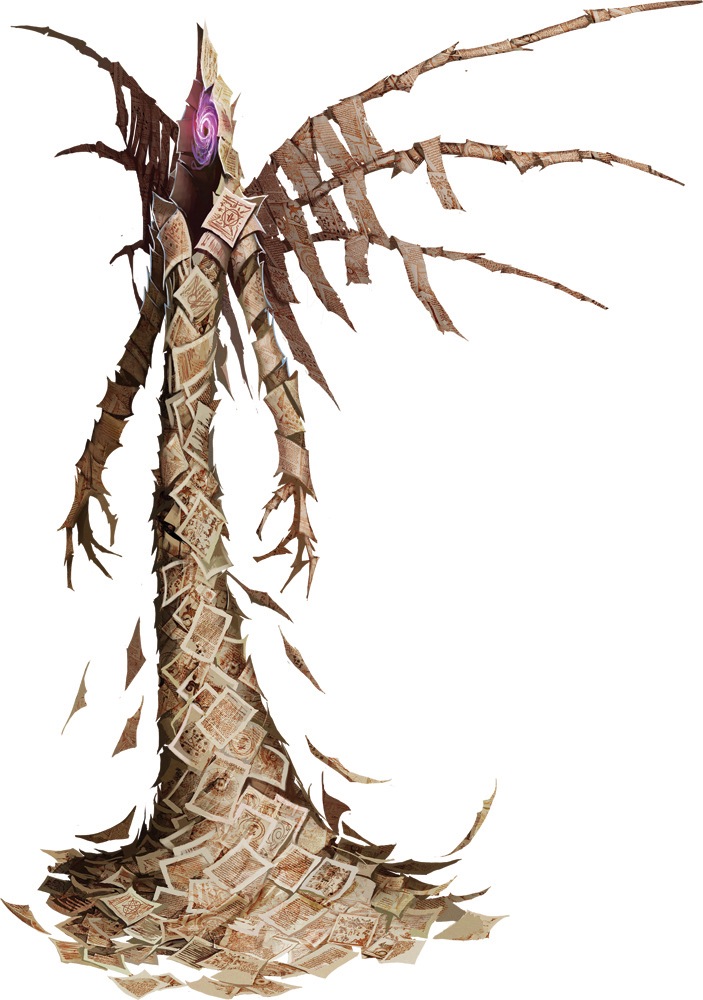
... Illustrations by Eric Belisle and Wayne Reynolds. Widescreen version here. Monsters Are Coming! Thursday, December 1, 2011The time draws nigh for Bestiary 3, so while you sharpen your blade and prepare your spells in advance of the monstrous onslaught, here's a little something to keep your mind on your task. ... Christopher Carey ... Editor ...

Illustrations by Eric Belisle and Wayne Reynolds. Widescreen version here.
Monsters Are Coming!
Thursday, December 1, 2011
The time draws nigh for Bestiary 3, so while you sharpen your blade and prepare your spells in advance of the monstrous onslaught, here's a little something to keep your mind on your task.
... Misfit Love Tuesday, November 29, 2011 Shhhhh... Don’t tell anyone, but here at Paizo we love our classic and misfit monsters. There is a tendency to look back at some of the oddball monsters that popped up in the sources of our youth and lament on how strange or even dumb they are. We take a different tact. Instead we revel in their strange and iconic natures. Any chance we get, we look for reason why even the most inexplicable monsters might exist in a fantasy world. ... If you’re a fan...
Misfit Love
Tuesday, November 29, 2011
Shhhhh... Don’t tell anyone, but here at Paizo we love our classic and misfit monsters. There is a tendency to look back at some of the oddball monsters that popped up in the sources of our youth and lament on how strange or even dumb they are. We take a different tact. Instead we revel in their strange and iconic natures. Any chance we get, we look for reason why even the most inexplicable monsters might exist in a fantasy world.
If you’re a fan of our Misfit Monsters Redeemed, you will like how many of those monsters show up in Bestiary 3. From the strangely philosophical flail snail, to those inexplicable fan favorites, the flumphs, to the downright creepy wolf-in-sheep’s-clothing, let’s just say this book is full of some strange old friends. But wait, there’s more!
Misfit Monsters Redeemed is not the only source of inspiration for the classic and misfit monsters that made the cut for Bestiary 3. Many Bonus Bestiary monsters found their way into Bestiary 3—from the axe beak, to the caryatid column, to the unholy huecuva—old favorites abound in this tome.
Now for those of you who buy nearly all of Paizo’s products, and are maybe becoming worried that you’ve seen many of the classic monsters that are appearing in Bestiary 3, don’t worry. While most of the monsters see updates, new information, and maybe some streamlining of mechanics, there are also some old favorites that show up for the first time in a Paizo product. Some of those highlights include the penanggalen, the vodyanoi, and one of my favorite old monsters, the kamadan, which is previewed below, along with its two variants: the dusk and polar kamadan.
Illustration by Eric Belisle
Kamadan CR 4
XP 1,200
NE Large magical beast Init +2; Senses darkvision 60 ft., low-light vision, scent; Perception +8
Defense
AC 17, touch 12, flat-footed 14 (+2 Dex, +1 dodge, +5 natural, –1 size) hp 42 (5d10+15) Fort +7, Ref +6, Will +2
Offense
Speed 40 ft. Melee bite +7 (1d6+3), 2 claws +7 (1d3+3), snakes +2 (1d4+1) Space 10 ft.; Reach 5 ft. (10 ft. with snakes) Special Attacks breath weapon (30-ft. cone, sleep, Fortitude DC 15 negates, usable every 1d4 rounds), pounce
Statistics
Str 17, Dex 15, Con 16, Int 5, Wis 12, Cha 9 Base Atk +5; CMB +9; CMD 22 (26 vs. trip) Feats Combat Reflexes, Dodge, Mobility Skills Acrobatics +6 (+10 when jumping), Perception +8, Stealth +6; Racial Modifiers +4 Stealth Languages Aklo
Ecology
Environment temperate or warm plains Organization solitary, pair, or pack (3–9) Treasure standard
Special Abilities
Breath Weapon (Su) A kamadan can exhale a cone of gas that makes living creatures fall asleep for 5 minutes (Fortitude DC 15 negates). Slapping or wounding awakens a creature put to sleep by this attack, but normal noise does not. This is a sleep effect. The save DC is Constitution-based. Snakes (Ex) A kamadan’s snakes attack simultaneously; this is always a secondary attack.
Dusk Kamadan (CR +1): A dusk kamadan has midnight black fur and snakes bearing black and red ring patterns on their bodies. A dusk kamadan has the advanced creature template, and its snakes have a poisonous bite: Snakes—injury; save Fort DC 17; frequency 1/round for 6 rounds; effect 1d2 Con; cure 2 consecutive saves.
Polar Kamadan (CR +2): A polar kamadan has white fur with black spots like a snow leopard. Its snakes are furred as well. A polar kamadan has the advanced creature template and batlike wings that grant it a fly speed of 60 ft. (average). The breath weapon of a polar kamadan is particularly cold—those who succumb to it also suffer 1d4 points of Dexterity damage from numbness.
Well, that’s it for this week. Come back next week when we unleash more monsters that will make their appearance in Bestiary 3!
... Death's Heretic Sample Chapter Wednesday, November 23, 2011by James L. Sutter ... In Death's Heretic, Salim Ghadafar is a problem-solver for a church he hates, bound by the death goddess to hunt down those who would rob her of her due. Presented below is the first chapter of the new Pathfinder Tales novel by Paizo Fiction Editor James L. Sutter! ... Death always smelled the same. ... After all this time, it wasn’t the stink that got to him—the reek of excrement, of putrefying flesh...
Death's Heretic Sample Chapter
Wednesday, November 23, 2011
by James L. Sutter
InDeath's Heretic, Salim Ghadafar is a problem-solver for a church he hates, bound by the death goddess to hunt down those who would rob her of her due. Presented below is the first chapter of the new Pathfinder Tales novel by Paizo Fiction Editor James L. Sutter!
Death always smelled the same.
After all this time, it wasn’t the stink that got to him—the reek of excrement, of putrefying flesh and organs never meant to see daylight. That was expected, easily imaginable by even the greenest killer. No, what stuck with Salim was the insufferable sweetness of it, the fact that behind the stomach-churning stench was the saccharine ghost of fermentation, cloying and coating the insides of his nostrils. It was impossible not to respond to it. Somewhere in the back of his brain, the part that was little more than animal, he knew that smell meant a kill, and that a kill meant success. That part of him wanted to crow, to roll in the filth until it covered him like a badge. On its own, the stink was tolerable. Combined with that sweetness, it made him want to vomit.
The undead had that smell, too. With some it was musty and old, others mixed with the heavy scent of wet earth, and still others—those that walked among the living without notice—so faint that the lightest perfume could cover it. Yet it was always there.
The ghouls had it in abundance, their dry, stretched flesh never quite sure if it wanted to heal or slough off completely. Without looking down, Salim stepped carefully over the nearest corpse and pressed up against the wall, studying the doorway.
He’d killed most of the pack, though not before they’d glutted themselves on the parishioners. It hadn’t been difficult. These weren’t civilized horrors like the monstrous citizens of Nemret Noktoria, but rather the newly risen dead, as naive in their own way as the rural farmers they fed upon. They were strong, and hungry, but knew nothing else. They’d never been hunted. Fear was something they inspired in others, and by the time Salim taught them otherwise, it was too late.
Still, it was the easy prey that surprised you, and there was no point in taking chances. There were still three of them beyond the door, waiting like cornered rats to rend and tear. It would only take one scratch from a poisoned finger-turned-claw to stiffen his limbs and leave him paralyzed, helpless while they fed—or, worse yet, let the infection in their bite spread through his veins like wildfire, burning out his flesh until he became one of them. No, this was no time to get cocky. Taking the ghouls might be easy, but there was no room for error. The execution had to be flawless.
The glow of his torch was barely enough to light the antechamber in which he stood, its flickers seemingly swallowed up by the black void beyond the archway. Fixing that was the first order of business. If they went for his light—and they certainly would—the burns they’d get trying to take it would be nothing compared to the disadvantage his human eyes would be in the tomb’s darkness.
Salim glanced around the crypt, silent save for the crackling of burning pitch. It was humble, little more than a brick-walled pit with steps leading up to the church, but it was this village’s holy of holies. Each of a dozen narrow wall niches held a cloth-wrapped form, most still thick with dust—the ghouls hadn’t bothered feeding on these mummified husks when the church graveyard bore riper, more putrescent fruit. Hands folded, covered with the withered threads of what were once flowers, the honored dead might have continued their dreamless sleep undisturbed, were it not for the two ghoul corpses that fouled the gray stone floor.
They were exactly what he needed. Without a second thought, Salim moved to the nearest niche and took hold of the corpse’s homespun burial shroud. A single pull sent its contents spinning to the floor, leaving Salim holding several yards of cloth, which he promptly put to the torch.
Flame caught the simple embroidery and raced up its edges. As he let the flickering tongues writhe over the sheet, Salim glanced down at its former occupant. A young man, and not recently dead by the look of him—tendons showed through withered flesh, but they still held the sack of bones in the rough shape of a man. The body’s relative cohesion gave Salim an idea, and he set down the torch, wrapped the now merrily blazing cloth around the blade of his sword, then leaned down to scoop up the corpse with his other arm. With the grisly parcel clutched to his chest like a lover, he moved along the wall toward the doorway.
No time like the present. With a flick of his sword, Salim sent the burning shroud sailing into the room, the fabric flapping open to light the sepulcher. Something hissed in the darkness, and he followed the light with his other prize, swinging the corpse around the corner and into the room at shoulder height.
The ruse worked. Thinking Salim had charged in after the blazing blanket, two of the ghouls pounced, dropping from the walls and ceiling to rend the corpse’s brittle flesh. In the second it took them to realize their mistake, the real Salim was among them, sword flashing.
The ghouls’ leathery hide was stronger than human skin, but it still parted easily under the edge of his blade. Salim’s initial thrust caught the first one in the center of its back and slid in smoothly, the flat of the blade kept parallel to the ground to avoid getting stuck between the creature’s ribs. His recovery gave the second ghoul time to face him, but not enough to get its glistening claws up. Salim’s swing didn’t take its head clean off—his sword was light, and that sort of thing was more for storybooks and campfire tales than real battles—but it did the job, sending the creature slumping backward, head lolling to one side on a thin strand of flesh. Salim ignored it, withdrawing to a defensive posture with his back to the wall next to the archway, waiting for the third ghoul’s attack.
It didn’t come. Heartbeat after heartbeat went by as Salim’s eyes darted back and forth, but the expected attack failed to manifest. The room was silent, save for his own heavy breathing. Then the blood pounding in his ears calmed, and he heard a new sound—a low, dry whimpering. Sword at the ready, he stepped forward and kicked the crackling shroud farther into the room.
The third ghoul was curled up in the back of the burial chamber, hunched over into a fetal position in order to pull itself as far as it could into an empty wall niche. It clutched its knees and moaned again as Salim advanced.
“Please,” it whined. Coming from the twisted form, the voice was shockingly human. It strained to shape the words with its grotesquely overlong tongue. “Please don’t kill. I’ll go. No more hunting. No more brothers. Just graves. Please.”
In its fear, the ghoul came closest to resembling the man it had once been. Had the creature’s previous incarnation made a similar plea, as farmer to ghoul? Salim said nothing, but the ghoul nodded anyway. Chin to knee, it curled tighter and closed its eyes.
“Hungry,” it whispered. From behind bruised-black eyelids, a tear welled and slid down the creature’s face. “So hungry.”
This time Salim did respond.
“I understand,” he said.
Then, with both hands, he lifted his sword and brought it down.
In the aftermath, Salim recovered his torch and let the light of it and the blackened, sputtering shroud show him the room in all its meager glory. It was as humble as the outer chamber, but it was clear that the room had been both crypt and funereal preparation chamber. A long stone slab that was almost an altar sat to one end, surrounded by the mundane implements of embalming, while the walls held more spaces for bodies, unlit lanterns, and fine tapestries showing the glory of various gods, from stag-headed Erastil to the Lady of Graves herself. Clearly, these villagers worshiped an array of divine beings, pooling their resources into a single church.
And hedging their bets, Salim thought.
Setting his torch down on the altar, Salim moved over to the baptismal font in the corner and looked down into its shallow basin. The holy water was still clear and unsullied—either the ghouls hadn’t had time to soil it properly, or one of them had accidentally been splashed and the rest had learned to keep their distance. Salim’s eyes, hooded and tired, stared back at him from the water’s reflection. The rest of his face—dark hair, dark skin, and thin, dark beard—all blended together into the chamber’s gloom. The splashes of black ghoul blood didn’t help, either. Balancing his sword along the stone where the font emerged from the wall, he leaned over and splashed his face, then began scrubbing his hands vigorously, setting clouds of black filth blooming like ink through the water.
And not just black, he realized. There was red in the water as well. He glanced quickly down at his robes. Had one of the ghouls managed a lucky scratch without him realizing it? If so, he needed to move quickly to avoid sharing their fate.
But no—he was unharmed. Looking down at the basin, he realized that the blood was welling up from beneath his fingernails, his hands slowly weeping red into the baptismal font. The realization was followed immediately by a telltale tickle on his upper lip.
Oh. Of course. Salim dipped his hands back into the icy water. From behind him came the soft flutter of wings, as of a flock of doves suddenly startled into flight.
“Hello, Salim.”
"Ceyanan has an interesting way of announcing itself."
“Ceyanan.” Salim waited a moment, hands gripping the font’s stone lip, then collected himself and turned.
The angel was floating in the chamber’s center, its toes pointed like a dancer two feet above the floor. The robes that flowed around it in an undetectable breeze were gray against worm-pale skin, and combined with the black hair they made the figure look like a charcoal sketch. Its features were too perfect to be truly beautiful, like a marble statue, and androgynous enough that not even the sheer fabric revealed a gender.
More arresting than all of these were the black-feathered wings that sprang from its back. Even half-folded, they were clearly not normal appendages. More shadow than form, they gave the impression that if they spread, they would not so much unfurl as bloom, the way the ghoul’s filth had expanded in the water of the font. Yet the angel’s floating seemed to have little to do with them, and they remained still, the individual feathers flickering in and out of visibility. It looked around the room.
“I love what you’ve done with the place,” Ceyanan said.
Salim ignored the apparition and instead located a clean patch of sleeve, which he used to wipe his nose, succeeding only in smearing the blood around.
“Is this really necessary?” he asked, gesturing at bloody lips. “Every time?”
The angel laughed, as innocent as a child, and spread its hands.
“Consider it a gift, Salim. What better way to know that you’re still alive?”
Salim let that one pass, but the angel wasn’t finished.
“Besides,” it said, motioning toward the floor, “was that necessary?”
Salim looked down. He was almost standing on the corpse that had acted as his decoy. The young man’s arms and legs, once locked tight in the stately constriction of the dead, were now sacks of shattered bone, flesh tattered by ghoul claws and the rough landing. Salim shrugged.
“He didn’t object,” he said, but he was still careful not to kick the corpse as he stepped over to one of the ornate tapestries and began systematically cleaning his sword. Ghoul blood had already dried along its length, crusting both the shining blade and the twisted, melted-looking hilt with filth.
“They rarely do,” the angel acknowledged. “But that’s neither here nor there. You know that I come bearing tidings.”
“And here I thought this was a purely social visit.” Salim sheathed the blade. “But please, Ceyanan, don’t keep me in suspense—pray tell me what the bitch-goddess wants from me now.” He turned to lock eyes with the angel. “Is there a vampiric orgy in Caliphas that I’m to break up? A mummy that needs unwrapping? Or did someone forget to dig a grave deep enough, and a coyote ran away with some bones?”
The angel frowned.
“You should learn to show proper respect,” it said.
“And you should know by now that I only give it where it’s due.” The mocking politesse was gone now, replaced by a cool, smooth anger. “If your lady wants to win my love, she’s got a long road ahead of her.”
The angel waved its hand as if shooing a fly, refusing to be baited. It was an old game.
“Have it your way,” it said. “You have the opportunity to work great justice in this world, but you’re welcome to see it as an order if it pleases you.”
Salim waited.
Ceyanan sighed. “No undead this time. Rather the opposite, actually—something uniquely suited to your skills. A kidnapping.”
“Kidnapping?” Despite his resentment, Salim couldn’t quite keep the curiosity out of his voice. “That’s hardly my usual fare. Or yours, for that matter. How do I factor in?”
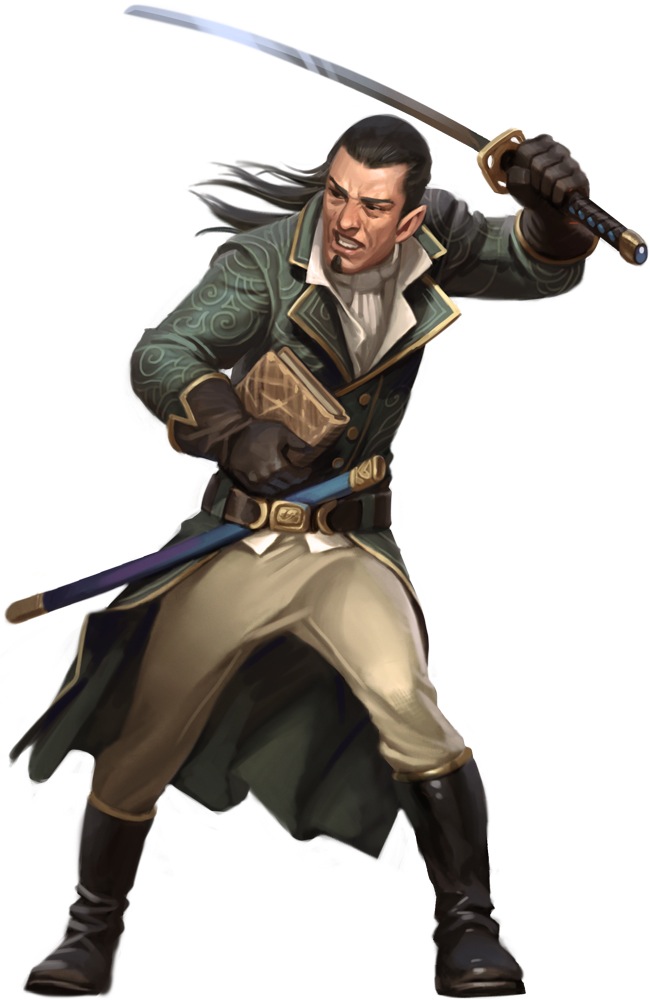
“In this case, the victim is already dead.”
The angel paused a moment to see if Salim would say anything. He didn’t.
“The merchant in question,” Ceyanan continued, “was the target of a routine assassination—nothing special there. But after his death, his soul was stolen from the Boneyard before it could pass on to its final reward. Not destroyed—stolen. The local clerics have been unable to raise the body, and now the kidnappers are offering to sell back the man’s spirit. Naturally, the church is more than a little upset. We’ve already got the local clergy working on the problem, but we’d like you to step in and handle things. You might consider it a nice change of pace.” The angel’s hand swung to encompass the crypt and the already decaying ghouls.
“Makes sense,” Salim said. “Letting a soul go missing hardly reflects well on the church. But why me? And why don’t they just pay the ransom and be done?”
“The situation is in Thuvia.”
Thuvia. The name hit Salim like a blow. That was too close. Far too close. But if the kidnapping were in Thuvia—
“The sun orchid elixir,” he said.
“Precisely.” The angel looked pleased.
“Stealing a soul and selling it back for a shot at immortality. No wonder the Gray Lady’s pissed.”
“Now you understand,” Ceyanan said. “You’ll depart immediately.”
Salim gritted his teeth. “You know I don’t like being that close.”
“As you so eloquently pointed out, winning your affection is not my first priority. Your familiarity with the region and its customs will make you that much more efficient. And you might even enjoy your time there.”
“Not that I have a choice.”
The angel smiled down at him again.
“You did, once.”
Salim opened his mouth to respond, but the angel had already grown transparent, its voice a whisper that receded into the distance.
Coming Next Week: A brand new, standalone adventure featuring Salim, Ceyanan, and even stranger characters!
James L. Sutter is the Fiction Editor for Paizo Publishing, author of the novel Death's Heretic, and co-creator of the Pathfinder Roleplaying Game campaign setting. His short stories have appeared in such publications as Escape Pod, Starship Sofa, Apex Magazine, and the #1 Amazon bestseller Machine of Death, and his anthology Before They Were Giants pairs the first published stories of SF luminaries with new interviews and writing advice from the authors themselves. In addition, James has written numerous Pathfinder supplements and City of Strangers and Distant Worlds. For more information, check out jameslsutter.com or follow him on Twitter at @jameslsutter.
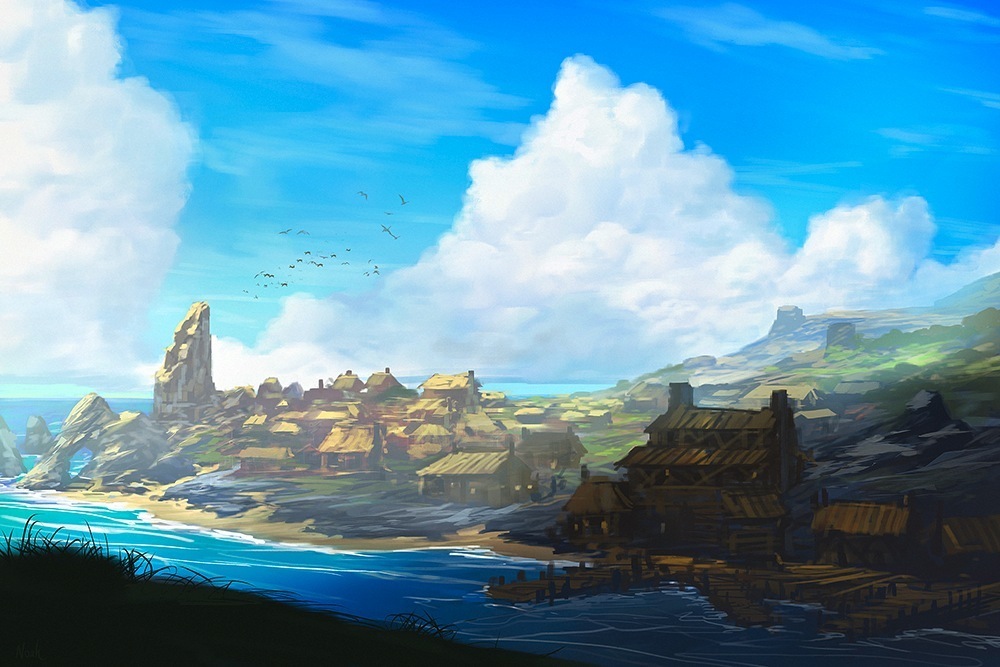
... Seven Veils Celebration Monday, November 21, 2011The Jestercap blog and boon seemed well received last month so I decided to try out another holiday this month. ... Seven Veils is mentioned on page 249 of Pathfinder Campaign Setting: The Inner Sea World Guide. We are advised it is a celebration of brotherhood between all civilized races, marked by interracial masquerade balls. I thought this seemed like a neat holiday and decided it should be expanded upon. ... Once again, creative...
Seven Veils Celebration
Monday, November 21, 2011
The Jestercap blog and boon seemed well received last month so I decided to try out another holiday this month.
Seven Veils is mentioned on page 249 of Pathfinder Campaign Setting: The Inner Sea World Guide. We are advised it is a celebration of brotherhood between all civilized races, marked by interracial masquerade balls. I thought this seemed like a neat holiday and decided it should be expanded upon.
Once again, creative Director James Jacobs wrote the description the holiday, and you will find a special Pathfinder Society Chronicle sheet you can download and apply to a Pathfinder Society character.
Illustration by Eric Belisle
Diversity is a fact of life in the Inner Sea region—not only do numerous human ethnicities mix and live among each other throughout the area, but races entirely separate from humanity dwell there as well. It’s not uncommon to see elves brushing shoulders with humans in marketplaces, gnomes working as merchants in dwarven settlements, or tengus serving aboard ships mostly helmed by humans. Indeed, two of the more widespread races in the Inner Sea region—the half-orc and the half-elf—are the specific results of diverse unions.
The holiday known as Seven Veils, which takes place on the 23rd of Neth in most realms found in the Inner Sea region, is a celebration of this diversity—a time when social boundaries break down even further in a day-long event filled with dancing, feasting, and courting. The evening traditionally closes out with the Seven Veil masquerade, a ball wherein the participants wear disguises that either hide their actual race and/or gender (often using minor magical trinkets and spells) or specifically disguise these features as entirely new characteristics. At the end of the ball, the participants remove their disguises to their partners, often with unpredictable and sometimes delightfully awkward results. Traditionalists and conservative minds often find the Seven Veils masquerades to be scandalous or off-putting, yet they remain particularly popular in most of the larger cities of the land.
Historians note that the original "Dance of the Seven Veils" has a much different genesis than one promoting diversity—the mysterious cult of Sivanah, goddess of illusions, mystery, and reflections, is generally cited as the source of this festival, and indeed, worshipers of the goddess (herself known as the Seventh Veil) count the 23rd of Neth as one of their most sacred of days. What rituals the church of Sivanah performs on this date, however, are unknown to outsiders, for the cult enjoys its secrets. This secrecy has, unsurprisingly, given rise to all manner of sinister rumor, yet when Seven Veils rolls around each year, its eager participants are quick to set aside rumor in preference for the night’s fun and games.
I am interested in reading your thoughts, not only on Jestercap and Seven Veils, but also on future holiday write-ups and boons. This is especially true in regard to the various equinoxes and solstices.
Download the Seven Veils Boon! - (111 KB zip/PDF)This Boon is no longer available as of 12/12/11.
P.S. Don't forget to check out the Pathfinder Tales author chats on tonight, November 21, hosted by Master of Ceremonies Dave Gross!
Mike Brock Pathfinder Society Campaign Coordinator
... Two New Kami Thursday, November 10, 2011 We’re coming up on the release of Bestiary 3 in the near future, and as readers of the Jade Regent Adventure Path have noticed, we’re already using monsters from that book in the adventures! This is more or less a necessity, since when you travel to the far side of the world, you expect to see brand-new creatures and monsters, after all. We’ve been filling the Jade Regent bestiaries with all sorts of monsters inspired from Asian mythology and...
Two New Kami
Thursday, November 10, 2011
We’re coming up on the release of Bestiary 3 in the near future, and as readers of the Jade Regent Adventure Path have noticed, we’re already using monsters from that book in the adventures! This is more or less a necessity, since when you travel to the far side of the world, you expect to see brand-new creatures and monsters, after all. We’ve been filling the Jade Regent bestiaries with all sorts of monsters inspired from Asian mythology and folklore, but we need more—and that’s where Bestiary 3 comes in.
One of the new types of monsters introduced in Bestiary 3 and the Jade Regent Adventure Path are the kami—usually (but not always) benevolent native outsiders who exist to protect that which cannot really protect itself from the advance of humanity and civilization. Pathfinder #52 and Bestiary 3 present several kami, ranging from CR 2 all the way up to CR 20.
Presented below are two of the kami who have roles to play in “Forest of Spirits.” We’re simply presenting their statistics here—what roles they play in the adventure must remain a secret until you play it or run it for your group!
Kami Subtype: Kami are a race of native outsiders who serve to protect what they refer to as “wards”—animals, plants, objects, and even locations—from being harmed or dishonored. All kami are outsiders with the native subtype. A kami possesses the following traits unless otherwise noted in a creature’s entry.
Immune to bleed, mind-affecting effects, petrification, and polymorph effects.
Resist acid 10, electricity 10, fire 10
Although they are native outsiders, kami do not eat, drink, or breathe.
Telepathy.
Fast Healing (Ex) As long as a kami is within 120 feet of its ward, it gains fast healing. The amount of fast healing it gains depends on the type of kami.
Merge with Ward (Su) As a standard action, a kami can merge its body and mind with its ward. When merged, the kami can observe the surrounding region with its senses as if it were using its own body, as well as via any senses its ward might have. It has no control over its ward, nor can it communicate or otherwise take any action other than to emerge from its ward as a standard action. A kami must be adjacent to its ward to merge with or emerge from it. If its ward is a creature, plant, or object, the kami can emerge mounted on the creature provided the kami’s body is at least one size category smaller than the creature. If its ward is a location, the kami may emerge at any point within that location.
Ward (Su) A kami has a specific ward—a creature with an Intelligence score of 2 or lower (usually an animal or vermin), a plant (not a plant creature), an object, or a location. The type of ward is listed in parentheses in the kami’s stat block. Several of a kami’s abilities function only when it is either merged with its ward or within 120 feet of it. If a kami’s ward is portable and travels with the kami to another plane, the kami does not gain the extraplanar subtype on that other plane as long as its ward remains within 120 feet. If a ward is destroyed while a kami is merged with it, the kami dies (no save). If a ward is destroyed while a kami is not merged with it, the kami loses its merge with ward ability and its fast healing, and becomes permanently sickened.
AC 15, touch 13, flat-footed 14 (+1 Dex, +2 natural, +2 size) hp 19 (3d10+3); fast healing 2 Fort +4, Ref +2, Will +8 DR 5/cold iron; Immune bleed, mind-affecting effects, petrification, polymorph; Resist acid 10, electricity 10, fire 10
Offense
Speed 30 ft. Melee improvised weapon +4 (1d4+2/x3) Ranged improvised weapon +6 (1d3+2/x3) Space 2-1/2 ft.; Reach 0 ft. Spell-Like Abilities (CL 6th; concentration +8)
At will—invisibility (self only), statue (self only)
3/day—hide from animals, purify food and drink
1/week—commune with nature (CL 12th)
Statistics
Str 8, Dex 13, Con 12, Int 11, Wis 17, Cha 14 Base Atk +3; CMB +2; CMD 11 Feats Alertness, Catch Off-GuardB, Iron Will, Throw AnythingB Skills Heal +9, Knowledge (nature) +6, Perception +11, Sense Motive +11, Stealth +15, Survival +9 Languages Common SQ improvised weapon mastery, merge with ward, ward (minor works of civilization)
Ecology
Environment any Organization solitary, pair, or gang (3–8) Treasure standard
Special Abilities
Improvised Weapon Mastery (Ex) A shikigami gains Catch Off-Guard and Throw Anything as bonus feats, and adds its Charisma modifier instead of its Strength modifier to damage done with any improvised weapon, as attacks it makes with such weapons seem supernaturally lucky in landing damaging blows. Although a shikigami is Tiny, it never provokes attacks of opportunity when it attacks an adjacent foe with a melee weapon. If a shikigami critically hits an opponent with an improvised weapon, it deals x3 damage.
Illustration by Mariusz Gandzel
Zuishin CR 10
XP 9,600
LG Medium outsider (kami, native) Init +9; Senses darkvision 60 ft., detect evil, see invisibility; Perception +20
Defense
AC 23, touch 13, flat-footed 20 (+6 armor, +3 Dex, +4 natural) hp 123 (13d10+52); fast healing 5 Fort +8, Ref +13, Will +14 DR 10/cold iron; Immune bleed, mind-affecting effects, petrification, polymorph; Resist acid 10, electricity 10, fire 10; SR 21
Offense
Speed fly 30 ft. (perfect, 40 ft. without armor) Melee +1 holy halberd +18/+13/+8 (1d10+7/x3) Ranged +1 holy composite longbow +20/+15/+10 (1d8+5/x3) Special Attacks healing arrow, holy weapons Spell-Like Abilities (CL 13th; concentration +18)
Constant—detect evil, see invisibility
At will—cure light wounds, dimension door
3/day—alarm, breath of life, dispel magic, neutralize poison, remove curse, remove disease, restoration
1/day—dispel evil (DC 20), heal, true seeing
Statistics
Str 18, Dex 21, Con 18, Int 11, Wis 18, Cha 21 Base Atk +13; CMB +17; CMD 34 (can’t be tripped) Feats Improved Initiative, Improved Precise Shot, Iron Will, Point-Blank Shot, Precise Shot, Rapid Shot, Weapon Focus (longbow) Skills Fly +10, Heal +20, Intimidate +18, Knowledge (nature) +16, Perception +20, Sense Motive +20, Stealth +18 Languages Common; telepathy 100 ft. SQ merge with ward, ward (gate, doorway, or shrine)
Ecology
Environment any Organization solitary, pair, or warband (3–8) Treasure double (+1 composite longbow [+4 Str], +1 halberd, masterwork breastplate, other treasure)
Special Abilities
Healing Arrow (Su) As a swift action, a zuishin can infuse an arrow it fires to carry any of the following effects: breath of life, cure light wounds, heal, neutralize poison, remove curse, remove disease, or restoration. Using one of these effects consumes a use of the same spell-like ability. The zuishin must make a touch attack to deliver the effect to the target—the target takes no damage from the arrow. Holy Weapons (Su) Any weapon wielded by a zuishin is treated as if it had the holy special ability. A zuishin creates arrows out of nothing as part of its attacks with any bow it wields.
Pathfinder Battles Preview: Heroes & Monsters Behind the Scenes
... Pathfinder Battles Preview: Heroes & Monsters Behind the Scenes Friday, September 23, 2011So far we’ve revealed the digital sculpts for 11 of the prepainted miniatures in our Pathfinder Battles: Heroes & Monsters base set, including the mighty Huge Black Dragon! Digital sculpts give us the chance to see what a miniature will look like in full color, and allow us a chance to make minor (or even major) adjustments to ensure that the miniatures accurately model the characters and creatures...
Pathfinder Battles Preview: Heroes & Monsters Behind the Scenes
Friday, September 23, 2011
So far we’ve revealed the digital sculpts for 11 of the prepainted miniatures in our Pathfinder Battles: Heroes & Monsters base set, including the mighty Huge Black Dragon! Digital sculpts give us the chance to see what a miniature will look like in full color, and allow us a chance to make minor (or even major) adjustments to ensure that the miniatures accurately model the characters and creatures that inhabit the Pathfinder world.
But digital is not the only way to sculpt a miniature, of course. Even though our partners at WizKids use the most modern methods to create their beautiful minis, sometimes the best way to make a miniature is to sculpt it by hand using precision tools and modeling putty. This is the same process by which most metal miniatures come into the world. Because the epoxy putty used by most sculptors is usually green, minis lingo refers to these preliminary miniature sculpts as “greens,” no matter what color they turn out to be.
Below you can see the green of the tallest miniature in the Heroes & Monsters set, the two-headed Ettin. The pose is an amalgamation of a black-and-white ettin image from a Pathfinder’s Journal fiction piece and the ettin entry in the Pathfinder RPG Bestiary. When WizKids provided this image to Paizo for approval, Senior Art Director Sarah Robinson and I thought it captured the creature perfectly, and gave the sculpt our stamp of approval almost immediately.
Once a sculpt has been approved, WizKids technicians use the green to form the basis of the mold from which the entire production run will come. At about the same time this is being done, painters must determine what the final paint job of the miniature will look like. In the case of digital sculpts, general paint guides come with the sculpt itself. In the case of traditional sculpts, however, the artists must interpret colors from the original art, and take their best shot at how they think the final colors should look.
Just this week, WizKids sent over the proposed paint deco specs for the Ettin, which looked like this:
Like the sculpt before it, the paint deco sample passed inspection with very few changes. We like the way this guy looks. That said, from experience with the Beginner Box Heroes set, WizKids improves the painting with each step, so the final miniature will likely look a little more “weathered” than this one, giving it a slightly more realistic look.
So the Ettin went very smoothly, transitioning from art to green to mold to paint deco with virtually no hitches. I’m happy to say that this has been the case for most of the miniatures in the Heroes & Monsters set, but a few have been somewhat more stubborn, requiring more substantial changes at each step in the process. A good example of this is the Human Ranger.
When we decided to put the Human Ranger in the set, we provided this great illustration by Eric Belisle to WizKids.
Their sculptor’s first crack at this miniature captured a lot of what we thought was important about the character’s costume and general demeanor, but Sarah and I were concerned that the pose was too two-dimensional, and wasn’t as dynamic as Belisle’s original illustration. Our WizKids counterparts agreed, and came back with the following major improvement:
We really liked this approach, and approved the sculpt. Now here was a bowman we could see people really wanting to play, and the pose really tells a lot about the character. We were excited! But things got a lot more exciting earlier this week, when WizKids sent over the following paint deco for approval:
And that, as they say, was a bulls-eye.
From here the paint decos will be turned into “masks” that go over the unpainted miniatures, allowing paint application to go in all the right places. Add some hand-finishing to bring out the tiny details, and the Ettin and Human Ranger are on their way to production!
The Ironroot Deceptionby Robin D. Laws ... Chapter One: The Snare Gad feels the roughness of the burr-oak's bark as its branch constricts tighter around his ankles. Though he is upside down, blood rushing to his head, his face retains its symmetry. A roguish skiff of stubble softens his jutting jaw. Gray-peppered hair clings closely to his scalp. Blue eyes sear out at his elven captor. ... The tree that dangles him stands at the edge of the Shudderwood. Its roots snake through a weed-choked...
The Ironroot Deception
by Robin D. Laws
Chapter One: The Snare
Gad feels the roughness of the burr-oak's bark as its branch constricts tighter around his ankles. Though he is upside down, blood rushing to his head, his face retains its symmetry. A roguish skiff of stubble softens his jutting jaw. Gray-peppered hair clings closely to his scalp. Blue eyes sear out at his elven captor.
The tree that dangles him stands at the edge of the Shudderwood. Its roots snake through a weed-choked pathway. A gang of firs bullies around it, swaying and trembling to spite the windless air. The dry earth writhes with insect life; biting ants and fat white grubs pulse to the demon harmonics of the nearby Worldwound.
The elf woman steps around him, squinting. From every angle, she assesses the tautness of his muscles and the straightness of his bones. The tree reverently moves its suspended prize, allowing her to circuit him easily. Her hair is an autumn tangle, recalling the sprigs and leaves of a grapevine after harvest has come and gone. The face is an arrangement of hardened planes: beautiful in theory, unyielding in practice. Her war-garb is worn in, well kept. Slung across her back are a long sword and an ornate, spiraled wand. A curved dagger accentuates a narrow hip.
"There are few situations that Gad can't talk himself out of. This appears to be one of them."
Behind thin, drawn lips, she clucks her tongue. "Among your fellow humans, you are reckoned handsome."
Gad smiles. "I look my best right side up."
She does not return the smile. "You will serve," she says.
"Will I now?"
With a curt turn of the head, she gestures to her retinue, gathered near a camouflaged ambush-screen on the treeline's edge. There are six of them: all elves, all strikingly equipped, all poised with martial confidence.
Gad's weapons—short sword, main dagger, hidden back dagger, visible right boot knife, concealed left boot knife—have all been plucked from him and lie in a mocking pile near a clump of dying milkweed.
"And who might I be serving?"
"My name is none of your affair."
"Maybe I like serving."
Elven features freeze. "Do libidinous undertones aid you with your fellows?"
Gad finds it hard to shrug. "A gentleman never tells."
"You do yourself no favors by provoking my disgust."
Again the urge to shrug. Gad resists. "You wouldn't be press-ganging me, would you?"
"Humans have forgotten their purpose on this world."
"Have we now?"
"You were born to brute labor. And you shall perform it."
"I don't work cheap."
She signals her men. The tallest, most sinewy specimen, glossy black hair trailing behind him as he strides, leads the pack. Wrist shackles clatter in his compact fist. He lowers his head as he approaches. "Lady Dualal."
"Good Ethundel," she says, "prepare the labor for transport."
Nothing about Ethundel looks good to Gad.
Dualal turns to the tree trunk and utters a command in archaic Elven. Its encircling branch loosens, releasing Gad's ankles. Two members of the retinue stand below. They catch him, saving him from a neck-breaking. Holding him tight, they wrestle him to his feet. Ethundel claps the shackles on him.
"I renew my objections to this wrongful treatment," Gad says.
Ethundel smacks the back of the head.
A faraway expression settles on Dualal. "If it is matters of justice that concern you, wanderer, your indenture furthers the most righteous of causes."
A white-blond elf grabs Gad by the right arm; an amber-blond elf by the left. They march him onto a deer trail leading into the woods.
"Care to specify?" Gad asks.
"Reclamation," Ethundel booms.
Gad ignores him, continuing to address the woman. "Oh, so you're one of those elves."
"Impertinence will be harshly dealt with." Dualal glides forward, to the middle of the marching order.
In the wood ahead, branches grow twisted and tangled. Keening cicadas assault the ears.
"Haven't you Reclaimers been plotting this for nine thousand years?" Gad braces for another hit but neither of his escorts seems interested in breaking stride. Ethundel, who struck him before, has moved up to take point. With no one to clout him, Gad continues: "Ridding Golarion of humankind—and dwarves and orcs and the rest—and taking it back? That's the dream, isn't it?"
"You are surprisingly versed in my race's lore," says Dualal.
"Isn't that a misleading way to put it?"
"What nonsense do you spout?"
"Don't most elves regard the idea of reclamation as lunacy?"
She whirls to face him. His escorts freeze, shying back from her. Gad stays cool.
Dualal sees this. She calms herself. A false, chill smile comes reluctantly to her lips. When she speaks, it is more to her men than to Gad. "It has never been the time to reassert our ownership of this profaned and polluted world."
"Until now?"
She gives him her back, resuming her regal mien.
"Have you considered, Dualal," he says, "that it's quite the coincidence?"
"What is?"
"That after all the other Reclaimers have failed and been proven wrong, century after century, that the great turning happens to dawn during your particular lifetime?"
"But it will!" blurts his amber-haired captor. "The gem!"
The elf's pallid skin turns whiter still, as he realizes he's stuck his foot in it. He flinches.
"Put a gag in that idiot's mouth," Dualal commands.
Gad protests and resists as blond elf and amber elf stuff a mildewy rag between his teeth. Inside, he is smiling. When an adversary thinks him an idiot, half of his work is already done.
∗ ∗ ∗
The Reclaimers drag him deeper into the forest. Gad is easier in a city than a wilderness, and this one is worse than most. Clouds of bloodthirsty bugs roll in like morning fog. A caustic oil drips from the leaves of certain trees. Unearthly murmurs, mimicking the groans of the tortured souls, rise from rills and meadows. Life is too strong in the Shudderwood. So strong that it is also death, a rancid cycle of birth and devouring.
A day and a night pass. They camp briefly, giving Gad four hours of sleep at best. The elves, rotating watches, get less. They feed him dry acorn-flower biscuits and a handful of crab apples. His head swims. When he slows, they prod him with scabbarded swords.
The biting bugs are worse the second day. With wrists in irons, he can barely swat them. His skin becomes a landscape of reddened, scabby bumps. Paying little heed to the elves' legendary harmony with nature, the insects feast on them, too. They spare only Dualal and Ethundel, who must benefit from some salve or charm. If he weren't gagged, Gad might work the lackeys, making hay of the gap in privilege between leader and led. With his mouth tied shut it's all moot.
He thinks they've edged back to the border of the haunted woodlands again, but can no longer be sure. When they're stopped for a short break by the side of a glassy stream, the conversation of another party drifts by. With silent efficiency, the Reclaimers grab Gad, fading behind a low ridge of mossy stone. The musicality of the overheard words is unmistakably elven. Clearly, the Reclaimers expect the local sharp-ears to treat them as interlopers. Gad waits for a chance to make the move he's been planning, but the opening never comes. His captors wait until the voices recede, then continue on.
A few hours later they hunker down again. Blond and amber stay by his side; the rest slip off through the firs. Gad mimes a request to get the gag off. They refuse him. He listens in with his barely passable Elven as they ponder which regions of the world they'll claim when Dualal rules the world.
They're arguing over the island of Absalom when the rest of the group tramps into view, dragging a new prisoner. The fresh unfortunate is male, human, young, and scrawny. A wiggle of drying blood runs from his scalp into a matted sideburn.
Gad seizes the moment of distraction. He bolts up, clouting the amber elf's temple with the edge of his shackles. Dodging slippery rocks, he bursts into the forest depths. Elven curses ring through gnarled pines. Uneven terrain adds effort to his flight. Gad's heart hammers; he gasps for breath. He stops to ease the gag from his mouth.
From nowhere, Ethundel is upon him. A fist catches Gad in the throat.
"Thought these woods would protect you, against an elf?"
Gad whirls back. He crashes into a tree. Pain throbs through his shoulder and down his side. He tries a double-handed swipe. The black-haired elf leaps gracefully back. With Gad off balance, he barrels in and kicks Gad's feet out from under him. Gad goes down, falling onto a rotting log. Ethundel aims a series of savage kicks at his legs. Gad holds up his bound hands. Sadism spasms across the elf's face. He grabs Gad by the back of the skull and crushes his face into the log.
"I give!" Gad cries.
"Now you supplicate? After mocking and profaning our mistress?" Ethundel punches Gad in the neck and steps back to draw his sword. "I don't care how well you haul a rock. It is unfortunate that in my attempt to subdue you, I was forced to draw steel, and underestimated the strength of my blow." He raises the blade.
"Ethundel! Stay your sword!"
The black-maned elf is not the only one who can move through a woods at a preternatural pace. Dualal stands a dozen yards off. She looks down on the scene from a leaf-strewn slope.
"Milady," Ethundel stammers.
Fir needles crunch underfoot as she draws nearer. "Your ardor is understandable. Humans are insufferable. This one more than most. They are also, in these woods, a scarce commodity. He who kills his thrall destroys his own property."
Ethundel visibly swallows. "Yes milady."
"We have two now. These will replace those we exhausted. Let us go now to the Ironroot, and resume the dig. When he has served his purpose, he is yours, to treat as whim decrees."
Ethundel dips his head and sheathes his sword.
At Gad's side now, she reaches down to grab the gag, still around his neck, and pull it up into his mouth. "And you. Do not count on a second reprieve."
Ethundel hauls him back to the others. The amber-haired elf greets him with a sullen stare. Before long, they are back on the trail. The new prisoner hasn't been gagged, but is too frightened to attempt a conversation.
Scrapes and contusions from Ethundel's beating gnaw at Gad as the elves push him on. He mimes his need for water. They let him linger for a while before slaking his thirst. They slog on past dusk.
The party is in a clearing when a thunder of breaking branches rises from a dense throng of pines. Tree trunks crack and topple. A throaty roar reverberates.
A creature leaps into the clearing, a wake of shattered wood fragments billowing behind it. Gad has never seen its like. It is a ball of quills and claws and fangs, ten feet high and as many wide. Its legs are pillars of muscle. As much as it seems like some unknown animal, it is also like a plant, festooned with vines and sprouting leaves.
It bounds, snarling and frothing, toward the elves and their prisoners.
Coming Next Week: Hard labor and quick thinking in Chapter Two of "The Ironroot Deception"!
Robin D. Laws is the author of the Pathfinder Tales novel The Worldwound Gambit—also starring Gad—and six other novels, as well as various short stories, web serials, and comic books, plus a long list of roleplaying game products. His novels include Pierced Heart, The Rough and the Smooth, and the Angelika Fleischer series for the Black Library. Robin created the classic RPG Feng Shui and such recent titles as Mutant City Blues, Skulduggery, and the newly redesigned HeroQuest 2. His previous fiction for the Pathfinder campaign setting includes “Plague of Light” in the Serpent’s Skull Adventure Path. Those interested in learning more about Robin are advised to check out his blog.
... Illustrations by Eric Belisle. Widescreen version here. ... Rivals! Friday, May 27th, 2011It's Friday, and even though Hyrum's out at BookExpo America this week, he and Crystal still managed to set us all up with another awesome wallpaper—this time featuring some of the excellent art in the new Pathfinder Campaign Setting: Rival Guide. Now wasn't that thoughtful? ... Enjoy the long weekend, and we'll see you all on Tuesday! ... James Sutter ... Fiction Editor ...
Illustrations by Eric Belisle. Widescreen version here.
Rivals!
Friday, May 27th, 2011
It's Friday, and even though Hyrum's out at BookExpo America this week, he and Crystal still managed to set us all up with another awesome wallpaper—this time featuring some of the excellent art in the new Pathfinder Campaign Setting: Rival Guide. Now wasn't that thoughtful?
Enjoy the long weekend, and we'll see you all on Tuesday!
... Magic Archetypes Tuesday, April 12, 2011For the next month or so, every Tuesday we are going to be digging into some of the new rules and options you will find in Ultimate Magic, which is due to release in May. This week, we'll take a look at some of the new archetypes that take up a full 32 pages of this 256 page tome. ... One of the first things you will notice about this book is that the new classes from the Advanced Player's Guide receive archetypes in this book (except the cavalier,...
Magic Archetypes
Tuesday, April 12, 2011
For the next month or so, every Tuesday we are going to be digging into some of the new rules and options you will find in Ultimate Magic, which is due to release in May. This week, we'll take a look at some of the new archetypes that take up a full 32 pages of this 256 page tome.
One of the first things you will notice about this book is that the new classes from the Advanced Player's Guide receive archetypes in this book (except the cavalier, who does not use magic). Here is an example of a new alchemist archetype, the vivisectionist.
Vivisectionist (Archetype)
A vivisectionist studies bodies to better understand their function. Unlike a chirurgeon, a vivisectionist's goals are not related to healing, but rather to experimentation and knowledge that most people would consider evil. A vivisectionist has the following class features. Sneak Attack: At 1st level, a vivisectionist gains the sneak attack ability as a rogue of the same level. If a character already has sneak attack from another class, the levels from the classes that grant sneak attack stack to determine the effective rogue level for the sneak attack's extra damage dice (so an alchemist 1/rogue 1 has a +1d6 sneak attack like a 2nd-level rogue, an alchemist 2/rogue 1 has a +2d6 sneak attack like a 3rd-level rogue, and so on). This ability replaces bomb. Torturer's Eye: At 2nd level, a vivisectionist adds deathwatch to his formula book as a 1st-level extract. Cruel Anatomist: At 3rd level, a vivisectionist may use his Knowledge (nature) skill bonus in place of his Heal skill bonus. Torturous Transformation: At 7th level, a vivisectionist adds anthropomorphic animal to his formula book as a 2nd-level extract. When he uses this extract, he injects it into an animal as part of a 2-hour surgical procedure. By using multiple doses of this extract as part of the surgery, he multiplies the duration by the number of extracts used.
At 9th level, a vivisectionist adds awaken and baleful polymorph to his formula book as 3rd-level extracts. When he uses the awaken and baleful polymorph extract, he injects it into the target (not a plant) as part of a 24-hour surgical procedure. He can make anthropomorphic animal permanent on a creature by spending 7,500 gp.
At 15th level, a vivisectionist adds regenerate to his formula book as a 5th-level extract. Bleeding Attack: A vivisectionist may select the bleeding attack rogue talent in place of a discovery. Crippling Strike: At 10th level or later, a vivisectionist may select the crippling strike rogue talent in place of a discovery. Discoveries: The following discoveries complement the vivisectionist archetype: alchemical simulacrum*, concentrate poison, doppelganger simulacrum*, feral mutagen, parasitic twin*, plague bomb*, poison bomb, preserve organs*, sticky bomb, tentacle*, tumor familiar*, vestigial arm*, and wings*.
Of course, the classes from the Core Rulebook receive a number of new archetypes as well. Take a look at the Undead Lord archetype for the cleric.
Illustration by Eric Belisle
Undead Lord (Archetype)
An undead lord is a cleric focused on using necromancy to control undead. Her flock is the walking dead and her choir the keening spirits of the damned. This unliving congregation is the manifestation of her unceasing love affair with death.
A cleric cannot take the undead lord archetype unless her deity's portfolio includes the Death domain or a similar domain that promotes undeath. An undead lord has the following class features. Death Magic: An undead lord must select the Death domain (and the Undead subdomain from the Advanced Player's Guide, if available in the campaign). She does not gain a second domain. In all other respects, this works like and replaces the standard cleric's domain ability.
Corpse Companion (Su): With a ritual requiring 8 hours, an undead lord can animate a single skeleton or zombie whose Hit Dice do not exceed her cleric level. This corpse companion automatically follows her commands and does not need to be controlled by her. She cannot have more than one corpse companion at a time. It does not count against the number of Hit Dice of undead controlled by other methods. She can use this ability to create a variant skeleton such as a bloody or burning skeleton, but its Hit Dice cannot exceed half her cleric level. She can dismiss her companion as a standard action, which destroys it. Bonus Feats: All undead lords gain Command Undead as a bonus feat. In addition, at 10th level, she may select one of the following as a bonus feat: Channel Smite, Extra Channel, Improved Channel, Quick Channel, Skeleton Summoner*, Undead Master*. Unlife Healer (Su): At 8th level, the undead lord's spells, spell-like abilities, and supernatural abilities used to heal undead heal an extra 50% damage. At 16th level, these effects automatically heal the maximum possible damage for the effect + the extra 50%. This does not stack with abilities or feats such as Empower Spell or Maximize Spell.
Well, that about wraps up this week. Next week, we will take a look at the magus. Before I go, here is one last bit to get you excited for this book. A complete list of all the archtypes found in Ultimate Magic (except for those sneaky magus archetypes, I'll save those for next week). Each one of these classes has other rules bits associated with them as well, but we will talk about those in a future blog. Enjoy.
Class Archetypes Alchemist: The chirurgeon, clone master, internal alchemist, mindchemist, preservationist, psychonaut, reanimator, and vivisectionist archetypes. Bard: The animal speaker, celebrity, demagogue, dirge bard, geisha, songhealer, and sound striker archetypes. Cleric: The cloistered cleric, separatist, theologian, and undead lord cleric archetypes. Druid: The dragon shaman, menhir savant, mooncaller, pack lord, reincarnated druid, saurian shaman, shark shaman, and storm druid archetypes. Inquisitor: The exorcist, heretic, infiltrator, preacher, and sin eater archetypes. Monk: The high-fantasy qinggong monk archetype. Oracle: The dual-cursed oracle, enlightened philosopher, planar oracle, possessed oracle, seer, and stargazer archetypes. Paladin: This section presents the oathbound paladin archetype. Ranger: The magic trap using trapper archetype. Sorcerer: The crossblooded and wildblooded archetypes. Summoner: The broodmaster, evolutionist, master summoner, and synthesist archetypes. Witch: The beast-bonded, gravewalker, hedge witch, and sea witch archetypes. Wizard: The metal elementalist and wood elementalist wizard schools and the scrollmaster wizard archetype.
Elyana Rides Again! Wednesday, March 2, 2011 ... Illustration by Eric Belisle ... It's time to begin another story on Paizo's free web fiction Wednesday, and this time we have something new and different for you! In celebration of the release of Plague of Shadows, the new Pathfinder Tales novel, we've brought you a brand-new prequel story from Plague of Shadows author Howard Andrew Jones, featuring a number of the same characters but taking place well before the novel. Once again (or rather,...
Elyana Rides Again!
Wednesday, March 2, 2011
Illustration by Eric Belisle
It's time to begin another story on Paizo's free web fiction Wednesday, and this time we have something new and different for you! In celebration of the release of Plague of Shadows, the new Pathfinder Tales novel, we've brought you a brand-new prequel story from Plague of Shadows author Howard Andrew Jones, featuring a number of the same characters but taking place well before the novel. Once again (or rather, once before) the Forlorn elf Elyana and her friends will encounter the evil of the Gray Gardeners in Galt—but this time there are the dark depths of the Verduran Forest to contend with as well. It's a pleasure to get to see characters from the novels in the web fiction, and we hope to do so each time a new novel releases—as well as sometimes just for fun.
As an author, Howard has knocked it out of the park. Early comments on Plague of Shadows have been extremely positive, and it's easy to see why. Perhaps it's the smooth speed with which he handles the fight scenes (and there are plenty), or the fast-paced sword and sorcery flavor (which is hardly surprising, given his status as Managing Editor of modern pulp magazine Black Gate). Yet even more than that, I think it's the classic feel of his stories that draw people in. Of all the novels we've published so far, Plague of Shadows is the one that most closely hews to the time-tested adventuring party dynamic. There's Elyana, the Forlorn elven ranger who knows her love for any human can never last; Drelm the honorable half-orc, struggling against his heritage; Vallyn the bard; Kellius the wizard—these are characters that feel familiar, even as they feel new.
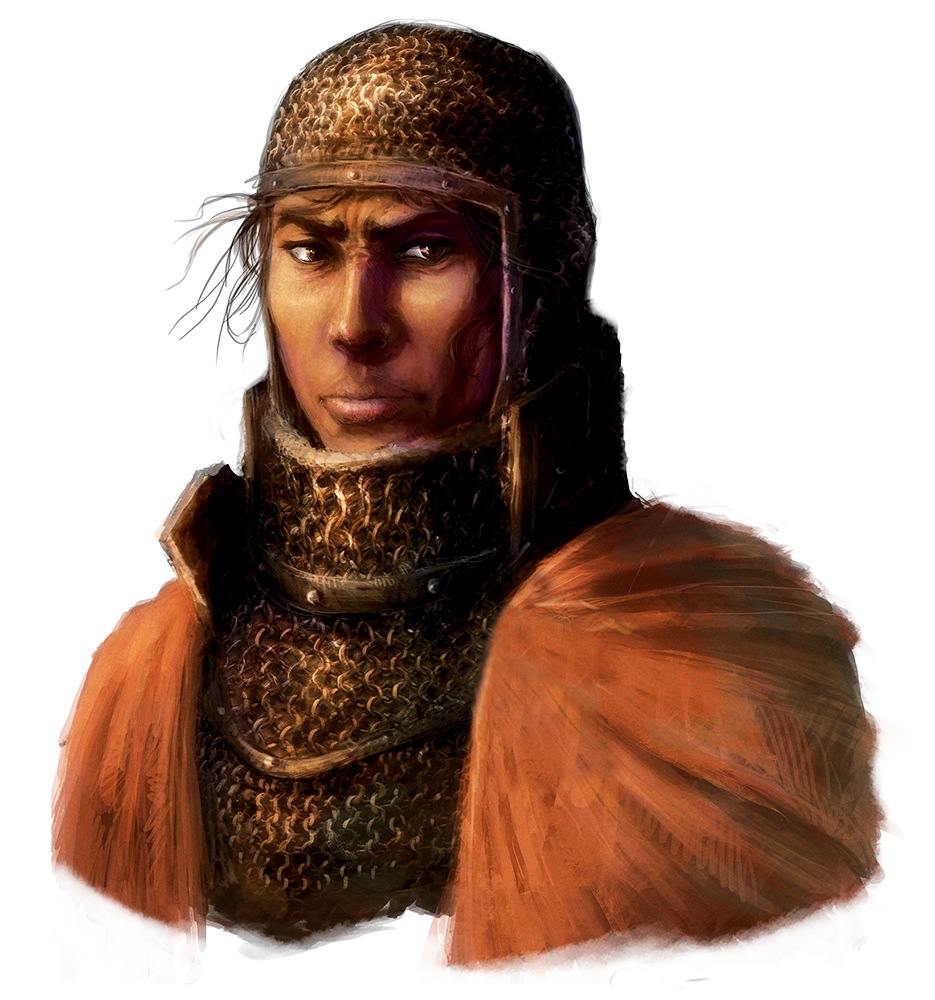
And that's just the main party. Set many years earlier than the novel, this new story, "The Walkers from the Crypt," introduces us to the party that came before, and to the tensions that laid the novel's groundwork. But I don't want to spoil anything, so I'll stop there, and just say that it's a lot of fun.
I would also be remiss if I didn't note artist Eric Belisle's amazing illustration of Elyana, who also features on the cover of Plague of Shadows. Eric's perfectly captured the look and feel of an elven ranger from Golarion, and I hope you'll agree that the character in both the story and the novel are every bit as compelling as the illustration.
Half-Orcs and Sneak Previews! Wednesday, January 26, 2011 ... Illustration by Darren Bader ... With the release date of Plague of Shadows, the new Pathfinder Tales novel, coming up fast, I thought it might be a good time to start stirring the pot with a little sneak preview in the form of a sample chapter as this week's installment of the weekly web fiction. ... I really can't overstate how excited I am for this book to come out. Not only does it have what may be my favorite cover yet for the...
Half-Orcs and Sneak Previews!
Wednesday, January 26, 2011
Illustration by Darren Bader
With the release date of Plague of Shadows, the new Pathfinder Tales novel, coming up fast, I thought it might be a good time to start stirring the pot with a little sneak preview in the form of a sample chapter as this week's installment of the weekly web fiction.
I really can't overstate how excited I am for this book to come out. Not only does it have what may be my favorite cover yet for the line, but it's also an old-school adventure in a way that Pathfinder Tales hasn't really seen so far. In Plague of Shadows, a team of adventurers featuring a Forlorn elf ranger, a civilized half-orc guard captain, an untested young noble, a retired bard, and a country bumpkin of a wizard must set off on a quest to retrieve an artifact in time to save their friend/father/liege lord who's been cursed. Sound familiar? It should—it's a classic quest setup that any gamer should recognize, and over the course of their adventure the party will be forced to deal with the chaos of revolutionary Galt, standoffish Kyonin elves, and the mysterious Vale of Shadows deep in the Five Kings Mountains. And yet while it's a time-honored trope with a generous helping of sword-and-sorcery flair (hardly surprising, given author Howard Andrew Jones's status as one of the foremost living editors and scholars of pulp fantasy), there's also plenty here that's new, and enough twists and turns to satisfy those readers with more complex tastes.
Illustration by Eric Belisle
In addition, I'm also pleased to show off this brand-new illustration of one of the novel's main characters: Captain Drelm, a half-orc raised from his base roots by the glory of Abadar and determined to prove himself as a man of honor. I think you'll agree that artist Eric Belisle (the same man responsible for our excellent Radovan and Jeggare illustrations) has done a beautiful job capturing both aspects of Drelm's character. As we continue to introduce more novels in the Pathfinder Tales line, we're looking forward to ordering brand-new illustrations like this to go along with our sample chapters, giving you one more reason to check on the web fiction each Wednesday.
So get to it, already! Click here to read the new sample chapter of Howard Andrew Jones's Plague of Shadows, then scroll down to the comments section and let us know what you think!
Plague of Shadows Sample Chapter—Chapter Seven: Detours
Plague of Shadows Sample Chapterby Howard Andrew Jones ... Illustration by Darren Bader ... Chapter Seven: Detours Elyana dearly wanted to remain at rest in the feather bed, but she forced herself into motion as she heard a rooster crow. Every day, every hour, was counting against Stelan. She wasn’t entirely convinced that the cleric and his acolytes had the skill and stamina to keep Stelan going, and there was the added wrinkle that broth and water would have to be spooned carefully into his...
Plague of Shadows Sample Chapter
by Howard Andrew Jones
Illustration by Darren Bader
Chapter Seven: Detours
Elyana dearly wanted to remain at rest in the feather bed, but she forced herself into motion as she heard a rooster crow. Every day, every hour, was counting against Stelan. She wasn’t entirely convinced that the cleric and his acolytes had the skill and stamina to keep Stelan going, and there was the added wrinkle that broth and water would have to be spooned carefully into his mouth to keep up his energy. He would be growing slowly weaker.
At dawn, the others found her already awake with Vallyn and helping to supervise the packing of supplies. The bard explained that he didn’t want to subject them to any more of Elyana’s cooking, so he was bringing plenty of food he himself could prepare.
A half-hour after breakfast they were on the road. Vallyn guided them northeast, where, he assured them, they’d be less likely to meet with a patrol than they were on a straight east jaunt, where lazier smugglers and refugees were apt to cross.
Captain Drelm is a most unusual half-orc.
Kellius had a violet petunia in his cap, and reported that he had rarely seen one of such a bright color. Vallyn then set to asking the mage questions about flowers and gardens, and the young wizard expounded upon them for almost an hour, demonstrating more expertise than Elyana had expected. Drelm, of course, remained quiet. If anything, though, Renar looked more suspicious than the half-orc, and Elyana could get nothing out of him. Finally, Vallyn announced to them all that they’d crossed over from the plains of Taldor to Galt.
"How do you know?" the young man asked.
"See that mountain to the north?"
Renar followed the bard’s pointing finger to a snow-topped peak thrusting toward the clouds.
"I mark it."
"That’s Mount Rein. Our angle’s passed far enough that we’re over now, you can be sure. Not that a Galtan patrol wouldn’t chase you past the border if they didn’t like your look, mind you. Or send something worse after—eh, Elyana?"
"True."
"Why are the Galtans so ...mad?" Renar asked.
Vallyn answered before Elyana. "They’re not mad, boy. They’re angry."
"Well, they seem mad. First they kill their rightful rulers. Then they rise up every few years and guillotine whoever they put in place the last time."
"They’re impatient, is what they are," Vallyn said. "They won’t give anyone a chance to set the place in order. The old ones, the nobles, a lot of them had it coming. In my opinion," Vallyn added.
This was news to Elyana, and the bard must have sensed her surprise, for he hurried to explain.
"The Galtans went way too far," Vallyn said. "I’m not excusing what they did. I’m just saying that their government wasn’t exactly looking out for anyone’s interests but its own."
"It’s not a good place," Elyana said to Renar. "There are spies everywhere. We must tread lightly even in the wilderness."
Renar fell silent for only a moment. "What are we really going to do about Arcil?"
If this was what had truly been troubling him, he would find no comfort from Elyana now. This was neither the time nor the place for that particular discussion. "Nothing I’d discuss without wards against scrying in place," Elyana replied.
"He didn’t used to know that kind of thing," Vallyn said.
"He didn’t used to be able to crush a man with shadows, either. From a distance."
Vallyn whistled. He rode in silence for a long moment, then said: "I always told you he was going to go bad."
So he had. And still Elyana sometimes wondered if there was something she might have said or done differently to help Arcil find the right direction. She didn’t mean to mislead Vallyn or Renar, but she had no intention of admitting to them—or to Arcil, should he be listening—that she had no idea how to stop her old friend. She was still hoping she’d find something within the tower to aid her.
That night they set up camp in the Galtan wilderness and lit no fire, subsisting only on cold rations. Elyana arranged to take the middle watch, and lay down to rest. Sleep came quickly to her.
"Elyana."
She opened her eyes to find Kellius looking down at her. While his expression was calm, the wizard’s face was strained. The stars shone in a clear sky. It was deep into the night.
Kellius pretended calm. "There’s something out there. Something large. I saw it flying—"
"Wake Drelm first. Hurry."
"It’s circled twice," Kellius said as he moved off.
Large and winged. Elyana ran over the possibilities as she slipped feet into boots and buckled into her leather cuirass. She climbed up to search the sky.
Dragons, wyverns, and giant birds could all be found near the Five Kings mountain range. Galt’s constant chaos meant patrols and huntsman were not as plentiful as they once had been, and all manner of wild beasts had multiplied in the wilderness.
And there was always the chance that Arcil had sent something against them, calling it down from the peaks or even the Plane of Shadow.
She saw that the land was dark but for a distant light from the Galtan city of Woodsedge, miles to the south. Their camp sat under a scrubby stand of trees, which might explain why whatever it was had not dropped straight in.
The black wall of the Five Kings loomed on the western horizon. Elyana glanced briefly toward it, then looked skyward once more. It was then that she saw the draconic shape blotting out a swath of stars.
The reptile was long and large, with a serpentine neck thrust low. It glided on huge, batlike wings, its tail hanging stiff. Elyana saw that it had no arms and knew then that it was no true dragon, but a wyvern. She’d faced one once before, a creature half this size, and that had been no easy day. Its poisoned sting had put two men in the ground. Wyverns were powerful, relentless, and hungry.
This one swung toward her and lowered its wings for a dive.
"Wyvern!" she screamed in warning, then launched two arrows. Even as the first was still arcing into the air she was running forward. She threw herself into the tall grass and landed with a whuff that knocked the air out of her.
The first arrow slammed home just left of the wyvern’s breastbone, provoking a growl that was cut off as the second caught it high along its wing. Its hooked claws grabbed at the dashing humanoid, but Elyana was too swift.
The wyvern landed with an earth-shaking thump. Its snaky neck swung left and right as it considered its targets, its roar a piercing shriek so loud that Elyana felt a sympathetic vibration deep in her chest. She heard Renar call out to her in worry, but stayed low as the wyvern searched the air with its long snout, snuffling.
Drelm praised one gift from his cursed heritage, and that was the ability to see not only in dim light, but in the deepest black. The humans might see the wyvern as a dark, threatening shape with a long neck, but he saw the glint of its eyes, the muscles along its chest as it thundered toward him. He heaved his throwing axe and ran to meet the beast. But the wyvern had hunched as it built speed for a charge, and the weapon soared over its shoulder.
The winged lizard lowered its head, its mouth widening in a display of daggerlike fangs. Drelm knew a burning thrill of action in his veins, a searing strength that left little room for anything but rage and power. He met the wyvern’s strike with a sideways slash of his greataxe. The blow ripped into the side of the monster’s head, tearing through scales in a spray of blood. The wyvern’s teeth clamped down, narrowly missing Drelm’s chest.
Drelm dodged left, his hands barely retaining hold of the axe as he leapt away. There was a blanket of darkness as the wing fell over him, and then the beast’s tail lashed down. He caught sight of the long, long spike and rolled, but the thing slammed into his arm, penetrating armor, flesh, and bone. He roared not at the pain, but in anger, and climbed to his feet.
The wyvern somehow managed a swift stop. It spun, horned head twisting toward him. Drelm readied his axe, wondering why his right hand shook so.
A lightning blast underlit the beast’s scaly maw, casting its brow ridge in shadow. The thing convulsed, then threw back its head in a deep-throated roar.
So close was the wyvern’s head to Drelm when the wizard’s lightning struck that he saw the beast’s pupils shrink. Drelm raised his axe, snarling, then realized he was strangely dizzy. Dimly, he perceived that Renar was running into the fray. He heard the pluck of a lute, of all things, and Vallyn shouting for Renar to get back. Drelm agreed, and tried to tell the boy to stay clear, but couldn’t quite find the strength.
Then a screen of shifting motes of light fell between him and the wyvern. Drelm did not understand where it had come from, but it was very beautiful, and he wanted to do nothing more than study the slowly changing colors, except that he was already feeling rather sleepy. He sat down, conscious that his arm ached and that he wasn’t thinking clearly. For whatever reason, it all seemed unimportant.
Renar was two-thirds of the way to the monstrous, roaring beast when Vallyn told him to get back. But Renar wasn’t about to retreat and be accused of cowardice. It didn’t matter that he could practically feel his heart in his mouth, or that his pulse beat in his temples like a drum. He pledged to himself that he would not hang back while his friends struggled. His father would not have done so.
When the lovely rainbow screen dropped all about the wyvern, the creature’s head swiveled his direction and Renar halted, thinking the thing had seen him. Then he noticed its eyes tracking after an especially pretty shimmer of blue drifting to the right. Renar had seen sorcery before, but never anything like this. Kellius had talent.
Renar steeled himself and advanced to swing at the beast’s swaying neck. It was a glancing blow, but he’d connected. Somehow that granted him greater courage, and his second strike bit through the blue-black scales. The impact of it raced up through his arms, and he knew a savage exultation as blood spurted forth in dark rain.
He heard Elyana cry a warning. "Renar! Jump back!"
He was accustomed to obeying Elyana instantly—there was no room for hesitation when training horses. He did as bade, and the swinging tail and its bloody spike missed him by a handspan.
As the wyvern’s head rose, Renar saw two arrows blossom along its neck like gruesome spines.
"Run, boy!" he heard Vallyn shout, and he leapt back, watching that tail and the head that was suddenly no longer fascinated by the shining lights. A clawed wing swung down as he backpedaled, and then a blazing ball of fire struck that same wing, filling the air with the sound of sizzling and the smell of burned meat.
The wyvern roared again, and at close range, Renar’s ears rang at the sound. Smoke rose up from the flapping wing as the creature beat it rapidly to put out the flame.
Elyana raced up on its blind side, the long slim blade glittering in both hands. Renar saw the creature’s nostrils flare open. Its head turned.
The elf’s blow sliced deeply into the beast’s neck a foot back from its head. Renar shouted warning as the tail swung up and then down at her, but Elyana threw up her sword. The tail spike clanged against it, and Elyana staggered, then dropped to her knee.
"Back!" she called to Renar in a strained voice. He’d assumed her first neck blow would kill the thing, but the wyvern beat the grass with its wings. Dirt, dry leaves, and grit blew out, stinging the boy’s eyes.
Elyana stumbled backward, panting, and Renar went with her. The wyvern beat its wings once, twice, gave a little hop as though it meant to take flight, and then crashed into the earth.
Its wings fluttered, feebly, and its legs clawed at the grasses. Even after it stopped moving it moaned for several long minutes, in such a pitiful way that Renar actually felt a little sorry for it.
"Is it dead?" Kellius asked, trotting up. A ball of light floated just back of his left shoulder, and black smoke trailed up from the ends of the fingers on his right hand.
"Mostly," Elyana told him. "Stay back." She moved off into the dark. Renar followed.
Elyana found Drelm lying still in the grass, his breathing swift and shallow. As if that weren’t a clear enough indicator of what had happened, the plate armor about his right arm was bashed in around a slim hole that leaked blood across the plate, the chain sleeve beneath it, and the tabard that covered both.
Poison. She had no cure for poison.
"Get Vallyn," she told Renar without turning. The young man dashed away as she bent down, centering her focus. There was a slim chance that the bard had learned greater healing magic in the intervening years. Certainly Arcil had improved—perhaps Vallyn had as well.
Elyana centered her focus with a deep breath. She lowered both hands to the wound and extended her spirit.
The injury was deep and painful, plunging through nearly the whole of the musculature, right down to the bone. The half-orc’s arm was more than twice as thick as hers. She wondered if the spike would have passed all the way through hers.
She sealed the upper layers of his flesh first, so that the blood ceased its egress from the body, and then set to work lacing the muscles together. She was not as practiced nor as polished with more challenging wounds, but she knew that the injury was most of the way knitted. The real problem was the weakness caused by the poison. It marched slow and steady through his bloodstream like a procession of mourners halfway up the cliff to where they would inter the body.
"Looks like we’d best start digging," she heard Vallyn say beside her, and she snapped out of her trance.
The bard’s lute was slung once more on his back. His nightshirt was rumpled, his hair mussed, and Elyana was surprised by how much older he seemed.
"He’s poisoned," Elyana said quickly to him. "Are your healing magics—"
"I don’t know poisons, Elyana." The bard cursed and passed a hand through his hair. "I never thought I’d be burying an orc," he finished, sounding bemused.
"We’re not burying him," Elyana said, rising. She did not remind him, again, that Drelm was a half-orc. She considered the horizon, and the distant point of light that was Woodsedge.
"He’s not dead already, is he?" Renar asked, dismayed. "Isn’t there something we can do? And what do you mean we aren’t going to bury him? He deserves a proper burial—"
Vallyn talked over Renar, paying him no heed. "That’s a Galtan city, Elyana. Even if they didn’t want to shoot you and me on sight, there’s no way any healer would help Drelm. He looks too much like an orc."
"We can get him to a temple of Abadar."
"He’ll be dead before we can make it," Vallyn countered.
"Not if we take a shadow ride," Elyana answered.
Vallyn winced. "A plague on shadows. You’d be mad to try."
She stared at him, hard, and he looked down.
"When I last saw you," she said, still staring at him, "you were working on spells that altered your appearance. Do you know them still?"
Vallyn nodded, reluctantly at first, then added a pleased little shrug. "I’ve gotten pretty good at it, if truth be told."
"Can you alter someone else?"
Kellius and Renar looked back and forth between them, wondering at the length of time it took Vallyn to reply.
"I can," he said. "But I can’t alter us all. Only one."
"One will have to do."
"But there’s three of us needing disguise."
"Two." Elyana produced an amulet from her pouch. "I have a little help from Arcil." So saying, she lifted the necklace and clasped it around her neck. Instantly Kellius beheld the face of the thin-nosed, arrogantly handsome man who’d confronted them in the ruins.
"Arcil!" Vallyn cried.
"He left this on the body of his apprentice," she said, astonished that her own voice had now taken on the haughty, male precision of her former friend. "Listen to me!" she said. Despite everything, amusement rang in her voice. "He’s very good."
"He’s very bad," Vallyn countered.
"Is this wyvern his work?" Kellius asked.
"Probably," Vallyn said. "It’d be like him. If he were listening and thought we had him pegged to attack after we found the crown, he might’ve sent the thing just to show us up."
"Wyverns are common in the mountains," Elyana noted.
"I know we’ve little time," Kellius said quickly, "but I have one more question. It’s clear the Galtans want you two dead. Arcil rode with you. Won’t they recognize his face?"
"Arcil was always good with concealment magic," Vallyn said. "I don’t think any Galtan that lived ever saw his real face."
Elyana faced the bard. "Set a spell on Drelm so we can be on our way."
Vallyn shook his head. "I’m still wanted there, remember?"
"When’s the last time you were on a wanted poster, Vallyn? Do you look the same?"
Vallyn’s hesitation seemed to indicate more surely than anything else that her point struck home. But he nodded. "They know me even better than you, Elyana."
"Very well." She undid the necklace and passed it over her head, changing in an instant back to her true form and voice. "You wear it. I shall wear a hood. Place your spell on Drelm."
Vallyn considered her, then let the amulet sink into his palm, the chain dangling between his fingers. "He’s probably not going to live," Vallyn cautioned. "This is—"
"The sooner we get moving," Elyana said coolly, "the better his chances. Cast your spell."
Vallyn thrust the necklace into an upper pocket on his shirt. He unslung his lute and stepped over to the prone captain.
In moments the bard was plucking at strings, singing a simple little melody, his voice rich and thoughtful. Drelm’s features wavered and blurred, and Elyana suddenly found herself regarding a pale fighting man with dark hair. He did not look so much a different man as he did an image of what Drelm would have been if the orc blood were somehow stripped away. Fangs vanished, the brow ridge faded, the ears shrank down. He was still thick and muscular, but even in rest was somehow more peaceful.
"There he is," Vallyn said, a touch of pride in his voice. "It’ll hold for a few hours. After that—they’ll have a half-orc on their hands."
"He might be dead before then," Elyana told him.
They worked quickly to saddle the horses and gather their gear. Even so, it was not swiftly enough, and Elyana twice checked Drelm’s pulse, so concerned was she that they were wasting time.
She herself held Drelm, knowing that she could trust Persaily to carry the extra weight and travel the strange terrain. She hoped she could likewise trust the mare to carry them through the Plane of Shadow. To the others she gave the lead lines of one pack animal each, hoping they were skilled enough to manage their beasts and lead another, then set her mind upon the ring and called forth the shadows.
Coming Next Week: The first installment in Monte Cook's new story about a man who talks to swords in "The Ghosts of Broken Blades."
Howard Andrew Jones is the Managing Editor of sword-and-sorcery icon Black Gate Magazine, the primary editor responsible for bringing pulp master Harold Lamb's historical fiction to a modern audience, and a respected fantasy author in his own right. His first non-Pathfinder novel, The Desert of Souls, releases this February from St. Martin's imprint Thomas Dunne Books. For more of his short stories and essays, see blackgate.com and howardandrewjones.com—for the rest of Plague of Shadows, pre-order now!
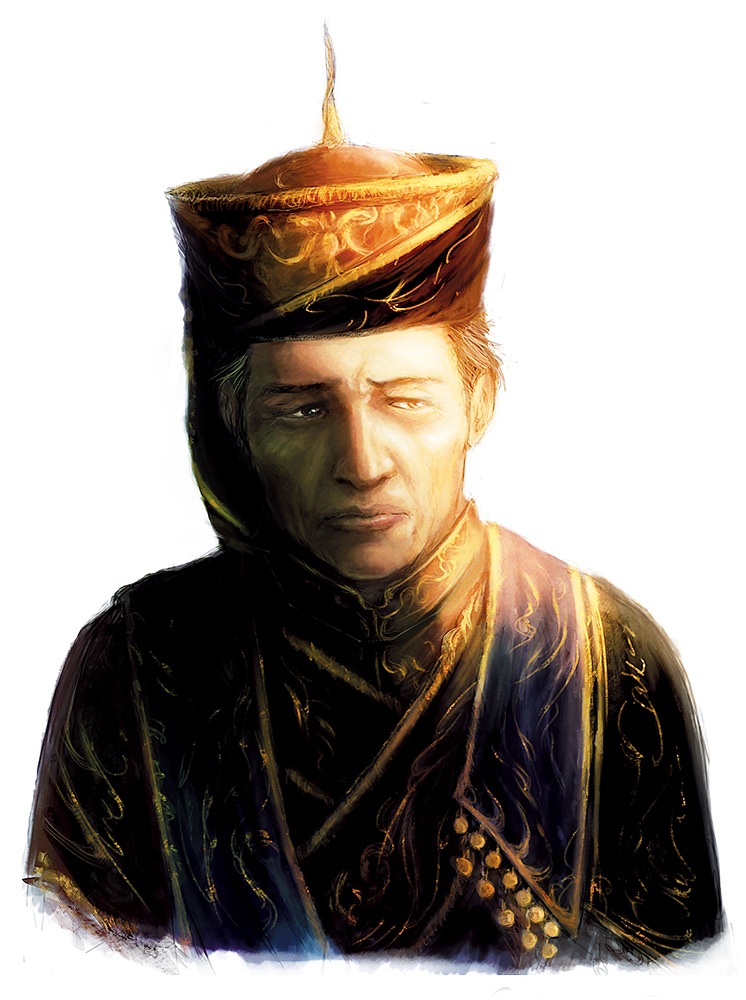
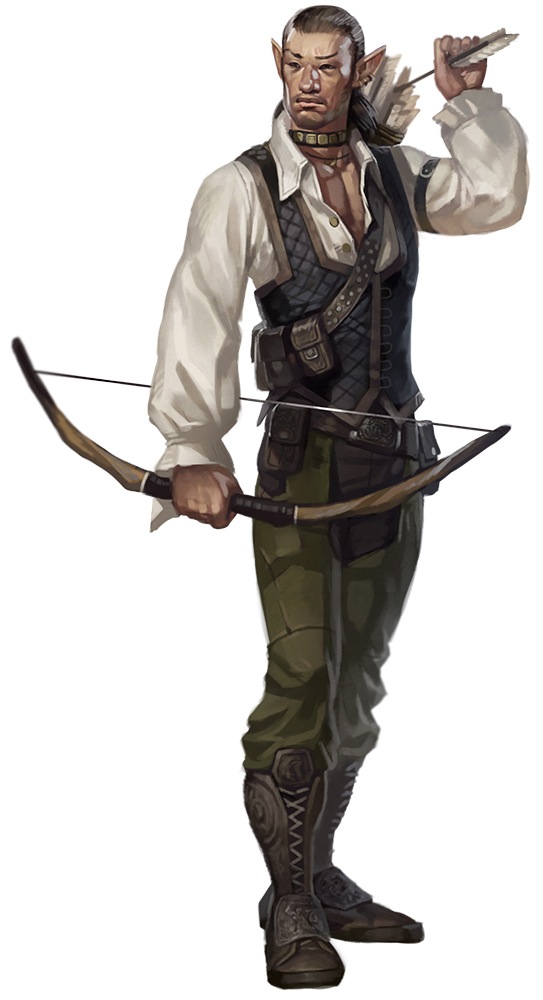
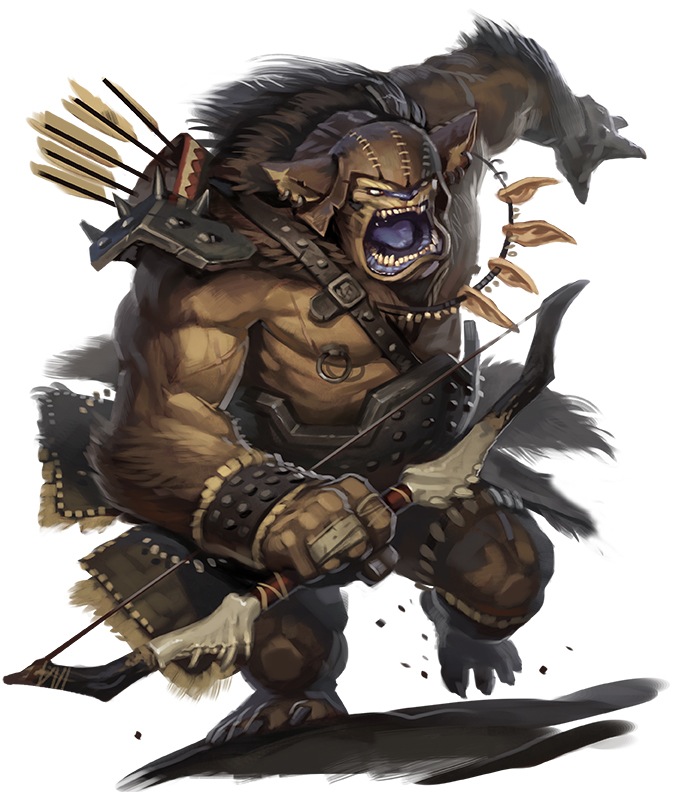
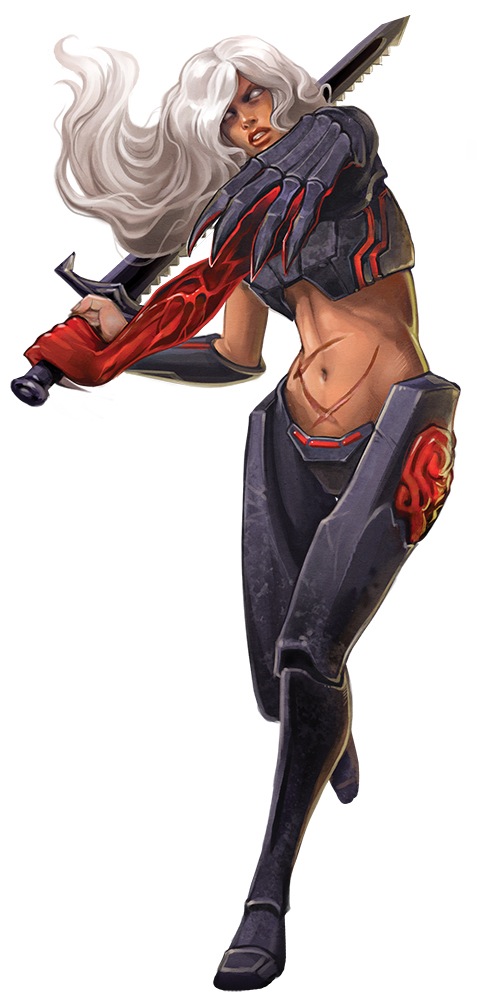
... Illustrations by Eric Belisle and Wayne Reynolds. Widescreen version here. ... Release the Hordes! December 31, 2010It’s the last day of 2010, and once again the Paizo offices are closed, this time in honor of the new year. It’s been an amazing 2010 here at Paizo, and we managed to cap it with a great new hardcover book. Bestiary 2 has begun to arrive in stores and in hands around the world, making it easy to surprise your players with new monsters during your games this weekend. Bestiary...
Illustrations by Eric Belisle and Wayne Reynolds. Widescreen version here.
Release the Hordes!
December 31, 2010
It’s the last day of 2010, and once again the Paizo offices are closed, this time in honor of the new year. It’s been an amazing 2010 here at Paizo, and we managed to cap it with a great new hardcover book. Bestiary 2 has begun to arrive in stores and in hands around the world, making it easy to surprise your players with new monsters during your games this weekend. Bestiary 2 is full of some great adversaries for you to defeat, and the poster we recently released will help you keep track of which ones have met their demise at the hands of your players. In honor of both the new year and the release of Bestiary 2, here’s another great wallpaper from our art team!
Pathfinder Tales Webfiction Will Return Next Week Wednesday, October 27, 2010With our industrious Fiction Editor out sick this week and then whisking his way off to Ohio for the weekend to talk up Pathfinder Tales and Planet Stories at World Fantasy Con, we've decided to postpone posting the opening installment of Richard Lee Byers' awesome new novella, Lord of Penance, until next Wednesday. I know, I know... it's a downer for all the folks who anxiously wait for the week to roll around to...
Pathfinder Tales Webfiction Will Return Next Week
Wednesday, October 27, 2010
With our industrious Fiction Editor out sick this week and then whisking his way off to Ohio for the weekend to talk up Pathfinder Tales and Planet Stories at World Fantasy Con, we've decided to postpone posting the opening installment of Richard Lee Byers' awesome new novella, "Lord of Penance," until next Wednesday. I know, I know... it's a downer for all the folks who anxiously wait for the week to roll around to get a new, free slice of Golarion, and I promise you we'll serve you up some Pathfinder Tales next Wednesday.
But there is a silver lining: You can now spend the next week catching up on or delving back into the webfiction we've already published, compliments of the brand-new ebook compilations we've recently made available on both the Paizo webstore and Apple's iBookstore (or just browse through the stories in the Pathfinder Tales archives ).
Mega Monster Meltdown! Tuesday, October 26, 2010All these Bestiary 2 monsters are CR 20 or higher. Deal with it! ... If you can. ... Illustration by Eric BelisleIllustration by Eva Widermann ... Illustrations by Jorge Maese ... Wes Schneider ... Managing Editor ...
Mega Monster Meltdown!
Tuesday, October 26, 2010
All these Bestiary 2 monsters are CR 20 or higher. Deal with it!
... Vanquished Beasts! Friday, October 1, 2010If you've been paying attention over the last few weeks, you've probably noticed a lot of talk about the whole office putting great effort into wrapping up the forthcoming Pathfinder Roleplaying Game Bestiary 2. Well, as of the end of the day Wednesday, the beasts—over 300 of them— were successfully wrangled into line, made to look sharp, and shipped off to the printer. Look for Bestiary 2 in bookstores, hobby stores, and on paizo.com...
Vanquished Beasts!
Friday, October 1, 2010
If you've been paying attention over the last few weeks, you've probably noticed a lot of talk about the whole office putting great effort into wrapping up the forthcoming Pathfinder Roleplaying Game Bestiary 2. Well, as of the end of the day Wednesday, the beasts—over 300 of them— were successfully wrangled into line, made to look sharp, and shipped off to the printer. Look for Bestiary 2 in bookstores, hobby stores, and on paizo.com in November. In celebration of this event, check out these lovely images:
... Pathfinder Advanced Player's Guide Preview #5 Thursday, July 29, 2010The Advanced Player's Guide releases in just one week and already boxes and boxes are on their way to your FLGS and subscriber copies are shipping out. One week from today, we will all be at Gen Con, handing out copies of this meaty rulebook. But that's next week. Today we have the final preview of the book, taking a look at prestige classes and some of the new rules found in the APG. ... There are eight prestige classes...
Pathfinder Advanced Player's Guide Preview #5
Thursday, July 29, 2010
The Advanced Player's Guide releases in just one week and already boxes and boxes are on their way to your FLGS and subscriber copies are shipping out. One week from today, we will all be at Gen Con, handing out copies of this meaty rulebook. But that's next week. Today we have the final preview of the book, taking a look at prestige classes and some of the new rules found in the APG.
There are eight prestige classes featured in the Advanced Players Guide, from the mighty Stalwart Defender to the sly Master Spy. Here is the name and brief summary of each class in the book.
Battle Herald: This class blends the best of the bard and the cavalier to create a character that can truly take control of the battlefield, granting big bonuses to his allies. Holy Vindicator: Mixing cleric and paladin, the holy vindicator is the perfect weapon to deliver his deity's will, usually at the end of a sword. Horizon Walker: A class that nearly anyone can qualify for, this class is perfect for adventurers that travel the world and the planes beyond, granting a wide variety of bonuses based on terrain. Master Chymist: A prestige class for alchemists whose minds have split into two because of repeated use of their mutagen—now they are part monster and part dangerous madman. Mastery Spy: Skilled at the art of lying, able to take on the appearance of others easily, and even able to hide their alignment from spells, the master spy is perfect for infiltrating and hiding with the enemy. Nature Warden: Bonding closely with her animal companion and the lands around her, the nature warden is a force of nature, deadly when protecting the lands that she calls home. Rage Prophet: Sometimes the spirits that speak to oracles drive them into a mad, rage-filled frenzy. This mix of barbarian and oracle is just that, blending spells and rage together. Stalwart Defender: This is a revision of the Dwarven Defender and it is no longer just for dwarves. This class is known for holding its ground and taking whatever punishment the enemy throws at it.
Illustration by Eric Belisle
Of course, that's not all that you'll find the APG. The last chapter of the book contains a host of new rules to use in your game, starting out with four new types of combat maneuver. The first, and perhaps my favorite, is the Dirty Trick combat maneuver. This maneuver lets you apply a penalty (either blinded, dazzled, deafened, entangled, shaken, or sickened) to your foe for 1 round plus 1 round for every 5 by which your check exceeds the target's CMD. The type of course, depends on the situation and your imagination. Kicking sand in an opponent's face might blind him, while pulling down his pants might entangle him.
The next maneuver is Drag. This works like Bull Rush, only in reverse. Next up is Reposition. This maneuver allows you to move your opponent to a different location within your threatened area, but you cannot use it to move a foe into a dangerous space, such as off a cliff or into a fire. Finally, there is Steal. This combat maneuver lets you snatch a small item that is loosely carried by your target. So while you cannot take the plate mail of a target or take the sword from his hand, you can rip the brooch off his cloak. Of course, each one of these maneuvers comes with a pair of feats (Improved and Greater) to increase your odds of success and grant additional bonuses.
After Combat Maneuvers is a complete system for using hero points in your game. This system grants PCs a small pool of points that they can spend at particularly dramatic moments, giving them an edge. The rules also include guidelines for granting new hero points, how they can be spent, and a number of feats, magic items, and spells that use these rules. We recognize that not everyone plays with a system like this, so this entire rules section is optional.
Last but not least is the system of character traits. This system first appeared in the Pathfinder Adventure Paths and it grants PCs a pair of small bonuses tied to their background at character creation. Your PC might bear a curious birthmark shaped like your deity's holy symbol that you can use as a divine focus or you might have grown up as a bully gaining a bonus on Intimidate. No matter what you choose, this system gives you a reason to work out where your hero came from.
Well, that about wraps up the previews of the Advanced Player's Guide. With the book hitting shelves next week, I hope that you will swing by Gen Con or your favorite game store and check it out. I would like to take a moment to thank all of the playtesters that, once again, helped contribute to a truly great book. Until next time.
... Demon Lord Thursday Thursday, June 24, 2010I'm still scrambling to finish up writing for Book of the Damned II: Lords of Chaos, and while I'm not done yet (I'm a VERY naughty freelancer!), all of the art for the book is done. And since my time writing should be devoted to demons and not blog posts... I'll stop here and just show off some pictures: Angazhan, Cyth-V'sug, Flauros, and Kostchtchie, all courtesy of the super-talented Eric Belisle! ... Illustrations by Eric Belisle ... James...
Demon Lord Thursday
Thursday, June 24, 2010
I'm still scrambling to finish up writing for Book of the Damned II: Lords of Chaos, and while I'm not done yet (I'm a VERY naughty freelancer!), all of the art for the book is done. And since my time writing should be devoted to demons and not blog posts... I'll stop here and just show off some pictures: Angazhan, Cyth-V'sug, Flauros, and Kostchtchie, all courtesy of the super-talented Eric Belisle!
... Pathfinder Advanced Player's Guide Preview Banquet Recap Tuesday, June 22, 2010With PaizoCon 2010 officially in the books, it's time to start looking forward to the Advanced Player's Guide, which releases in early August at Gen Con. On Saturday night, during the banquet, I gave a nice long preview of the book, and wanted to make sure that everyone who was not able to attend also had a chance to hear about some of the exciting new rules and features in this mighty tome. ... First off, we...
With PaizoCon 2010 officially in the books, it's time to start looking forward to the Advanced Player's Guide, which releases in early August at Gen Con. On Saturday night, during the banquet, I gave a nice long preview of the book, and wanted to make sure that everyone who was not able to attend also had a chance to hear about some of the exciting new rules and features in this mighty tome.
First off, we took a look at the races chapter, which includes a two-page spread of information on each of the seven core races. Each one includes new alternate racial class features for you to choose from and new favored class options. The latter gives you another thing to choose from when you take a level in a class favored by your race. For example, dwarven barbarians can choose to gain 1 additional round of rage per day instead of an additional hit point or skill rank.
Next comes the classes chapter, which starts off with the six new base classes and then continues on with new rules and material for the 11 core classes from the Core Rulebook. The base classes have received a host of updates since the playtest, but still primarily function much in the same way as they did before. For the core classes, we added scores of new rules. Most of the classes contain numerous archetypes, or different takes on the class, which includes a number of alternate abilities that you can take as a package. For example, rogues can select the sniper archetype which grants them increased range with their sneak attack and reduces their penalties for making attacks at long range.
Illustrations by Eric Belisle
Although this chapter has a little something for everyone, one of the things I was most excited to reveal was the antipaladin class. This alternate paladin is sure to keep your players up at night. His smite good attack deals double damage to paladins and good-aligned clerics on the first successful attack. His touch of corruption deals damage and can inflict terrible cruelties on hapless PCs. He can be a carrier of disease and can radiate an aura of sin. He is a tough, tough customer. But my favorite part of putting together the entire book was writing his code of conduct. Here is an excerpt:
Under exceptional circumstances, an antipaladin can ally with good associates, but only to defeat them from within and bring ruin to their ranks.
After classes is a meaty feats chapter, containing 163 feats that range from metamagic feats, combat feats, and even a host of racial feats. This chapter even includes a number of high-level feats that duplicate a number of powers of the old 3.5 archmage prestige class. One feat of note is Shadow Strike, which allows a character to deal precision damage, even if the target has concealment, allowing rogues to finally be able to sneak attack a foe in a dark alley.
After feats comes equipment, which contains new tools, useable by nearly any PC, and a lengthy chapter full of spells. There are spells in this book for every spellcasting character, including new spell lists for elementalist wizards. All told, 57 pages of spells with new choices at every level of play. After spells comes the prestige class chapter, which includes 8 new classes. I previewed the Stalwart Defender during the banquet, which is an update of the 3.5 Dwarven Defender. The name change stems from the fact that you no longer need to be a dwarf to take levels in this class. The class also grants many new abilities that the defender can choose from as he gains levels.
The book is rounded out with a large magic items chapter, including new items from virtually every category. It starts with armor and weapons and wraps up with cursed items and artifacts. That chapter is followed up with the new rules chapter, which includes info on four new combat maneuvers (dirty trick, drag, reposition, and steal), an optional hero point system, and the entire traits system used by the Pathfinder Adventure Paths.
All of that, crammed into 336 pages between two beautiful covers. A detailed preview of the Advanced Player's Guide will start very soon. Keep your eyes here on the Paizo blog for more information on this exciting book.
The Lost Pathfinder—Chapter Three: The Grand Opera
The Lost Pathfinderby Dave Gross ... Chapter Three: The Grand Opera Thanks to the longevity granted by my mingled elven and human blood, I have held a box at the opera longer than any other member of the Jeggare family. Even before my mother bequeathed it to me, her parents had held it throughout their long lives, and so had their venerable parents before them. It is in fact one of the four longest-held boxes in the Opera House of Egorian, and upon her ascent to the throne, the first Queen...
The Lost Pathfinder
by Dave Gross
Chapter Three: The Grand Opera
Thanks to the longevity granted by my mingled elven and human blood, I have held a box at the opera longer than any other member of the Jeggare family. Even before my mother bequeathed it to me, her parents had held it throughout their long lives, and so had their venerable parents before them. It is in fact one of the four longest-held boxes in the Opera House of Egorian, and upon her ascent to the throne, the first Queen Abrogail condescended to spare it when she claimed the first and third boxes for herself.
It is, however, one of the smaller boxes, accommodating only two in comfort. Such limited space was no hardship while my mother lived, for we happily entertained each other. Since her death, however, the limited seating has on occasion presented me with mild social quandaries, as any invitation I might extend to an eligible lady posed her chaperone the uncomfortable choice between standing and abandoning her charge for the duration of the performance. Often I preferred to avoid the dilemma by offering the lady and her chaperone the box with the understanding that we would meet afterward to discuss the opera.
In recent decades, I have enjoyed the comforts of the box unaccompanied. The whispers of my peers returned like flotsam on the tides of gossip, so I knew the prevailing speculation was that I had simply accepted the fact that I had grown too old for marriage. Some hypothesized my sexual interests lay beyond the field of Egorian's noble maidens and widows. The most offensive rumors were those that hinted at perversions that could be satisfied only in the utmost secrecy. The latter had the unfortunate effect of stimulating the curiosity of women for whom traditional assignations had grown stale.
Thus it was that I had become accustomed to appearing alone within my box on opening nights of a new opera, to a general stir among the audience. As the ushers parted the drape, I tugged my gloves snug at the wrist. My opera cloak lay folded over my right shoulder, revealing its plum-colored silk lining. I stepped through and rested a hand upon the back of one chair, adopting a casual posture as I observed the house.
"That they would dare snub a scion of House Jeggare is unthinkable."
The velvet curtain hung in sensuous crimson folds from a height of twenty feet. The fabric displayed the first hints of wear and would soon be replaced, a transition I had witnessed with some mourning six or seven times over the past ninety years. Each time, in support of future performances, I had purchased a scrap of the fabric as a memento, which I kept in frames on the walls of my library at Greensteeples. The edge of the stage was aglow with limelight that warmed the first few rows, rendering them the least desirable of the floor seats. Ushers led nobles to their seats on the floor and the three general balconies, while those of us privileged to enjoy private boxes were attended by servants employed by the opera house. Above us all, the lighted chandeliers cast a golden aura about the vast, multi-tiered auditorium.
I searched for a friendly face among those taking their seats below. Soon I spied a plump matron of House Elliendo, but she missed my smile or pretended so. That was not too strange, since her cousin and I were rivals. I was more disappointed when a toothsome widow of House Leroung obviously ignored my bow in her direction. Her gaze was not entirely averted, so I raised a hand in greeting.
She turned her back to me. She had clearly seen my gesture, yet she rebuffed it.
Shocked at the blunt offense, I turned away. My gaze fell upon a young woman who had only six months earlier hung on every word of my account of an investigation into a lost idol of Sarenrae. A smile flickered upon her lips until her mother bent to whisper in her ear. Then both showed me their backs.
As a few stones accumulate into an avalanche, so too did the several snubs spread throughout the auditorium until everyone who had turned to notice my presence turned away to face no particular direction, which is to say any direction other than the one in which I stood.
They had no other object to attend. There could be no mistaking their intention. One and all, my Egorian peers shunned me.
∗ ∗ ∗
The carriage driver was a slip named Miro. He'd been working for the boss for a few years, but I'd only recently learned his name after he did me a good turn. That opened my eyes to the fact that slips didn't have it much better than my sort did. In Cheliax, both halflings and hellspawn were more often slaves than free men. I'd looked down on the little fellows all my life, just like the humans turned their noses up at both of us. Problem was, slips were little, and lifetimes of abuse had turned a lot of them crafty or mean. Hell, when I thought about it, I had to admit the same was probably true of me. I couldn't decide whether I was getting enlightened or just starting to realize what an ass I'd been to the slips.
Anyway, Miro was a good fellow. I stood him a few pints after the Henderthane affair, and I'd sort of apologized for putting him in a bad spot and sort of thanked him for helping me out of it. He liked this restricted tobacco from Nirmathas, and I'd found him a pouch on the black market. The stuff smelled good, but smoking it made me slow and goofy, so I declined when he offered me some. We'd been chatty ever since, which was good. Like my old colleague Maccabus, sometimes I wanted a favor, and now there was another place I could find one.
Miro's sons also served at Greensteeples, Lom assisting the gardener, Vono working in the stables. Miro made sure both of them came along on the ride to the opera house. That was good because it gave us two footmen to wear the house livery, which I hate. While they were grown halflings, Lom and Vono were small enough to share one of the carriage's steps while I balanced them by standing on the other, after the boss was inside. The way he'd treated me earlier, I figured it was simpler if he didn't know I was along for the ride, especially out of uniform. When he got this way, it was best to leave him gazing into Elfland while the rest of us took care of business.
When the boss disembarked, I stayed on the other side of the red carriage. The boys escorted him to the opera house entrance and bowed as he went in. With very few exceptions, the guards didn't welcome nonhumans inside, especially hellspawn. When the boys came back to the carriage, I told them the plan.
"Pick a side," I said. "See anyone with horns or a tail, hustle it back here to finger him. I'll take it from there."
They nodded and strolled up and down the line of carriages parked along Carthagnion Drive, where drivers and footmen would smoke, share hip flasks, and throw cards while their betters enjoyed the show. Only tonight, one of them was a hellspawn assassin looking for a shot at my boss. If I spotted him first, he'd have a bad night. If not, I'd be out of a job.
I was confident Vincenzo's information was good. Caught between me and the giant bunyip, he'd spilled all he knew. If nothing else, his sense of self-preservation was strong enough to know a lie would mean I'd find him again, and this time I wouldn't just leave him to dream off his last dose of shiver.
Impatience was making me fidget. I climbed the back of the carriage to stand on the roof. A gull-faced driver from House Sarini tilted his head back to look down his nose at me. I shot him the tines, and he flustered up like a nanny who'd just been pinched on the bottom. Ignoring him, I checked out the line of carriages in either direction. I saw a lot of familiar faces, and those I didn't recognize were human or, occasionally, halfling.
I spotted Vono pumping his little arms as he ran back toward the red carriage. I jumped down to meet him halfway, but he was already pointing to the side entrance. A couple of guards stood beside the service door. One of them was reading a card he'd taken from a broad-shouldered man holding a long box under one arm. Even from this distance, I recognized the guard dipping his hand into his pocket to secure the bribe he'd been passed with the card. I couldn't identify the house crest on the visitor's livery, but his face had a fiendish silhouette.
By the time I reached the door, the hellspawn was already inside. The guards stepped forward to intercept me. Each was a good six inches taller than me, and a stone or two heavier.
"I'm with him," I said.
"Nice try," said one of them. His partner slipped his baton out of its belt loop.
I showed my palms to the sky and smiled a weak apology. There hadn't been time to come up with a better bluff, so I gave them each a knuckle-shot to the throat. The friendly one dropped to his knees, while his buddy dropped his weapon. I snagged the baton and gave the stunned guards a rap on the head to buy a few minutes. There hadn't been time to be gentle, either.
Inside was a hall connecting the lobby to a couple of doors. From the side entrance we were below stage level, so I figured the doors led to the orchestra pit and backstage. An usher of considerably less physical menace than the door guards had just closed the second door. He looked at me suspiciously, and I ran toward him while beckoning him close for a whisper. The gullible fool leaned in, and I gave him a nice clean rap on the sleepy button. I caught his body before he could hit the floor, dragged him in through the door, and closed it behind us.
Past the second door was an irregular little room with two exits: another door and a short flight of steps leading up to a heavy black curtain. The fabric still swayed as though someone had recently pushed past it.
Beyond the curtain was just what I'd guessed, a high room filled with a confusion of scaffolds, curtains, wheeled scenery, ropes, hoists, ladders, and a dozen objects and tools I couldn't begin to name. Ahead of me was the main stage, barely illuminated by offstage lamps as the chorus took their places.
From nights I'd accompanied the boss home after the opera, listening to his detailed accounts of the evening's entertainment, I knew enough to realize that meant there were only moments left before the curtain rose. As if mocking my thought, a sharp report from a timpani marked the beginning of a rising drum roll, and music overflowed the orchestra pit beyond the curtain. Before I looked away, I saw the famous soprano taking her position on the opposite wing. One look at her beefy arms, and I knew I wouldn't want that woman coming after me with a switch.
I looked around for any clue as to the assassin's trail. The ladder to the scaffolding nearest the front curtain shuddered, and I looked up to see someone stepping onto the catwalk twenty feet above. It could have been one of the stagehands, but it also looked like the best spot for a sniper. Maybe that had been some sort of disassembled crossbow in the box he'd carried inside.
I put a foot on the first iron rung of the ladder. Something cracked me hard on the back of the skull, and my vision wavered. I reached for the grip of my dagger, but a hand slapped my arm away, and I was too weak to send it back before I teetered and fell in a clumsy spiral to the floor. My last vision was of a face looking down at me. It wasn't a man but a masculine-faced woman, hellspawn like me, but a lot less pretty. She shook her head slightly as if disappointed as she held a leather sap above her head.
Then she brought it down between my eyes.
Coming Next Week: Radovan meets his match in the final chapter of "The Lost Pathfinder."
Dave Gross has been a technical writer, a teacher, a magazine and book editor, and a novelist. He is the author of the forthcoming Pathfinder Tales novel Prince of Wolves and the Hell's Pawns series in the Pathfinder's Journal for Council of Thieves, both of which star Varian Jeggare and Radovan, the heroes of this story. His previous novels include Black Wolf and Lord of Stormweather.
The Lost Pathfinderby Dave Gross ... Chapter One: The Solarium It was good to be home, but the tranquility of my greenhouse had not yet ameliorated my headache before the butler interrupted my reverie with a letter. He lingered after I took it from the silver tray, requiring me to dismiss him by raising an eyebrow. The staff had taken to hovering since the Henderthane affair. The devotion the halflings had cultivated over four generations of service to my house was degenerating into...
The Lost Pathfinder
by Dave Gross
Chapter One: The Solarium
It was good to be home, but the tranquility of my greenhouse had not yet ameliorated my headache before the butler interrupted my reverie with a letter. He lingered after I took it from the silver tray, requiring me to dismiss him by raising an eyebrow. The staff had taken to hovering since the Henderthane affair. The devotion the halflings had cultivated over four generations of service to my house was degenerating into sentimentality. I hoped it would not become necessary to dismiss the worst offenders as an example.
The postmark from Absalom piqued my interest. It had been months since my superiors in the Society had contacted me. There had once been a time when I received frequent notes of praise and requests to direct my agents to pursue new leads and uncover previously undiscovered sites. Such a message might be exactly the tonic I required to sooth the ennui that followed my recent misfortunes.
My hope vanished as I read the first lines of the message, and when I glanced down to see not a signature but merely the seal of the Decemvirate, indignation filled my heart with steam. Some anonymous member of the inner circle presumed to chastise me, Venture-Captain Varian Jeggare, one of the longest-serving members of the Pathfinder Society.
After the initial shock of the effrontery, I drained my glass of a promising vintage from one of my southern holdings. Although the unwelcome news diminished my pleasure in the wine, it was an altogether drinkable claret of deep red hue and a deep, earthy nose. Fortunately, the bottle contained just enough to refill my glass as I examined the message closely.
While I found the letter's tone irritating, I could not dispute the facts it presented. It had been more than two months since I last received reports from the Pathfinders it named, and the agent who last reported from Ustalav had not contacted me since early spring. In her case, fortunately, I had arranged a contingency should she find herself in a location too remote for mundane channels of communication.
I rose from my lounging chair, stumbling before catching myself on the edge of a planter. I made a mental note to admonish the gardener for leaving the stone path slippery, although the rest of the walkway seemed dry enough as I navigated the long rows in search of the whispering lilies. I found them in a sunny spot beside a flourishing patch of memory ferns whose properties I had yet to exploit to their full potential.
There were eight rows of whispering lilies, each containing four distinct plants. I had entrusted the twins of each set of four bulbs to my most daring agents. In the event that they should find themselves stranded, they had only to plant the bulbs. Once beneath moist soil, the bulbs bloomed within a day or two, and their roots transmitted a signal that could be received only by the bulb's other half. I theorized that the transmission occurred via the elemental planes, accessed via microscopic gates, but I had yet to perform the necessary experiments to compose a treatise on the subject. No matter the exact nature of the mechanism, the lilies provided almost instantaneous communication between twinned flowers. One had only to speak into the open blossom of one, and the message emerged simultaneously from the other.
Of the thirty-two whispering lilies in the flowerbed, none had changed hue from the white-peach color that indicated the plant's twin remained dormant. However, all four of those I had given to my agent in Ustalav had withered, their dull petals lying at the base of limp stems.
Whatever had become of my Pathfinder, the bulbs she carried had not survived.
∗ ∗ ∗
"Say what you will about Radovan’s heritage,
he’s good at what he does."
"Nice jacket."
I tensed the way you do when hearing an unexpected noise in an Eel Street alley. I knew the voice and stopped myself from going for the big knife hidden in the spine of my fancy new jacket. The grip hung down like a stubby tail, which had gotten me some ribbing in the Trick Street brothels.
"Desna weeps, Mac," I said without turning. My heart was pumping so hard he could probably hear it. I kept my eyes on the street, where I expected to spot Paracount Unizo Fermat sometime that morning. His wife wanted to prove he'd been gambling away the family income, and the boss had passed the boring job down to me. With any luck, I'd be done before lunch.
"Sorry, Spikes," he said, using a childhood nickname that had never really stuck. The only time anyone ever used it was to remind me how long we'd known each other. Mac needed a favor.
Among the Goatherds, Maccabus was one of the old men, by which I mean he had lived past forty years on the dirty streets of West Egorian. He was the top enforcer for Zandros the Fair, and over the years he'd earned a reputation for acquiring with a cool word what usually took a few pints of blood and a busted kneecap. He was one of the few surviving members of the gang who I'd drag out of a fire. Now and then we'd stand each other a pint and talk about anything but business.
Problem was, we'd been quits for a long time. Before I'd agreed to work for my present boss, the count, I'd earned my freedom from Zandros—not that he always remembered that fact. The scabby old bastard still tried to call in favors I never owed from time to time, jealous that I had a new master. Employer, I should say. That was one of the terms of our arrangement. I'm nobody's slave these days.
On the other hand, Mac had stood up for me the last time Zandros tried pulling my tail—metaphorically, that is. Despite what those doxies say, a tail is not among my devilish features.
"What do you need?" I asked.
"Little muscle for ten minutes."
"And what's for me?"
"Word on a hit," he said. "Your boss."
That got my attention. Both the boss and I knew there'd be repercussions from our last case. We'd gotten the job done all right, but in the process we'd busted open a bigger secret. It was the kind of thing that hurt a lot of the noble houses, the sort of people who usually hire the boss. They're also the sort of people who usually hire assassins.
"Where'd you hear it?"
Mac said nothing. When I turned to look at him, he just stared at the street.
"Vincenzo, right?" Lately the weasel-mouthed informer had been leaking word of high-end assassinations so often it was a wonder he hadn't taken his last swim in Lake Sorrow.
Mac shrugged.
"I could just go ask him." Vincenzo had developed an expensive habit, and if he'd sold news of this magnitude, he'd have gone straight to a shiver den. The problem was Vincenzo was notoriously paranoid, so he probably wouldn't take the stuff there.
"It's going down tonight," said Mac.
That's what made Mac so good at his job. He had a way of offering choices that weren't choices at all. I gave up my vigil for the paracount and followed him.
A few blocks away, he nodded at a row house I recognized as the front for a lending operation. We went around to the rear alley. It was empty except for a pair of scabby cats picking through a spilled garbage pail, and the back door of the lending house was boarded shut. Mac looked up at the second floor windows, which were shut against the stink of the alley.
I took his cue and climbed up. The shutters were closed with a simple latch, so I didn't bother removing any of the tools hidden in my sleeve pockets and instead slipped it open with the thin blade of one of my throwing knives.
Peering in, I saw an unoccupied room with four straw mattresses on the floor. Through the open door I heard the sound of knucklebones clattering downstairs. Three, maybe four voices crowed and complained without enthusiasm. I shot Mac the all clear and eased over the sill. A few seconds later, he was beside me. Together we padded out onto the landing and looked down.
Three men with their sleeves rolled up crowded a little table dotted with piles of copper and silver coins. All of them had long knives at their hips, and beside one lay one of those hand crossbows that are barely worth a damn unless you've poisoned the dart. Mac pointed out the fellow he wanted, leaving the other two to me. I raised my eyebrow, and he made the thief's signs for "big entrance" before easing onto the stairway. It was only about an eight-foot drop. I vaulted the rail and dropped down just as one of the men threw the dice.
Coins flew in all directions as my feet hit the table. I'd hoped it would splinter, breaking my fall, but it held up, and I went down on one hand to keep from tumbling off. The first man to reach for a knife got my new boot in the face and tumbled backward over his chair. The second—Mac's target—had the good sense to throw himself to the floor and roll away, but the third reached for the crossbow.
I showed him the big grin. It's a sight that has made grown men piss themselves, and it doesn't come without cost. I'd have a sore jaw for a few hours after exposing a smile that resembles a box of long nails.
To his credit, the man before me barely whimpered. The bow wasn't cocked, but it had a barbed dart already in place. His hand moved an inch toward the lever and hesitated. A second later he lay the weapon down and showed me his hands as he backed against the wall.
I nodded my approval and heard the gasp that told me Mac had his man. Out of the corner of my eye, I saw the one I'd kicked standing up, his hand on the grip of his knife.
I whirled off the table, throwing my back against the wall. He turned, surprised to find me beside him. That's where I'm most dangerous. I threw him an elbow, pinning his knife shoulder with my spur. My spurs aren't long enough to staple a man to the wall—they won't even reach the heart—but they hurt.
When his knife hit the ground, I kept the man pinned and whispered a sweet nothing in his ear. He nodded and showed me his hands. I glanced at his companion to make sure he was still where I wanted him. He was.
Across the table, Mac had put his man back on a stool and gripped his shoulder, bending over to whisper in his ear like a concerned uncle. Whatever he was saying made the man's face pale as sailcloth. He said nothing, but from time to time he nodded an affirmation.
The five of us stayed that way for a few minutes. The man I'd pinned grimaced in pain, and I removed my spur. He released a grateful sigh and kept his eyes on the empty table. The other fellow looked me up and down, admiring my new clothes: jacket, trousers, and kickers, all red Chelish leather tooled in swoops and thorns that highlighted my devilish good looks. They'd cost me the better part of what the boss called my "retention bonus," a fat purse he'd given me when I didn't leave town after our last caper went sour.
Mac gave me the look that tells me he's done. We left through the front door and walked away like honest citizens. When we were out of sight of the house, he gave me what he'd promised.
"The guy you want to talk to?" he said. "Vincenzo."
Coming Next Week: Knives in the dark and one seriously angry bunyip in Chapter Two of "The Lost Pathfinder."
Dave Gross has been a technical writer, a teacher, a magazine and book editor, and a novelist. He is the author of the forthcoming Pathfinder Tales novel Prince of Wolves and the Hell's Pawns series in the Pathfinder's Journal for Council of Thieves, both of which star Varian Jeggare and Radovan, the heroes of this story. His previous novels include Black Wolf and Lord of Stormweather.
... Oh yeah! Adventure Paths! Friday, February 12, 2010Huh. It's been a while since I've talked about an Adventure Path in the blog, I just realized. Looking back, seems the last time we talked about an Adventure Path at all was on January 6th, in fact. AIEEE! ... Now... sometime soon I wanna share with you some excerpts from Merisiel's journal that have come into my possession... excerpts that catalog her joys and frustrations over the foundation of her new nation in the northeastern River...
Oh yeah! Adventure Paths!
Friday, February 12, 2010
Huh. It's been a while since I've talked about an Adventure Path in the blog, I just realized. Looking back, seems the last time we talked about an Adventure Path at all was on January 6th, in fact. AIEEE!
Now... sometime soon I wanna share with you some excerpts from Merisiel's journal that have come into my possession... excerpts that catalog her joys and frustrations over the foundation of her new nation in the northeastern River Kingdoms... but I'm still deep in the process of translating it to English from Elven and excising all the racy parts that the MAN won't let me put on the blog.
So, since I don't have the time yet to post that preview of the kingdom-building rules that'll be appearing in Pathfinder Adventure Path #32, why don't I show off some of the art from the first Kingmaker adventure instead? Let's see... how about pictures of two of the more ferocious war chieftains your PCs will be dealing with during the course of "Stolen Land?" Names withheld to prevent the not-so-innocent...
And I promise to make public Merisiel's journal soon! Stay tuned!
Illustration by Kyushik Shin
Illustration by Eric Belisle
Illustration by Scott Purdy
PS: Yes... the third picture is of a carbuncle. For real.