



 Vic Wertz
Chief Technical Officer
Vic Wertz
Chief Technical Officer
|

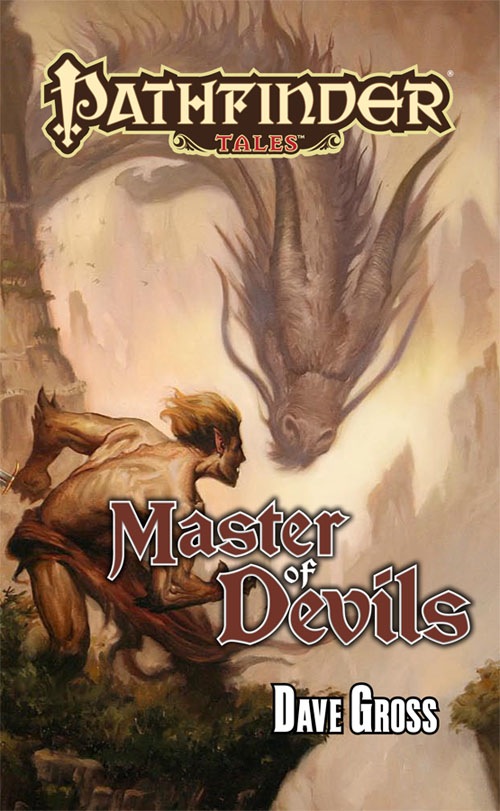
Just announced! The cover is a mockup, and will change prior to publication.


 Dark_Mistress
|

Cool cover and yes I know it is a mock up. :)
|
Dave Gross
Contributor
|

Wait until you see the final artwork. James gave me a peek at it today. I've been blessed with a few great covers in past, but this one leaves them all behind. Acknowledging my obvious bias, I'm tempted to say it's the finest piece of artwork I've yet seen from Paizo ... and that is saying a lot.
 weirmonken
|

Having highly enjoyed Prince of Wolves, I have to say I'm looking forward to this. Congrats on your ongoing relationship with Pathfinder Tales, Mr. Gross!
| Lilith |

I keep wanting to break out into Metallica's "Master of Puppets" song.
This is entirely your fault Dave.


| Justin Franklin |

I keep wanting to break out into Metallica's "Master of Puppets" song.
This is entirely your fault Dave.
And that is a problem why? ;) I am looking forward to this one.
|
srd5090
|

A new Varian and Radovan book? YESSSS
Prince of Wolves was such a great book. Looking forward to more awesome tales featuring those two characters.
 Lazaro
|

I keep wanting to break out into Metallica's "Master of Puppets" song.
This is entirely your fault Dave.
And fixed :p


|
Asgetrion
|

*Snif*, a "twisted Master of Devils"... you guys finally decided to publish a book featuring me?

| Nickolas Russell |

A black & white pic is in the back of Worldwound Gambit, let us see the color version!
|
Dave Gross
Contributor
|
I'll do more of this sort of post closer to the release date, but here are some notes on one of the films that would have inspired Master of Devils if I'd seen it before finishing the manuscript: Detective Dee and the Mystery of the Phantom Flame.
|
Dave Gross
Contributor
|
I'll do more of this sort of post closer to the release date, but here are some notes on one of the films that would have inspired Master of Devils if I'd seen it before finishing the manuscript: Detective Dee and the Mystery of the Phantom Flame.
I've added several more wuxia film recommendations at my blog. Another's coming on Monday.
|
Rivermurk the Vengeful
|

Excellent - Prince of Wolves was a great read and was enough to convince me to sign up for a Pathfinder Tales subscription. Looking forward to some Radovan goodness, with his 'big smile'.
|
srd5090
|
I was present at Paizocon for Mr. Gross to discuss this book, and he mentioned the chronological timing of this book and the next entry in the Pathfinder Chronicles fiction featuring Varian and Radovan.
I forget the order though....
I believe it was Master of Devils, THEN the Jade Regent fiction?
I know it's not important to the stories but I still like to be in order. =) Any help?
|
Dave Gross
Contributor
|
I was present at Paizocon for Mr. Gross to discuss this book, and he mentioned the chronological timing of this book and the next entry in the Pathfinder Chronicles fiction featuring Varian and Radovan.
I forget the order though....
I believe it was Master of Devils, THEN the Jade Regent fiction?
I know it's not important to the stories but I still like to be in order. =) Any help?
Let me emphasize that the order in which you read them truly doesn't matter. In fact, the Wayfinder/Web story "A Lesson in Taxonomy" is chronologically the first Varian Jeggare story, but it's much more fun to read it after experiencing the first few tales of Radovan and the Count.
Chronologically it's "A Passage to Absalom" (the web fiction starting next Wednesday), then "Husks" (the AP serial), and then Master of Devils.
I wrote them in reverse chronological order, though, so there's a good argument for going backward.
|
srd5090
|
Let me emphasize that the order in which you read them truly doesn't matter. In fact, the Wayfinder/Web story "A Lesson in Taxonomy" is chronologically the first Varian Jeggare story, but it's much more fun to read it after experiencing the first few tales of Radovan and the Count.
Chronologically it's "A Passage to Absalom" (the web fiction starting next Wednesday), then "Husks" (the AP serial), and then Master of Devils.
I wrote them in reverse chronological order, though, so there's a good argument for going backward.
Thank you Dave! That reassures me.
I guess while we are on the subject (and to help those who are also HUGE fans of V&R!), what are the other orders of their stories?
I think we can obviously say Prince of Wolves is before the Tian stories, but before that, does it go A Lesson in Taxonomy -> Hell's Pawns -> Lost Pathfinder -> Prince of Wolves?
I'm OCD about chronological orders...
 Paris Crenshaw
Contributor
Paris Crenshaw
Contributor
|

I finally posted a review on my blog. I had hoped to get this out before GenCon, so folks would be encouraged to pick up the novel there. Sorry for the delay.
I didn't post the full review in the "reviews" section, because it's a double-feature post for Prince of Wolves and Master of Devils. It is a very long article.
I will post a link to the same article on Amazon.com when I'm able to enter a review on their website. It's still listed as "unavailable" there.
 Sara Marie
|

I finished reading this on the way out to GenCon and the ending was quite spectacular. The bit with the thing and the stuff was so cool!
|
Enlight_Bystand
|

Quote:Let me emphasize that the order in which you read them truly doesn't matter. In fact, the Wayfinder/Web story "A Lesson in Taxonomy" is chronologically the first Varian Jeggare story, but it's much more fun to read it after experiencing the first few tales of Radovan and the Count.
Chronologically it's "A Passage to Absalom" (the web fiction starting next Wednesday), then "Husks" (the AP serial), and then Master of Devils.
I wrote them in reverse chronological order, though, so there's a good argument for going backward.
Thank you Dave! That reassures me.
I guess while we are on the subject (and to help those who are also HUGE fans of V&R!), what are the other orders of their stories?
I think we can obviously say Prince of Wolves is before the Tian stories, but before that, does it go A Lesson in Taxonomy -> Hell's Pawns -> Lost Pathfinder -> Prince of Wolves?
I'm OCD about chronological orders...
That's right.
|
Chris Ballard
|

I'm wondering if there's any copies out there, besides mine, that had issues with faintly printed pages. They aren't so faint I can't read the pages but there is quite a difference in those pages and other pages.
|
Stark Enterprises VP
|

I'm wondering if there's any copies out there, besides mine, that had issues with faintly printed pages. They aren't so faint I can't read the pages but there is quite a difference in those pages and other pages.
Precisely ONE page of mine had this problem, so I know what you are talking about, at least.
|
Dark_Mistress
|
I checked mine and it has a number of pages where the text looks a lot more like very dark grey than black. I could tell some text was lighter than other text. None of it is so light as to be hard to read though.
| Christopher Paul Carey |

I'm wondering if there's any copies out there, besides mine, that had issues with faintly printed pages. They aren't so faint I can't read the pages but there is quite a difference in those pages and other pages.
That's a printer error. The inking looks good on all the copies I've seen. I'll alert customer service to this and see if they can't take care of you.
|
Sara Marie
|
Chris Ballard wrote:I'm wondering if there's any copies out there, besides mine, that had issues with faintly printed pages. They aren't so faint I can't read the pages but there is quite a difference in those pages and other pages.That's a printer error. The inking looks good on all the copies I've seen. I'll alert customer service to this and see if they can't take care of you.
Email sent :D
Thanks for bringing this to my attention Chris!| gbonehead Owner - House of Books and Games LLC |

Mine's certainly not illegible, but the print is noticeably weird.
| Thanael |

Same here. Some pages are very faint, not unreadable but faint.
That said, it's a great book so far. I bow to Dave's knowledge of eastern movies and tropes. Great fun!
| gbonehead Owner - House of Books and Games LLC |
Same here. Some pages are very faint, not unreadable but faint.
That said, it's a great book so far. I bow to Dave's knowledge of eastern movies and tropes. Great fun!
I agree. This is definitely one of my favorites; I'm just under half done and it's going fast.
| Thanael |
So now for the nerdy part. I know i know it's a novel and doesn't have to 100% follow the PF rules, but indulge me.
Radovan was revealed to be a CL7 (rog5/mnk2) character in KQ14. I don't know at which point in the novels/stories that is but it feels about right for before Prince of Wolves. Now in Master of Devils without doubt both Jeggare and Radovan gain a few levels, learning some monkish skills...
For example Radovan learns the High Jump monk skill (mmk5) and later Abundant Step (mnk12!)and even Quivering Palm(mnk15!!!). Is he really a 15 the level monk at the end of the novel then? On top of his rogue levels? Or is there a spell or a function of his devil-side that allows him to gain those skills?
This would mean a significant increase of character level between the novels, which i just can't really . It breaks suspension of disbelief at bit for the continuity imho. No doubt the novel is a great fun high level adventure but i can't quite wrap my head around that crass shift of power level of the protagonists.
|
Dave Gross
Contributor
|
So now for the nerdy part. I know i know it's a novel and doesn't have to 100% follow the PF rules, but indulge me.
** spoiler omitted **
Another look at Chapter Six might answer your question, but if not I'll give you the blunt answer if you can join us on the 29th.
Master of Devils Chat
Monday, August 29, 9:00 ET, 6:00 PT
To join the chat, point your browser to chat.dmtools.org, choose a screen name, and type /join PFTales.
| Thanael |
Thanks for the answer Dave. I reread chapter 6 , but i still don't get it.
Will see if I can make the chat.
BTW Dave, i read on your facebook page that you're searching for a reasonably priced copy of Snake in Eagle's Shadow. I do hope you have at least seen the film, or did you really not? It's a great classic, and has been broadcast on TV here in Germany quite a few times.
|
Dave Gross
Contributor
|
BTW Dave, i read on your facebook page that you're searching for a reasonably priced copy of Snake in Eagle's Shadow. I do hope you have at least seen the film, or did you really not? It's a great classic, and has been broadcast on TV here in Germany quite a few times.
No, I still haven't seen this movie, I've only read about it and viewed a few scenes. It's one of the remaining major gaps in my wuxia movie education.
If you don't catch me in the chat room Monday night, you can find me there on and off much of the time. Just shoot me a message, and I'll give you that straight answer, assuming no one else has done so before then.
|
Dave Gross
Contributor
|
BTW Dave, i read on your facebook page that you're searching for a reasonably priced copy of Snake in Eagle's Shadow. I do hope you have at least seen the film, or did you really not? It's a great classic, and has been broadcast on TV here in Germany quite a few times.
Also, Flames Rising has posted five more of my kung fu movie recommendations. I'll resume my regular blog recommendations soon.
|
Dave Gross
Contributor
|
Well I couldn't make it to the chat. Care to let the cat out of the bag, Dave?
The chat's still about six hours away. If you still can't make it, I'll respond under a spoiler-tag, but it's a BIG spoiler for those who haven't read the book. If you come to the chat room soon, you might catch me while I'm hanging out and eating my lunch for the next little while. Go to chat.dmtools.org and pick a username.
|
Dave Gross
Contributor
|
So now for the nerdy part. I know i know it's a novel and doesn't have to 100% follow the PF rules, but indulge me....
** spoiler omitted **
Thus, once he's shed of the big devil body, and while he may have picked up a few things along the way, Radovan's not walking off with the power to perform those high-level monk abilities. They died with the big devil he was stuck inside.

 Bagpuss
|

Written a review (summary: I really like the book).
I personally don't care about any speedy advance in power that wouldn't happen in-game, because the rules aren't written to make good fiction.
| Protoman |

I loved this book! I ESPECIALLY love the appearance of my favorite simian demigod as I never get enough of him in any sorts of media. I've been wanting to read an asian-themed fantasy D&D story since I've started playing so I'm grateful you wrote it.