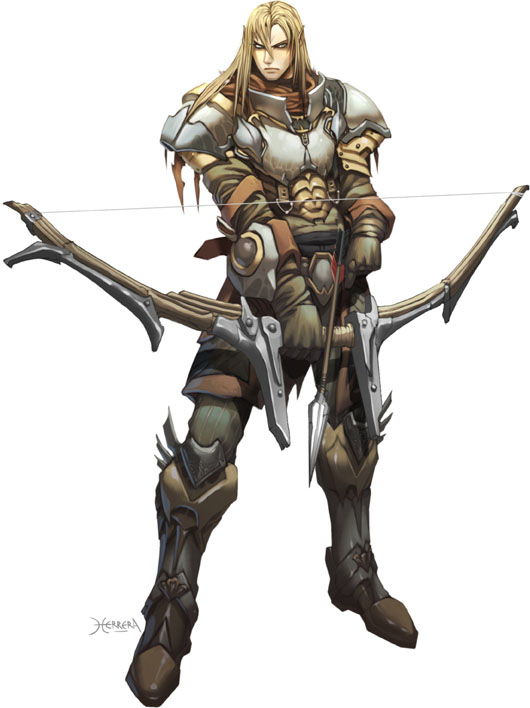
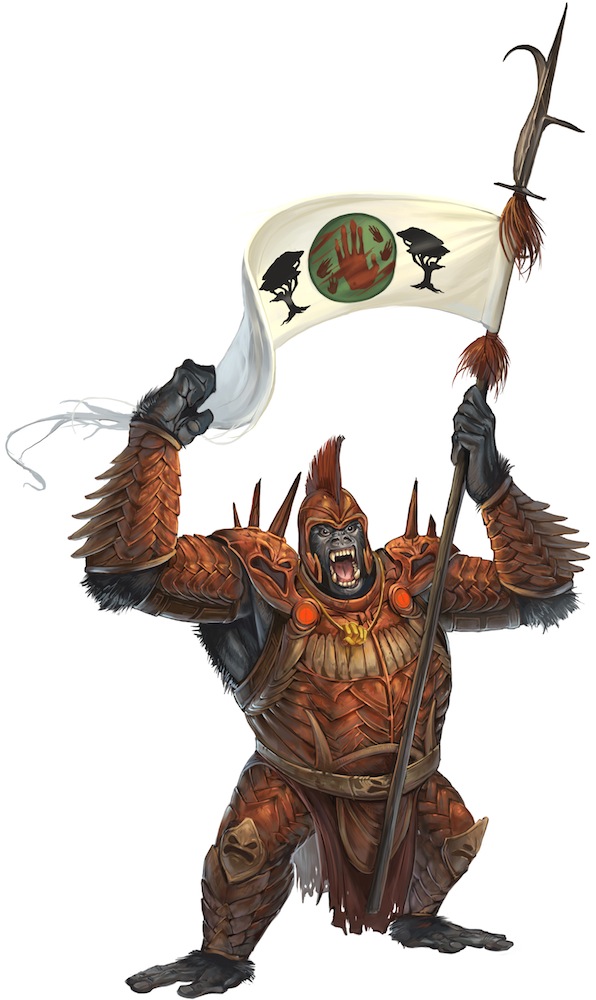
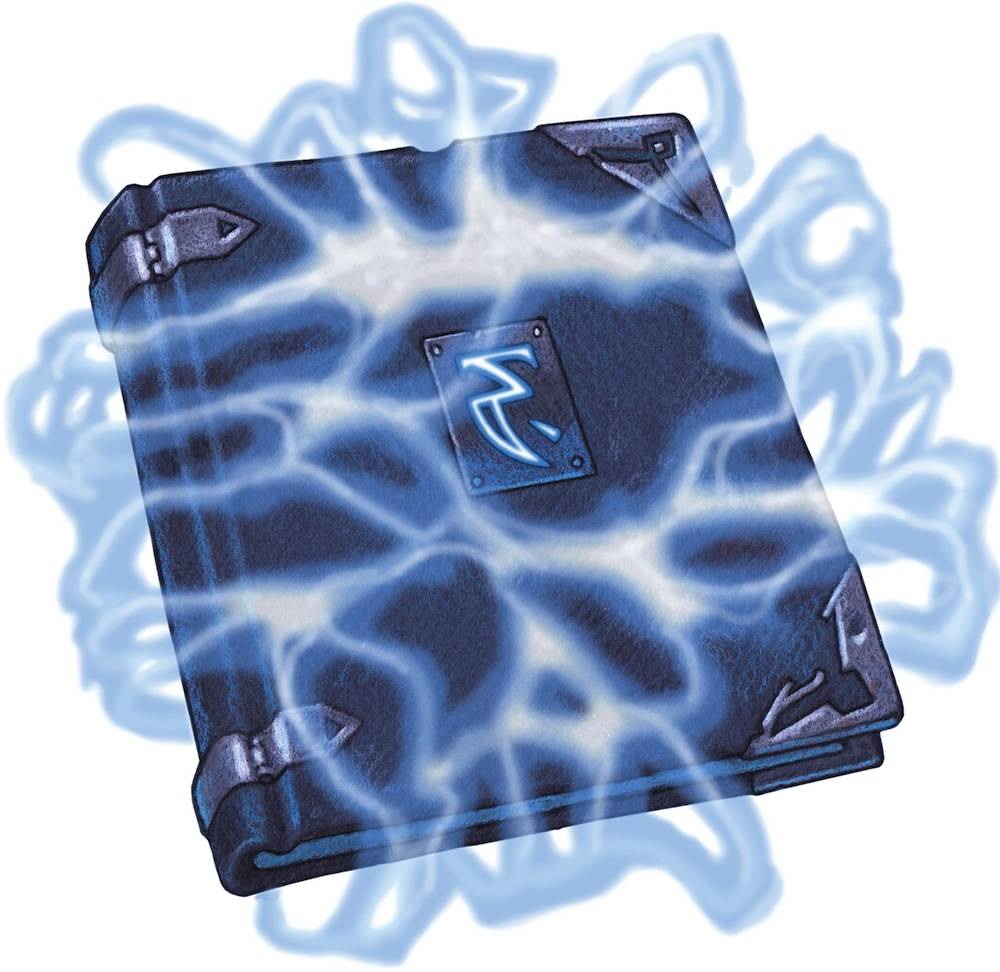
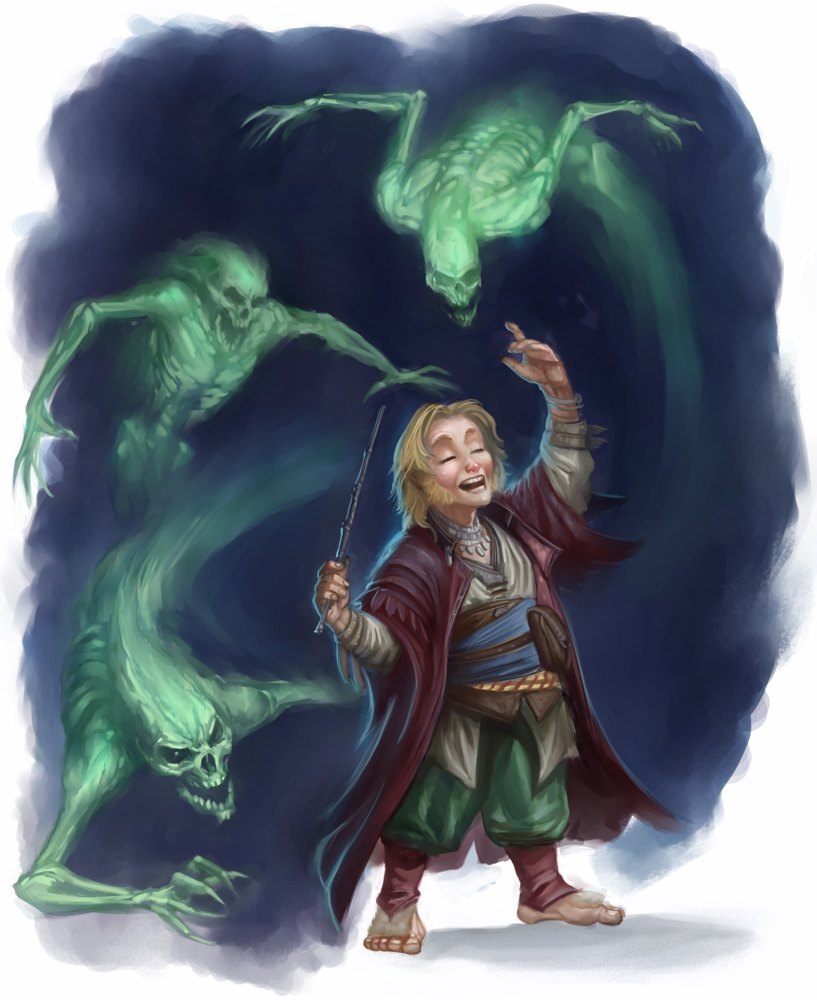
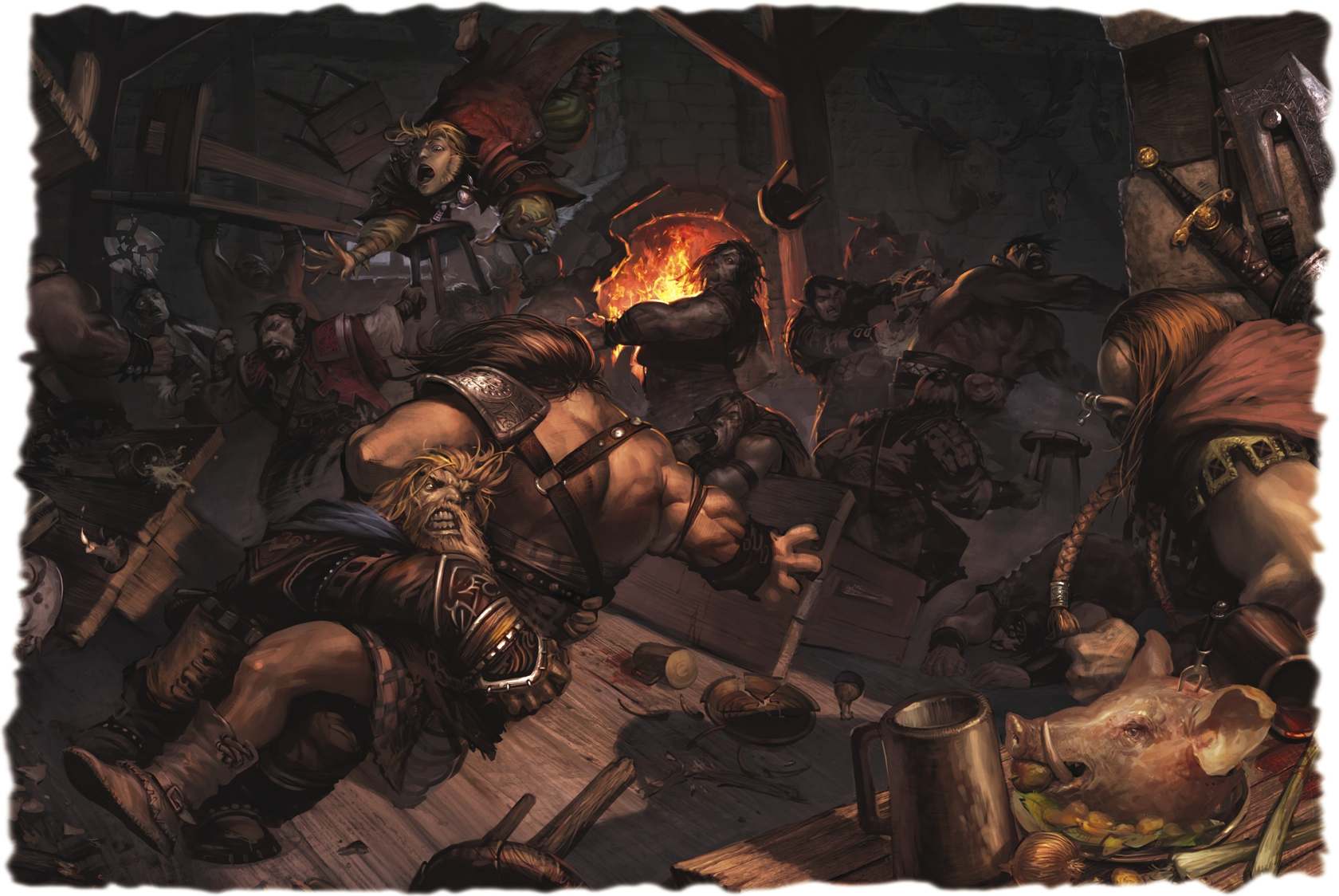
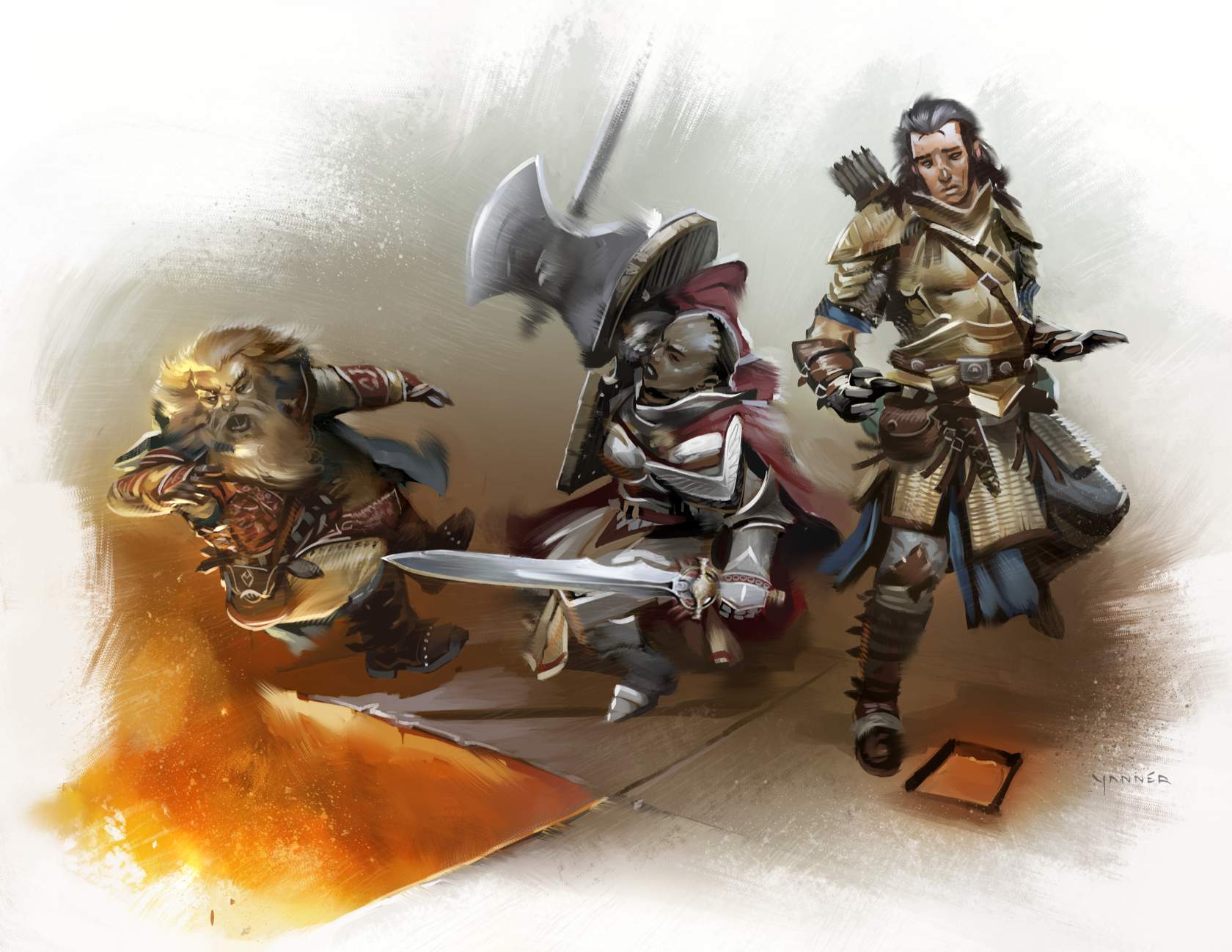
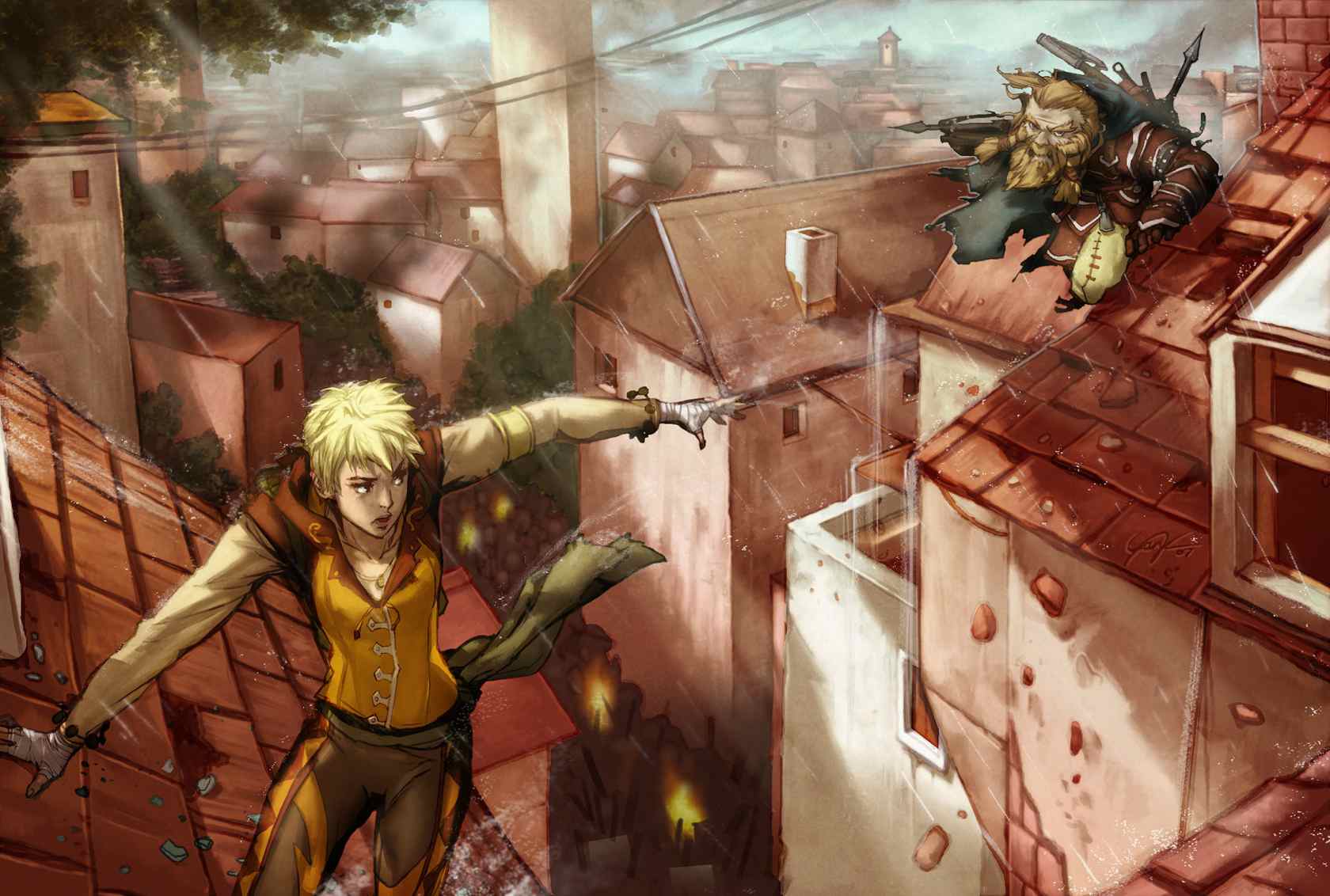
... Puzzling Races Tuesday, December 27, 2011 Last week Sean shared a list of the featured races appearing in the Advanced Race Guide. He’s a softie, intoxicated with a dose of holiday cheer, and was hopped up on the sugary goodness that is Andrew Vallas’s mom’s delicious baklava. (She sends a care package with enough for everyone in the Paizo offices just in time for Christmas and it is marvelous. Phenomenal even...but I digress.) ... This week, you get me. I’m not nearly as charitable, I’m...
Puzzling Races
Tuesday, December 27, 2011
Last week Sean shared a list of the featured races appearing in the Advanced Race Guide. He’s a softie, intoxicated with a dose of holiday cheer, and was hopped up on the sugary goodness that is Andrew Vallas’s mom’s delicious baklava. (She sends a care package with enough for everyone in the Paizo offices just in time for Christmas and it is marvelous. Phenomenal even...but I digress.)
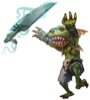
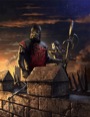
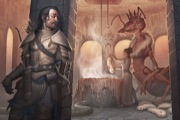
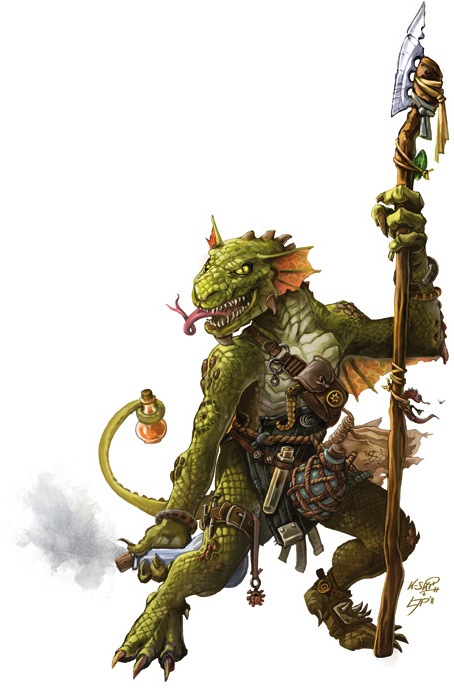
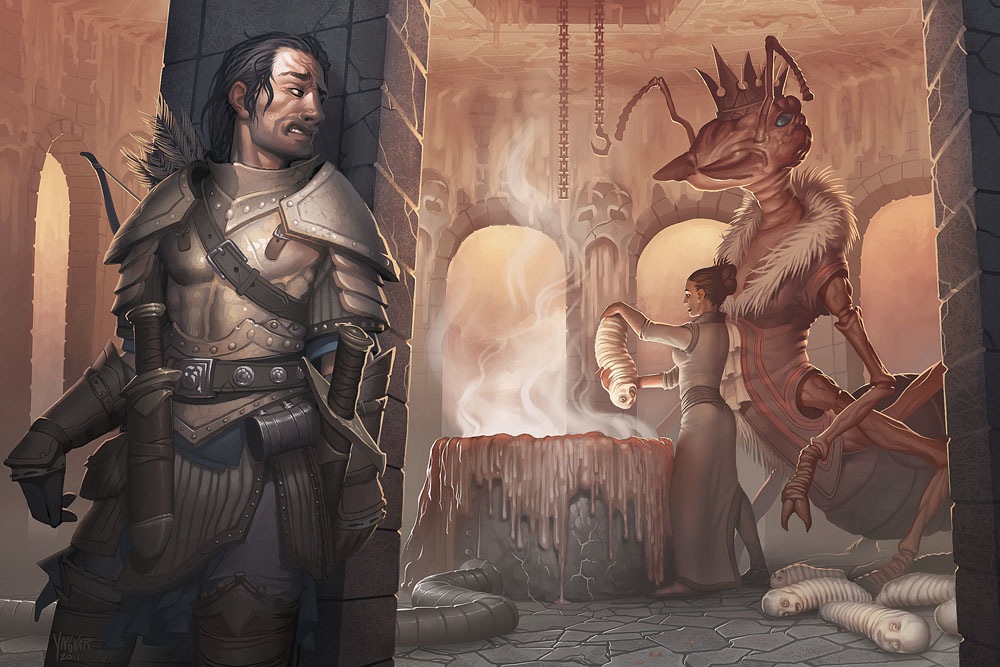
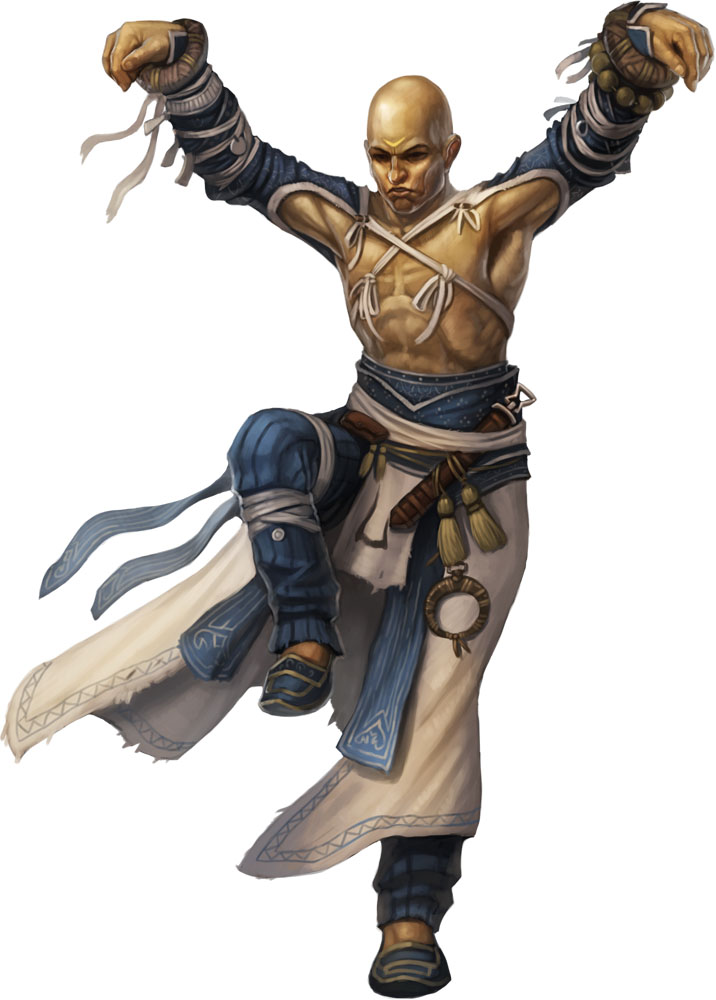
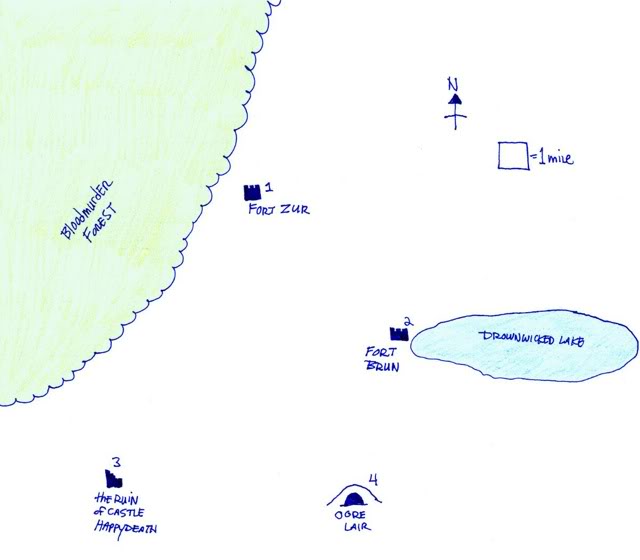
This week, you get me. I’m not nearly as charitable, I’m a bit of a humbug, and all my baklava is long gone, so I’m going to make you work for the next preview. As Sean explained last week, Chapter 3 of the Advanced Race Guide provides information about 14 uncommon races. Below you’ll find the first letter of the name of each of those races. Let’s see how long it takes you to correctly guess them all.
... Illustration by Klaus Scherwinski Advanced Race Guide: Featured Races Tuesday, December 20, 2011Now that we’re wrapping up the last of the Advanced Race Guide, we’ve decided to give you a very early sneak peek at some of its contents. While Chapter 1 covers the races in the Core Rulebook, Chapter 2: Featured Races gives more details on many popular but less common races for the game, plus game mechanics like alternate racial traits and favored class options (like you saw for the core...
Illustration by Klaus Scherwinski
Advanced Race Guide: Featured Races
Tuesday, December 20, 2011
Now that we’re wrapping up the last of the Advanced Race Guide, we’ve decided to give you a very early sneak peek at some of its contents. While Chapter 1 covers the races in the Core Rulebook, Chapter 2: Featured Races gives more details on many popular but less common races for the game, plus game mechanics like alternate racial traits and favored class options (like you saw for the core races in the Advanced Player’s Guide) and some other neat stuff you’ll find out about later. Here’s the list of races in this chapter, each getting 6 pages:
Aasimar
Catfolk
Dhampir
Drow
Fetchling
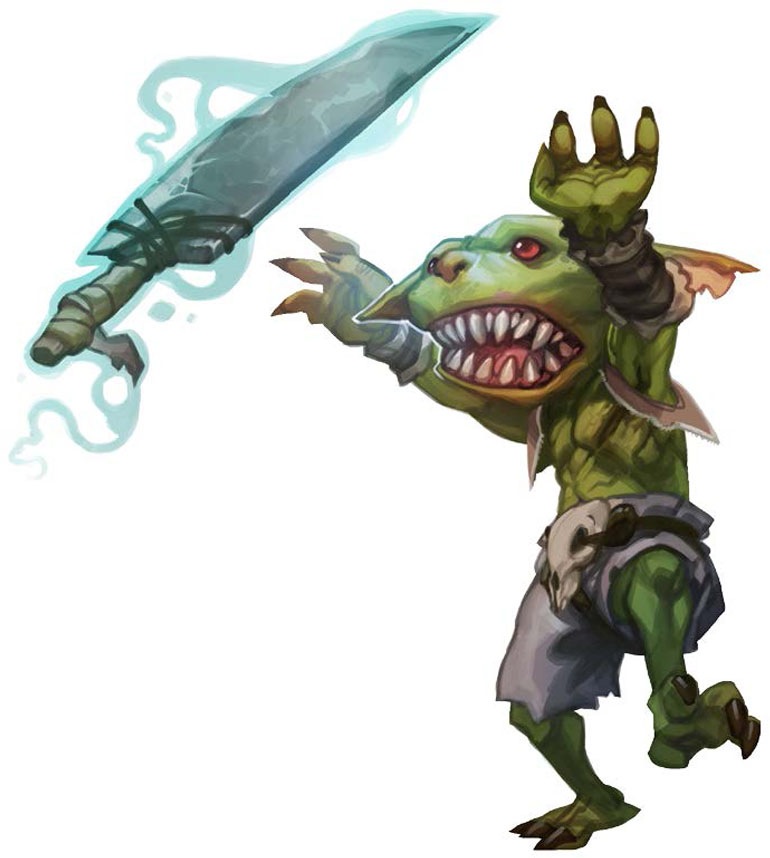
Goblin
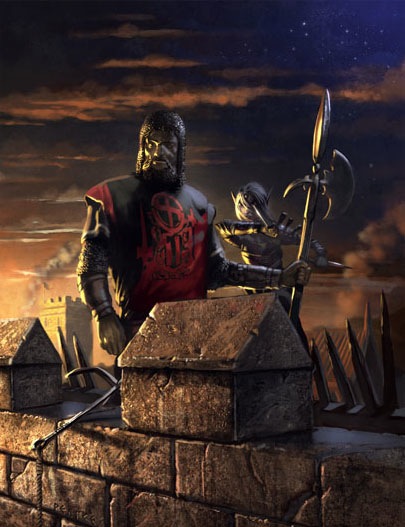
Hobgoblin
Ifrit
Kobold
Orc
Oread
Ratfolk
Sylph
Tengu
Tiefling
Undine
If your favorite non-core PC race isn’t listed here, don’t worry—there are 14 races getting two pages each in Chapter 3, and the build-a-race options in Chapter 4 give you even more choices.
... Unflinching Evil Tuesday, December 6, 2011 When brainstorming a new hardcover bestiary, we have many goals. These books give us an opportunity to support new Adventure Paths and other products. A new 300-plus-page volume of monsters gives us a chance to delve deep into the world’s mythologies and find new and interesting creatures from stories around the world. We get to express our love for classic creatures, exploring the genre’s rich history and smoothing out some of its wackiness. But...
Unflinching Evil
Tuesday, December 6, 2011
When brainstorming a new hardcover bestiary, we have many goals. These books give us an opportunity to support new Adventure Paths and other products. A new 300-plus-page volume of monsters gives us a chance to delve deep into the world’s mythologies and find new and interesting creatures from stories around the world. We get to express our love for classic creatures, exploring the genre’s rich history and smoothing out some of its wackiness. But it also gives us the opportunity to be evil.
And we love us some evil.
Monsters have the potential to take on a number of roles in the Pathfinder Roleplaying Game. They can help a GM illuminate his or her campaign world. Monsters can serve as the impetus for adventure, calling the characters to quests with both words and actions. There is little doubt, though, that the chief job of monsters is to bring the hurt. Some of the best monsters are unflinching in their evil, and that’s the way we like them. While any monster has the potential for true evil, few fill that role like undead. And Bestiary 3has a large portion of undead. From the life-draining hollow serpent, to the soul trapping demilich, to the ship-wreaking sea bonze, all of these monsters have an all-consuming hatred for living things and the living world that has forsaken them. Even on the rare occasions where diplomacy is employed and parley is engaged, all but the most hopeful or deluded adventurer knows that an encounter with undead is doomed to end in the destruction of that corrupt thing or with character death. Their foul nature leaves little room for any middle ground. Even the gun-toting pale stranger—a gunslinger risen from the grave to right some past wrong—is corrupt, evil, and must eventually be put down to make the world a better, safer place.
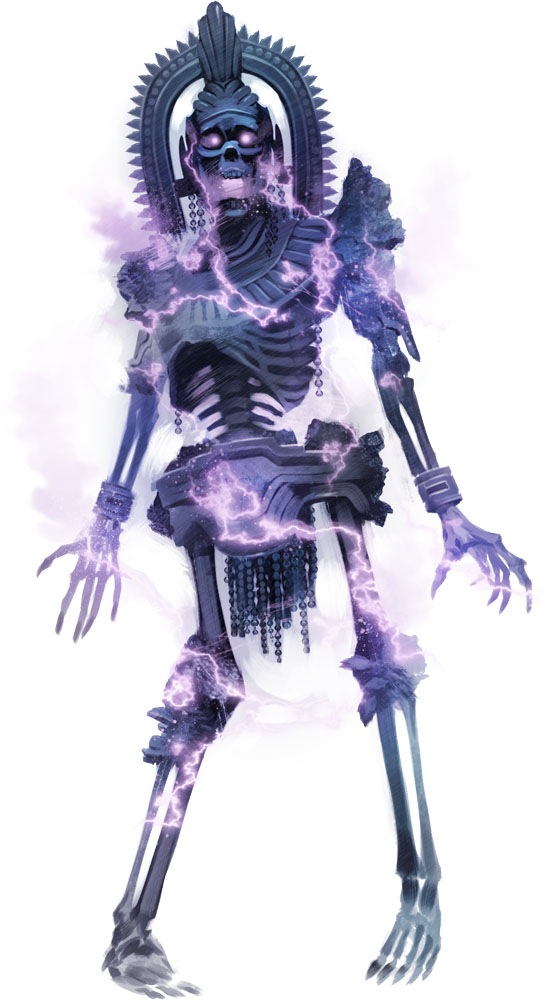
So if you are like me, you love your monsters purely evil, and like to unleash hordes of unredeemable and creepy undead at your party, you are going to like what you find when you crack open Bestiary 3. While Halloween is long gone, consider celebrating a nightmarish holiday season with the ghastly things you find within its pages. You can start with this one: the tzitzimitl, and creature of apocalyptic evil, which exists only to blot out the sun and end all life that dares come across its path.
Illustration by Kieran Yanner
Tzitzimitl CR 19
XP 204,800
NE Gargantuan undead Init +9; Sensesarcane sight, darkvision 60 ft., true seeing; Perception +31
Defense
AC 35, touch 11, flat-footed 30 (+5 Dex, +24 natural, –4 size) hp 319 (22d8+220); fast healing 15 Fort +17, Ref +14, Will +19 Defensive Abilities channel resistance +4, light to dark; DR 15/bludgeoning and good; Immune cold, electricity, undead traits; Resist fire 15; SR 30
Offense
Speed 50 ft., fly 60 ft. (good) Melee bite +26 (2d8+14 plus 3d6 electricity and energy drain), 2 claws +27 (2d6+14/19–20 plus 3d6 electricity) Ranged eye beam +17 touch (10d6 electricity and 10d6 force) Space 20 ft.; Reach 20 ft. Special Attacks eclipse, energy drain (2 levels, DC 31) Spell-Like Abilities (CL 19th; concentration +29)
Constant—arcane sight, fly, true seeing
At will—bestow curse (DC 24), deeper darkness
3/day—animate dead, contagion (DC 23), greater teleport, haste
1/day—create undead, temporal stasis (DC 28), wail of the banshee (DC 29)
Statistics
Str 39, Dex 21, Con —, Int 20, Wis 23, Cha 30 Base Atk +16; CMB +29; CMD 44 Feats Awesome Blow, Combat Reflexes, Improved Bull Rush, Improved Critical (claw), Improved Initiative, Lightning Reflexes, Point-Blank Shot, Power Attack, Precise Shot, Vital Strike, Weapon Focus (claw) Skills Fly +35, Knowledge (arcana) +28, Knowledge (nature) +27, Knowledge (planes) +25, Knowledge (religion) +30, Perception +31, Sense Motive +31, Spellcraft +23, Survival +21, Use Magic Device +30 Languages Abyssal, Aklo, Celestial, Common
Ecology
Environment any Organization solitary Treasure standard
Special Abilities
Eclipse (Su) Anytime a tzitzimitl casts deeper darkness, any creatures in the area of darkness when it is created take 8d6 points of cold damage (DC 31 Fortitude for half). Any creature that takes damage from this effect becomes staggered as long as it remains in the area of darkness and for 1d4 rounds after it leaves that area. The save DC is Charisma-based. Eye Beam (Su) As a standard action, a tzitzimitl can fire a glowing beam of force from its eyes at a range of 100 feet as a ranged touch attack dealing 10d6 points of force damage and 10d6 points of electricity damage. Light to Dark (Su) As an immediate action up to three times per day, a tzitzimitl can convert a positive energy effect that affects it into negative energy. Doing so transforms the entire effect, such that it affects other creatures as well. A tzitzimitl can transform channeled positive energy in this way even if the positive energy would not otherwise harm it.
... Misfit Love Tuesday, November 29, 2011 Shhhhh... Don’t tell anyone, but here at Paizo we love our classic and misfit monsters. There is a tendency to look back at some of the oddball monsters that popped up in the sources of our youth and lament on how strange or even dumb they are. We take a different tact. Instead we revel in their strange and iconic natures. Any chance we get, we look for reason why even the most inexplicable monsters might exist in a fantasy world. ... If you’re a fan...
Misfit Love
Tuesday, November 29, 2011
Shhhhh... Don’t tell anyone, but here at Paizo we love our classic and misfit monsters. There is a tendency to look back at some of the oddball monsters that popped up in the sources of our youth and lament on how strange or even dumb they are. We take a different tact. Instead we revel in their strange and iconic natures. Any chance we get, we look for reason why even the most inexplicable monsters might exist in a fantasy world.
If you’re a fan of our Misfit Monsters Redeemed, you will like how many of those monsters show up in Bestiary 3. From the strangely philosophical flail snail, to those inexplicable fan favorites, the flumphs, to the downright creepy wolf-in-sheep’s-clothing, let’s just say this book is full of some strange old friends. But wait, there’s more!
Misfit Monsters Redeemed is not the only source of inspiration for the classic and misfit monsters that made the cut for Bestiary 3. Many Bonus Bestiary monsters found their way into Bestiary 3—from the axe beak, to the caryatid column, to the unholy huecuva—old favorites abound in this tome.
Now for those of you who buy nearly all of Paizo’s products, and are maybe becoming worried that you’ve seen many of the classic monsters that are appearing in Bestiary 3, don’t worry. While most of the monsters see updates, new information, and maybe some streamlining of mechanics, there are also some old favorites that show up for the first time in a Paizo product. Some of those highlights include the penanggalen, the vodyanoi, and one of my favorite old monsters, the kamadan, which is previewed below, along with its two variants: the dusk and polar kamadan.
Illustration by Eric Belisle
Kamadan CR 4
XP 1,200
NE Large magical beast Init +2; Senses darkvision 60 ft., low-light vision, scent; Perception +8
Defense
AC 17, touch 12, flat-footed 14 (+2 Dex, +1 dodge, +5 natural, –1 size) hp 42 (5d10+15) Fort +7, Ref +6, Will +2
Offense
Speed 40 ft. Melee bite +7 (1d6+3), 2 claws +7 (1d3+3), snakes +2 (1d4+1) Space 10 ft.; Reach 5 ft. (10 ft. with snakes) Special Attacks breath weapon (30-ft. cone, sleep, Fortitude DC 15 negates, usable every 1d4 rounds), pounce
Statistics
Str 17, Dex 15, Con 16, Int 5, Wis 12, Cha 9 Base Atk +5; CMB +9; CMD 22 (26 vs. trip) Feats Combat Reflexes, Dodge, Mobility Skills Acrobatics +6 (+10 when jumping), Perception +8, Stealth +6; Racial Modifiers +4 Stealth Languages Aklo
Ecology
Environment temperate or warm plains Organization solitary, pair, or pack (3–9) Treasure standard
Special Abilities
Breath Weapon (Su) A kamadan can exhale a cone of gas that makes living creatures fall asleep for 5 minutes (Fortitude DC 15 negates). Slapping or wounding awakens a creature put to sleep by this attack, but normal noise does not. This is a sleep effect. The save DC is Constitution-based. Snakes (Ex) A kamadan’s snakes attack simultaneously; this is always a secondary attack.
Dusk Kamadan (CR +1): A dusk kamadan has midnight black fur and snakes bearing black and red ring patterns on their bodies. A dusk kamadan has the advanced creature template, and its snakes have a poisonous bite: Snakes—injury; save Fort DC 17; frequency 1/round for 6 rounds; effect 1d2 Con; cure 2 consecutive saves.
Polar Kamadan (CR +2): A polar kamadan has white fur with black spots like a snow leopard. Its snakes are furred as well. A polar kamadan has the advanced creature template and batlike wings that grant it a fly speed of 60 ft. (average). The breath weapon of a polar kamadan is particularly cold—those who succumb to it also suffer 1d4 points of Dexterity damage from numbness.
Well, that’s it for this week. Come back next week when we unleash more monsters that will make their appearance in Bestiary 3!
... Enter the Dragon! Tuesday, November 15, 2011 Unless you’ve been trapped in jotund troll’s lair for the past few months, you’ve probably noticed that here at Paizo we’ve been exploring a number of Asian themes for the Pathfinder RPG. From the release of the ninja and samurai alternate classes in Ultimate Combat to the Jade Regent Adventure Path, we’ve definitely had the myths and monstrous challenges of the East on our minds. ... To kick off our preview of the soon-to-be-released...
Enter the Dragon!
Tuesday, November 15, 2011
Unless you’ve been trapped in jotund troll’s lair for the past few months, you’ve probably noticed that here at Paizo we’ve been exploring a number of Asian themes for the Pathfinder RPG. From the release of the ninja and samurai alternate classes in Ultimate Combat to the Jade Regent Adventure Path, we’ve definitely had the myths and monstrous challenges of the East on our minds.
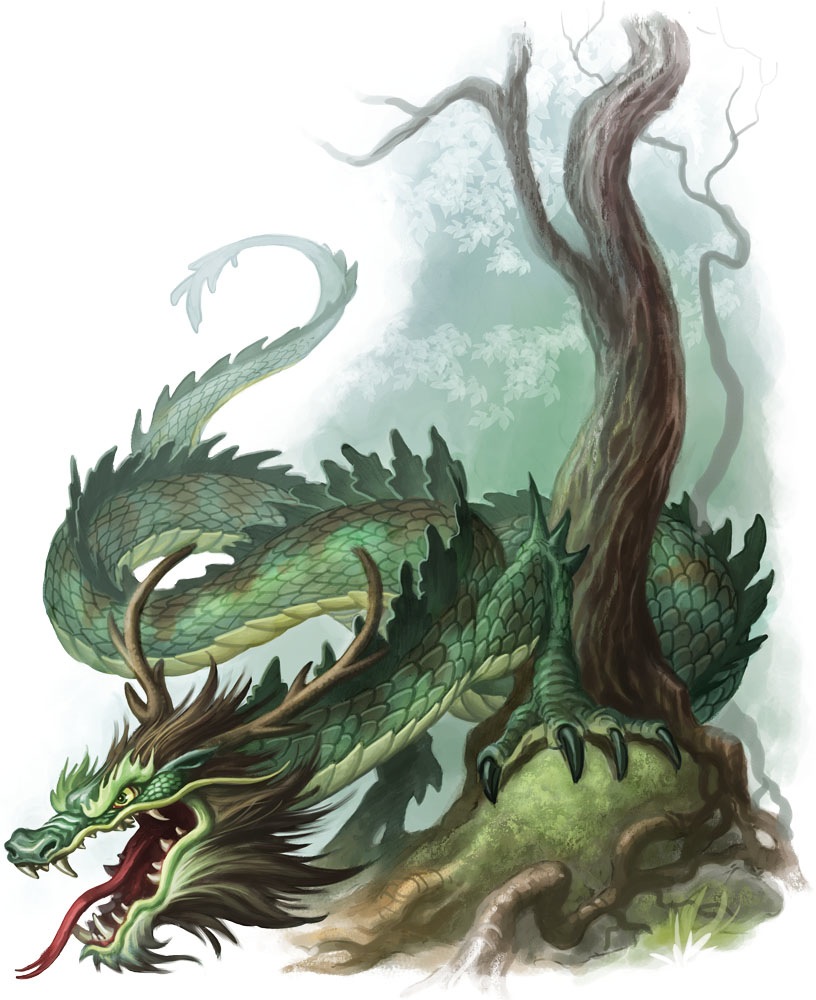
To kick off our preview of the soon-to-be-released Pathfinder RPG Bestiary 3, we are going to continue on with that theme and unleash one of the great challenges of the Dragon Empires—the forest dragon!
Just one of a suite of new imperial dragons—serpentine agents of ancient lands and cosmic balance—these fickle and malevolent creatures wind their way through the forest mists. And while they are capable of the wingless flight common to dragons of their ilk, they prefer to hunt on the forest floor, waylaying those foolish enough to trespass upon their emerald domain.
Illustration by Jim Nelson
Young Forest Dragon CR 10
XP 9,600
CE Large dragon (earth) Init +5; Senses dragon senses, tremorsense 60 ft.; Perception +15
Defense
AC 22, touch 10, flat-footed 21 (+1 Dex, +12 natural, –1 size) hp 126 (11d12+55) Fort +11, Ref +8, Will +8 Immune paralysis, poison, sleep
Offense
Speed 40 ft., burrow 20 ft., climb 30 ft., fly 200 ft. (poor) Melee bite +17 (2d6+9), 2 claws +16 (1d8+6), gore +16 (1d8+9), tail slap +14 (1d8+9) Space 10 ft.; Reach 5 ft. (10 ft. with bite and gore) Special Attacks breath weapon (40-ft. cone, 6d6 piercing damage, DC 19) Spell-Like Abilities (CL 11th; concentration +12)
At will—pass without trace Spells Known (CL 1st; concentration +12)
1st (4/day)—obscuring mist, shield
0 (at-will)—ghost sound, read magic, resistance, touch of fatigue
Statistics
Str 23, Dex 12, Con 18, Int 12, Wis 13, Cha 12 Base Atk +11; CMB +18; CMD 29 (33 vs. trip) Feats Improved Initiative, Multiattack, Power Attack, Skill Focus (Stealth), Toughness, Weapon Focus (bite) Skills Acrobatics +10 (+14 when jumping), Bluff +15, Climb +28, Fly –3, Intimidate +15, Knowledge (arcana, nature) +9, Perception +15, Stealth +17, Survival +10 Languages Common, Draconic SQ sound imitation, woodland stride
Bestiary 3 features adult and ancient versions of this dragon and three versions of the other imperial dragons—sea dragons, sky dragons, sovereign dragons, and underworld dragons—as well as rules for you to make your own imperial dragon menace. This monstrous supplement also features a host of other, similarly themed monsters. From a template for the noble guardian foo creatures, to the treacherous spidery jorogumos, to the ancient and otherworldly kami, and a host of new deadly oni, Bestiary 3 has enough monsters to stock an entire Dragon Empires campaign!
Not planning on adventuring in that part of Golarion for a while? Don’t fret. Next week we will be looking at a host of other monsters in Bestiary 3 that we’re sure can find a place in any one of your upcoming adventures. Until then, beware the twisting trail and cunning tactics of the forest dragon!
Combat Maneuvers and Weapon Special Features Tuesday, September 27, 2011 ... Page 199 of the Pathfinder RPG Core Rulebook says, “When you attempt to perform a combat maneuver, make an attack roll and add your CMB in place of your normal attack bonus. Add any bonuses you currently have on attack rolls due to spells, feats, and other effects. These bonuses must be applicable to the weapon or attack used to perform the maneuver.” That last sentence implies that some weapons apply their bonuses...
Combat Maneuvers and Weapon Special Features
Tuesday, September 27, 2011
Page 199 of the Pathfinder RPG Core Rulebook says, “When you attempt to perform a combat maneuver, make an attack roll and add your CMB in place of your normal attack bonus. Add any bonuses you currently have on attack rolls due to spells, feats, and other effects. These bonuses must be applicable to the weapon or attack used to perform the maneuver.” That last sentence implies that some weapons apply their bonuses on combat maneuver checks, and some do not. So how do you know which weapons do? The answer depends on what kind of combat maneuver you’re attempting, and in some cases what kind of weapon you’re using.
Disarm, sunder, and trip are normally the only kinds of combat maneuvers in which you’re actually using a weapon (natural weapons and unarmed strikes are considered weapons for this purpose) to perform the maneuver, and therefore the weapon’s bonuses (enhancement bonuses, feats such as Weapon Focus, fighter weapon training, and so on) apply to the roll.
For other maneuvers, either you’re not using a weapon at all, or the weapon is incidental to making the maneuver and its bonuses shouldn’t make you better at attempting the maneuver. For example, just because you have a +5 greatsword doesn’t mean it gives you a +5 bonus on dirty trick checks (Pathfinder RPG Advanced Player’s Guide 320), and just because you have a +5 dagger doesn’t mean it gives you a +5 bonus on grapple checks. Of course, the GM is free to rule that in certain circumstances, a creature can apply weapon bonuses for these maneuvers, such as when using a sap in a dirty trick maneuver to hit an opponent in a sensitive spot.
There is a special exception to the above rules. If you’re using a weapon with the trip special feature, and you’re attempting a drag or reposition combat maneuver (Advanced Player’s Guide 321–322), you may apply the weapon’s bonuses to the roll because trip weapons are also suitable for dragging and repositioning (this also means we don’t have to add “drag” and “reposition” weapon properties to existing weapons).
Additionally, the polearm master fighter archetype (Advanced Player’s Guide 106) has an ability called sweeping fend that allows the fighter to use any spear or polearm to make bull rush or trip maneuvers. For the bull rush, this is a specific exception that overrides the general rule of “weapon bonuses don’t apply on bull rushes.” For the trip, the text as written is redundant because anyone can already use a weapon as part of a trip attempt, so giving the polearm master this ability has no effect. This ability needs to be updated as follows.
Update: On page 106 of the Advanced Player’s Guide, Polearm Master, Sweeping Fend ability, delete the second sentence. Replace the first sentence with “At 13th level, a polearm master can use any spear or polearm to make bull rush maneuvers, though he takes a –4 penalty on combat maneuver checks when making such attempts. When using a spear or polearm to make a trip maneuver, he treats these weapons as if they had the trip weapon feature.”
... Stealth Playtest, Round Two Tuesday, September 20, 2011 ... Illustration by Christian PearceIn case you missed it, a few weeks ago the Pathfinder design team previewed some changes we were considering making to the Stealth skill. Like any design endeavor, game design benefits from iteration. After letting all of you playtest the rules and let us know what you thought of the first draft, we went back to the drawing board and made some changes based on that fantastic feedback. ... In this...
Stealth Playtest, Round Two
Tuesday, September 20, 2011
Illustration by Christian Pearce
In case you missed it, a few weeks ago the Pathfinder design team previewed some changes we were considering making to the Stealth skill. Like any design endeavor, game design benefits from iteration. After letting all of you playtest the rules and let us know what you thought of the first draft, we went back to the drawing board and made some changes based on that fantastic feedback.
In this round of playtesting, you'll find that we've cleared up some action issues. We have opened up the possibilities for using standard actions with the Stealth skill, as long as those standard actions do not attack creatures. In this way, the Stealth skill mirrors the rules found in the invisibility spell; at least as far as what actions you can attempt while you are hidden without automatically ending that condition.
Speaking of hidden, while we have kept the invisible condition, and have even strengthened the wording on that condition a bit, we have also created a lesser, connected condition called hidden. You gain the hidden condition when you benefit from Stealth, and you gain the invisible condition when you use a spell or effect that makes you visually undetectable, like the invisibility spell. Hidden is the base condition, and invisible is an upgrade of that condition.
Lastly, we have added some small language changes to explain how the hidden condition interacts with some universal monster rules dealing with senses—specifically blindsense, blindsight, scent, and tremorsense.
Just like the last round of playtesting, keep in mind that these changes are not yet official. While you are free to use them in your home game—and we would like you to do so—these changes are not yet ready for Pathfinder Society play. This time around we are going to give you two weeks to playtest and comment on these proposed changes, so tell us what you think sometime before October 3rd. We'll announce the final version in the Design Tuesday blog sometime after the playtest is completed, and make changes to the rules using the Pathfinder RPG FAQ system.
Stealth
(Dex; Armor Check Penalty) You are skilled at avoiding detection, allowing you to slip past foes or strike from an unseen position. This skill covers hiding and moving silently.
Check: Your Stealth check is opposed by the Perception check of anyone who might notice you. Usually a Stealth check is made at the start of an action when you have some kind of cover (except for soft cover) or concealment. You cannot spend a free action to initiate Stealth, but if you spend a free action while under the effects of Stealth, you must make a new Stealth check to continue its effects. You can always spend a swift action to stay immobile and make a Stealth check. You can move up to half your speed and use Stealth at no penalty. When moving at a speed greater than half your speed and up to your normal speed, you take a –5 penalty on the Stealth check. It's usually impossible to use Stealth while taking an immediate action, a full-round action, or any action to make an attack, unless you are subject to greater invisibility or a similar effect, or you are sniping (see below). When you make your Stealth check, those creatures that didn't succeed at the opposed roll treat you as hidden until the start of your next action or until the end of your turn if you do not end your turn with cover or concealment. You are not hidden from creatures that are observing you (creatures that you didn't have cover or concealment from) or that succeed at the opposed check.
A creature larger or smaller than Medium takes a size bonus or penalty on Stealth checks depending on its size category: Fine +16, Diminutive +12, Tiny +8, Small +4, Large –4, Huge –8, Gargantuan –12, Colossal –16.
Attacking while Hidden: Usually, making an attack against a creature ends the hidden condition. For purposes of Stealth, an attack includes any spell targeting a foe or whose area or effect includes a foe. Actions directed at an unattended object do not end Stealth. Causing harm indirectly is not an attack. If during your last action you were hidden to a creature, you are still considered hidden when you make the first attack of that new action.
Other Perception Checks: If a creature makes a Perception check as a move action to notice a hidden creature, the DC of the Perception check is the hidden creature's last Stealth check. This is also the case if a creature makes a Perception check to notice a hidden creature because the perceiving creature is entering an area where it could possibly notice a hidden creature.
Sniping: If you already are hidden to a target and you are at least 10 feet away from that target, as a standard action, you can make one ranged attack against that target and immediately make an opposed Stealth check to stay hidden. You take a –20 penalty on your Stealth check when attempting to snipe.
Creating a Diversion to Hide: You can use Bluff to allow you to use Stealth. If you do not have cover or concealment, as a swift action, you can attempt a Bluff check opposed by the Sense Motive of opponents that can see you. If you are successful, you are considered to have concealment from those creatures (but you do not gain the percent miss chance from concealment) until the end of your next action, you make an attack (as defined in the Attacking while Hidden section, above), or the end of your turn, whichever happens first.
Action: Usually making a Stealth check is not an action. Using Stealth is part of the action you are taking.
Special: If you are subject to the invisibility or greater invisibility spells or a similar effect, you gain a +40 bonus on Stealth checks while you are immobile, or a +20 bonus on Stealth checks while you're moving. If you have the Stealthy feat, you get a bonus on Stealth checks (see Chapter 5).
Conditions
Hidden: You are difficult to detect but you not invisible. A hidden creature gains a +2 bonus on attack rolls against sighted opponents, and ignores its opponents' Dexterity bonus to AC (if any). You do not have line of sight to a creature or object that is hidden from you.
Invisible: Invisible creatures are visually undetectable. An invisible creature or object gains the benefits of the hidden condition. An invisible object or creature gains total concealment.
Universal Monster Rules
Blindsense (Ex) Using nonvisual senses, such as acute smell or hearing, a creature with blindsense notices things it cannot see. The creature usually does not need to make Perception checks notice hidden creatures or to pinpoint the location of an invisible creature within range of its blindsense ability, provided that it has line of effect to that creature. Any opponent the creature cannot see still has total concealment from the creature with blindsense, and the creature still has the normal miss chance when attacking foes that have concealment. Visibility still affects the movement of a creature with blindsense. A creature with blindsense is still denied its Dexterity bonus to Armor Class against attacks from creatures it cannot see. Format: blindsense 60 ft.; Location: Senses.
Blindsight (Ex) This ability is similar to blindsense, but is far more discerning. Using nonvisual senses, such as sensitivity to vibrations, keen smell, acute hearing, or echolocation, a creature with blindsight maneuvers and fights as well as a sighted creature. invisibility, darkness, and most kinds of concealment are irrelevant, as is the hidden condition, though the creature must have line of effect to a creature or object to discern that creature or object. The ability's range is specified in the creature's descriptive text. The creature usually does not need to make Perception checks to notice creatures within this range. Unless noted otherwise, blindsight is continuous, and the creature need do nothing to use it. Some forms of blindsight, however, must be triggered as a free action. If so, this is noted in the creature's description. If a creature must trigger its blindsight ability, the creature gains the benefits of blindsight only during its turn. Format: blindsight 60 ft.; Location: Senses.
Scent (Ex) This special quality allows a creature to detect approaching enemies, sniff out hidden foes, and track by sense of smell. Creatures with the scent ability can identify familiar odors just as humans do familiar sights.
The creature can detect opponents within 30 feet by sense of smell. If the opponent is upwind, the range increases to 60 feet; if downwind, it drops to 15 feet. Strong scents, such as smoke or rotting garbage, can be detected at twice the ranges noted above. Overpowering scents, such as skunk musk or troglodyte stench, can be detected at triple normal range.
When a creature detects a scent, the exact location of the source is not revealed—only its presence somewhere within range. The creature can take a move action to note the direction of the scent. When it is within 5 feet of the source, the creature pinpoints the source's location or notices a hidden creature.
A creature with the scent ability can follow tracks by smell, making a Wisdom (or Survival) check to find or follow a track. The typical DC for a fresh trail is 10 (no matter what kind of surface holds the scent). This DC increases or decreases depending on how strong the quarry's odor is, the number of creatures, and the age of the trail. For each hour that the trail is cold, the DC increases by 2. The ability otherwise follows the rules for the Survival skill. Creatures tracking by scent ignore the effects of surface conditions and poor visibility. Format: scent; Location: Senses.
Tremorsense (Ex) A creature with tremorsense is sensitive to vibrations in the ground and can automatically notice hidden creatures and objects as well as pinpoint invisible creatures and objects in contact with the ground. Aquatic creatures with tremorsense can also sense the location of creatures moving through water. The ability's range is specified in the creature's descriptive text. Format: tremorsense 60 ft.; Location: Senses.
... Stealth Playtest Tuesday, August 23, 2011 ... Illustration by Yngvar ApslundHere at Paizo, the design team has a host of challenges. Some of the greatest challenges come when dealing with the rules of our game that don't work as well as we would like. For a number of weeks we have been talking about the issues concerning the Stealth skill. Over the course of those conversations we have come up with many ideas to improve this skill and make its use both clearer and more playable. ... So,...
Stealth Playtest
Tuesday, August 23, 2011
Illustration by Yngvar Apslund
Here at Paizo, the design team has a host of challenges. Some of the greatest challenges come when dealing with the rules of our game that don't work as well as we would like. For a number of weeks we have been talking about the issues concerning the Stealth skill. Over the course of those conversations we have come up with many ideas to improve this skill and make its use both clearer and more playable.
So, here is our crazy idea: We are thinking about just rewriting the skill. This is our first stab at a rewrite, but before we make any definitive change, we want to unleash our crazy ideas to you—the Pathfinder players—to poke holes in, give us input on, and playtest. The following changes to the Stealth rules are by no means final, nowhere near official, and definitely not usable in Pathfinder Society. They're here for you to read, think on, playtest, and then for you to give us feedback. We will be listening for the next week. Have fun!
Stealth
(Dex; Armor Check Penalty)
You are skilled at avoiding detection, allowing you to slip past foes or strike from an unseen position. This skill covers hiding and moving silently.
Check: Your Stealth check is opposed by the Perception check of anyone who might notice you. Usually a Stealth check is made at the start of a free, move, or swift action when you start that action with either some kind of cover (except for soft cover) or concealment. You can always spend a swift action to stay immobile and make a Stealth check. You cannot spend a free action to initiate a Stealth check, but if you spend a free action while under the effects of Stealth, you must make a new Stealth check in order to continue the effects of Stealth. You can move up to half your normal speed and use Stealth at no penalty. When moving at a speed greater than half and up to your normal speed, you take a –5 penalty. It's usually impossible to use Stealth while taking an immediate action, standard action, or a full-round action, unless you are subject to greater invisibility or a similar effect, you are sniping (see below), or you are using a standard action to ready an action. When you make your Stealth check, those creatures that didn't succeed at the opposed roll treat you as invisible until the start of your next action or until the end of your turn if you do not end your turn with cover or concealment. When you use Stealth, creatures that are observing you (creatures that you didn't have cover or concealment from) or that succeed at the opposed check do not treat you as invisible.
A creature larger or smaller than Medium takes a size bonus or penalty on Stealth checks depending on its size category: Fine +16, Diminutive +12, Tiny +8, Small +4, Large –4, Huge –8, Gargantuan –12, Colossal –16.
Attacking from Invisibility: Usually making an attack against a creature ends the invisible condition. If during your last action were invisible to a creature, you are still considered invisible when you make the first attack of that new action.
Other Perception Checks: If a creature makes a Perception check as a move action to notice an invisible creature, the DC of the Perception check is the invisible creature's last Stealth check. This is also the case if a creature makes a Perception check to notice an invisible creature because the perceiving creature is entering an area where it could possibly notice an invisible creature.
Sniping: If you already are invisible to a target and you are 10 feet from that target, as a standard action, you can make one ranged attack against that target and immediately make an opposed Stealth check to stay invisible. You take a –20 penalty on your Stealth check when attempting to snipe.
Creating a Diversion to Hide: If you do not have cover or concealment, as a standard action, you can attempt a Bluff check opposed by the Perception of opponents that can see you. On a success, you become invisible to those creatures and can move up to half your speed. When you do this, you take a –10 penalty on the Bluff check.
Action: Usually making a Stealth check is not an action. Using Stealth is part of the action are taking.
Special: If you are subject to the invisibility or greater invisibility spells or a similar effect, you gain a +40 bonus on Stealth checks while you are immobile, or a +20 bonus on Stealth checks while you're moving.
If you have the Stealthy feat, you get a bonus on Stealth checks (see Chapter 5).
... Ultimate Combat Preview #2 Tuesday, July 26, 2011During the preview banquet at PaizoCon this year, I boasted that Ultimate Combat had a gigantic feats chapter, which started off with a seven-page table, summarizing all the feats. While that is impressive, I realized later that I made a mistake—the feats table is nine pages long! ... This week we're going to take a look at the feats chapter a bit more closely, since it is such an important part of this book. This chapter contains 256...
Ultimate Combat Preview #2
Tuesday, July 26, 2011
During the preview banquet at PaizoCon this year, I boasted that Ultimate Combat had a gigantic feats chapter, which started off with a seven-page table, summarizing all the feats. While that is impressive, I realized later that I made a mistake—the feats table is nine pages long!
This week we're going to take a look at the feats chapter a bit more closely, since it is such an important part of this book. This chapter contains 256 feats, suitable for characters of every race and class. There are feats to grant bonuses with nets, feats that let you mix a hex with an unarmed strike, and feats that nearly let you rip off your opponents head! While many of them are combat feats, there are a few new feat categories as well. Grit feats modify and amplify the abilities of the gunslinger class, while style feats represent fighting forms and techniques, primarily employed by martial art masters, such as the monk. Take a look at this chain of style feats.
Illustration by Dmitry Burmak
Crane Style (Combat, Style)
Your unarmed fighting techniques blend poise with graceful defense. Prerequisites: Dodge, Improved Unarmed Strike, base attack bonus +2 or monk level 1st. Benefit: You take only a –2 penalty on attack rolls for fighting defensively. While using this style and fighting defensively or using the total defense action, you gain an additional +1 dodge bonus to your Armor Class.
Crane Wing (Combat)
You move with the speed and finesse of an avian hunter, your sweeping blocks and graceful motions allowing you to deflect melee attacks with ease. Prerequisites: Crane Style, Dodge, Improved Unarmed Strike, base attack bonus +5 or monk level 5th. Benefit: Once per round while using Crane Style, when you have at least one hand free and are either fighting defensively or using the total defense action, you can deflect one melee weapon attack that would normally hit you. You expend no action to deflect the attack, but you must be aware of it and not flat-footed. An attack so deflected deals no damage to you.
Crane Riposte (Combat)
You use your defensive abilities to make overpowering counterattacks. Prerequisites: Crane Style, Crane Wing, Dodge, Improved Unarmed Strike, base attack bonus +8 or monk level 7th. Benefit: You take only a –1 penalty on attack rolls for fighting defensively. Whenever you use Crane Wing to deflect an opponent's attack, you can make an attack of opportunity against that opponent after the attack is deflected.
This is one of the easiest style feats to qualify for, but the trick with these feats is that you cannot utilize more than one style feat at a time, and you cannot use the other feats in the chain unless you are using the base style feat as well. While this means you can get some pretty good abilities if you just focus on one chain, getting into multiple chains forces you to make decisions about which abilities you want on a given round.
Of course, the chapter also features some new teamwork feats and a new classification of feats called Performance feats, which give you an edge when fighting in an arena or other theater of blood. Take a look at these two, one from each category.
Shake It Off (Teamwork)
You support your allies and help them recover from crippling effects. Benefit: When you are adjacent to one or more allies who also have this feat, you gain a +1 bonus on saving throws per such ally (maximum +4).
Murderer's Circle (Combat, Performance)
After savaging your foe, you circle like a hunter ready for the kill. Prerequisites: Dodge, Acrobatics 4 ranks. Benefit: When you spend a swift action to make a performance combat check after scoring a critical hit or performing a combat maneuver, and you are adjacent to the target of the critical hit or combat maneuver, you can move to any other space that is adjacent to the target without provoking attacks of opportunity. You must have a clear path to that space and the ability to reach it by spending a move action. If you end this move in any space other than the one where you started, you gain a +2 bonus on the performance combat check.
I must admit, I picked those two to show off due mainly to their awesome names. There are a lot of really great feats in this book and I would love to show off all of them to you, but you'll just have to check them out for yourself when the book releases next week. For our final preview, we're going to take a look at some of the great new rules systems found in this book, including vehicle combat!
... Ultimate Combat Preview #1 Tuesday, July 19, 2011Time slips by so quickly during the summer months that it seems like a new rulebook is just around the corner. As it turns out, Ultimate Combat is due to release in just a few weeks. From now until Gen Con, we will be showing off some of the exciting new options for characters and GMs alike that hide inside this blood-drenched tome. ... To kick things off, I can think of no better way than to take a look at the classes chapter of Ultimate...
Ultimate Combat Preview #1
Tuesday, July 19, 2011
Time slips by so quickly during the summer months that it seems like a new rulebook is just around the corner. As it turns out, Ultimate Combat is due to release in just a few weeks. From now until Gen Con, we will be showing off some of the exciting new options for characters and GMs alike that hide inside this blood-drenched tome.
To kick things off, I can think of no better way than to take a look at the classes chapter of Ultimate Combat. This book features one brand-new class, the gunslinger, as well as two alternate classes, the ninja and the samurai. In addition, all of the classes that focus on melee or ranged combat get a host of new archetypes in this book. Take a look a this list.
Illustration by Mauricio Herrera
Alchemist: This section presents the beastmorph and ragechemist archetypes. Barbarian: This section includes the armored hulk, scarred rager, sea reaver, titan mauler, true primitive, urban barbarian, and wild rager. Bard: This section includes the archaeologist, daredevil, and dervish dancer. Cavalier: This section includes the beast rider, emissary, gendarme, honor guard, luring cavalier, musketeer, standard bearer, and strategist. Cleric: This section includes the crusader, divine strategist, evangelist, and merciful healer. Druid: This section includes the ape shaman, bat shaman, and boar shaman, as well as the world walker. Fighter: This section includes the armor master, brawler, cad, dragoon, gladiator, tactician, thunderstriker, tower shield specialist, unarmed fighter, and unbreakable. Gunslinger: This section includes the gun tank, musket master, mysterious stranger, and pistolero. Inquisitor: This section includes the iconoclast, spellbreaker, and witch hunter. Magus: This section includes the kensai, myrmidarch, skirnir, and soul forger. Monk: This section includes the flowing monk, maneuver master, martial artist, master of many styles, sensei, sohei, and tetori. Paladin: This section includes the divine hunter, empyreal knight, holy gun, holy tactician, knight of the sepulcher, and sacred shield. Ranger: This section includes the battle scout, deep walker, falconer, trophy hunter, warden, and wild stalker. Rogue: This section includes new rogue talents, plus the bandit, chameleon, charlatan, driver, knife master, pirate, roof runner, sanctified rogue, and survivalist. Wizard: This section includes the arcane bomber, siege mage, and spellslinger.
Of course, some of these classes get other new rules as well, such as rage powers, rogue talents, and the like. Some of these archetypes can make for some versatile and powerful characters. I myself am playing with one of these archetypes in a campaign being run by our illustrious publisher, Erik Mona. Take a look at the Maneuver Master.
Maneuver Master (Archetype)
The maneuver master specializes in more complicated moves than simple damage-dealing strikes. Bonus Feat: In addition to normal monk bonus feats, a maneuver master may select any Improved combat maneuver feat (such as Improved Overrun) as a bonus feat. At 6th level and above, he may select any Greater combat maneuver feat (such as Greater Grapple) as a bonus feat. At 10th level and above, he may select any maneuver Strike feat (such as Tripping Strike) as a bonus feat. Flurry of Maneuvers (Ex): At 1st level, as part of a full-attack action, a maneuver master can make one additional combat maneuver, regardless of whether the maneuver normally replaces a melee attack or requires a standard action. The maneuver master uses his monk level in place of his base attack bonus to determine his CMB for the bonus maneuvers, though all combat maneuver checks suffer a –2 penalty when using a flurry. At 8th level, a maneuver master may attempt a second additional combat maneuver, with an additional –3 penalty on combat maneuver checks. At 15th level, a maneuver master may attempt a third additional combat maneuver, with an additional –7 penalty on combat maneuver checks. This ability replaces flurry of blows. Maneuver Defense (Ex): At 3rd level, if a maneuver master has an Improved combat maneuver feat, any creature attempting that maneuver against the maneuver master provokes an attack of opportunity, even if it would not normally do so. This ability replaces still mind. Reliable Maneuver (Ex): At 4th level, as a swift action, a maneuver master may spend 1 point from his ki pool before attempting a combat maneuver. He can roll his combat maneuver check for that maneuver twice and use the better result. This ability replaces slow fall. Meditative Maneuver (Ex): At 5th level, as a swift action, a maneuver master can add his Wisdom modifier on any combat maneuver check he makes before the beginning of his next turn. He must choose which combat maneuver check to grant the bonus to before making the combat maneuver check. This ability replaces purity of body. Sweeping Maneuver (Ex): At 11th level, a maneuver master can make two combat maneuvers as a standard action, as long as neither maneuver requires the maneuver master to move. He may perform two identical maneuvers against two adjacent enemies, or he may perform two different combat maneuvers against the same target. This ability replaces diamond body. Whirlwind Maneuver (Ex): At 15th level, once per day as a full-round action, a maneuver master can attempt a single combat maneuver against every opponent he threatens, as long as the combat maneuver does not require movement. He makes a single combat maneuver check, and it applies to all targets. This ability replaces quivering palm.
After the first session, I can tell you that this archetype has been a blast to play. We will be looking at some of the fun toys for the monk in more detail next week, but let me close out with one last list of class-filled fun. Here is the revised and expanded list of fighter weapon groups. Weapons marked with one asterisk (*) can be found in the Advanced Player's Guide, while those with two asterisks (**) are from Ultimate Combat. Enjoy and see you all next week.
Axes: bardiche*, battleaxe, dwarven waraxe, greataxe, handaxe, heavy pick, hooked axe**, knuckle axe**, light pick, mattock**, orc double axe, pata**, and throwing axe Blades, Heavy: bastard sword, chakram*, double chicken saber**, double walking stick katana**, elven curve blade, falcata*, falchion, greatsword, great terbutje**, katana**, khopesh*, longsword, nine-ring broadsword**, nodachi**, scimitar, scythe, seven-branched sword**, shotel**, temple sword*, terbutje**, and two-bladed sword Blades, Light: bayonet*, butterfly sword**, dagger, gladius**, kama, kerambit**, kukri, pata**, quadrens**, rapier, short sword, sica**, sickle, starknife, swordbreaker dagger*, sword cane*, and wakizashi** Bows: composite longbow, composite shortbow, longbow, and shortbow Close: bayonet*, brass knuckles*, cestus**, dan bong**, emei piercer**, fighting fan**, gauntlet, heavy shield, iron brush**, light shield, madu**, mere club**, punching dagger, sap, scizore**, spiked armor, spiked gauntlet, spiked shield, tekko-kagi**, tonfa**, unarmed strike, wooden stake*, and wushu dart** Crossbows: double crossbow*, hand crossbow, heavy crossbow, heavy repeating crossbow, light crossbow, light repeating crossbow, and tube arrow shooter** Double: dire flail, dwarven urgrosh, gnome hooked hammer, orc double axe, quarterstaff, and two-bladed sword Firearms: all one-handed**, two-handed**, and siege firearms** Flails: chain spear*, dire flail, double chained kama**, flail, flying blade**, heavy flail, kusarigama**, kyoketsu shoge**, meteor hammer**, morningstar, nine-section whip**, nunchaku, sansetsukon**, scorpion whip**, spiked chain, urumi**, and whip Hammers: aklys**, battle aspergillum*, club, greatclub, heavy mace, light hammer, light mace, mere club**, taiaha**, tetsubo**, wahaika**, and warhammer Monk: bo staff**, brass knuckles**, butterfly sword**, cestus*, dan bong**, double chained kama**, double chicken saber**, emei piercer**, fighting fan**, jutte**, kama, kusarigama**, kyoketsu shoge**, lungshuan tamo**, monk's spade**, nine-ring broadsword**, nine-section whip**, nunchaku, quarterstaff, rope dart**, sai, sansetsukon**, seven-branched sword**, shang gou**, shuriken, siangham, tiger fork**, tonfa**, tri-point double-edged sword**, unarmed strike, urumi**, wushu dart** Natural: unarmed strike and all natural weapons, such as bite, claw, gore, tail, and wing Polearms: bardiche*, bec de corbin*, bill*, glaive, glaive-guisarme*, guisarme, halberd, hooked lance**, lucerne hammer*, mancatcher*, monk's spade**, naginata**, nodachi**, ranseur, rohomphaia**,tepoztopili**, and tiger fork** Spears: amentum**, boar spear*, javelin, harpoon**, lance, longspear, pilum*, shortspear, sibat**, spear, tiger fork**, and trident Thrown: aklys**, amentum**, atlatl**, blowgun, bolas, boomerang*, chakram*, club, dagger, dart, halfling sling staff, harpoon**, javelin, lasso*, kestros**, light hammer, net, poisoned sand tube**, rope dart**, shortspear, shuriken, sling, spear, starknife, throwing axe, throwing shield**, trident, and wushu dart** Siege Engines: all siege engines**
... Outmaneuvered II: Revenge of the Grappled Tuesday, July 12, 2011About a month ago I was punished... er.., I mean rewarded with the task of answering questions about combat maneuvers in the Pathfinder Roleplaying Game. The blog was so well received that I quickly promised to do another one in short order. Well, projects flew by, and I got pulled away, and short order dragged out into weeks, but now I'm back, and here to answer more pressing questions about combat maneuvers. Ready?...
Outmaneuvered II: Revenge of the Grappled
Tuesday, July 12, 2011
About a month ago I was punished... er.., I mean rewarded with the task of answering questions about combat maneuvers in the Pathfinder Roleplaying Game. The blog was so well received that I quickly promised to do another one in short order. Well, projects flew by, and I got pulled away, and short order dragged out into weeks, but now I'm back, and here to answer more pressing questions about combat maneuvers.
Ready?
Illustration by Tyler Walpole
Question:What kind of attacks can you make while you are being grappled? Specifically, if I'm being grappled, can I forgo escaping the grapple to make a full-attack action with a natural, unarmed attack, or attack with light weapon, getting any and all iterative attacks if possible with that action?
Yes. Furthermore, you don't even have to make these attacks against the creature grappling you. While do suffer the normal –2 penalties on attack rolls while grappled, and you are limited in the types of attacks you can make, you gain all the normal attack rolls such an action would normally give you against any creature within your reach.
If you're the one grappling the creature, you can also make your normal attacks, but realize that this ends the grapple. Most of the time you're better off selecting the grapple option that allows you to deal damage to your target as a single unarmed attack, natural attack, or an attack with a light weapon. While you do not get more damage potential based on any iterative attacks, you do not have to make an attack roll. The damage is automatic with the successful grapple check. And let's face it; if you're performing this maneuver, chances are you're pretty good at it.
Lastly, while it should go without saying, keep in mind that attacks of opportunity are not possible while you are grappled, unless you have some feat or other effect that specifically allows them in that condition.
Question: Both the bull rush and drag combat maneuvers say that you have to move the foe in a straight line either forward or backward, depending on the combat maneuver you are performing. What exactly does that mean if the person performing the maneuver is moving diagonally?
When one of these maneuvers tells you to move a foe forward or backward in a straight line, start by placing a point in the middle of your space and make a line to the center of your target's space. Then extend that line in the direction you are trying to move your foe. If you succeed in performing the maneuver you can move your foe into any square that line crosses, depending on how much movement your check grants you.
In the case of a bull rush, if you do not move into the square your foe occupied, and you move that creature more than 5 feet, you cannot reposition this line based on the opponent's new location. The bull rush continues to follow the original line. But if you do move into a new space as part of the maneuver and then continue to move your foe, you can reposition the line of movement each time you change the location of your space, granting you more options when it comes to your foe's final positioning.
When adjudicating the movement of larger creatures, this system may create movement that seems out of the ordinary or conceptually improbable. Your GM has final discretion when determining what squares you can bull rush or drag a creature into or out of.
... Outmaneuvered Tuesday, June 7, 2011Even in the midst of PaizoCon preparation, the design staff just loves those crazy little rules questions that pop up on the messageboards, during actual play, or that just randomly stray into our heads when we are designing an archetype or putting the finishing touches on a monster. Since I just returned from Comicpalooza in Houston, I had a number of those questions come up while conversing with players or that popped up during play, and shared those...
Outmaneuvered
Tuesday, June 7, 2011
Even in the midst of PaizoCon preparation, the design staff just loves those crazy little rules questions that pop up on the messageboards, during actual play, or that just randomly stray into our heads when we are designing an archetype or putting the finishing touches on a monster.
Since I just returned from Comicpalooza in Houston, I had a number of those questions come up while conversing with players or that popped up during play, and shared those experiences when I returned. Well, no good deed goes unpunished. While in the middle of sharing my experiences, Jason quickly pointed out that we needed a Design Tuesday blog. So let's look at some question and answers involving everyone's favorite subject—combat maneuvers! Today I'll go over a couple of pressing ones. We will get into more minutia next week.
Illustration by Allision Theus
Question: Standing up provokes an attack of opportunity. I can attempt to trip a creature with an attack of opportunity. Can I use the trip combat maneuver to keep my opponent down on the ground?
In a word, no. By far this was the most common combat maneuver question at the show that people asked me. I had folks try to use it in the game, and I can understand why. As a tactic, it seems pretty powerful. Too powerful, and that's why there are some subtle timing issues that are going on when a creature attempts to stand up and provokes the attack of opportunity.
When the attack of opportunity is provoked for standing up, the creature is still prone, since an attack of opportunity interrupts the action that provoked it. Since that's the case, the creature is still prone when the attack is provoked, and you cannot trip a prone creature, as it is already prone.
Okay, all you trip monkeys out there, don't fret overly much. If you want an effect similar to the one you desire, you just have to pay a higher action cost. Use the ready action. Just make sure your triggered action is "after the creature stands up from being prone" or something similar. I know, it's not nearly as sexy (or free) but I have faith you'll find a way to make it work to the detriment of those wily monsters.
Question: A creature grappling an opponent typically needs to make two combat maneuver checks to pin someone (one to grapple, the next to pin). If you're pinned, do you also need to succeed at two checks to escape, one for the grab and the other for the pin?
The answer to this question is also no. When a creature is pinned, it gains this more severe version of the grappled condition, and the two conditions do not stack (as described in the pinned condition). While this means that you do not take both the penalties for both the grapple and the pin, this also means that pinned supersedes the grapple condition; it does not compound it. For this reason you only need to succeed one combat maneuver or Escape Artist check to escape either a grapple or a pin.
... Ultimate Cantrips Tuesday, May 24, 2011 ... Illustration by Craig J Spearing ... It didn't take long for many of you to notice that there were no 0-level spells in Ultimate Magic. We made finding this omission easy when we inadvertently left some 0-level spell names in the section containing sample spellbooks. While future printings of the book will fix this problem by deleting the mention of those 0-level spells, until then, we thought you might like to see the developed 0-level spells...
Ultimate Cantrips
Tuesday, May 24, 2011
Illustration by Craig J Spearing
It didn't take long for many of you to notice that there were no 0-level spells in Ultimate Magic. We made finding this omission easy when we inadvertently left some 0-level spell names in the section containing sample spellbooks. While future printings of the book will fix this problem by deleting the mention of those 0-level spells, until then, we thought you might like to see the developed 0-level spells that didn't make it in the book.
The following spells are different from your standard cantrips. They are rare cantrips. Spellcasters that gain access to all 0-level spells at 1st level do not gain access to rare cantrips. A spellcaster gains access to rare cantrips only by uncovering their secrets in some other way. Some are guarded by jealous mages, while others are lost in missing libraries or molder on forgotten scrolls.
These cantrips are not legal in Pathfinder Society play. Note that penumbra was changed into the higher-level spell protective penumbra. The cantrip version is similar, but does not replace its higher-level counterpart.
Breeze School evocation (air); Level sorcerer/wizard 0 Casting Time 1 standard action Components V, S, M (a miniature fan) Range close (25 ft. + 5 ft./2 levels) Target one creature or object Duration 1 hour (D) Saving Throw Will negates (harmless); Spell Resistance yes
You create a light wind that blows against the target, from a direction of your choice. The breeze grants the subject a +2 bonus on saves against very hot conditions, severe heat, breath weapons, and saves against cloud vapors and gases (such as cloudkill, stinking cloud, and inhaled poisons). This spell does not function without air or underwater.
You can only have one breeze active at any one time. If you cast this spell while another casting is still in effect, the previous casting is dispelled.
Drench School conjuration (creation) [water]; Level sorcerer/wizard 0 Casting Time 1 standard action Components V, S Range close (25 ft. + 5 ft./2 levels) Target one creature or object of size Large or smaller Duration 1 round Saving Throw Reflex negates (object); Spell Resistance yes (object)
A sudden downpour soaks the target creature or object. The rain follows the subject up to the range of the spell, soaking the target with water. If the target is on fire, the flames are automatically extinguished. Fires smaller than campfires (such as lanterns and torches) are automatically extinguished by this spell.
Jolt School transmutation [electricity]; Level sorcerer/wizard 0 Casting Time 1 standard action Components V, S Range close (25 ft. + 5 ft./2 levels) Effect spark of electricity Duration instantaneous Saving Throw none; Spell Resistance Yes
You cause a spark of electricity to strike the target with a successful ranged touch attack. The spell deals 1d3 points of electricity damage.
Penumbra School evocation [darkness]; Level sorcerer/wizard 0 Casting Time 1 standard action Components V, S, M (a bit of soot) Range touch Target creature or object touched Duration 10 minutes/level (D) Saving Throw Will negates (harmless); Spell Resistance yes
This spell keeps the creature or object touched slightly in shadow. The target of this spell does not suffer any penalties or blindness caused by bright light, such as those from light sensitivity or light blindness.
You can have only one penumbra spell active at any one time. If you cast this spell while another casting is still in effect, the previous casting is dispelled.
Root School transmutation [earth]; Level sorcerer/wizard 0 Casting Time 1 standard action Components V, S, M (a pinch of dirt) Range touch Target creature touched Duration 1 minute (D) Saving Throw Will negates (harmless); Spell Resistance yes
This spell strengthens the subject's connection to the ground below, bolstering its defense against combat maneuvers. It gains a +2 insight bonus to its CMD to resist being moved or tripped and a +2 competence bonus on all Acrobatics checks made to balance or remain standing on earth, sand, stone, or a similar rocky substance.
Scoop School evocation [force]; Level sorcerer/wizard 0 Casting Time 1 standard action Components V, S Range close (25 ft. + 5 ft./2 levels) Effect 6 inch diameter container of force
Duration concentration Saving Throw none; Spell Resistance yes
You will a small vessel of force into existence. As a move action, you can direct the container up to 15 feet per round in any direction, though the spell ends if the distance between you and the container ever exceeds the spell's range. You can dip the container to pick up or drop a liquid as a move action. The vessel holds up to 1 pint of liquid or small objects, weighing up to 5 pounds. You can also gather up a pint of liquid or small objects spread cross a surface with 1 minute of careful concentration.
... Powerful Words Tuesday, May 17, 2011It is just about here. The newest addition to the Pathfinder RPG line releases this week and you should be able to find Ultimate Magic online or at your local game store any day now. For our final look into this mighty tome of magic, we are going to look at the Words of Power chapter. ... Words of power is an alternative system of spellcasting that allows the wordcaster to create spells using any of the words that he knows. While these spells still...
Powerful Words
Tuesday, May 17, 2011
It is just about here. The newest addition to the Pathfinder RPG line releases this week and you should be able to find Ultimate Magic online or at your local game store any day now. For our final look into this mighty tome of magic, we are going to look at the Words of Power chapter.
Words of power is an alternative system of spellcasting that allows the wordcaster to create spells using any of the words that he knows. While these spells still consume specific slots, what goes in each slot each day depends entirely upon what words the wordscaster knows and how he wants to combine them.
This system went through significant revision throughout the playtesting process. Originally, the system was based on points, with each word added to a spell costing a set amount. A wordcaster could add nearly any number of words so long as the spell slot in question had enough points to pay for them. While this was supremely flexible, most found the point tracking to be too cumbersome and prone to abuse. The new system allows a wordcaster to add one effect word of a level equal to the spell slot used, or multiple words of a lower level. In addition, each spell can have one of a number of different target words (which are not counted against the total number of words in the spell) and they can include one or more meta words (which add power and flexibility to the spell). This means that most spells can be built quite easily if that is what the caster wants (which is certainly the case on the GMs side of the screen), but each can also be carefully crafted out of multiple words to create interesting and unique effects. Take the following effect words for example.
Accelerate (Time) School transmutation; Level alchemist 2, bard 2, magus 2, sorcerer/wizard 2, summoner 2 Duration 1 round/level Saving Throw Will negates (harmless); Spell Resistance yes (harmless) Target Restrictions selected
The target of a wordspell with this effect word can take one additional move action each turn. This move action can come before, after, or between other actions, but not during a full-round action. Boost: If the target takes a full-attack action, it can, instead of taking an extra move action, make one additional attack at its highest attack bonus.
Perfect Form (Body) School transmutation; Level alchemist 4, bard 4, cleric 4, druid 4, magus 4, sorcerer/wizard 4, summoner 4 Duration 1 round/level Saving Throw Will negates (harmless); Spell Resistance yes (harmless) Target Restriction personal, selected
The target of a wordspell with this effect word receives a +4 enhancement to Strength, Dexterity, and Constitution.
Accelerate is a simple enough word, granting its target an additional move action. Perfect form is also relatively straight-forward, granting a +4 bonus to physical ability scores. One of the great things about this system is that the two could be combined by any class capable of casting both into one 5th-level wordspell that enacts both effects simultaneously.
Things get really interesting with the addition of meta words. These words allow a spellcaster to access even greater powers without, necessarily, using up a higher spell slot. For example, the boost meta words can be used with the accelerate word to grant an extra attack instead of a move action. Boosting the selected target word allows a wordspell to affect more than one target, but this has the side effect of increasing the level of spell by three levels. While meta words add a great deal of flexibility to how a wordcaster uses his magic, there is a limit to the number of meta words a wordcaster can use per day. Take a look at this powerful meta word.
Irresistible Level 5
Targets of a wordspell with this meta word must roll their saving throws twice and take the worse result. This meta word increases the level of all the effect words in the wordspell that allow a saving throw by two levels.
As you can see, there are a great deal of possibilities with the words of power system, especially with over 120 effect words at your disposal. And with that, we wrap up our look at Ultimate Magic. We hope you use it to add a bit of magic to your game. In the coming months, expect to hear a lot about the companion to this book, Ultimate Combat, due out in August. Until then.
... Feat of Magic Tuesday, May 10, 2011Due to hit subscribers and store shelves in just a few days, we are continuing our look into Ultimate Magic. This week we are diving into the feats chapter, with a bonus look at spells. ... At 20 pages long, the feats chapter is by no means huge, but it does feature a little something for just about every spellcaster in the game, with a few options for nonspellcasters thrown in for good measure. While a number of these feats are here to complement one of...
Feat of Magic
Tuesday, May 10, 2011
Due to hit subscribers and store shelves in just a few days, we are continuing our look into Ultimate Magic. This week we are diving into the feats chapter, with a bonus look at spells.
At 20 pages long, the feats chapter is by no means huge, but it does feature a little something for just about every spellcaster in the game, with a few options for nonspellcasters thrown in for good measure. While a number of these feats are here to complement one of the new archetypes, some fill out some holes left by the APG. For example, Extra Evolution gives the summoner more points to use when building his eidolon. Looking through the feat lists, though, I am drawn to the feats that allow characters to explore the game in new and interesting ways. Take a look at this one.
Eldritch Heritage
You are descended from a long line of sorcerers, and some portion of their power flows in your veins. Prerequisites: Cha 13, Skill Focus with the class skill of bloodline selected for this feat (see below), character level 3rd. Benefit: Select one sorcerer bloodline. You must have Skill focus in the class skill that bloodline grants to a sorcerer at 1st level (for example, Heal for the celestial bloodline). This bloodline cannot be a bloodline you already have. You gain the first-level bloodline power for the selected bloodline. For purposes of using that power, treat your sorcerer level as equal to your character level – 2, even if you have levels in sorcerer. You do not gain any of the other bloodline abilities.
Bloodlines—they're not just for sorcerers anymore.
Moving on, this book has a number of metamagic feats, as well, for every spellcaster to play with. While a number of these add effects to spells that deal a specific kind of energy damage, my personal favorite (due to some recent frustrating encounters) has to be this one.
Piercing Spell (Metamagic)
Your studies have helped you develop methods to overcome spell resistance. Benefit: When you cast a piercing spell against a target with spell resistance, it treats the spell resistance of the target as 5 lower than its actual SR. A piercing spell uses up a spell slot one level higher than the spell's actual level.
Not surprisingly, this book also includes a sizable number of new spells for every spellcaster in the game. There are new symbol spells, new spells for the polymorph subschool (undead anatomy has been long awaited), and plenty of unique spells for some of the newer spellcasting classes (like witch and inquisitor). In addition, there are a lot spells designed specifically to add a bit of interesting flavor to the spellcaster's arsenal. Looking to flesh out your evil bard? Take a look at this spell.
Illustration by Tyler Walpole
Haunting Choir School necromancy [mind-affecting, pain]; Level bard 3 Casting Time 1 standard action Components V, S Range close (25 ft. + 5 ft./2 levels) Area 30-ft.-radius emanation Duration concentration + 2 rounds Saving Throw Will negates; Spell Resistance yes
You create a spectral choir and conduct its tortured, ghostly moans, deluding listeners into believing they are suffering the torments of the dead. The transparent singers occupy a 10-foot cube, but they are intangible and do not interfere with creatures in any physical way, nor can they be attacked. Creatures within 30 feet of the choir experience wracking pain that causes them to take a –2 penalty on attack rolls, skill checks, and ability checks. Individuals who exit the area of effect take these penalties for an additional 2 rounds before the delusion wears off.
I was about to wrap up the blog right there, but then I remember seeing this spell. I will end with this festive magic. Next week, we will wrap up our previews with one last look at the words of power alternative spellcasting system. Enjoy.
Snapdragon Fireworks School transmutation [fire, light]; Level bard 2, sorcerer/wizard 1 Casting Time 1 standard action Components S, V, M (a bundle of sulfur wrapped in cloth) Range long (400 ft. + 40 ft./level) Effect dragon-shaped fireworks Duration 1 round/level Saving Throw Reflex negates; Spell Resistance yes
A favorite display at halfling midsummer festivals, this spell lets you create fireworks in the shape of tiny dragons. Once per round, as a move action, you may designate a target 5-foot-square within range and launch a pyrotechnic in that direction. The pyrotechnic takes a zigzag path from you to that square, always missing creatures and objects in its path, and detonates in that square with a bang and a colorful burst of fire and light. Creatures in the target square take 1d4 points of fire damage and are dazzled for 1 round (Reflex half, a successful save negates the dazzled condition). Normally when this spell is used as part of a festival, the chosen target is high in the sky to increase visibility and protect observers.
Magus Preview Tuesday, April 26, 2011 ... Illustration by Wayne Reynolds ... Every Tuesday until the book's release, we are going to be digging into some of the new rules and options you will find in Ultimate Magic. After a bit of a mix up last week, this week we are going to take a look at the new base class, the magus, and the archetypes slated to appear in this book. ... From its first appearance as part of the playtest of this book, the magus has gone through a number of iterations. The...
Magus Preview
Tuesday, April 26, 2011
Illustration by Wayne Reynolds
Every Tuesday until the book's release, we are going to be digging into some of the new rules and options you will find in Ultimate Magic. After a bit of a mix up last week, this week we are going to take a look at the new base class, the magus, and the archetypes slated to appear in this book.
From its first appearance as part of the playtest of this book, the magus has gone through a number of iterations. The second playtest version of the class is, in fact, quite a bit similar to the final version of the class, with a number of clarifications made to make things work a bit more smoothly. Take a look at the revised spell strike ability, for example.
Spellstrike (Su): At 2nd level, whenever a magus casts a spell with a range of "touch" from the magus spell list, he can deliver the spell through any weapon he is wielding as part of a melee attack. Instead of the free melee touch attack normally allowed to deliver the spell, a magus can make one free melee attack with his weapon (at his highest base attack bonus) as part of casting this spell. If successful, this melee attack deals its normal damage as well as the effects of the spell. If the magus makes this attack in concert with spell combat, this melee attack takes all the penalties accrued by spell combat melee attacks. This attack uses the weapon's critical range (20, 19–20, or 18–20 and modified by the keen weapon property or similar effects), but the spell effect only deals x2 damage on a successful critical hit, while the weapon damage uses its own critical modifier.
As you can see, we clarified how the attack worked, and how critical hits were handled when using this ability. In addition, we replaced the pool spell abilities with ones that are a bit more in line with the flavor of the class. Take a look at these.
Spell Recall (Su): At 4th level, the magus learns to use his arcane pool to recall spells he has already cast. With a swift action he can recall any single magus spell that he has already prepared and cast that day by expending a number of points from his arcane pool equal to the spell's level (minimum 1). The spell is prepared again, just as if it had not been cast. Improved Spell Recall (Su): At 11th level, the magus's ability to recall spells using his arcane pool becomes more efficient. Whenever he recalls a spell with spell recall, he expends a number of points from his arcane pool equal to 1/2 the spell's level (minimum 1). Furthermore, instead of recalling a used spell, as a swift action the magus can prepare a spell of the same level that he has in his spellbook. He does so by expending a number of points from his arcane pool equal to the spell's level (minimum 1). The magus cannot apply metamagic feats to a spell prepared in this way. The magus does not need to reference his spellbook to prepare a spell in this way.
So, that is a taste of the sorts of changes you can expect to see with the base class itself, but how about those archetypes? Here is a list of all the magus archetypes in the book, with a short description of each.
Magus Archetypes Bladebound: A magus with this archtype is bound to a special sword, called a black blade, that gains powers, and over time, sentience. Hexcrafter: Using the powers of a witch, this magus can use hexes and can curse his enemies. Spellblade: Capable of creating a light blade of pure force, the spellblade can wield two weapons and still cast his spells. Staff Magus: Skilled at using the quarterstaff, these powerful magi can eventually treat any magic staff as a deadly weapon.
That wraps up our preview for this week. Come back next week when we will examine some of the ways this book will help you master magic.
... Illustration by Kieran Yanner ... Ultimate Magic: Witches and Wizards Tuesday, April 19, 2011This week's theme is witches and wizards: two new familiars, two new patron themes, and two arcane discoveries. New Familiars The following are two of the many new familiars presented in Ultimate Magic. ... Fox CR 1/4 ... XP 100 ... N Tiny animal ... Init +2; Senses low-light vision, scent; Perception +8 ... Defense ... AC 14, touch 14, flat-footed 12 (+2 Dex, +2 size) ... hp 5...
Illustration by Kieran Yanner
Ultimate Magic: Witches and Wizards
Tuesday, April 19, 2011
This week's theme is witches and wizards: two new familiars, two new patron themes, and two arcane discoveries.
New Familiars
The following are two of the many new familiars presented in Ultimate Magic.
Fox CR 1/4 XP 100
N Tiny animal Init +2; Senses low-light vision, scent;
Perception +8 Defense AC 14, touch 14, flat-footed 12
(+2 Dex, +2 size) hp 5 (1d8+1) Fort +3, Ref +4, Will +1 Offense Speed 40 ft. Melee bite +1 (1d3-1) Space 2-1/2 ft.; Reach 0 ft. Statistics Str 9, Dex 15, Con 13, Int 2, Wis 12, Cha 6 Base Atk +0; CMB +0; CMD 9 (13 vs. trip) Feats Skill Focus (Perception) Skills Acrobatics +2 (+10
jumping), Perception +8, Stealth +10, Survival +1 (+5 scent tracking); Racial Modifiers +4 Acrobatics when
jumping, +4 Survival when tracking by scent Ecology Environment any Organization solitary, pair, or
skulk (3–12) Treasure none
Foxes are small, doglike carnivores with narrow snouts and bushy tails. A fox's master gains a +2 bonus on Reflex saves.
Hedgehog CR 1/8 XP 50
N Diminutive animal Init +3; Senses low-light vision; Perception
+1 Defense AC 18, touch 17, flat-footed 15
(+3 Dex, +1 natural, +4 size) hp 2 (1d8–2) Fort +0, Ref +5, Will +1 Offense
Speed 20 ft.
Space 1 ft.; Reach 0 ft. Statistics Str 1, Dex 16, Con 6, Int 2, Wis 12, Cha 7 Base Atk +0; CMB –1; CMD 4 (8 vs. trip) Feats Athletic Skills Climb +5, Stealth +19,
Swim +5 Ecology Environment tropical or
temperate forests Organization solitary or pair Treasure none Special
Abilities Spiny Defense (Ex) As a move
action, a hedgehog can roll itself up into a spiny ball. While rolled
up, it gains a +1 enhancement bonus to its existing natural armor, and
any creature attempting to grapple the hedgehog takes 1d3 damage on
making a grapple check. While rolled up, a hedgehog cannot take any
action other than leaving this state. The hedgehog can leave this state
as a move action.
Hedgehogs are spiny, insectivorous mammals. When threatened, a hedgehog
rolls up into a spiny ball as a defense mechanism. A hedgehog's master gains a +2 bonus on Will saves
Witch Patron Themes
The following are some of the alternative witch patron themes presented
in Ultimate Magic.
Arcane discoveries are a new option presented in Ultimate Magic. A wizard can learn an arcane discovery in place of a regular feat or wizard bonus feat.
Fast Study: Normally, a
wizard spends 1 hour preparing all of his spells for the day, or
proportionately less if he only prepares some spells, with a minimum of
15 minutes of preparation. Thanks to mental discipline and clever
mnemonics, you can prepare all of your spells in only 15 minutes, and
your minimum preparation time is only 1 minute. You must be at least a
5th-level wizard to select this discovery. Multimorph (Su): Your studies
in transmogrification have increased your control over shapechanging
spells. When you cast a spell of the polymorph subschool on yourself,
you may expend 1 minute of the spell's duration as a standard action to
assume another form allowed by the spell. You can do this as often as
you like, subject to the duration of the spell. You must be at least a
5th-level wizard to select this discovery.
... Magic Archetypes Tuesday, April 12, 2011For the next month or so, every Tuesday we are going to be digging into some of the new rules and options you will find in Ultimate Magic, which is due to release in May. This week, we'll take a look at some of the new archetypes that take up a full 32 pages of this 256 page tome. ... One of the first things you will notice about this book is that the new classes from the Advanced Player's Guide receive archetypes in this book (except the cavalier,...
Magic Archetypes
Tuesday, April 12, 2011
For the next month or so, every Tuesday we are going to be digging into some of the new rules and options you will find in Ultimate Magic, which is due to release in May. This week, we'll take a look at some of the new archetypes that take up a full 32 pages of this 256 page tome.
One of the first things you will notice about this book is that the new classes from the Advanced Player's Guide receive archetypes in this book (except the cavalier, who does not use magic). Here is an example of a new alchemist archetype, the vivisectionist.
Vivisectionist (Archetype)
A vivisectionist studies bodies to better understand their function. Unlike a chirurgeon, a vivisectionist's goals are not related to healing, but rather to experimentation and knowledge that most people would consider evil. A vivisectionist has the following class features. Sneak Attack: At 1st level, a vivisectionist gains the sneak attack ability as a rogue of the same level. If a character already has sneak attack from another class, the levels from the classes that grant sneak attack stack to determine the effective rogue level for the sneak attack's extra damage dice (so an alchemist 1/rogue 1 has a +1d6 sneak attack like a 2nd-level rogue, an alchemist 2/rogue 1 has a +2d6 sneak attack like a 3rd-level rogue, and so on). This ability replaces bomb. Torturer's Eye: At 2nd level, a vivisectionist adds deathwatch to his formula book as a 1st-level extract. Cruel Anatomist: At 3rd level, a vivisectionist may use his Knowledge (nature) skill bonus in place of his Heal skill bonus. Torturous Transformation: At 7th level, a vivisectionist adds anthropomorphic animal to his formula book as a 2nd-level extract. When he uses this extract, he injects it into an animal as part of a 2-hour surgical procedure. By using multiple doses of this extract as part of the surgery, he multiplies the duration by the number of extracts used.
At 9th level, a vivisectionist adds awaken and baleful polymorph to his formula book as 3rd-level extracts. When he uses the awaken and baleful polymorph extract, he injects it into the target (not a plant) as part of a 24-hour surgical procedure. He can make anthropomorphic animal permanent on a creature by spending 7,500 gp.
At 15th level, a vivisectionist adds regenerate to his formula book as a 5th-level extract. Bleeding Attack: A vivisectionist may select the bleeding attack rogue talent in place of a discovery. Crippling Strike: At 10th level or later, a vivisectionist may select the crippling strike rogue talent in place of a discovery. Discoveries: The following discoveries complement the vivisectionist archetype: alchemical simulacrum*, concentrate poison, doppelganger simulacrum*, feral mutagen, parasitic twin*, plague bomb*, poison bomb, preserve organs*, sticky bomb, tentacle*, tumor familiar*, vestigial arm*, and wings*.
Of course, the classes from the Core Rulebook receive a number of new archetypes as well. Take a look at the Undead Lord archetype for the cleric.
Illustration by Eric Belisle
Undead Lord (Archetype)
An undead lord is a cleric focused on using necromancy to control undead. Her flock is the walking dead and her choir the keening spirits of the damned. This unliving congregation is the manifestation of her unceasing love affair with death.
A cleric cannot take the undead lord archetype unless her deity's portfolio includes the Death domain or a similar domain that promotes undeath. An undead lord has the following class features. Death Magic: An undead lord must select the Death domain (and the Undead subdomain from the Advanced Player's Guide, if available in the campaign). She does not gain a second domain. In all other respects, this works like and replaces the standard cleric's domain ability.
Corpse Companion (Su): With a ritual requiring 8 hours, an undead lord can animate a single skeleton or zombie whose Hit Dice do not exceed her cleric level. This corpse companion automatically follows her commands and does not need to be controlled by her. She cannot have more than one corpse companion at a time. It does not count against the number of Hit Dice of undead controlled by other methods. She can use this ability to create a variant skeleton such as a bloody or burning skeleton, but its Hit Dice cannot exceed half her cleric level. She can dismiss her companion as a standard action, which destroys it. Bonus Feats: All undead lords gain Command Undead as a bonus feat. In addition, at 10th level, she may select one of the following as a bonus feat: Channel Smite, Extra Channel, Improved Channel, Quick Channel, Skeleton Summoner*, Undead Master*. Unlife Healer (Su): At 8th level, the undead lord's spells, spell-like abilities, and supernatural abilities used to heal undead heal an extra 50% damage. At 16th level, these effects automatically heal the maximum possible damage for the effect + the extra 50%. This does not stack with abilities or feats such as Empower Spell or Maximize Spell.
Well, that about wraps up this week. Next week, we will take a look at the magus. Before I go, here is one last bit to get you excited for this book. A complete list of all the archtypes found in Ultimate Magic (except for those sneaky magus archetypes, I'll save those for next week). Each one of these classes has other rules bits associated with them as well, but we will talk about those in a future blog. Enjoy.
Class Archetypes Alchemist: The chirurgeon, clone master, internal alchemist, mindchemist, preservationist, psychonaut, reanimator, and vivisectionist archetypes. Bard: The animal speaker, celebrity, demagogue, dirge bard, geisha, songhealer, and sound striker archetypes. Cleric: The cloistered cleric, separatist, theologian, and undead lord cleric archetypes. Druid: The dragon shaman, menhir savant, mooncaller, pack lord, reincarnated druid, saurian shaman, shark shaman, and storm druid archetypes. Inquisitor: The exorcist, heretic, infiltrator, preacher, and sin eater archetypes. Monk: The high-fantasy qinggong monk archetype. Oracle: The dual-cursed oracle, enlightened philosopher, planar oracle, possessed oracle, seer, and stargazer archetypes. Paladin: This section presents the oathbound paladin archetype. Ranger: The magic trap using trapper archetype. Sorcerer: The crossblooded and wildblooded archetypes. Summoner: The broodmaster, evolutionist, master summoner, and synthesist archetypes. Witch: The beast-bonded, gravewalker, hedge witch, and sea witch archetypes. Wizard: The metal elementalist and wood elementalist wizard schools and the scrollmaster wizard archetype.
Ultimate Magic Previews Start Next Week! Tuesday, April 5, 2011 The newest hardcover for the Pathfinder RPG, Ultimate Magic, is scheduled to ship mid-May, so for the next six weeks we're previewing material from the book. Get ready for: New options and archetypes for every base spellcasting class; More information on the magus class and Words of Power system; New familiars; New magical feats; New spell descriptors and new spells; Guidelines for designing new spells. ... Stay tuned! ......
Ultimate Magic Previews Start Next Week!
Tuesday, April 5, 2011
The newest hardcover for the Pathfinder RPG, Ultimate Magic, is scheduled to ship mid-May, so for the next six weeks we're previewing material from the book. Get ready for:
New options and archetypes for every base spellcasting class
More information on the magus class and Words of Power system
Monkey See, Monkey Do? An FAQ on Intelligent Animals
... Illustration by Mauricio Herrera ... Monkey See, Monkey Do? An FAQ on Intelligent Animals Tuesday, March 29, 2011This is an odd FAQ item that we see pop up on occasion in a variety of different places. What happens when an animal gets an increased Intelligence score? There are a lot of different ways this can happen, and a number of strange routes that a GM could take when resolving this issue. Today, we are going to attempt to untangle this particular knot and see if we can't come up...
Illustration by Mauricio Herrera
Monkey See, Monkey Do? An FAQ on Intelligent Animals
Tuesday, March 29, 2011
This is an odd FAQ item that we see pop up on occasion in a variety of different places. What happens when an animal gets an increased Intelligence score? There are a lot of different ways this can happen, and a number of strange routes that a GM could take when resolving this issue. Today, we are going to attempt to untangle this particular knot and see if we can't come up with some guidelines that make sense.
There are many ways an animal can gain intelligence. It can gain hit dice and apply its ability score boost to Int. It can gain the advanced simple template. A druid could cast awaken on it. Regardless of the source, an increase in Int comes with all of the standard bonuses, such as additional skill points. Once a creature's Int reaches 3, it also gains a language. This is where things start to get tricky. "Really, now my pet monkey can talk?" Well, not really. Allow me to explain.
Gaining a language does not necessarily grant the ability to speak. Most animals do not possess the correct anatomy for speech. While a very intelligent dolphin might be taught to understand Common, there's no way for him speak it. There is also the issue of learning the language. The rules are mostly silent on this front, due to ease of play for PCs, but a GM should feel safe in assuming that it might take years to actually teach Common to an intelligent animal. All of this, of course, assumes that the animal even bothers to fill that language slot. Possessing the ability to use a language does not necessarily mean that such an ability is utilized.
Another aspect of intelligent animals is tool use. There are a number of feats that convey an understanding and the proper use of weapons and armor. Generally speaking, these feats are off-limits to animals, but when their intelligence reaches 3, the rules state that they can use any feat that they are physically capable of using. Some people take this to mean that they can equip their animal companion in chainmail and arm him with a greatsword given the correct feats. While you could interpret the rules in this way, the "capable of use" clause is very important. Most weapons require thumbs to use properly, and even then, few animals would choose to use an artificial weapon in place of the natural weapons that have served them all their life. It's what they were born with, after all, and virtually no amount of training will change that. In the end, the GM should feel free to restrict such choices if he feels that they take away from the feel of his campaign. The rules themselves are left a little vague to give the GM the latitude to make the call that's right for his campaign.
The Handle Animal skill functions similarly no matter how intelligent an animal becomes. A character must still make Handle Animal checks to train his animal and get him to perform the appropriate tasks. A GM should, however, make exceptions in the case of how such an intelligent animal might react in absence of instructions. It might not know to unlock a door to escape a burning building—as that's a fact that's learned over time and experience—but a smart animal might have a better chance of finding a way out.
The spell awaken changes much of this, however, since the spell is specifically designed to raise a creature up to sentience. GMs should feel free to loosen the above guidelines in the case of animals who have been the subject of this spell (since they become magical beasts), but should also note that awakened animals do not continue to serve as animal companions or familiars. Such creatures gain their own desires and feelings, and may seek to set out on their own to determine their own fate. They may not leave right away, but GMs should keep in mind that eventually any such creatures (or trees) may wish to leave to find their fortune.
Note that while the monster guidelines talk about a maximum Int for an animal, this only applies to the creation process. Giving an animal a higher Intelligence score does not somehow transform it into a magical beast, unless the effect says otherwise, such as in the case of awaken. Animals can grow to have an Int higher than 2 through a variety of means, but they should not, as a general rule, be created that way.
Well, that about wraps up our look at intelligent animals. We hope these guidelines and ideas help inform the issue in your game. If you have any further questions on the topic, ask them in the comments to this blog. Until next time!
... I Drank What? An FAQ on Poison Tuesday, March 22, 2011 For quite a while now there has been a bit of confusion on how poison is applied in the Pathfinder RPG. While the application of a single dose is simple enough, the rules allow for the stacking of poisons that causes them to combine into a more powerful effect. There are, unfortunately, some timing issues with these rules that can make poisons a bit tricky to adjudicate during play. Since this issue is a bit more complex than your...
I Drank What? An FAQ on Poison
Tuesday, March 22, 2011
For quite a while now there has been a bit of confusion on how poison is applied in the Pathfinder RPG. While the application of a single dose is simple enough, the rules allow for the stacking of poisons that causes them to combine into a more powerful effect. There are, unfortunately, some timing issues with these rules that can make poisons a bit tricky to adjudicate during play. Since this issue is a bit more complex than your average FAQ issue, the design team thought it would be a good idea to take a more in depth look at the issue here.
Poisons fall under the category of afflictions. They each have a save, a frequency, an effect, and a cure. At the most simple level, this means that when a character comes into contact with the poison, she gets a save. If the save succeeds, the poison has no effect, regardless of the cure entry. If the saving throw is failed, the character takes the effect and must continue to makes saves, dictated by the frequency, or continue to take the effect with each failed save. The only way to be free of the poison at this point is to meet the conditions of the cure entry, usually one or more successful saving throws (usually consecutively if more than one).
When a character is subject to more than 1 dose of the same poison, things get interesting. Each dose increases the DC by +2 and increases the total duration listed in the frequency by half of the original duration. Due to timing, however, this can make for a rather confusing situation. When does the DC increase apply? When are the saving throws made? When is the duration increased? To keep things simple, use the following guidelines.
1. Whenever a character is exposed to a poison (regardless of method), that character gets a saving throw to negate the poison. 2. The saving throw DC is increased by +2 for every active dose currently affecting the character. Poisons that were cured, have run through their entire frequency, or were negated with a successful initial saving throw do not increase the DC. 3. The character must make a saving throw against every poison affecting him on his turn, but may make the saving throw at any point during his turn. If a poisoned character delays his turn, he must immediately make these saving throws. They are not delayed. 4. Unless the poison has an onset time, the character takes the effect of the poison every time he fails a saving throw against the poison, even when additional doses are inflicted. 5. The total duration of the poison listed in the frequency only increases by half the original duration and only when the initial saving throw against a dose is failed. If the initial saving throw is made, the duration is not increased. 6. If a character is exposed to multiple doses of inhaled and ingested poisons simultaneously, only one save is made at the higher DC. If the save fails, the character is subject to all of the doses, but still only takes the effect once for the failed saving throw. If the save succeeds, the character avoids all of the doses. 7. Finally, if the character is exposed to a poison that is similar, but not the same, such as having a slightly different frequency or DC, it is treated as a different affliction that is tracked separately, even if it has the same name or other identical entries.
So, keeping these rules in mind, let's take a look at a few scenarios using poison and how they are resolved. In all cases, the character is exposed to greenblood oil, an injury poison, with a DC of 13, a frequency of 1/round for 4 rounds, an effect of 1 Con damage, and a cure entry of 1 save.
Scenario A: Valeros is hit by an arrow coated in greenblood oil. He fails the DC 13 Fort save and takes 1 point of Con damage. At the end of his turn, he fails a saving throw against the poison and takes 1 more point of Con damage. Before his second turn, he gets hit again and must attempt a DC 15 Fort save (because 1 dose is already affecting him). He fails this save as well, which deals another point of Con damage, increases the save DC he must make each round to 15, and extends the total duration by 2 rounds.
Scenario B: Valeros is hit by a pair of arrows coated in greenblood oil, during the turn of one enemy archer. He fails the first DC 13 Fort save and takes 1 point of Con damage. He then must make a DC 15 Fort save for the second arrow. He makes this save and suffers no ill effect. On his turn, he must make a DC 13 For save (since only 1 dose of the poison is in effect). He makes this save and takes no damage, as the poison ends. If he is hit again on the next turn, his save would reset to DC 13.
Scenario C: Valeros is hit by a pair of arrows coated in greenblood oil. He fails the DC 13 Fort save and takes 1 point of Con damage. He then must make a DC 15 Fort save for the second arrow. He fails this save and takes 1 point of Con damage. On his turn, he must make another DC 15 Fort save, which he fails, causing him to take yet another point of Con damage. On the next turn, the archer fires an arrow coated in special greenblood oil poison, with a DC of 20. It hits poor Valeros, who fails the save and now must track the two poisons separately (since they are not identical). To add to his misery, another arrow coated in ordinary greenblood oil poison hits him as well, forcing him to make a DC 17 Fortitude save, which he also fails, increasing the total duration to 8 rounds (1 of which has passed). Valeros is in trouble.
As you can see, poison is a deadly business. Monsters that can use injury poison, such as spiders and centipedes, should not be taken lightly. Best to stock up on a scroll or two of neutralize poison, or better yet, a wand.
... Manipulating Terrain Tuesday, March 15, 2011For the last installment of the Design Tuesday blog on terrain, we are going to look at a relatively new type of terrain—terrain that you can actively manipulate. This kind of terrain can grant a creature a variety of effects, from an attack, to cover, to a special or enhanced mode of movement. ... Some of the examples of this type of terrain will look familiar. Much of it can already be found within existing encounters. Where this is the...
Manipulating Terrain
Tuesday, March 15, 2011
For the last installment of the Design Tuesday blog on terrain, we are going to look at a relatively new type of terrain—terrain that you can actively manipulate. This kind of terrain can grant a creature a variety of effects, from an attack, to cover, to a special or enhanced mode of movement.
Some of the examples of this type of terrain will look familiar. Much of it can already be found within existing encounters. Where this is the case, it is up to you, the GM, to decide whether or not you wish to allow the special terrain effects described below.
Other samples of this type of terrain are new. Some, like the blink crystal, grant magical effects, and can add a sense of mystery and danger, as well as the possibility for strange tactics on the part of the PCs and their opponents.
Like the hazardous terrain presented last week, these new terrain types straddle the line between terrain and new dangers. Based on how much of this terrain you plan to use, you may want to consider adjusting the CR of encounters that use these more active forms of terrain, especially if their use grants one side of the combat more advantage than their foes.
Alchemical Devices: This terrain is actually a broad class of similarly acting terrains. They can be as simple as a workbench cluttered with beakers filled with roiling concoctions, or as complex as a distiller or even stranger alchemical machines. Manipulating such devices requires a standard action and any number of skill checks. Toppling a table requires a Strength check. Making a distiller shoot a gout of highly-pressurized alchemical gas may require a Disable Device check, a Craft (alchemy) check, or even a Strength check, if the PCs are using a strategic application of brute force. Interacting with more complex machinery usually requires a Disable Device check, though a higher DC Craft (alchemy) or Knowledge (arcana) check may do in a pinch.
Whatever the type of alchemical device, the basic rules for its manipulation are as follows. A successful check made as a standard action creates a 15-foot cone (or alternatively a 20-foot line) of damaging energy, controlled by the creature that successfully manipulated the device. It deals damage to creatures within the area of effect. A Reflex or a Fortitude DC halves the damage. Often alchemical devices create an area of acid, but the destructive energy could be cold, electrical, fire, or in rare cases even sonic or force damage, depending on the nature of the device.
To add more flavor and danger to specific alchemical devices, you can layer on additional conditions and effects. You could add bleed damage (which works well for acid or even fire damage devices), have creatures knocked prone on a failed saving throw (for sonic or force damage devices), or have a failed saving throw entangle creatures for 1d4 rounds (for cold damage devices) or even daze creatures for 1 round (for electrical damage devices).
The following are some suggestions for baseline effects of alchemical devices based on the base CR of the encounter.
Simple Alchemical Device (CR 1–5): Activating—DC 14 check; Effect—DC 12 Reflex saving throw for 2d6 acid, fire, or electrical damage, or a DC 12 Fortitude saving throw if the device deals cold, sonic, or force damage.
Complicated Alchemical Device (CR 6–10): Activating—DC 17 check; Effect—DC 15 Reflex saving throw for 3d6 acid, fire, or electrical damage, or a DC 15 Fortitude saving throw if the device deals cold, sonic, or force damage.
Advanced Alchemical Device (CR 11–15): Activating—DC 22 check; Effect—DC 20 Reflex saving throw for 4d6 acid, fire, or electrical damage, or a DC 20 Fortitude saving throw if the device deals cold, sonic, or force damage.
Magic-Infused Alchemical Device (CR 16+): Activating—DC 27 check; Effect—DC 25 Reflex saving throw for 4d6 acid, fire, or electrical damage, or a DC 25 Fortitude saving throw if the device deals cold, sonic, or force damage.
Blink Crystal: These strange, cloudy-white crystals glow with a faint purplish radiance. Typically blink crystals are the size of large gemstones, and they are always set in a statue or some similar large and immobile casing. If a blink crystal is removed from its casing, it loses its magic and becomes nothing more than a large piece of common quartz (worth 10 gp). A creature adjacent to a blink crystal can touch it as a free action, which causes the creature to teleport up to 20 feet to an unoccupied space on stable ground within line of sight. Touching a blink crystal as a swift action along with a successful DC 20 Spellcraft or Use Magical Device check can increase the range of the teleport to 40 feet. Failing this check allows the creature to teleport 20 feet.
Bubbling Caldron: A size Large bubbling caldron can be tipped over with a DC 15 Strength check made as a standard action. Doing so releases a 30-foot cone of boiling liquid from the caldron in the direction of the creature’s choosing, and deals 2d6 fire damage to all creatures within the cone’s area. A successful DC 12 Reflex saving throw halves the damage.
The liquid makes the area of the cone slippery (Pathfinder RPG Core Rulebook 412) until it dries or dissipates. The cone of liquid affects creatures on the ground only. Flying or levitating creatures can avoid the liquid and its damaging effect.
Chandelier: Successfully leaping onto a chandelier allows a creature to hang from it and use its momentum to increase the power of a jump before the end of the leaping creature’s next turn. A creature is flat-footed while it hangs or balances on chandelier.
Using the momentum of the chandelier grants the leaping creature a +5 circumstance bonus on Acrobatic checks made to jump off the chandelier, and the jump is considered to have a running start for purposes of determining the DC of the check.
Chandeliers have size categories like creatures do. They are typically size Small or larger. A chandelier can easily support a single creature of its own size or smaller.
A creature larger than the chandelier’s size (or two creatures of the same size or smaller than the chandelier) can attempt to hang on it or use it to gain the bonus on Acrobatics checks made to jump, but at the end of the creature’s turn (or the second creature’s turn, if two creatures are using the chandelier for the same effect), the chandelier breaks free from its supports and both the chandelier and any creatures hanging from it fall to the ground. If either a creature two or more size categories larger than the chandelier or three smaller creatures leap on to the chandelier, the chandelier and those hanging on it fall immediately. Creatures take normal damage from the fall plus an additional 1d10 damage from the falling chandelier. At the GM’s discretion, extremely large or heavy chandeliers or chandeliers with sharp protrusions or other dangers can deal additional damage upon a fall.
Furniture: From flipping over a table to using a gong as makeshift shield, a movable piece of furniture can be manipulated to create partial cover for a short period of time. A creature that is adjacent to the piece of movable furniture can attempt a Strength check as a move-equivalent action to gain cover from the item until the start of its next turn.
The DC of the Strength check depends on the size of the furniture. The base is DC 10 for size Small furniture, and the DC increases by 5 for each size category over Small (moving a Medium piece of furniture is DC 15, moving a Large piece of furniture is DC 20, and so on). A creature cannot attempt this manipulation if it is two or more size categories smaller than the piece of movable furniture it wants to manipulate.
Rug: A creature can spend a standard action to attempt to pull a rug out from under creatures standing atop the rug. This requires a DC 15 or higher Strength check, depending on the size of the rug. If successful, each creature standing atop the rug (some of its space must be on atop the rug) must succeed on a DC 12 Reflex saving throw or fall prone. Creatures that cannot be tripped are immune to this effect. Rugs that are larger than a 4-square area require higher Strength checks. The DC increases by 2 for every additional 2 squares of rug area beyond 4 squares.
... Illustration by Kieran Yanner ... Hazardous Terrain Tuesday, March 8, 2011In last week's Design Tuesday blog, I delved into the importance of terrain to push your encounter design to the next level, and provided you with some design philosophy to ponder when designing your own terrain. This week, I'm back with some concrete examples. ... The Pathfinder Roleplaying Game assumes combatants are able to use their movement abilities with little or no hindrance. Sure, there are walls, doors,...
Illustration by Kieran Yanner
Hazardous Terrain
Tuesday, March 8, 2011
In last week's Design Tuesday blog, I delved into the importance of terrain to push your encounter design to the next level, and provided you with some design philosophy to ponder when designing your own terrain. This week, I'm back with some concrete examples.
The Pathfinder Roleplaying Game assumes combatants are able to use their movement abilities with little or no hindrance. Sure, there are walls, doors, and difficult terrain to navigate, or maybe some obscuring effects to grant a little concealment, but for the most part PCs and monsters have free reign to move about the rooms and corridors of the dungeon as they wish. The following types of terrain are all exceptions to this norm. While some act as difficult terrain, they present further hazards while navigating the battlefield.
One thing to keep in mind about all of these new terrain types is that they typically work best as smaller, tactically placed patches. You may be tempted to fill an entire battlefield with one of these new terrains, but doing this should be the exception rather than the rule. They all work best when they give characters a choice between freedom and danger. When properly placed, they can reward the use of combat maneuvers and spells that grant increased mobility to allies or restrict or force the movement of enemies, and may limit the opportunities to make charge attacks without stymieing that tactic outright.
You may notice that these new terrain types are very similar to the hazards presented on pages 244–245 of the Pathfinder RPG GameMastery Guide. So what is the difference between these terrains and hazards? These hazardous terrains involve slightly more choice on the part of combatant than hazards do. Most, if not all, have effects when a character chooses to move into or is forced into them, and those effects should be relatively easy to determine before the combatant enters them, either by way of their physical characteristic or an easy Knowledge check (DC 10) of the appropriate type.
Anchor Stone: This strange stone has a debilitating gravitational effect on those who do not traverse over it quickly. Each time a creature starts its turn on an area of anchor stone, it must succeed at a DC 12 Fortitude saving throw. Any creature that fails can only take a 5-foot step on its turn. Any creature that succeeds at the saving throw must move at half speed on its turn.
To take the effects of anchor stone, a creature must be standing on or touching the stone. Anchor stone has no effect on those who fly over it or otherwise do not have physical contact with the stone.
Some areas of anchor stone are more powerful than others, having a DC of 15, 20, or even higher.
Choke Spores: This type of fungus thrives in subterranean caves and other damp and lightless areas. The first time a creature starts its turn within an area containing choke spores, the poison of the fungus is released, inflicting those within that space with the following poison.
Choke Spore Poison
Type poison, inhaled; Save Fortitude DC 14
Frequency 1/round for 1d4 rounds
Effect 1 Dex and 1 Wis damage; Cure 1 save
Once an area of choke spores releases its poison, that area becomes dormant for 1 day. With a single standard action, a creature can use fire (from a torch, a flaming magical weapon, or a similar implement) to destroy all the choke spore balls within all 5-foot-squares adjacent to the creature. Acid, cold, and fire damage from area effect spells automatically destroy patches of choke spores within the spells' effect areas.
Fey Mist: This strange swirling mist of purple and green gas and motes of light dazzles those who stray within it. Fey mist provides concealment. Furthermore, a living, non-fey creature that starts its turn within the mist must make a DC 12 Will saving throw or become confused for 1 round. Those that make their saving throws are dazzled for 1 round instead. This is an enchantment effect.
Some areas of fey mist are more powerful than others, and have and require a DC 15, DC 20, or even DC 25 Will saving throw to avoid its confusion.
Flame: A house is on fire and that flame rages in large areas, a hellish landscape burns around you, or a large bonfire rages in a clearing where a coven of witches chant evil incantations. While the Pathfinder RPG Core Rulebook has rules for forest fires, sometimes you may want to have a section of an encounter area that just burns.
When a creature starts its turn with its space fully within an area of flame, it takes 1d6 points of fire damage, and if the creature is wearing metal armor, it is affected as if by a heat metal spell. A creature that starts its turn with its space only partially within an area of flame must succeed at a DC 12 Reflex saving throw or take the damage and the heat metal effect if it is wearing metal armor. A creature that moves through areas of flame must make a DC 12 Reflex saving throw or take 1d6 points of fire damage, but avoids the heat metal effect. This save is made the first time a creature moves into flame with a move action or when it is affected by something that pushes or otherwise forces the creature into an area of flame.
Supernatural or powerful flames can have higher DCs. A raging fire can have a DC of 15 or the fires of Hell can have a DC of 20, 25, or 30 depending on the power of the flames.
Areas of flame often create smoke, the effects of which can be found on page 444 of the Pathfinder RPG Core Rulebook.
Haunted Ground: These areas of accursed ground are often the sites of horrid crimes or intense and bloody battles. The intense fear of those who lost their lives lingers and saturates the area. This fear affects living creatures that stray within these areas. A living creature that starts its turn in an area of haunted ground must succeed at a DC 15 Will saving throw or become shaken for 1d4 rounds. If the creature is already shaken, it becomes frightened for the same duration instead. Frightened creatures become panicked for the same duration instead. Creatures that are immune to fear effects are immune to haunted ground.
Razor Rubble: Either rubble made of sharp stone, or laced with small sharp blades, this terrain functions like difficult terrain (see Pathfinder RPG Core Rulebook193), but each square a creature enters deals 1 point of damage to that creature. A creature moving at half speed, or that succeeds at a DC 15 Acrobatics check as a free action when first moving into an area of razor rubble can avoid the damaging affects for the round but not the difficult terrain effect.
Slick Ice: A frozen lake, a sheen of thick ice on a dungeon or cavern floor, or some other cold and slick surface, slick ice can be hard to traverse, but can also increase the speed of creatures that are agile or foolhardy enough to utilize its surface's lack of friction.
A creature traversing slick ice at more than half speed is required to make a DC 15 Acrobatic check at the start of the movement. Failure causes the creature to fall prone at the start of the movement. Running or charging on slick ice increases the DC by 5, with the same effect on a failed skill check. A creature that succeeds at this check by 5 or more can increase its move across the ice by 10 feet, but is considered flat-footed until the start of its next turn. Creatures (like those with enough levels of barbarian or rogue) that can't be caught flat-footed at the start of combat are immune to this flat-footed effect as well.
Tentacle Mold: This strange vermillion fungus clings to the moist walls, floors, and even ceilings of dungeons and caverns. When a living creature is in or near a patch of this fungus, acidic pseudopods lash out, with sickening effect.
When a living creature starts it turn in an area of or in a square next to (if it clings to the walls or the ceiling) of tentacle mold, it must make a DC 15 Fortitude saving throw; on a failed saving throw the creature takes 1 acid damage and is sickened for 1 round. Though the effect is like a poison, this is not actually a poison effect; the strange chemistry of this kind of mold makes it more alchemical in nature.
Design Tuesday: Fun with Terrain—First Things First
... Illustration by Kevin Yan ... Design Tuesday: Fun with Terrain Tuesday, March 1, 2011When designing an encounter, it's tempting to focus the majority of your attention on the mix of monsters and villains. After all, coming up with interesting enemy synergies and evocative scenes of terror, threat, and evil-doing go a long way in making encounters both memorable and fun. Often neglected, though, is making sure that the setting you place these bad guys in offers both threat and opportunity...
Illustration by Kevin Yan
Design Tuesday: Fun with Terrain
Tuesday, March 1, 2011
When designing an encounter, it's tempting to focus the majority of your attention on the mix of monsters and villains. After all, coming up with interesting enemy synergies and evocative scenes of terror, threat, and evil-doing go a long way in making encounters both memorable and fun. Often neglected, though, is making sure that the setting you place these bad guys in offers both threat and opportunity of its own. When designed correctly, the terrain of an encounter can provide opportunity and challenges that not only compliment the opponents that you select, but can make combat the stuff of gaming stories for years to come.
First Things First
There are two ways to go about terrain selection for your encounter. The first is to think about the environment that you want to set your encounters, or an entire adventure, within, and filling it with the proper terrain. When it comes to dungeon and cavern settings, much of this work is already done for you. Take a look at Chapter 13 of the Pathfinder RPG Core Rulebook, especially pages 410&ndash416, and you'll find a good selection of terrain types to stock your dungeon. You'll also want to check out pages 193—194 of the Core Rulebook as it has the rules for difficult terrain and obstacles, and maybe take a peek at pages 244–245 Pathfinder RPG GameMastery Guide for some sample hazards to play with.
Picking proper terrain is all about creating interesting exceptions, so the first thing you'll want to do is make decisions about the baseline terrain for your dungeon. Unless your group is full of seasoned Pathfinder veterans, you'll want to set those baselines at or near the base assumptions of the Pathfinder rules: Masonry walls, flagstone, and wooden doors are a good start. For the most part you, and your players will not have to think about these areas of terrain at all. They're the standard dungeon dressing everyone is use to. Then you'll want to think about the possible exceptions for your dungeon. Are parts of the dungeon in disrepair? Are parts of the dungeon in the midst of construction? Does the dungeon serve as an entryway to a subterranean cave system? Does it lead to an underground river or water or magma? Once you are done imagining your dungeon, and maybe even sketching it on some graph paper, you can start to figure out where the exceptions sit, and then start brainstorming possibilities that you can't find in the rules... but we will get to that later.
Straying deeper into Chapter 13, you can make similar choices for large areas of terrain that are not dungeons, but the principles are the same. Find your baseline, and then ponder the possibility of interesting and evocative exceptions to that baseline. Take some notes, ponder some possibilities, and search the rules for similar types of terrain.
The other way to go about creating interesting environments is to think about the monsters and villains you want in your encounter in the adventure, and ask yourself two questions. The first question is, what kind of terrain compliments the monsters' or villains' tactics? The second question is, what kind of terrain compliments your PCs' abilities? Answering the second question can be a little tricky, especially if your end result is being designed for a nonspecific group of PCs (say you're writing an adventure for a convention or Pathfinder Society open call, or you're already thinking about next year's RPG Superstar). More often than not, you'll want to try to fill your encounters with terrain that does both simultaneously. This creates better-balanced encounters that don't favor one side or the other overly much, which not only tend to create more exciting encounters, but can also bypass the need to adjust the CR of your encounters because terrain favors one side more than the other.
Whenever possible, it's best to use a mixture of these two approaches. Treat each one as lenses toward your ultimate goal—to create a fun game experience in a world that seem rich, vibrant, and full of possibilities and potential dangers for the PCs to explore.
Designing New Terrain
Whenever you get the itch to create a new piece of terrain, you should shoot toward making your terrain challenging to interact with but not overly frustrating. In general, you will want one of two speeds for your new terrain. The first speed is terrain that has automatic effects when a creature spends an action to interact with it, but the effect is always constant. Unlocked doors, stairs, and small passageways all fall under this category. They talk directly to the action economy of the game. Someone must spend an action or slightly modify her normal actions in order to use them (think squeezing, opening doors, or basic difficult terrain). This type of terrain is easy to use, quick to remember, but it lacks variability. Some of the most exciting terrain features effects that do not guarantee success, or, better yet, feature varying degrees of success.
Enter the second speed of terrain, where actions are often required, but the effect is variable. Usually such variability is tied to the uses of a skill. For most terrain you will want to pick a basic skill that can be used untrained and that makes sense for the terrain type. Acrobatics, Climb, Escape Artist, Fly, Survival, Swim, and even raw Strength checks are some obvious examples, with Acrobatics already doing a lot of the heavy lifting with the terrain found in the Core Rulebook (see hewn stone floors, rubble, and slippery floors). But don't be afraid to mix it up a little with other skills, even those that can't be used untrained (Disable Device, Ride, and even Stealth are some personal favorites). Creating such terrain is just another way where PCs (or monsters) with high skill bonuses have an opportunity to shine, but at a cost. Failure is a possibility.
When creating new terrain, it is not only important to make sure that they work within the normal rules of the Pathfinder RPG but that they are also the right fit for the PC and creature mix you are designing encounters and adventure for. Designing a fight on a frozen lake may seem like fun, but the last thing you want to do is slow down the encounter to a crawl with every creature being forced to make an Acrobatics check in order to accomplish any kind of movement whatsoever. Consider creating relatively safe areas (maybe areas covered with snow or rough ice that grants more traction), giving clumsy creatures slightly suboptimal movement choices, while allowing agile creatures to gamble for success, or even the possibility of greater effect. With those sheets of ice, consider giving them the possibility of bonuses when higher Acrobatics checks are rolled.
Can We Get Some Examples?
With some of terrain philosophy out of the way, start fooling around with creating your own terrain. Tune in next Tuesday for some new pre-made terrain objects to spice up your game. Next week we will be focusing on some terrain primarily designed to limit or focus movement and action types, and the week after we will unleash some crazy terrain options that grant new action options, such as movement and even some terrain that grants creatures special attacks.
Design Tuesday: Superstar Maps! Tuesday, February 15, 2011For RPG Superstar last year, I put together a series of quick map sketches with commentary on my personal blog in order to show different map turnovers, ranging from absolutely pathetic to pretty good. This year, we've migrated that information to here on the Paizo blog so it's easier for competitors to find. ... As a general tip, make your maps legible. If your map is just a few wavy lines on the page, if your handwriting is so...
2010
Design Tuesday: Superstar Maps!
Tuesday, February 15, 2011
For RPG Superstarlast year, I put together a series of quick map sketches with commentary on my personal blog in order to show different map turnovers, ranging from absolutely pathetic to pretty good. This year, we've migrated that information to here on the Paizo blog so it's easier for competitors to find.
As a general tip, make your maps legible. If your map is just a few wavy lines on the page, if your handwriting is so illegible that only you can tell the difference between a 5 and a 9, if you can't draw a straight line with a ruler, do whatever it takes to improve. You have to bring your A-game. Just as your text has to stand on its own without a mini-you nearby to explain it, your maps have to, too, and if a professional cartographer can't decipher your map, their version of your map probably isn't going to match up with your text.
So take a look at the map turnover examples below, and try to make your map the best it can be. If you need inspiration for a great map turnover, check out this Paizo blog featuring the work of frequent contributor Tim Hitchcock. Pretty stuff!
I'm just putting these all together for comparison's sake for the benefit of the competitors in this round.
This map gets an "F." This map is awful. It's drawn in pencil and the scan barely shows the lines. I can't easily see where everything is supposed to be. Even where I can see it, I don't know what it is! Are those lines rivers? Are they forests? Lakes? What are those circles? Are those letters or numbers next to them?
Map, grade "D." This map is marginally better than the previous one. All I did was go over the pencil with a dark pen so the lines would show up more clearly on the scan. I still don't know what these lines represent, or the circles, and the numbering isn't even clear.
Map, grade "C." This is a marked improvement, but could still be clearer. It looks like the upper left border uses the old "use a humped line to indicate the edge of a forest." The big loop on the right may be a lake, a giant mud pit, a swampy area, not entirely clear, but a quick email to the designer would clear it up. Rather than generic circles, the four locations use little icons--two forts or castles, some kind of ruin, and something that's hopefully a cave but maybe is a giant eyeball. The numbers are clear and legible. If you can't draw forts, cities, or what have you, find a symbol on the internet, print it out, and tape or glue it to your map before you scan it.
This ENworld link is a handy collection of common gaming map symbols, and here is another.
Map, grade "B." This is the exact same map as the Grade C map, except I colored in the forest and the blob on the right--green means forest, blue means water (rather than mud or swamp or magical barrier). It doesn't matter if you color it with colored pencils before you scan it or if you're using a coloring tool on your scanned map--color helps clarify what you're depicting.
This map is still missing a compass (indicating north) and a scale marker, so I'd still need to talk to the designer about it.
Map, grade "A minus." Some map as before, except I actually named the locations on the map as well as giving them numbers. I also added a simple compass rose and a scale marker.
Note that the scale marker is based on the grid size of the paper, which doesn't show up on the scan--if squares are important (like in a dungeon), make sure the grid shows up so the mapper knows what the scale is!
Also, because the resolution of the scan may mean your map appears at a different size on your screen than the mapper's screen, thus relative statements like "1 inch = 1 mile" may change; always include an on-map scale marker so the mapper can determine the scale without having to figure out at what DPI you scanned your map. I give this map an A- rather than an A because in some places the handwriting is a little sloppy; if you have text on a map, it's best to include a text file turnover of all the text on the map, spelled correctly. This allows the mapper to (1) just copy & paste the text onto the map, rather than puzzling out your handwriting, (2) cross off each piece of text as he works on adding it to the map, so he doesn't miss anything that's supposed to be there.
Thus, for this map, I should include a text file that says: 1 Fort Zur 2 Fort Brun 3 The Ruin of Castle Happydeath 4 Ogre Lair Bloodmurder Forest Drownwicked Lake [[compass rose]] 1 square = 1 mile
(The last two entries are mainly reminders rather than actual copy-paste goals... the cartographer isn't going to put the text "[[compass rose]]" on the map. We're not expecting Round 4 entries to include a map tags list, just make your map readable, please!)
If your handwriting is bad, either use a text tool in your graphics program to add text to the map, or print out the text, cut it out, and glue it onto the map before scanning it.
Note that the A- map doesn't get an A- grade for being awesome or interesting, it gets an A- for readability and how easily the cartographer could turn this into a professional map. I am 99% sure that if I handed this to a cartographer, he'd create a map that is exactly what I'm looking for.
Note also that this map could be much more interesting, with more details and such--but remember that the cartographer hasn't read your text for the book, he doesn't know if all the extra little details are necessary for your map, or if they're just flavor to make it look cool (for example, if you draw a scrap of paper on the floor of a room, he doesn't know if you're trying to make the room look more interesting, or if that paper is a vital clue the PCs can find in the room). As you work with a company and a cartographer more, you'll gain an understanding of the acceptable level of detail. For the purpose of RPG Superstar, the priority is readable, functional maps, not creating maps that are so awesome and detailed that you should be working as a professional cartographer rather than a writer.
... Spell Design: Depletable Statistics Tuesday, February 8, 2011We're just about ready to send Ultimate Magic off to the printer! The last chapter is a big collection of spells, and Chapter 2 includes a 12-page section about spell design, complete with an analysis of what goes in the spell stat block and benchmarks of good, typical, and poor spells for each spell level. One of the topics discussed in that section is the idea of depletable statistics—numbers in a creature's stat block...
Spell Design: Depletable Statistics
Tuesday, February 8, 2011
We're just about ready to send Ultimate Magic off to the printer! The last chapter is a big collection of spells, and Chapter 2 includes a 12-page section about spell design, complete with an analysis of what goes in the spell stat block and benchmarks of good, typical, and poor spells for each spell level. One of the topics discussed in that section is the idea of "depletable statistics"—numbers in a creature's stat block that kill or incapacitate the creature when the number reaches 0. Examples of depletable statistics are hit points, ability scores, or even levels or Hit Dice—knock those down to 0, such as with fireball, poison, or enervation, and the creature is out of the fight. The primary depletable statistic is hit points, of course, and the advantage of attacking hit points is all characters are able to deal hit point damage, so blasting an opponent with a direct damage spell allows the party fighter and rogue to work toward eliminating that opponent.
By comparison, a creature's stat block has many numbers that are not depletable statistics—not that you can't penalize those numbers, but reducing them may not have an adverse effect on the target and won't eventually kill them. For example, a spell that gives a target a –10 attack penalty has little effect on a sorcerer casting fireball, as would a spell that gave her a –10 penalty on her Will saving throw; despite her poor attack rolls and miserable Will saves, she is still quite capable of blasting her opponents to bits, whether these penalties are –10 or –100. Similarly, a fighter with a –10 penalty on Fortitude saving throws can still swing a sword, as can one with a –10 penalty to Armor Class; the fighter is still viable despite these penalties. These enemies may be vulnerable to other attacks because of these penalties (the sorcerer with a –10 Will save is a sucker for charm person, and the fighter with a –10 penalty on Fort saves is wary of poisons) but the penalties themselves won't kill them. Attack bonuses, saving throw bonuses, Armor Class, CMD, CMB, initiative, speed, skill modifiers, and most other game statistics aren't depletable statistics. This is not to say that targeting these numbers is a bad idea—a brute monster with a –20 penalty on its attack roll is no longer a threat and easy to dispatch—but doing so doesn't have a reachable goal of disabling that opponent with these penalties. Furthermore, spells that penalize these statistics generally don't stack with themselves; multiple castings of bane don't result in greater attack penalties, multiple castings of slow don't make enemies immobile or unable to take actions, and so on.
The idea of a game stat being a depletable statistic or not is a helpful concept when you're comparing the power levels of two spells. Because balancing spells lacks the formulae of pricing magic items, comparison is the only way to judge whether or not a new spell is at the appropriate spell level, and in most cases it comes down to which spell is more effective at disabling an opponent, often by targeting depletable statistics.
... The Magic Item Will See You Now Tuesday, February 1, 2011Welcome to the final installment of a three-part series of Design Tuesday blogs exploring Intelligent Magic Items. Part 1 of this series can be found here. Part 2 can be found here. ... Intelligent Magic Items: Part 3 ... We've looked at how you design the history and the mechanics behind intelligent magic items, but now its time to put this information to use and look at some sample intelligent magic items. Using some art from the...
The Magic Item Will See You Now
Tuesday, February 1, 2011
Welcome to the final installment of a three-part series of Design Tuesday blogs exploring Intelligent Magic Items. Part 1 of this series can be found here. Part 2 can be found here.
Intelligent Magic Items: Part 3
We've looked at how you design the history and the mechanics behind intelligent magic items, but now its time to put this information to use and look at some sample intelligent magic items. Using some art from the upcoming Carrion Crown Item Card Deck, we've created a pair of interesting intelligent items, ready to drop right into your game. These items vary wildly in cost, power, and personality, exploring the various concepts and rules that make intelligent magic items fun.
Each item starts off with a physical description, a history, notes on its personality and goals, as well as a complete write-up on its powers, cost, and ego.
Darnisan, the Lord's Cloak Made from a regal purple cloth with a red lining, with golden trim, this cloak gives of an aura of majesty
History: Crafted by the vizier of a decadent kingdom for a wealthy nobleman, this cloak was imbued with sentience so that it might spy on the nobleman's business dealings and report to the vizier. As the months went by, however, the cloak realized it was meant for greatness and that neither man was worthy of its power. Calling itself Darnisan, it revealed itself to the nobleman, pretending to be an agent of his god, and told him of his vizier's treachery. Enraged, the nobleman confronted his vizier, and in the ensuing battle, both were slain. Unfortunately for Darnisan, it was buried with its master, and has been waiting in his tomb ever since for the right individual to claim it and its power. Personality: Darnisan is slow to reveal its true nature to anyone with the arrogance to don it. It usually takes a bit of time to determine if the wearer is worthy and how best to shape him into a true and noble leader before making itself known. Darnisan is haughty and thinks very highly of itself. It seeks to be the mantle of a great ruler and will encourage its wearer in whatever way it can to lead him into greatness, even if that means mortal danger. If Darnisan finds its wearer to be unworthy, it might eventually form a plan to be rid of him and to end up in the hands of a more worthy individual. Should Darnisan gain control of a character, it immediately attempts to take control of the situation or find a more worthy host. Powers: Darnisan is a cloak of minor displacement that also grants its wearer a +2 resistance bonus on saving throws. It also has the hiding special ability, described in the previous article, which it uses to make itself invisible if someone truly unworthy finds it. It has a special purpose, to be worn by and defend a ruling monarch or leader of a large city. If it finds its wearer promising, it can cast resist energy and stoneskin on its wearer each once per day (caster level 7th). Finally, the cloak has the uncaring drawback, as it truly does not care about its wearer, only the greatness that such a wearer might bestow on the cloak. This only applies if the cloak does not think the wearer could be great, and as such, the ego reduction is only a –1. Darnisan has the following statistics. Alignment Lawful neutral. Int 14 Wis 12 Cha 16 Abilities senses 30 ft., speech Cost 51,300 gp Ego 15
Thirst, the Vampire Blade Forged in ages past, this worn, wicked sword is stained with the blood of its victims and marred by the countless battles it has fought
History: Back in a more barbaric age, this sword was made for the sole purpose of taking life. Given to a powerful warrior, Thirst, as it would later be known, was used to carve a swath of death and destruction across the land, changing hands sometimes more than once in a single day. As the years passed, all of the souls that were claimed by the blade began to coalesce into a single consciousness, one that desired only more life. It hungers for blood and for the life of living creatures. Those who wield the blade for long periods of time find that it draws in their life force, causing them to hunger for life at the same time. This can turn the wielder into a vampire. Its current wielder is one such individual, a powerful vampire that uses Thirst to slay countless innocent creatures every night. It remains at its side to this day, consuming just as much life as its master. Personality: Thirst knows nothing of pity or remorse. It seeks only to kill and consume. It grows angry and restless when not in use, and should it go more than a few days without killing, it grows hostile to its wielder and attempts to control him to go on a murderous rampage. Thirst is very powerful, making it worth keeping, but should it gain control of its wielder, it becomes a serious danger to all those around it. Powers: Thirst is a +2 keen vicious wounding longsword. When Thirst is used to perform a coup de grace, the DC to avoid death is increased by +4. Thirst can cast vampiric touch three times per day (caster level 18th). Slaying all creatures is its special purpose, and it can cast enervation at will, but only when targeting a living creature. Finally, whenever the blade is used to coup de grace a creature, its wielder gains a permanent negative level. If the wielder dies due to negative levels in this way, he rises as a vampire 24 hours later. Alignment Chaotic Evil Int 10 Wis 14 Cha 20 Abilities telepathy, darkvision 120 ft. Cost 191,815 gp Ego 21
That's all for this series. Tune in next week for the start of a brand-new series of Design Tuesday articles.
In Soviet Pathfinder, Ring Wears You! Tuesday, January 18, 2011 Welcome to the second installment of a three-part series of Design Tuesday blogs exploring Intelligent Magic Items. Part 1 of this series can be found here. ... Intelligent Magic Items: Part 2 ... Last week, we examined the basics of adding an intelligent magic item to your campaign. This week, we are investigating the process of determining the powers and abilities of intelligent magic items. While this process is not too...
In Soviet Pathfinder, Ring Wears You!
Tuesday, January 18, 2011
Welcome to the second installment of a three-part series of Design Tuesday blogs exploring Intelligent Magic Items. Part 1 of this series can be found here.
Intelligent Magic Items: Part 2
Last week, we examined the basics of adding an intelligent magic item to your campaign. This week, we are investigating the process of determining the powers and abilities of intelligent magic items. While this process is not too complicated, what powers are given to an item greatly influence how it interacts with the game.
The process used in building intelligent magic items is relatively straightforward, moving from one step to the next, but there are a number of particular tips that are worth noting.
Cost: The price for an intelligent magic item can go up very quickly. As a result, intelligent magic items tend to be out of the reach of most low-level characters. This is one area, however, where the GM can relax the usual wealth guidelines a bit if it serves the story. In addition, the item might not have access to or choose to use certain abilities until its possessor is suitably experienced, meaning that the item's approximate value might increase over time, making it more affordable at lower levels. This can even extend to the powers granted by the base item on which the intelligent item is built. For example, an intelligent ring of protection might start out granting a +1 deflection bonus and be perfectly suitable for a low-level hero, but as time goes on, this bonus might increase and other abilities might reveal themselves as the ring learns to trust its possessor.
Ego: Most of the time, an intelligent magic item is more than willing to work with its possessor, but those with a high ego often try to control the relationship. When building an item, you should decide how its personality affects its ego score. While not all items act in this way, the following general guidelines should help you determine the item's personality. Items with an ego less than 10 are generally passive, willing to work with their possessors almost unquestioningly. Items with egos between 11 and 19 are confident and sometimes quarrel with their possessors if it is something they are passionate about. Items with egos between 20 and 30 are arrogant and believe they know what is best almost all the time. They are difficult to control. An item with an ego greater than 30 almost always tries to dominate the situation, seeing its possessor as a vessel for its supreme will, a tool to be used to achieve its ends.
Base Item: The base item can tell you a lot about the item and its story. As a general rule, items with interesting mechanics make for better base items. A cloak of arachnida is a lot more evocative than a cloak of resistance +2, but it is not always a bad thing to have a less interesting item as basis of an intelligent item. The cloak of resistance is more of a blank slate, allowing you to associate nearly any personality with the item, whereas the cloak of arachnida only makes sense with backgrounds and personalities of a specific flavor.
Keeping these in mind, along with the item's background and story, deciding on most of its powers and abilities is an easy process. The most interesting part is deciding on its powers and special purpose (if it has one). While Table 15–24 gives a good starting point for powers, it is not particularly evocative, primarily because the powers on this list are made to be used with any magic item in the game. You should feel free to use these as a guideline to design specific powers that better fit the item's theme, type, and backstory. To assist you in this process, here is a list of new powers designed for specific item types or story ideas, including their costs and ego modifiers.
Hiding: The item can make itself invisible as per the spell once per day. Although it cannot be actively used while hidden in this way, any constant powers or bonuses it grants or possesses remain active. Item Type: Any. Price Modifier: 1,200 gp. Ego Modifier: +1.
Leaping: The item can leap to its possessor's hand or become instantly equipped. As long as the possessor has the item on his person, as a free action he can call out to the item, causing it to jump into his hand (if that is how it is wielded) or equip itself in the appropriate slot (if it takes up a slot). Items that are not wielded or do not take up a slot cannot have this power. The possessor must have a free hand or the appropriate slot free for this ability to function. Item Type: Special. Price Modifier: 2,000 gp. Ego Modifier: +1.
Maneuvering: Whenever this weapon is used to perform one specific type of combat maneuver, usually disarm or sunder, the possessor receives a +2 bonus on the check and does not provoke attacks of opportunity when attempting the combat maneuver. This does not stack with the bonus gained from the feat that grants the same bonus, such as Improved Disarm. Item Type: Weapon. Price Modifier: 8,000 gp. Ego Modifier: +1.
Proficiency: The possessor is automatically considered proficient in the weapon's use. This power does not grant the possessor the ability to use other weapons of the same type or to use this magically granted proficiency to meet prerequisites. Item Type: Weapon. Price Modifier: 2,000 gp. Ego Modifier: +1.
Recharging: The item regains one charge each day that it does not use a power that consumes a charge. If the item is a wand, it is not destroyed when it is reduced to 0 charges. The item cannot have more charges than its maximum (50 for a wand, 10 for a staff). Item Type: Staff, Wand, or other charged item. Price Modifier: 18,000 gp. Ego Modifier: +2.
In addition to powers, you might want to consider giving the item a drawback or two, to fit with its flavor. These drawbacks reduce the ego of the item, but do not otherwise affect its cost. An item should not have more than one drawback. A caster that crafts an intelligent item cannot build it with a drawback. These develop naturally over time or as the result of a botched creation attempt.
Forgetful: The item does not remember its possessor. Each morning it treats its possessor as if it does not know him. As a result, he must constantly earn its trust. Ego Modifier: –1.
Secretive: The item's special powers are not discernable by detect magic or identify. The special powers can be identified with analyze dweomer. The powers and the abilities of the base item can be learned normally. Ego Modifier: –1.
Singing: The item sings or talks at inappropriate times, giving its possessor a –4 penalty on Stealth skill checks. The item must possess the ability to speak to have this drawback. Ego Modifier: –1.
Split: The item has two alignments, and each day the GM determines which one of the alignments manifests. These alignments are always opposite one another. Ego Modifier: –2.
Uncaring: The item does not care about its possessor's safety or goals, and will gladly put him in harm's way if it gets the item closer to its purpose. As a result, the possessor must make a Will save against the item's Ego each day. If the save fails, the item does not function that day, unless events or the actions of the possessor bring it closer to its purpose. Ego Modifier: –3.
Unreliable: The item is very old and has forgotten how to reliably use its abilities. Whenever a possessor attempts to use its powers, there is a 25% chance that the power does not work. Ego Modifier: –2.
That about wraps up our look at creating intelligent magic items. Next week we'll conclude this series by giving you a number of sample intelligent magic items.
... Pathfinder to get the new Smart Sword Tuesday, January 11, 2011Welcome to the first Design Tuesday blog, a series of blogs that explore the rules of the Pathfinder Roleplaying Game. Over the next few weeks, we're going to be exploring intelligent magic items and how to use them in your game. ... Intelligent Magic Items: Part 1 ... Adding magic items to your game is already a time-consuming process. As a GM, you must evaluate the party's needs, look at their wealth levels, and assign...
Pathfinder to get the new Smart Sword
Tuesday, January 11, 2011
Welcome to the first Design Tuesday blog, a series of blogs that explore the rules of the Pathfinder Roleplaying Game. Over the next few weeks, we're going to be exploring intelligent magic items and how to use them in your game.
Intelligent Magic Items: Part 1
Adding magic items to your game is already a time-consuming process. As a GM, you must evaluate the party's needs, look at their wealth levels, and assign appropriate and fun items to the hoards they might discover. Adding an intelligent magic item to the mix is often seen as one step too many, combining the treasure distribution rules with many of the aspects of NPC creation. There are, however, a number of reasons to put an intelligent magic item into your game, making them more than worth the extra effort.
Intelligent magic items are a useful way for the GM to directly participate in the narrative of the campaign whenever it's convenient. The magic item is always with the group, but unlike an ordinary NPC, no one expects an intelligent magic item to participate in every conversation or combat. An actual NPC that fades in and out of the scene can be jarring to some and, when forgotten, can lead to awkward situations where the only solution is to revise history. An intelligent magic item, however, can easily speak up when it has something vital to add, and can just as easily be silent without breaking any sense of verisimilitude. Intelligent items are a perfect means for adding twists and turns to an adventure, while allowing the PCs to feel like they are in control.
Before adding an intelligent magic item into your game, you should first design an adventure or plotline around the object. To get the most out of an intelligent item, it should be featured heavily in at least one adventure or arc in the campaign. This makes the item special and lets it stand out. Giving the item this much spotlight will also greatly help develop its personality and background. This adventure does not have to take place the moment the item is acquired, but it should be known during the process of creating the item, as it will drive many of your design decisions. Treat the item like an NPC. It has motivations and some sort of goal or desire. At the very least, it has a history to draw upon. Here are a few example adventure seeds that involve some sort of intelligent item:
The magic item was once the property of a renowned adventurer who died in a deadly dungeon. The item remembers much of the layout of that dungeon and might be able to aid its new owner in navigating the deathtrap.
The magic item was used to store the soul of a powerful spellcaster who desperately wants to be restored to life. The item knows the one way that this can be accomplished—by taking the item to a unique mountaintop shrine.
The item was once the property of an angelic being, but fell into the hands of an evil creature that never knew its true power. Now recovered, the item wishes to complete the quest of its slain master. Unknown to the item, its original master still lives and is seeking the item.
These are just some of the possible stories that involve an intelligent item. Once you've got the background and goal of the magic item worked out, it's time to design the item and introduce it to the group. We'll cover some design tips and tricks in part 2 of this series, so for now, let's look at how to introduce the item to the group. There are many ways that an intelligent item might find its way into the hands of a PC, the simplest being inclusion in a treasure hoard or as part of a villain's gear. There are also less conventional means that you might want to consider:
The item belongs to a merchant who is tired of its constant bickering and talking and is desperate to be rid of the item. He practically gives it away to the first PC who seems remotely interested in it.
The item's previous owner thought it was haunted and threw it away—down a well, into a fireplace, etc. The PCs stumble upon it and save it from destruction or neglect.
The PCs encounter the item's current owner, who the item finds totally unsuitable to its purpose. In an obvious battle of wills, the item forces its current owner to hand the item over to the most suitable PC.
Once the PCs have the item, it's time for it to introduce itself. This should not happen right away. Intelligent items have a tendency to make themselves known only once their owner has proven to be worthwhile (or so terribly unsuitable to the item that it cannot stand the misuse any longer). This should be a memorable encounter, where the item suddenly speaks out or uses an ability unknown to its new owner. After the first encounter, the PCs will undoubtedly have a lot of questions for the item. Make sure to be careful with what the PCs know at first. The item cannot usually leave if its owner decides to mistreat it, and as a result, most intelligent magic items guard their secrets carefully and only reveal all to an owner that they trust implicitly. Remember the item's true goals or purpose throughout this process. While the PCs should not learn this right away, they might get a clue from these first conversations.
From this point onward, the item can act as an occasional source of information, throwing out bits and pieces of knowledge as needed by the GM, so long as they can be made to fit in the object's story. The item can be used as a foil for a PC who thinks too much of himself, or to bolster a lowly character's confidence. An intelligent magic item is a valuable tool, one that every GM should consider adding to the campaign.
That's all for this week. Next week we'll look at the mechanics behind designing an intelligent magic item, and even give you some new rules to work with.
... Illustration by Wayne Reynolds ... Design Tuesdays Tuesday, January 4, 20112011 is here at last, and with the start of the new year, we've got a new program that we are happy to unveil. Every Tuesday, you are going to see a blog from one of the members of the design team (that being Sean K Reynolds, Stephen Radney MacFarland, or myself), looking into the mechanics of the game and giving you tips, tricks, and tools to make your game run smoothly and easily. ... I am hoping to use these...
Illustration by Wayne Reynolds
Design Tuesdays
Tuesday, January 4, 2011
2011 is here at last, and with the start of the new year, we've got a new program that we are happy to unveil. Every Tuesday, you are going to see a blog from one of the members of the design team (that being Sean K Reynolds, Stephen Radney MacFarland, or myself), looking into the mechanics of the game and giving you tips, tricks, and tools to make your game run smoothly and easily.
I am hoping to use these blogs to present new and interesting rules and ideas to use at the game table, perhaps even a few serials, where we explore a concept or idea more deeply. For example, we might run a series of blogs that explore intelligent magic items and how they can be used in your game, giving you a host of samples, and presenting a few new abilities. Or, we might spend a few weeks looking at the rules for afflictions, and adding a couple of new curses, diseases, and poisons to use in your game. Now, I have a list of ideas for what we might use to fill up this space, but here at the outset, I thought it might be useful to ask you, the reader, what you want to see appear in this space. I'll leave the campaign-specific material and preview for the other days of the week—this space will be used exclusively to look at the rules of the game.
I want to hear what you want to see. Check out this thread on our messageboards and add your thoughts to the growing discussion. See you next week.