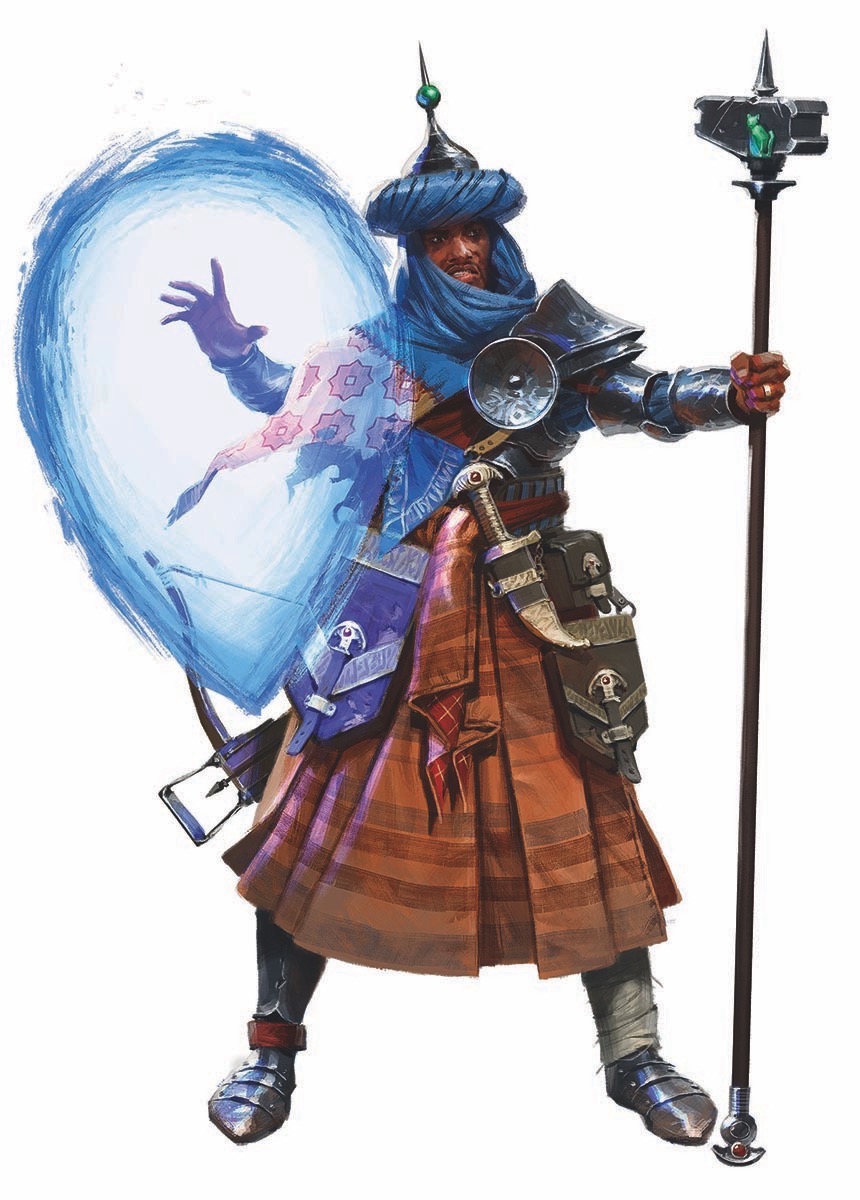
Illustration by Giorgio Baroni
You've created your character. You've tasted that first bite of toil and heroics, earned your first thousand Experience Points, and come back to town a hero. Is it time to hang up the sword, sidle into the local tavern, and get free drinks for years in return for spinning yarns of your youthful adventuring day?
Hell no. It's time to level up your character so you can do it all again!
This week we're going to examine how you advance your characters in Pathfinder. We are going to start with your young fighter who resists the urge to retire and sit on his laurels and instead decides that adventuring is his jam. Let's start by advancing the hero of our story—a human (skilled) fighter, with the nomad background. Let's call him Kaliban.
First Steps
Each time you gain a new level, there're a few things you're going to want to do first. First, you're going to increase your level by one and subtract 1,000 Experience Points (XP) for your XP total. Then you're going to increase your Hit Points by the amount determined by class and then add your Constitution modifier.
Kaliban is a fighter, so his Hit Points increase by 10 + his Constitution bonus (let's say he has Con 14) so his total Hit Points at 2nd level become 32.
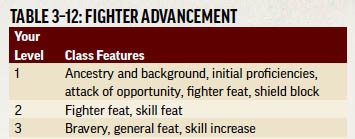
Lastly, you're going to take a look at your class progression table and apply any class features that aren't feat choices, ability boosts, or skill increases. We'll take a closer look at that later, at 3rd level when Kaliban gains the bravery class feature, but at 2nd level, Kaliban gains a fighter feat and a skill feat as class features, so we are going to move on to the next step.
Choose Your Feats
In terms of pure role and effectiveness oomph, choosing a new class feat is often the most exciting choice you can make when advancing your character. First off, let's assume that during character creation Kaliban had already taken Power Attack.
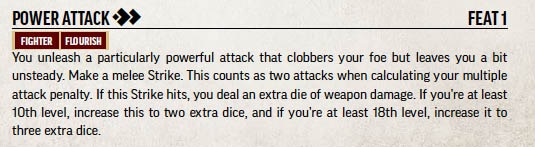
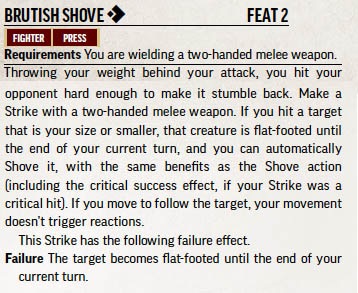
Kaliban likes power. And Power Attack allows Kaliban to deal even more damage with his favorite weapon—a maul. At 2nd level, he could continue on this punishing path by taking the Brutish Shove fighter feat, which allows him to throw his enemies around the battlefield.
This seems like the obvious choice, but let's imagine Kaliban is not your typical fighter. He's a particularly smart fellow (Intelligence 14). Let's also imagine that during his first adventure, he came across a frightfully competent gnoll evoker who gave Kaliban and his companions a tough time of it. And during that encounter, while taking the abuse that gnoll was dishing out, Kaliban wondered what it would be like to mix martial prowess with that kind of arcane might. Lucky for Kaliban, once he reaches 2nd level, the fighter has the opportunity to grow in a different direction. He can choose to multiclass.
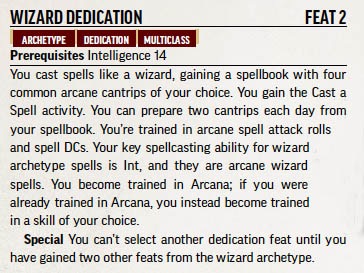
It's not a bad deal. A spellbook with four cantrips, the ability to prepare two of them a day, and training in Arcana strikes the fighter as more promising than just pushing around his enemies. Some fighters might scoff at such dalliance, but Kaliban decides to go the fighter/wizard route. Taking a quick look at the arcane cantrips, he chooses to scribble daze, mage hand, shield, and telekinetic projectile in his spellbook. Most adventuring days, he typically leans on shield and telekinetic projectile as his prepared cantrips.
After picking his class feat, Kaliban picks a skill feat. He has training in the following skills: Acrobatics, Arcana, Athletics, Crafting, Desert Lore, Intimidation, Nature, Society, Stealth, and Survival, so he has a lot of choices. But let's say Kaliban has become enamored with his brief magical studies and chooses Arcane Sense.
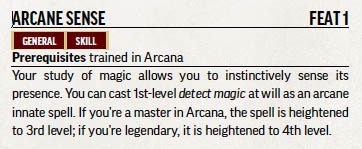
This way Kaliban can always be on the lookout for more magic to supplement his spellbook, equipment, and his split aspirations.
With his skill feat chosen, all he has to do is adjust his various skills, attack rolls, and DCs to reflect his increased level and new bonuses, and he is done. He has everything he needs to continue adventuring with more than a few new tricks up his sleeve.
Each New Level, Repeat
Each time you gain a level, the method by which you increase your level stays the same. Only the details and choices change. To make it easy for you to remember what you need to do each level, there's a bullet-point list on page 31 of the Pathfinder Second Edition Core Rulebook. Follow those directions each level, and you'll be set.
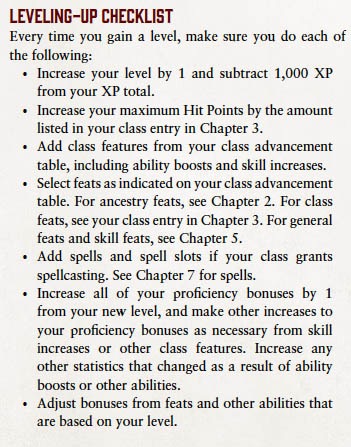
When Kaliban reaches 3rd level, even though he's multiclassed into wizard, he is still primarily a fighter, and he is going to advance as a 3rd-level fighter. He'll gain 12 more Hit Points (bringing his total to 44) and get the bravery class feature, along with a general feat and a skill increase. First, let's take a look at bravery.
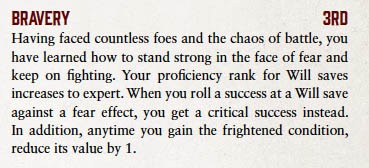
While Kaliban is trained in Will saving throws, during character creation he chose to boost Intelligence instead of Wisdom, so bravery is going to be a big help. At second level his Will saving throw was +4. Thanks to bravery it jumps up to a +7 while granting him some extra protection against fear effects.
The skill increase allows him to either become trained in a new skill or to become an expert in a skill he's already trained in. Kaliban has a pretty robust set of skills, especially for a fighter, so he is going to invest the skill increase in raising one of his skills to expert proficiency. Since he's been focusing many of his build resources into his magical training, this time he'll use his skill training to become an expert in Athletics.
What about that general feat? Well, it just so happens that Magical Crafting pops up at 2nd level, so maybe Kaliban can find a way to increase his power in the magical arts after all.
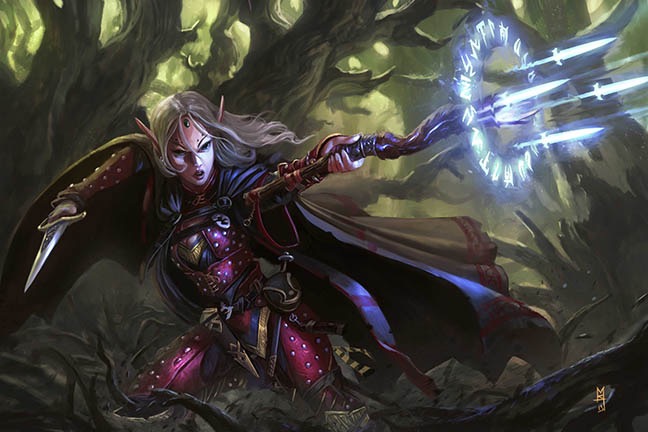
Illustration by Matteo Spirito
Only the Beginning
In the end, each level that you attain increases your ability to customize your character. We only completed two levels of Kaliban's advancement, and he has made many exciting and diverse choices, most of which were out of the ordinary. Not only does the fighter have an abundance of choice with just fighter class feats, but by taking dedication feats to multiclass or take on an archetype, the fighter increases the number and variety of choices available to him at each new level. Add to that further customization through skill advancement, general feats (skill and otherwise), and ancestry feats gained after 1st level, and at every level your adventurer becomes a unique legend sure to leave a mark on your campaign's story and the world of Pathfinder.
Stephen Radney-MacFarland
Senior Designer
Adventure Marches On
Monday, July 15, 2019