Core Principles: Injecting Story into the Pathfinder ACG
Thursday, September 6, 2018
In the first installment of this blog series, I laid out the principles guiding our new incarnation of the Pathfinder Adventure Card Game. We aren't rebooting the game—everything will still work with everything else—but with the new Core Set, we're making significant improvements that we've been wanting to make for years. I will go through them one by one in the leadup to the game's intended launch at PaizoCon 2019.
The improvement I'm describing today is adding more story. To get what I mean by that, you have to understand what we're surrounded by. When you walk into the Paizo conference room, you are surrounded by many bookshelves of everything Paizo has created. There are hundreds of adventures, novels, rulebooks, setting books, and card decks set in the world of Golarion and beyond.
For each PACG set, we would choose an RPG Adventure Path to adapt—each consisting of six 96-page volumes, not counting any supplemental books—and wedge that story onto 1 Adventure Path card, 7 adventure cards, and about 35 scenario cards, each of which would have at most 70 words on it. That meant we had to condense 576 pages of roleplaying game text into about 3,000 words spread across 43 poker-sized cards.
To say we fell short of the full grandeur of the Pathfinder world would be underselling it. You had to interpret so much from the cards that our community members wrote their own story guides to help explain the stories we were telling to others.
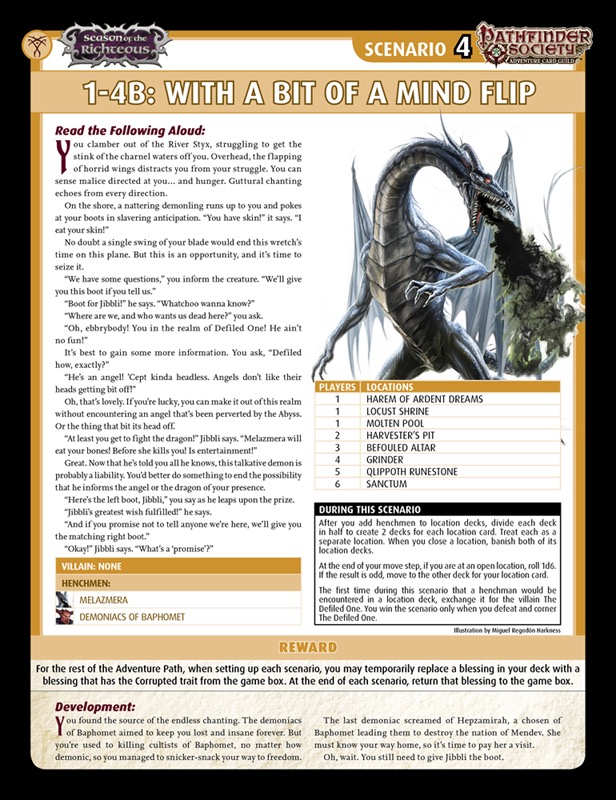
Meanwhile, over on aisle Adventure Card Guild, we were doing something very different indeed. Our story authors were cranking out brand new epics. We would plot out major adventure arcs and then we would write. Each page—one scenario, say—would have an entire story, with a setup, gameplay, and development, and the text for one page would often have more story text than an entire adventure worth of cards in the main box. This is much harder work, but it helped make our Adventure Card Guild games even more fun than our base set games.
For example, here's a scenario from Season of the Righteous Adventure 4: The Mighty and the Righteous. The characters are in the Abyss, having just barely escaped the dark clutches of the demon-angel Shamira.
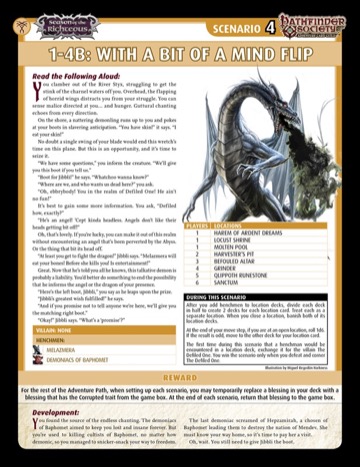
We probably had a reason to name these scenarios after lyrics from The Rocky Horror Picture Show's "The Time Warp," but it's lost to the ages.You can see how much fun I had writing this. Thinking back on it, there was no reason we couldn't have that much fun writing the box sets as well. Organized play had the right idea.
So, we stole it.
For the Core Set and Curse of the Crimson Throne, I'm diving much deeper into the stories of the adventures we're adapting. Core had us searching for the perfect story to tell an introductory adventure: if this was your first encounter with PACG, we wanted it to be a memorable one.
Enter The Dragon's Demand, a brilliant bit of creativity by Aching God author Mike Shel. This is NOT Wrath of the Righteous. You don't exactly become mythic demigods in this one. Instead, you get stuck in a Podunk town and have to figure out whether the townsfolk are being harassed by a long-dead dragon. If you win, you save the town. If you lose, well, that's just how Golarion goes sometimes. It's a great adventure where everybody in it takes themselves very seriously and yet you just have the sense that no one really thought their plans through too well.
The first step on this road was to set fire to the Adventure Path, adventure, and scenario cards. You heard me, they're gone. Poof. Instead, I'd write a storybook (a term I stole from Apocrypha) which had all the adventure content and a lot more story.
I cracked open a Word document and started figuring out what I needed to do to tell that story. One consideration was this: We wanted to make our Adventure Path boxes like Curse physically a lot smaller than before. I once walked into my favorite restaurant/board game store, Mox Boarding House, and saw an employee sorting Netrunner cards under a hanging rack of all my Pathfinder box sets. I gently asked him "Do those ever fall on you?" and he said "Oh, all the time," and I thought "Man, I am not going to jail for THAT."
So we wanted to cut it down a bit. The Core Set will come in a 9"×12" box—that's just a little larger than the Pathfinder RPG Beginner Box—that holds your cards, dice, pawns (more on that later), and rulebooks. And Curse will be even smaller than that: 7.5"×9"—just a bit bigger than the Pathfinder RPG Pocket Edition. And all of Curse will be in that box—no more individual adventure boxes, and no more five-month delays between the first part and the last. You'll buy it all at once and you can blast through it as fast as you like. You want it, you got it.
To play with it, you'll shuffle the cards from your Curse set into your Core Set. This is a trick we pulled on Apocrypha, and it really works. Since you can easily tell the cards from the sets apart, you can quickly pull out the ones you don't need and shuffle in the ones you do need. It takes only a few minutes to change the whole play experience.
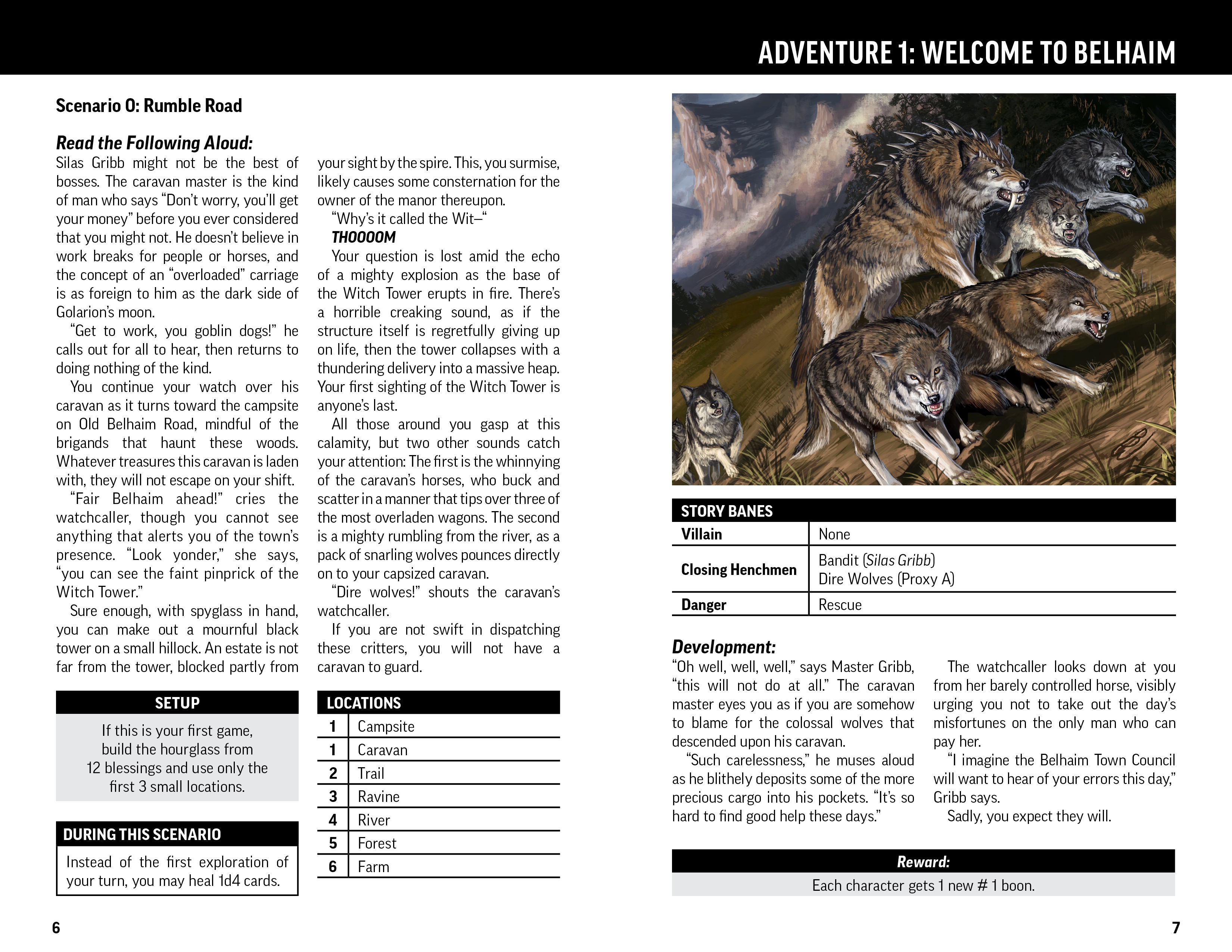
But Vic noted that the 7.5"×9" Adventure Path box meant we couldn't just use the Adventure Card Guild's 8.5"×11" page format, at least not without some TARDIS-like technology making it bigger on the inside. I proposed we turn the page sideways and fold it in half, making each scenario a two-page spread in a 5.5"×8.5" storybook. That gave me a fair amount of room to play with. But I had a lot to wedge in there. After some brainstorming with art director Sarah Robinson and graphic designer Sonja Morris, we found a layout I could work with. Here's what it looks like right now. (It will have additional attention from the art team before it's done.)
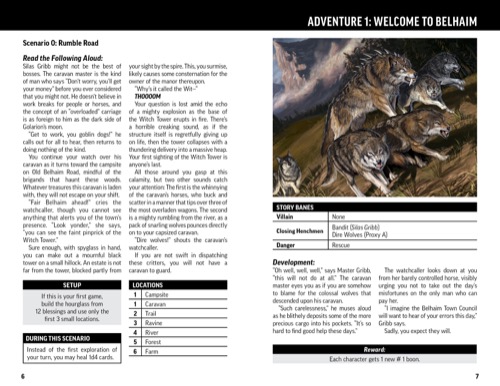
Here's a scenario spread from The Dragon's Demand.Okay, try not to go down the rabbit-hole on all those new terms like "hourglass," "small location," "heal," "story bane," "closing henchmen," "Proxy A," and "danger." I'll get to those soon, I promise. For now, let's just talk big picture.
This scenario shows how we put real story into a two-page spread. We get an evocative introduction that draws you into the scenario. Then there's a section on setup and another one on what you do during play, plus a location list. We have a nice space for art, then the conclusion to the story and its rewards. It's a nice-looking layout, even before Sarah and Sonja get to prettying it up.
That's a lot better than anything that would fit on a card, I think. Let us know what you think of this!
Mike Selinker
Lead Designer, Adventure Card Game
We have updated our Privacy Policy.
Paizo.com uses cookies. You can block paizo.com from using cookies within your browser settings, but doing so will hinder site functionality.
More information can be found in our Privacy Policy.