Class Preview: The Operative
Monday, May 8, 2017
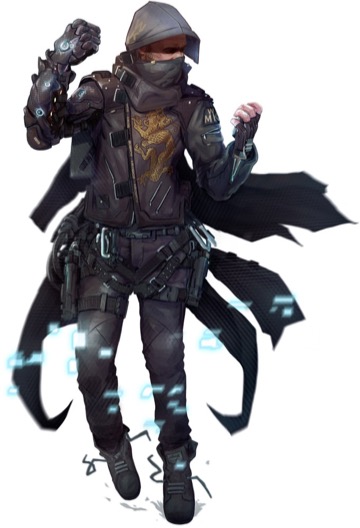
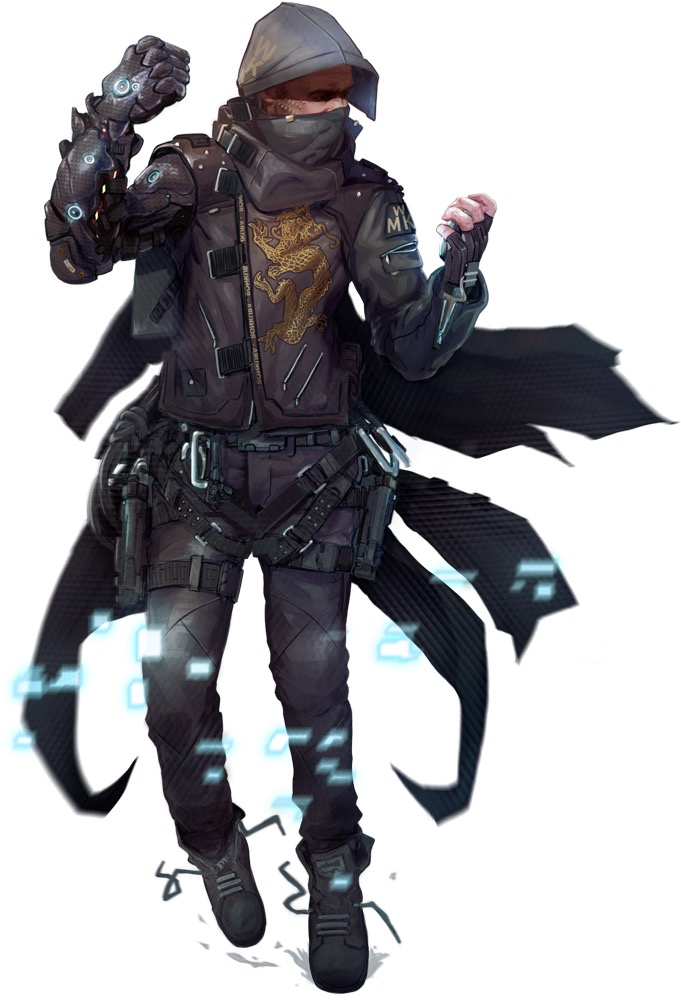
Illustration by Miroslav Petrov
Last Friday we took a look at the envoy. As soon as we announced the operative as a class, many fans began to theorize it would act as the "star thief," and wondered how it would be different from the rogue class in Pathfinder. There are certainly some thematic similarities between the two classes, but just as a 16th-century highwayman's tactics and skills were different from a modern hacker's, a character with a knack for stealth, security systems, and unexpected attacks in Starfinder should be significantly different from a Pathfinder rogue. We need a class that can easily serve as spy, assassin, thief, hacker, investigator, and trailblazer. That was the spark for the operative, which gets the following description in the Starfinder Core Rulebook:
You're a shadow. You move swiftly, strike suddenly, and always have an escape plan. You're a consummate professional, and always get the job done, whether it's scouting enemy lines, hunting down criminals, stealing and smuggling items, or assassinating key figures. As an operative, you're skilled in a wide variety of disciplines and specialties, and use speed, mobility, and your quick wits rather than relying on heavy weapons. You excel at the art of surprise, whether it's sniping targets from cover or striking while their backs are turned. Your cause may be righteous, but you have no problem fighting dirty—achieving your objective is all that matters.
The operative is very much a character skilled at working outside the norms of society. Whether committing crimes, hunting criminals, or just living on the fringes, operatives find ways to get things done, though their methods don't always meet with public approval. This takes skill, so the operative gets 8 skill points per level, and 16 class skills. Operatives also get the operative's edge class feature granting a bonus to all skill checks (as well as initiative checks). The class also receives special bonuses at 7th level with any skill in which the character has the Skill Focus feat.
The operative knows that sometimes getting things done means doing some damage, and the class gains a fair base attack bonus, poor Fortitude saves but good Reflex and Will saves, light armor, and proficiency (and eventually specialization) with basic melee weapons, small arms, and sniper weapons. The operative can augment the damage done with basic melee weapons and small arms with his trick attack.
Trick attack may sound on the surface like Pathfinder's sneak attack, but it works very differently. An operative can attempt a trick attack regardless of the combat situation—it's not restricted to targets that are flanked or have the flat-footed condition. Instead, the operative must make an opposed skill check (normally Bluff, Intimidate, or Stealth, though class features can alter that) to gain an advantage over his foe for the trick attack to function. At higher levels, the operative can also apply penalties to foes hit with a trick attack, beginning with the flat-footed and off-target conditions and expanding from there (potentially even applying such effects to sniper weapon attacks).
Because operatives have different methods and thus focus on different techniques, each operative selects a specialization. We present seven specializations in the core rulebook—daredevil, detective, explorer, ghost, hacker, spy, and thief. Each has an effect on that operative's trick attack (a detective can use Sense Motive to activate her trick attack, for example), and grants bonuses to specific skills and access to new abilities.
Finally, operatives also have exploits—special tricks they learn as they gain levels to help customize their abilities. While the selection of exploits is fairly small at first, they expand as the operative levels up, making increasingly powerful exploits available. Here's a sample of a 10th-level exploit (though the ghost specialization receives it at 5th level):
Cloaking Field (Ex)
You can bend light around yourself and muffle any minor sounds you make, allowing you to nearly vanish when not moving. Even when you move, you appear only as an outline with blurry features. This cloaking field doesn't make you invisible, but it does make it easier to sneak around. Activating the cloaking field is a move action. While the cloaking field is active, you can use Stealth to hide, even while being directly observed and with no place to hide. Attacking doesn't end the cloaking field, but it does end that particular attempt to hide. If you remain perfectly still for at least 1 round, you gain a +10 bonus to Stealth checks (which doesn't stack with invisibility) until you move.
Your cloaking field lasts for up to 10 rounds before it becomes inactive. While inactive, the cloaking field recharges automatically at the rate of 1 round of cloaking per minute.
We already looked at the envoy last week, and we'll present more information on the remaining five classes in the coming weeks. And, of course, you can read the full classes this August when the Starfinder Core Rulebook is released at Gen Con!
Owen K.C. Stephens
Developer

We have updated our Privacy Policy.
Paizo.com uses cookies. You can block paizo.com from using cookies within your browser settings, but doing so will hinder site functionality.
More information can be found in our Privacy Policy.