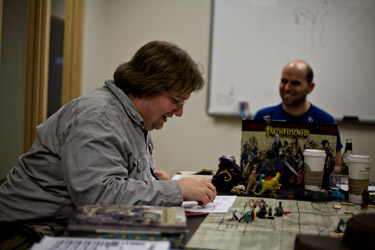
After a long hiatus because of convention season, the drow nobles game continued with a hunt for the kidnapped acting matron of the House Azrinae—and split into two groups of PCs when Ylvirixna (Rob McCreary) and Alivora (James Jacobs) decided the matron (decerebrated by mi-go) was no longer in charge and ran off with her body. Confounded by this betrayal, Rackutio (Josh Frost), Phyxafein (Tim Nightengale), and Verandia (Jodi Lane) returned to the drow city of Far Parathra to plan their next move. Or so they thought.
The group couldn't find Zwimessa (Crystal Frasier) when they left to find the matron that morning (Crystal missed that session). Zwimessa, meanwhile, couldn't find any of the others when she woke—their rooms were empty, and the drow commoner prisoner they had taken from their occupied house was dead in one of the rooms. Hiring a diviner in Far Parathra, Zwimessa found that her family members had been kidnapped, and paid the mage to teleport her to where they were held, bringing two mage-called demons (Kelly Marie and Troy Siefker) with her for extra muscle.
Zwimessa, Fumerott (Kelly), and Poograh (Troy) arrived just outside of a strange laboratory where three mi-go had Alivorah, Phyxafein, Rackutio, Verandia, and Ylvirixna strapped to tables, with needles in their skulls connected to strange metal canisters. After routing the mi-go, Zwimessa's team freed the others, though Ylvirixna's brain had been removed and had to be put back in her skull with some powerful healing magic. Retrieving their gear from a nearby nook, the drow followed an escape tunnel (with a comatose Ylvirixna riding Alivorah's snake-like phantom steed).
The tunnel opened up into a cavern with several mi-go crates (each marked with magical runes) and a strange underground lake. While investigating the crates, they spotted movement in the murky water, and something hurled a rock at Zwimessa.
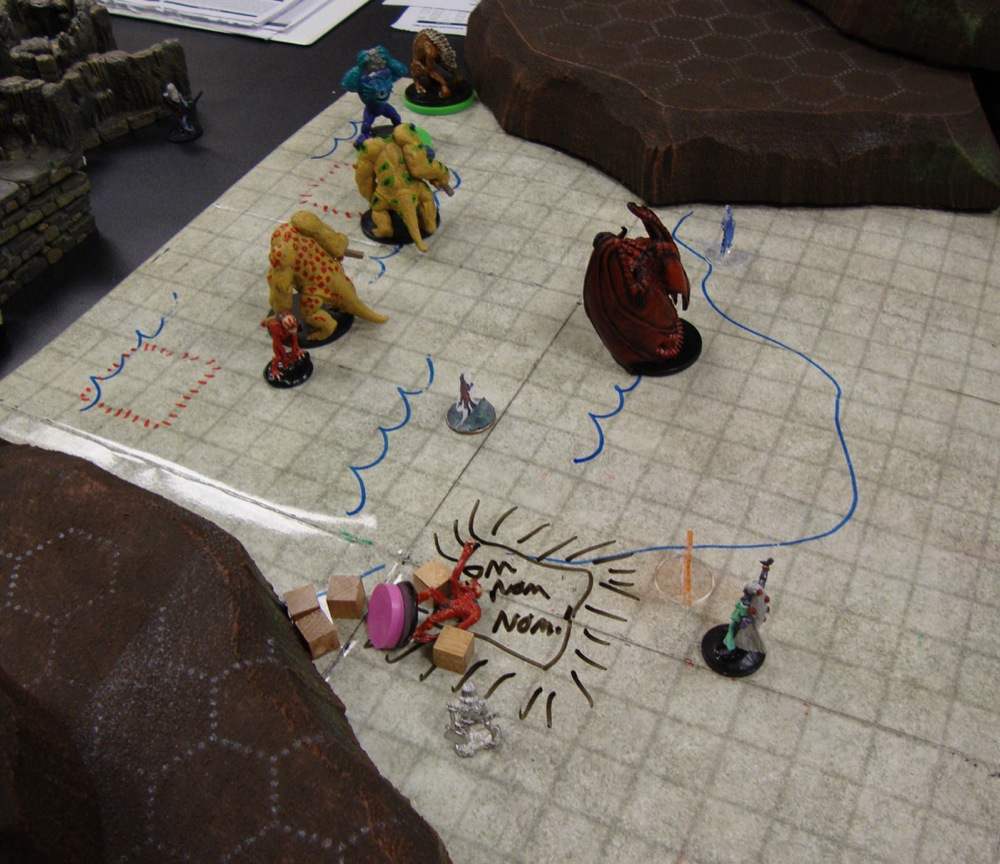
What followed was a furious battle with a pair of giant fish-men and two mutated, skinned ghouls. Fumerott grabbed and hurled one of the ghouls to the shore so Alivorah, Rackutio, and Verandia would have something to fight. Rackutio cast hungry pit on it, pulling in the wounded creature as well as two of the crates, which exploded on impact. OM NOM NOM! On the other side of the battle, the two giant fish-men deal horrendous damage to Poograh, but the stubborn demon continues to fight.
Fumerott and Zwimessa make short work of the remaining mutant ghoul, prompting the demon to eat her fallen enemy. Delicious!
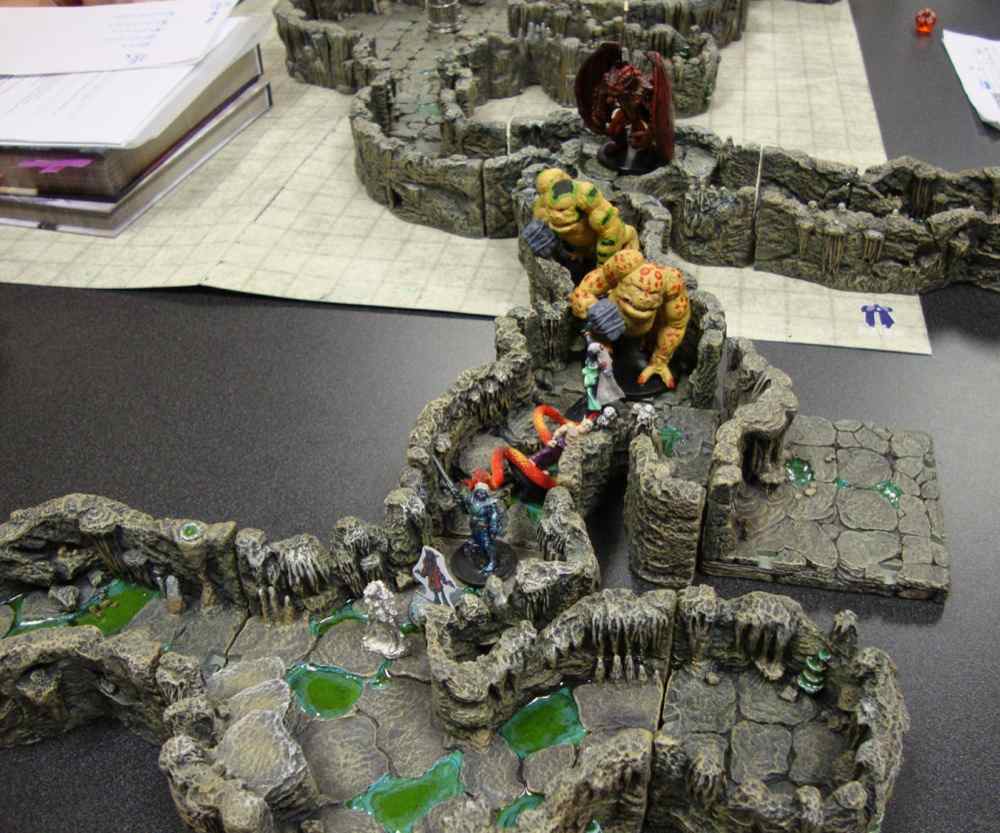
The giant fish-men turned their attention on 20, Rackutio's eidolon, and managed to tear it apart, sending it back to its home plane. As the rest of the group converged on these foes, Rackutio summoned a greater water elemental (represented by a fire elemental in this picture, recolored blue with the magic of photo manipulation) to pound on the slimy things, and Verandia ended the fight with a controlled burst of channeled negative energy. Time to rest and loot... which, in Poograh's case, included eating the dead fish-men!
Tip: If you have players who are new to the Pathfinder RPG (as Kelly and Troy were) or gaming in general, all the choices for a classed character can be overwhelming. Sometimes it's easier to have them play an allied monster, which has fewer options for the player to learn. In this case, I copied the stats for a hezrou demon onto a character sheet, removed references to rules they didn't need to know about (like Improved Initiative, which is built into the stat block), summarized other complex abilities (like greater teleport), and didn't include other abilities they wouldn't need (like summon). This let them focus on playing their monster characters and dealing with dice rolls for attacks, damage, skills, and saves. Because these players are only present for this one high-level session, using conjured monsters allows them to play without devising a complex in-game story for why these two characters would show up and leave after a short time.
Wednesday night we finished session #3 of Exiles of Zirnakaynin, my high-level, all-evil, all-drow-noble campaign. This session started with getting James Jacobs and Rob McCreary caught up to the rest of the group, as they missed session #2 due to bad cases of the sicky sickies. Once sisters Alivorah (James) and Ylvirixna (Rob) reached the pleasure-haven drow city of Far Parathra, they were attacked by mysterious creatures that crawled out of the angles formed by the walls and floors of their hotel rooms. Similar creatures attacked the rest of the PCs at the end of session #2, and most of Wednesday's game involved six individual, simultaneous battles against these creatures, as all the PCs had split up for the night.
Things I learned in last night's session include:
Even a creature of the Mythos can succumb to a baleful polymorph if you try enough times (ook ook!).
Remembering you have Combat Casting can be the difference between successfully casting a ground-zero flame strike and eye-rolling failure.
14th-level fighters and inquisitors can deal a horrendous amount of damage in one round.
Fast zombies make fine litter-bearers but poor obstacles against CR 9 opponents.
Letting a demon possess a PC sometimes means the PC goes crazy and destroys her sister's undead lackeys.
It seems like I’m the guy who usually ends up running the game, so when Sean announced that he was going to run a high-level campaign where all the PCs would be demon-worshiping drow nobles, I jumped at the chance to play. After all, high-level play, demons, and drow are three of my favorite things! You got a first look into the mayhem of our first session last week when Sean showed off his creepy black light, but today I’m going to tell you about my character. Like it or not!
Photography by James Jacobs
Alivorah Azrinae (CE female drow noble bard 7/demoniac 6) is something of a troublemaker, even in drow society. She's gotten in hot water with the Azrinaes many times in the past for cavorting and fraternizing with other houses—she thinks of herself as a spy, and loves learning secrets about other people and organizations. Her main problem is that she doesn't follow orders well and doesn't like divulging secrets without learning a secret in return—a trait that makes her not very helpful as a spy to anyone but herself. As a demoniac, she bears the mark of Abraxas on her right shoulder as a pale tattoo-like marking. Currently, she's a bit agonized by the fact that she actually knew a few secrets about the attack on the Azrinae family—had she divulged them, she could have possibly saved her house from being exiled. Her main goal now is to see that the Azrinae family gets to return to Zirnakaynin in a greater position of power than before. And if she gets herself a promotion in the family to a position of greater power, all the better!
The attached picture features the miniature I’m using for Alivorah, standing next to her entry on the family tree chart that Sean provided us. The mini (which was painted for me by the always-awesome Stephen Radney-MacFarland, who’s mini-painting skills are SIGNIFICANT) is one I originally used for Jason’s campaign a year or so ago, but since Jason quit running that game, I saw this as a great opportunity to use my cool drow mini again, even though she doesn’t really match the type of gear Alivorah carries. Also, those with keen eyes will note that Alivorah is the sister of Rob McCreary’s character, and that Josh is playing her uncle and Crystal her aunt. Should make for some interesting dynamics around the table!
As for that bit about being a “demoniac,” well... that’s a prestige class I’m taking the opportunity to playtest during this campaign. Originally presented as the 5-level demonic initiate prestige class in Pathfinder Adventure Path #15, this class is being upgraded to a 10-level prestige class and renamed to “demoniac” (the noun definition of which is “a person seemingly possessed by a demon or evil spirit”—it’s not a prestige class for characters who make smart decisions regarding the well-being of their immortal soul). Full details on the demoniac prestige class will appear in the upcoming Lords of Chaos: Book of the Damned Volume 2.
And for those readers who don’t care about my new character (you’re dead to me!), here’s a quick preview of some of the content I’m working on for Lords of Chaos—the beginning of Abraxas’s entry in Chapter 1: The Abyss and its Lords! (Note! The following hasn’t even been through development yet—some elements are certain to change by the time it sees print later this year.)
Abraxas
Master of the Final Incantation
Male demon lord of magic and forbidden lore
Cult
Temple libraries, reliquaries, vaults
Worshipers drow, sorcerers
Minions mariliths, xacarbas (see Pathfinder Bestiary II), serpentine creatures
Sacrifice spellbooks, magic scrolls, those who reveal secrets
Obedience Self-flagellate with a small whip or tree branch, punctuating each stroke with utterances of mystic words of power. Gain a +4 profane bonus on saves against written magical effects, such as sepia snake sigil or symbol of death.
Boons
1: Secret Lore (Sp) Gain one of the following spell-like abilities: identify 3/day, augury 2/day, or illusory script 1/day
2: Heretical Revelation (Su) Up to three times a day you can whisper terrible secrets to an adjacent target as a standard action. The target can resist with a Will save (DC = 10 + 1/2 your HD + your Charisma modifier). If the target fails its save, it is stunned for 1 round, then confused for 1d4 rounds, and then nauseated for 2d6 rounds. This is a mind-affecting effect.
3: Penultimate Incantation (Sp) You affect a single creature within 60 feet with a targeted greater dispel magic. Each spell or effect dispelled inflicts fire damage to the target equal to the result of your caster level check made to dispel the magic.
In a fit of madness, I decided to run a high-level playtest so we could have an ongoing idea of how high-level play works in the Pathfinder RPG. In a fit of double-madness, I decided it would be an "evil" game. Triple-madness means everyone is playing a drow noble from House Azrinae in the Darklands. The result is Exiles of Zirnakaynin.
As I'm a miniatures geek, this meant painting up a bunch of dark elf PCs and NPCs, plus other Darklands monsters and underground terrain. As I'm a science geek, I painted many of these things with fluorescent paint highlights, glow-in-the-dark paint, or glow-in-the-dark varnish so they react to a black light.
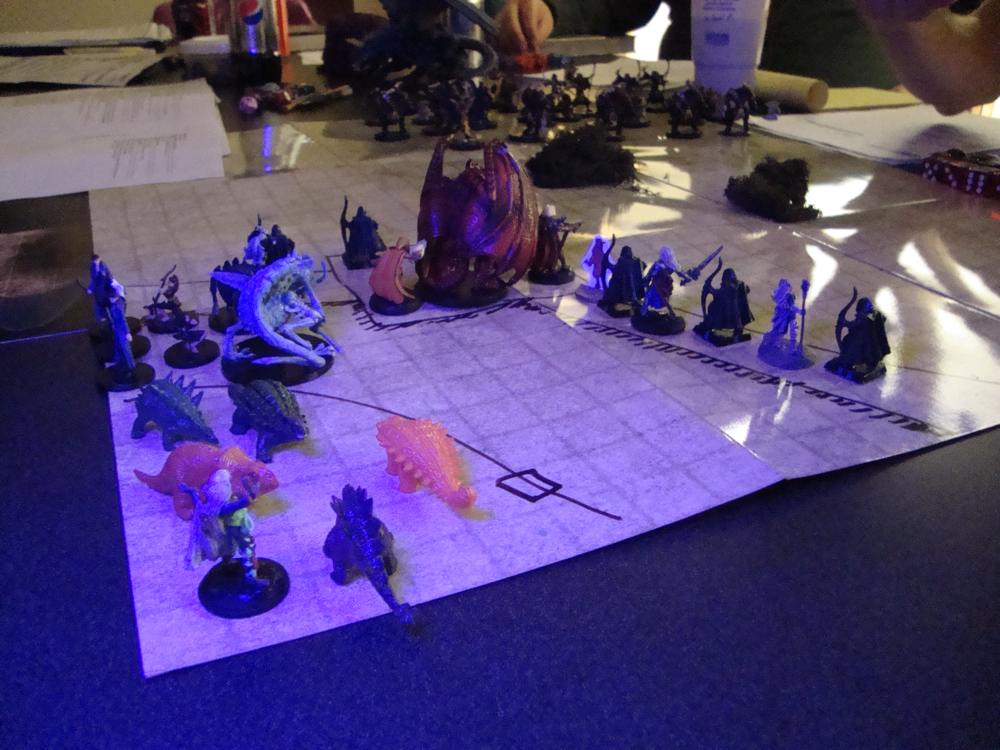
This photograph is from our first session, where the PCs (and associated undead and eidolon minions) and soldiers of House Azrinae line up on the eastern wall and tower of the House grounds (with the riding-lizard stable in the foreground) to defend against an attacking force of half-fiend minotaurs, enemy drow soldiers, some treant-like fungus creatures, and a few other surprises not yet on the map.
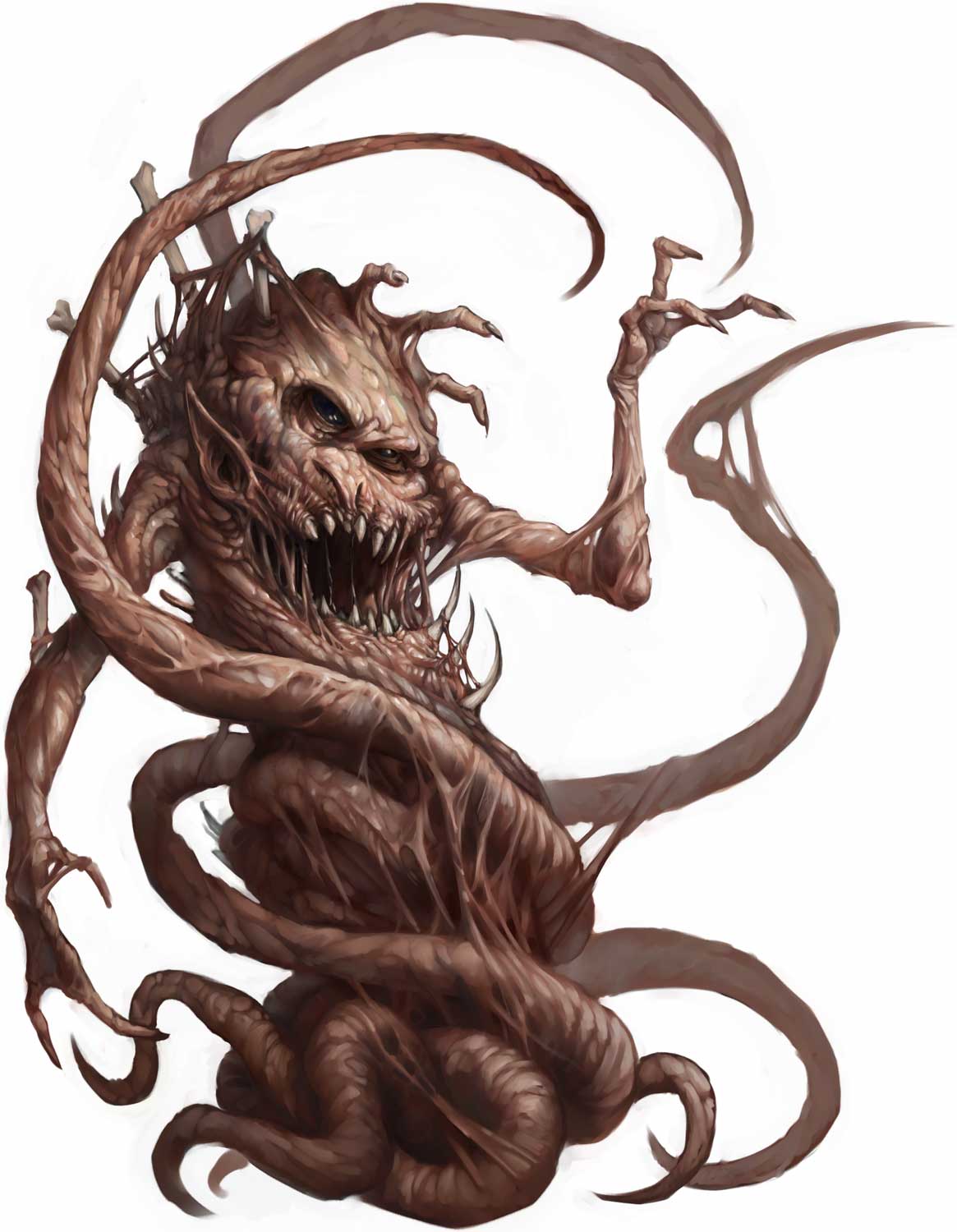
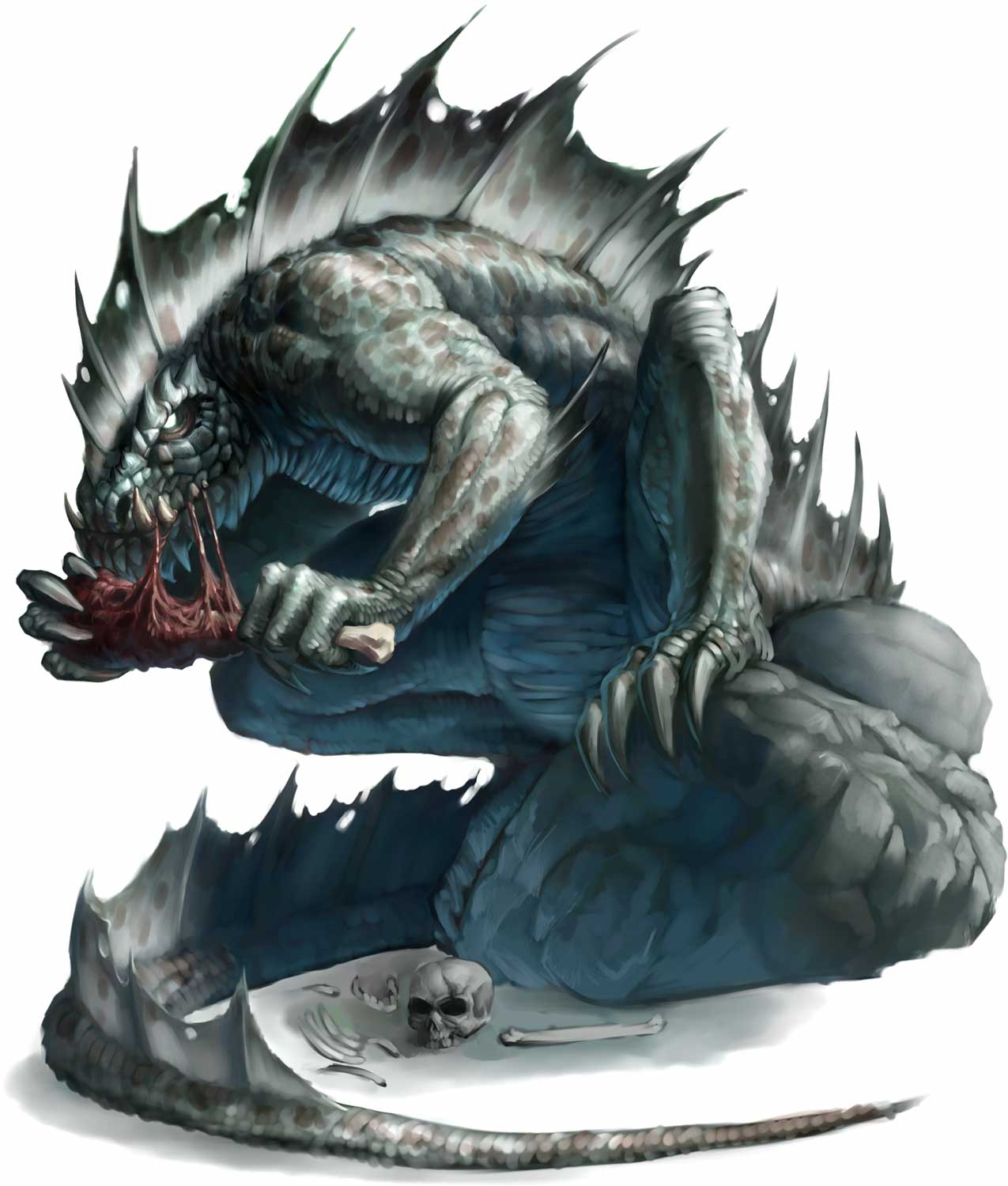
Through dark magic and foul rites drow corrupt the unworthy of their society into horrifying creatures—skittering, spider-legged abominations known as driders. But what about other races? If the drow work such perversion upon their own brethren, what terrors might they inflict upon their enemies? With demonic magic and deadly alchemy the fleshcrafters of Zirnakaynin rework their captives into terrible new forms, better suiting their cruel desires and sadistic pleasures. Take the muscle-burdened ghonhatine and pain-wracked irnakurse for example, just two of the new fleshwarps detailed in Pathfinder #16's "Abominations of the Drow." Can you guess what they use to be? And are you sure you really want to know?
In the Second Darkness Adventure Path, we knew we wanted to use the drow as the primary antagonists. And of course, where there's drow, there's driders. Yet with the changes to drow society in Golarion (and in particular who and what they worship) versus their classic representation in the game, the genesis story for driders had to change. This gave us a pretty interesting bit of new flavor for both driders and drow.
In (under?) Golarion, driders are not punishments meted out by the gods. They are punishments meted out by the drow themselves. One noble family of drow, House Parastric, has maintained their power due to their possession of a powerful secret—the art of fleshcrafting. On one level, this art lets a drow use various poisons to reshape parts of the body, granting a soldier large claws or a poisonous bite, for example, or a scout antennae so he can navigate even more easily in the dark. Yet this is just the beginning, for the drow of House Parastric also developed a method to reshape an entire creature—this is known as fleshwarping, and those that survive the painful and humiliating process are known as fleshwarps. Every race put through the process emerges as something different—all troglodytes come out as hulking behemoths; all surface elves emerge as twisted deformed monsters; all halfings come out as skittering quadrapedal beasts, and so on. But it was the drow themselves who proved the most impressive subjects for fleshwarping, for all drow that undergo the process emerge as driders.
In drow society, driders are seen as freaks and mutants. Becoming a drider is not prestigious—it's physical proof of punishment and a brand of shame. Yet driders are not frail or helpless fleshwarps; they're powerful creatures in their own regard. As a result, in drow society driders are often kept as guardians, soldiers, or bodyguards. Retaining little of their previous life's memories, most driders serve their drow lords and ladies without question. But not all of them.
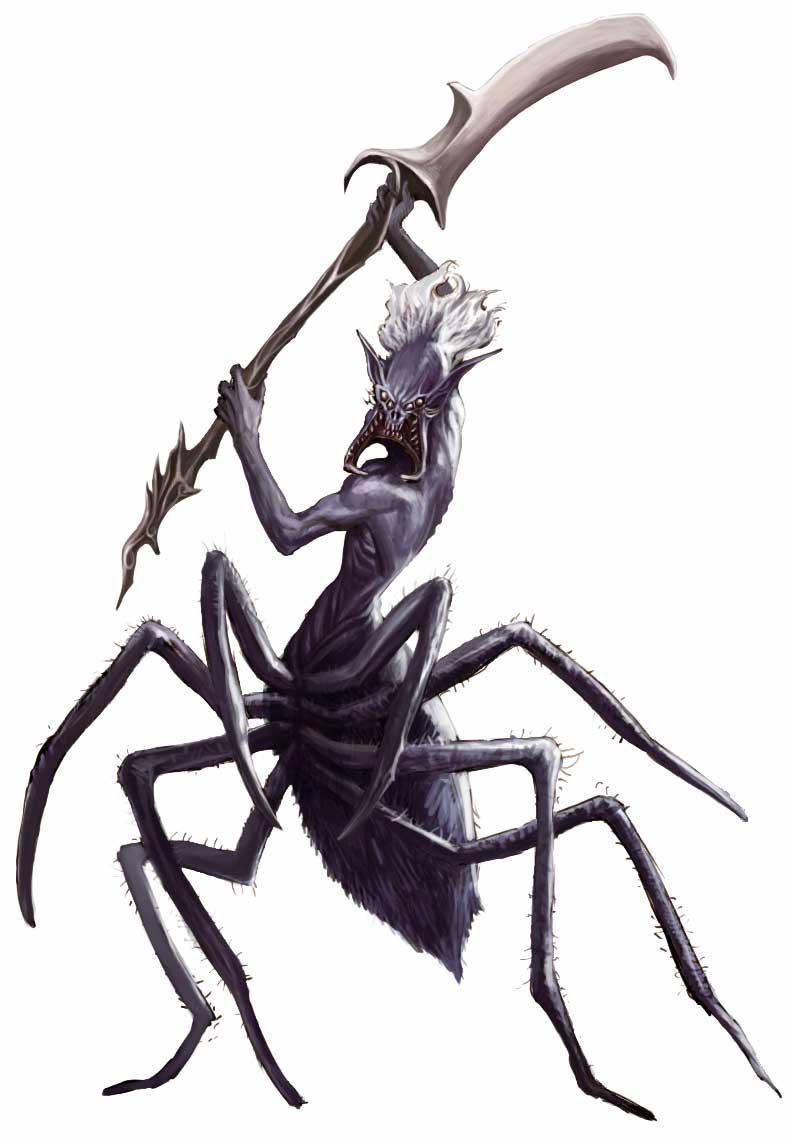
Female driders in particular are more headstrong and aggressive, just as with the drow themselves. Most drider rebellions are instigated by a female, and today there are numerous small tribes of driders dwelling in the remote corners of the Darklands, free from drow rule. The majority of driders one sees in drow cities are male, as a result. And fortunately for those drow, it's real easy to tell them apart. Female driders retain their sleek, beautiful, and elven shapes above the waist; below, their spider bodies are similarly sleek and smooth. Males, though, are much more bestial. Their faces are a horrific blend of drow and spider, and their bodies are spiny and rough. Pictured here are examples of the sexual dimorphism driders present, a female illustrated by Ben Wootten and a male illustrated by Concept Art House.
In Pathfinder #16, we present "Abominations of the Drow," an article that discusses both fleshcrafting and fleshwarping so that if your PCs stumble into the hands of the drow of House Parastric, you'll know what kinds of things they'll have to look forward to.
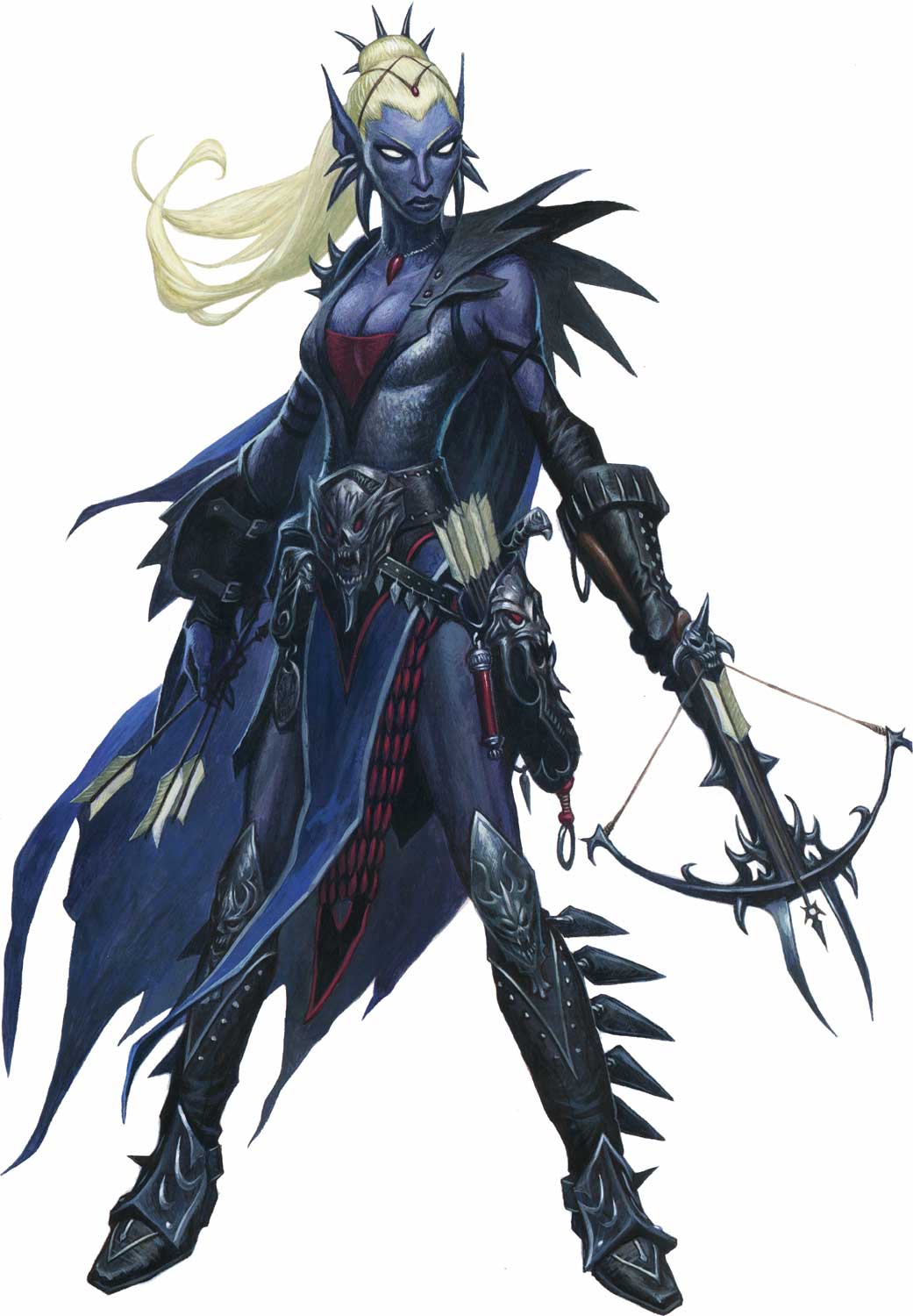
As the Second DarknessAdventure Path progresses, the PCs will become more and more familiar with the countless ways the drow have to inflict pain, suffering, and ruin. In Pathfinder #15, alchemy is added to the dark elves' arsenal, including alchemical ammunition for their ubiquitous hand crossbows.
Acid Bolts: These metal bolts have a glass section in the middle, filled with acid. On a successful hit, they deal normal damage and 1d4 points of additional acid damage. Acid bolts do not cause any splash damage. Cost: 40 gp per bolt.
Drow Poison Bolts: These iron bolts have small resin tips that break when the bolts strike their targets. Inside is a dose of drow poison. Anyone struck by a drow poison bolt must make a DC 13 Fortitude save or fall unconscious for 1 minute. After 1 minute, the subject must succeed on another DC 13 Fortitude save or remain unconscious for 2d4 hours. Those using drow poison bolts do not risk poisoning themselves, but the strange tip affects the bolts' accuracy. Double the range penalties when using a drow poison bolt. Cost: 100 gp per bolt.
One of the great things about working on Pathfinder is that I get to work with my heroes. In Pathfinder #15, we have an article about the drow written by none other than Jeff Grubb, author of such products as Manual of the Planes, Spelljammer, The Finder's Stone Trilogy, and countless other classics. And as it works out, he worked on my favorite D&D adventure of all time, the super-module Queen of the Spiders. So his resume was pretty solid for the guy who we wanted to write about our drow.
In Pathfinder #15, we'll have just such an article—everything you wanted to know about how the drow of Golarion are different from those of other campaign settings, or how they're the same. Jeff did an excellent job capturing the depravity that is drow, but they're different enough that they're unique to Golarion.
With Pathfinder #12, we'll have introduced our twelve core "iconic" characters, the heroes you'll see going up against the bad guys in all Pathinfder products. These iconics are basically meant to be stand-ins for your PCs, but once we hit our 11th one (Lini the gnome druid), we'd covered all of the core classes. Our 12th iconic will be our "iconic multiclass" character—a fighter/sorcerer (keep an eye for his debut on our blog in a few weeks), but after that, we didn't really want to dilute our iconics by coming up with new ones. Nor did we want to put the same characters on the cover over and over.
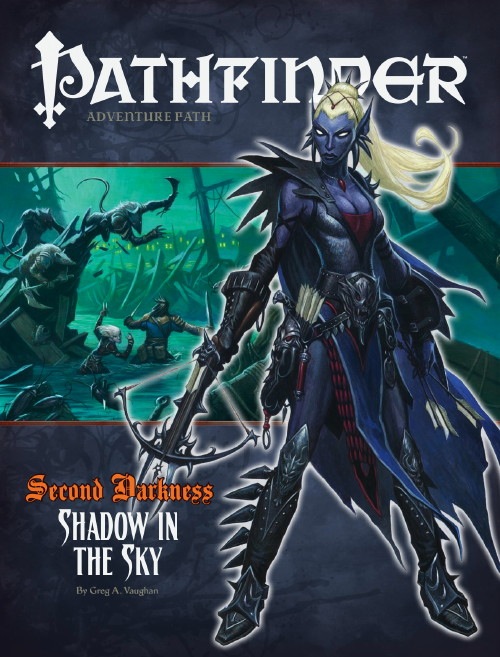
Instead, with Pathfinder #13, our cover characters are transitioning from PCs to NPCs. Just as Karzoug appeared on the alternate Gen Con cover to Pathfinder #1, going forward, we'll be putting important NPCs from the adventure on the cover. In some cases, this NPC will be that adventure's primary villain, but in others the NPC may end up being an important ally. Pictured here is the cover to Pathfinder #13, which unveils our first drow character as well—whether or not she's destined to be an ally or an enemy isn't something I'm going to spoil here. But, come on. She's a drow! And look at that crossbow! You can't get into the good-guy meetings with that kind of accessorizing going on!