Paizo Publishing's 10th Anniversary Retrospective—Year 0 (2002)
The Thrill of Starting Something New
Thursday, February 9, 2012
2012 marks Paizo’s 10th anniversary. I plan to do monthly blogs for the rest of the year that relive the highlights (and some of the lowlights) from our first ten years of business, and then I’ll take a look into the future as the year comes to a close. There will be side anecdotes and hopefully more than a few embarrassing pictures. And at the end of it all, I hope our readers will have a better sense of where Paizo has been—and where we’re going!
The paizo.com home page in 2002.The seeds of Paizo Publishing were planted in late 2000: I was working at Wizards of the Coast as the Brand Manager for Star Wars when the seemingly annual Christmas layoffs claimed me as their victim. As I was walking around the building saying my goodbyes to a lot of good friends, I mentioned to a few of them that I thought Hasbro might decide to divest themselves of parts of their business in the next few years and, if that were to happen, they should feel free to give me a call.
My partner Vic had recently departed his previous job as well, so 2001 was a year of relaxing for us; we traveled a bit and spent a lot of time building up our Star Wars collection. But by the end of the year, the two of us were stir crazy. So we were both relieved when, shortly before Christmas, Johnny Wilson, Group Publisher for the Periodicals division at Wizards of the Coast, called me to let me know that Wizards wanted to divest itself of its magazine business, which at the time included Dragon, Dungeon, and Star Wars Insider magazines, as well as the Official Star Wars Fan Club for Lucasfilm. I was a longtime subscriber to Dragon and Dungeon, so that was right up my alley, and the thought of running the Star Wars Fan Club and publishing Star Wars Insider excited both Vic and myself. Our own experience with magazines was limited, but Johnny had been in magazines for ages, so we felt we had our bases covered.
We met with Johnny in early 2002 to start planning the company. Johnny taught us what he called the “three-legged stool” model of the magazine business. Magazines needed income from three sources: subscriptions, newsstand sales, and advertising. If you ever let one of those three “legs” suffer, the whole would become unstable. (It took us a couple of years to figure out that there was a major problem with this model, but that’s a topic for a future installment.)
One of the earliest decisions we made was naming our new company. Johnny, being a religious scholar, had the name “Paizo”—biblical Greek for “I play”—floating around in his head for a number of years. It fit our gaming company nicely, and we could get a trademark for it, so we settled on it quickly. Of course, if we would have realized how easily it was going to be mispronounced over the years (pay-zo, pi-at-zoe, paz-zo, even pee-zo) we might have changed our minds and settled on something easier to pronounce.
We went over the financials Johnny had, and it looked like a promising business. Over the next few months, we had numerous meetings with Wizards and Lucasfilm, both of whom approved our plans, so we were good to go! We set up Paizo Publishing as an LLC with three owners: myself, Vic Wertz, and Johnny Wilson.
Paizo's first office was on the far right of the ground floor of this building in Bellevue.We had our first bit of great luck when our real estate agent found us an office space that had been vacated in a rush by another company—it was still fully furnished, including desks, chairs, a photocopier, and even a postage machine. We paid the landlord $1 for all of the equipment, a fantastic deal which kept getting better as we explored our new digs—we found a $20 bill in one of the drawers, and there was over $100 in prepaid postage in the postage machine! We’ve moved twice since then, and the postage machine is long gone, but we still use the copier and a lot of the furniture—it was the best dollar we’ve ever spent.
We took over the entire magazine division from Wizards lock, stock, and barrel—all of the department’s employees signed on with Paizo, and Wizards gave us a nice deal on their computers, office supplies, printers, back issues, and pretty much anything else we could load into our moving truck. We made a couple new hires to round out our administrative staff, and we officially started operations on July 1, 2002.
Our initial staff was as follows:
Administrative Team
Lisa Stevens: CEO
Johnny Wilson: Publisher
Vic Wertz: Technical Director
Mary Franklin: Director of Operations and Marketing
Wailam Wilson: Corporate AdminPublishing Team
John Dunn: Director of Production
Pierce Watters: Circulation Director
Jefferson Dunlap: Prepress Supervisor
Theresa Cummins: Production Specialist
Dawnelle Miesner: Ad Traffic ManagerDragon Team
Jesse Decker: Editor-in-Chief
Matt Sernett: Editor
Stacie Fiorito (now Magelssen): Associate Editor
Lisa Chido: Art DirectorDungeon Team
Chris Thomasson (now Youngs): Editor
Erik Mona: Editor
Kyle Hunter: Art DirectorStar Wars Insider Team
Dave Gross: Editor-in-Chief
Michael Mikaelian: Managing Editor
Vic Wertz: Editor
Scott Ricker (now Okumura): Art Director
Scott Ricker (now Okumura) looking up from his gig art directing Star Wars Insider.We continued the production schedule that Wizards had set up for the magazines, and finished the issues they had in the pipeline as we worked on their followups. The first all-Paizo issue of Dragon was #299, followed by the milestone 300th issue, which included a special sealed-content section covering The Book of Vile Darkness. In all, we produced four issues of Dragon that year.
Dungeon was bimonthly at the time and had two issues come out under Paizo’s watch in 2002. Issue 95 also had a sealed-content section like its sister periodical. Dungeon garnered Paizo our first ENnie Award, for Best Aid/Accessory.
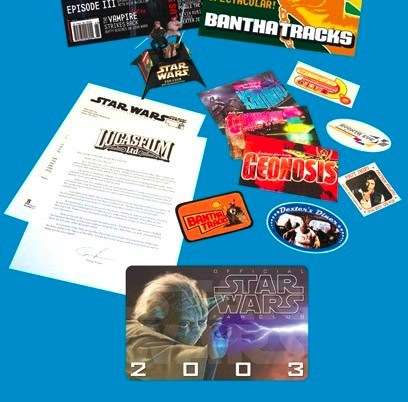
We did quite a lot with Star Wars Insider and the Official Star Wars Fan Club in 2002. We brought the Bantha Tracks fan section back to the magazine for the first time since the late 1970s. It had also been a while since the Fan Club had done a membership kit, and we put together a great one. It included the following:
- Official Star Wars Fan Club Membership Card
- Letter to members from George Lucas
- Exclusive 3-D fold-together mini-standee
- Three travel destination postcards from the galaxy far, far away
- Travel stickers from exotic Star Wars destinations
- A letter from myself as the President of the Official Star Wars Fan Club
We also were able to procure the official Attack of the Clones IMAX posters and banners to sell to Star Wars fans everywhere (heck, we still have them available for sale today). We also managed to arrange a great subscriber premium, a limited-edition LEGO TIE Fighter Mini Building Set.
Our first Official Star Wars Fan Club membership kit, along with the Attack of the Clones IMAX poster we started selling at the end of 2002 and our awesome LEGO subscription premium for Star Wars Insider.But things weren’t all rosy. While Johnny knew everything about actually producing magazines, it turns out that he had never been exposed to any of the financial details. In particular, newsstand distribution terms were far more complicated than we’d anticipated. It took us a while to find an accountant that could make sense of the hideously complex reports we were getting, which thoroughly obfuscated the answers to seemingly simple questions such as “how much do we get paid, and when?” Once we negotiated our way though it all, we realized that the time it took to get paid for a given issue was many months longer than Johnny expected, and the distribution fees involved were also higher than we’d been led to believe. That meant that we were going to have to stretch our startup capital much longer than we’d intended.
Also, along with the Star Wars Fan Club, we had inherited the phone number 1-800-TRUE-FAN, which was printed as part of a “join the Fan Club” blurb on the back of every Star Wars product produced in the previous few years. That seemed like good marketing, but it really meant that we were paying a lot of money to answer calls from five-year-olds who wanted to talk to Luke Skywalker, or from slightly more sophisticated nine-year-olds hoping to speak with George Lucas. We dropped the 800 number as soon as we could reasonably phase it out.
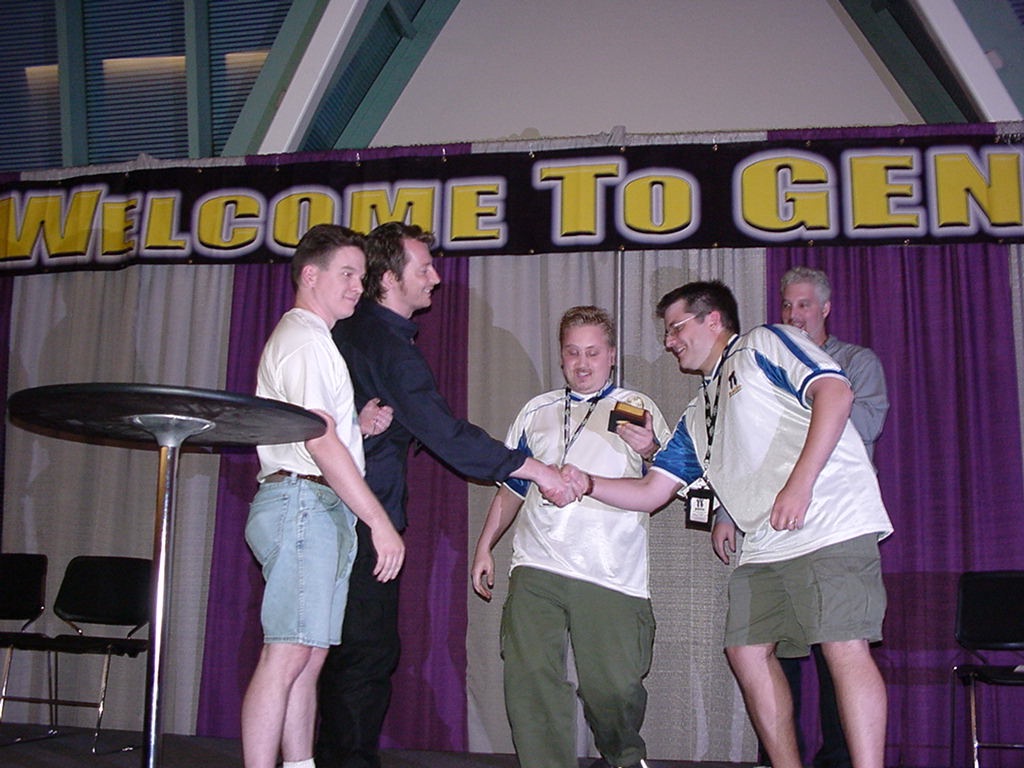
Paizo receives its first ENnie as part of the second annual ENnie Awards, held on a makeshift stage in the hallway of the MECCA during the last Gen Con in Milwaukee. Left to right: Eric Noah, Russell Morrissey, Erik Mona, Chris Thomasson (now Youngs), Ryan DanceyWe had also continued using the out-of-house subscription fulfillment service that Wizards had used for the magazines, and we soon learned that their costs were much higher than we’d expected. They handled all customer service related to subscriptions, and charged us based on each customer contact—there was a fee for every letter, email, and phone call they received, and another fee for every reply they made. We soon realized that meant they had no incentive to solve problems quickly—in fact, they’d make more money if it took multiple contacts to resolve an issue! It became clear that we’d save a lot of money—and provide better service—if we could bring subscriptions and customer service in-house. That became our first major goal for 2003.
We ended the year with a multi-course holiday dinner for the employees at my favorite restaurant at the time, Gene’s Ristorante in Renton. Chef Charles Maddrey created a feast for us, and lots of wine and beer were served. Even though things weren’t working out exactly as planned, we were hopeful and wanted to celebrate the founding of Paizo and looked forward to what the new year would bring!
Employees who started later in 2002:
Grace Liang, Corporate Accountant
David Erickson, Corporate Accountant
Matt Beals, Lead Prepress OperatorEmployees who left in 2002:
Jefferson Dunlap, Prepress Supervisor
Grace Liang, Corporate AccountantFor myself, 2002 will always be remembered for the excitement of starting something new and for the realization that I had a lot to learn when it came to the magazine business.
Lisa Stevens
CEOThe Paizo Company Logo
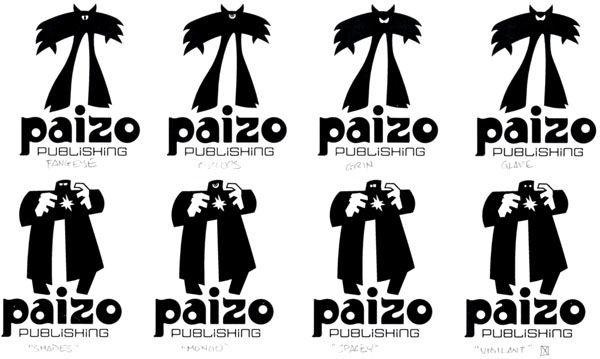
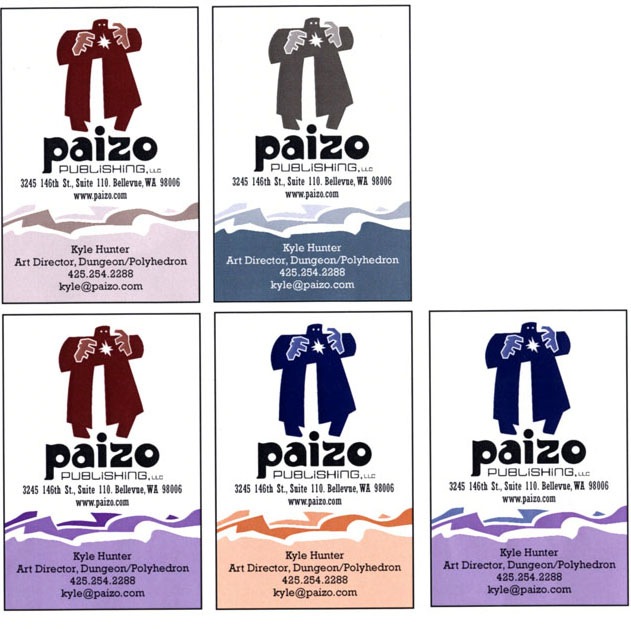
Once we had settled on the name of the company, Johnny had Art Director Kyle Hunter take a stab at some logos for the newly minted corporation. There were two basic styles: one was a calligraphy letter pi fused with a smoke monster, and the other was the same letter pi in the shape of the now familiar golem. Each of these creatures was given varying sets of eyes to convey different moods. From top left: Fangeye, Cyclops, Grin, Glare, Shades, Mongo, Spacey and Vigilant (the logo we ended up choosing). With the design settled, Kyle then did a number of different color treatments. We eventually went with the now-familiar “Paizo purple,” although Kyle was angling for the rusty color you can see in the bottom sample of his business card.
Kyle Hunter’s first takes at a Paizo logo and designs for the first Paizo business card (in a few different color schemes). We ended up picking the business card design on the far right of the second row.Erik’s Memories of Year Zero
The first half of 2002 was a strange time to work at Wizards of the Coast. On one hand, the Hasbro purchase was still recent, and the luster of big bonuses and watching friends with lots of seniority get new cars and houses was still relatively fresh. On the other hand, Wizards was busily streamlining their business to focus on “core competencies,” and starting in 2000, lots of people lost their jobs in a series of layoffs.
Erik Mona and Kyle Hunter discover a haunt near their desks.Despite individual successes at work, there was a strong undercurrent of “I’m sure I’m going to be fired soon” that seemed that year to be even more potent than it had been in the past couple of years. I had only recently been transferred from the RPGA Network to the Periodicals Department, and the two magazines I was shepherding at the time—Polyhedron and the Living Greyhawk Journal—had become sections of Dungeon and Dragon, respectively. I was really enjoying the challenge of integrating these sections, and was doing some of the most fun creative editorial work of my career, but it soon became clear that magazines were not a safe place to work when the company was paring its focus to just its core game business.
About this time, our Group Publisher, Johnny Wilson, began whispering about his plan to save everyone’s jobs and ensure that the venerable magazines of Dungeons & Dragons would continue indefinitely. He had found some investors interested in taking over the magazine business in the likely event that Wizards cut it off, and in his impish way he named the effort “La Cosa Nostra,” or “our thing.” Yes, that’s also the name of the Mafia, but Johnny has an evil sense of humor for a guy as religious as he is, and he’d rub his hands together while talking about his diabolical plan. Coming from between his rosy cherub cheeks, his words filled us all with hope at a time when it was in extremely limited supply around the office.
I was much relieved to learn that Johnny’s mystery investors turned out to be Lisa Stevens and Vic Wertz, two of my earliest Seattle friends. Lisa gave me my first real break in the industry as a continuity consultant for the Greyhawk products she was managing in the late 1990s, and I knew that she and Vic knew enough about business and were the kind of game-loving advocates that it would take to make a project like this work.
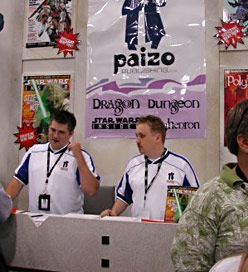
Chris Thomasson (now Youngs) and Erik Mona at the Paizo booth, Gen Con 2002.They were (and are) major Star Wars collectors, and many of us around the office joked that the real reason Vic and Lisa wanted to run the magazine business was to add Star Wars Insider to their considerable Star Wars collection, but my time working on Greyhawk with Lisa convinced me that the Dragon and Dungeon elements were just as important—if not more important—to their interests. I wasn’t worried at all. In fact, once I learned Lisa and Vic were our potential saviors, the only real question was when we were going to move out of the building. My stress evaporated with that revelation, and as I recall things, we were all pretty excited about moving on to the next phase of our professional lives.
As it happens, I am a collector too, so one of my favorite early Paizo memories involved physically loading up all of the department’s assets into a moving truck headed to the new Paizo offices. Johnny suggested that we leave all of the back issues at Wizards, mostly because hauling them all down to the truck would take hours of physical labor, and nobody really wanted all those old magazines anyway. Lisa and I refused to let that happen, knowing just how valuable those dozens of boxes would be, and how criminal it would have been to throw them away. So long after most of the staff had gone home, Lisa, Vic, and I (and perhaps others I can no longer remember) worked into the early morning hours to load those back issues onto the truck.
Even as we loaded them up, Lisa explained (and I well knew) that we weren’t just salvaging the old issues for nostalgia. “Someday we’ll have a website where we can sell these to people who want them,” she said. “We are going to make a ton of money off of these things.”
We still sell those back issues today. That website grew to become paizo.com, one of the internet’s leading hobby stores. Even from the very beginning, Lisa showed that the company would be managed with a balance of genuinely geeky love for the game and strong business sense. It’s the main reason I’ve stuck around here every year since that first night we loaded up the truck with old back issues, and it’s the reason why the company has been able to survive and grow stronger far longer than many companies in this industry.
Erik Mona
Publisher
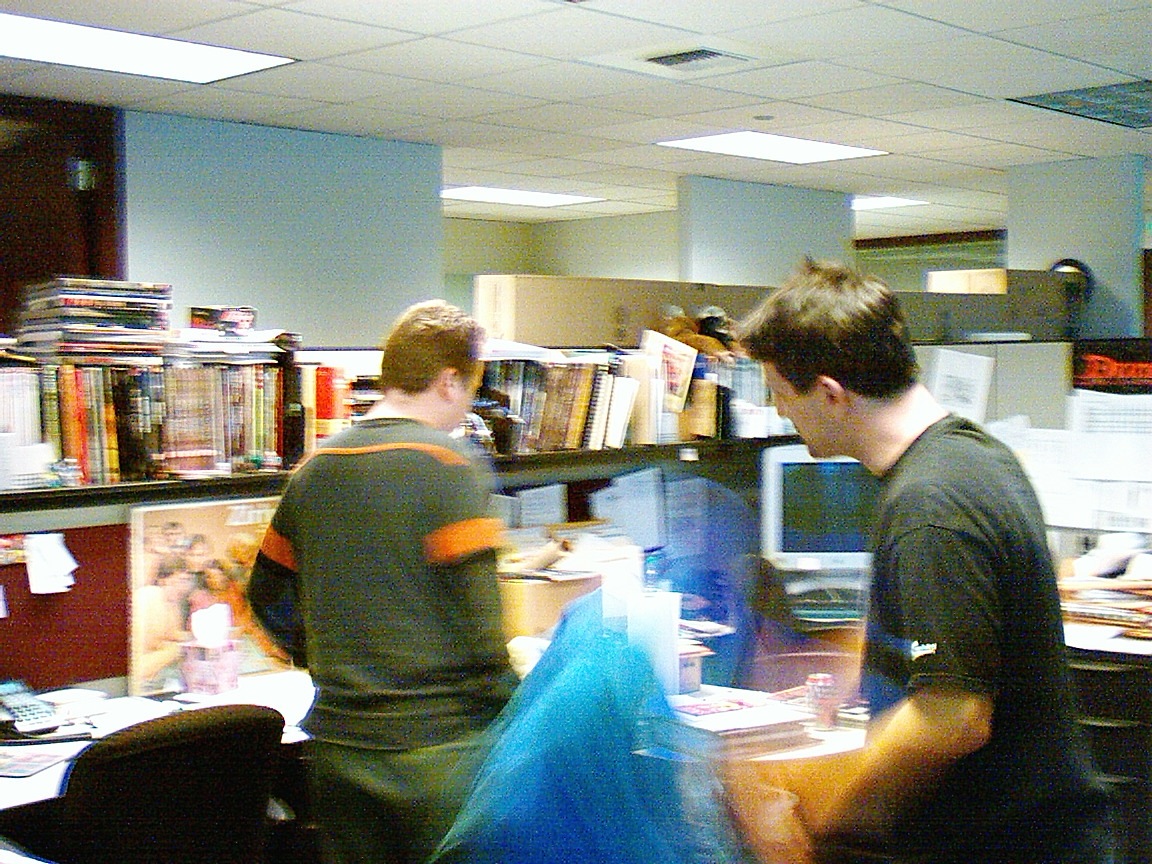
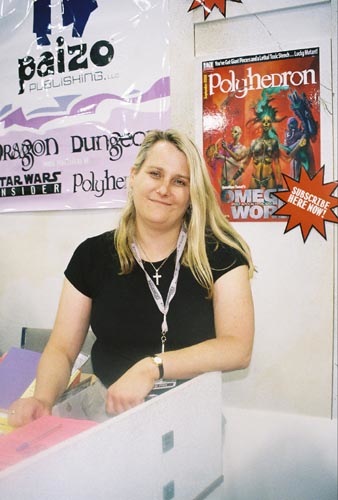
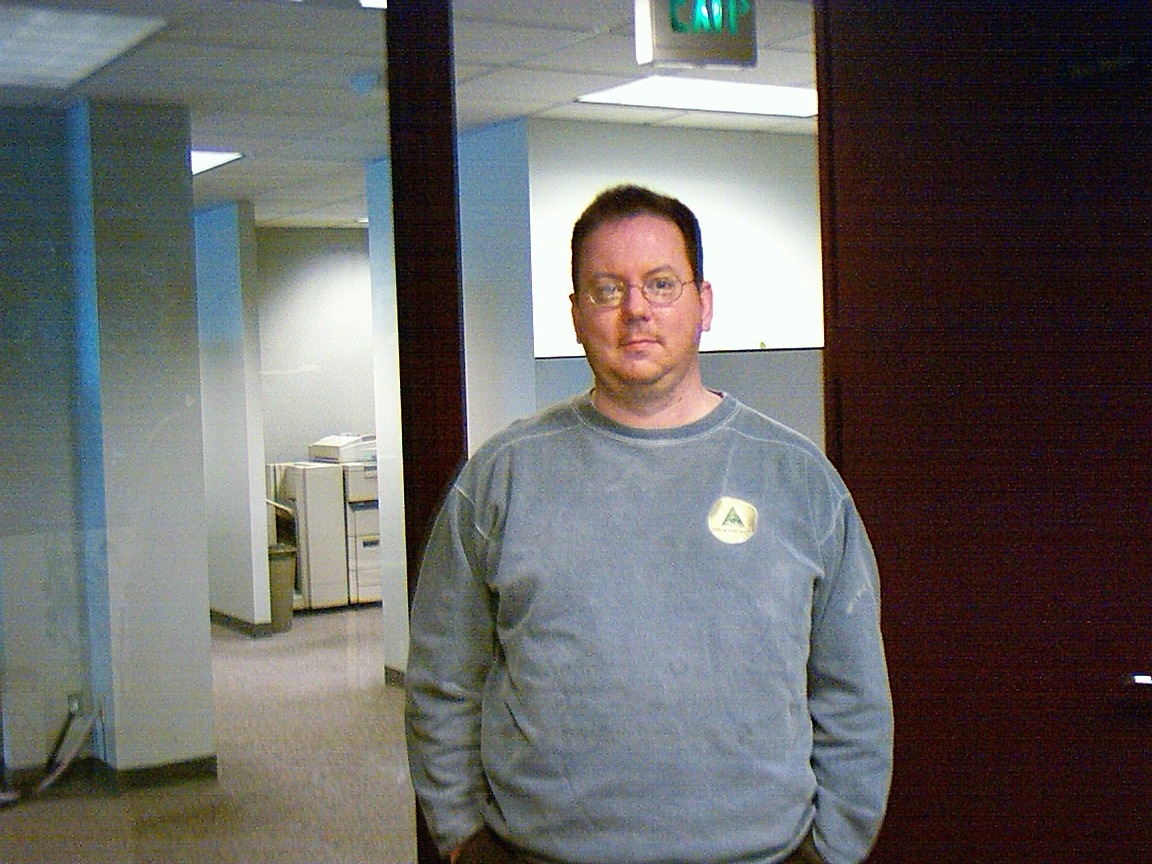
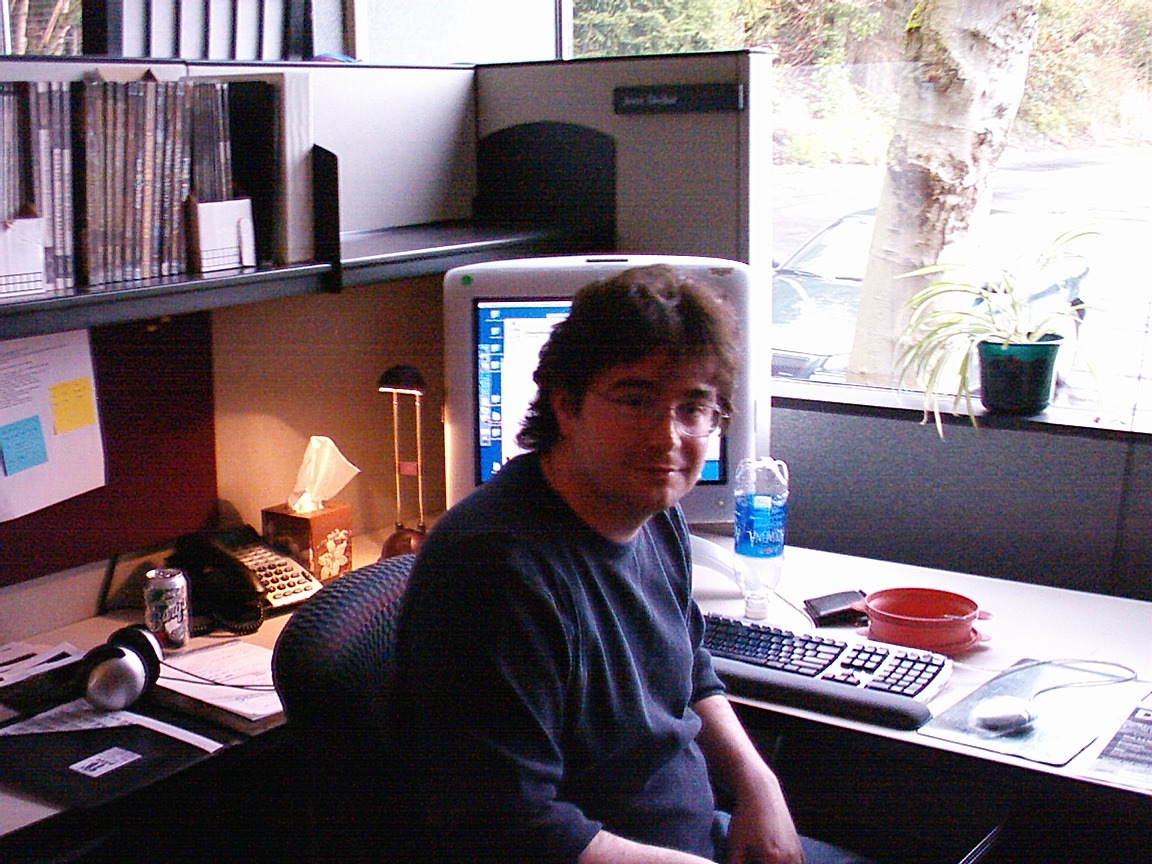
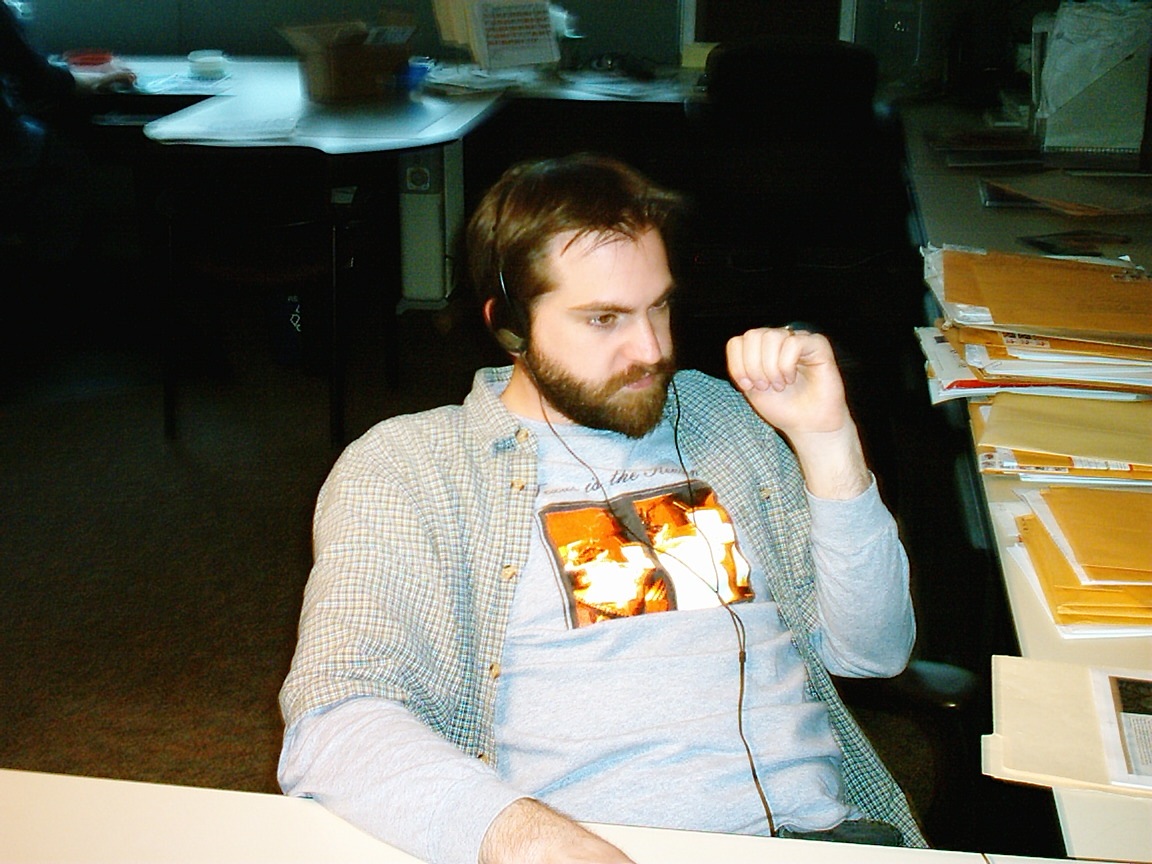
Lisa Stevens at the Paizo booth, inside the Wizards castle at Gen Con 2002. Dave Gross checks out the new Paizo digs before we move in. (The photocopier in the back is part of the best dollar we ever spent.) Jesse Decker with a coveted window seat. Matt Sernett doing his best to ignore the camera. Johnny’s wife Wailam Wilson holds down the front of the office.





We have updated our Privacy Policy.
Paizo.com uses cookies. You can block paizo.com from using cookies within your browser settings, but doing so will hinder site functionality.
More information can be found in our Privacy Policy.