Deep in an ancient forest, a trembling young woman enters the clearing where a ramshackle hut crouches on birds’ legs.
Far below the earth, a caravan of kobold merchants passes through a stone archway carved with the faces of leering ghouls.
High atop a northern mountain, a dwarf grips his battle-axe and gazes over the rim of the world toward whatever fate the gods have in store for him.
This is Midgard, and its gates are now open.
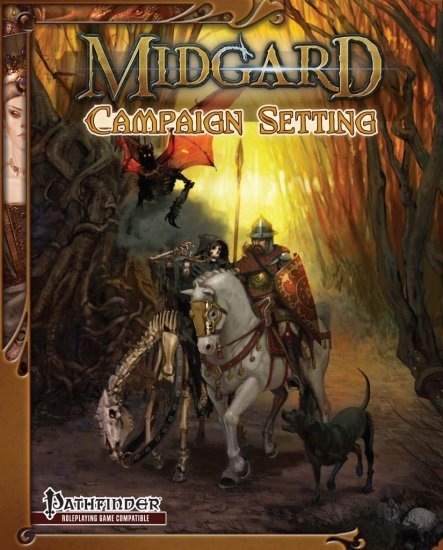
The Midgard Campaign Setting brings to life a dark world of deep magic, with seven regions flavored by the folklore of Central and Eastern Europe plus a heady dose of weird fantasy. Lead designers Wolfgang Baur, Jeff Grubb, and Brandon Hodge led the Open Design community in a two-year project to build a sprawling setting supported by adventures and sourcebooks compatible with the Pathfinder Roleplaying Game, Dungeons & Dragons, AGE System, and more.
Midgard is ley line magic and warped alchemical experiments; the Western Waste’s giant, shambling horrors and magic-blasted landscapes; diabolical gnomes and the schemes of immortal Baba Yaga; wild, wind-riding elves and swashbuckling minotaur corsairs; the Mharoti Empire’s lethal assassins and exotic splendors; and the dragon-haunted crags of the icy Northlands.
The Midgard Campaign Setting 296-page book includes:
Pathfinder Roleplaying Game and AGE System rules for gearforged, kobold, and minotaur PCs
26 new backgrounds, 3 new schools of magic, and new specialties for AGE System
New clerical domains including clockwork, moon, hunger, and beer
More than 50 kingdom write-ups, with new feats and traits for each region of Midgard
New spells, magical items, and incantations
New gear and weapons unique to the setting
Ley line magic and the secrets of the shadow roads!
From the Northern fjords to the hidden tombs of the gnolls, from the raven-headed reavers to the ruins of the great mage-kingdoms: all of Midgard is yours!
"A wonderfully rich and beautiful sourcebook chronicling the world of Midgard. Think of how many game masters have fancied their campaign worlds awesome enough to publish in the book. So few actually have the writing and publishing chops to accomplish this, and to do so with such style is pretty much unheard of." —WIRED GeekDad Holiday Gift Guide 2012
"What I look for in a setting book, particularly a fantasy setting book, is something that inspires me to run a game there—a book that draws me into the world, presents setting material in a way that’s both useful and entertaining, and looks like it will shows its best qualities at the table. The Midgard Campaign Setting is all of those things, in spades, with extra magic gravy on top. This is a superb book that I can recommend without qualification to any GM who likes well-realized, gazetteer-style fantasy settings." —Martin Ralya, Gnome Stew
"If you’re looking for a campaign setting that is familiar with a twist, and a book that is the spiritual successor to the 3e Forgotten Realms Campaign Setting book, the Midgard Campaign Setting is for you. ...There is stuff here you can steal for your own setting, and it’s 'generic' but different. This goes double if you loved the 3e Forgotten Realms campaign or Mystara." —Critical Hits
Lead Designers: Wolfgang Baur, Jeff Grubb, and Brandon Hodge
Cartographers: Jonathan Roberts, official cartographer of George R.R. Martin's Westeros, with Lucas Haley and Sean Macdonald
Artists: Aaron Miller, Blanca Martinez de Rituerto, Christophe Swal, Hugo Solis, Jason Rainville, Rick Hershey, Marc Radle, Malcolm McClinton, Pat Loboyko, Steve Wood, and Darren Calvert
Editor: Michele Carter
Additional Product Images
(click to enlarge)
Product Availability
Fulfilled immediately.
Are there errors or omissions in this product information? Got corrections? Let us know at
store@paizo.com.
The foreword explains the origins of Midgard as Wolfgang Baur's own home game setting that he's been building since he was 14, and how it is amazing even to him to see the piles of scribbled notes and sketched maps that he ran games from turned into a full-colour proper book! Like many gamers I've long enjoyed creating my own worlds to adventure in, but few of us have the talent, perseverence and opportunity to share them with anyone other than their gaming group. This one is replete with a depth that comes of some 25 years of dreaming, writing and playing, jam-packed with lots going on never mind what adventurers might be doing yet plenty of opportunities for them to get involved or carve their own path. Just what you want in a campaign setting!
Chapter 1: Welcome to Midgard gives a high-level overview of the world. It's a place with a rich history of heroes that has fallen on dark times, a place waiting for new heroes to arise. For anyone who might think that this sounds like many other campaign worlds, seven differences between Midgard and 'standard' fantasy settings are laid out. For a start it is flat. In a quasi-mediaeval world, you might expect plenty of people to think that their world is flat, but this one really is flat. With edges. There are ley lines, utilised by the elves. Dragons are linked to the elements, and enjoy ruling whatever they can get their claws on, as well as the traditional dragon pursuit of amassing a good hoard. There are novel races, each with their own history and place in the world, as well as the standard fantasy human, elf, dwarf and so on. Personal prestige is important. The deities meddle with what goes on in mortal life. And it's not a static place. Boundaries between kingdoms change. Dynasties rise and fall. The party may have a chance to influence - even instigate - such change, but happen it will whatever they do.
The epic sweep of Midgard's creation (or at least, what is known and surmised about it) is then explained. Naturally all deities claim to have made it, but it's likely that they are lying. The creation myth told by the Northlanders is probably closer to the truth, but who knows? Races came and went, kingdoms rose and fell, a succession through giants and then elves until now when, although the other races are still around, humans take a more prominent role. Naturally the succession has rarely be peaceful with rebellions and wars... and if battlefield strife was not bad enough, the wizards cut loose too and waged war with arcane powers, leading to great swathes of devastation. And then the dragons and the vampires emerged to stake their claims... Ending with events of the last hundred years, the chapter finishes with a discussion of time, planets and dates. Flat or not, Midgard has a sun that rises in the east and sets in the west, not that anyone knows just what happens to it when it is not in view. There are moons and planets around as well. Naturally there are quite a few festivals and holidays to celebrate.
Next is Chapter 2: Heroes of Midgard. This provides details about the major races and assorted minor ones to be found in Midgard. It includes fascinating snippets and a wide range of variation within races, depending on where they hail from - things that create a diverse society and plenty of options for those seeking to create characters truly embedded in the lands from which they come. Humans, dragonkin, dwarves, elves, the gearforged, kobolds, and minotaurs make up the major races, and whilst some are well known, those that are not are described in sufficient detail to empower players who wish to experiment with a novel race for their character. There are seven minor races as well, ones who - as well as being less familiar as player-character races - are only found in specific parts of the world. There's a note on languages, and then it's on to a collection of Midgard-specific feats and traits. No matter where your character comes from, there is a range of traits that he can choose between, all providing distinctive regional and racial flavour.
The book goes on to describe the seven major regions of Midgard, geographically and culturally distinctive, with each getting its own chapter. In the middle of the world is Crossroads, then there are the Rothenian Plain, the Dragon Empire, the Seven Cities, the Wasted West, the Domains of the Princes, and the Northlands. Each has a wealth of description and some detailed maps to help you get a feel for the lay of the land. Crossroads can be a bit of a melting-pot of cultures, and at its heart is the Free City of Zobeck, which already has a sourcebook and an adventure collection of its own. Here there are brief notes and its coat of arms (the blazon is not quite right, the shield is not quartered but divided per pale - the full blazon is per pale gules and or, a gearwheel counterchanged if you really want to know!), plenty for a brief visit although if your game is going to spend much time there, get a copy of the Zobeck Gazetteer. Of particular note are references to magic unique to Zobeck, the Clockwork School and the School of Illumination Magic. The discussion moves on to trade, with loads of detail about trading companies, trade routes and so on, then to mercenary companies and many other locations that are to be found in the Crossroads area. The sheer wealth of detailed information packed in here is quite amazing... it spawns adventure ideas, never mind being useful if you already have reason to tread these lands. Numerous kingdoms, organisations, individuals and locations are all here...
And so it continues through chapter after chapter until all seven regions are described. As you read, the roots of Midgard begin to show: Middle European folk tales and legends, often the darker nightmare-inspiring end of things. But there is much more. A cluster of halflings around the great World Tree of Domovogrod, nomads roaming vast plains with a 'city on wheels' that travels around, as nomadic as the people it serves. There are spreading forests and towering mountains, strange customs and stranger titles... never mind the beings bearing them. Every region has distinctive spells, equipment and more. Throughout, there are suggestions for adventure, rooted in the people and places you are reading about at the time. The richness of this setting is matched by how integrated it is: sometimes you read of a campaign world where it seems a human world with other races tacked on because a fantasy world ought to have them: here they belong, as integral a part of the setting as any other creature.
After the regional chapters, there is a chapter detailing the pantheon of Midgard. It takes things much further than the usual list of deities and the domains over which they have influence, though. These gods are properly mysterious, they and their ways cannot be understood and categorised by mere mortals. Sometimes aloof, they can be jealous - it's said that the best way to attract one god's attention is to worship another one! - and are said to interfere in mortal affairs. Through a system of 'masks' deities are able to walk the land and meddle in whatever takes their interest. Mechanically, there are new domains and spells and the concept of the pantheistic priest. This novel cleric worships the five gods designated as the major powers wherever he lives, each week chosing one of them to venerate and receiving access to the appropriate domains. The underlying reasons for why the gods of Midgard are as they appear are explained, but this is a matter properly for the GM: even their clerics and most fervent devotees do not know! There's a lot of material here, enough to keep the keenest student of theology busy. Finally, an Appendix provides resources for those who'd like to use the Midgard setting with the AGE system rather than Pathfinder.
It's the sort of world that you feel that you could take a lifetime exploring it and still feel that you have only scratched at the surface. This is a book to dip into, to browse through, to read again and again. Whether you like to prowl in the woods, roam vast plains, travese deserts or trudge through deep snow, there is adventure and excitement and things to see and do at every turn. Primarily a book for GMs, there's a series of Player's Guides to the different regions available, if you want your players to learn more about where their characters are without giving away too many secrets. In sheer depth and richness, this setting is hard to beat - and one wonders just how so much is packed into 'only' just under 300 pages!
I bought this book as a pdf and this review covers the pdf version of the product.
It was a campaign setting (the Forgotten Realms) that got me involved in RPGs, hooking me to the idea of playing (and running) adventures in an actual world that keeps on spinning regardless of the adventure's outcome, with nations, power groups, and individuals with their own goals and plots full of gaming potential. Flipping through the pages of a good campaign setting usually leaves me with dozens of potential adventure or campaign ideas.
The Midgard campaign setting is no exception. This wonderful, mythical world is overflowing with fascinating locations, horrifying evils, and excellent, original takes on many fantasy tropes. On most pages there is at least one or two ideas ready to be made into campaign or character ideas. There is an excellent mix of folklore inspired and truly original creations. Some particular standouts for me include the subterranean Ghoul Empire, the Seven Cities and their wars, the Wasted West with the slow moving horrors, Ley Lines, Shadow Roads, and the Gnomes, oh the awesome of the gnomes.
If you are looking for a world oozing with fun, flavorful locations and beings, with intriguing adventure ideas on almost every page, pick up this setting. Even if you don't move your campaign to Midgard you can find lots to use in this great book and setting.
(This is my 1st review.)
I’m a sucker for campaign settings. I have been since I purchased that first Greyhawk Campaign Setting with the charging knight on the front. I’ve used them as the foundation of my campaigns (Greyhawk, Forgotten Realms, Birthright, Golarion) and I’ve taken and ported elements that I liked from others (Ravenloft, Scarred Lands, Krynn). But despite my love of campaign settings, as with most things gaming, I’m pretty damned picky. If something doesn’t work for me, it usually really doesn’t work for me.
Also, for the record, prior to a few issues of Kobold Quarterly and an Advanced Feats PDF or two, I had not purchased any Open Design/Kobold Press products prior to the Midgard Campaign Setting, so I’m not reviewing this product through the lens of a Patron, a Kickstarter supporter, or as an established fan of the setting. I’m also someone who initially avoided the setting as it seemed to me that in those dark days before the PFRPG was launched, the setting was fully embracing 4e. (Full disclosure, there is little in 4e that appeals to me.)
This review is of the PDF, solely focused on the PFRPG elements (but I’ve ordered a hardcopy).
WHAT COMPRISES THE MIDGARD CAMPAIGN SETTING?
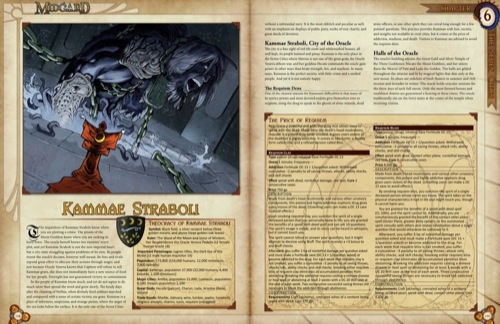
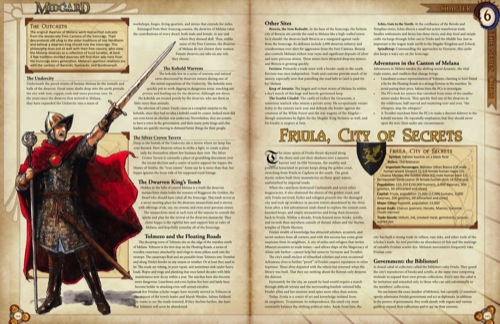
The Midgard Campaign Setting is a gorgeous book. Layout is clear, yet attractive with full-colored illustrations & detailed maps (with a scale on each map!).
Chapter 1: Midgard presents the setting at a high level and introduces setting-specific characteristics. Most notable are the “Seven Secrets” that present some core fundamentals about Midgard, in particular, that dragons seek to rule in parts of the world, ley lines are a major conceit of the setting, and that while the timeline isn’t overtly fixed, it is assumed that the setting can change in significant ways. While that last bit may be old hat for seasoned gamers, I’ve rarely seen the “permission” to change the world so explicitly stated.
History, calendar, recent events, festivals, and planes are presented next. The history is detailed enough to present a sense of scope and backdrop without bogging down into textbook-style reading, the planes are flavorful and presented more in a tone of myth and uncertainty than a scholar’s treatise on their characteristics. Calendars, festivals, and recent events, which are often relegated to later chapters in other setting books, help ground the reader in the setting by showing up earlier than usual.
Finally, Ley Line mechanics are presented. These support the richness of the setting lore within the familiar framework of Pathfinder feats. Some subsystem details complete the Ley Line rules without becoming a burdensome add-on.
Chapter 2: Heroes
Races, Languages, and campaign-specific Feats & Traits are up next. Here are many of the things that make Midgard distinct and they are the same things that foolishly deterred me from looking at the early Open Design releases when they were 4e-centric. Kobolds as a major race? Minotaurs as a player race – didn’t we already get that with DragonLance? Dragonkin, -er Dragonborn… can you see the eye-rolling from here? Except that it all works and deliciously, flavorfully, so. The dragonkin & kobolds tie directly to the setting conceit of empire-building dragons. The dragonkin are more akin to Arcana Evolved’s dragonman race than the 4e dragonborn fluff hyped by WotC (IMO, at least). Much as Paizo has done for Goblins and Ogres, dwarves and elves are familiar but varied slightly in their own unique ways. I’m still not a huge fan of Gearforged but they’re not omni-present in the setting. Centaurs, gnolls, and tengu get more prominence than they do in many settings. Every race is recognizable from Pathfinder RPG core concepts, but all have a distinctive Midgard spin to them.
The standouts of this chapter, however, are the Midgard Feats & Traits. Broken down by region, they are mechanically sound yet dripping with setting flavor from evocative names to concise descriptive text. These reinforce the cultural differences of the various regions while avoiding long stretches of description-by-essay. By not having to hit the “generic PFRPG” button that the PFRPG line has to do, these all feel very connected to the setting yet can easily be ported to other settings. They avoid the sometimes over-specific traits found in some of the PF AP player’s guides, but those are designed to serve a slightly different function anyway.
Chapters 3-9: The Regions of Midgard
The bulk of the campaign setting, it is also the part I will summarize the most as this review is lengthy as-is. Here are the sections where Midgard is painted in vivid colors and contrasts. Each chapter covers a particular region: The Crossroads, the Wasted West, the Dragon Empire, the Seven Cities, the Rothenian Plain, the Domains of the Princes, and the Northlands. With the exception of the Northlands, the names themselves are evocative and inspire further investigation. Yet all of the chapters have a structure and flow to them that encourages one to continue reading through – a feat most campaign settings fail to achieve. Plot hooks and adventure seeds are laden throughout and each region is distinct. Yet by pulling from Earth-based myth, particularly of Norse and Eastern Europe, it has a familiarity that allows the reader to quickly grasp the cultural concepts of each region.
Important game info is presented for each region: a more detailed map, population info, gods worshipped, etc. as one would expect. But it’s the little details that stand out. Details that are often hand-waved away in other settings are found here as well. Travel times & costs between various cities, trade goods, prominent castles, cultural tidbits, and relevant game mechanics all combine to form a rich, yet cohesive whole that can support a very diverse range of themes & playstyles. It’s a customized kitchen sink, not a generic one, and the setting is stronger for it.
Midgard is a darker setting yet is still a setting ideally suited for High Fantasy. Most settings chose to hew strongly towards the dark (WHFRP’s Known World) or the High Fantasy genre (Forgotten Realms), with only token attempts to support other genres and styles of play. Midgard strikes a great balance, making it easy for a GM to lean whichever way suits the campaign or players without having to drastically change the tone of the setting.
Chapter 10: Pantheon
Once again, my expectations were dashed with this chapter. Fantasy pantheons are a favorite setting aspect of mine and compared to a Book of the Righteous or Scarred Lands’ pantheon, how could gods pulled from Norse, Eastern European, and Egyptian myth possibly compare?
As it turns out, pretty damn well. Forgive my soapbox-grandstanding for a moment, but gods should not be the top of the monster pyramid for homicidal players to slay. In a game where alignment provides a shorthand for a character’s morality and ethics, portraying the gods as relevant for something more than the source of a cleric’s power can be a difficult goal to achieve. Pages of backstory on a god’s personality might make for an interesting read, but often has little bearing on the playing of the game. Too often, there is little room for theological debates, heresies, or wars and a rich source of conflict and story/setting development is lost.
So how does Midgard avoid these pitfalls? Masks & alignment. See, some of Midgard’s theologians believe that the gods represent themselves differently to different cultures. Few regions agree which of their gods are the “masks” of another in a different region. One man’s Thor may, or may not, be another man’s Mavros. Also, most gods, being unknowable and beyond mortality, usually only have one alignment axis fixed (Law, Chaos, Good, or Evil) and the other is variable. The result is a world where the familiar mythological figures shorten the learning curve for new players and where mystery is injected back into fantasy RPG religions.
In short, it rocks.
Of equal import, rather than paragraphs and pages on a god’s personality, we get more practical, game-relevant info: expectations of worshipers, symbols, holy texts, shrines, priests, and interactions with other faiths along with standard domain & favored weapon info.
WHAT SETS MIDGARD APART FROM OTHER SETTINGS?
I’ve considered writing RPG reviews of other products. However, with Midgard, I was inspired to write a review. Honestly, that bugged me. What was it about this setting that made it stand out among the many I’ve read and used in my games over the years? I’ve been ruminating over it for a few days and these were my “Aha!” takeaways:
1. Seasoned, not saturated.
This was the setting I shouldn’t have liked. It allowed for dragonman characters, gunpowder, clockwork/steampunk, and Earth-myth gods. All things I generally do not like in my FRPGing. But they’re placed in the setting in such a light-touched and organic way that the “coolness” outweighs my reservations. Limitations are placed in a way that seems plausible rather than forced. Most importantly, the writers understand that a little can go a long way and that it’s easier to increase certain elements to suit a GM’s game than it is to rip something out.
I love the clockwork city of Zobeck and the fact that dwarves have invented gunpowder. But I still get to have orders of knighthood, witches in the forest, and all of the medieval tropes that I embraced when I bought that first Greyhawk campaign setting. It doesn’t feel forced and it’s not laden with anachronisms that break the immersion in the setting.
2. Rules serve the setting rather than the setting serving the rules.
This is perhaps an unfair critique against other settings, and I’m sure it’s not true in all cases but it rings true to me. It’s how I felt after reading this book. I look at things like Ley Lines, the Mana Wastes, gearforged and the rest and it’s clear that they are there because the writers thought they were interesting and cool. They added to the distinctiveness of the world, the plot hooks, the adventure seeds – they added to Midgard’s character. They didn’t build a world to fit the Pathfinder RPG. They built a world and then built PFRPG rules that made the integration seamless.
3. “I want to run a campaign…here”.
This is the first RPG setting where I could not only envision running a campaign in every region, I wanted to do so. There were no regions that didn’t interest me, nowhere that I definitely wanted to stay away from, no place that didn’t “work for me”. I don’t know that anyone else will feel that way, but it was a first for me.
WHAT’S NOT TO LIKE?
Not a great deal, honestly. There are a few errors/typos such as the omission of the “Time Flies” optional rule while reference to it survives and things like races having a Favored Class rather than a character choosing their favored class.
While some will find it part of the setting’s charm, fans of elves and half-elves may be surprised at how elves are less common than in other settings. Halflings return to their Tolkein-esque roots and seem almost an afterthought.
After Paizo’s much-cheered revamp of gnomes into an interesting race, some might be taken aback at the dark circumstances of many of Midgard’s gnomes. However, it’s not a universal situation for the entire race, so again, season to taste.
There is little mention of orcs, and I’ve always had a soft-spot for orcs as one of my go-to bad guys. I hope that they gain some prominence in the setting if the line expands to regions beyond the seven described in the campaign setting.
CONCLUSION
Midgard is a rich, vibrant campaign setting that should be in every fantasy RPG library. It’s familiar without feeling rehashed. It’s unique in a way that enriches the differences rather than overshadowing other genres or aspects of the game. It’s written in a way that provides a massive amount of info in manageable chunks and ignites the imagination.
Yes, it’s that damn good. Go get it now. 5 of 5 stars.
a great book, please, where in golarion can i put the Midgard?
I can support most of the positive things people have said below, so there's no reason to dive into what others have obviously spent more time going over. I love the flavor of the world and the setting, and it has a nice Germanic flavor that really tickles my personal interest. I love the cartography in this book as well, so amazingly well done!
I do have some problems with the product though and figure I may as well give warning to anyone interested in purchasing the first print run. There are quite a few typos throughout the book, and while that's not so bad there are some instances of placeholder text left in (the most prominent instance was $$ rather than the page number that was being referenced). While this can be understandable to some as an admissible error for a smaller publishing company, but when I'm investing $50 on a hardcover book this leaves a bitter taste in my mouth.
Other small complaints of mine include: I feel there is some pretty poor art at points, but the overwhelming amount of art is astounding and more than makes up for it. This is a very admissible problem for a smaller publisher, and the good far outweighs the bad. I was also a bit disappointed with the section on the races of Midgard in general, it only encompass about 1/2 the amount of info I would have liked and am left assuming that if it wasn't covered in the MCS that I should just grab the flavor from Golarion (which takes me out of the setting a little).
So as you can tell these are only minor distractions. Honestly if just a bit more care was taken with the copy editing for this book I would still have given this product a 5 star rating, and I personally find the amount of issues in this book to be careless and not just an accident here and there. The second printing I'm sure will fix these issues so my recommendation is to wait on that and get the gorgeous hardcover version. The setting, layout, cartography, and world building in this book are top notch and it is because of that the issues I have with the first printing sting all the more.
If I preorder here, is a Print+PDF bundle an option, or jut print? I would rather purchase here than on the KQ store directly because of shipping charges.
Kthulhu, you should have gotten the various playtest PDFs already. The final PDF has not been released yet, but all patrons of the project will get it when it ships.
Thanks for the glitch report! That's likely a corrupted cookie: if so, try another browser or delete the Kobold cookie and it should work.
I went to get my patronage cheap (print, I have the PDF coming) copy on the Kobold store... postage SIXTY FIVE BUCKS OF YOUR FINEST YANKEE DOLLARS!
So I think I'll get it chucked in with a subscription shipment from here.
This looks great. I will have to admit that I have not been lucky enough to have already been following this project. I have clearly been missing out!
For those of us who are learning about this for the first time, is there a 1 or 2 page preview (Table of Contents would be great) or a place I can go to learn more?
ElfIRL, you will definitely see additional previews this month on the Kobold blog and Facebook page. There's also this summary page of the setting.
EonTrinity, thank you for the vote of confidence. The Northlands level of quality definitely set the bar here, and I like to think we have cleared it. We'll see soon!
EonTrinity, thank you for the vote of confidence. The Northlands level of quality definitely set the bar here, and I like to think we have cleared it. We'll see soon!
You bet. When I pre-ordered, I also just picked up the Imperial Gazeteer PDF, and it is really awesome.
Tharen, it doesn't say "PDF" yet because I don't have a PDF to add to the site yet. When one is available, you will be granted a copy of the PDF for your print preorder.
you will definitely see additional previews this month on the Kobold blog and Facebook page. There's also this summary page of the setting.
Thank you for dropping by and giving us some info. Been a fan of the setting on facebook for a while, so long in fact I'd forgotten a lot about it (doesn't really take long for me to start forgetting nowadays)!
So, long story short, I'm now officially salivating (again) and pre-ordering.
Best wishes, good luck on the launch/1st printing!
Pathfinder Maps, Pathfinder Accessories Subscriber; Pathfinder Roleplaying Game Charter Superscriber; Starfinder Charter Superscriber
I'm a little irritated that this shows up with $52 of shipping charges to Germany (for the hardcover version). Thats more than I just paid even for the Bestiary Box. That can't be right, can it?
Zaister, our weight estimation for this product was off (way off), which pushed it above the four pound mark for international shipping. I've adjusted it to something more reasonable—try again!
The initial street date had been set for October 1st, but it's not ready quite yet (I think the kobolds are still waiting for it to hatch), which is why it was listed as unavailable. You should now be able to preorder it again.
I am a compulsive homebrewer, I rarely play campaigns straight from a book, and as much as I love this book I don’t think I will switch my long running campaign to Midgard. Still this book has a LOT for me. There are rules throughout that I will steal for my game, such as Ley Lines, Status rules, the mechanical effects of languages, new races, traits and feats, pantheists priests, and then there are the details on nations and places that can be picked up and inserted into any campaign. This book will see great use at my table…
This is not your typical setting, and that is great!
I have got my patron copy pdf and the race section cannot be properly displayed in Adobe X. Is that again an OBS-related problem or did anyone else experience this particular glitch?
I am interested in the Player's guides the book says are available. My guess they aren't yet. :)
Very nice setting. It got me to also get the Zobeck and Northlands books. Though I wish the Northlands extra was also available at DTRPG, I like to keep my setting purchases from the same location.
I can't believe how good this book is! A decade from now, when people talk about seminal campaign settings, Midgard will be discussed along with Greyhawk and Forgotten Realms.
I find it unique that there is a list that uses the d30. Being a fairly new RPG'er I have never run across a use for that particular die yet.
Heh... As it happens, I own a 30-sider but I hardly ever use it. Not only are d30 tables scarcer than hen's teeth, but with thirty sides it's darn near spherical - it takes forever for it to come to a halt!
Earlier in my gaming life I bought some huge dice, and among the one's I got were 4 d30's.
The one's I have a very hard time reading are the single d100's. I never can figure out where to look for the number on top.
I got one of the dice trays so they don't roll all over the table or onto the floor. There used to be a guy on here that was making custom trays. Wish I had bought one when he was making them.
I can't believe how good this book is! A decade from now, when people talk about seminal campaign settings, Midgard will be discussed along with Greyhawk and Forgotten Realms.
I'd ask you why, but I already read your review! It was a tantalizing read--thank you, by the way--now I just have to wait for access to the PDF and then the sweet, sweet hard copy to arrive =)




 Rafilar

 Kthulhu

 Wolfgang Baur
Kobold Press
Wolfgang Baur
Kobold Press


 Tharen the Damned


