|
|
|

2009 ENnie Voting Ends!
Friday, July 31, 2009
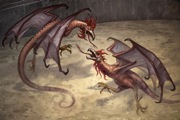
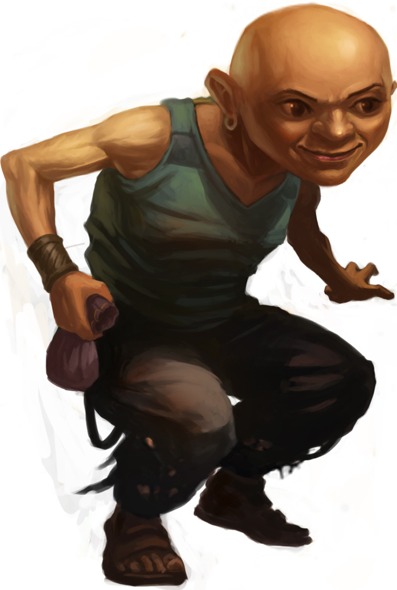
Last time I'll mention it this year, promise. Voting for the ENnie Awards ends tomorrow, so if you haven't cast your ballot yet for your favorite games and accessories, WHAT ARE YOU WAITING FOR!? Intimidation? Is that's what it's going to take? Fine then, I'll leave that to Dave Allsop's mite from the upcoming Pathfinder RPG Bestiary. Now go vote!
Illustration by Dave Allsop
Wes Schneider
Managing Editor
Link.
Tags:
Dave Allsop, Monsters, Pathfinder Roleplaying Game
|

Illustration by Tomasz Jedruszek |
We're Baaaaaaaack!
Thursday, July 30, 2009
Shameful! Absolutely shameful!
I refer, of course, to the fact that the last several months have seen the Planet Stories footprint on this blog dwindle down to almost nothing. It turns out that producing a 576-page RPG core rulebook and a bestiary with more than 350 monsters in addition to our Pathfinder, Pathfinder Companion, Pathfinder Chronicles, Pathfinder Modules, Pathfinder Scenarios, GameMastery, Titanic, and Planet Stories lines is a bit time-consuming. (Just reading over that list makes me want to hide under my desk and take a nap.)
But those days of slothful negligence are past! The classic SF of Planet Stories will once again shine forth from this blog, and given our total artistic redesign of the line, there's never been a better time for it. In the coming weeks, we'll be talking more about Robots Have No Tails by Henry Kuttner, the first book in the new format, as well as its introduction by weird-fiction superstar Tim Powers and Kuttner praise from H. P. Lovecraft himself, plus subscription benefits and the philosophy behind the new look for the line. For now, however, I'm happy to let Mr. Kuttner speak for himself. The following excerpt is from the Robots Have No Tails story "The World is Mine," in which our drunken scientist hero attempts to solve his own murder while wrangling three adorable and incompetent martians bent on planetary conquest...
"The little guys came through the machine or whatever it was. You said you hadn't adjusted it right, so you fixed it."
"I wonder what I had in mind," Gallegher pondered.
The Lybblas had finished their milk. "We're through," said the fat one. "Now we'll conquer the world. Where'll we begin?"
Gallegher shrugged, "I fear I can't advise you, gentlemen. I've never had the inclination myself. Wouldn't have the faintest idea how to go about it."
"First we destroy the big cities," said the smallest Lybbla excitedly, "then we capture pretty girls and hold them for ransom or something. Then everybody's scared and we win."
"How do you figure that out?" Gallegher asked.
"It's in the books. That's how it's always done. We know. We'll be tyrants and beat everybody. I want some more milk, please."
"So do I," said two other piping little voices.
Grinning, Gallegher served. "You don't seem much surprised by finding yourselves here."
"That's in the books, too." Lap-lap.
"You mean—this?" Gallegher's eyebrows went up.
"Oh, no. But all about time-traveling. All the novels in our era are about science and things. We read lots. There isn't much else to do in the Valley," the Lybbla ended, a bit sadly.
"Is that all you read?"
"No, we read everything. Technical books on science as well as novels. How disintegrators are made and so on. We'll tell you how to make weapons for us."
"Thanks. That sort of literature is open to the public?"
"Sure. Why not?"
"I should think it would be dangerous."
"So should I," the fat Lybbla said thoughtfully, "but it isn't somehow."
Gallegher pondered. "Could you tell me how to make a heat ray, for example?"
"Yes," was the excited reply, "and then we'd destroy the big cities and capture—"
"I know. Pretty girls and hold them for ransom. Why?"
"We know what's what," a Lybbla said shrewdly. "We read books, we do." He spilled his cup, looked at the puddle of milk, and let his ears droop disconsolately.
The other two Lybblas hastily patted him on the back. "Don't cry," the biggest one urged.
"I gotta," the Lybbla said. "It's in the books."
"You have it backward. You don't cry over spilt milk."
"Do. Will," said the recalcitrant Lybbla, and began to weep.
Gallegher brought him more milk. "About this heat ray," he said. "Just how—"
"Simple," the fat Lybbla said, and explained.
It was simple. Grandpa didn't get it, of course, but he watched interestedly as Gallegher went to work. Within half an hour the job was completed. It was a heat ray, too. It burned a hole through a closet door.
"Whew!" Gallegher breathed, watching smoke rise from the charred wood. "That's something!" He examined the small metal cylinder in his hand.
"It kills people, too," the fat Lybbla murmured. "Like the man in the back yard."
"Yes, it— What? The man in—"
"The back yard. We sat on him for a while, but he got cold after a bit. There's a hole burned through his chest."
"You did it," Gallegher accused, gulping.
"No. He came out of time, too, I expect. There was a heat-ray hole in him."
"Who...who was he?"
"Never saw him before in my life," the fat Lybbla said, losing interest. "I want more milk." He leaped to the bench top and peered through the window at the towers of Manhattan's skyline. "Wheeee! The world is ours!"
The doorbell sang. Gallegher, a little pale said, "Grandpa, see what it is. Send him away in any case. Probably a bill collector. They're used to being turned away. Oh, Lord! I've never committed a murder before—"
"I have," Grandpa murmured, departing. He did not clarify the statement.
Gallegher went into the back yard, accompanied by the scuttling small figures of the Lybblas. The worst had happened. In the middle of the rose garden lay a dead body. It was the corpse of a man, bearded and ancient, quite bald, and wearing garments made, apparently of flexible, tinted cellophane. Through his tunic and chest was the distinctive hole burned by a heat-ray projector.
"He looks familiar, somehow," Gallegher decided. "Dunno why. Was he dead when he came out of time?"
"Dead but warm," one of the Lybblas said. "That was nice."
Gallegher repressed a shudder. Horrid little creatures...
James Sutter
Editor, Planet Stories
Link.
Tags:
Henry Kuttner, Planet Stories, Tim Powers, Tomasz Jedruszek
Pathfinder Roleplaying Game Preview #12
Wednesday, July 29, 2009
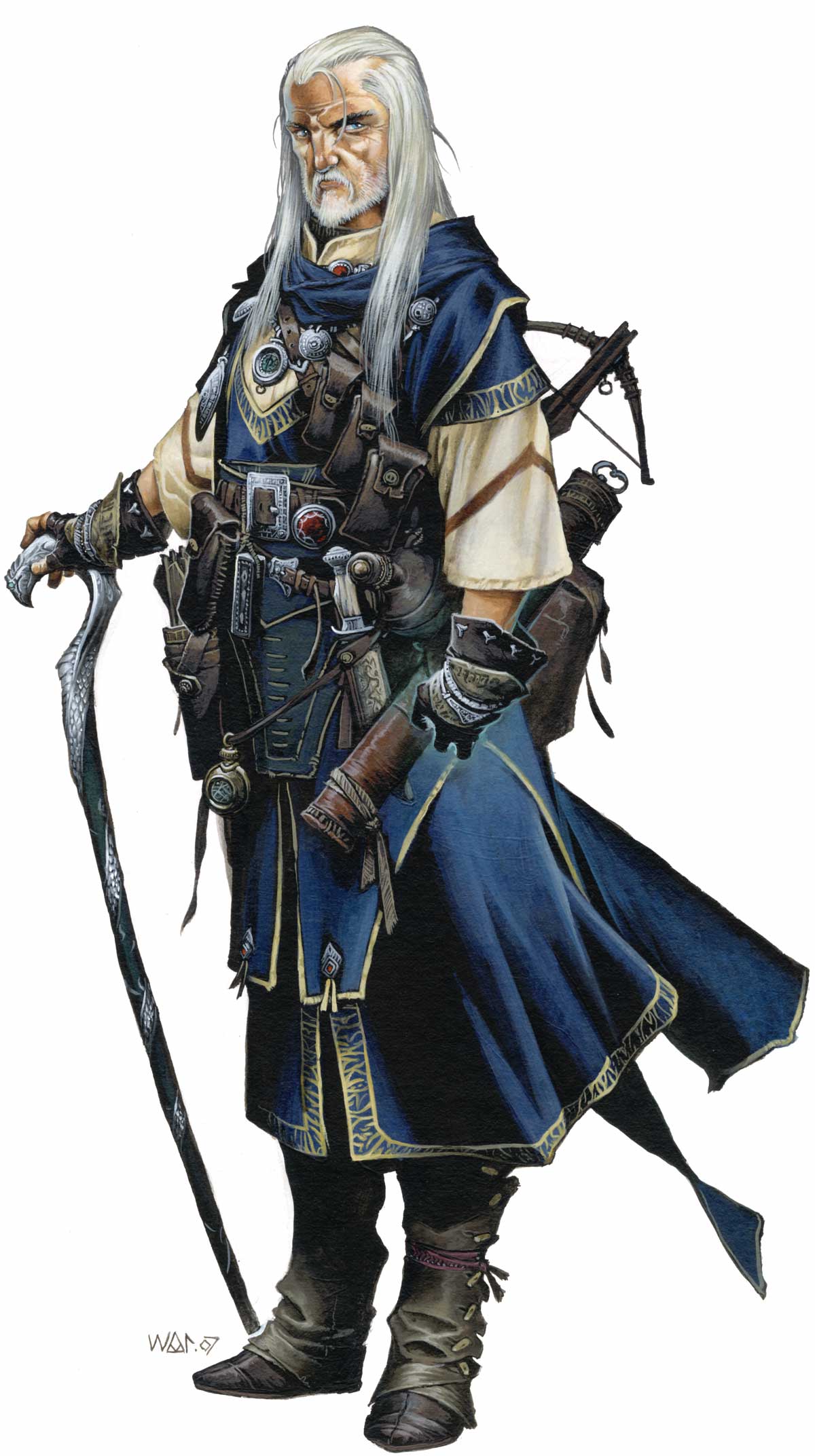
The Pathfinder Roleplaying Game Core Rulebook is set to release on August 13th, 2009, and in anticipation, we are releasing a preview of the game each week until the game hits store shelves. This week, we are delving the depths of power with Ezren, the iconic wizard.
Ezren
Male human wizard 10
NG Medium humanoid (human)
Init +3; Senses Perception +12
Defense
AC 15, touch 11, flat-footed 15 (+4 armor, +2 deflection, –1 Dex)
hp 57 (10d6+20)
Fort +8, Ref +4, Will +11
Offense
Speed 30 ft.
Melee club +5 (1d6)
Special Attacks hand of the apprentice (9/day, +11 ranged), metamagic mastery (2/day)
Spells Prepared (CL 10th)
5th—cone of cold (DC 21), teleport, wall of force
4th—dimension door, enervation, ice storm, stoneskin
3rd—dispel magic, fireball (DC 19), fly, haste
2nd—bull's strength, invisibility, mirror image, scorching ray (2), web (DC 18)
1st—alarm, magic missile (3), ray of enfeeblement, shield
0—detect magic, light, mage hand, read magic
Statistics
Str 11, Dex 9, Con 12, Int 22, Wis 15, Cha 9
Base Atk +5; CMB +5; CMD 21
Feats Arcane Strike, Combat Casting, Defensive Combat Training, Empower Spell, Great Fortitude, Improved Initiative, Scribe Scroll, Silent Spell
Skills Appraise +19, Fly +12, Knowledge (arcana) +19, Knowledge (engineering) +19, Knowledge (geography) +19, Knowledge (history) +19, Knowledge (planes) +19, Perception +12, Spellcraft +19
Languages Common, Draconic, Dwarven, Elven, Gnome, Halfling, Orc
SQ arcane bond (cane), cantrips
Combat Gear potion of cure serious wounds, scroll of dispel magic, wand of magic missile (CL 9th, 50 charges); Other Gear ring of protection +2, cloak of resistance +2, bracers of armor +4, cane (treat as a club), bead of force, blessed book, headband of vast intelligence +2 (Perception), pearl of power (3rd level)
Here we are, growing ever closer to the release of the game with Ezren rounding out the preview of the 11 core classes. As one of my favorite classes, I save the wizard for last. When we first started working on the class, back in the Alpha version of the game, the initial thought was to treat arcane school specialization like cleric domains in some regards, with the school granting limited power to add some real flavor and depth to an otherwise straightforward class. This left us with a balance issue, though, and that was what to do with the universalist wizard (the wizard without a specialty). We couldn't just remove him, as he is an iconic part of the game (literally, Ezren is a universalist) and we couldn't just give him the same powers as the specialists (as we did in the Beta playtest), so we had to search for a middle ground.
In the final version of the game, wizards with an arcane school receive bonus spells, much as they did in 3.5, but universalists do not. That said, the universalist school does grant a pair of powers. The first is the ever-popular hand of the apprentice. This power has undergone some significant redesign since the Beta, where it was arguably a bit too good (and quite confusing). The new power reads as follows.
Hand of the Apprentice (Su): You cause your melee weapon to fly from your grasp and strike a foe before instantly returning to you. As a standard action, you can make a single attack using a melee weapon at a range of 30 feet. This attack is treated as a ranged attack with a thrown weapon, except that you add your Intelligence modifier on the attack roll instead of your Dexterity modifier (damage still relies on Strength). This ability cannot be used to perform a combat maneuver. You can use this ability a number of times per day equal to 3 + your Intelligence modifier.
This new ability works off the ranged attack rules, making it simpler to use and adjudicate than the previous system, which was full of odd rules exceptions. The second ability also caused a bit of trouble in the Beta playtest. Metamagic mastery now allows the wizard to add a metamagic feat to a spell without increasing the spell level, but it does come with some restrictions. First, it can only be used 1/day at 8th level and one additional time per day for every two levels beyond 8th. Adding a feat to a spell that would increase the spell's level by more than 1 uses up an additional use of the ability for each level beyond one (i.e., if you Empower a fireball, it would use up two uses of this ability). Finally, you cannot add a metamagic feat to a spell using this ability if that feat would have made the spell higher level than a level of spell that you are capable of casting.
I do want to take a moment to talk about some of the other arcane schools before moving on to spells themselves. Many of the schools got a bit of a revamp, most due to playtester feedback. Take the necromancy school for example. The core power of this school now allows a necromancer to control or turn undead (as per the feats) a number of times per day, meaning that a necromancer does not necessarily have to be evil (the white necromancy option). We also changed the way that wizards with an arcane school interact with their prohibited schools. They can now learn and cast these spells just like any other wizard; however, when they prepare them, spells from a wizard's prohibited school take up two slots instead of one. For example, a 6th-level wizard with three 3rd-level spell spots could use two of them to prepare a dispel magic spell, even if abjuration was one of his prohibited schools.
Moving on, let's take a look at some of Ezren's spells. There have been some modifications to a wide variety of spells and effects to make them a bit more balanced with one another. Take teleport, for example. In 3.5 you could use scry to view a location and then use teleport to get there quickly. While this was fun for the players, it could very easily ruin a plot or bypass large bits of the adventure. While we did not want to completely eliminate this option, we have made it a bit harder. Now when you use scry to view a location, it only counts as "viewed once" for the purposes of teleport, making it quite a bit more risky to cast (25% chance of something going wrong).
Wall of force has seen some changes as well (as have all of the spells that create force bubbles or other effects). These force walls now have a hardness of 30 and 20 hit points per caster level. While this means that they are almost impossible to break down, they can no longer be used to hold back the tarrasque or a lava flow, which was asking for a bit much out of a 5th-level spell. This also means that if a wall of force cuts off half the party, they have a chance to destroy it without having to resort to a disintegrate (which still instantly destroys the wall).
Fly, and other spells like it, now grants a built-in bonus to Fly skill checks, to help compensate for characters without any ranks in the skill. They will not be doing loops around dragons anytime soon, but they at least try to pull a 45-degree turn at full speed in an emergency. Web has seen some changes as well. This spell now works as a grapple, with those that fail their saves being caught by the sticky strands. Those that make it can move with a combat maneuver or escape artist check (DC = to the DC of the spell). Characters moving through the webs that fail their checks are grappled in the first square that they enter, whereas those that make it can move through the difficult terrain. The spell is still good and useful to control the battlefield, but it is no longer the combat-ender that it once was. Ray of enfeeblement was sort of in the same boat, as a spell that was a bit too good for its level. To balance it out a bit, the spell now allows a Fort save to reduce the Strength penalty by half. Other spells on Ezren's list have seen some shifts as well, such as ice storm and dispel magic (both of which we covered in the Seoni preview).
You might have noticed that Ezren does not have a familiar. Instead, he chose to bond with his cane, using the arcane bond class feature (which allows you to get a familiar if you want). This ability allows him to cast any one spell that he knows and is capable of casting, once per day without having the spell prepared. He can also enchant his cane as if he had the feats required, so long as he is of the minimum level to get the feat (such as 11th level for a staff using Craft Staff, or 7th level using Forge Ring). Such power does not come without a price though, as Ezren must make concentration checks to cast any spell if he does not have his cane in hand.
Before I close things out on this preview, I wanted to point out a bit about Ezren's feats. Ezren has Combat Casting, which means that he has a total of +20 on his concentration checks, which means that he can defensively cast his 5th-level spells by rolling a 5 or higher on his checks. Ezren's Arcane Strike feat allows him to spend a swift action to add a +3 bonus to damage with his cane for 1 round, which he can combine with the hand of the apprentice ability to give it a bit of power. You might also notice that Ezren has a rather high Combat Maneuver Defense (or CMD). This is because of the Defensive Combat Training feat, which allows him to treat his character level as his base attack bonus when calculating his CMD, making this feat handy for wizards and sorcerers.
There are only two more previews left to go before the release of the Core Rulebook. Since we are done with the core classes, next week we are going to take a look at Seltyiel, our iconic eldritch knight!
Jason Bulmahn
Lead Designer
Link.
Tags:
Iconics, Pathfinder Roleplaying Game, Wayne Reynolds, Wizards
Cheliax, Empire of Devils
Tuesday, July 28, 2009
Available mid-August, Cheliax, Empire of Devils is a Pathfinder Companion sourcebook written by a star cast of authors led by Amber Scott (contributor to Dragon magazine, the "Ecology of the Varisians" article for Pathfinder, and Dark Markets, A Guide to Katapesh) and Colin McComb (TSR veteran and a designer for Fallout II and Planescape: Torment). Developed hand-in-hand with the Council of Thieves Adventure Path, Cheliax serves up a big spicy dish of diabolical bureaucracy with its hands around the throat of the common people.
In a land ruled by devil-worshipers, nothing is quite... normal. Basement arenas in slums host cockatrice fights. The elite military forces train against devils to overcome fear. Priests of Asmodeus interpret laws. At the top of the hierarchy, lovely young Queen Abrogail issues orders to the royal scribes, redacting events of the past and issuing new official histories so that eventually all will believe that Cheliax has always been in league with Hell.
As the Pathfinder Companion line is designed to be player-friendly, inside you'll find articles on Westcrown (an excellent source of info for players about to start the Council of Thieves Adventure Path) and the capital city of Egorian, magic items and spells of Cheliax, religion in Cheliax (including how non-Asmodean religions are allowed to exist there), new traits, new combat feats to emulate devil fighting styles, and four fully statted NPCs suitable for contacts, hirelings, or cohorts.
Sean K Reynolds
Developer, Pathfinder Companion
Link.
Tags:
Amber Scott, Cheliax, Colin McComb, Council of Thieves, Jim Nelson, Pathfinder Companion

Qadira, Gateway to the East
Monday, July 27, 2009
Qadira, Gateway to the East is a bit unique. It got delayed by the Paizo "snowpocalypse" of 2008, and its revised release date placed it much closer to the release date of the Pathfinder RPG Core Rulebook. Rather than publishing a regional sourcebook and follow it a month later with the new rules, we secretly replaced its regular coffee with... I mean, secretly updated all the rules content to the Pathfinder RPG. So, technically, Qadira is a preview of Pathfinder that's available right now... we just kept it a secret.
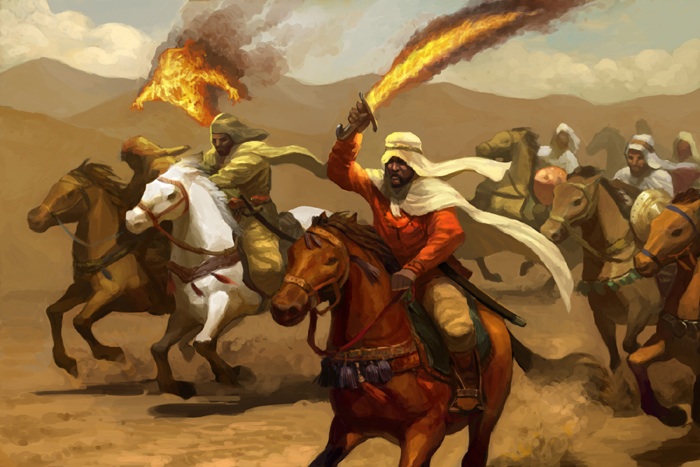
Qadira is a cool book, especially if you like adventures in the style of Aladdin, Ali Baba, and Sinbad. The book gives the history of Qadira, its political climate (internal and external), a geographical overview, an in-character Qadiran perspective on the races and character archetypes of Golarion, the city of Katheer, Qadiran magical studies, feats, the daivrat prestige class (why force genies to do your bidding when they'll do it willingly for you?), and—of course—new traits! It's also the only Pathfinder Companion with monsters instead of a regular Persona column—but given the unique role of genies in Qadira, these "monsters" may actually be relatives of Qadiran PCs, whether a half-janni or the suli-jann. And every daivrat needs a little zhyen genie buddy! Just treat them nicely or they may turn into a cruel prankster called a jocta...
Sean K Reynolds
Developer, Pathfinder Companion
Link.
Tags:
Brian Cortijo, Concept Art House, Genies, Pathfinder Companion, Qadira
Link.

The Fabled Appendix – F. Wesley Schneider (Part 2)
Thursday, July 23, 2009
Presented here is the second part of my interview with Pathfinder Managing Editor F. Wesley Schneider about the sources of inspiration he would include in Paizo's own Appendix N. In this part, he discusses how Golarion was created to accommodate a wide variety of influences and inspirations, and lists his most recent favorite gothic horror authors!
David: So how did the influences of mythology affect the design of Golarion?
Wes: Well, Golarion is meant to be a place where you can have everything. It's not just a place for editors' pet projects—gamers should be able to run whatever type of game they want in the setting. However, we have only shown 1/16 of the entire world of Golarion, and future products will open new doors for influences and inspiration.
D&D for the last 30 years has been a fantastic thief, stealing ideas from mythology, folklore, and pulp fantasy and horror. Golarion is similar in this regard, as you can see many of the same trappings in our own setting. But we also are trying to present things that people haven't seen before, like a land of devil-worshipers where people live in fear but order has been maintained; or a land where religion has been outlawed, despite the very real presence of the gods; or a land where questionable eugenics are being used for the supposed betterment of humanity. The wide variety of styles and influences is obvious enough when you look at the titles of each nation–Numeria, for example, is described as the "Savage Land of Super-Science." The influence of things like Thundarr the Barbarian is very clearly present. Despite any obvious influences, however, Golarion is meant to fuel ideas for stories and campaigns; rather than present a story for you to participate in, the approach we wanted to take with the setting was "here is an interesting locale in which to tell a story."
David: Give me a quick list of some things that have recently inspired your game design.
Wes: Off the top of my head, I've really enjoyed Sheridan Le Fanu's stories. Among other things, he's famous for writing Carmilla, a vampire story that predated and influenced Bram Stoker's Dracula. I've also been reading M. R. James's work; he wrote tons of ghost stories that have quietly influenced hundreds of stories and movies like The Twilight Zone and the recent film Drag Me To Hell. I also recently discovered the artist and author Wayne Barlowe in my research for the Book of the Damned Volume I, who greatly influenced my take on Hell.
James Jacobs and Pierce Watters also introduced me to the old Hammer Horror movies—they have terrible acting and even worse special effects, but the ideas presented in many of these movies are amazing. The Devil Rides Out has been one of my favorites so far: Christopher Lee fights a cult trying to summon the Devil. Awesome!
Thus ends my interview with Wes Schneider, Paizo's resident expert on the intersection of folklore and horror. And this wraps up interviews with Paizo's editorial pit. Thanks a ton to all the designers and to all of you for reading!
David Eitelbach
Editorial Intern
Link.
Tags:
Appendix N, F. Wesley Schneider, Interviews
Pathfinder Roleplaying Game Preview #11
Wednesday, July 22, 2009
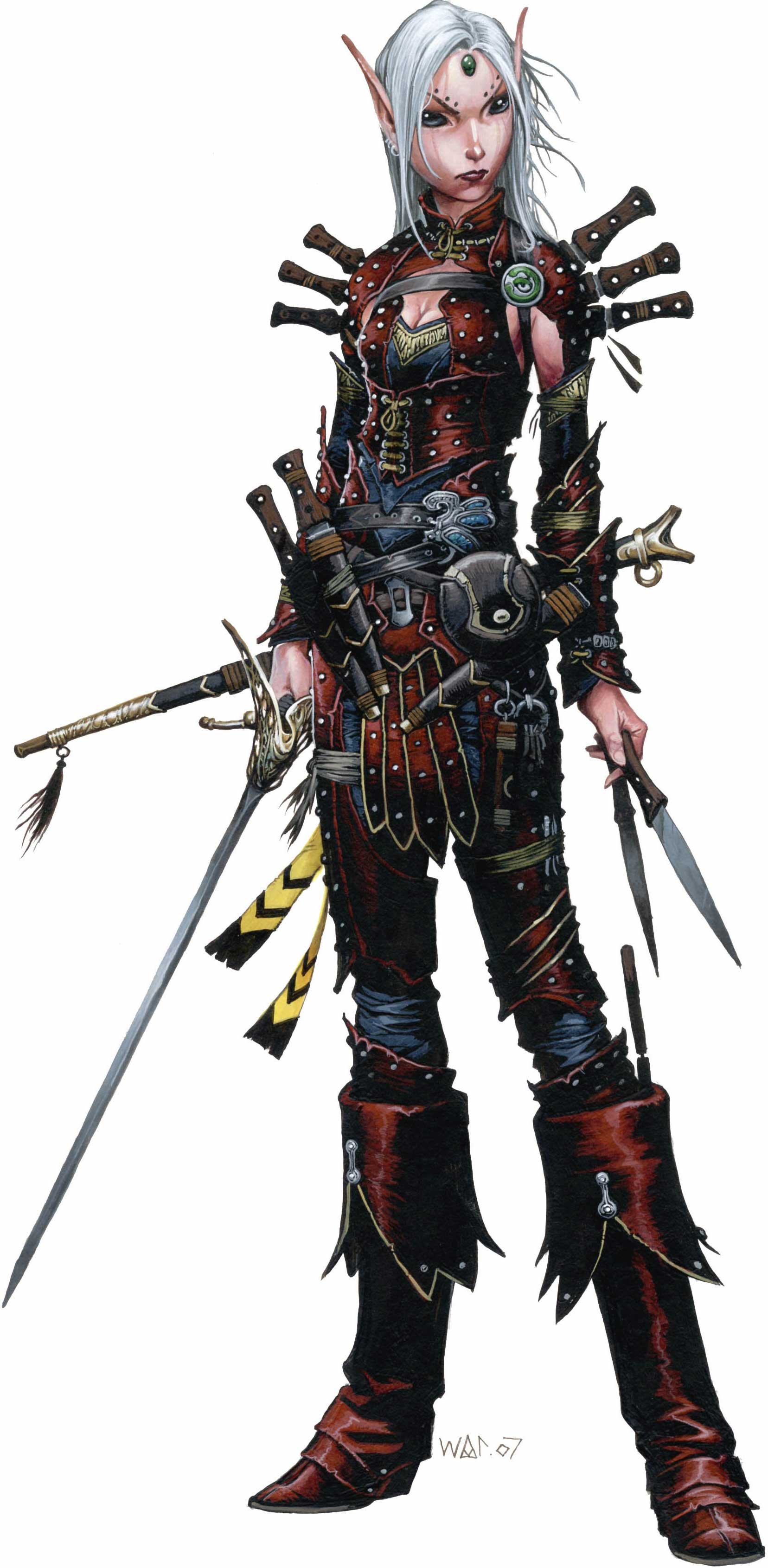
The Pathfinder Roleplaying Game Core Rulebook is set to release on August 13th, 2009, and in anticipation, we are releasing a preview of the game each week until the game hits store shelves. This week, we are sneaking around with Merisiel, the iconic rogue.
Merisiel
Female elf rogue 6
CN Medium humanoid (elf)
Init +4; Senses low-light vision; Perception +12
DEFENSE
AC 20, touch 15, flat-footed 15 (+5 armor, +4 Dex, +1 dodge)
hp 42 (6d8+12)
Fort +4, Ref +10, Will +4; +2 vs. enchantments
Defensive Abilities evasion, trap sense +2, uncanny dodge
OFFENSE
Speed 30 ft.
Melee +1 rapier +9 (1d6+2/18–20)
Ranged dagger +8 (1d4/19–20)
Special Attacks sneak attack +3d6, surprise attack
STATISTICS
Str 12, Dex 18, Con 12, Int 10, Wis 13, Cha 10
Base Atk +4; CMB +5; CMD 20
Feats Dodge, Mobility, Nimble Moves, Weapon Finesse
Skills Acrobatics +13, Climb +10, Disable Device +18, Knowledge (local) +9, Perception +12, Sleight of Hand +13, Stealth +13, Swim +10
Languages Common, Elven
SQ finesse rogue, trapfinding +3, trap spotter
Combat Gear dust of tracelessness, potion of cure moderate wounds, potion of invisibility (2); Other Gear +2 studded leather, cloak of resistance +1, +1 rapier, daggers (8), handy haversack, masterwork thieves tools, ring of feather falling, rope of climbing

Hey, have you seen Merisiel around here anywhere? I am waiting for her to get here so that I can properly preview her and her awesome rogue talents, but she must be running late. Just like an elf, always running late. I know they live for hundreds of years, but my poor human life is short and I would like to spend it on things other than waiting for her to show up. Ow... my kidney!
So, now that Merisiel is finally here and I am shy one kidney, it is time to look at the rogue. Not much changed between the Beta version of the rules and the final game, but for those who are not familiar, let me walk you through the major differences.
The big change for rogues in the Pathfinder Roleplaying Game is the addition of rogue talents. These work like the special abilities that rogues gained at higher levels in 3.5, but now they are scaled and a rogue gets her first one at 2nd. Every 2 levels beyond 2nd, she can select an additional talent, and upon reaching 10th level, she can begin selecting advanced talents (which includes all of the special abilities from 3.5). Rogue talents are a mixed bag of abilities that allow a rogue to become a little better at one facet of rogue life. Merisiel here has three talents: finesse rogue, surprise attack, and trap spotter. The first gives her Weapon Finesse as a bonus feat, making it a common choice for 2nd level rogues. Surprise attack causes all of Merisiel's opponents to be treated as flat-footed to her attacks during a surprise round, even if they have already acted. Finally, trap spotter gives Merisiel a Perception check to notice a trap the moment she moves to within 10 feet of it.
Other rogue talents add to a rogue's sneak attack, such as slow reactions that causes an opponent hit by a rogue's sneak attack to lose the ability to make attacks of opportunity for 1 round. There are a number of rogue talents that affect movement, allowing a rogue to move faster while balancing or sneaking. There are even a pair of talents that allow rogues to cast a limited number of simple spells to aid them in their shadowy deeds.
Aside from rogue talents, there have been a few other modifications and additions to the rogue. The biggest of these are the changes to sneak attack. This iconic ability now functions on a wider variety of creatures, such as undead and constructs. Now that all characters can locate and disarm mechanical traps regardless of the DC, the trapfinding ability now grants a bonus on Perception checks to notice traps and Disable Device checks equal to half the rogue's level. It also grants rogues the ability to disarm magic traps. Finally, up at 20th level, the rogue gains the master strike class feature, which allows her to kill, paralyze, or put targets to sleep with a successful sneak attack.
Aside from her class features, there are a few other interesting rules bits presented here. Dodge now grants a +1 dodge bonus to AC (and CMD) against all targets. Never again will you need to remember to designate a single foe. Mobility works much as before, but Nimble Moves is a new feat. This allows Merisiel to ignore 5 feet of difficult terrain each round while moving. It might not seem like much but it does allow her to take a 5-foot-step into such terrain or move through it during a charge, both of which might be vital depending on the circumstances.
Well, that is all for this week. Wait a minute, that was a bit short. Since I seem to have a bit of extra space this week, I guess I will take a look at some of the other rules that a rogue must contend with on a daily basis. Of course, I am talking about traps and poisons.
While traps work much in the same way that they always have, the trap rules have been adjusted to scale all the way up to CR 20. This was accomplished by adding in some modifiers for traps that target multiple creatures or last for more than 1 round. For example, the chamber of blades trap, presented below, that deals damage to everyone within a large chamber and lasts for 1d4 rounds. On average, this trap is going to last for 2 rounds and everyone in the room is going to be attacked twice at a +20 bonus for 3d8+3 on each hit. While this is not a huge amount of damage for 10th level characters, it can add up really quick. On average, PCs are going to take 32 points of damage before this trap has run it course (or double that if a 4 is rolled for the duration).
Chamber of Blades Trap (CR 10)
Type mechanical; Perception DC 25; Disable Device DC 20
EFFECTS
Trigger location; Duration 1d4 rounds; Reset repair
Effect Atk +20 melee (3d8+3); multiple targets (all targets in a 20-foot-square chamber)
Poisons, on the other hand, have seen some revisions. After PCs hit about 7th level in 3.5, poison becomes almost an irrelevant threat. Once heroes feast becomes an option, it is completely pointless, which is a shame. In the Pathfinder RPG, poisons are a threat again at every level. The immunity gained from heroes feast has been changed to a bonus against poison saves (the same has happened to its immunity to fear) and neutralize poison now requires a caster level check versus the DC of the poison to remove it. Add that in with some advanced poisons and you have a threat that the PCs must now consider when taking on some of the more iconic monsters in the game.
In addition, the mechanics behind poison have changed. Most now deal damage every round until they have run their course (this is called the frequency), but the amount of damage per round has been decreased a bit to compensate. Each poison has a cure line as well, which tells you how many saves you need to make to be free of the poison before the frequency has run out. If you have been poisoned multiple times by the same source, you no longer need to make multiple saves. Instead, the duration of the poison increases by 50% of the original duration and the DC of the save increases by +2. So, if you were poisoned three times by a wyvern, the frequency would become 1/round for 12 rounds and the DC would increase to 21. This system really opens up the poison rules (and curses and diseases which work under similar rules), allowing you to concoct all manner of vile ways to die. Here are a few sample poisons from the Core Rulebook to get your ideas flowing.
Belladonna
Type poison, ingested; Save Fortitude DC 14
Onset 10 minutes; Frequency 1/minute for 6 minutes
Effect 1d2 Str damage, target can attempt one save to cure a lycanthropy affliction contracted in the past hour; Cure 1 save
Insanity Mist
Type poison, inhaled; Save Fortitude DC 15
Frequency 1/round for 6 rounds
Effect 1d3 Wis damage; Cure 1 save
King's Sleep
Type poison, ingested; Save Fortitude DC 19
Onset 1 day; Frequency 1/day (unlike others, this poison continues until cured)
Effect 1 Con drain; Cure 2 consecutive saves
Tears of Death
Type poison, contact; Save Fortitude DC 22
Onset 1 minute; Frequency 1/minute for 6 minutes
Effect 1d6 Con damage and paralyzed for 1 minute; Cure none (This poison continues until the end of its frequency, regardless of the number of saving throws made)
Wyvern Poison
Type poison, injury; Save Fortitude DC 17
Frequency 1/round for 6 rounds
Effect 1d4 Con damage; Cure 2 consecutive saves
There are only three more previews left to go before the release of the Pathfinder RPG Core Rulebook. Of course, if you want a bit more, check out Kobold Quarterly #10, which contains another preview written by yours truly and a look at the revised shadowdancer prestige class. Next week, we will round out our look at the base classes by taking a look at Ezren, the iconic wizard.
Jason Bulmahn
Lead Designer
Link.
Tags:
Iconics, Pathfinder Roleplaying Game, Rogues, Wayne Reynolds
Link.
Tags:
Community, GameMastery, Pathfinder, Pathfinder Chronicles, Pathfinder Chronicles Campaign Setting, Planet Stories
Snagged from the Vault: Pathfinder RPG Bestiary
Monday, July 20, 2009
Work continues frantically as we put the final touches on the Pathfinder RPG Bestiary. In anticipation of the light at the end of this beastly tunnel, here's a host of new divine creatures preparing to come to your PCs' aid in just a few short weeks!
 |
 |
| Art by Michael Jaecks | Art by Alex Schim |
 |
 |
Art by Andrew Hou | Art by Kieran Yanner |
F. Wesley Schneider
Managing Editor
Link.
Tags:
Andrew Hou, Kieran Yanner, Michael Jaecks, Monsters, Pathfinder Roleplaying Game

The Fabled Appendix – Sean K Reynolds (Part 2)
Friday, July 17, 2009
Here follows Part 2 of my interview with Developer Sean K Reynolds, game designer extraordinaire and all-around nice guy, in which he discusses how he differentiates Golarion's deities from the gods of Greyhawk and the Forgotten Realms, and gives a list of the works that most influenced his game design.
David: Is it hard to make Golarion's gods different from those of other campaign settings?
Sean; My technique is to approach the gods like they're people, with their own motivations and agendas. In fact, many of Golarion's deities were once mortals themselves; and, because the world itself is so old, often I can just ask myself, "What would these deities have been doing this whole time?" I really try to explore each god's niche. In terms of making them different than the gods of Greyhawk and the Forgotten Realms, the history and cosmology of Golarion naturally differentiate them. A good example of this is Oerth's Pelor and Mayaheine versus Golarion's Aroden and Iomedae; the structure of the relationship between the deities is similar (an older, male deity mentoring a younger, female warrior deity), but a few obvious differences are that Pelor is a benevolent god while Aroden is more neutral, and Mayaheine is a defensive deity whereas Iomedae is an active crusader against evil.
David: Briefly give me a list of some of the most influential works you've encountered.
Sean: As a younger kid, the books that made the most impression on me were Lloyd Alexander's books about Taran the Wanderer, which discuss old magic, learning your place in the world, and the apocalypse; Madeline L'Engle's A Wrinkle in Time series (which includes super-science and biblical references), Anne McCaffrey's Pern books, and Piers Anthony's Xanth and Incarnations of Immortality series. In my teens I chewed through Edgar Rice Burroughs's Mars books, Norman Winski's The Sword and the Sorcerer, Larry Niven's linked fantasy stories ("The Magic Goes Away," "What Good is a Glass Dagger?", and so on), Fred Saberhagen's Book of Swords series, Robert Asprin's Myth series, some collections put together by Isaac Asimov (Wizards, Witches, and so on), and the Thieves' World books (also edited by Robert Asprin), as well as anything by Stephen King and Clive Barker.
Growing up the in '80s, we also had a lot of cool, weird, and bad inspirational fantasy and SF movies as well: Clash of the Titans, Conan the Barbarian Labyrinth, Hawk the Slayer, The Sword and the Sorcerer, The Dark Crystal, Barbarians, Dragonslayer, Krull, the Rankin-Bass version of The Hobbit, Highlander, Blade Runner, Akira, and Ralph Bashki's animated features (Lord of the Rings, Wizards, and Fire and Ice).
This concludes my interview with Sean K Reynolds. Thanks for reading the Fabled Appendix, Paizonians! I hope you've enjoyed it as much as I've enjoyed interviewing the fine game designers at Paizo!
David Eitelbach
Editorial Intern
Link.
Tags:
Appendix N, Interviews, Sean K Reynolds
Pathfinder Roleplaying Game Preview #10
Wednesday, July 15, 2009
The Pathfinder Roleplaying Game Core Rulebook is set to release on August 13th, 2009, and in anticipation, we are releasing a preview of the game each week until the game hits store shelves. This week, we are getting angry with Amiri, the iconic barbarian.
Amiri
Female human barbarian 17
CN Medium humanoid (human)
Init +2; Senses Perception +21
DEFENSE
AC 26, touch 14, flat-footed 24 (+9 armor, +4 deflection, +2 Dex, +3 natural, –2 rage)
hp 252 (17d12+136)
Fort +19, Ref +10, Will +14; +4 vs. enchantment
Defensive Abilities improved uncanny dodge, indomitable will, trap sense +5; DR 4/—
OFFENSE
Speed 40 ft.
Melee +4 frost keen adamantine greatsword +31/+26/+21/+16 (2d6+19/17–20 plus 1d6 cold)
Ranged +2 frost composite longbow +21/+16/+11/+6 (1d8+9/x3 plus 1d6 cold)
Special Attacks greater rage (41 rounds/day), rage powers (fearless rage, increased damage reduction, intimidating glare, knockback, powerful blow +5, renewed vigor [4d8+6], superstition +6, terrifying howl [DC 27])
BASE STATISTICS
AC 28, touch 16, flat-footed 26 (+9 armor, +4 deflection, +2 Dex, +3 natural)
hp 201 (17d12+85)
Fort +16, Will +11
Melee +4 frost keen adamantine greatsword +28/+23/+18/+13 (2d6+14/17–20 plus 1d6 cold)
CMB +24; CMD 40
Skills Climb +27
STATISTICS
Str 24 (30), Dex 14, Con 16 (22), Int 10, Wis 12, Cha 8
Base Atk +17; CMB +27; CMD 41
Feats Bleeding Critical, Blind-Fight, Critical Focus, Greater Vital Strike, Improved Iron Will, Improved Vital Strike, Iron Will, Power Attack, Toughness, Vital Strike
Skills Acrobatics +22, Climb +30, Intimidate +19, Perception +21, Survival +21
SQ tireless rage
Combat Gear potion of cure serious wounds (6), potion of haste (2); Other Gear ring of protection +4, amulet of natural armor +3, cloak of resistance +3, +4 frost keen adamantine greatsword, +2 frost composite longbow (Str +7), +5 moderate fortification hide armor, bag of holding (type II), belt of giant strength +6, cube of force, ring of freedom of movement, scarab of protection, winged boots
Don't make Amiri angry, you won't like her when she's angry. Of all of our iconics, none is more focused on dishing out pain than the barbarian. Although her stat block shows her damage while raging, it does not include Power Attack, which would give her a –5 on attack rolls, but increase her damage to 2d6+34. If she were to score a critical hit, while using Greater Vital Strike and Power Attack, her damage would jump to 10d6+68 and her victim would take 2d6 points of bleed damage each round thereafter. Enough with the math though, lets get in to some of the specifics of the barbarian.
To start off, let's take a look at rage. In the Beta version of the Pathfinder RPG rules, barbarians received a pool of rage points that they could spend on rounds of rage and to activate various rage powers. We have simplified this for the final, making it so that the barbarian now only needs to track the total number of rounds of rage per day. This starts at 4 + her Constitution modifier and increases by 2 for every level beyond 1st, meaning that even a 1st-level barbarian can rage more than once per day, so long as they are short rages. She also spends only 1 round of rage per round, regardless of the type of rage she is using (this is a change from the Beta).
Rage powers were added to the barbarian early on in the design. These powers can only be used while raging and allow the barbarian to perform fantastic feats of Strength, make more powerful attacks, and terrify those around her. Since these no long consume rage points, most have been reworked to be used only once per rage or once per day. Rage powers are gained at 2nd level and the barbarian gains an additional power for every two levels beyond that. Let's take a closer look at Amiri's specific powers.
Fearless Rage: With this power, which cannot be selected until 12th level, Amiri is immune to shaken and frightened condition while raging.
Increased Damage Reduction: While raging, Amiri's DR increases to 5/—.
Intimidating Glare: With this power, Amiri can attempt to Initimidate one adjacent foe as a move action, causing them to become shaken for 1d4 rounds +1 round for every 5 points by which her check exceeds the DC.
Knockback: Once per round, Amiri can use this power make a bull rush attempt against a foe in place of a melee attack. If successful, the target takes damage equal to her Strength modifier and is moved back without Amiri needing to follow.
Powerful Blow: Once per rage, Amiri can use this power as a swift action to add +5 to one melee damage roll. This bonus scales as she gains levels.
Renewed Vigor: Once per day, while raging, Amiri can use this power to heal herself. It starts at only 1d8 + her Constitution modifier, but scales as she gains level. Amiri must be 4th level before taking this power.
Superstition: This new rage power gives a barbarian a morale bonus on all saves against spells, supernatural abilities, and spell-like abilities while raging. While valuable, it comes with the drawback. While raging, Amiri cannot be the willing target of any spell and must attempt to resist all spells, even those case by allies.
Terrifying Howl: Amiri had to take Intimidating Glare before she could select this 8th-level rage power. As a standard action, Amiri can unleash a blood-curdling war cry that causes all shaken enemies within 30 feet to make a Will save or become panicked for 1d4+1 rounds. Once a foe has made a save, successful or not, they are immune to this power for 24 hours.
These powers are designed to give the barbarian a few more options in combat besides running up and murdering folks (although there are plenty that do that too). During the Beta, there were a few rage powers that did not really fit the theme (such as the one that did elemental damage), but these have been trimmed in favor of abilities that are all exceptional abilities. You might see some supernatural rage powers in later books, but they will be tied to specific themes.
Beyond the changes to rage and the addition of rage powers, not much else has changed with the barbarian. She still gets greater and mighty rage at high levels, damage reduction, uncanny dodge, and trap sense. We added Acrobatics and Knowledge (nature) to her list of class skills. The other changes of note here are in her feats. Critical Focus and Bleeding Critical give her a +4 bonus on attack rolls made to confirm critical hits and anyone who takes a critical hit also gains 2d6 points of bleed (damage that recurs each round until healed). Iron Will works as before, but Improved Iron Will lets Amiri reroll one Will Save made each day, after the first roll is made but before the results are revealed. Toughness grants +1 hit point per level, with a minimum of +3 hit points (so +3 until you reach 4th level, at which point it becomes +4). Finally, there is Power Attack, which grants a +2 bonus on damage for a –1 penalty on attack rolls. When your base attack bonus reaches +4, and for every 4 beyond +4, the bonus to damage increases by +2 and the penalty increase by –1. Wielding a two-handed weapon increases the damage by 50%, whereas off-hand weapons get only half the damage bonus. Just thought I would let that cat out of the bag, since there has been quite a bit of speculation as to the exact formula.
There are only four more previews before the release of the Core Rulebook! If I can find her, next week we will take a look at Merisiel, the iconic rogue.
Jason Bulmahn
Lead Designer
Link.
Tags:
Barbarians, Iconics, Pathfinder Roleplaying Game, Wayne Reynolds
Pathfinder Core Rulebook Preview Video!
Tuesday, July 14, 2009
We know most of you can’t wait to get your hands on the Pathfinder Roleplaying Game Core Rulebook, and while we can’t release the book until August 13, 2009, we have a few copies that the printer sent directly to us for approval purposes.
And do we ever approve! The book is such a massive and beautiful sight to behold that we simply couldn’t keep it to ourselves any longer.
We thought you deserved a sneak peek of your own!
Only a little less than a month to go before the Core Rulebook hits stores and ships to subscribers. If you have yet to place your order or let your local game store know you’ll be picking up a copy, now is the time to do so!
Please remember to visit the Paizo blog again on Wednesday, when Lead Designer Jason Bulmahn will preview the new barbarian!
Erik Mona
Publisher
Link.
Tags:
Pathfinder Roleplaying Game
The Fabled Appendix – Sean K Reynolds (Part 1)
Friday, July 10, 2009
Sean K Reynolds: Developer, diehard miniatures painter, and resident "gods guy" of the Paizo offices. Recently, I had the opportunity to speak with both Sean and Managing Editor F. Wesley Schneider about the sources of inspiration they would include in Paizo's own Appendix N. Switching things up a bit, this week we've got Part 1 of Sean's interview, with more from Wes next week. As would be expected from a game designer who worked at TSR during the era of 2nd edition, Sean's influences stretch back to the earliest roots of the hobby.
David: I understand that you are pretty well known as the go-to guy when it comes to writing about the deities of Greyhawk, the Forgotten Realms, and Golarion. What sparked this interest?
Sean: I got into D&D by playing the basic boxed set with my Dad and then later with my cousin. What really got me hooked was when, at the library, I picked up a book of Greek mythology, D'Aulaires' Book of Greek Myths, which talked about the gods, the births and deaths of heroes, and how the gods made the greatest heroes into constellations. Reading this, I realized that these characters—even the gods—had personalities and agendas, just like actual people. Later, I got a similar book about Norse mythology, D'Aulaire's Norse Gods & Giants (now retitled as D'Aulaire's Book of Norse Myths), which was even better than the Greeks' because they all wore heavy armor, the gods themselves fought the crazy monsters, and they even had a prophecy about the end of the world. This is probably how I became the "gods guy" of D&D, because these books laid the foundation for my interest in the apocalypse and the gods.
I remember playing in Monte Cook's Praemal campaign—the precursor to Ptolus—where the characters were the 3rd generation of humans to be on the planet, still dealing with the very real influence of the gods and the forces of creation. We even found gigantic handprints in the walls of a canyon from a battle between the gods. I found the combination of creation and destruction very appealing.
David: You started full-time in the RPG industry with Greyhawk, correct?
Sean:Right. My first Greyhawk sourcebook was about The Scarlet Brotherhood, who had always been very mysterious even from the days when Gary Gygax was doing all the writing for the published setting. My sourcebook was the first time anyone had really talked in depth about their society from their perspective. I worked with Erik on the project. One of the daunting but fun things about it was that there was an entire continent—Hepmonaland—that was entirely unexplored in game books; it was barely visible on the Oerth map and nobody really knew what was going on there. Erik and I were both familiar with really old adventures like The Hidden Shrine of Tamoachan, so we knew that there were Aztec-like people running around. We pieced together little bits of information and then had to make it our own. That was part of the product design philosophy at the time: we'd publish the basics for your campaign and give you a lot of room to create your own material, fill in the blanks, and make connections between various plot hooks. This was very different from my later work on the Forgotten Realms, because books for that line are more about giving people everything they need to run a campaign without having build up anything on their own.
This concludes Part 1 of my interview with Sean K Reynolds. Tune in next time for his comparison of Golarion's gods with the deities of Greyhawk and the Forgotten Realms, and his list of some of the works that most influenced his game design.
David Eitelbach
Editorial Intern
Link.
Tags:
Appendix N, Interviews, Sean K Reynolds
Ask a Pro: Question Seven
Thursday, July 9, 2009
7. You are running an Adventure Path, and one of your players is ignoring the obvious hook. Do you gently nudge him in the planned direction, or do you go with the flow and see where this digression might take you?
Lisa Stevens: Basically I try to nudge, or I may come up with a different hook. For example, in Shackled City, there is an adventure where the players need to be convinced to go to an evil plane, and I just knew the hook as written would not work on my players, so instead I had the NPC seek out one of my PCs who was a rogue, and basically had the NPC convince him that great wealth and power were to be had there, and then I just let him convince the rest of the party. But in one of my early D&D groups, my players made me a sign that read "HINT HINT," and they told me to hold it up whenever they were being too dense. So basically I would be like, "The bartender begins telling you about an old abandoned mine..." (holds up sign).
F. Wesley Schneider: I think the most interesting thing about being a GM is the art of getting the players to do exactly what you want but making them think it was their idea. There is nothing more satisfying than having your players come up with this really brilliant and clever idea, and it's exactly what you wanted them to do from the beginning.
James Jacobs: I let the players do their own thing, but they eventually end up where I want them regardless. Basically I just remain flexible and adapt.
Erik Mona: I just let them go wherever. I'm perfectly happy allowing them to dictate the action.
Jason Bulmahn: Depends on the group. Sometimes you'll get a bunch of chaotic players who want to be the embodiment of mayhem. In those situations you have to make a decision: do you keep slapping them with plot hooks or do you just wander off aimlessly into the woods?
Sean K Reynolds: I don't plan too far ahead, so I can remain flexible to my players' actions.
Joshua J. Frost: I try to gently nudge them back, usually with an NPC. But if they insist on running off, I'm pretty good at improv.
James Sutter: It depends on the type of game I'm running. A lot of the time I'll just play a sandbox style of game, where I'll show up with some sticky notes and that's it. If it's an AP, I generally try to weave and nudge them in the right direction. But I also tend to play with big groups; my last campaign had eight players. In those situations, I really feed off of what my players give me, and in a lot of ways depend on that. I'm a big fan of using experienced players to my advantage, too. I rely on the more experienced players to help coach the novices.
Chris Self: If the players are following something that might actually lead somewhere, then I'll let them do whatever, but if they're just sort of spinning their wheels, I'll try to nudge them in the right direction. I actually once played in a campaign that fell apart because the GM gave us too many hooks and not enough of a nudge in any one direction.
I've never minded players wandering off. I'll kill them wherever they go, one way or another.
Hank Woon
Editorial Intern
Link.
Tags:
Ask a Pro, Game Mastering, Interviews
Pathfinder Roleplaying Game Preview #9
Wednesday, July 8, 2009
The Pathfinder Roleplaying Game Core Rulebook is set to release on August 13th, 2009, and in anticipation, we are releasing a preview of the game each week until the game hits store shelves. This week, we are cracking some heads with Sajan, the iconic monk.
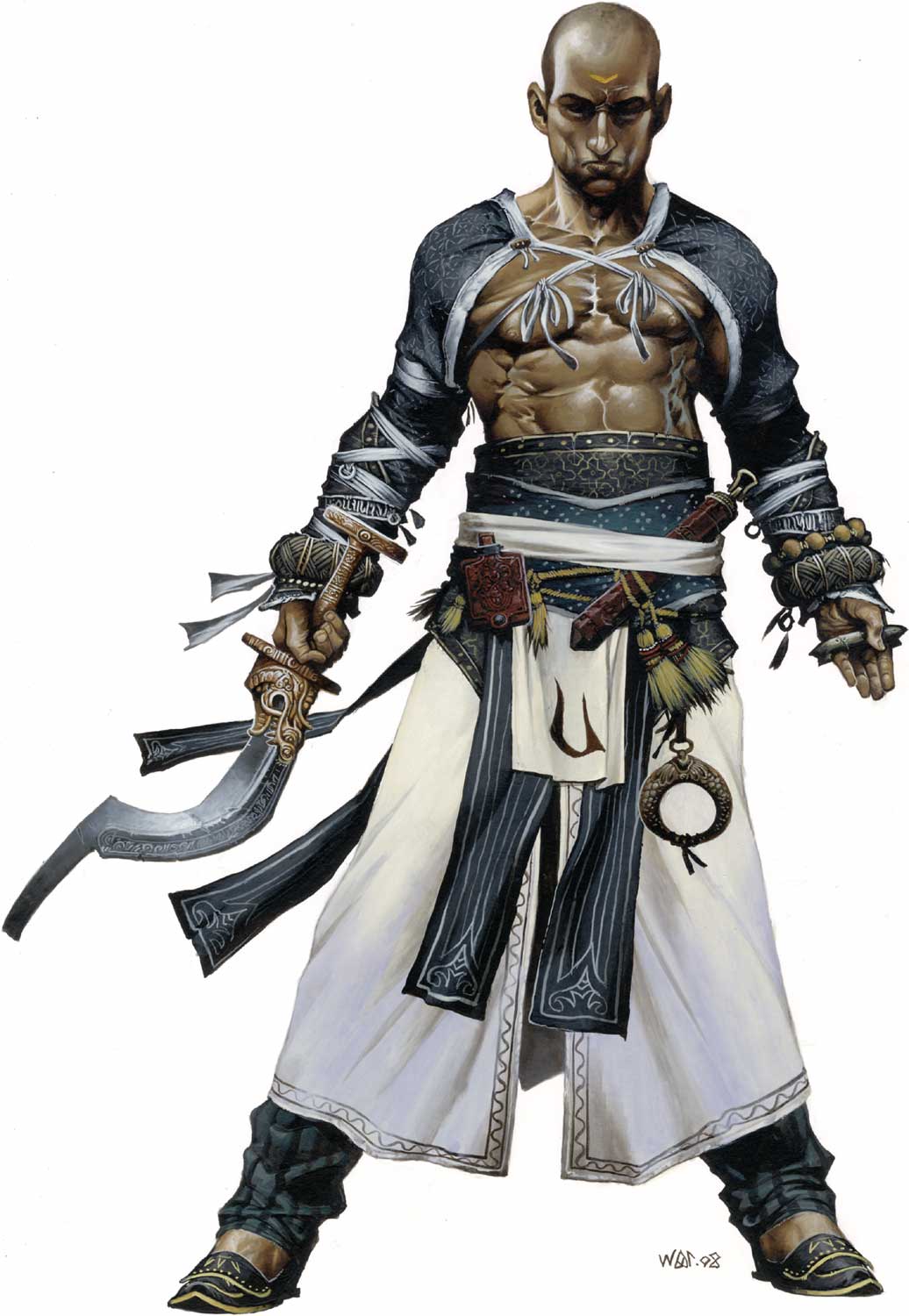
Sajan
Male human monk 8
LN Medium humanoid (human)
Init +3; Senses Perception +3
DEFENSE
AC 23, touch 21, flat-footed 19 (+2 armor, +1 deflection, +3 Dex, +1 dodge, +3 monk, +3 Wis)
hp 63 (8d8+24)
Fort +8, Ref +9, Will +9; +2 against enchantment
Defensive Abilties evasion, slow fall 40 ft.; Immune disease
OFFENSE
Speed 50 ft.
Melee flurry of blows +9/+9/+4/+4 (2d6+2 plus 1d6 fire) or mwk shortsword +9/+4 (1d6+2/19–20)
Ranged shuriken +9/+4 (1d2+2)
Special Attacks stunning fist (8/day, stun, fatigue, or sicken, DC 17)
STATISTICS
Str 14, Dex 16, Con 14, Int 10, Wis 16, Cha 8
Base Atk +6; CMB +10; CMD 29
Feats Combat Reflexes, Dodge, Extra Ki, Greater Disarm, Improved Disarm, Improved Unarmed Strike, Scorpion Style, Stand Still, Stunning Fist, Weapon Focus (unarmed strike)
Skills Acrobatics +14 (+30 jump), Climb +13, Sense Motive +14, Stealth +14, Swim +13
Languages Common
SQ fast movement, high jump, ki pool (9 points), maneuver training, purity of body, still mind, wholeness of body
Combat Gear oil of greater magic fang (+3), potion of cure serious wounds (2); Other Gear mwk shortsword, shuriken (20), ring of protection +1, light fortification bracers of armor +2, flaming amulet of mighty fists, headband of inspiring wisdom +2, monk's robe
Everybody was kung fu fighting! Those cats were fast as lightning! Ahem. You will excuse my outburst of the Carl Douglas classic. This week we are taking a look at Sajan, the iconic monk. During the playtest there was a lot of debate on what to do with the monk, and everyone seemed to have their own idea on how to fix the class. From the beta to the final, we made a lot of tweaks to improve the class, from speeding up some progressions (such as the monk AC bonus) to adding more bonus feats (including the number granted and the selection available), but we also made a few large changes.
Let's start by taking a look at the monk's primary mode of attack: flurry of blows. This system is revised from the 3.5 version to work using mechanics similar to the Two-Weapon Fighting feats, but the new monk goes one step further and uses its monk level as its base attack bonus whenever it uses flurry of blows. At 8th level, this means that Sajan has one additional attack and all of those attacks are at a +1 over his 3.5 counterpart. If we look at 20th level, Sajan would have 2 extra attacks and those attacks are at a +3 over the 3.5 statistics. Of course, Sajan can still use special monk weapons for these attacks as well.
In addition, all monks now receive the Stunning Fist feat for free, allowing them to stun opponents for 1 round with a hit. As a monk gains levels, he can decide to apply different effects, some of which last considerably longer. At 8th level, Sajan can make his opponents fatigued (which lasts until they rest) or sickened for 1 minute. At 12th level, Sajan could instead stagger his foes for 1d6+1 rounds (making it so they can only take a move or a standard action each turn). At 16th level he can permanently blind or deafen his enemies and at 20th level, he can paralyze them for 1d6+1 rounds. These abilities are separate from the monk's quivering palm attack, which functions much as before, except that now monks can use quivering palm once per day (as opposed to once per week).
Monks are also skilled at performing and defending against combat maneuvers (such as grapple, bull rush, and trip). They use their monk level as their base attack bonus when calculating their Combat Maneuver Bonus. They also add their Wisdom and monk AC bonus to their Combat Maneuver Defense, making them truly skilled at resisting attempts made against them.
To add to the monk's offensive and defensive abilities, they now gain access to a pool of ki points that can be spent for temporary bonuses. At 4th level, Sajan gained the ability to spend 1 point as a swift action to make an additional attack as part of a flurry of blows (at his highest bonus), increase his speed by +20 ft. for 1 round, or to grant himself a +4 dodge bonus to his AC. At 5th level, he gained the high jump ability, which grants him a bonus equal to his class level on all Acrobatics checks made to jump, but it also allows him to spend a ki point for a +20 bonus to a single check. At 7th level, Sajan gained the ability to heal himself by spending 2 ki points. At higher levels, he can use this pool to dimension door or to become ethereal. The number of points in his pool goes up with his level as well, granting him 1 point per two levels, plus his Wisdom modifier (and 2 from the Extra Ki feat). As long as he has at least 1 ki point in his pool, all of his attacks are treated as magic for the purpose of overcoming damage reduction. At 10th level, they are treated as lawful and at 16th level, they are treated as adamantine.
Finally, we made one additional change, although subtle, to boost the power of the monk. The amulet of mighty fists can now be used to grant melee special weapon qualities to the monk's unarmed strikes (flaming in this case). We also repriced the item to make it a bit more attractive for our kung fu masters (this one only costs 5,000 gp to add flaming to all his natural attacks, but the higher level version received a discount as well). A similar change was made to bracers of armor, allowing them to grant special armor qualities, such as light fortification.
Sajan also has a few feats to make him more versatile in combat. Improved Disarm and Greater Disarm give him a +14 bonus total on disarm combat maneuvers and any weapons he disarms are knocked up to 15 feet away from the wielder. Stand Still forces those that attempt to move past Sajan to stop if he strikes them with an attack of opportunity (of which he gets 4 per round due to Combat Reflexes). Combined with Scorpion Style, which allows Sajan to make a single attack that reduces the target's speed to 5 feet for 3 rounds, he can really stop a foe from moving past him and then prevent that foe from moving away later.
Eight classes down and three to go, which means that we are only five weeks from the release of the Core Rulebook! Next week I will rant and rage about the powers of Amiri, the iconic barbarian.
Jason Bulmahn
Lead Designer
Link.
Tags:
Iconics, Monks, Pathfinder Roleplaying Game, Wayne Reynolds
Dungeonaday Pathfinder Style
Tuesday, July 7, 2009
With the Pathfinder RPG debuting next month, you're going to need adventures. Sure, you'll have Council of Thieves and Crypt of the Everflame to tear through, but what about after that? And after that? And, for the most avid adventuring parties, after that?
If you haven't checked it out already, truly insatiable dungeon delvers should definitely click on over to Monte Cook's Dungeonaday.com, an endless adventure, updated daily, and chock full of art, player handouts, and campaign ideas for any campaign world. Beyond the daily encounters there's also advice on how and why the encounters work, forums, photos, podcasts, and lots more. And best of all for Paizo fans, our own lead designer, Jason Bulmahn, does monthly conversions, updating the ever growing dungeon for use with the Pathfinder Roleplaying Game.
It's a ton of stuff, and until July 13th, Monte's showing it all off to Paizo fans for free!
Just head on over to Dungeonaday.com and become a member using the promotional code "Paizo" and you're signed up for a free preview week of adventure. At the end of that week, if you do nothing, you're automatically signed up for a year of Dungeonaday.com access at the special discount rate of $84, which is only $7 per month (as opposed to the normal monthly rate of $10 per month). Or, cancel before the end of the week and be charged nothing.
It's a free week of adventure by one of the biggest names in the RPG world, and it assures that you're well prepared for next month's huge Pathfinder RPG release. So check it out! The offer is only good for 5 more days, so jump on over to Dungeonaday.com and load up on all the Pathfinder dungeon deadliness you need!
Wes Schneider
Managing Editor
Link.
Link.
Tags:
Ben Wooten, Kevin Yan, Monsters, Pathfinder Roleplaying Game, Tyler Walpole
The Fabled Appendix – F. Wesley Schneider (Part 1)
Friday, July 3, 2009
The Fabled Appendix continues! Yesterday I had the pleasure of interviewing Pathfinder Managing Editor F. Wesley Schneider and Developer Sean K Reynolds about the sources of inspiration they would include in Paizo's very own Appendix N. Both had very different replies, which was fun to see. I'll begin with Wes, whose early experiences with console RPGs and later introduction to horror literature have coalesced to form a unique style all his own.
Alas, today is my last day as an editorial intern, so these Appendix N blog posts will be the last I write. With any luck, however, future interns will continue where I leave off!
David: I understand that World of Darkness, Ravenloft, and Call of Cthulhu were some of your first loves when it came to roleplaying settings. How much were those influences on your game design today?
Wes: Those games and settings both were and weren't influences. My majors inspirations tend to come more from the things that inspired those worlds than from the games themselves, from authors like Walpole, Lovecraft, Shelly, Stoker, Poe, Le Fanu, and Crane. I really enjoy finding the more obscure early horror writers, people who wrote when horror wasn't even truly considered a genre and their tales were more often regarded as ghost stories or dark romances. I've also always been very interested in mythologies from a wide variety of cultures and time periods. What began as a childhood fascination with Greek myth took the typical evolution into Norse and Egyptian legends, and gradually turned into an interest in folklore in general–especially South and Eastern Europe, Middle Eastern, and East Asian.
Also, having been the young guy at Paizo for a long time, I've always felt that I come from the generation after a number of my coworkers. Talking to Erik and James, it becomes clear that their background is in 1st edition D&D and the literature listed in the Dungeon Master's Guide’s original Appendix N. But I didn’t start playing D&D until mid-2nd edition. Although I have great respect for it and the origins of the game, I never played in Greyhawk, getting most of my early D&D exposure through the Forgotten Realms, Ravenloft, Planescape, and their novels. Even before these, though, probably my earliest introduction to RPGs came with the Nintendo Entertainment System in the late '80s. I remember getting a NES for Christmas and it coming with a coupon for Nintendo Power magazine, and if I used the coupon I could also get the game Dragon Warrior for free. Of course, Dragon Warrior led to Final Fantasy, which led to Shadow Gate and the D&D “Gold Box” games, and so on and so on to this day. So, for as long as I've been a D&D gamer, I've been a computer and video game player.
This concludes Part 1 of my interview with Wes Schneider. Stay tuned for Part 2, in which he discusses how Golarion is like a melting pot of ideas and lists his favorite, most recent sources of gothic horror!
David Eitelbach
Editorial Intern
Link.
Tags:
Appendix N, F. Wesley Schneider, Interviews
Pathfinder Roleplaying Game Preview #8
Wednesday, July 1, 2009
The Pathfinder Roleplaying Game Core Rulebook is set to release on August 13th, 2009, and in anticipation, we are releasing a preview of the game each week until the game hits store shelves. This week, we are taking a look at Lini, the iconic druid, and her snow leopard animal companion, Droogami.
Lini
Female gnome druid 8
N Small humanoid (gnome)
Init +5; Senses low-light vision; Perception +15
DEFENSE
AC 18, touch 14, flat-footed 17 (+4 armor, +2 deflection, +1 Dex, +1 size)
hp 71 (8d8+32)
Fort +9, Ref +3, Will +10; +2 vs. illusion
Defensive Abilities defensive training
OFFENSE
Speed 20 ft.
Melee mwk sickle +7 (1d4–1)
Ranged +1 sling +9 (1d3+1)
Special Attacks wild shape 4/day
Spell-Like Abilities (CL 8th):
1/day—dancing lights, ghost sound, prestidigitation, speak with animals
Druid Spells Prepared (CL 8th):
4th—cure serious wounds, flame strike (DC 18), freedom of movement
3rd—call lightning (DC 17), dominate animal (DC 17), greater magic fang, poison (DC 17)
2nd—barkskin, bull's strength, flame blade, lesser restoration
1st—cure light wounds (2), entangle (DC 15), longstrider, obscuring mist
0—create water, detect magic, know direction, stabilize
STATISTICS
Str 8, Dex 12, Con 16, Int 8, Wis 18, Cha 16
Base Atk +6; CMB +4; CMD 17
Feats Combat Casting, Improved Initiative, Natural Spell, Weapon Focus (claw)
Skills Acrobatics +8, Fly +10, Handle Animal +10, Knowledge (nature) +8, Perception +15, Survival +13
Languages Common, Gnome
SQ nature bond (snow leopard animal companion), nature sense, resist nature's lure, trackless step, wild empathy +11, woodland stride
Combat Gear wand of cure light wounds; Other Gear mwk sickle, +1 sling, +2 leather armor, amulet of mighty fists +1, boots of elvenkind, druid vestments, elemental gem (air), headband of inspired wisdom +2, ring of protection +2
Droogami
Male snow leopard
N Medium animal
Init +6; Senses low-light vision, scent; Perception +8
DEFENSE
AC 22, touch 17, flat-footed 15 (+6 Dex, +1 dodge, +5 natural)
hp 45 (7d8+14)
Fort +7, Ref +11, Will +3; +4 vs. enchantment
Defensive Abilities evasion
OFFENSE
Speed 50 ft.
Melee bite +9 (1d6+4 plus trip), 2 claws +9 (1d3+4)
STATISTICS
Str 18, Dex 22, Con 15, Int 2, Wis 12, Cha 6
Base Atk +5; CMB +9; CMD 26
Feats Alertness, Combat Reflexes, Dodge, Stealthy
Skills Acrobatics +10, Climb +9, Perception +8, Stealth +13
SQ devotion, link, share spells, sprint
So a druid and her animal companion walk into the forest. Wait, I did that bit last week. The druid is one of those classes that is tough to nail down. The rules for the druid involve a number of different subsystems, including animal companions and the rules for changing shape. Not surprisingly, of all the parts of a druid, these two received the biggest overhaul.
Let's start off by taking a look at wild shape. The old rules were a bit disjointed, giving you additional uses almost sporadically as you gained levels, while granting different types and sizes along the way. The new system grants you the ability to wild shape one level earlier (4th, instead of 5th) and gives you an additional usage every two levels after that (Lini is wearing druid vestments which gives her an additional use). Just like before, you can maintain a form for one hour per Druid level. Unlike the old system, which gave you the exact stats of the animal, the new system is based off a number of spells that grant a specific list of ability score bonuses. These spells also grant some of the powers of your new form, depending on the spells level (just as they did in the Beta playtest version of the rules). For example, at 8th level, Lini can turn into any animal from size Diminutive to Huge, a Small or Medium elemental creature, or a Small or Medium plant creature. If she were to change her shape into a Large dire tiger, her Strength would jump to 12 and her Dex would drop to 10. She would also gain a +4 natural armor bonus, a speed of 40 feet, and the tiger's claw and bite attacks, as well as its ability to pounce, rake, and grab. The big change here is that these alterations to her statistics are now size bonuses, meaning that she can take advantage of spells like bull’s strength and magic items to enhance her ability scores (magic items that continuously function continue to do so while in wild shape, such as her amulet of mighty fists). Add in bull's strength and Lini the dire tiger could make two claw attacks at +10, dealing 2d4+4 each, and one bite attack at +9, dealing 2d6+3 with the opportunity to grapple anyone she hits. So while this ability allows Lini to become a respectable melee threat, it does not allow her to ignore her physical stats during creation if she wants to be good at combat.
The Beta playtest rules for animal companions were very similar to their 3.5 counterparts, which caused a number of issues. If you wanted to be a druid with a bear animal companion, you had to wait until 4th level, and once you got past 7th level, you really needed to trade in your loyal bear for a bigger, better bear companion. We wanted druids to be able to form a meaningful bond with their companion from first level, regardless of type, and to keep that companion up through the higher levels of play. During the playtest, we posted up some alternate rules for animal companions, which have made it into the final game with a few alterations. Druids still have the option of taking a cleric domain in place of animal companion, but those that choose a friend will be pleasantly surprised. Companions are now based on a straightforward progression, gaining Hit Dice and other abilities as the druid gains levels. Each animal type is a sort of template that is applied to the base statistics shared by all animal companions. These templates define the companions' ability scores, attacks, defenses, movement types, and special abilities. At 4th or 7th level (depending upon the power of the companion), many animal companions gain a large set of increases, usually based on size (although druids who want a smaller pet now have the option of keeping it the same size). Droogami, for example, started out with the following block of information.
Cat, Small (Cheetah Leopard)
Starting Statistics: Size Small; Speed 50 ft.; AC +1 natural armor; Attack bite (1d4 plus trip), 2 claws (1d2); Ability Scores Str 12, Dex 21, Con 13, Int 2, Wis 12, Cha 6; Special Qualities low-light vision, scent.
4th-Level Advancement: Size Medium; Attack bite (1d6 plus trip), 2 claws (1d3); Ability Scores Str +4, Dex –2, Con +2; Special Qualities sprint.
Droogami's other statistics are derived from a simple chart that tells you the number of Hit Dice, skill points, feats, natural armor bonuses, and Strength and Dexterity bonuses. Droogami also receives an ability score boost that can be placed anywhere (Dexterity in this case). All of this is on top of the old druid animal companion abilities, such as share spells and evasion.
Aside from these big changes, there have been a number of smaller alterations to the some of the rules used in Lini's stat block. Resist nature's lure, for example, now also applies to any effect that targets plants or wood, such as entangle and warp wood. The spell poison now works with the new poison rules (in this case, dealing 1d3 Con damage per round for 6 rounds, or until a save is made). Entangle has been clarified a bit, giving the entangled condition to those that fail their save, while those that make it can move through the area, which is considered difficult terrain. Of course, the spell still requires tall grass, weeds, or bushes. Since Hide and Move Silently were combined into Stealth, the boots of elvenkind and cloak of elvenkind became a bit redundant. To alleviate this, the boots now grant a +5 bonus on Acrobatics checks.
I should also take a brief moment to talk about the Fly skill (which has been controversial from the start). This skill helps to adjudicate actions in the air, which were previously an all-or-nothing affair based on your maneuverability. Now, just like walking, swimming, or climbing, there is a set list of maneuvers you can perform without a skill check, and some, more difficult flying maneuvers (such as hovering or turning 180 degrees) that require a check. While this is a bit more complicated, it is far more dynamic, allowing for sky chases, dramatic crashes, and my personal favorite, attempting to force a dragon to land by shooting him down. This skill bonus is modified by both your size and your maneuverability, which means that even large Hit Dice creatures, such as dragons, do not necessarily receive high scores, while smaller creatures, such as bats, are quite skilled.
Alright, we are out of the forest now, and over half way done. Come back next week for a lesson on inner peace and busting heads with Sajan, the iconic monk.
Jason Bulmahn
Lead Designer
Link.
Tags:
Druids, Iconics, Pathfinder Roleplaying Game, Wayne Reynolds
|
|
|
|
|
French Wolf's Howl of the Carrion King,
54 seconds ago
by
French Wolf
WoTC Adventures,
1 minute ago
by
Uchawi
Question about DM rewards....,
2 minutes ago
by
Derek Poppink
Catch-all post with my concerns, questions and complaints,
2 minutes ago
by
vagrant-poet
The Order of the Stick #4: Don't Split the Party,
2 minutes ago
by
yoda8myhead
Edge of Anarchy - Some advice needed,
2 minutes ago
by
Simcha
Son of Forums are Way Too Long!!!,
2 minutes ago
by
David Fryer
Ogre's Sheet - An Excel Character Sheet Creator like no other! (Alpha testing),
5 minutes ago
by
jreyst
Killing your players.,
6 minutes ago
by
GabrielMiller
Savage Blight - aka Son of Rune Stones,
7 minutes ago
by
Rev Rosey
|
|
|
|
|
|
|
|
It's Savagely Delicious!,
Yesterday, 07:30 PM
Livin' Lodge!,
Wednesday, 07:00 PM
Look, Sir—Droids!,
Tuesday, 07:00 PM
Finders Reapers!,
Monday, 07:00 PM
Night at the Museum!,
Nov 13, 2009
Sign up for our weekly store newsletter
|
|
|
|
|
|
|
|
Paizo Launches Pathfinder Advanced Player's Guide Open Playtest,
Tuesday, 03:00 PM
Paizo Publishing Hires Rob McCreary as New Assistant Editor,
Oct 29, 2009
Paizo Publishing and King of the Castle Games to Produce Campaign Coins,
Oct 20, 2009
Paizo Publishing Moves Offices,
Aug 27, 2009
Paizo Partners with Reaper to Produce Pathfinder Miniatures,
Aug 12, 2009
|
|
|
|
|
|