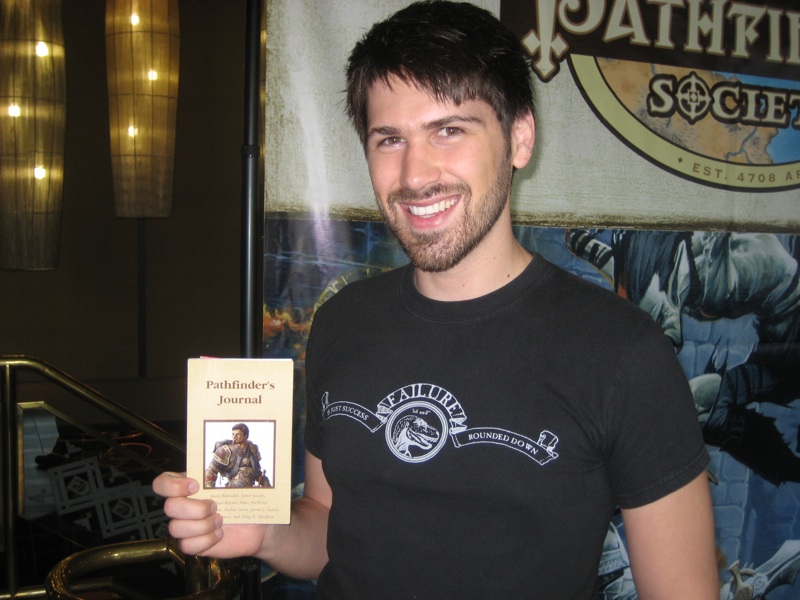
PAIZOCON has come and gone, and we're all still recovering from the unbelievable amount of fun we had this weekend. Those of you who were there doubtlessly have your own favorite moments, but for those who weren't, I'd have to say my high points were playing Wes's imp familiar during the Pathfinder Society Interactive, possessing the spirit-medium Sean during the same event, running panels, hearing hundreds of people yell out Paizo trivia answers at the banquet (and yes, I'm in fact the youngest editor—don't be fooled by Wes's beardlessness!), and kickin' it into the wee hours of the morning with a number of our favorite fans and contributors. I'm sure several other Paizo staffers will be on here in the week to come sharing their favorite con memories and photos, but for now, I wanted to show you all pictures of two particular events that stand out in my mind:
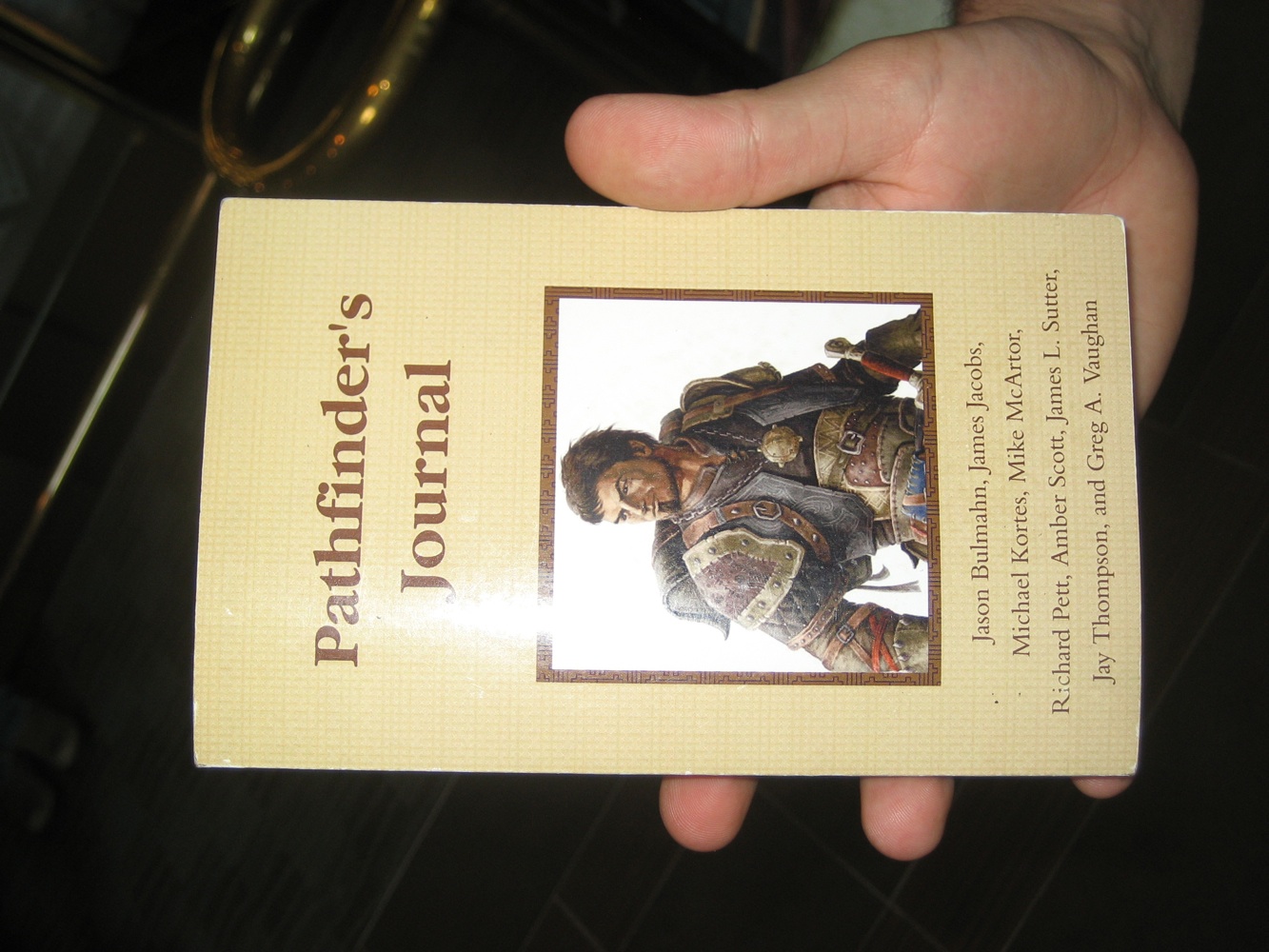
These pictures were taken on the first day, and totally blew my mind. In order to make it easier to read on the bus, superfan Mark Moreland (aka Yoda8myhead on the boards) decide to rip the text from all 18 Eando Kline Pathfinder's Journal episodes and bind them into a single, totally beautiful chapbook, complete with Jason Engle's art on the cover. As I'm particularly attached to Eando, it warmed my heart to see everything collected under one cover.
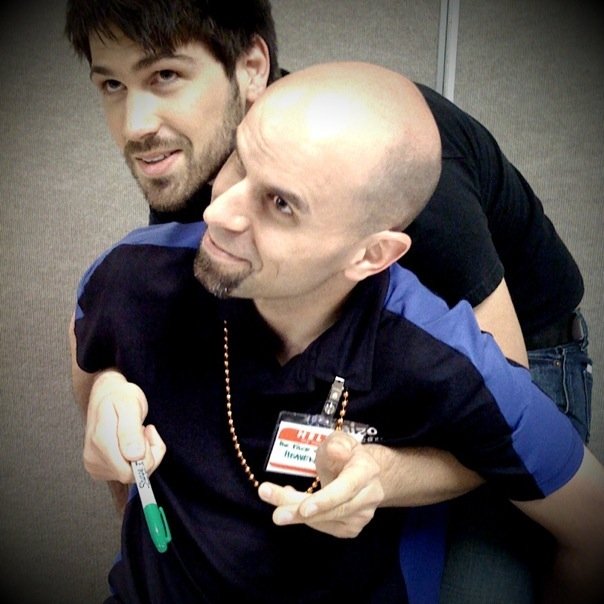
And of course, as Wes will happily tell you, no account of PAIZOCON would be complete without a photo of me manhandling Mr. Reynolds. But that's what you get when you insist on channeling the spirit of the great and powerful imp Chumley...
Thanks again to everyone who attended the con, and hopefully we'll see even more of you there next year!
When you think of characters in game-world fiction, what first comes to mind are the fighters, wizards, and rogues. Priests are fine if they're sufficiently powerful and conflicted, otherwise, not so much. Bards generally play second fiddle, you should pardon the expression, and paladins are seldom cast in starring roles. The druids, apparently, are too busy communing with nature to bother with fiction.
Since the publication of my first shared-world book, Elfshadow, in 1991, I've hit most of the character classes with the exception of the druid. Channa Ti, the protagonist of the Pathfinder's Journal fiction in the Legacy of Fire Adventure Path, is my first.
I started with a typical D&D druid—a serene mystic who dwells in emerald groves, nurturing the woodland creatures and healing hapless passersby with potions brewed from rare herbs and crafted from recipes learned at the feet of wise, benevolent elven mentors. And then I put him in a cage match with Channa and observed while she stomped him into organic fertilizer.
Sometimes the creative process takes interesting turns.
Once I started thinking seriously about druids, one of Tennyson's more famous quatrains came to mind:
Who trusted God was love indeed
And love Creation's final law—
Tho' Nature, red in tooth and claw
With ravine, shrieked against his creed—
Why should druids embody calm serenity and selfless love rather than "Nature, red in tooth and claw"? Surely some druids would be more closely attuned to nature's predators. This notion was central to Channa Ti's creation. To her way of thinking, "A paladin's noble steed must eat, but then, so must a crocodile."
Another inspiration came from Pathfinder's ingenious addition to the druid class: the Nature Bond, which allows druids to specialize in one of the domains—Air, Animal, Earth, Fire, Plant, Water, or Weather—rather than forming a partnership with a companion animal. Since Channa is a loner by nature and circumstances, this suited her perfectly. An affinity for water also gives her considerable value in a desert clime. An expert dowser, she occasionally pays her way as a "water witch." Her ability to sense a coming rain is highly valued in a culture that still mourns the passing of the Age of Prophecy and is always seeking some way to foresee the future. Finally, her affinity with water gives her skills that interest people obsessed with an ancient, sea-swallowed realm.
Nature Bond offers intriguing potential for character development and storytelling, not just for fiction, but also for campaign use. For those of you who've never played a druid—and I'm guessing that's most of you—the Pathfinder setting is a great place to start.
Part of the joy of being an editorial intern is getting to read all the goodness that is Pathfinder. For free. And before the rest of the world. Recently, I was asked to give an editing pass over a few chapters of the new Pathfinder's Journal, "Dark Tapestry," penned by the prolific and outrageously talented Elaine Cunningham (seriously, who wouldn't want this job?!).
Set in the desert realm of Osirion, this new Pathfinder story does everything a piece of fiction set in an RPG campaign world should do: it reveals believable and interesting characters, it brings the setting to life, and most of all, it makes me want to play a Pathfinder campaign set in Osirion right now.
Really though, the story highlights for me everything I really enjoy about Pathfinder. There is a touch of the familiar, but at the same time, never once can I say, "Hey, I've been here before." While reading the Pathfinder's Journal, I recognized many well-known aspects—a magical item here, a class-name drop there—and even though I have been playing RPGs since I was in junior high, never once did I feel like it was just another tired rehash. And while Osirion clearly draws inspiration from ancient Egypt, never once does it feel like a shallow interpretation of real-life history. While reading Elaine Cunningham's words, it truly felt that if I could somehow peel back the crawling desert sands, it would reveal the bones of countless centuries, a deep, rich, and lived history filled with epic stories and sweeping tales of heroism and tragedy, of which the PCs' adventures comprise only the latest chapter.
So I think I'm going to slip on some sandals, slap on some sunscreen, and head on back over to Osirion. See you there!
By the time we reached Pathfinder #2, however, it was clear that what Pathfinder really needed was something different—a straight-up epic fantasy story with a familiar character who would give us fun world details, yes, but who would also pull people through them via a fast-paced narrative. Something that GMs, players, and even non-gaming fantasy enthusiasts could pick up and use to immediately get a sense of Golarion. And to do that, we needed a protagonist. Enter Eando Kline.
Eando's story arc has taken numerous directions since those early days, as we grew ever more ambitious with his destiny. What started as standalone travel journals became adventure-path-spanning short stories and finally a full 18-part novella leading him halfway across our world to confront the mysterious leaders of the Pathfinder Society—and all stemming from that mysterious little box he runs across in his first episode.
Many quality authors have helped to shape Eando since his conception two years ago, and through his adventures shaped parts of Golarion: before Eando's travels took him there, we knew next to nothing about Belkzen, Kaer Maga, or any number of other locations in northwest Varisia. Moreover, he gave us an archetype to work from in designing the Pathfinder Society. It wasn't always easy reconciling so many different voices and styles—something that's been my department since The Hook Mountain Massacre—but in doing so Eando became a living, breathing character, chock-full of flaws and little moments of heroism.
And now, after 18 episodes, his story is coming to a close.
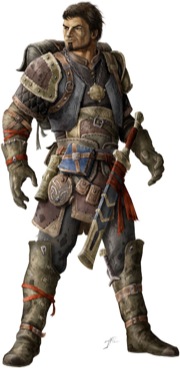
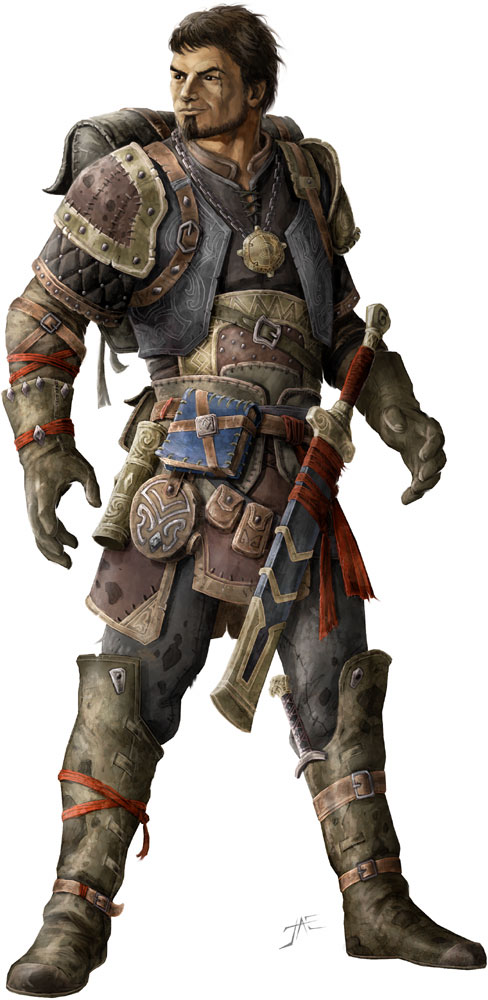
It was my honor to write the final chapter in Eando's saga, and I hope that when it arrives in your mailbox or local game store you'll find it a fitting conclusion for Golarion's first action hero. Along with the story, you'll also find a two-page NPC write-up with Eando's post-conclusion stat block and featuring this awesome character portrait from Jason Engle—a little thank-you present to all those readers who've been asking us "So is Eando a bard, or what?" for the last 18 months.
Starting with Pathfinder #19, all of the Pathfinder's Journals in a given adventure path will be by a single author, and feature a single story arc with a new protagonist. For Legacy of Fire, that's New York Times bestselling author Elaine Cunningham, who'll be introducing us to Channa Ti, a half-elven, half-Mwangi water druid making her way through Katapesh and Osirion in search of a lost city and an imprisoned god. Talk about exotic—even Eando would approve.
Eando Kline may be back someday—his type always tends to pop up just when you least expect it—but for now, at least, his sun has set, and it's time for some new heroes to take the stage. I hope you've enjoyed his story. I know I have.
Now if you'll excuse me, I have something in my eye...
When we first came up with the outline for a typical volume of Pathfinder, there were several key things we wanted to make sure made it into every book. There had to be an adventure, of course, and several supporting articles giving background material that specifically expanded the adventure. There had to be an introduction that gave people a look behind the scenes, pregenerated characters, and numerous new monsters that could be easily dropped into that volume's adventure or a homebrew campaign. But there was still something missing—a space for us to shade in more of our world beyond just the current adventure's location. A narrative that would help get people invested and allow us to explore and expand, reconcepting established monsters for our setting and breathing that much more life into the world as a whole.
To this end, we created the Pathfinder Journal. Each month in Rise of the Runelords, we'll follow the journal of Eando Kline, a neophyte member of the Pathfinder organization, as he adventures through the region of Varisia, recording the knowledge he uncovers and sending it back to his venture-captain superior in hopes of one day being deemed worthy of publication in the illustrious Pathfinder Chronicles.
While Pathfinder Journals will normally be presented in-character as musings and naturalist-style sketches from Kline's logs, "Opening Moves," the initial installment that appears in "Burnt Offerings" breaks the mold before its even been established. In this first taste, Erik Mona sets the scene by presenting an in-depth background of the Pathfinder organization—its goals, leadership, and place in the myriad societies of Golarion. Steal a taste of the hidden knowledge that rests inside the much-coveted chronicles, and study the creeds by which all pathfinders must abide.
All of which will prepare you for volume two, in which Jason Bulmahn presents the first chapter in the wanderings of Eando Kline, pathfinder extraordinaire....