
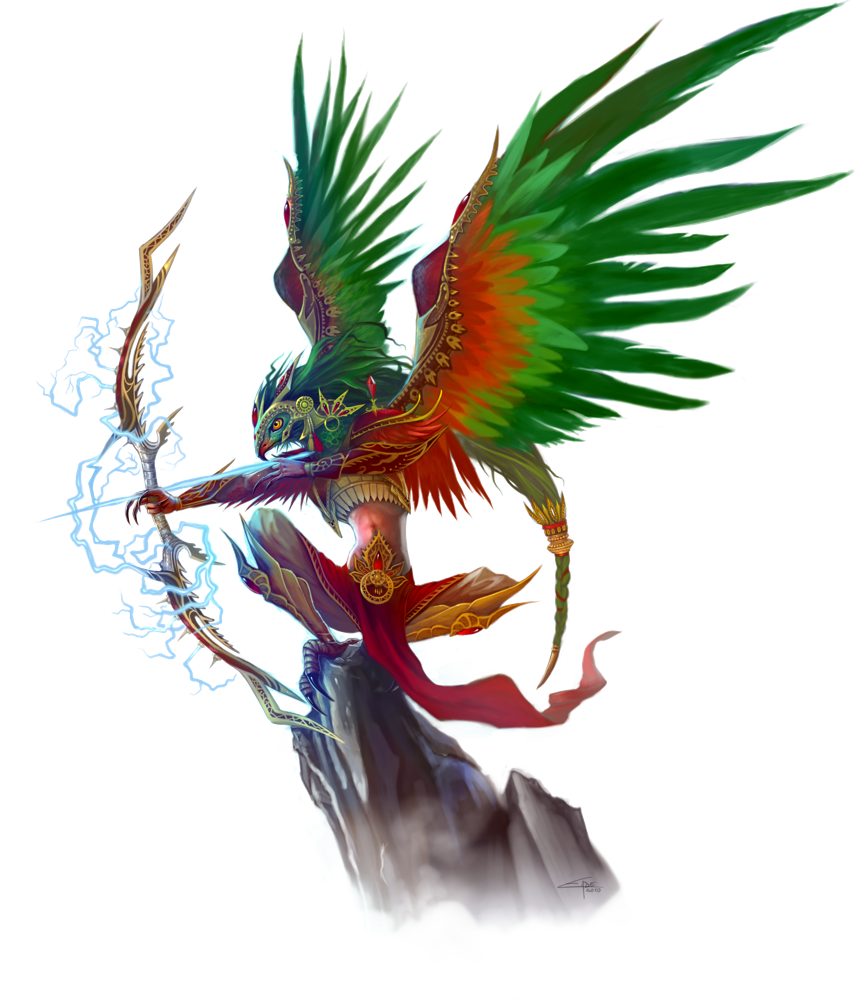
... Illustration by Carolina Eade ... The Origin of the Garuda Wednesday, February 9, 2011As we find ourselves deep in the midst of RPG Superstar 2011, it is fitting that last year's winning adventure proposal is shipping out to subscribers this week. Matthew Goodall's Cult of the Ebon Destroyers pits the PCs against a despicable cult of assassins and murderers from the distant land of Vudra. Among the many new Vudran elements featured in the module is the book's new monster—the garuda....
Illustration by Carolina Eade
The Origin of the Garuda
Wednesday, February 9, 2011
As we find ourselves deep in the midst of RPG Superstar 2011, it is fitting that last year's winning adventure proposal is shipping out to subscribers this week. Matthew Goodall's Cult of the Ebon Destroyers pits the PCs against a despicable cult of assassins and murderers from the distant land of Vudra. Among the many new Vudran elements featured in the module is the book's new monster—the garuda. These avian native outsiders typically inhabit rugged hills and sometimes serve as protectors of isolated human settlements. Due to space constraints, we had to cut much of the garuda's world flavor from its write-up in the adventure itself, but it seemed a waste to simply leave it in my ever-growing cut text scrapbook file. What better way to show off Matt's debut adventure than feature his winged creation on the Paizo blog?
Garudas are distant descendants of the goddess Janasini, the mother of birds. Legend tells that Janasini made an unwise wager with her sister Ravithra, the goddess of nagas and snakes. Ravithra cheated, and Janasini lost and became the slave of Ravithra's naga children. Sudachala, the first of Janasini's garuda children, offered to complete any task to free his mother. The nagas demanded a legendary bowl of nectar said to rest atop the tallest mountain in Vudra. Sudachala flew to the mountain and overcame many obstacles to retrieve the bowl, as detailed in the Azvadeva Pujila.
As Sudachala flew back, the god Gruhastha appeared and told Sudachala that the nectar was the elixir of immortality. The wicked nagas had tried to trick Sudachala into stealing the elixir from the gods' hiding place so they could drink it and live forever.
Sudachala alighted in front of the waiting nagas, placing the bowl on some sedge grass, and the nagas freed Janasini from servitude. But when the nagas tried to drink from the bowl, they cut their tongues on the sharp grass, for as Sudachala and Gruhastha had planned, the god had whisked the true elixir away, leaving only an illusion in its place.
Since then, garudas have been the mortal enemies of nagas. Only the most depraved and outcast garuda would knowingly associate with any kind of aberrant serpent.
Additionally, we've released rules to run the module as part of the Pathfinder Society Organized Play campaign, complete with a unique Chronicle and advice on running it within the organized play format, available as a free download here.
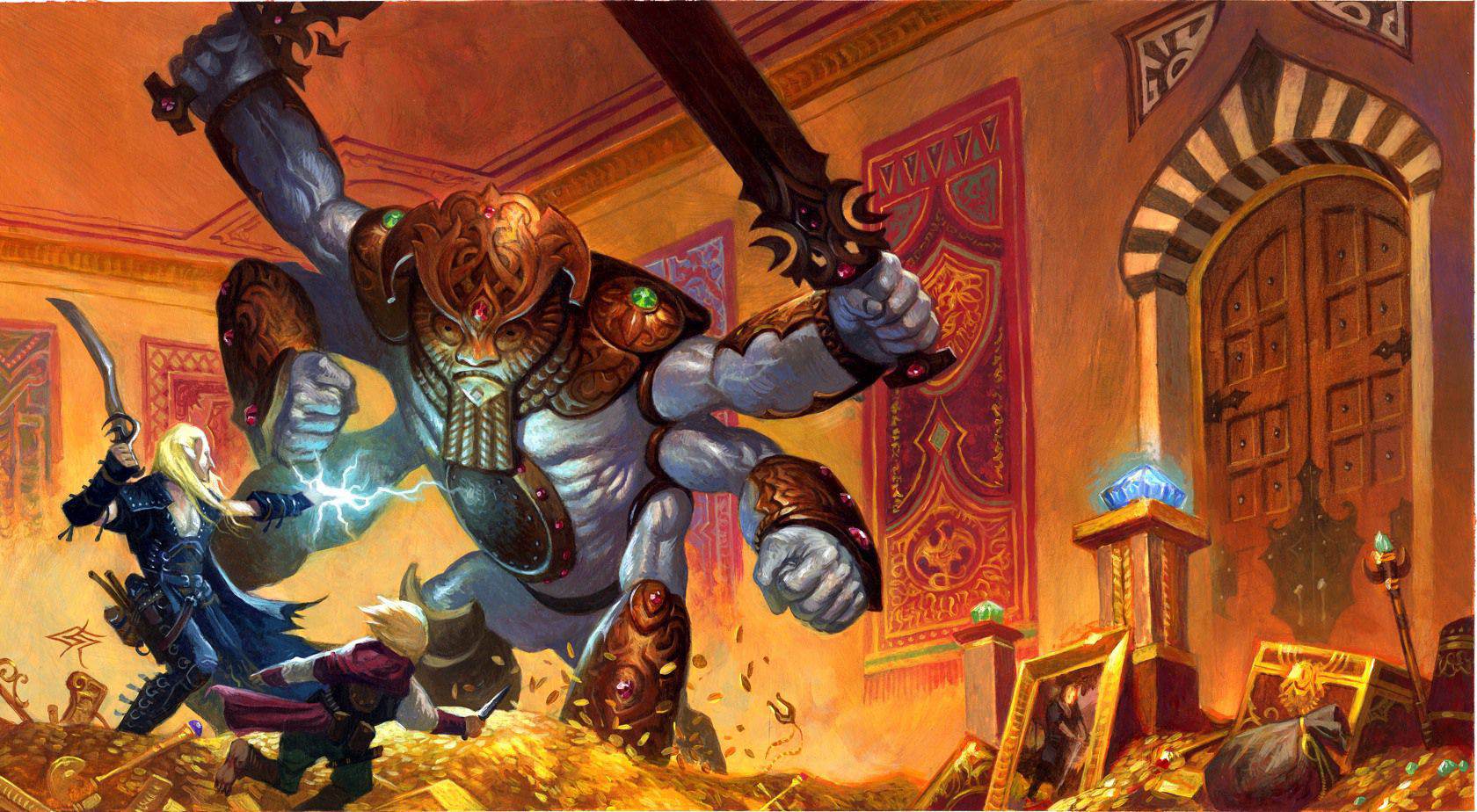
... Illustration by Steve Prescott ... Introducing the Calikang Friday, November 6, 2009Sometimes, art makes the choices for me. When we ordered the cover to Greg A. Vaughn's Mother of Flies, we asked Steve Prescott to paint us a scene in a thieves' guild treasury involving the iconics in a fight against a six-armed stone golem. The art, as you can see here, is great! ... Unfortunately, by the time I got to the section in the adventure where this six-armed menace made its appearance, I...
Illustration by Steve Prescott
Introducing the Calikang
Friday, November 6, 2009
Sometimes, art makes the choices for me. When we ordered the cover to Greg A. Vaughn's "Mother of Flies," we asked Steve Prescott to paint us a scene in a thieves' guild treasury involving the iconics in a fight against a six-armed stone golem. The art, as you can see here, is great!
Unfortunately, by the time I got to the section in the adventure where this six-armed menace made its appearance, I realized something. A six-armed stone golem (particularly one armed with a pair of tree-sized-swords) would be something like a CR 15 monster. Not really a fair fight to inflict on 10th-level characters, and certainly not good design to have the dude guarding the treasury be tougher than the adventure's actual boss.
So, in a last-minute brainstorm in Wes's office when he was probably trying to go home, he, Crystal Frasier, Lisa Stevens, and I figured out what to do with the situation. The result is a new monster from distant Vudra, the six-armed calikang, a race spawned from a deity's failure and doomed now to seek atonement for an ancient sin. We ordered an extra piece of art for this volume's Bestiary, I wrote up the monster that weekend, and everything fell perfectly in place just in time to ship to the printers.
As for the calikang itself? You'll just have to wait for "Mother of Flies" to find out what he can do!
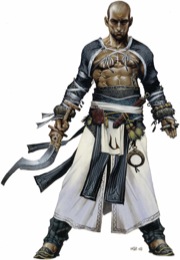
... Meet the Iconics: Sajan Monday, March 3rd, 2008Birthed to parents of the padaprajna caste of warriors in beautiful Vudra, Sajan Gadadvara and his twin sister Sajni learned to hold a temple sword before they could walk. Strict padaprajna discipline forged a tight bond between the twins, who spent even their infrequent times of rest together, practicing the latest martial techniques taught to them. On their twelfth birthday, the twins were forcefully separated: Sajan went to live with the...
Meet the Iconics: Sajan
Monday, March 3rd, 2008
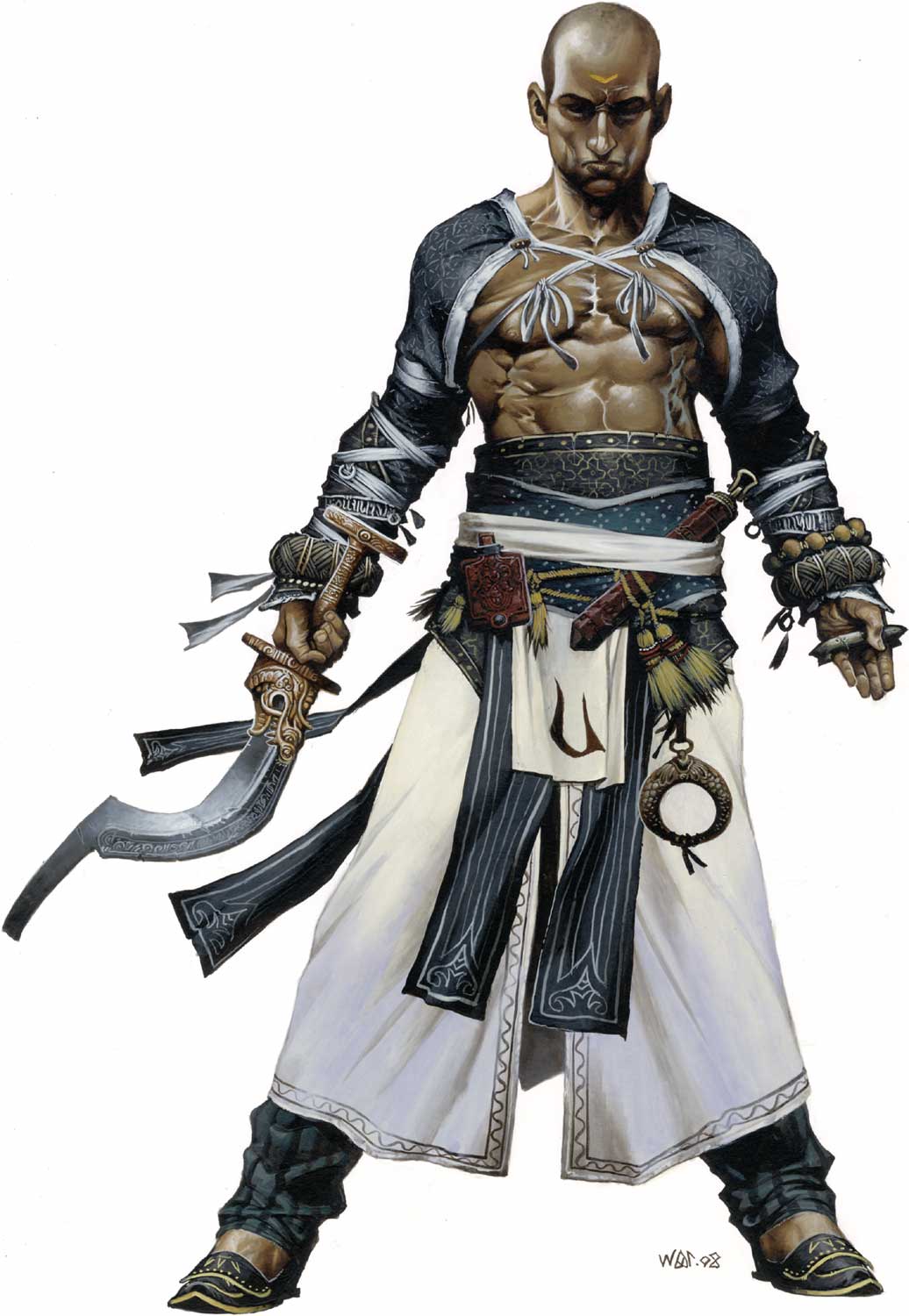
Birthed to parents of the padaprajna caste of warriors in beautiful Vudra, Sajan Gadadvara and his twin sister Sajni learned to hold a temple sword before they could walk. Strict padaprajna discipline forged a tight bond between the twins, who spent even their infrequent times of rest together, practicing the latest martial techniques taught to them. On their twelfth birthday, the twins were forcefully separated: Sajan went to live with the fighting men of the ghana padaprajna, while Sajni joined the battling women of the sastra padaprajna. Despite their separation, the twins continued to meet when they could, sparring and joking as they had in their childhoods.
As the insightful narrative of the Vigrahin Patitraka states, "A warrior's life is to war." Thus it was that Sajan's lord embroiled himself in a conflict with a neighbor. Most of the army fielded by Sajan's lord consisted of conscripts wielding tools of their trades, while the valuable padaprajna watched the battle in reserve. The warriors deduced quickly that they stood on the losing side, but they were duty-bound to fight to the death when instructed. Instead, their lord stole from them the glory of battle-death when he sued for peace after his conscripts fled the field. As part of his surrender, the lord gave over half of his sastra padapranja—including young Sajni.
Distraught, Sajan returned to his barracks in tears (for which he received severe beatings from his own father), and vowed that night to be reunited with his sister. Several weeks passed before he found his opportunity for escape. He fled into the countryside and slipped stealthily into the city of Sumadhadra, through whose gates Sajan watched his sister pass. After several days of clumsily seeking information on his sister, he finally discovered that all the traded sastra padapranja were loaded onto ships bound for distant Jalmeray.
Sajan quickly hired himself as a guard aboard a ship bound for the far-away island, and several months later he found himself on its heavily guarded docks. Within a week, Sajan uncovered the fates of most of the sastra padapranja, who worked as guards and courtiers for the island's thakur. Sajni was not among them. More weeks passed before Sajan learned that his sister had, like him, signed on as a guard aboard a trading ship—hers bound for a place called Absalom.
The desperate young padapranja gained passage to Absalom and, upon arrival, stared in wonder at its size and splendor. It seemed to him that the strange western barbarians he found himself among were incapable of a place so grand. By the time he found his bearings and rejoined his search, however, he found himself without leads, for the sheer size that so impressed him also made finding his sister nearly impossible.
Sajan knows he cannot return to Vudra, for the padapranja there would execute him as a deserter. He cares not for his home country, however, and continues to seek out any clue that might point him toward his sister.