This week we released the newest Planet Stories book, The Ship of Ishtar, by A. Merritt. Not only is this my personal favorite of the 22 books we have released since the launch of Planet Stories about a year and a half ago, but it's also an interesting look at the Planet Stories process, and how in many ways we here in the office are learning just as much about the history of the most important early authors and books in the science fiction and fantasy fields as our readers are.
I often received letters of thanks form Planet Stories readers for introducing them to authors like Leigh Brackett, C. L. Moore, or Henry Kuttner. Most of these authors began their careers in the 1930s and early 1940s, publishing their stories in the pre-war pulp magazines like the original Planet Stories, Startling Stories, Thrilling Wonder Stories, and similar magazines.
In order to locate and restore the oldest, most complete texts of the tales we've published so far, I have accumulated a respectable selection of pulp magazines. One of my absolute favorites was called Famous Fantastic Mysteries. Along with its sister magazine, Fantastic Novels, editor Mary Gnaedinger culled the vast archives of the Munsey Magazines (primarily Argosy and All-Story in their various forms and spin-offs), collecting the best fantastic material for affordable reprints. In some ways FFM was the "original" version of our Planet Stories book line, only in this case they reprinted work from the first three decades of the twentieth century almost exclusively.
Two things strike me as fascinating about these magazines beyond the actual stories they contained (many of which were brilliant) and the fact that a woman was setting the original "canon" of science fiction and fantasy in an era when many other women had to hide behind pseudonyms to get their work published at all. Beyond those two substantive issues, the things I find most fascinating about these magazines are the art, and the reader letter column.
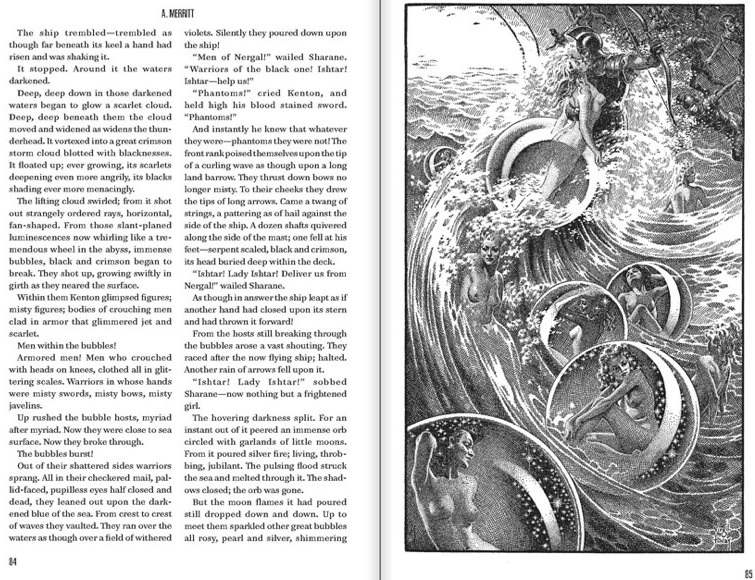
The art stands out particularly because most of it (especially early on) came from the peerless pen of Virgil Finlay, for my money the finest illustrator ever to work in the pulp field and one of the greatest American illustrators of all time, period. Finlay's distinctive scratchboard style, fine figure work, and juxtaposition of light and dark tones is breathtaking more than six decades after it was originally commissioned, and his work brings a continuity to the canon of Famous Fantastic Mysteries that might otherwise have been less clear, different as the stories published in the magazine may have been. Many of Finlay's works have been reprinted over the years (and a Google image search will turn up hundreds more), but like the authors whose work he illustrated, he was amazingly prolific. Many of his illustrations appear only in their original pulp form, so opening a "new" issue of FFM rescued from a used book or magazine shop can often feel like digging for visual treasure.
Beyond the stories and illustrations, tacked onto the ends of the magazines and presented in tiny type, came the letters to the editor, often dozens at a time. In the course of praising or criticizing a given issue's content, these letters often include praise of authors and stories that are nearly forgotten today. How many readers other than the most dedicated literary archeologists know much about authors like E. Charles Vivian or Charles B. Stilson? Beyond King Solomon's Mines and perhaps She, who can name the titles of further adventures of H. Rider Haggard's character Allan Quatermain or the dozens of other high-adventure fantasy novels he wrote in the late nineteenth century? FFM published many of them, and the letter columns are filled to bursting with suggestions on even more minor or forgotten works that were fading into obscurity (rightly or wrongly) more than 60 years ago. Of course, even back then, fantasy fans could agree on very few things.
One thing almost everyone seemed to agree on, however, was the overwhelming quality and beauty of language in the works of A. Merritt, particularly his groundbreaking fantasy The Ship of Ishtar.
Merritt's influential 1919 novel The Moon Pool has been in print more or less consistently since it was first published, and it was one of several stories in the very first issue of Famous Fantastic Mysteries that solidified the magazine as a major success that would last more than a decade (not bad for a pulp focused almost exclusively on reprints!). He was a major stylistic influence on authors like H. P. Lovecraft, Clark Ashton Smith, C. L. Moore, and Henry Kuttner.
Prior to coming across praise for his works in the letter pages of FFM, I'd never really heard of him. I came to Lovecraft decades ago, and in subsequent works by the above-named authors I always identified the florid, lush description as particularly Lovecraftian. In fact, Lovecraft was a great admirer of Merritt, and it's clear that Merritt's style was a huge influence upon him.
Listen to what HPL said about Merritt in a letter to a friend, praising the Merritt novel The Metal Monster: "[Merritt] has a peculiar power of working up an atmosphere and investing a region with an aura of unholy dread... the most remarkable presentation of the utterly alien and non-human that I have ever seen. Merritt is certainly great stuff—he has a subtle command of an unique type of strangeness which no one else has been able to parallel."
In the early 20th century, Merritt was considered, if not the most popular fantasist (that honor probably goes to Edgar Rice Burroughs), certainly among the top two or three fantasy authors in America. A journalist by trade, Merritt edited the prestigious American Weekly for Willian Randolph Hearst, and was one of the best-paid journalists in the world, bringing in an annual salary of $100,000 at the time of his death in 1943.
His busy career left him relatively little time for fiction writing, limiting his output to fewer than a dozen novels and about the same number of short stories. All are infused with powerful, vivid imagery, an unparalleled sense of place, and unforgettable characters.
This month's Planet Stories release, The Ship of Ishtar, is considered by most critics the finest of Merritt's masterworks, a precursor of the sword and sorcery genre that would come to inform the birth of fantasy roleplaying, and one of the most important fantasy novels of the early twentieth century. Merritt was the late Gary Gygax's favorite writer, and up until the month of Gary's recent death, he kept pushing me to publish some of his works. I wish Gary could have survived to see us get to The Ship of Ishtar, but I know he would have been happy to have one of his favorite tales presented to the audience of fantasy enthusiasts he helped to create and maintain.
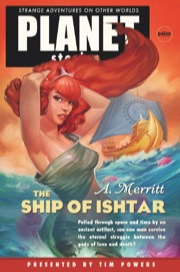
The Planet Stories edition of The Ship of Ishtar features Merritt's complete, preferred text for the first time in more than 60 years. It also includes 10 beautiful prints by Merritt's favorite artist and friend, Virgil Finlay, collected into a single volume for the first time ever. Prominent modern author Tim Powers provides a compelling introduction, and the book comes wrapped in a beautiful, pulpy cover by artist Kieran Yanner.
Illustration by Virgil Finlay
I am enormously proud of this book. Many of you have sent me letters of thanks and encouragement for introducing you to some of the classic authors we've covered so far in Planet Stories. And if not for Planet Stories, I may not have discovered this book, so I offer my own thanks to Gary Gygax, and my own invitation to all of you to order the book and give Planet Stories and A. Merritt a try.
One of the world's finest fantasies awaits!
Erik Mona, Publisher
At the World Fantasy Convention
San Jose, California
October, 2009
I refer, of course, to the fact that the last several months have seen the Planet Stories footprint on this blog dwindle down to almost nothing. It turns out that producing a 576-page RPG core rulebook and a bestiary with more than 350 monsters in addition to our Pathfinder, Pathfinder Companion, Pathfinder Chronicles, Pathfinder Modules, Pathfinder Scenarios, GameMastery, Titanic, and Planet Stories lines is a bit time-consuming. (Just reading over that list makes me want to hide under my desk and take a nap.)
But those days of slothful negligence are past! The classic SF of Planet Stories will once again shine forth from this blog, and given our total artistic redesign of the line, there's never been a better time for it. In the coming weeks, we'll be talking more about Robots Have No Tails by Henry Kuttner, the first book in the new format, as well as its introduction by weird-fiction superstar Tim Powers and Kuttner praise from H. P. Lovecraft himself, plus subscription benefits and the philosophy behind the new look for the line. For now, however, I'm happy to let Mr. Kuttner speak for himself. The following excerpt is from the Robots Have No Tails story "The World is Mine," in which our drunken scientist hero attempts to solve his own murder while wrangling three adorable and incompetent martians bent on planetary conquest...
"The little guys came through the machine or whatever it was. You said you hadn't adjusted it right, so you fixed it."
"I wonder what I had in mind," Gallegher pondered.
The Lybblas had finished their milk. "We're through," said the fat one. "Now we'll conquer the world. Where'll we begin?"
Gallegher shrugged, "I fear I can't advise you, gentlemen. I've never had the inclination myself. Wouldn't have the faintest idea how to go about it."
"First we destroy the big cities," said the smallest Lybbla excitedly, "then we capture pretty girls and hold them for ransom or something. Then everybody's scared and we win."
"How do you figure that out?" Gallegher asked.
"It's in the books. That's how it's always done. We know. We'll be tyrants and beat everybody. I want some more milk, please."
"So do I," said two other piping little voices.
Grinning, Gallegher served. "You don't seem much surprised by finding yourselves here."
"That's in the books, too." Lap-lap.
"You mean—this?" Gallegher's eyebrows went up.
"Oh, no. But all about time-traveling. All the novels in our era are about science and things. We read lots. There isn't much else to do in the Valley," the Lybbla ended, a bit sadly.
"Is that all you read?"
"No, we read everything. Technical books on science as well as novels. How disintegrators are made and so on. We'll tell you how to make weapons for us."
"Thanks. That sort of literature is open to the public?"
"Sure. Why not?"
"I should think it would be dangerous."
"So should I," the fat Lybbla said thoughtfully, "but it isn't somehow."
Gallegher pondered. "Could you tell me how to make a heat ray, for example?"
"Yes," was the excited reply, "and then we'd destroy the big cities and capture—"
"I know. Pretty girls and hold them for ransom. Why?"
"We know what's what," a Lybbla said shrewdly. "We read books, we do." He spilled his cup, looked at the puddle of milk, and let his ears droop disconsolately.
The other two Lybblas hastily patted him on the back. "Don't cry," the biggest one urged.
"I gotta," the Lybbla said. "It's in the books."
"You have it backward. You don't cry over spilt milk."
"Do. Will," said the recalcitrant Lybbla, and began to weep.
Gallegher brought him more milk. "About this heat ray," he said. "Just how—"
"Simple," the fat Lybbla said, and explained.
It was simple. Grandpa didn't get it, of course, but he watched interestedly as Gallegher went to work. Within half an hour the job was completed. It was a heat ray, too. It burned a hole through a closet door.
"Whew!" Gallegher breathed, watching smoke rise from the charred wood. "That's something!" He examined the small metal cylinder in his hand.
"It kills people, too," the fat Lybbla murmured. "Like the man in the back yard."
"Yes, it— What? The man in—"
"The back yard. We sat on him for a while, but he got cold after a bit. There's a hole burned through his chest."
"You did it," Gallegher accused, gulping.
"No. He came out of time, too, I expect. There was a heat-ray hole in him."
"Who...who was he?"
"Never saw him before in my life," the fat Lybbla said, losing interest. "I want more milk." He leaped to the bench top and peered through the window at the towers of Manhattan's skyline. "Wheeee! The world is ours!"
The doorbell sang. Gallegher, a little pale said, "Grandpa, see what it is. Send him away in any case. Probably a bill collector. They're used to being turned away. Oh, Lord! I've never committed a murder before—"
"I have," Grandpa murmured, departing. He did not clarify the statement.
Gallegher went into the back yard, accompanied by the scuttling small figures of the Lybblas. The worst had happened. In the middle of the rose garden lay a dead body. It was the corpse of a man, bearded and ancient, quite bald, and wearing garments made, apparently of flexible, tinted cellophane. Through his tunic and chest was the distinctive hole burned by a heat-ray projector.
"He looks familiar, somehow," Gallegher decided. "Dunno why. Was he dead when he came out of time?"
"Dead but warm," one of the Lybblas said. "That was nice."
Gallegher repressed a shudder. Horrid little creatures...