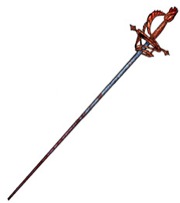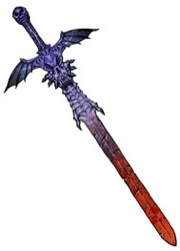
We've all been there. We've faced the sad crossroads when we realized that our favorite magic item just wasn't cutting it, and we couldn't justify keeping it instead of equipping the new and shinier item the party just found instead. But what about the blacksmith who becomes a hero fighting with her father's sword? Or the halfling who found a strange item early in his career that turned out to be more than it seemed? That's where the scaling magic items from Pathfinder Unchained come in. These items scale as you level, allowing them to be an important part of your character (these sorts of items are called wonders) or a small and handy tool throughout your career (these are called baubles) or something in between. The math is all worked out to allow GMs to use a few different systems for the advancement, including automatic advancement (in which case, it's recommended to dole out less treasure if you want to keep the party at about the same power level) or advancement using rituals and gold (the easier method for someone running a published adventure). Scaling items have starting and ending levels for scaling, so I've included two of the most wondrous of the wonders: wonders that scale all the way up to 20th level!
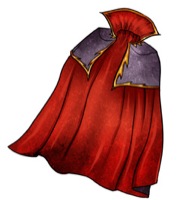
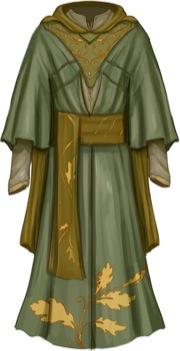
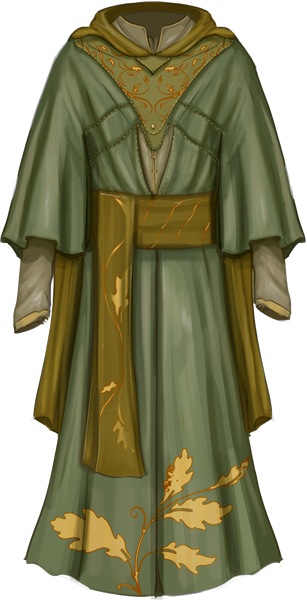
Robe of the Faerie Queen
Price 4,800 gp
Slot body; CL 6th; Weight 1 lb.
Aura strong transmutation; Scaling wonderWhen donned, this sheer, sleeved cape fades to near invisibility. It grants the wearer a +4 competence bonus on Bluff, Diplomacy, Intimidate, and Sense Motive checks against fey. On command, the mantle glows in delicate faerie fire of any color, and a second command word ceases its glow.
8th Level: The mantle magnifies and sharpens the wearer's beauty such that her +4 competence bonus now applies to all Charisma checks, Charisma-based skill checks, and Sense Motive checks against creatures. Against fey, the bonus increases to +6.
10th Level: The mantle's wearer becomes manipulative and eloquent in social situations. Whenever she converses with creatures, she can insert a suggestion (DC 14 Will save negates) for every 10 minutes of conversation by succeeding at a DC 14 Perform (oratory) check. If she ever fails the Perform (oratory) check to use this ability, all creatures who witnessed her misstep are immune to this ability for 24 hours.
12th Level: Once per day, the wearer can release the glow within the mantle in a single coruscating burst of color. This blinds creatures in a 10-foot radius (Reflex DC 19 negates) for 1d4 rounds and completely dispels any darkness spells of 6th level or lower whose source is within its area.
14th Level: The wearer grows a pair of gossamer wings. The wings are delicate and weak, carrying the wearer only with difficulty. She gains a fly speed of 30 feet (poor maneuverability).
16th Level: The wearer's wings grow stronger, more agile, and more beautiful, as iridescent patterns trace along them. Her fly speed increases to 60 feet (good maneuverability), and she gains a +5 competence bonus to Fly checks.
18th Level: The wearer gains a small domain in the fey realm. She can access her domain from any location, creating a silvery gateway. Treat her domain as a mage's magnificent mansion except that its size is equal to 20 10-ft. cubes/level, the domain appears as a natural wilderness instead of a mansion, and the servants are tiny fey instead of nearly-transparent liveried servants.
20th Level: The wearer's type changes to fey, and she gains DR 10/cold iron. If the wearer's type was already fey and she already possessed DR/cold iron, her DR increases by 10 and magic weapons with enhancement bonuses of +3 or greater do not count as cold iron for the purpose of bypassing her DR.
Construction
Requirements Craft Wondrous Item, eagle's splendor, faerie fire, fly, mage's magnificent mansion, sunburst, suggestion, creator must be fey; Cost 132,000 gp
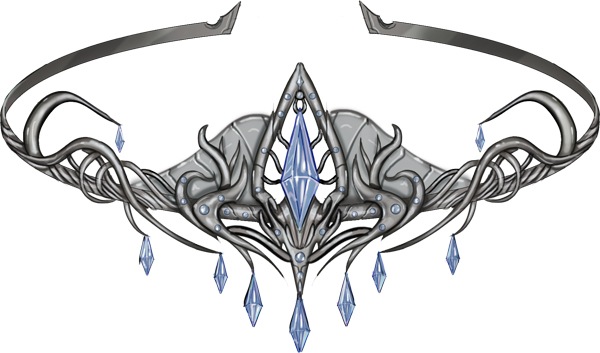
Crystal Tiara
Price 1,000 GP
Slot head; CL 3rd; Weight –
Aura moderate conjuration; Scaling wonderDespite its fragile appearance, this intricate ice crystal tiara has hardness 12 and 10 hp. Its wearer gains the effects of endure elements against cold conditions only.
5th Level: Once per day, the wearer can summon a small ice elemental as summon monster II.
7th Level: As a standard action, the wearer can launch an icicle at a foe within 30 ft. as a ranged attack. On a hit, the icicle deals 1d6 points of piercing damage and 1d6 points of cold damage. The wearer can walk across icy ground without slipping.
10th Level: As part of her move action, the wearer can step into the air, creating crystalline stairs beneath her feat, adding new steps in whichever direction she travels, and melting away behind her. If another tries to climb the steps, they crumble away, leaving only the portions beneath the wearer's feet intact. This otherwise acts as the air walk spell. She can use this ability each day for 10 minutes per level, divided any way she chooses in 10 minute intervals.
12th Level: Once per day, the wearer can call forth an ice storm. When she uses the tiara to summon ice elementals, she can either summon 1d4 small ice elementals or 1 medium ice elemental as summon monster IV.
14th Level: Once per day, the wearer can travel to a safe, very familiar location, as if she had cast ice crystal teleport on herself. When she uses the tiara to summon ice elementals, she can also choose to summon 1d3 medium ice elementals or 1 large ice elemental as summon monster V.
16th Level: The wearer can use the tiara to call up a tower of ice, exactly as an instant fortress except that the tiara does not transform into the tower, the tower takes 1 minute to rise instead of 1 round, the walls of the tower only have 12 hardness, like the tiara, and damage to the tower does not carry over upon multiple uses of this ability.
18th Level: When the wearer calls forth a tower of ice, if there is enough open space, she can also choose to call forth a small palace instead, 100 feet square at the base with 20 foot tall rooms, with a central tower 20 feet square and 100 feet high. At will, she can spend 5 rounds to transform into a flurry of snowflakes that can move at incredible speed. Treat this as wind walk except she gains vulnerability to fire. It normally takes 5 rounds to transform back into her normal shape. However, she can revert to her original form early as a standard action. If she does so, she cannot transform into snowflakes again for 24 hours. When she uses the tiara to summon ice elements, she can also choose to summon 1d4+1 medium ice elementals, 1d3 large ice elementals, or 1 huge ice elemental as summon monster VI.
20th Level: The wearer gains cold resistance 30. When she uses the tiara to summon ice elementals, she can also choose to summon 1d4+1 huge ice elementals, 1d3 greater ice elementals, or 1 elder ice elemental as summon monster VIII. She can create ice stairs without a daily limit, and if she wishes, they last for 1 minute before melting, even if another creature tries to climb them. If she chooses to make them last longer, she can dismiss the stairs behind her as a swift action, potentially causing creatures climbing the stairs to fall.
Construction
Requirements Craft Wondrous Item, air walk, ice crystal teleport, ice storm, summon monster VIII, wind walk; Cost 132,000 gp
The magic chapter has even more surprises, including one of my personal favorite sections in the book, a narrative variant of magic item creation, complete with strange quirks that your item might develop ("My sword is sprouting tentacles!? Aberrant bloodrager, I knew we shouldn't have listened to your gut!" "Hey, the tentacles are helping, man!) Tune in next week for our final preview of Pathfinder Unchained!
Mark Seifter
Designer
Illustrations by Mattias Fahlberg.