Obsidian Gets Difficult
Tuesday, March 8, 2016
A couple of weeks ago, we debuted Pathfinder Adventures on the Obsidian Plays Twitch Stream. Viewers got to see a new feature that many card game players have been begging for: adjustable difficulty. Now you can play in several modes: Normal, Heroic, and Legendary Difficulty, with or without permanent character death. To kick things off, I played Black Fang's Dungeon on Legendary Difficulty with 6 characters. Even though I've played Black Fang literally hundreds of times at this point, I still sweat bullets in this, my favorite play mode.
Let me walk you through another good scenario...
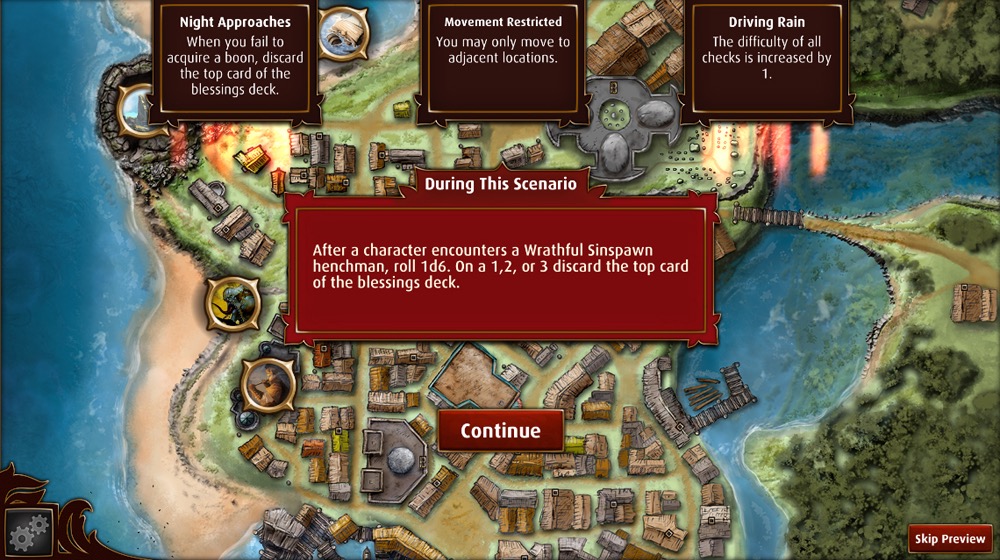
I recently jumped into Trouble in Sandpoint in "Burnt Offerings." After selecting the scenario and watching a short cutscene, we see the scenario preview which would normally show a power telling me that after encountering a Wrathful Sinspawn, I would have a 1 in 6 chance of discarding blessings from the blessings deck. As you see below, things have changed... a bit.
Who needs a blessings deck anyway?Instead of a 1 in 6 chance of losing blessings, it's 1 in 2. Given that most of the henchmen, one of the location closing conditions, and the villain's summoning power will trigger this, my time is limited.
But wait, there's more! I've also been given two "Wildcard" powers. Wildcards are additional randomly chosen increases in difficulty. Night is approaching which means that each time I fail to get a boon, I lose another blessing, and coupled with the driving rain, those boons will be even harder to get. Time is definitely not on my side.
But wait, there's even more! I can move only to an adjacent location. Let's see what that means.
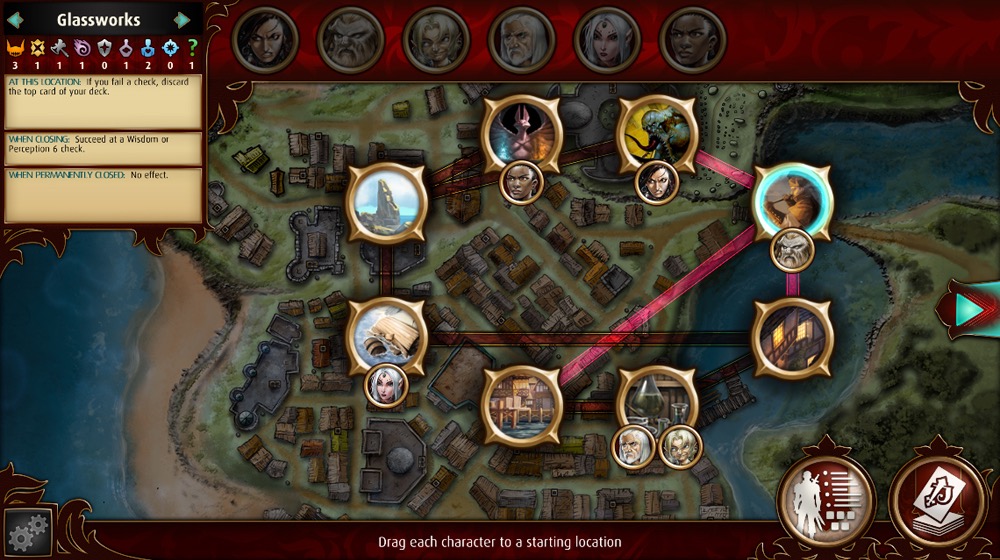
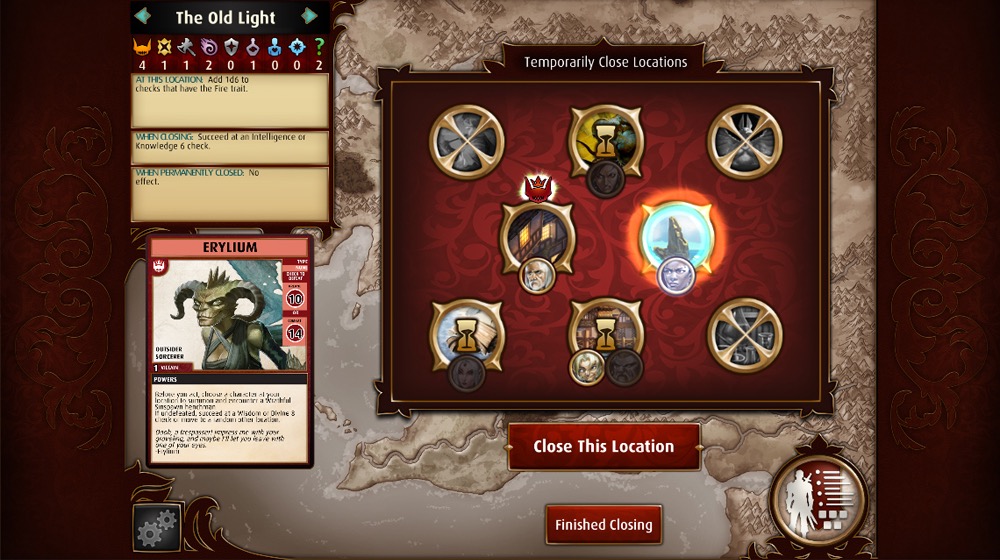
Amiri and Seelah leap into danger, while Ezren and Lem chill at the Apothecary. Yeah, that's about right.This is our location selection screen to place characters before the scenario begins. There are now connections between all of the locations and now movement is limited to those travel lines. No longer will healers be able to parachute into any location they're needed. So I have to place each character carefully using a strategy that takes into account location deck composition, location power, closing check, connections to the locations around it, distance from other characters, and an ideal path
I see a couple challenges immediately:
- Two Intelligence/Knowledge location closures are spread far apart, but for Lem to be effective, I want to group him with Ezren.
- Shrine of Lamashtu is connected only to the Old Light, so it's isolated. I decide to post Seelah there because, let's face it, she was made to face the Shrine.
So we're set! Let's take a look at what this looks like in game.
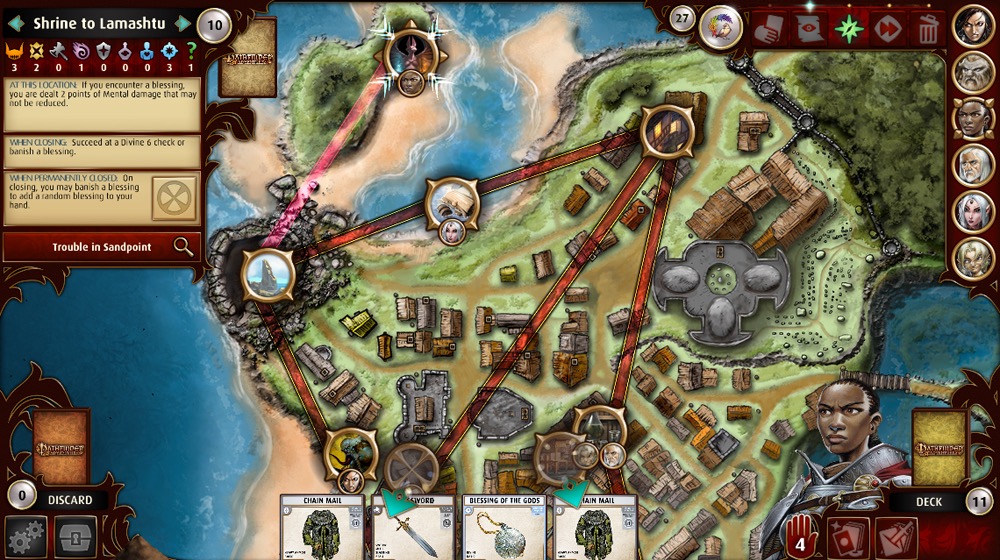
Welcome to Sandpoint, where you'll find bunyips aplenty in Ven Vinder's general store.From this view, which we call the scenario view, you can better see the spatial and thematic reasons that the travel lines are configured in this way. The Village House is acting as a hub and the Shrine to Lamashtu is the most remote location on the map. Not all locations map exactly to a place in Sandpoint, but if you look at the map of Sandpoint in the Rise of the Runelords Anniversary Edition, you’ll find that the Old Light, Junk Beach, and the Glassworks are all in the right places; the Apothecary is located at Pillbug Podiker’s, and the Village House is at the White Deer tavern and inn.
Speaking of the Village House, let's fast forward to the end of the Scenario. I have 2 blessings left before the scenario ends. Those blessings went fast! Ezren's moved over to Village House, Lem and Harsk have converged on the Waterfront, Amiri and Merisiel are tied up at their starting locations, and Seelah's just closed the Shrine. Ezren defeated the henchman last turn so he knows he's about to fight the villain. The Old Light is open.
If only I had a way to get someone over to Old Light...
Ezren knows that he's got a useful spell in his deck and he just drew Detect Magic. Ezren understands that the best way to hit a dangerous enemy is... carefully. And he embarks on some rather arcane planning. He casts Detect Magic to look at the villain he already knows to be there, and activates his Expanded Spellbook and comes across...
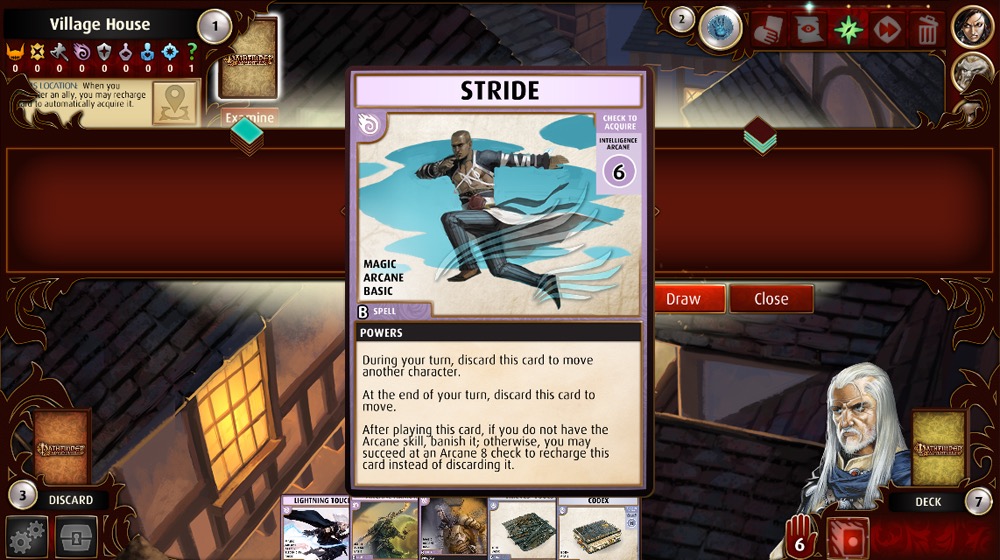
Swift like a Sajan!...Stride! Perfect!
Stride is Obsidian's version of Levitate. We found that while Levitate was a good card (particularly for Legendary difficulty), it would have to prompt at the end of each character’s turn to activate properly, which can get old real fast. We pitched an alternate version with less versatility in some ways and more in others to Mike Selinker, Chad Brown, and Vic Wertz. Vic made an excellent point that we'd be diverging enough from the original Levitate card that it would make sense to call it something else. And since it's a new card, new art!
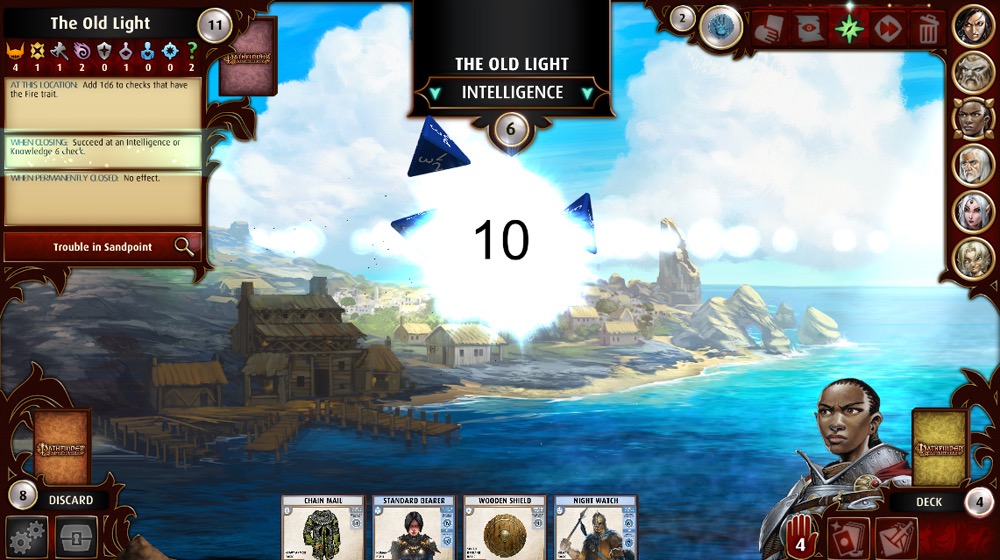
Anyway, back to the matter at hand. It's time for Seelah to move to The Old Light and do hero's work. Ezren pulls Erylium from the location deck and trusts in his friends to close their locations. Everyone does their part, leaving Seelah to try an Intelligence check.
Seelah's got this because she's literally the best character.It's tough, but with the power of prayer and Irori's blessing...
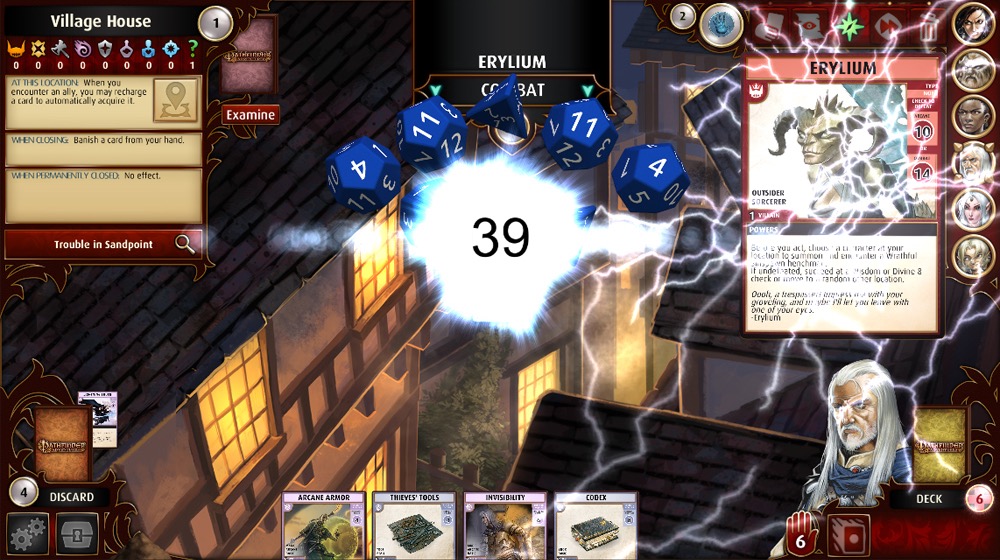
Faith is just as good as brains to Seelah.She nails it! Now all that's left is for Ezren to blast Erylium to bits with all of the remaining dice.
Lightning never gets old!Boom!
Now that you have a sense for how Legendary Difficulty works, I'll give a super-brief history of this feature. One of the first big shifts we made from PACG was the use of maps and points to show the locations. Almost immediately, it was clear that we could do something more with maps, but we held off for a long time. We started developing the concept for having increased difficulties based on a number of factors. We knew that there was a strong desire to replay scenarios from Rise of the Runelords and many of you have run through Perils of the Lost Coast many, many times. I also spent some time checking out a lot of homebrew mods people had done to make the game their own. I put this version of restricted movement together before PaizoCon last year (along with some other stuff we will talk about soon) and requested a meeting with the original PACG development team at the convention.
I think I led with, "We love your game! Development is going really well! Here's my plan to screw it all up." Mercifully, the whole team was excited and on board! They gave us a lot of fantastic input across the board.
The plan simmered for a while as we were nailing down other parts of the project, like the tutorial and roles. At the end of last year, David Williams (Designer for Legend of the Five Rings, Doomtown, and so many more) joined the team here at Obsidian and locked down our difficulty design and added the concept of randomly chosen Wildcard powers which makes such a big difference in replayability and challenge level.
Dave will be joined by art lead and UI designer Andre Nguyen and artist Lindsay Laney in another Twitch stream this Friday at 4 PM Pacific time! Be sure to check it out!
Nathan Davis
Game Director, Obsidian Entertainment
@nathan_J_davis
(Previously Harsk in Rise of the Runelords and Ranzak in Skull & Shackles; currently Alain in Wrath of the Righteous)
We have updated our Privacy Policy.
Paizo.com uses cookies. You can block paizo.com from using cookies within your browser settings, but doing so will hinder site functionality.
More information can be found in our Privacy Policy.