Pathfinder Adventure Card Game Strategy #13—Building a Party: Other Considerations
Thursday, September 7, 2017
This is the thirteenth installment of our strategy blog written by game historian Shannon Appelcline. You can read all the installments here.
Great Pathfinder Adventure Card Game parties will have characters in different roles and will contain sets of powers that work well together. However, there are a few other characteristics you should consider when assembling a party.
Vary your niches
Make sure you have characters who fill a variety of niches. Choose some magic-users and some fighters; some characters who help with non-combat targets and some who support fighting; some who are great when grouped together and some who are great alone. You're going to face a variety of challenges, so make sure you have a variety of abilities to meet them.
Corollary #1: Especially vary complementary characters. If you've chosen two characters who will often work together, try to make them as different from one another as you can.
Vary characters by primary skills
There are six dice-based skills in PACG: Strength, Dexterity, Constitution, Intelligence, Wisdom, and Charisma. Among your party, try to have good dice in each of these primary skills. If each skill is supported by at least one character with a d8, that's great; if your whole party tops out at a d4 or a d6 on something, consider how to fix that.
Vary characters by secondary skills
Here's a breakdown of the secondary skills and the number of characters in Rise of the Runelords who have each: Acrobatics [2], Arcane [3], Craft [0], Diplomacy [3], Disable [1], Divine [4], Fortitude [3], Knowledge [3], Melee [4], Perception [2], Ranged [1], Stealth [1], Survival [3]. (You could make a similar list for any of the other adventure paths.)
Ideally, you'll want each of these skills covered, meaning you can send someone to defeat each card and close each location. Absent that, choose characters that offer a wide spread of skills; work particularly hard not to add any characters to your party whose skills are totally redundant. Also, look carefully at the skills that are most common among the characters published with the adventure path you're playing, because they're probably the most important. The fact that none of the Runelords characters have Craft lets you know that you can get by without it. Similarly, missing Acrobatics or Stealth generally won't be a big deal in Rise of the Runelords, but you should think more carefully before voiding Diplomacy or Survival.
Corollary #1: Choose characters that have a lot of skills, especially if you have fewer players. The fewer characters you have, the harder it is to cover all the skills. So for low player-count games, consider characters who have three or four secondary skills over those who have just two.
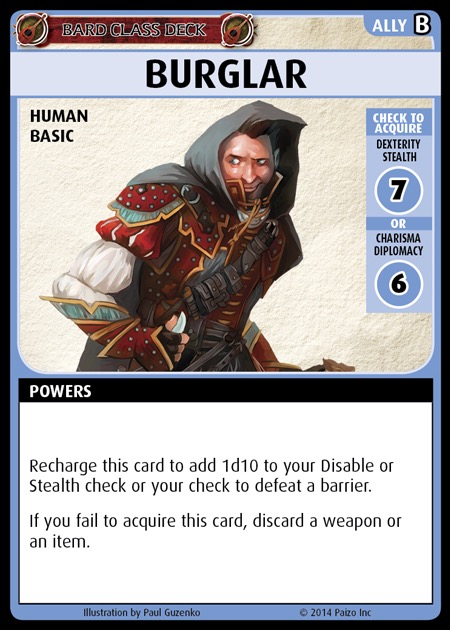
Corollary #2: Manage gaps with cards. If you have gaps in your skill coverage, put cards that help with those skills into your deck. Just as a Masterwork Tools can cover a missing Disabler, a Burglar can help with both Disable and Stealth. (Remember which characters have those boons so you can send people where they need to go!)
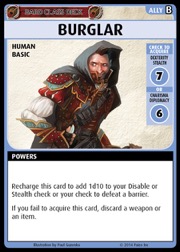
Sometimes you just need friends in low places.
Vary characters by cards
There is nothing sadder in PACG than acquiring a great card and having to throw it out at the end of the scenario because nobody has room in their deck for it. This is also a pragmatic issue: You're only going to get so many great cards each game, so the more of them you can keep, the better your party becomes. So for each type of boon, you want at least one character whose deck list is strong in that type.
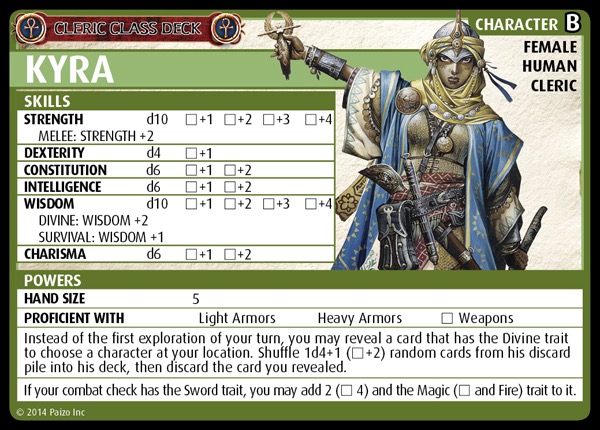
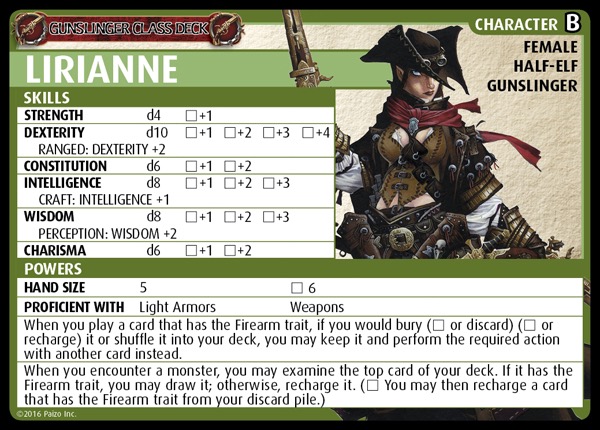
Corollary #1: Consider subtypes too. Covering a range of card subtypes with your characters can be even more important. In particular, if you can have arcane and divine spell users, and melee and ranged weapon users, and characters proficient with both light armor and heavy armor, then you're more likely to be able to use everything you acquire. Certain characters can even be even more specialized: If you have the sword-wielding Kyra from the Cleric Class Deck, you may want someone who can use the great melee weapons that aren't swords; if you have Lirianne, you may want someone to take the ranged weapons that aren't firearms. (Of course that way lies absurdity; there will always be some cards you can't use, but minimize them!)
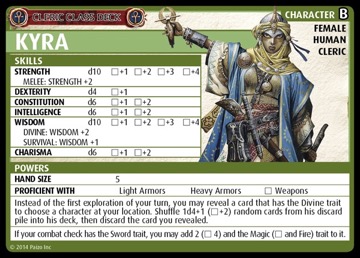
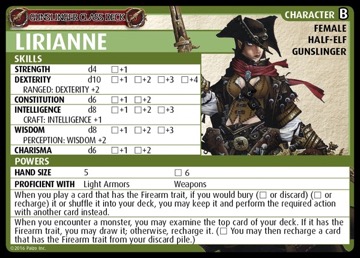
Don't ask what happens if they find a card that has the Firearm trait and the Sword trait...
Corollary #2: Consider blessings too. Most characters tend to prefer specific blessings, either to complement certain skills or to overcome deficiencies in certain skills, or because their role cards provide benefits for using them. Try and spread these out too, so that you can happily use the maximum number of blessing types.
Vary characters after the fact
Sometimes, you can vary characters as they develop over time. Amiri, Kyra, and Valeros might initially all pick from the same set of weapons, but you might be able to specialize each during play, due either to power feats or to combos built by acquiring other boons.
Take what you want
You should never follow any of this strategy advice if it's impacting your fun, and that's especially true when you're picking characters. Yes, it's great to have characters that work well together, that can answer all of the game's challenges, and that make optimal use of your cards. But don't let it stop you from taking the character that you'll enjoy playing the most.
Don't be afraid to abandon characters
So you've carefully built your party... and you find out it doesn't really work. Two character powers clash (like Merisiel and Valeros) or two characters are fighting too much for cards (like Ezren and Seoni). Don't be afraid to dump one of the characters that's clashing and replace them, particularly if it's still early in the adventure path! The end result will probably be better play.
Choosing your party is just the first part of the metagame; how you improve those characters over play is even more important (and is the topic of the next article).
Shannon Appelcline
Game Historian

We have updated our Privacy Policy.
Paizo.com uses cookies. You can block paizo.com from using cookies within your browser settings, but doing so will hinder site functionality.
More information can be found in our Privacy Policy.