Pathfinder Adventure Card Game Strategy #11—Building a Party
Thursday, July 13, 2017
This is the eleventh installment of our strategy blog written by game historian Shannon Appelcline. You can read all the installments here.
To date, these strategy articles have concentrated on the gameplay of Pathfinder Adventure Card Game scenarios. However, the metagame of PACG is quite important too—and it's much of what makes the game unique. That metagame begins with the construction of a party, which depends on understanding the types of characters you're using.
Warriors are the most important characters
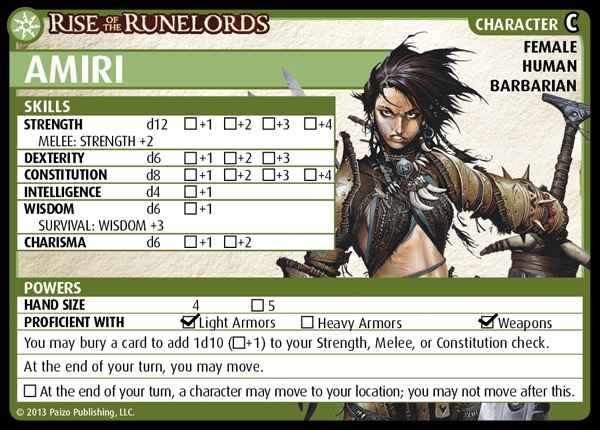
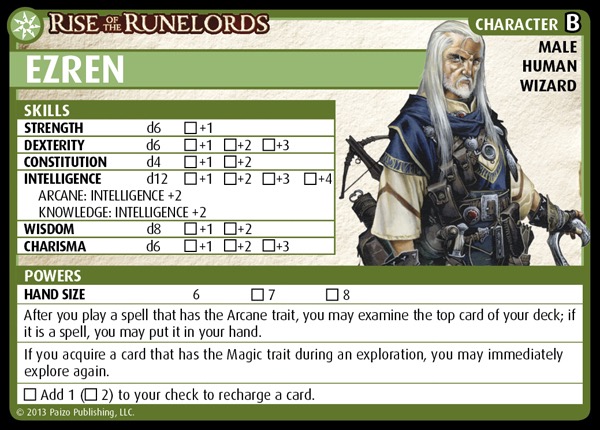
The two main goals in most scenarios are to defeat henchmen so that you can close locations and to defeat villains so that you can win the game. This means that warriors are the most important type of character in the game. However, don't take this to mean just weapon users; warriors include any character who can generate high results on combat checks. Amiri is a warrior, obviously, but so is Ezren, since he can reliably draw spells and use them to generate high combat values.
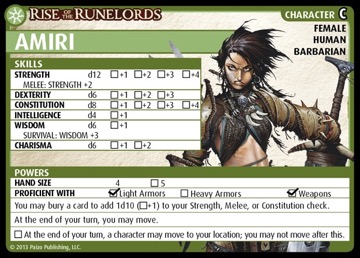
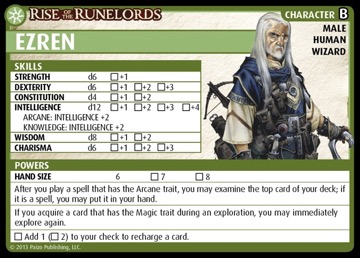
Wars not make one great. Warriors make one great.
Whatever their precise class, you should have lots of warriors.
Corollary #1: Be very careful of characters with weak skill/card combos. If a character doesn't have either the Ranged or Melee skill, he's more likely to end up in a bad situation, rolling small, unmodified dice in combat. But you need to be especially careful if these characters also have few weapons or few combat spells. Lini may be the weakest warrior in Rise of the Runelords because she has no Ranged skill, no Melee skill, starts out rolling a d4 in combat, has to pay a card to get that to a reasonable number, has no weapons, and will likely use some of her spell slots for healing or support.
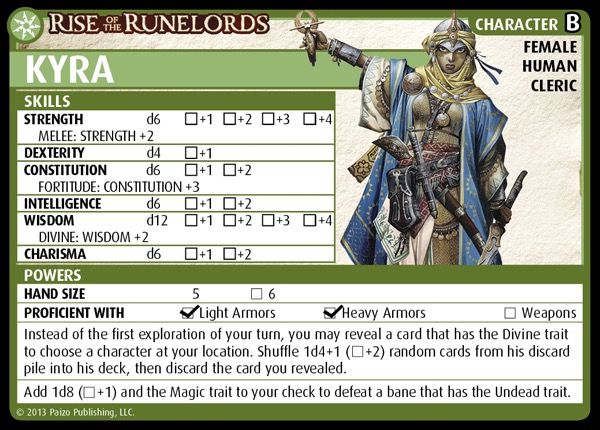
Corollary #2: Be somewhat careful of characters with low fighting stats. It may be less obvious that you should be wary of characters who have a low die associated with their Ranged or Melee skill. Kyra from Rise of the Runelords is the prime example here, since she uses a lowly d6 for her Melee skill. This is fine for fighting most low-level monsters, but it's awful when you're fighting powerful monsters, henchmen, or villains, because in those situations you often want to lay down the blessings… and they'll be worth just 1d6 each!
Corollary #3: Be aware of your weak warriors. Just because warriors are important doesn't mean you should ignore characters who are weak at fighting, because everyone has their own advantages: Kyra is crucial for healing and Lini is perhaps the best character in the game because she's strong at everything other than combat if she has an animal present. The trick is to know who your strong warriors are and who your weak warriors are, and use them appropriately. Send the strong warriors after villains and monster-heavy locations and send the weak warriors after boon-filled locations and use them to temporarily close locations while the villain is being fought.
Healers are the second most important characters
Because cards are a limited resource in PACG, a party without a healer is at a grave disadvantage. Characters will usually only be able to use their cards once, and every one that slips out of a deck due to play or to damage puts that character one inevitable step closer to both death and loss. One healer in a party is practically required, so healers are the second most important character type in PACG.
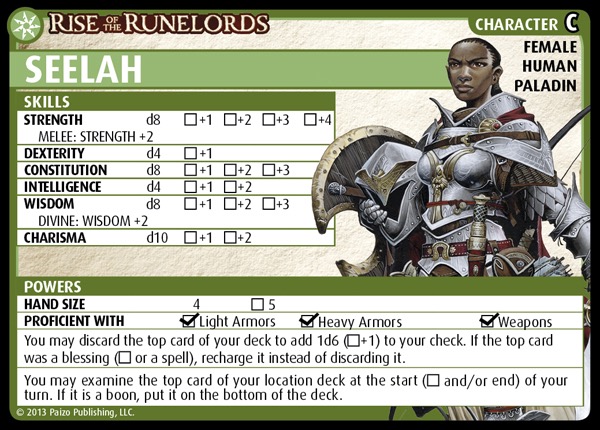
Healers typically include any character with the Divine skill and spell card slots (and, obviously, some healing spells in those slots). A few characters like Kyra and Seelah can heal without specific spells, but spells are generally better, so those powers should be considered backups.
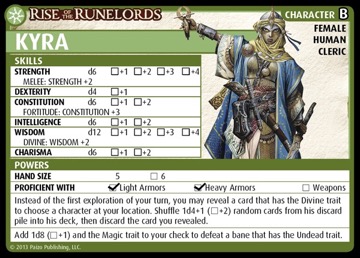
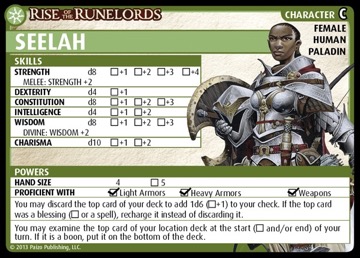
To err is human; to heal, Divine.
If you have no healers, then you're likely to spend a lot of your time and effort figuring out how to overcome that deficiency, perhaps with one-use healing spells for Merisiel, perhaps with healing objects and healing allies. You'll be able to make a go of it, but it'll hurt your efficiency.
Corollary #1: It's good to have a backup healer. One healer is good, but having at least one and a half is better. It might be another major healer or it might be someone like Lem (or even an advanced Merisiel) who can mix a Cure spell into his deck. The object is to have healing available if your main healer is tied down, if her deck is clogged, or even if she's not available for a play session. But don't go overboard: healing is vitally important, but you'll pay for it with lost efficiency in other areas (like fighting!), so only include the healers you need, which is probably somewhere between one and two.
Corollary #2: Make sure your main healer can recycle cards. You should make sure that your main healer has some way to get expended healing back into her deck. For example, Kyra and Seelah can both do so with their special healing abilities, while Lem can exchange other spells for his healing if it ends up in his discard pile. Another easy method to keep a healer cycling is to make sure she has at least two healing spells: if she fails to recharge the first, she can heal herself with the second.
Disablers are the third most important characters
Banes fall into two categories: monsters and barriers. Thanks to your focus on warriors, you've already taken care of the monsters, but you still need to worry about barriers. If you continually fail to defeat them, they can dramatically slow down your gameplay. If they get stuck on top of a location deck, they can prevent exploration. And if they do lots of damage, they can even kill your characters.
They're a lot more varied than monsters, so how do you defeat them? Make sure that your party has at least some disabler support with a character strong in Dexterity (possibly with the Acrobatics or Disable skills) and/or Wisdom (possibly with the Perception skill).
Merisiel is usually an optimal character to fill the disabler niche. In Rise of the Runelords, she has all three skills, with Acrobatics and Disable at d12+2. Rise of the Runelords Sajan is almost as good, with Acrobatics at d10+2 and Wisdom at d8. In Skull & Shackles, Damiel and Jirelle are good choices; in Wrath of the Righteous, Arueshalae and Ekkie are strong at Dexterity but weak at Wisdom. Mummy's Mask offers quite a few possibilities, of which Damiel and Mavaro are the most well-rounded.
Corollary #1: Be aware of your deficiency. Since they're your third priority, disablers are the character type that you're most likely to neglect in your PACG party. If so, be aware of this deficiency. Save the barrier-heavy locations for last, or be sure you have extra blessings when you visit them. Alternatively, build your decks and take feats to help you better deal with barriers: Masterwork Tools can be a pretty good solution until late in an adventure path.
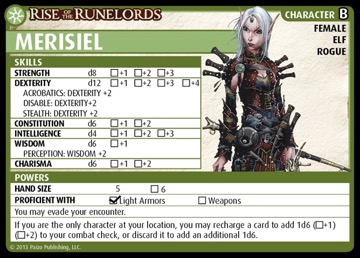
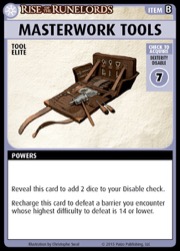
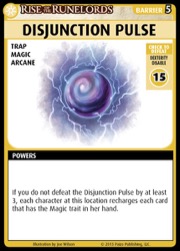
Sometimes you need skills, and sometimes you need cards. And sometimes you need both.
Corollary #2: Be aware of your adventure. Also be aware that there's quite a bit of variability for barriers between the different adventure paths. Rise of the Runelords has the most traditional traps. Skull & Shackles has quite a few Task barriers that require a wider variety of skills. Wrath of the Righteous has a lot of Temptations that can (perhaps) be easily overcome without skill rolls.
Of course, knowing the types of characters to include in your group is just the first step; there's a lot more to building a good party, as will be discussed in the next two articles.
Shannon Appelcline
Game Historian



We have updated our Privacy Policy.
Paizo.com uses cookies. You can block paizo.com from using cookies within your browser settings, but doing so will hinder site functionality.
More information can be found in our Privacy Policy.