Pathfinder Adventure Card Game Strategy #15—Improving Your Character: Cards & Traits
Thursday, April 26, 2018
This is the fifteenth installment of our strategy blog written by game historian Shannon Appelcline. You can read all the installments here.
The previous article offered some general strategies for choosing cards as you build your characters; this one goes into the tactics: which cards are you looking for?
Upgrade your magic and elemental traits
Your characters will start off with mundane weapons and with subpar elements like Poison.
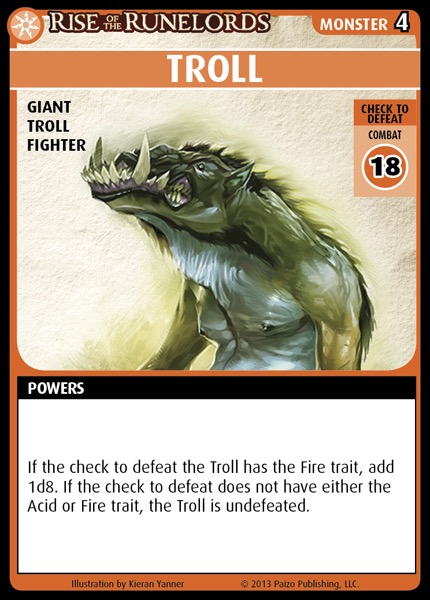
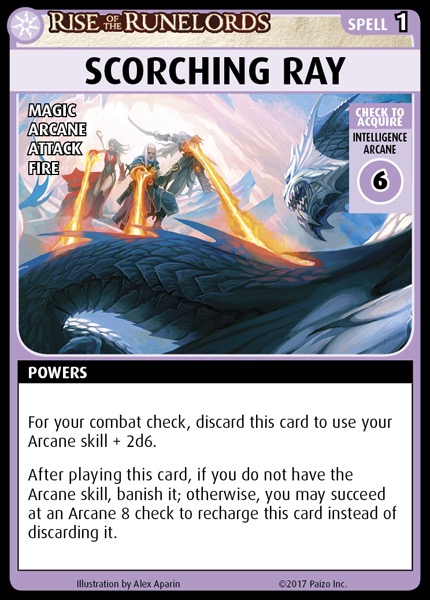
Prioritize grabbing Magic weapons and especially Fire magic. One of the main reasons for this is monsters like Rise of the Runelords' Troll, which is one of the most annoying banes ever if you don't have the Fire (or Acid) trait to permanently put him to rest. Every Adventure Path has cards that require specific traits to defeat, and Magic and Fire are two of the most important.


Burn it with fire.
Generally, it's good to accumulate cards that upgrade your elemental traits. Poison is the worst, because many things are immune to it. Force is the best, because not much is immune to it. So replace Poison with Acid, Cold, Electricity, or Fire when you can, then replace those with Force.
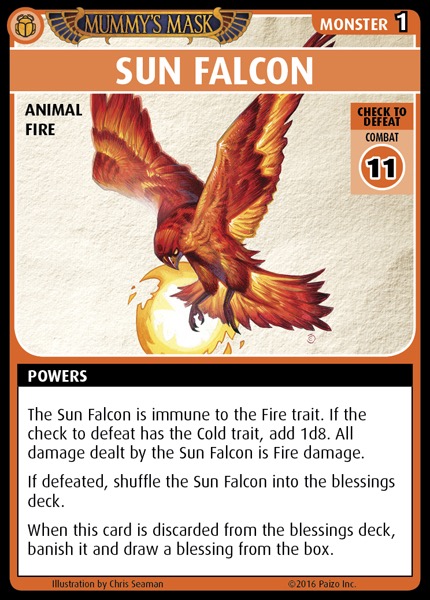
Corollary #1: Diversify your traits. When you're upgrading, don't get too focused on one trait. Occasionally you'll meet monsters like the Troll that require a specific element to defeat; more frequently you'll meet a monster immune to particular elements. So it's always good to have variety in your hand.


Sometimes nothing burns like the cold.
Offset gaps in your party
When you're gathering cards, look for ones that offset ability gaps in your party. That means if you're missing a specific skill, get cards that will help you succeed at tests of that skill. Allies are the most common card type that give you a bonus in a particular skill, and they have the additional advantage that they can usually be used to explore, which means they won't be stuck in your hand: use them to explore when there's not an obvious need for their skill bonus.
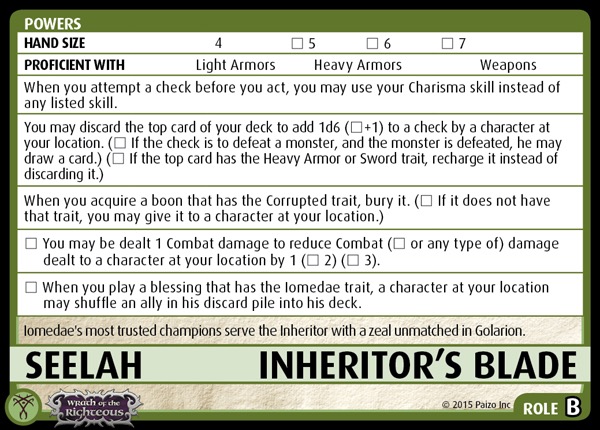
Corollary #1: If you're short on healers, get healing. To offset a lack of healing spells or powers, you can most obviously get Potions of Healing. However, there are also occasional allies or other items that can offset this deficit. Spread these healing cards out, and in particular give them to characters who are light on recharging and heavy on discarding, like Seelah or Seoni.
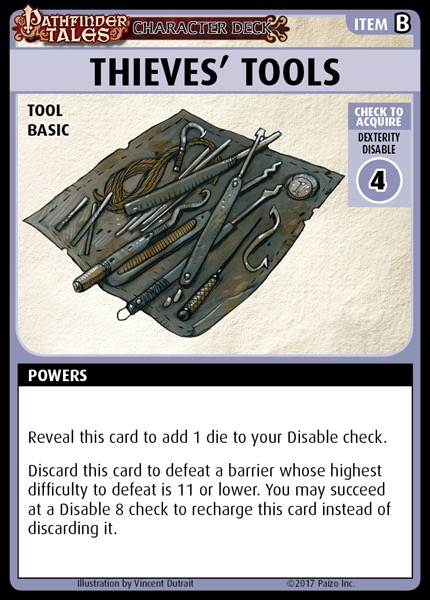
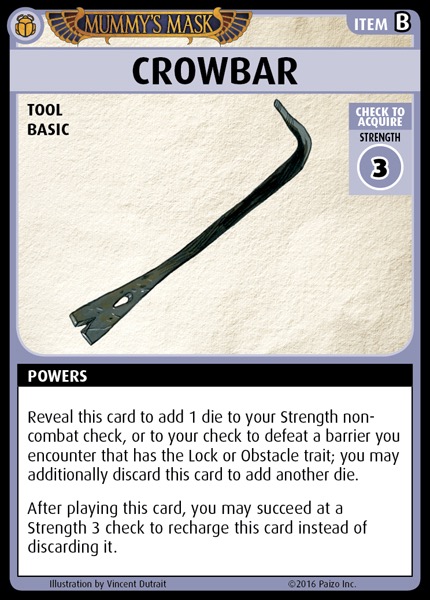
Corollary #2: If you're short on disablers, get toolkits. If your party generally lacks the Disable skill, spread around items that can help with traps and other barriers. Thieves' Tools and Masterwork Tools are the obvious choices, but the Crowbar can also be shockingly useful.


Sometimes the right tool for the job is a Tool.
Upgrade your skills
Sometimes, instead of filling ability gaps in your party, you want to accentuate what you already have. Hunt for items that will improve the characters' best skills to make them all the more able to close locations (or to succeed at other skill tests). Get Merisiel Boots of Elvenkind and Seoni a Crown of Charisma. Find a Sage for Kyra or a Standard Bearer for Harsk.
These might not be the best boons for these characters long-term, but improving good stats should always be a consideration.
Don't be afraid of inappropriate cards
When you're improving your characters, you'll generally want to take cards that the characters are proficient with and to avoid the ones that they can't use to their best effect. But this is not always the best strategy. Sometimes you'll want to take an inappropriate card because it's better than an appropriate card, because it helps your character (or the party) fill an ability gap, or just because it's what's available.
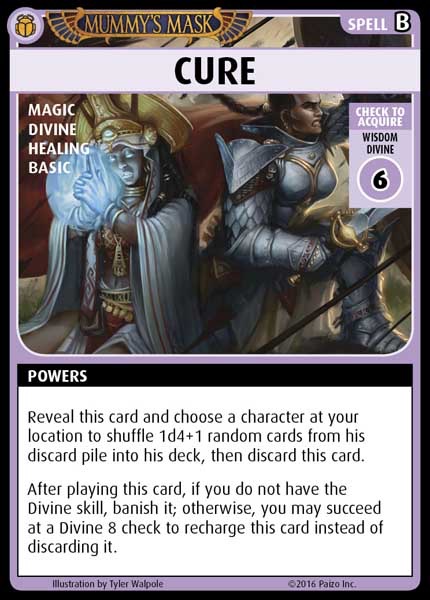
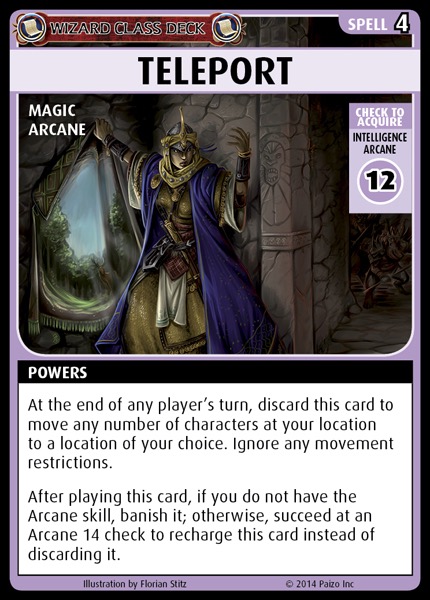
Corollary #1: Remember that inappropriate spells still allow one use. It's perfectly okay for Arcane casters to pick up Divine-only spells and for Divine casters to grab Arcane-only spells. They just end up being single shots. This works best for spells where you're not adding the skill's die. So, if your party really needs healing, don't be afraid to give your Arcane caster Cure. Similarly, a Divine caster could take Mirror Image to help with damage or Teleport to help with movement.
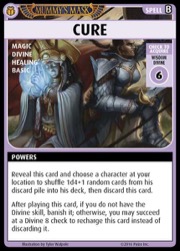

Don't fear that last paragraph.
Corollary #2: Remember that inappropriate armor is usable. Armor can be ineffective in two ways if you don't have the appropriate proficiency. First, it often gets banished when you reduce large amounts of damage. Second, it often can't be recharged at round's end. The first problem is not a problem at all: if it's great armor, keep it, and if you use it, you can hopefully replace it with something else great. However, not being able to recharge is problematic, because it clogs your hand. Still, there will sometimes be inappropriate, non-recharging armor that's worthwhile.
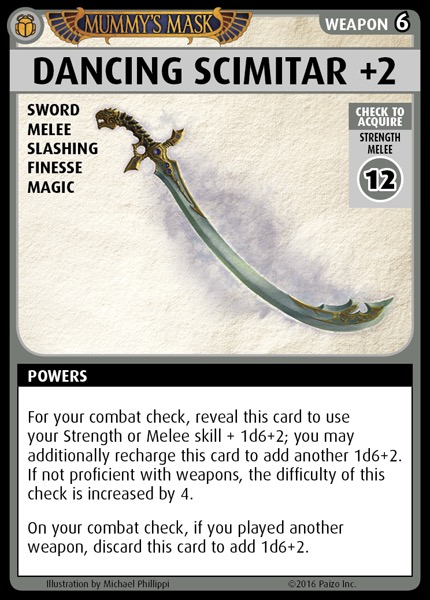
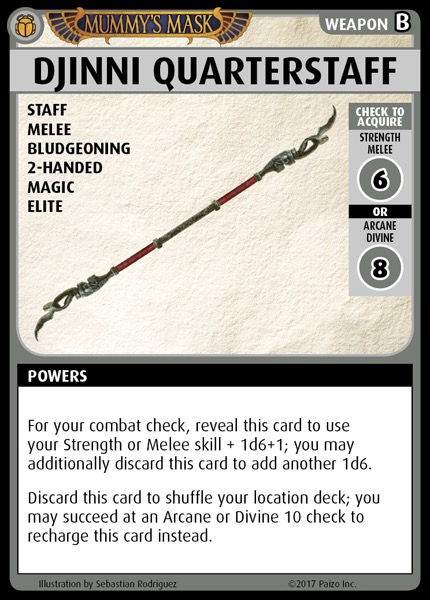
Corollary #3: Remember that inappropriate weapons… are probably still bad. If you don't have the required proficiency for a weapon, it tends to increase the difficulty for challenges, usually by 4. It feels like a really good weapon should overcome this problem, but that doesn't tend to be the case. You're unlikely to find an inappropriate weapon that adds at least 5 (or a d10) more than an available weapon that [i]doesn't[/i] require proficiency, and that's what you typically need for it to actually be better.


The right weapon in the wrong hands is the wrong weapon.
Corollary #4: Use inappropriate card to create voids. Inappropriate items that get banished (i.e. spells and armor) can work very well in a voiding strategy where you're trying to end up with too few of a card type so that you can choose a new card from the box. Hold onto these banishable cards during a game when you have an excess of the card type, then banish them in a later game when you're not gaining that type of card.
Plan for your blessings
Some characters get benefits from specific blessings on their role cards. Try to plan for this. Look at your role card early on, choose your preferred role, and start collecting any appropriate blessings. If you don't, it's possible you'll never get many of the right blessings, because the role card arrives relatively late in the game.


Count your blessings before they hatch. (Or something like that.)
Sometimes building your deck is as much about what you get rid of as what you keep...
Don't get hung up on banishable cards
Cards that must be banished to be used are usually powerful, so it's tempting to always put them in your deck. Don't. Consider any banishable card carefully and be sure that it's a great card that you'll actually use.
Corollary #1: Throw out banishable cards you're not using. If you didn't manage to use a banishable card for two or three scenarios, get rid of it. It might have a great power, but if you never play it, who cares? (But before you put it back in the box, see if perhaps another character would be more likely to play it.)
Don't get hung up on loot
There's a tendency to hold onto loot because it's unique and was given as a special prize. There's a lot of loot that is worth keeping through an entire Adventure Path, but some loot may never be valuable to you, and other loot may get overshadowed over time. Toss it out if something else looks better!
And that brings my look at improving characters to a close… and it also ends my series of general strategy articles for the Pathfinder Adventure Card Game. I've thought about writing some articles about the specifics of certain characters and about all the different sorts of cards, but for now other writing is calling me. Maybe I'll return some day.
For now, thank you to Mike Selinker and Paizo for giving me this opportunity to talk about my strategy ideas and for publishing a game that's racked up over 100 games on my tabletop. And thank you to everyone here on the forums who contributed corrections and additional strategy ideas. I intend to gather them all up at some point and use them to put together a v2 of these strategy articles, probably on my Mechanics & Meeples blogs.
Until then, see you in Golarion!
Shannon Appelcline
Game Historian

We have updated our Privacy Policy.
Paizo.com uses cookies. You can block paizo.com from using cookies within your browser settings, but doing so will hinder site functionality.
More information can be found in our Privacy Policy.