Pathfinder Adventure Card Game Strategy #12—Complementary Powers
Thursday, August 3, 2017
This is the twelfth installment of our strategy blog written by game historian Shannon Appelcline. You can read all the installments here.
Building a party of adventurers for the Pathfinder Adventure Card Game is about more than just selecting your warriors, your healers, and your disablers. You also have to consider the characters' most notable aspects—their unique powers—and how those powers interact.
Choose powers that work together
Powers work best when they allow characters to support each other. There are many ways to do this. They can be directly additive, or they can be supportive in several different ways. Each of these methodologies requires some discussion of its own.
Corollary #1: Don't assume that complementary powers must be used together. Even if you build your party so that certain powers help characters work together, they don't always have to be used that way. You'll usually want to put the best co-op characters, like Lem, with someone else, but you don't necessarily need to group together your other power combos until the going gets tough.
Choose powers that are additive
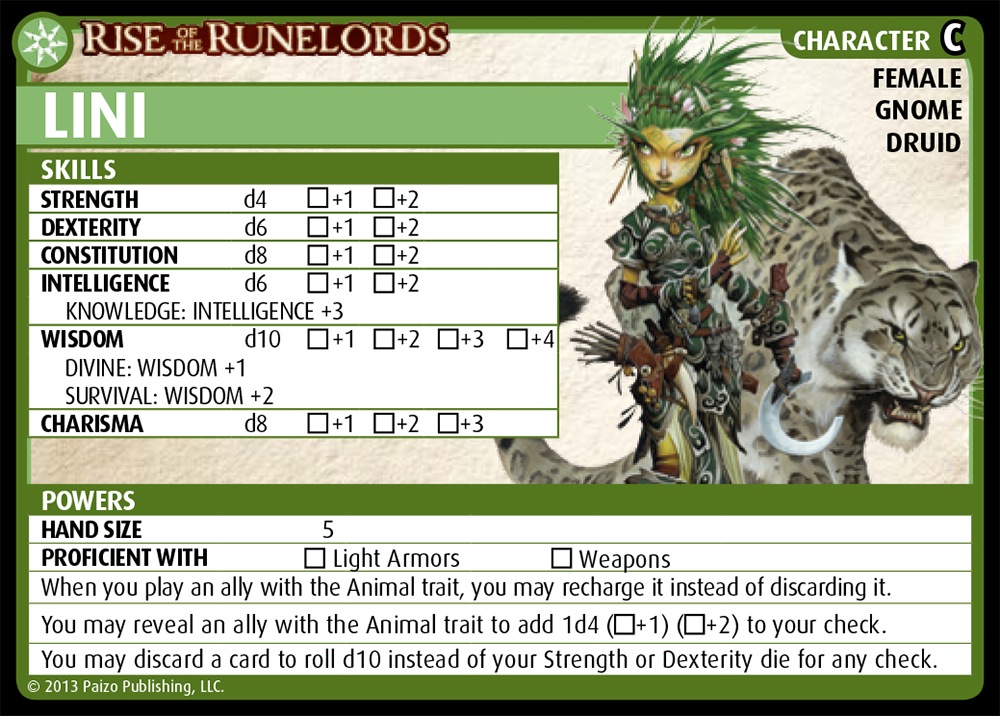
Some powers are directly additive, meaning they each provide bonuses to the same action. This makes them both powerful and easy to use. For example, Lem can give others bonuses when he has cards to recharge, and Lini can give herself bonuses when she has animals to reveal. This combination can make Lini able to succeed at almost any check because she'll start with three dice, and after a few power feats on their role cards, she may even have a +7 on top of that!
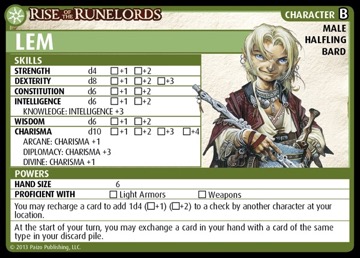
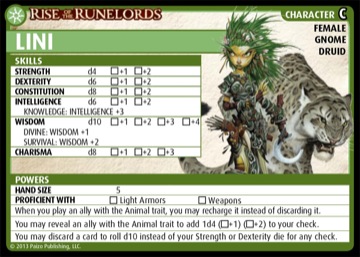
Lem + Lini = Lemmy? Insert joke about Lem's sideburns here.
Choose powers that support powers
Powers can also support other powers in less obvious ways. For example, Lem and Valeros can help characters at their locations, while Amiri can move characters around at the end of her turn. These powers aren't directly additive, but they're still complementary: When Lem and Amiri are at the same location, Lem can take his turn, then support Amiri during her turn. At the end of Amiri's turn, she can take Lem to another location where he can help out whoever's there.
Corollary #1: Turn order is important. The order in which players go can have an impact on how powers interact. For example, Amiri must go immediately after Lem and before other players for their particular combo to work optimally.
Choose powers that support weaknesses
Good power choice isn't just about creating power combos. You can also choose powers that benefit other characters in other ways. Best of all, powers can support other characters' weakness. For example, without spending resources, Lini's combat checks are typically limited to a couple of smaller dice, so building a party that also includes Harsk or Valeros can help to overcome that weakness.
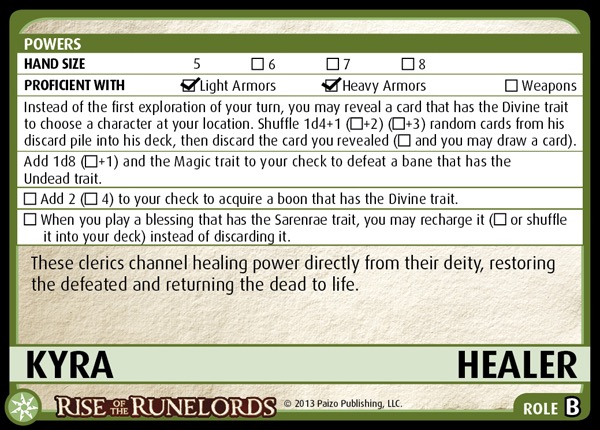
As another example: many role cards offer improved abilities for acquiring certain types of cards. They can be used to help other characters who want those types of cards but aren't very good at acquiring them. For example, Sajan is great at using blessings efficiently, and in her Healer role, Kyra is great at acquiring them.
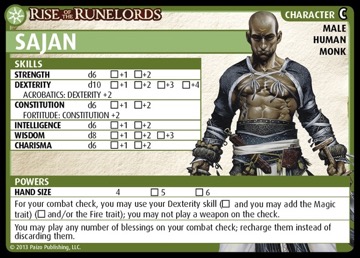
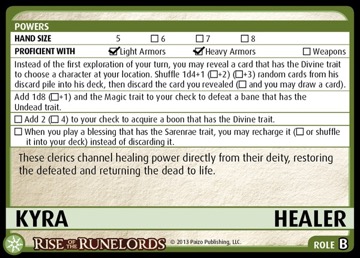
Count your blessings. If you don't have enough, ask Kyra.
Corollary #1: Also consider card gaps. When a character's cards list precludes them from having cards of a particular type, that can be a pretty grave weakness. So, support those too! For example, Ezren, Lem, Sajan, and Seoni don't tend to have much in the way of armor in hand. This makes them particularly vulnerable to powers that deal damage before you act, which can make them unable to fight. You can support that weakness by teaming them up with Valeros in his Guardian role, which lets him reduce damage to other characters.
Choose powers that support card usage
Another important aspect of characters is how they use cards. Are they likely to discard, recharge, bury, or banish? You should assess these patterns, and then give your party powers that support them.
Corollary #1: Link discarders with healers. Some characters discard a lot. For example, Harsk tends to discard his weapons and Seoni discards for fire blasts. A healing power like Kyra's or Seelah's can support this.
Corollary #2: Link buriers with acquirers. Amiri can be tricky to play because she buries cards to generate bonuses, reducing the size of her deck over time. Pair her with someone like Lini, who is good at all low-level acquisitions due to her animal companions, or characters who get better at acquiring cards when they adopt their roles; they can feed Amiri's burial customs.
Consider the ranges of powers
There's one last thing to consider when choosing powers. What range do they have? Do they work better if characters are together or apart?
Corollary #1: Pick a few characters who benefit from being alone. PACG generally rewards you for splitting up so that you can cover as many locations as possible. The fastest way to win is to close two locations and then sit on all the rest until you hit the villain. So, characters who benefit from being alone are quite valuable, whether that's Merisiel, who can fight better while alone; or ranged characters like Harsk and Lirianne, who can support others from afar.
Corollary #2: If you pick one character who works well with others, pick a second. Don't leave a helper on their own! Lem and Valeros are an example of a great combo: Valeros can help Lem fight and Lem can help Valeros do everything else.
Corollary #3: Don't overspecialize on either loner or group characters. You don't want too many characters who benefit from being at the same location, else you'll be discouraged from spreading out; and similarly, you don't want too many characters that are penalized when they're together, else you'll often have problems when facing the final villain, if you've closed most of the locations.
Corollary #4: Be especially thoughtful about ranges if you're playing with just two characters If you only have two characters, don't pick a pair where one player works well alone and one works well with others. Merisiel and Valeros would be a poor combo, as would Lem and Harsk.
Of course, character roles and complementary powers aren't the only thing to consider when putting together a party. There's a lot more, as the next article will discuss.
Shannon Appelcline
Game Historian


We have updated our Privacy Policy.
Paizo.com uses cookies. You can block paizo.com from using cookies within your browser settings, but doing so will hinder site functionality.
More information can be found in our Privacy Policy.