Pathfinder Adventure Card Game Strategy #10—Fighting the Villains
Thursday, June 8, 2017
This is the tenth installment of our strategy blog written by game historian Shannon Appelcline. You can read all the installments here.
Throughout these articles on Pathfinder Adventure Card Game tactics, we've touched on a lot of important subjects. Now we come to the subject that matters the most in most games: finding and fighting the villains. Villains are a special type of bane, and they require very special consideration. Beating the villain at the right time is how you win, after all, but facing the villain at the wrong time can cost you dearly.
Do what you can to isolate the villain
Often, you'll just stumble into the villain. However, you should also do your best to spot him in advance with Auguries, Spyglasses, oracular seeings, and any other means you can devise. Use these scouting powers as much as you can; after you find the villain, leave him alone until you're ready to face him.
Corollary #1: Use evasion as a detection technique. Evading a villain after stumbling upon him is a great strategy. Merisiel excels at this, but several spells help with this type of painless discovery.
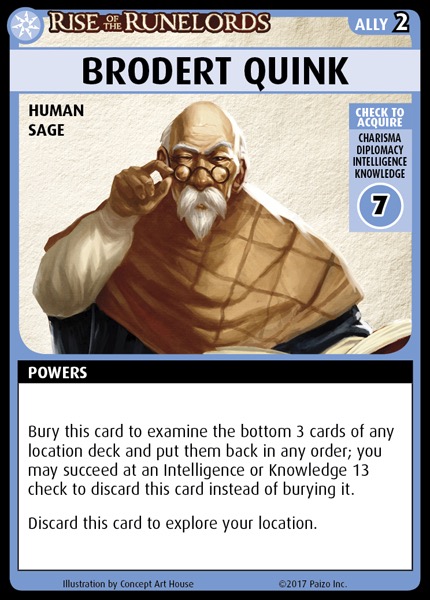
Corollary #2: After you find the villain, try to position him in his deck. Once you've discovered where a villain is, organize his deck if you can; this is particularly helpful if he's near the bottom. Have Seelah remove boons that are on top of the villain. If you know he's low in the deck, just losing to a monster can shuffle the deck and maybe bring the villain up higher. If he's near the top, use a Magic Spyglass to make him the first card; if he's at the bottom, use Brodert Quink to move him up a little.
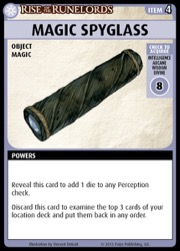
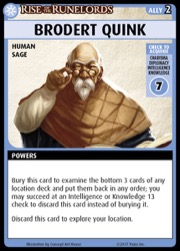
Shifting the villain up even a couple spots can be the difference between winning and losing.
If you're not ready to win the game, don't worry about temp closes
You may encounter the villain before you're ready to win. Perhaps you haven't permanently closed two locations, perhaps you haven't stationed characters at all the remaining locations, or perhaps you just have poor odds to win the fight. In this case, you shouldn't worry too much about temporarily closing locations.
Yes, it's always better to temporarily close what you easily can. That way there will be fewer places for the villain to escape to, and in the worst case, if you lose a fight with the villain, you'll lose fewer turns from the blessings deck. So, you might want to expend a little effort on temporary closing locations. But you probably won't want to expend too many blessings or to pay other notable costs.
Corollary #1: Consider the value of blessings. A blessing on the blessings deck is worth a turn, while a blessing in your hand is generally worth one exploration. Since a well-played turn will usually encompass multiple explorations, that means a blessing on the blessings deck is worth at least as much as a blessing from your hand. And the more capable you are of making multiple explorations in each future turn (not counting any resources you'll spend to temp close), the more it's worth to avoid losing that turn. So it's generally worthwhile to spend at least one blessing if you need it to temporarily close your location.
Be prepared to close every location
In most scenarios, defeating the villain only allows you to win when you have permanently closed at least two locations and spread the characters to cover all of the open locations. Be willing to use blessings and to make permanent expenditures (like burying or banishing cards) to temporarily close locations when you're ready to beat up the big bad. It's the cost you must pay.
Corollary #1: Plan your expenditures in advance. The catch is that you don't want to expend so many resources while temp closing that you can no longer defeat the villain. So, count your blessings and other resources and decide which you're going to allocate to closing and which to the villain fight. If you figure it out all at once at the start, you're more likely to be successful.
Be prepared to beat the villain
When you decide to face the villain, you should be ready to deal with his specific powers. Usually this means sending your best fighter to the villain's presumed location, but it could also mean sending a character equipped with just the right cards. Be particularly aware if a villain will require a specific check.
(Note that the rules remain silent on whether you should read the villain card before playing the scenario; even the Pathfinder Adventures app allows you to either read the villain or skip it. Use this to adjust the difficulty of the game for your group: If you keep losing because the villain kicks you to the curb, try reading it in advance. If you're smashing the villain the first time you encounter him, and regularly winning before the blessings deck is low, you may find it more fun if you aren't prepared for this step.)
Corollary #1: Have armor ready for before-you-act damage. Some villains do damage in advance of combat. When it's a big number like Black Fang's 1d4-1 or Nualia's 1d4, this can be crippling, preventing you from winning the fight. So send characters with armor against those pre-battle damage wielders!
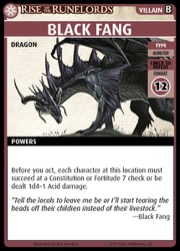
You really don't want to discard all of your weapons or spells before the big fight.
Use multiple characters to kill a villain if you can
Villains are the cards most likely to require multiple checks to defeat. Although some characters, such as Valeros and Seoni, can easily draw hands that can create two stunning attacks in a row, it's harder for other characters, like Sajan and Lini. As a result, it's often best to face villains with two characters, letting one take on each roll. This means that you may want to wait until you've closed three locations before facing the villain.
Corollary #1: Plan your battle in advance. The order of the checks can matter a lot. If you blow the first check, you're going to lose whether or not you succeed on the second. Sometimes your toughest character should go first and expend the most resources. Or sometimes the active player should go first so that if he loses his hand, he can just choose to lose again.
If you don't kill the villain, monitor your blessings
Card counting is usually more trouble than it's worth in PACG, but there's one situation where that's not the case: If the villain escapes, he'll be shuffled together with some blessing cards, then they'll be distributed among several decks. If at all possible, keep count of the blessings in each of those decks. When you find that a deck has more blessings than the location card says it should, you know the villain isn't there! You can then concentrate elsewhere.
That's it for the core tactics of Pathfinder Adventure Card Game play; in the next few months I'm going to talk about some of the bigger-picture strategies, including how to form parties and advance characters.
Shannon Appelcline
Game Historian


We have updated our Privacy Policy.
Paizo.com uses cookies. You can block paizo.com from using cookies within your browser settings, but doing so will hinder site functionality.
More information can be found in our Privacy Policy.