Good Maps Make for Good Adventures
Thursday, February 4, 2010
Nothing ruins a session of Pathfinder RPG more than a badly drawn map. You sit in your chair, your character sheet and dice firmly in hand, and stare at the crudely drawn map the GM sketched on the mat, struggling to discern exactly what those squiggles on the board are supposed to be.
"So, where's the door?" you ask and the GM points to a series of more complicated squiggles in the mass of squiggles. You put your mini down on the map and your GM sighs and says something like, "That's not even a room," and moves your mini over a few squares—like you could even see a room in the spaghetti shapes spattered on the mat.
Good maps make for good adventures. A bad map, whether it's drawn on a mat by your GM or published in a printed adventure, can ruin everything. If you can't tell where anything is supposed to be or what those squares, lines, tags, squiggles, or eraser marks are supposed to represent, it's going to be awfully difficult to explain them to your players—or, heck, to even figure them out for yourself. Pathfinder RPG, like its predecessor, is a game wherein eventually minis come out, get placed on 5-foot squares, and action happens. That action can either happen in a lavishly detailed temple of Cayden Cailean, or it can happen on a board that looks like a cross between a blood stain and a chalk board full of combinatory mathematics.
I have a handful of authors for the Pathfinder Society scenarios who turn over absolutely amazing maps with every adventure—sometimes these maps are so good I question why we're sending them to a professional cartographer to, essentially, just be colored. Tim Hitchcock is easily my best author-turned-map artist. The sample map below was his turnover for the temple of Cayden Cailean in Absalom for Pathfinder Society Scenario #40: The Hall of Drunken Heroes. As soon as I opened that image I knew exactly what the hall looked like, where everything was, how to get in and out, and where every set of stairs, every door, and every window was. In my art order to Mike Schley, the Pathfinder Society cartographer (and an amazing artist), I simply said, "Awesome author turnover—follow his lead."
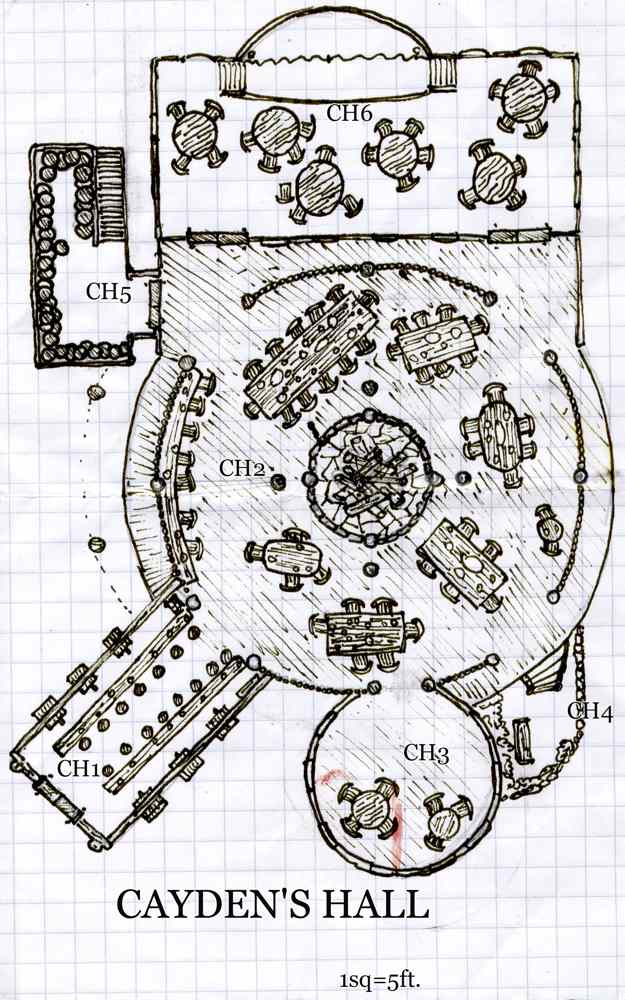 |
| Turnover by Tim Hitchcock |
]]>I wish I could say it was always like that. I wish I could say every turnover we receive at Paizo is art and requires no extra work on the part of the developers. I wish I could say every turnover had a one-line art order to the cartographer like mine above. Unfortunately, we receive a lot of really bad maps. That's not to say we have a lot of really bad designers or anything—far from it. It's more to say that perhaps we haven't emphasized enough what a gargantuan pain in the tail slap a bad map turnover is. Let's say you're designing a small 5,000-person city for us. Your map turnover comes in with 5 box shapes, a circle, and a few smudges. Now, we can read through your text and pull out all of the relevant tags and information about the city and add those to the map (which we'd rather not do, mind you) but, in the end, we're going to have to redraw that map ourselves—which is time we should be spending making the adventure or city write-up better, rather than fixing the turnover.
A good map, like Tim's, tells us immediately everything we need to know about the location. I don't have to redraw his map and I don't have to send a novel with the map order that includes tags and descriptions for every room so the cartographer can get the map right. Were we to send our cartographers the bad map example from above, without also sending along the entire article that goes with it, we'd get back a nicely drawn, full-color drawing of 5 box shapes, a circle, and a few smudges. Our cartographers are awesome, but their base for quality is only as good as the hand-drawn map they receive. A cartographer should be able to open the author's map and immediately get to work turning a good map into a great map rather than reading a wall of text and then turning a terrible map into a mediocre map.
A lesson for all of you would-be future Paizo authors and current Paizo freelancers: a map turnover can make or break your submission. When you're done drawing it, look it over with a careful, discerning, player-focused eye. If you drew that map for your table of players, would they have any idea what it was on first glance or would they, like the first example, put their mini in the wrong place when combat started? Your map doesn't have to be a work of art—it just has to be interpretable so our artists can make it one.
Joshua J. Frost
Events Manager