
Certainty
by Liane Merciel
Chapter Four: The Stone
"Jelani, Adrun, with me," I said. "The rest of you, keep going." Whatever the scout had found had terrified the man, and I didn't want his panic spreading to the others.
"Found tracks," the scout said when we were out of the others' earshot. "Followed them." He thrust a hand forward, jerkily, as if to hurl the memory away.
I was about to ask how he had spotted tracks on the tundra when I saw them myself: a line of booted prints sunk deep into the ground, as though it were summer's soggy marshland instead of the rock-hard terrain of late fall. The earth was slimy and discolored in those prints; the very dirt and ice seemed to have rotted at the touch of whoever had passed there.
"Seen that kind of thing around the Worldwound," the scout said. "Never on this side."
The bootprints tattooed a dark line back to the wardstone. Nearer us, they went over a low, rocky rise and into a shallow cleft. I followed, uneasy. Adrun and Jelani were watchful at my sides; the scout lagged fearful behind.
In the cleft we found the man who had made those prints. He'd died badly. Deep gouges tore through the back of his sheepskin coat. Green-black rivulets leaked from the wounds; the stench of sickness pervaded the area despite the wind and chill. I could see brown bone under the flapping tatters of the man's coat; the skin and muscle was rotted away entirely.
He'd survived his poisoned wounds long enough to get this far, though, and I didn't think they'd killed him. Blisters covered his mouth in a frozen pink froth. His throat had collapsed, eaten away from the inside; its long red track vanished into his sternum. The soft part of his jaw was gone, too, and a shaggy beard of red ice spilled across his chest.
An empty waterskin lay near his hand. It bore the same mark as the ones we'd received in Kenabres.
"Holy water," Jelani said, reaching the same realization that I had. "He was already dead—or rather, undead. He killed himself by drinking holy water."
"Maybe he thought it could flush out the poison from whatever got him in the back," Adrun said. "Maybe it would have, if the poison hadn't spread."
I left them to their speculations and rummaged through the dead man's kit. He didn't have much. A few blankets, some lamp oil, a good sheepskin hat. Most of it was standard-issue, like ours. He'd been a soldier, or stolen from one—and, like many crusaders, he had a sizable collection of warding amulets. I picked them up as an afterthought. They didn't take much space, and he might have a sweetheart or an orphan back in Kenabres who'd want them.
We returned to the company in silence. The others watched us apprehensively, aware that something had gone wrong without knowing what. A gloomy mood fell over the camp, and it deepened when the other scout failed to come back. No one mentioned it, but I knew no one expected to see him again.
That night, as the others talked or slept, Jelani scratched furrows in the frozen ground and filled them from one of our blessed waterskins.
"What are you doing?" I asked.
"Making spears," she said.
"Of ice? They'll shatter."
She only smiled. In the firelight, that smile was a mystery. "I have seen storms that sent twigs through solid walls. My spears will have their use."
She would tell me no more than that, and I went to my bedroll puzzled.
Morning did nothing to lift our spirits. The tundra stretched on, frozen and lifeless; the wardstone waited, leaning against a stricken sky. Soon after we broke camp, the wind turned, bringing a charnel house stench that defied the cold.
"It's not from the Worldwound," Jelani said, prying sticks of ice up from her furrows. "Wind's blowing the wrong way."
"Weapons ready," I ordered, drawing my own sword. I could hear bones popping and teeth gnashing on the wind. It might have been miles away; I wasn't used to judging how the tundra played with noise. But if it wasn't, I wanted to be armed.
I was right to be cautious. As we crested the next rise, we saw our foes.
They were eating our scout. Eight of them crouched around his corpse, hissing and snapping at one another over the meat. They wore the tatters of soldiers' clothes, but they weren't human anymore.
"Ghouls," Adrun whispered.
"Not quite," I said. They were ghouls—I recognized their quick, jerky movements, the high-pitched feral snarling, the carrion reek of guts rotting in their bloated bellies—but something else blighted them too. Their veins bulged with the same greenish-black filth that had corrupted the dead soldier's wounds. Oozing sores covered their tongues and spotted their backs, dripping the same putrescence.
"Close enough," the priest said. "I'll keep them from noticing us immediately. You've a few minutes before my spell fails."
"Let me," Jelani said, touching her quiver of dirty icicles.
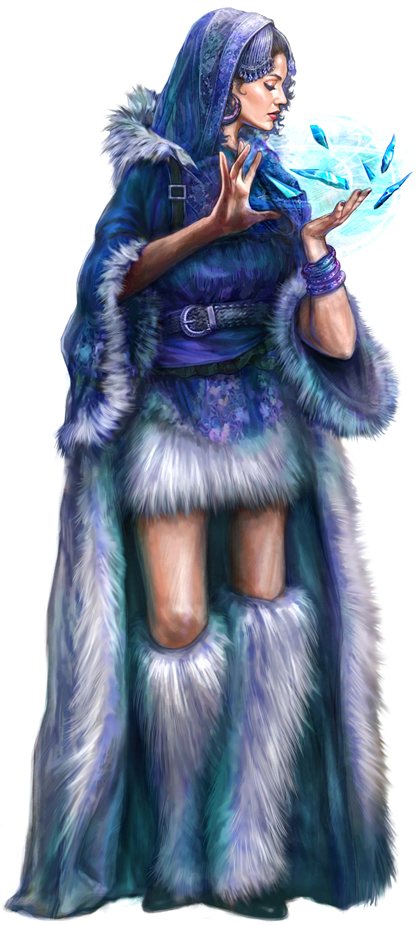 | |
| "Even outside of the desert, Jelani is a formidable ally." | |
I saw nothing but calm confidence on her bronze face. I nodded, stepping aside.
Jelani laid her ice spears on the barren crest, angling them toward the ghouls. They never looked up. She stripped off her mittens and began a chant, her fingers dancing through the spell's gestures.
A gust of wind circled around the woman, gathering intensity until it whipped her black hair free of its scarf and forced Jelani to squeeze her eyes shut in the cyclone. Then, abruptly, it howled away, hurling the icy lances into the ghouls with spell-driven force.
The spears shattered as they plunged into undead flesh, but the wind-whipped shards were just as deadly. Ice ripped the ghouls' hides apart and pinned their limbs to their bodies. The stink from their ruptured stomachs was overwhelming; two of my men doubled over, vomiting.
Some of the ghouls fell. The survivors' heads snapped up. One's left eye was gone, replaced by a thick splinter of ice; another had two feet of ice through its gut. But the attack had broken Adrun's spell, and the ghouls had seen Jelani. Howling, they rushed at her.
She didn't flinch. Holding her hands out, Jelani called another invocation. Sunlight twinkled on her gold and bronze rings, then ignited in her cupped palms. She threw it, and the spark swelled into a fireball as it flew. It exploded over the ghouls in a rush of translucent, blue-edged flame. They shrieked as they burned—and then they collapsed, spasming, as the ice lances melted in the fireball's heat and spilled holy water through their innards like lye.
"Finish them," I shouted, leading my soldiers into the fray.
Even dying, the ghouls fought viciously. They writhed on the ground, covering it with their own deliquescing corruption, and pulled down soldiers who slipped on the slime. Those who fell were doomed. The Kellid woman lost her footing when she swung too vigorously at a fallen ghoul; she crushed her victim's skull, but went to a knee as she did. Instantly two of them were on her, and by the time we battered them away, nothing was left but the bear claws of her necklace, scattered among red rags of skin and bone.
Another crippled ghoul bit its own arm, filling its mouth with poison, then sank its teeth into Adrun's calf when he ventured into the melee to heal a wounded soldier. The priest screamed, hitting it with his holy symbol in a fist. White light flared, consuming the creature; its skull dropped lifeless onto a bed of ash. But the damage was done. Adrun staggered away, clutching his leg as sickly discoloration seeped through his skin. Two steps from the battle, he fell.
We destroyed the rest.
I took stock of the casualties as Jelani cauterized the survivors' wounds with enchanted flame. The Kellid was dead, as was one of the Mendevians. Adrun was badly injured, but if we could get him to a healer before the ghoul's poison took hold, he might live. I wasn't optimistic, but I was willing to take the chance. If it came to the worst, I'd give him mercy myself.
I touched Jelani's shoulder. "These ghouls carried crusaders' tokens. I think they were the last company of soldiers sent to Valas's Gift. If the wardstone has failed that badly, I don't want to risk the others—but you and I should examine it."
She paled, but she put her mittens back on. "As you will."
I hadn't realized how huge the wardstone was until we reached its foot. Even with its wind-pushed lean, it towered thirty feet above us and measured ten feet across its base.
Chunks of the lichen-stained stone were missing, rupturing the wardstone's rings of runes and leaving a gap large enough for a man to walk through. Peering into the breach, I saw that the wardstone was hollow at its core. Hard-packed silvery dust filled it, or had. The dust had been scraped out as far as a tall man could reach. Where the wardstone had been hollowed, its runes were black and oozing, weeping like cuts in a pine tree's trunk. The ground was spongy with decay where that ichor trickled, as it had been in the dying soldier's bootprints.
"They took the nexavar," Jelani breathed, tracing the ruined sigils. She was careful to avoid their dripping ink. "That's why the wardstone's failing, and why those soldiers turned to ghouls. They were mining out the nexavar. They took too much, though, and they couldn't have known what these runes said, or they wouldn't have broken through this section. They ruptured the ward, and the backlash killed them."
"Why would they take nexavar from a wardstone?" I asked.
She gave me a skeptical look, then laughed. "I forgot. You don't have time for superstitions like the rest of us. You've seen those warding amulets people wear to fend off demons."
"Yes."
"The ones that work use nexavar. It's weak magic, but real. People around the Worldwound will pay a lot of money for that—even, or especially, the crusaders themselves. If you care more about lining your own pockets than protecting the border, a wardstone's better than a diamond mine."
I scowled. If Jelani was right, the dead men had paid for their selfishness, but their deaths didn't end the danger. "Can you fix it?"
Jelani paced around the wardstone, examining its broken runes and hollow core. At length she stepped back, shaking her head. "I'd need enough nexavar to replace what was taken. Without it, my spells would fade in hours, if I even had the strength to hold them that long."
My heart sank. It could take months to requisition that much nexavar and bring it back to the wardstone... or longer, with winter hard upon us. I'd heard the nexavar trade depended on river traffic. If that was true, and the supply was locked on frozen boats, we might have to wait until spring. All the while, the Worldwound's poison would seep through the crack in the wards. I hadn't felt so hopeless since Iomedae turned from me.
And yet that desolation might hold the answer to this one.
I knelt by the ruined wardstone, just beyond the reach of its spoiled earth. I'd come to Mendev expecting a clear-cut war of good men against evil demons. I'd found selfishness, greed, fanaticism, and bitter grief. And grace, sometimes, though it was fragile and fleeting.
But no certainty, not until now. Only now, as I clasped my sword between both hands to hold it up as Iomedae's symbol, did I know with absolute, soul-deep clarity that I was acting on behalf of something right. Healing the wardstone was an absolute good. The people of Mendev weren't saints; neither were the unwilling exiles who had joined their war. But they had the potential for virtue amidst their flaws, and sheltering that potential was an unalloyed good. Valas had seen the same before me, and his gift was proof that the gods agreed.
Iomedae, I prayed, hear me. Grant your unworthy servant this boon. Hold the wardstone's magic a little longer. Protect the people of Mendev from the Worldwound. I ask this for them, not for myself. I will give my life for this, if you ask. I will give my soul. But shield them, I beg you.
I waited, kneeling, for some sign. Light, song, agony. Anything.
Nothing came. The wind wailed on. My knees ached. I heard Jelani pacing back and forth behind me, trying to keep warm as she waited.
Finally, despairing, I opened my eyes.
The ground before me was laced with frost—bright, clean frost, with no sign of the previous decay. The rift in the wardstone's side remained, but a shimmering lattice filled the gap, like a tapestry of starlight stretched over black night. The runes at the base had stopped dripping; the poisoned ichor might have been an ugly dream.
"You did it," Jelani said in wonder. "I don't know what you did, but you did it."
"How long will the magic last?" I asked.
"I don't know. It's... not the magic I know. This is holy work." She raised her eyebrows. "I thought you weren't a paladin."
"I'm not." I'd had so little faith that I hadn't believed Iomedae heard me without a sign.
"Then what—"
"We have a reprieve. The chance to do good. But only a chance."
"Ah." She smiled wearily. "Well, a chance is more than we had before."
"It is," I agreed, and we walked back to our war.
Coming Next Week: Death in the bog in the first chapter of Amber Scott's "Swamp Warden."
Liane Merciel is the author of The River Kings' Road: A Novel of Ithelas, available now from Gallery. For more information on her writing, visit lianemerciel.com.
Art by KyuShik Shin.