Mapping the Path
Tuesday, January 17, 2012
I’ll be honest with you. I love maps. I always have, so when Erik, Wes, and Jason asked me if I wanted to start designing the Map Packs and Flip-Maps for the GameMastery line, I just yelled, “Gimme!” Then I ran away, laughing manically with my new toy.
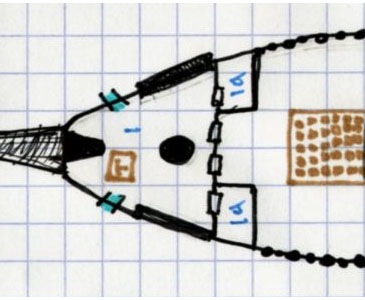
This is a section of the “artwork” I sent to Jason for Flip-Mat: Pirate Ship. It’s ugly, but gets the point across, which is the purpose of the sketch.By designing maps, I don’t mean that I actually do the cartography. That’s a job for far more artistically savvy folk, like the talented Jason Engle, who is currently doing the artistic heavy lifting for these products. But before we can have Jason do his magic, there is a lot of work and planning that goes into each of these products. This week, I’m going to hijack the blog to shed some light on the process of designing a GameMastery Map Pack or Flip-Mat product.
Each map product starts out as a vague concept on the product schedule. I say vague concept, but there is actually a lot of thought that goes into the concept phase. A few of us sit around the table, look at the current map products we have available, determine which ones sold well, which ones didn’t, and rifle though the Paizo messageboards about such products and see what kind of things the fans liked, what they didn’t, and what kind of things they would like to see in the future. Often, a Map Pack or a Flip-Mat is meant to complement Pathfinder products set for release around the same period of time.
For instance, both the upcoming Map Pack: Ship’s Cabins and the Flip-Mat: Pirate Ship were expressly designed to complement the Skull & Shackles Adventure Path. Sure, each of these products features cool ships that you could use in any campaign, but each one also details ships that the PCs actually use in that Adventure Path. Because of this dual purpose, I worked closely with Rob McCreary (Adventure Path developer extraordinaire) to make sure that each map product would have everything that he and the AP designers would need for that project. This give-and-take started with Rob giving me preliminary information about the AP adventures, particularly encounters taking place on the various ships. From there, I put together rough sketches of the maps and had Rob give me feedback on them. That feedback often forced me to go back to the drawing board, create a new round of rough sketches, and then we would start the process all over again, iterating until everything was right.
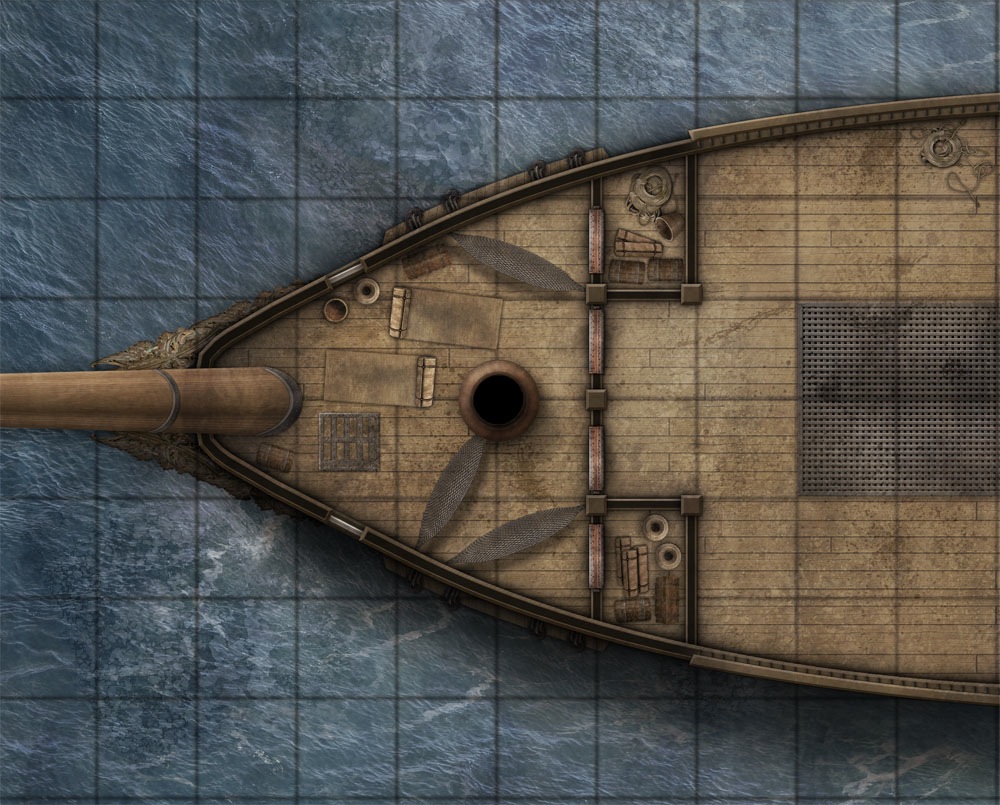
Jason Engle’s final product using my rough sketch and area descriptions as direction. The final product is beautiful and spot on. Jason rocks!While the maps connected to the Skull & Shackles Adventure Path were a little more cooperation-intensive than most map projects, every early map product process starts with brainstorming, rough sketching, and making sure all the stakeholders are happy with the initial map design. Once that’s achieved, the next step is to make those rough sketches something more concrete—more than just a bunch of pencil scribbles on graph paper. They have to be something that an artist can understand clearly and easily. This involves cleaner maps sketched with my set of gaudy-but-striking colored pens and a map order that lists all the important details of the map. These refined rough sketches and the map order then goes to the art department. The art director, Sarah Robinson, then takes a look, makes sure it is as clear as possible, asking me questions about things that seem vague or somewhat questionable, revisions are made again if necessary, and then she sends it to Jason for beautification.
The process does not end there, though. Jason sends us his preliminary work on the maps, usually in the form of a black-and-white “sketch,” which is nearly complete, except for the color. We then take a look at his work, making sure that all of the details presented in my initial drawings and map order are all there, and take a critical eye at the often wondrous details he provides. Once that’s done, we either send a list of small changes or—more often than not—just let Jason know that his work is spot on and then move on to the next step: final or nearly final turnover by the artist.
With the color maps in, we look over them carefully, making sure everything looks gorgeous and the details are correct, and then move on to last-minute approvals from all the stakeholders and the business team. On rare occasions, the map goes back for some last-minute tweaking. When we are all happy with the final result, packaging is designed, and the files get sent to the printer. Lastly, the product gets shipped out to subscribers and distributors. It’s final journey ends with the “ooohs” and “aaahs of players” as GMs everywhere plop the finished product on the game table before uttering that magical phrase, “Roll initiative.”
Stephen Radney-MacFarland
Designer
We have updated our Privacy Policy.
Paizo.com uses cookies. You can block paizo.com from using cookies within your browser settings, but doing so will hinder site functionality.
More information can be found in our Privacy Policy.