 |
Manipulating TerrainTuesday, March 15, 2011
For the last installment of the Design Tuesday blog on terrain, we are going to look at a relatively new type of terrain—terrain that you can actively manipulate. This kind of terrain can grant a creature a variety of effects, from an attack, to cover, to a special or enhanced mode of movement.
Some of the examples of this type of terrain will look familiar. Much of it can already be found within existing encounters. Where this is the case, it is up to you, the GM, to decide whether or not you wish to allow the special terrain effects described below.
Other samples of this type of terrain are new. Some, like the blink crystal, grant magical effects, and can add a sense of mystery and danger, as well as the possibility for strange tactics on the part of the PCs and their opponents.
Like the hazardous terrain presented last week, these new terrain types straddle the line between terrain and new dangers. Based on how much of this terrain you plan to use, you may want to consider adjusting the CR of encounters that use these more active forms of terrain, especially if their use grants one side of the combat more advantage than their foes.
Alchemical Devices: This terrain is actually a broad class of similarly acting terrains. They can be as simple as a workbench cluttered with beakers filled with roiling concoctions, or as complex as a distiller or even stranger alchemical machines. Manipulating such devices requires a standard action and any number of skill checks. Toppling a table requires a Strength check. Making a distiller shoot a gout of highly-pressurized alchemical gas may require a Disable Device check, a Craft (alchemy) check, or even a Strength check, if the PCs are using a strategic application of brute force. Interacting with more complex machinery usually requires a Disable Device check, though a higher DC Craft (alchemy) or Knowledge (arcana) check may do in a pinch.
Whatever the type of alchemical device, the basic rules for its manipulation are as follows. A successful check made as a standard action creates a 15-foot cone (or alternatively a 20-foot line) of damaging energy, controlled by the creature that successfully manipulated the device. It deals damage to creatures within the area of effect. A Reflex or a Fortitude DC halves the damage. Often alchemical devices create an area of acid, but the destructive energy could be cold, electrical, fire, or in rare cases even sonic or force damage, depending on the nature of the device.
To add more flavor and danger to specific alchemical devices, you can layer on additional conditions and effects. You could add bleed damage (which works well for acid or even fire damage devices), have creatures knocked prone on a failed saving throw (for sonic or force damage devices), or have a failed saving throw entangle creatures for 1d4 rounds (for cold damage devices) or even daze creatures for 1 round (for electrical damage devices).
The following are some suggestions for baseline effects of alchemical devices based on the base CR of the encounter.
Simple Alchemical Device (CR 1–5): Activating—DC 14 check; Effect—DC 12 Reflex saving throw for 2d6 acid, fire, or electrical damage, or a DC 12 Fortitude saving throw if the device deals cold, sonic, or force damage.
Complicated Alchemical Device (CR 6–10): Activating—DC 17 check; Effect—DC 15 Reflex saving throw for 3d6 acid, fire, or electrical damage, or a DC 15 Fortitude saving throw if the device deals cold, sonic, or force damage.
Advanced Alchemical Device (CR 11–15): Activating—DC 22 check; Effect—DC 20 Reflex saving throw for 4d6 acid, fire, or electrical damage, or a DC 20 Fortitude saving throw if the device deals cold, sonic, or force damage.
Magic-Infused Alchemical Device (CR 16+): Activating—DC 27 check; Effect—DC 25 Reflex saving throw for 4d6 acid, fire, or electrical damage, or a DC 25 Fortitude saving throw if the device deals cold, sonic, or force damage.
Blink Crystal: These strange, cloudy-white crystals glow with a faint purplish radiance. Typically blink crystals are the size of large gemstones, and they are always set in a statue or some similar large and immobile casing. If a blink crystal is removed from its casing, it loses its magic and becomes nothing more than a large piece of common quartz (worth 10 gp). A creature adjacent to a blink crystal can touch it as a free action, which causes the creature to teleport up to 20 feet to an unoccupied space on stable ground within line of sight. Touching a blink crystal as a swift action along with a successful DC 20 Spellcraft or Use Magical Device check can increase the range of the teleport to 40 feet. Failing this check allows the creature to teleport 20 feet.
Bubbling Caldron: A size Large bubbling caldron can be tipped over with a DC 15 Strength check made as a standard action. Doing so releases a 30-foot cone of boiling liquid from the caldron in the direction of the creature’s choosing, and deals 2d6 fire damage to all creatures within the cone’s area. A successful DC 12 Reflex saving throw halves the damage.
The liquid makes the area of the cone slippery (Pathfinder RPG Core Rulebook 412) until it dries or dissipates. The cone of liquid affects creatures on the ground only. Flying or levitating creatures can avoid the liquid and its damaging effect.
Chandelier: Successfully leaping onto a chandelier allows a creature to hang from it and use its momentum to increase the power of a jump before the end of the leaping creature’s next turn. A creature is flat-footed while it hangs or balances on chandelier.
Using the momentum of the chandelier grants the leaping creature a +5 circumstance bonus on Acrobatic checks made to jump off the chandelier, and the jump is considered to have a running start for purposes of determining the DC of the check.
Chandeliers have size categories like creatures do. They are typically size Small or larger. A chandelier can easily support a single creature of its own size or smaller.
A creature larger than the chandelier’s size (or two creatures of the same size or smaller than the chandelier) can attempt to hang on it or use it to gain the bonus on Acrobatics checks made to jump, but at the end of the creature’s turn (or the second creature’s turn, if two creatures are using the chandelier for the same effect), the chandelier breaks free from its supports and both the chandelier and any creatures hanging from it fall to the ground. If either a creature two or more size categories larger than the chandelier or three smaller creatures leap on to the chandelier, the chandelier and those hanging on it fall immediately. Creatures take normal damage from the fall plus an additional 1d10 damage from the falling chandelier. At the GM’s discretion, extremely large or heavy chandeliers or chandeliers with sharp protrusions or other dangers can deal additional damage upon a fall.
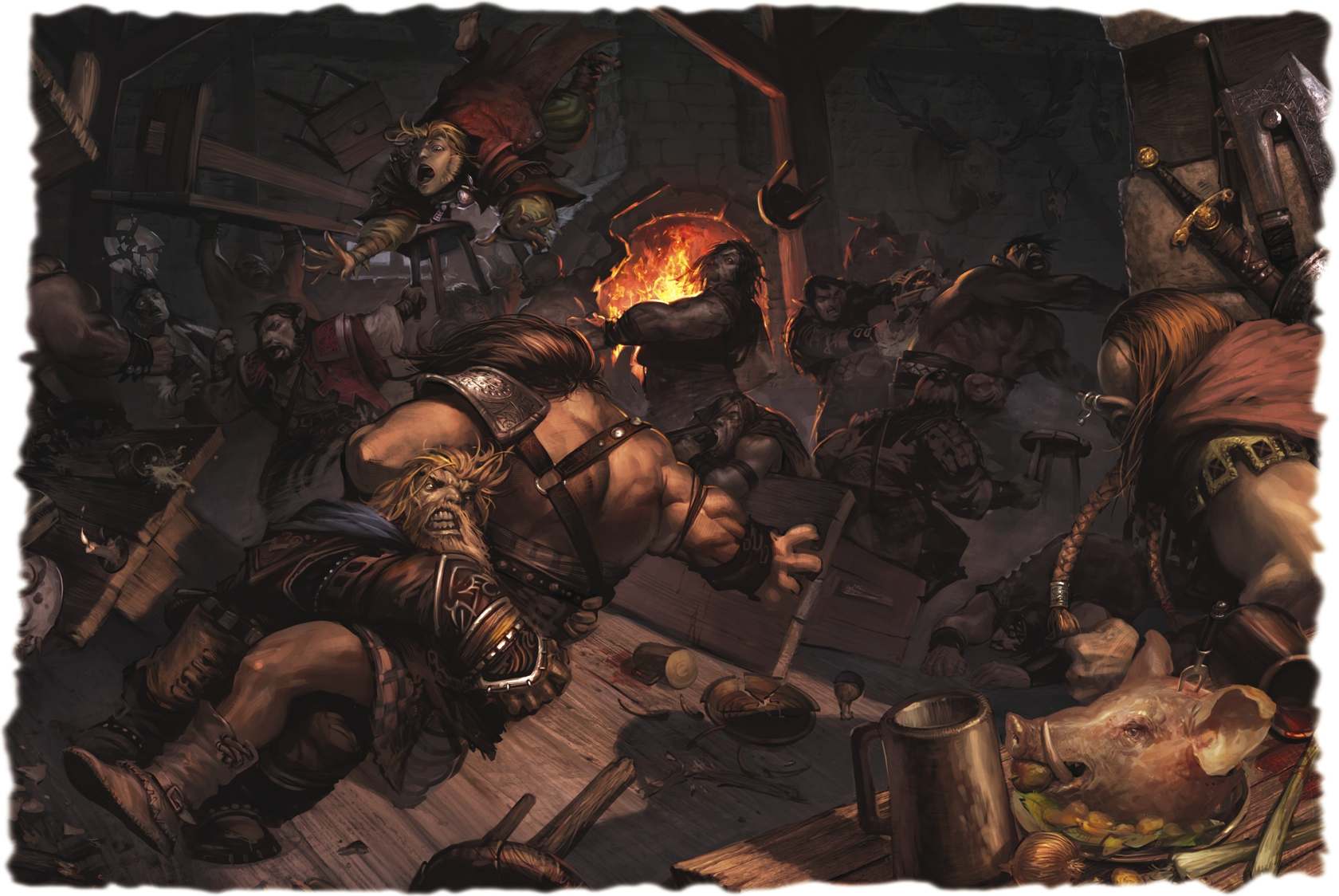
Furniture: From flipping over a table to using a gong as makeshift shield, a movable piece of furniture can be manipulated to create partial cover for a short period of time. A creature that is adjacent to the piece of movable furniture can attempt a Strength check as a move-equivalent action to gain cover from the item until the start of its next turn.
The DC of the Strength check depends on the size of the furniture. The base is DC 10 for size Small furniture, and the DC increases by 5 for each size category over Small (moving a Medium piece of furniture is DC 15, moving a Large piece of furniture is DC 20, and so on). A creature cannot attempt this manipulation if it is two or more size categories smaller than the piece of movable furniture it wants to manipulate.
Rug: A creature can spend a standard action to attempt to pull a rug out from under creatures standing atop the rug. This requires a DC 15 or higher Strength check, depending on the size of the rug. If successful, each creature standing atop the rug (some of its space must be on atop the rug) must succeed on a DC 12 Reflex saving throw or fall prone. Creatures that cannot be tripped are immune to this effect. Rugs that are larger than a 4-square area require higher Strength checks. The DC increases by 2 for every additional 2 squares of rug area beyond 4 squares.
Stephen Radney-MacFarland
Pathfinder RPG Designer