 |
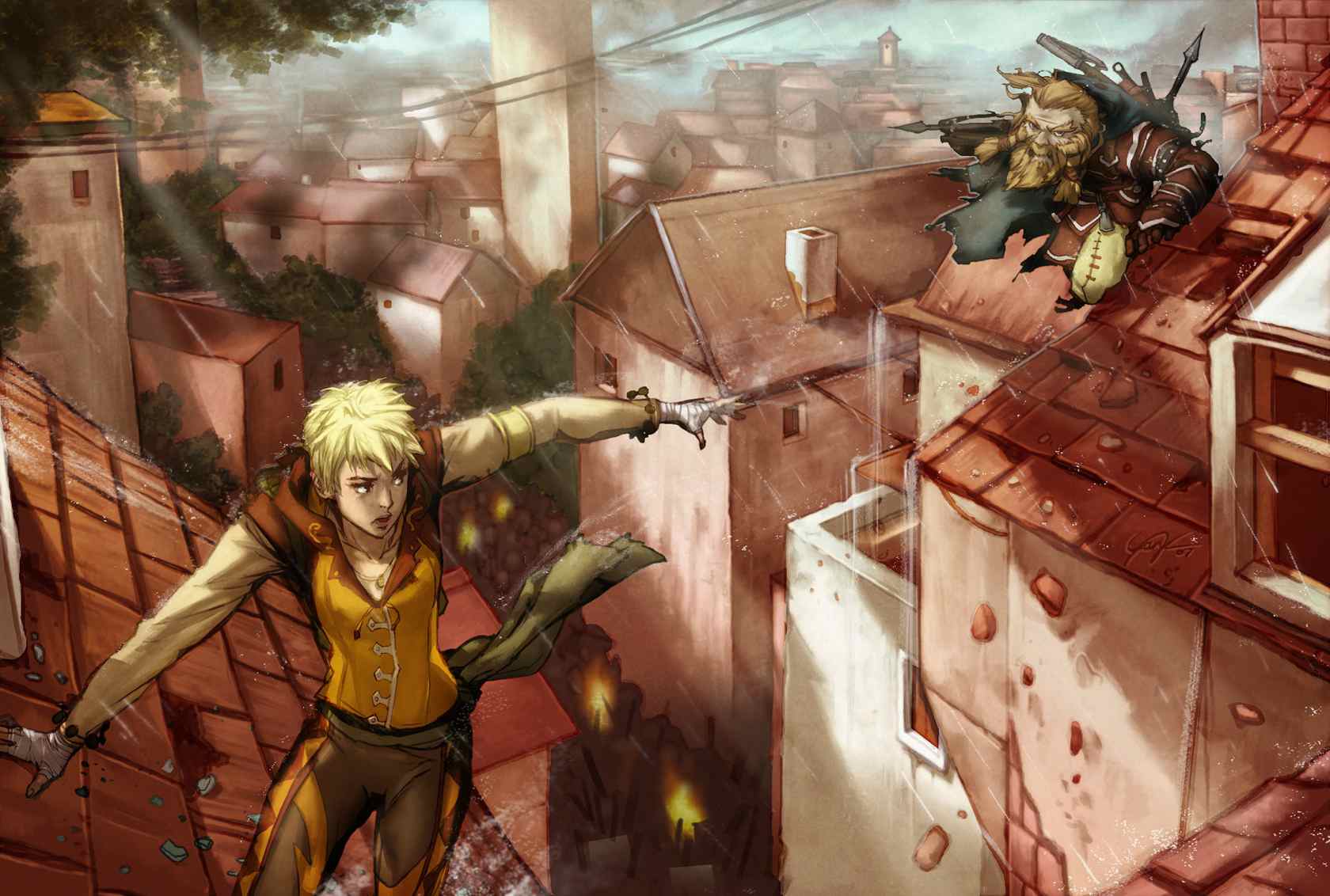
| Illustration by Kevin Yan |
Design Tuesday: Fun with Terrain
Tuesday, March 1, 2011
When designing an encounter, it's tempting to focus the majority of your attention on the mix of monsters and villains. After all, coming up with interesting enemy synergies and evocative scenes of terror, threat, and evil-doing go a long way in making encounters both memorable and fun. Often neglected, though, is making sure that the setting you place these bad guys in offers both threat and opportunity of its own. When designed correctly, the terrain of an encounter can provide opportunity and challenges that not only compliment the opponents that you select, but can make combat the stuff of gaming stories for years to come.
First Things First
There are two ways to go about terrain selection for your encounter. The first is to think about the environment that you want to set your encounters, or an entire adventure, within, and filling it with the proper terrain. When it comes to dungeon and cavern settings, much of this work is already done for you. Take a look at Chapter 13 of the Pathfinder RPG Core Rulebook, especially pages 410&ndash416, and you'll find a good selection of terrain types to stock your dungeon. You'll also want to check out pages 193—194 of the Core Rulebook as it has the rules for difficult terrain and obstacles, and maybe take a peek at pages 244–245 Pathfinder RPG GameMastery Guide for some sample hazards to play with.
Picking proper terrain is all about creating interesting exceptions, so the first thing you'll want to do is make decisions about the baseline terrain for your dungeon. Unless your group is full of seasoned Pathfinder veterans, you'll want to set those baselines at or near the base assumptions of the Pathfinder rules: Masonry walls, flagstone, and wooden doors are a good start. For the most part you, and your players will not have to think about these areas of terrain at all. They're the standard dungeon dressing everyone is use to. Then you'll want to think about the possible exceptions for your dungeon. Are parts of the dungeon in disrepair? Are parts of the dungeon in the midst of construction? Does the dungeon serve as an entryway to a subterranean cave system? Does it lead to an underground river or water or magma? Once you are done imagining your dungeon, and maybe even sketching it on some graph paper, you can start to figure out where the exceptions sit, and then start brainstorming possibilities that you can't find in the rules... but we will get to that later.
Straying deeper into Chapter 13, you can make similar choices for large areas of terrain that are not dungeons, but the principles are the same. Find your baseline, and then ponder the possibility of interesting and evocative exceptions to that baseline. Take some notes, ponder some possibilities, and search the rules for similar types of terrain.
The other way to go about creating interesting environments is to think about the monsters and villains you want in your encounter in the adventure, and ask yourself two questions. The first question is, what kind of terrain compliments the monsters' or villains' tactics? The second question is, what kind of terrain compliments your PCs' abilities? Answering the second question can be a little tricky, especially if your end result is being designed for a nonspecific group of PCs (say you're writing an adventure for a convention or Pathfinder Society open call, or you're already thinking about next year's RPG Superstar). More often than not, you'll want to try to fill your encounters with terrain that does both simultaneously. This creates better-balanced encounters that don't favor one side or the other overly much, which not only tend to create more exciting encounters, but can also bypass the need to adjust the CR of your encounters because terrain favors one side more than the other.
Whenever possible, it's best to use a mixture of these two approaches. Treat each one as lenses toward your ultimate goal—to create a fun game experience in a world that seem rich, vibrant, and full of possibilities and potential dangers for the PCs to explore.
Designing New Terrain
Whenever you get the itch to create a new piece of terrain, you should shoot toward making your terrain challenging to interact with but not overly frustrating. In general, you will want one of two speeds for your new terrain. The first speed is terrain that has automatic effects when a creature spends an action to interact with it, but the effect is always constant. Unlocked doors, stairs, and small passageways all fall under this category. They talk directly to the action economy of the game. Someone must spend an action or slightly modify her normal actions in order to use them (think squeezing, opening doors, or basic difficult terrain). This type of terrain is easy to use, quick to remember, but it lacks variability. Some of the most exciting terrain features effects that do not guarantee success, or, better yet, feature varying degrees of success.
Enter the second speed of terrain, where actions are often required, but the effect is variable. Usually such variability is tied to the uses of a skill. For most terrain you will want to pick a basic skill that can be used untrained and that makes sense for the terrain type. Acrobatics, Climb, Escape Artist, Fly, Survival, Swim, and even raw Strength checks are some obvious examples, with Acrobatics already doing a lot of the heavy lifting with the terrain found in the Core Rulebook (see hewn stone floors, rubble, and slippery floors). But don't be afraid to mix it up a little with other skills, even those that can't be used untrained (Disable Device, Ride, and even Stealth are some personal favorites). Creating such terrain is just another way where PCs (or monsters) with high skill bonuses have an opportunity to shine, but at a cost. Failure is a possibility.
When creating new terrain, it is not only important to make sure that they work within the normal rules of the Pathfinder RPG but that they are also the right fit for the PC and creature mix you are designing encounters and adventure for. Designing a fight on a frozen lake may seem like fun, but the last thing you want to do is slow down the encounter to a crawl with every creature being forced to make an Acrobatics check in order to accomplish any kind of movement whatsoever. Consider creating relatively safe areas (maybe areas covered with snow or rough ice that grants more traction), giving clumsy creatures slightly suboptimal movement choices, while allowing agile creatures to gamble for success, or even the possibility of greater effect. With those sheets of ice, consider giving them the possibility of bonuses when higher Acrobatics checks are rolled.
Can We Get Some Examples?
With some of terrain philosophy out of the way, start fooling around with creating your own terrain. Tune in next Tuesday for some new pre-made terrain objects to spice up your game. Next week we will be focusing on some terrain primarily designed to limit or focus movement and action types, and the week after we will unleash some crazy terrain options that grant new action options, such as movement and even some terrain that grants creatures special attacks.
Stephen Radney-MacFarland
Pathfinder RPG Designer