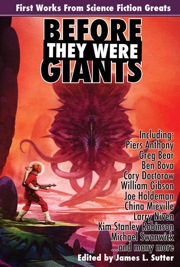
They say you always hurt the ones you love, and now that Before They Were Giants is shipping from the warehouse to subscribers and bookstores everywhere, I've looked back over the last few months of the blog and realized that I've only blogged about it once. Which is astonishing when you consider that this might just be the coolest product I've ever worked on in my life.
Illustration by Kieran Yanner
Allow me to elaborate: With Planet Stories, we've published a lot of science fiction and fantasy that we felt was both fun and significant to the history of the genre. Which is why, about two years ago, I went to Erik with a proposal: what if we got together 15 of the coolest, most important SF authors alive—with an admitted bias toward the folks at the top of my own bookshelf—and convinced them to let us publish their first-ever SF short stories. In addition, we'd get new interviews from all the authors in which they would critique their own work, explaining what they know now that they wish they'd known then about writing, and giving advice for aspiring authors. It would be both an insightful look at the origins of my favorite authors (appealing to the fanboy in me) and a treasure trove of invaluable authorial advice (for which I remain a total sucker). Without question, it would be a lot of fun to put together. The real question was whether or not it was possible.
As it turns out, it was possible. Within a few weeks of beginning my quest, the anthology had expanded into an absolute powerhouse roster. While we already had good relationships with a few folks—preexisting friends of Paizo like China Miéville, Ben Bova, Nicola Griffith, and Piers Anthony—I was amazed to find just how generous and enthusiastic many of my favorite authors are. Cory Doctorow? Larry Niven? Mr. William "Invented-Internet-Culture" Gibson? Just seeing their names in my inbox was a childhood dream come true.
And now here's the result: an anthology full of advice and encouragement for writers, as well as rare early stories from your favorite authors—many that you may never have seen before, as they've lain fallow in out-of-print magazines. (For instance, when I first asked China to join the anthology, he sent me back not "Looking For Jake," which I had expected, but a bizarre post-apocalyptic short story that had been published when he was still just a kid, and which as far as my Internet research was concerned did not exist. That's the sort of discovery that can really make an editor's day.)
But I've rambled long enough. Below is the full table of contents, and I couldn't be prouder of it. If you decide to pick up a copy, be sure to head on over to the product discussion and post about it—I can't wait to hear which stories (and interviews!) are people's favorites!
It takes a delicate hand to do certain things in writing, especially in the realms of science fiction and fantasy. Aside from character development, plotting, dialogue, description, pacing, and theme, science fiction and fantasy must overcome the additional hurtle which is world building. As an aspiring writer, I can tell you that world building is tough. Never mind how easy the other guys here make it look. Never mind all the wonderful freelancers we work with, or the submissions for RPG Superstar or Pathfinder Society Open Call—these people are all conspiring to get you to believe the lie that world building happens at the drop of a hat.
It just doesn't work that way.
Not to say that good world building isn't rewarding, both for the creator and the consumer. Who can say they don't enjoy a fantastical world? And yet, as difficult as it is to write good science fiction or fantasy, some authors choose to take on an additional challenge; to marry the two together in an attempt to weave a seamless narrative of swords and spaceships.
Illustration by Kieran Yanner
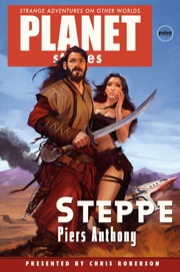
Piers Anthony's Steppe takes on this challenge with bravado (though more sword than spaceship), using a future simulation of the past to explore both history and imagination. In his imagined year 2332, society revolves around the "Game" of history, where players have to reenact genuinely historical battles without having access to knowledge of that history. Literal twenty to thirty year chunks of time are periodically erased from the society's history in order to facilitate fair play. Enter, Alp: our Ender-Wigginesque (though created before Card was milling about) middle-aged battle-trained warrior from a 9th century mid-Asia steppe (hence, the title) with a really cool horse. How's that for hybridization?
I began reading Steppe for a few reasons (not least of all, the fact that a free copy of the book was among my compensations as an unpaid intern). Additionally, having read little other than academic theory for the past three years (graduation, you elusive tunnel light you!), I was thrilled both by the newness of this 1976 gem, and by the fact that all the research into finding the text had been done for me already; by the wonderfully conceived Planet Stories line. This is cultural archaeology at its finest, folks. It brings light to the shadowy places that academic canon does not reach into. And if nothing else, it opens us up to traditions we didn't know existed (to say nothing bad of Asimov or Clarke, it's nice to mix things up a bit).
Therefore, I can say with certainty that when my time here ends (and I stop getting free stuff), I'll be picking up a Planet Stories subscription for these exact reasons.
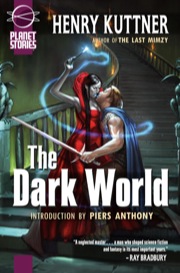
In my last Planet Stories post, I talked all about The Dark World, Henry Kuttner's story of two men trapped in the same body and thrust into a world of mythology and corruption, and dropped quotes by everyone from Ray Bradbury to Marion Zimmer Bradley to Roger Zelazny about how much they adore the book and the ways in which its unique take on science fantasy influenced their own writing.
Since I can't top their comments, I'm not even going to try. Instead, here's an excerpt from The Dark World, coming soon from Planet Stories:
Gripped in my right hand I still held the sword. I cut at him savagely by way of answer. He sprang back, glanced over his shoulder, and drew his weapon. I followed his glance and saw another green figure dodging forward among the trees. It was smaller and slenderer—a girl, in a tunic the color of earth and forest. Her black hair swung upon her shoulders. She was tugging at her belt as she ran, and the face she turned to me was ugly with hate, her teeth showing in a snarl.
The man before me was saying something.
"Edward, listen to me!" he was crying. "Even if you're Ganelon, you remember Edward Bond! He was with us—he believed in us. Give us a hearing before it's too late! Arles could convince you, Edward! Come to Arles. Even if you're Ganelon, let me take you to Arles!"
"It's no use, Ertu," the voice of the girl cried thinly. She was struggling with the last of the trees, whose flexible bough-tips still clutched to stop her. Neither of them tried now to keep their voices down. They were shouting, and I knew they must rouse the guards at any moment, and I wanted to kill them both myself before anyone came to forestall me by accident. I was hungry and thirsty for the blood of these enemies, and in that moment the name of Edward Bond was not even memory.
"Kill him, Ertu!" cried the girl. "Kill him or stand out of the way! I know Ganelon!"
I looked at her and took a fresh grip on my sword. Yes, she spoke the truth. She knew Ganelon. And Ganelon knew her, and remembered dimly that she had reason for her hate. I had seen that face before, contorted with fury and despair. I could not recall when or where or why, but she looked familiar.
The man Ertu drew his weapon reluctantly. To him I was still at least the image of a friend. I laughed exultantly and swung at him again with the sword, hearing it hiss viciously through the air. This time I drew blood. He stepped back again, lifting his weapon so that I looked down its black barrel.
"Don't make me do it," he said between his teeth. "This will pass. You have been Edward Bond—you will be again. Don't make me kill you, Ganelon!"
I lifted the sword, seeing him only dimly through a ruddy haze of anger. There was a great exultation in me. I could already see the fountain of blood that would leap from his severed arteries when my blade completed its swing.
I braced my body for a great full-armed blow!
And the sword came alive in my hand. It leaped and shuddered against my fist.
Impossibly—in a way I cannot describe—that blow reversed itself. All the energy I was braced to expend upon my enemy recoiled up the sword, up my arm, crashed against my own body. A violent explosion of pain and shock sent the garden reeling. The earth struck hard against my knees.
Mist cleared from my eyes. I was still Ganelon, but a Ganelon dizzy from something more powerful than a blow.
I was kneeling on the grass, braced with one hand, shaking the throbbing fingers of my sword-hand and staring at the sword that lay a dozen feet away, still faintly glowing.
It was Matholch's doing—I knew that! I should have remembered how little I could trust that shifting, unstable wolfing. I had laid hands upon him in his tower-room—I should have known he would have his revenge for that. Even Edward Bond—soft fool that he was—would have been wise enough not to accept a gift from the shape-changer.
There was no time now for anger at Matholch, though. I was looking up into Ertu's eyes, and into the muzzle of his weapon, and the look of decision grew slowly in his face as he scanned mine.
"Ganelon!" he said, almost whispering, "Warlock!"
He tilted the weapon down at me, his finger moving on the trigger.
"Wait, Ertu!" cried a thin voice behind him. "Wait—let me!"
I looked up, still dazed. It had all happened so quickly that the girl was still struggling in the edge of the trees, though she cleared them as I looked and lifted her own weapon. Behind it her face was white and blazing with relentless hate. "Let me!" she cried again. "He owed me this!"
I was helpless. I knew that even at this distance she would not miss. I saw the glare of fury in her eyes and I saw the muzzle waver a little as her hand shook with rage, but I knew she would not miss me. I thought of a great many things in that instant—confused memories of Ganelon's and of Edward Bond's surged together through my mind.
Then a great hissing like a wind swept up among the trees behind the girl. They all swayed toward her more swiftly than trees have any right to move, stooping and straining and hissing with a dreadful vicious avidity. Ertu shouted something inarticulate. But I think the girl was too angry to hear or see.
She never knew what happened. She could only have felt the great bone-cracking sweep of the nearest branch, reaching out for her from the leaning tree...