... Illustration by Brandon Kitkouski ... That's Racist! Tuesday, February 10, 2009At Planet Stories, we're all about recovering cherished pieces of SF's past; treasures that have fallen between the cracks and been forgotten by modern readers, despite their merit and importance to the genre. But one of the problems with history is that it happened in the past... and the past is rarely clean. In order to unearth the gems, you have to dig up some serious dirt. So let's get messy. ... Let's talk...
Illustration by Brandon Kitkouski
That's Racist!
Tuesday, February 10, 2009
At Planet Stories, we're all about recovering cherished pieces of SF's past; treasures that have fallen between the cracks and been forgotten by modern readers, despite their merit and importance to the genre. But one of the problems with history is that it happened in the past... and the past is rarely clean. In order to unearth the gems, you have to dig up some serious dirt. So let's get messy.
Let's talk about racism.
One of the issues we've run up against time and again with Planet Stories, especially with stories from back in the 1930s, is the use of racist language and ideas. Even beyond the standard prejudicial themes and cliches of the day—the fact that the "advanced" races were always white, and all the dark-skinned characters were described by their bright white teeth (seriously, try finding one where that isn't mentioned)—pulp writers were fascinated by the issue of race. Remember, this is decades before the Civil Rights Movement, a time when the oldest readers might still remember legalized slavery.
Otis Adelbert Kline was no different. Both of his novels published by Planet Stories, The Swordsman of Mars and the newly available Outlaws of Mars, deal extensively with the issue of race, and for Outlaws, the entire plot depends on it: a planetary race riot between the white-skinned rulers, their dark servitors, and the menacing yellow men from another world. The patois of Dr. Morgan's faithful African-American servant, Plato, is also likely to make the unsuspecting modern reader cringe—for in this blatant (if sympathetic) caricature, Kline paints a picture of a past most Americans would like to forget.
Yet, as Joe Lansdale points out in his introduction, you can't hold these stories to modern standards of political correctness—and in fact to do so would be a disservice to the author. In his words:
Kline's work is of its time. Non-white races suffer under his hand, though Plato, the black servant of Dr. Morgan, is treated kindly enough, if in an unintentionally condescending way. Still, Kline, like Burroughs, would have probably been considered liberal in their times. They could at least appreciate the fact that someone of a different color could be brave and loyal and worthy of the mantle of humanity. Even Jack London had problems with that, and no doubt he is a more celebrated author.
"Worthy of the mantle of humanity." A phrase so obvious to most of us today that it seems offensive, yet Joe is absolutely right. At the time, belief in racial equality was a bold position in the States.
Which is why at Planet Stories, we feel that it's important to give you the whole manuscripts, unabridged and unabashed. In the past, publishers uncomfortable with content sometimes cut drastically from older books (especially Kline) in order to sanitize for their new era. We say: let the works stand on their own and speak for themselves. H. P. Lovecraft used the N-word. Robert E. Howard had some (today) scandalously negative portrayals of non-white races. Yet this is history, and to redact history is to lose a vital part of how we got to where we are.
In 2009, with the United States' first black president in office, I can read these books and separate the prejudices of the time from the stories themselves, and I have faith that Planet Stories readers will do the same. If anything, I think these books are all the more significant for their transgressions—a glimpse, not just of science fiction's history, but America's past as a whole.
... Illustration by Brandon Kitkouski ... Lansdale on Kline ... Tuesday, February 3, 2009One of the greatest strengths of the Planet Stories book line is that, in addition to republishing SF classics by some brilliant and historically significant authors, we have the chance to get other amazing authors to introduce them. People like F. Paul Wilson, George Lucas, C. J. Cherryh, Ben Bova, Samuel R. Delany—it never fails to blow my mind every time I see their names in my email inbox....
Illustration by Brandon Kitkouski
Lansdale on Kline
Tuesday, February 3, 2009
One of the greatest strengths of the Planet Stories book line is that, in addition to republishing SF classics by some brilliant and historically significant authors, we have the chance to get other amazing authors to introduce them. People like F. Paul Wilson, George Lucas, C. J. Cherryh, Ben Bova, Samuel R. Delany—it never fails to blow my mind every time I see their names in my email inbox. Through their introductions, these authors get to contextualize the forgotten literary heroes that influenced them most and help usher their teachers back into print, the better to educate the next generation of science fiction and fantasy authors.
Which, really, makes me wonder why I'm saying anything at all about these books, when I could get out of the way and let them do it for me. So without further ado, here's an excerpt from Bubba Ho-Tep creator Joe R. Lansdale on why Otis Adelbert Kline's The Outlaws of Mars deserves to be in your shopping cart as we speak:
The Outlaws of Mars was written in the thirties and appeared in Argosy Weekly. It is very much in the Burroughs interplanetary format. A young American, Jerry Morgan, already skilled in the ways of combat due to his time in the army, goes to the home of his uncle, Dr. Morgan, and is after a little too much explanation about telepathy and machinery, transported, via machine, to Mars. The reason for Jerry's departure is embarrassment of a sort, having to do with a woman. Though the event is never fully explained, it appears Jerry has allowed a lie about himself to exist to keep from compromising the aforementioned young lady. So, our noble, romantic, and very Victorian hero flees our world for one of adventure on Mars. Upon his arrival, there is enough action for three novels: some court intrigue, treachery, weird inhabitants, sword fighting, and one hot mama named Junia.
Frankly, the plot is of little consequence, and is not dissimilar from those of the Burroughs novels, or of any sword and planet adventure written by Kline himself. Movement is the name of the game, and Kline provides that in the proverbial spades. There is hardly a moment to breathe, and the only time the novel bogs down is when Kline tries to justify his plot with too much explanation. When Kline is moving the story forward, bringing on the action, keeping us tightly wrapped up in his warm and bloody dream, we are with him all the way. It is only when he pauses to explain that the cocoon we were so tightly wrapped in breaks open and we fall out.
These moments are few, and Kline is more than willing to rewrap us, and we are more than willing to let him. There is plenty of color and beauty and a sweeping approach to story that reminds me of the cinema. In fact, with the popularity of such films as Star Wars and Indiana Jones, I would have thought by now, considering special effects have improved to the point of being almost as incredible as our most astounding dreams, that Burroughs and possibly Kline's characters would have been updated and filmed. Certainly, it's this color and sweep and majesty of background that make these stories so damned appealing; they are like movies in the head.
... O.A.K. for the win! Tuesday, January 27, 2009It's teaser time! Otis Adelbert Kline, the man who brought you so much sword-swinging, dalf-fighting, empire-overthrowing Martian action in The Swordsman of Mars, is back again with all that and more in The Outlaws of Mars! Scroll down to take a peek at the action that's in store: She screamed and shrank back from him, evidently rooted to the spot with terror. ... Scarcely had he regained his balance, when Jerry's attention was attracted by a...
O.A.K. for the win!
Tuesday, January 27, 2009
It's teaser time! Otis Adelbert Kline, the man who brought you so much sword-swinging, dalf-fighting, empire-overthrowing Martian action in The Swordsman of Mars, is back again with all that and more in The Outlaws of Mars! Scroll down to take a peek at the action that's in store:
She screamed and shrank back from him, evidently rooted to the spot with terror.
Scarcely had he regained his balance, when Jerry's attention was attracted by a new sound—a terrific roar which came from a huge beast that was bounding toward them along the path. With a yawning, tooth-filled mouth as large as that of an alligator, a furry black body fully as big as that of a lion, short legs, and a hairless, leathery tail, paddle-shaped and edged with sharp spines, the oncoming monster certainly looked formidable.
Jerry thought and acted swiftly. He realized that to attempt to stop such a creature with one shot would be futile. If his first bullet should not be instantly fatal, it would be upon them, a wounded and enraged instrument of death and destruction, before he could bring it down with a second. His first duty was to get the girl out of the path of the charging monster.
Gripping his rifle in his left hand, he bent and encircled her slender waist with his right arm. Then he leaped to one side, just in time to avoid those gaping jaws. But the spring he made surprised him fully as much as it did the baffled beast, for it carried him clear over the hedge, and into a carefully tended bed of tiny flowering plants upon the other side.
For the first time since he had landed on Mars, he realized the tremendous advantage of his Earth-trained muscles. Nor was he slow to make use of it. The short-legged beast, unable to leap over the hedge, was crashing through it. So he turned, and still carrying the girl beneath his arm, bounded away with the tremendous leaps which it would have been difficult for a terrestrial kangaroo to equal in its native habitat.
The slender form of the girl was feather-light, and impeded him scarcely at all. On Earth she would have weighed about ninety pounds; on Mars she weighed but thirty-four.
Glancing back over his shoulder, he saw that although he had a good start on the beast, it was following him with a speed that was amazing in a creature with such short legs. Instinctively, he had started toward the wall. Soon the stairway loomed before him, and he bounded up it, five steps at a time. As soon as he reached the top of the wall he put the girl down and turned to face their pursuer, which had meantime reached the steps.
Snapping his gun to his shoulder, he took careful aim between the blazing green eyes, and fired...
... Kline is Back! Tuesday, January 13, 2009One of Erik's first pulp discoveries when he started researching books for Planet Stories was a man named Otis Adelbert Kline, a former giant of the sword-and-planet genre who is remembered today primarily as the literary agent for Conan-creator Robert E. Howard. From the very beginning, Kline symbolized everything Erik wanted in a Planet Stories book—sword-swinging adventure on other worlds with strange creatures, bizarre cultures,...
Kline is Back!
Tuesday, January 13, 2009
One of Erik's first pulp discoveries when he started researching books for Planet Stories was a man named Otis Adelbert Kline, a former giant of the sword-and-planet genre who is remembered today primarily as the literary agent for Conan-creator Robert E. Howard. From the very beginning, Kline symbolized everything Erik wanted in a Planet Stories book—sword-swinging adventure on other worlds with strange creatures, bizarre cultures, scantily-clad princesses, and two-fisted plot advancement on every page.
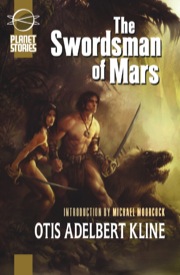
It took us over a year, but in the end we did it, and resurrected Otis Adelbert Kline's The Swordsman of Mars from the literary graveyard, bringing it back for modern audiences to enjoy. And they did—which is why we're now privileged to bring you its standalone sequel, The Outlaws of Mars.
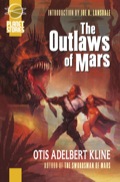
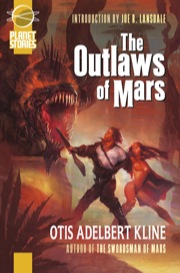
It's all here—the swords, the action, the double-crosses and intrigue—but this time we've changed it up and tried a different cover style with veteran fantasy artist Brandon Kitkouski. While I'm a huge fan of Daryl Madryk's Swordsman cover, I have to tip my hat to Brandon for his take on the rampaging dalf.
But I'm just one person. What do you think? What about a cover makes you pick it up, and which artists would you like to see more of from Planet Stories? Head on over to the Planet Stories messageboards and make your opinions heard!
... The Dueling Writers of Mars! Tuesday, November 4, 2008The first manuscript I had an opportunity to read after being welcomed aboard the Planet Stories staff was Otis Adelbert Kline's The Swordsman of Mars. As a lifelong Edgar Rice Burroughs enthusiast I had, of course, heard about Kline and the long-standing notion among Burroughs's readers that the two men, Kline and Burroughs, considered themselves bitter rivals. Kline's Venus series is generally recognized as having been penned in the...
The Dueling Writers of Mars!
Tuesday, November 4, 2008
The first manuscript I had an opportunity to read after being welcomed aboard the Planet Stories staff was Otis Adelbert Kline's The Swordsman of Mars. As a lifelong Edgar Rice Burroughs enthusiast I had, of course, heard about Kline and the long-standing notion among Burroughs's readers that the two men, Kline and Burroughs, considered themselves bitter rivals. Kline's Venus series is generally recognized as having been penned in the style of Burroughs's Mars (or Barsoom) books, and so the story goes that Burroughs launched his own Venus series to impart some kind of retribution against his popular imitator. The notion of a Burroughs-Kline feud, however, bears little evidence to support it, but even so, I must admit it was with some skepticism that I picked up The Swordsman of Mars and began to read it. After all, there's little doubt in my mind that fate would never have led me to a job at Planet Stories if as a kid I had never read ERB, the author who ignited my interest in reading and writing, and by a long and tangled path, editing. Above all, Burroughs is an incomparable Storyteller, capital S, and his works have never gone out of print in the 97 years since he published the serialization of his first novel, Under the Moons of Mars (later retitled A Princess of Mars), in All-Story Magazine—the same novel that introduced me to ERB and got me permanently hooked. When I was in my teens, I devoured ERB's works—systematically, ruthlessly, obsessively—racing first across the dead sea bottoms of Barsoom with John Carter, then on to the lands that time forgot of Caspak and Pellucidar, touring savage jungles and lost cities with Lord Greystoke, flying through the shrouded skies of Amtor (Venus) with Carson Napier, and reveling in the adventure and romance of every one of Burroughs's many standalone novels. How could Kline possibly measure up to that? It was such a game of expectations that kept me from reading Kline for all these years in the first place.
I was in for a heck of a surprise. What I found when I finally pored over The Swordsman of Mars was that Otis Adelbert Kline knew his ERB. In particular, he knew ERB's Mars books. He had an almost uncanny knack for creating Barsoomian-sounding names and terminology—Sheb Takkor, Sel Han, Lal Vak, Kov Lutas, Rad, Jen, Dixtar—and his descriptions of exotic settings, such as "the glittering, frost-covered jungles" of the Takkor Marsh or the dark pits of the Martian baridium mines, are on par with ERB's own. Kline was apparently so well studied in his Burroughs that some fans have gone so far as to conjecture that The Swordsman of Mars and its sequel The Outlaws of Mars (a forthcoming Planet Stories release) take place on some remote corner of ERB's own Barsoom!
But much more important than the literary artifices he employs, Kline understood the mechanics of story on the same instinctive level as Burroughs. For with both authors, it's all about the romance and adventure, pulling the reader in to the point where the distinction between reader and hero begins to blur—and that's where Kline (and Burroughs) grabs you. For at that point of identification, as the hero at last gets within fingertip-reach of the ultimate goal, the conditions shift unexpectedly. The hero suddenly finds that what had seemed a simple outcome of success or failure is instead a head-swirling, heart-wracking turn of events that leaves you racing to the next page to find out how the author can possibly maneuver out of what is seemingly the ultimate inextricable dilemma.
And that's why Otis Adelbert Kline deserves his place in history—like Burroughs he is a Storyteller who, on a primal level, has the ability to mesmerize his audience with a captivating tale of honor and betrayal. A pulp writer, yes, but one with a rare gift of the bards of ancient days, whose simple words enchant and bring to life the archetypes that lie in wait in the imagination. Readers of Burroughs should love The Swordsman of Mars. I know this one did.
... The Swordsman of Mars: The Media Takes Notice Tuesday, October 14, 2008Otis Adelbert Kline was one of the first forgotten pulpsters we targeted a few years ago when Pierce Watters and I started talking about the classic SF line that would become Paizo's Planet Stories imprint. We originally wanted to do his first sword and planet serial, Planet of Peril, a yarn featuring an Earthman's adventures on Venus published a few years after Edgar Rice Burroughs invented the sub–genre with...
The Swordsman of Mars: The Media Takes Notice
Tuesday, October 14, 2008
Otis Adelbert Kline was one of the first "forgotten pulpsters" we targeted a few years ago when Pierce Watters and I started talking about the classic SF line that would become Paizo's Planet Stories imprint. We originally wanted to do his first sword and planet serial, Planet of Peril, a yarn featuring an Earthman's adventures on Venus published a few years after Edgar Rice Burroughs invented the sub–genre with his "Under the Moons of Mars" (later A Princess of Mars). We backed off on those plans when our buddies over at Wildside released a new print–on–demand version of Planet of Peril, and instead opted to publish Kline's two Mars books first.
In a way this is fitting, as the Mars books seem to happen chronologically before the Venus books, even though they were published after. There are, at least, four more Kline serials I'd like to reprint as part of Planet Stories, and beyond that there are a handful of interesting stories that were never republished in the paperback era of the 1960s that readers might enjoy.
This month's publication of an Otis Adelbert Kline novel in the Planet Stories line may be our fourteenth release, but in many ways it feels like the very first.
Because of that, it's gratifying to see bloggers and members of the science–fiction media taking notice of the book and spreading the word about the new edition and about the Planet Stories book line. The latest comes from io9.com, an exciting new general interest sci–fi site that first mentioned Planet Stories a few months ago.
Kudos to io9 editor Ed Grabianowski for his excellent taste and his continued attention to our Planet Stories line.
... Two Swordsmen of Mars! Saturday, September 20, 2008While pulp science-fiction magazines had entered a sort of digest-sized hibernation by the early 1960s, the paperback book phenomenon was hitting with full force, exposing readers to a new generation of writers while bringing many of the old pulp classics of the past into book form for the very first time. The celebrated Ace Doubles of the era presented many of the books we've already published in our Planet Stories classic fantasy line,...
Two Swordsmen of Mars!
Saturday, September 20, 2008
While pulp science-fiction magazines had entered a sort of digest-sized hibernation by the early 1960s, the paperback book phenomenon was hitting with full force, exposing readers to a new generation of writers while bringing many of the old pulp classics of the past into book form for the very first time. The celebrated Ace Doubles of the era presented many of the books we've already published in our Planet Stories classic fantasy line, including Leigh Brackett's The Secret of Sinharat and People of the Talisman, both of which first appeared in the original Planet Stories magazine of the 1940s. Ace also republished many full book-length tales, including this month's Planet Stories release, Otis Adelbert Kline's The Swordsman of Mars.
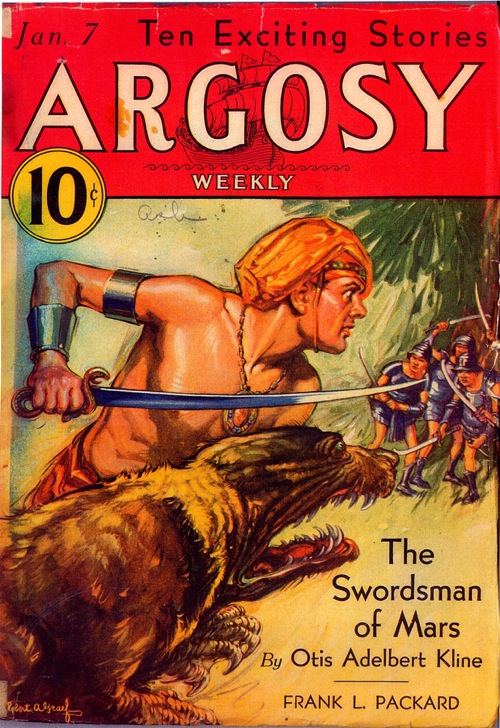
Kline's classic tale of swashbuckling and savage monsters in the deserts, swamps, and jungles of Mars first appeared in 1933 as a 6-chapter weekly serial in Argosy Magazine, the very pulp that had birthed the so-called "sword and planet" genre with the publication of Edgar Rice Burroughs's Under the Moons of Mars 21 years prior. Contemporary fans of Burrough's John Carter of Mars and Carson of Venus tales often ranked Kline's planetary adventures as equal or near-to-equal those penned by the master himself, but in the 75 years since the original publication of The Swordsman of Mars, Kline's reputation as an author has not fared quite as well as that of Edgar Rice Burroughs.
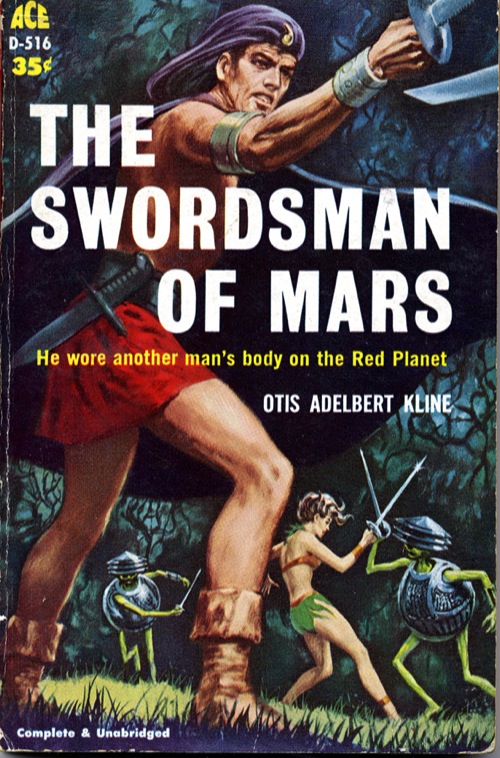
The tale's paperback publication came in 1960 from Ace, appearing alongside such science-fiction classics as Journey to the Center of the Earth by Jules Verne, The Isle of Doctor Moreau by H. G. Wells, and The Weapon Shops of Isher by A. E. Van Vogt. The boldly colored cover depicts a long-haired John Carter clone and his damsel battling some Martians under the banner "He wore another man's body on the Red Planet". Tucked away at the bottom of the frame, near the left-hand corner, is the tiny legend "Complete & Unabridged."
As with many early paperbacks, this latter claim is more complicated than it appears. The 1960 Ace edition is an "unabridged" reprint of the 1960 hardcover edition of The Swordsman of Mars from a publisher called Avalon, who reprinted all of Kline's sword and planet fiction starting in that year. Rather than a celebration of Kline's important serial work, the '60s Avalon editions are badly truncated rewrites. Entire chapters are missing, key character and location descriptions are completely absent, and the final product cuts a slash across the chest of Kline's literary reputation that would be totally invisible to readers unable to assemble the original Argosy serial and compare the two texts.
Happily, we at Planet Stories did just that when preparing our manuscript for print, and the differences between the original and the "Complete & Unabridged" versions are staggering. Yes, the serial is much longer, which is to be expected. But the changes made to The Swordsman of Mars rob the story of a great deal of description, characterization, pacing, and background that does no service to the original tale or the literary legacy of Otis Adelbert Kline.
Take a look at the first chapter of The Swordsman of Mars, first in its Ace paperback/Avalon edition, and then in the complete serial publication used as the basis for our Planet Stories edition.
Here's the Ace version:
PROLOGUE
Harry Thorne opened his eyes and gazed about him with a startled expression. This was not the tawdry hotel bedroom in which he had gone to sleep; it was a small room with bare, concrete walls, a door of hardwood planking studded with bolts, and a barred window. The only articles of furniture were the cot on which he was lying, a chair, and a small table.
So the sleeping pills didn't finish me off, he thought. Now I'm in jail for attempted suicide!
Thorne sat up, then rose unsteadily to his feet and staggered to the window. Supporting himself by gripping the thick iron bars, he peered out. It was broad daylight and the sun was high in the heavens. Below him stretched a deep valley, through which a narrow stream meandered. And as far as he could see in all directions there were mountains, though the highest peaks were all below the level of his own eyes.
He turned from the window at the sound of a key grating in a lock. Then the heavy door swung inward, and a large man entered the cell, bearing a tray of food and a steaming pot of coffee. Behind the man was a still larger figure, whose very presence radiated authority. His forehead was high and bulged outward over shaggy eyebrows that met above his aquiline nose. He wore a pointed, closely cropped Vandyke, black with a slight sprinkling of gray, and was dressed in faultlessly tailored evening clothes.
Thorne got to his feet as his singular visitor closed the door behind him. Then, in a booming bass, the man said, "At last, Mr. Thorne, I have caught up with you. I am Dr. Morgan." He smiled. "And I might add, not a moment too soon. You gave us quite a time—Boyd and I managed to get you out of that hotel room and down to the street, passing you off as a drunk. Don't you remember a knocking at the door? You weren't quite out when we came in."
Thorne thought for a moment, then nodded. It seemed that there had been a pounding somewhere. "How did you get in? I thought I locked the door."
"You did—but I had skeleton keys with me, just in case. We took you to my apartment, treated you, and brought you out here." Morgan nodded to Boyd, who left the room, then waved his hand invitingly toward the tray. "I ordered breakfast served in your room. I especially urge you to try the coffee. It will counteract the effect of the sedatives I was compelled to use in order to save your life to bring you here."
"You've gone to a lot of trouble to save something I don't want," Thorne said. "May I ask why you are interfering in my affairs?"
"I need you," Morgan replied simply. "And I can offer you adventure such as only one other man of Earth has known—possibly glory, possibly death. But if death, not the mean sort you were seeking."
Harry Thorne frowned. "You referred to a man of Earth as if there were men not of Earth. Are you suggesting a trip to Mars?"
Dr. Morgan laughed. "Splendid, Mr. Thorne. But suppose you tackle breakfast. It will put you in a better frame of mind for what I am going to tell you. I shall not lock the door as I leave. When you have finished, join me in the drawing room—at the end of the corridor to your right." He paused in the doorway. "You mentioned a trip to Mars, Mr. Thorne. Forgive me if I keep you in suspense for a time, but—although it is not exactly what you think those words mean—that is what I am going to propose."
So that's it. Quick, to the point. Our hero is Harry Thorne. We don't know what he looks like, how he came to be in this room, why he wanted to commit suicide, or really anything about him other than his name. We've met the esteemed Doctor Morgan (the scientist who ties together all of Kline's Mars and Venus serials), but we don't understand why he would be interested in poor, old suicidal Harry Thorne. This introduction is a serviceable stepping stone to the adventures to come, but it does little to ground the reader's interest in the protagonist or foreshadow future events.
Here's the first section of the original serial, as it will appear in this month's Planet Stories release:
CHAPTER 1
A VERY STRANGE VISITOR
"Is Mr. McGinnis in?"
The girl who presided at the information desk and switchboard of the McGinnis Physical Culture Institute suspended her gum chewing long enough to reply: "I'll see. What's the name?"
"Thorne. Harry Thorne."
As she connected the office phone of her employer, the girl surveyed the young man before her with a look of approval. He was tall and slender, with wavy hair of a chestnut brown shade, and there was a pantherish suppleness about his movements which hinted of powerful muscles, perfectly controlled. His faultless attire and aristocratic air told her that he was likely to prove a wealthy prospect for the services which Mr. McGinnis had to offer, so she rang three times, a signal which her employer would understand.
"Mr. Harry Thorne to see you, sir."
She nodded and smiled at the young man. "You may go in, Mr. Thorne. The first office at your right."
"Thank you." Thorne followed her directions, and was welcomed at the door of the office by the beaming proprietor of the institution, a middle-aged gentleman with bulging chest and biceps, a broken nose, and cauliflower ears.
"Come right in, Mr. Thorne. Take a chair. A wonderful frame you have to put muscle on. Now with our system of training we guarantee to add an inch to the circumference of your biceps in less than-⎯"
"One moment, Mr. McGinnis. I came here to be built up, not physically, but financially. In short, I am after that job you advertised in this morning's paper."
McGinnis settled back, a look of disappointment on his face.
"Oh, so you want a job as my assistant fencing master. Can you handle a foil?"
"Fencing has been a hobby of mine."
"A hobby, eh? You'll have to make it a profession if you work here. But come. I'll try you out."
McGinnis led him down the hallway, and through a large room where a group of perspiring financiers dressed in shorts and jerseys were going through various contortions under the direction of a husky looking young man wearing a striped sweater. A conspicuous majority of these striving athletes looked as if their chests had slipped down beneath their belts, and the calves and biceps were undeveloped.
They passed through another room, where a number of corpulent gentlemen were being mauled, poked, pinched, prodded and steam-cooked, and thence into a small empty gymnasium.
McGinnis removed his coat and invited Thorne to do likewise. Then he handled him plastron, mask, glove and foil, and both men armed themselves.
"Now, my lad," said McGinnis, when Thorne was ready, "we'll see what we'll see. On guard!"
They saluted and engaged. Before he had got fairly warmed up, McGinnis, much to his surprise, was hit. "Accidents will happen," he said. "We'll try again."
They did, and this time McGinnis was disarmed. The sudden realization of this made him quite red in the face—he, a fencing master, disarmed by this amateur.
"That was a coincidence," he said, as Thorne politely handed him his foil. "We'll try it once more."
Much to his astonishment and chagrin, the master was hit in the fifth disengage. He threw down his foil and tore off his mask. "Enough's enough." He growled.
"Do I get the job?" asked Thorne.
"Not in a thousand years, my boy. Do you think I'd be fool enough to hire an assistant who can beat me? Don't slam the door as you go out."
Out on the street once more, Thorne fished his last fifty cent piece from his pocket and bought an early edition of an afternoon paper. Pocketing his change, he retired to a doorway to scan the "Help Wanted" column.
Evening found him still tramping, after having followed five more fruitless leads. He fingered the change in his pocket reflectively. Not enough for a decent meal, but if husbanded carefully it would keep body and soul together for the next two or three days. He expended five cents on coffee and doughnuts, his first meal of the day. Then he returned to the cheap hotel where he had taken lodging and where his room rent, which had been paid in advance, would expire on the morrow.
As the clerk handed him his key, he said: "A gentleman called to see you, Mr. Thorne. Said he'd be back later."
"A gentleman to see me! That's strange. Did he leave any message?"
"Only that he'd be back later."
"Thanks."
Thorne climbed the creaky stairs with their covering of dusty, moth-eaten carpet, and entered his room. Shortly thereafter, in dressing gown and slippers and with his pipe going, he sat down in his creaky rocker, vintage of 1880, to think out the situation in which he found himself. He had already pawned his watch and ring, and the money was all but gone. The dressing gown would be next, he decided. Then his reverie was interrupted by a knock at the door.
"Come in," he said, wearily.
He looked up curiously as the door opened, then suppressed a gasp of amazement at sight of the striking individual who entered. His visitor, almost a giant in stature, was obviously a tremendously powerful man. But the impression of great physical strength which the stranger's physique induced was overshadowed by the promise of inconceivably greater mental force which shone from his face. His forehead was high and bulged outward over shaggy eyebrows that met above his aquiline nose. His piercing black eyes seemed to look through Thorne's own, and into his very brain. He wore a pointed, closely-cropped Vandyke, black with a slight sprinkling of gray hairs, and was dressed in faultlessly tailored evening clothes.
Thorne got to his feet as his singular visitor closed the door behind him. Then, in a booming bass voice, the big man said: "At last, Mr. Thorne, I have caught up with you. I am Dr. Morgan."
Surprised, Thorne took the proffered hand and muttered an acknowledgement. "Take the chair, doctor," he invited. "I'll sit here on the bed." As his visitor complied, he continued: "You say you have caught up with me. Am I to understand from this that you have been following me?"
"Halfway across the world and back again," was the reply. "I first saw your photograph in a local paper, accompanying an article which told of your hunting expedition in British East Africa. I followed you there, only to learn that you had sailed there days before my arrival."
"You saw my picture and followed me there? Why?"
"I'll come to that presently. When I reached New York, I called your father's home in Long Island. I was advised that you had left, and that no one knew of your whereabouts. After that, it was not easy to trace you. I learned that you had sailed for home sooner than you planned, because of a wire from your father. I also discovered that on your return, you and your father had quarreled, and that as a result you were disowned and disinherited."
"You seem to have taken a remarkably keen interest in my affairs," said Thorne, amazed at the intimate details of his private business with which this strange individual was familiar.
"Exactly. And I presume you have seen the evening paper."
"Only the 'Help Wanted' columns."
"In that case," said the doctor, "you missed some news which will be of interest to you." He took a clipping from his pocket and passed it to Thorne.
With a shock that turned him suddenly pale beneath his coat of tan, he read:
FIANCÉE OF HARRY THORNE
ELOPES WITH OTHER MAN
Sylvia Thompson, daughter of Dr. and Mrs. Horatio Thompson, of Newport, whose engagement to Harry Thorne, scion of the wealthy Long Island family, was recently announced, has eloped with Herbert Lloyd Vandevetter.
There were details, but Thorne did not read these. Instead, he looked at the pictures of his lovely fiancée, his best friend, and himself, conspicuously displayed beside the article. Then the page blurred and he turned away. A great sorrow gripped his heart. Sylvia Thompson was the one person in whom he had not lost faith. Before leaving for Chicago he had confided in her, had told her that he was penniless, and must seek out a new means of livelihood before they could be married. She had promised to wait. And now—this!
"She was false—a cheat, a fraud!" he said, bitterly. "I'll never believe any woman again. I'll never believe anybody."
"Steady boy," admonished the doctor. "You're taking a lot of territory."
"I mean it," said Thorne. "I—I don't care to live any longer."
"Suppose you were offered a new interest in life. Excitement and adventures beyond your wildest dreams. A chance to view new scenes that no earthly being save one has ever glimpsed. To meet new and strange peoples."
"All that is old stuff to me," replied Thorne. "I've traveled until I'm sick of it. I've hunted big game in Asia, Africa and the Americas. I've been in every important country on the globe. The only adventure I have not tried is death, and just now it is the one adventure that intrigues me."
He got up suddenly, and stepping to where his suitcase lay open on the grip-rack, drew therefrom a .38 caliber pistol. "I don't know why you've come here, doctor," he said, "and I don't much care. But I'll appreciate the favor if you will notify my fond relatives of my demise. I don't like being messy, and I haven't the slightest desire to be dramatic, so I'll go into the bathroom for the last act."
"One moment, before you go," said the doctor. "Do you realize that if you do this deed while I am present you will implicate me as a murderer?"
"Right. I hadn't thought of that. Sorry. I'll say good-by then, and give you time to get away."
The doctor rose. "That's considerate of you my boy, and I'll be glad to notify your relatives for you. Good-by." He held out his hand.
Thorne listlessly grasped the extended hand. As he did so, he felt a sharp pricking sensation in his palm, followed by a numbness which shot up his arm and traveled rapidly through the rest of his body. The gun, which he had been holding in his left hand, clattered to the floor. A moment later things went black before his eyes. His knees buckled under him, and the doctor, catching him beneath the arms, eased him back upon the bed. Then consciousness left him.
The original Kline text reveals his hero to be a weary world traveler, an adventurer of impeccable swordsmanship and an aristocratic background (all of which will serve him well on the Red Planet). We have a fitting physical description for the ideal sword and planet hero, and we have a tragic love story that explains Harry Thorne's self-destructive impulse and the motivation that will eventually send him to Mars.
Otis Adelbert Kline died 14 years prior to the publication of Avalon's The Swordsman of Mars hit the shelves. Whoever wrote the short version, it wasn't the original author, and the merciless cuts did little to help Kline's literary reputation. No less an authority than The Encyclopedia of Science Fiction calls Kline's work "pulp fiction at its worst." But these analyses, indeed most modern perception of Kline's fantasy output, is based not on the original pulp printing, but on posthumous editorial hack-jobs perpetrated long after the author himself had died.
Now, for the first time in 75 years, Planet Stories presents Otis Adelbert Kline in his own words. Order The Swordsman of Mars today and take the fantastic journey to the Red Planet the way the author originally intended it.
You'll find it makes all the difference in the world.
... Swamp Fight! Tuesday, August 26, 2008Last time I discussed how Otis Adelbert Kline, author of The Swordsman of Mars, ties into the overall idea of Planet Stories—a forgotten master in the Edgar Rice Burroughs tradition, who set precedents both through his own work and as a member of the Weird Tales editorial staff (not to mention as the literary agent for Conan creator Robert E. Howard). This week, however, I'd like to focus the spotlight on the one reason for republishing The...
Swamp Fight!
Tuesday, August 26, 2008
Last time I discussed how Otis Adelbert Kline, author of The Swordsman of Mars, ties into the overall idea of Planet Stories—a forgotten master in the Edgar Rice Burroughs tradition, who set precedents both through his own work and as a member of the Weird Tales editorial staff (not to mention as the literary agent for Conan creator Robert E. Howard). This week, however, I'd like to focus the spotlight on the one reason for republishing The Swordsman of Mars that we haven't talked about yet:
Because it's fun.
In order to illustrate that, I've picked one of my favorite sections and included a snippet from it here. Though there are a number of memorable scenes, one of my favorite things about Kline is the new monsters he invents, and this scene features not just one, but three of his motley creations... and that's just on one page. Let's hear it for authors who aren't stingy with their beasties!
For some time the Earth-man was too busy getting his breath to take note of his surroundings. Then he looked around for his mount, and saw it swimming directly away from him at a distance of about three hundred yards. Although the gawr was moving at a speed which he could not possibly hope to equal, he was about to set out in futile pursuit when a huge and terrible reptilian head suddenly reared itself between them, a scaly, silver neck. The monster looked first at the retreating gawr, then at the man, and evidently deciding that the latter would be the easier prey, began gliding swiftly toward him.
Thorne glanced around him. Although it seemed utterly futile for him even to attempt to make the shore, about a quarter of a mile distant, where a dense fringe of trees nodded over the water, no other avenue of escape was open to him, and he struck out desperately.
It was manifest from the start that he could not hope to outstrip his fearful aquatic enemy. As he forged ahead with long, powerful overhand strokes, he glanced back from time to time, and saw that the monster was swiftly gaining on him. Soon the terrific pace began to tell on him. His arms grew numb, and it seemed that they moved automatically, while breathing momentarily became more difficult. But the thought of those dreadful jaws, now gaping close behind him, spurred him on.
With the shore but two hundred feet distant, he felt this last ounce of strength ebbing. A backward glance showed his monstrous pursuer so near that it was arching its neck for the kill. Then just ahead of him he noticed a tiny ripple of water, and there emerged a pair of jaws like those of a crocodile, but larger than those of any crocodile he had ever seen or heard of. There followed a broad, flat head, and thick neck, both covered with glossy fur, the head black, the neck ringed with a bright yellow band.
Hemmed thus between the two aquatic monsters, he did the only thing left for him to do. Filling his lungs, he plunged beneath the surface and dived under the oncoming beast. For a moment he heard the rush and swirl of the swimming thing above him, and felt the eddying currents which it kicked downward and backward. These passed, he forged onward, remaining under water until compelled to return to the surface for air.
When he had shaken the water out of his eyes, Thorne saw a fearsome sight. The two monsters had met, and were engaged in a terrific struggle. The silver-gray scales of the one which had been following him flashed in the sun as it endeavored to shake off its small adversary which had seized it by the lower lip.
Suddenly it reared its head until the black-furred creature was drawn completely out of the water, and he saw that the latter was a web-footed animal about as large as a full-grown terrestrial lion, with short legs and a leathery, paddle-shaped tail which was edged with sharp spines. With the exception of the tail and claws, the body was covered with fur. The scaly monster shook its head, dislodging its smaller enemy and losing most of its lower lip in the process. Then, as the furry creature splashed into the water, it arched its neck and struck.
Thorne expected to see the smaller creature instantly slain. Instead he saw a startling demonstration of its superior cunning and quickness. With a speed his eye could scarcely follow, it avoided the lunge of that terrible head, and turning, seized the slender, stalklike neck of its adversary in its own relatively large jaws. One powerful crunch, and the battle was over. The severed head sank from sight, and the huge body, floundering about with reptilian tenacity to life, churned the water to a foam and sent huge waves scurrying in all directions.
So absorbed had he been in this strange battle that Thorne had momentarily forgotten his own exhaustion and the peril that menaced him. Now, as the victor turned from the carcass of its vanquished enemy and swam straight toward him, the realization of his danger redoubled. He struck out for the shore, essaying the fast overhand stroke he had previously used on the surface, but his weary muscles had reached the limit of their endurance. A few feeble efforts, and a backward glance at the swiftly moving beast, convinced him that he was doomed. Better death by drowning than in those horrible jaws. He filled his lungs and dived. At a depth of about fifteen feet he found a large water plant to which he clung with his last remaining strength.
But it seemed he was not even to be given his choice of deaths. Suddenly he became aware of the dark object in the green water above him. Then a huge jaw closed around his waist...
... One of a Kline Tuesday, August 12, 2008Otis Adelbert Kline, author of The Swordsman of Mars, is probably the author with the least name recognition on our current schedule. ... And that's on purpose. You see, once upon a time, before we realized that we could actually get folks like Michael Moorcock, Piers Anthony, and Robert E. Howard, we set our sights on trying to bring back, not just the best authors of the genre, but the best forgotten authors. Yet once we opened our doors, we...
One of a Kline
Tuesday, August 12, 2008
Otis Adelbert Kline, author of The Swordsman of Mars, is probably the author with the least name recognition on our current schedule.
And that's on purpose. You see, once upon a time, before we realized that we could actually get folks like Michael Moorcock, Piers Anthony, and Robert E. Howard, we set our sights on trying to bring back, not just the best authors of the genre, but the best forgotten authors. Yet once we opened our doors, we discovered a veritable horde of high-quality, big-name authors who'd been languishing out of print. As the roster started filling up with giants—both the folks I've already mentioned and people like C. L. Moore, the first female sword-and-sorcery author, or Leigh Brackett, who wrote the first draft of The Empire Strikes Back—I began to wonder if there was indeed still a place in readers' hearts for Otis Adelbert Kline. Then I sent the manuscript out to our typist, who's retyped all the old books in our line, from Moorcock to Howard. Shortly thereafter I received the typed manuscript along with a simple note saying:
"This one was my favorite by far!"
And why shouldn't it be? Though these days he's best known as the literary agent for Robert E. Howard and supposed rival of Edgar Rice Burroughs, at the height of the pulp era Kline was nearly as big a name as Howard and Burroughs himself. Though Kline's famous feud with Burroughs—in which Burroughs would publish a Mars book so Kline would publish a Venus one, prompting Burroughs to publish a Venus one, which in turn forced Kline to respond with a Mars saga, etc.—turns out to have been entirely the creation of imaginative fans, there can be no doubt that the two authors shared both style and subject matter. Indeed, Kline has frequently been called Burroughs's only true competitor. While he produced only a handful of novels before his death at the age of 55, Kline's presence on the original editorial staff of Weird Tales and his sword-swinging romances on the red and green planets did much to influence the genre, and his legacy lives on in the tradition of sword and planet novels to this day.
So will our grand experiment work? Can we fulfill the promise we made to our readers, not just to give them fun, historically significant works of fantasy and science fiction, but to give them great stories that they've never heard of before? Are today's audiences open to the Burroughsian derring-do of characters like Harry Thorne, the swashbuckling, Depression-era dynamo sent to the Red Planet in The Swordsman of Mars?
Buckle your seatbelts, folks. We're about to find out.
... Conan in Space! Tuesday, February 19, 2008Okay, I lied. Robert E. Howard's Almuric, the latest release from Planet Stories, isn't actually a Conan novel. But it sure feels like one. No, as a piece of literary history, Almuric is actually far more fascinating. Best-known as the creator of Conan the Barbarian, Robert E. Howard was one of the most distinctive and well-regarded voices of the pulp era. His brutal, might-make-right take on fantasy inspired generations of books, films, and...
Conan in Space!
Tuesday, February 19, 2008
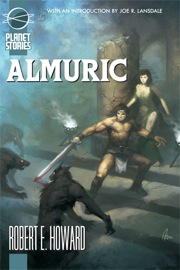
Okay, I lied. Robert E. Howard's Almuric, the latest release from Planet Stories, isn't actually a Conan novel. But it sure feels like one.
No, as a piece of literary history, Almuric is actually far more fascinating. Best-known as the creator of Conan the Barbarian, Robert E. Howard was one of the most distinctive and well-regarded voices of the pulp era. His brutal, might-make-right take on fantasy inspired generations of books, films, and games, almost single-handedly popularizing the sword and sorcery genre in the 1920s and 30s. His friendship with H. P. Lovecraft led to contributions to the vast and intricate Cthulhu mythos. His work has been called "so highly charged with energy that it nearly gives off sparks" by none other than Stephen King himself. Even his personal life has become legend, having been turned into the award-winning movie "The Whole Wide World." And who knows how much more he might have accomplished had he not infamously taken his own life at the age of 30.
Yet for all of his extensive achievements and hundreds of stories, Howard wrote very few actual novels, of which Almuric is by far the largest and best-known. Within its pages, a Conan-esque brute named Esau Cairn, dissatisfied with life on earth and running from the law, finds himself transported to another world, where his natural strength and savagery make him a powerful captain of men. On this planet of beautiful maidens and their Neanderthal-like warrior consorts, strange beasts and black-winged men, Esau carves out a place for himself with bared steel, and in so doing rescues a valiant civilization from the oppression of sadistic masters. In short—classic Howard.
Or is it? Therein lies the mystery that's one of the most fascinating things about Almuric.
You see, Almuric was first published three years after Howard's death in 1936, supposedly from a complete manuscript discovered among his personal documents. Yet while most of the manuscript has been universally accepted to be original Howard material, the last few chapters have long been a source of controversy. Did Howard, indeed, finish the last section? Or was the story instead, as some personal letters from Howard's father hint, finished by another author as part of a shrewd financial move? For those historians who believe the latter theory, the chief suspect responsible for wrapping up Almuric is none other than Otis Adelbert Kline, Howard's literary agent and himself a prominent Weird Tales author (who, incidentally, will be seeing print in Planet Stories this September). In addition to veiled references to shady arrangements, theorists who believe Howard never lived to see a complete Almuric draft point to the novel's ending as uncharacteristic of Howard's style, whereas others accuse such conspiracy theorists of jumping at shadows. The debate rages on to this day.
So pick up a copy, breeze through its action-packed story, and see which camp you fall into. And once you've made up your mind, post on our messageboards and let us know where your suspicions lie!
And now, a sample:
Of all the forms of life I had encountered on that strange planet, none filled me with as much loathing as these dwarfish monstrosities. I backed away from the mangled heap on the earth, as a nauseous flood poured through the rift in the wall.
The effect of those vermin emerging from that broken wall was almost intolerably sickening; the suggestion was that of maggots squirming out of a cracked and bleached skull.
Turning, I caught Altha up in one arm and raced across the open space. They followed fleetingly, running now on all fours, and now upright like a man. And suddenly they broke out into their hellish laughter again, and I saw we were trapped. Ahead of me were more emerging from some other subterranean entrance. We were cut off.
A giant pedestal, from which the column had been broken, stood before us. With a bound I reached it, set the girl on the jagged pinnacle, and wheeled on the lower base to take such toll of our pursuers as I might. Blood streaming from a score of gashes trickled down the pedestal on which I stood, and I shook my head violently to rid my eyes of blinding sweat.
They ringed me in a wide semicircle, deliberate now that their prey seemed certain, and I cannot recall a time when I was more revolted by horror and disgust, than when I stood with my back to that marble pillar and faced those verminous monsters of the lower world.