Thieves Vinegarby Kevin Andrew Murphy ... Chapter Four: The Hall of Whispers You might think that watching cultists devour a corpse would be the most horrible sight one could witness. ... You'd be wrong. ... The most horrible sight is watching those cultists throwing the corpse back up while a vampire vomits. This latter is particularly bad when you remember who the priestess seated me opposite. If I ever hear a bard say the words bathed in blood again, I swear I'll kick him. ... I wanted to...
Thieves Vinegar
by Kevin Andrew Murphy
Chapter Four: The Hall of Whispers
You might think that watching cultists devour a corpse would be the most horrible sight one could witness.
You'd be wrong.
The most horrible sight is watching those cultists throwing the corpse back up while a vampire vomits. This latter is particularly bad when you remember who the priestess seated me opposite. If I ever hear a bard say the words "bathed in blood" again, I swear I'll kick him.
I wanted to kick my brother, but he'd saved us. While the cultists dealt with their unexpected illness, he'd located a secret side door and unlocked it with a mithral chime, then bustled us through. When the door was safely latched behind us again, he began to explain about harmonics and sympathetic vibrations, but I really didn't care. I was covered with the blood of Zharmides the Godless while Norret didn't have a speck on him. He'd been standing safely out of range, painting the portrait.
Norret was actually quite pleased with how it had turned out, and I had to admit that it was well done, assuming one likes portraits of cultists slicing up dead naked wizards. I was in the back, holding the unicorn horn spoon in one hand and the vampire's lavalier in the other. Rhodel was there as well, holding Zharmides' damned snuffbox with the lions and lilies, like a treasure chest for a pixie pirate queen.
Norret was happy that he'd found such a good use for the canvas, while I was upset because Urgathoa's pepper mill was still amethyst even though Rhodel wasn't touching it.
"Hmm, interesting." Norret took it, holding it by the chain as it went white. He touched it with his bare fingers, watching it change to rose quartz.
He handed it back. While it was pink for a moment, it swiftly purpled. "But I'm not undead!"
"Probably another false positive," Norret speculated. "It may test for some other property. Perhaps Urgathoa's approval."
I was about to protest that I didn't know why Urgathoa, goddess of sickness and escaping your grave, might approve of me, but I bit my tongue. Plus I'd just had a vampire get sick all over me. "What was in that vial?"
"Syrup of ipecac," Norret replied, "a powerful emetic. It's made from the root of the ipecacuanha plant. Didn't I tell you?"
He hadn't, nor had he told me we'd be traveling through Korvosa's sewers.
He was still holding the map he'd purchased before, tracing imaginary lines on it as we made turn after turn through the stinking—but admittedly rather spacious—tunnels beneath the streets. I didn't like to think about why folks would need to build them so large.
Norret was mumbling to himself, counting his paces. Each time I started to breach the silence, he waved my questions away, lest I interrupt his rapidly expanding total. At last he said, "If we went left there, then we should be under it right about..."
We turned a corner, and found a wall with an unmarked iron door set into it.
"Perfect!" Norret said. He opened his box labeled Hessim, Newby, & Sage Paint Manufactory's Complete Pigment Panoply. He selected the smallest pot of paint—already half empty—took a nip of some elixir, and set to painting an intricate key on a page of his formulary. He blew on it to dry, then held up the book and shook it.
A complicated iron key fell into his hand.
Norret corked the tiny sample pot, cleaned the brush, and put away the set.
The key fit the lock like it was made for it.
Nella is a tricky one, that's for sure.
An iron staircase wound upward. Occasionally passageways branched off. Terrible screams and moans echoed from those halls. We passed a silver mirror, and in it I glimpsed Rhodel talking with two men dressed as guards. No one stood on the stairs.
At last we came to another door with a keyhole. Norret inserted the iron key. It turned.
It opened out into a library—an unusually round one—with the door a hidden panel disguised as a shelf of books. A moment later I realized that all the books were false. They were made out of bronze, the same as the busts of the dead wizards and the statues of the past headmasters of the Acadamae. The floor was black marble inlaid with silver circles and arcane diagrams, and the dome above was painted midnight blue and spangled with stars. In the middle hung a great glass lantern painted to look like the moon, but from this angle, it looked more like a skull.
"It's the columbarium," I breathed. "The Hall of Whispers...."
As I said the words, they were repeated, ghostly echoes whispering around the room.
"Oh!" exclaimed Norret. "A whispering gallery! I've read about these! Some interesting acoustical properties here...."
His words echoed around the room as well, hissing and whispering as they passed the bronze books and the effigies of wizards past. Then they were followed by other words, repeated whispers not spoken by my brother: "Ya thievin' packrats! Give back what ya stole!"
There, before an alcove with his bust, stood Zharmides the Godless–completely transparent. But this time, thankfully, with his clothes.
Something was wrong, subtly wrong, but I couldn't quite say what.
"Give it back!" he wailed. "Give back my iv'ry chest or I'll curse ya ta–"
Suddenly the scent of ectoplasm and roses manifested as another ghost appeared—one I knew—and I realized what was wrong. Zharmides looked like a ghost, but didn't smell like one. Ever since I'd died and come back, I'd had the ability to sense ghosts by smell. And this one didn't smell at all.
Rhodel stared eye to eye with her fellow ghost. "Boo!" she said as she reached up and flicked his hat.
Zharmides' bowler raised in the air, hissing, while lines of blood appeared, trickling down his face. His hat flew atop his bronze bust and turned into a pug-nosed orange tabby. "Marcat! No!" the dead wizard cried in a feminine voice.
Rhodel disappeared, smirking.
The ghost of Zharmides the Godless turned toward us.
"My mistake." Nella Cailean's illusion melted. "Never pick drama over believability. I should have just impersonated Headmaster Ornelos." She shrugged. "Anyway, I still want the little ivory chest." She held out her hand.
"Why?" I almost screamed. "Are all wizards mad? What's so important about a snuffbox?"
"Sivanah only knows!" she laughed. "But all the older instructors have them, so I intend to find out."
"And how'd you know we'd be here?"
"My main field of study is illusion, but I dabble in divination as well. I spy with my little scry..." She produced a sheet of paper and grinned at Norret. "I still haven't figured out your claw spell, but a page from an alchemist's formulary and a handwriting sample? Can't ask for better sympathy than that."
"I thought I felt someone was watching me," said Norret.
"And a whole lot more will be if you don't give me Zharmides' snuffbox." She paused. "And the vault key. I only reserved the columbarium for an hour, and you must have alerted half the spectral spies."
A knock sounded at a door on the other side of the chamber.
"Reserved!" Nella cried. "Summoning!"
"Acadamae security!"
Nella looked at Norret. "Give me the goods, and I'll get you out. Refuse, and you deal with the guards."
"So will you."
"I'm a student. I'm used to it. You?" She cocked her head. "Did you hear the screams in the halls below?"
"Fine," he agreed. "Just be quick." He placed the key and the snuffbox in her hand.
They disappeared up her sleeve. "Understood." Nella wove her hands in the air, muttering arcane syllables. My brother's appearance melted, reforming into the image of Arlunia Ehrmande, Lecturer in Charms.
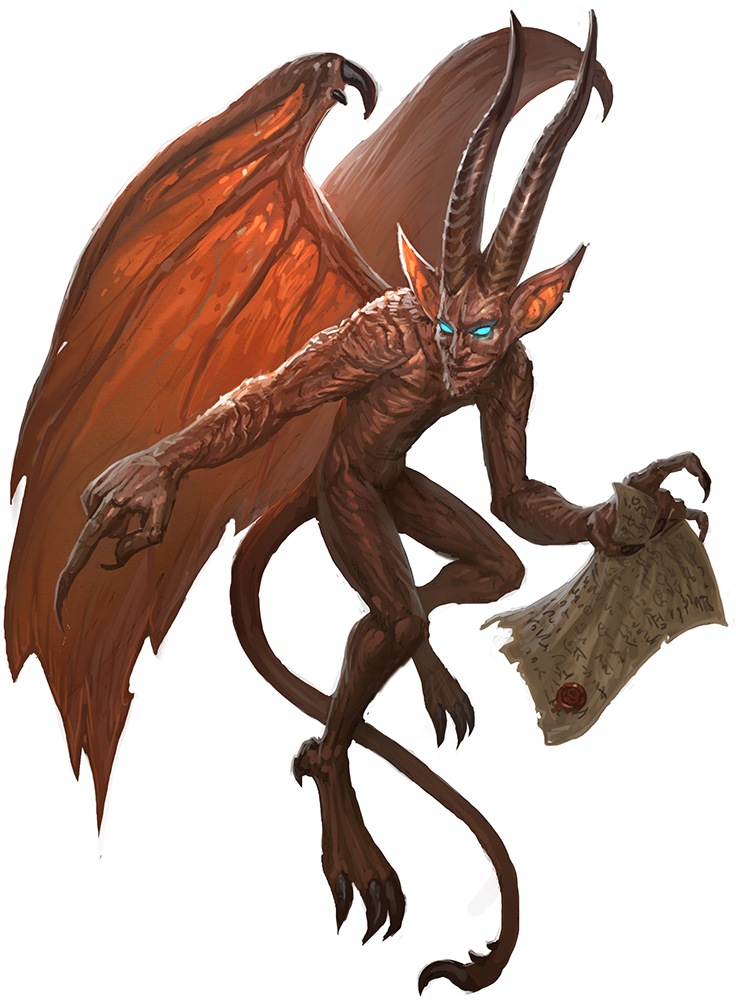
The door opened and three hellspawn entered the chamber.
"You fools!" Nella screamed. "I summoned a drekavac, and now it's out of its circle!" She pointed at me.
"What's a drekavac?" the first hellspawn asked.
The second stared at me in horror. "You summoned a plague spirit?" He turned to Nella. "Are you insane?"
The third remarked, "Don't drekavacs have animal heads?"
"It's a greater drekavac!" Nella improvised. "A bloody drekavac! A child who died of the plague!"
So far as I knew, I'd only died of a fever, but Nella's lies were uncomfortably close to the truth. I was also acutely aware that I was still drenched in the blood of Zharmides the Godless.
"Professor Ehrmande, do you think you can hold it?" Nella asked breathily.
"I think so," said Norret in his normal, masculine voice.
The hellspawn stared at him. "Does she have the plague?"
Norret coughed.
"Save yourselves!" cried Nella.
The hellspawn ran out the door.
Nella produced a wand. "Hold hands and run for the Acadamae gates. This won't last long." She touched me with the wand and said a single word: "Fernseed." Then she touched Norret. "Fernseed," she pronounced again and he vanished.
We were invisible. We ran for the open door and out into the Hall of Whispers. We found the main entrance by following the cries of "Drekavac! Drekavac! Run!"
We were out on the lawn, out the front gates, and halfway down a side street before the spell wore off. The illusion of Arlunia Ehrmande lasted a little longer, but was gone by the time we found a bridge to cross the Narrows of Saint Alika.
By the time we got to the Old Quay, I was staggering. Norret covered me with his cloak, and I finally slept.
∗∗∗
Teleportation is an awful way to wake up, but it was followed by the realization that we were back in Galt, in the Primrose Suite.
Sweet Galt. How I'd missed her.
"Blue Liberty!" Dr. Orontius swore. "What happened, Orlin? You look like you were in the front row at a particularly spectacular beheading!"
I wanted to say, "No, a vampire got sick on me," then found that I already had. Before I hardly knew what I was doing, the whole story came out. Norret even had pictures, including his painting of the cult's feast just before they all threw up.
Dr. Orontius worked a small spell, making all the blood that covered me vanish, then Norret told the rest of the tale, including how he'd lost the snuffbox.
"'Nella Cailean,' you say?" asked Dr. Orontius. "Saucy little minx. Well, two can play at the scrying game...."
"Unless there's lead in the way."
"Well, yes," admitted Dr. Orontius, "but it's not that common."
"White lead is also the primary ingredient in flake white, which I used to gesso my canvas." Norret opened his case of pigments, revealing a full jar of white paint. "I used to be a soldier, so I'm familiar with the feeling of being scried on." Norret reached into the jar and removed a tiny chest. "I assumed you could clean this off."
"Splendid!" cried Dr. Orontius. "You painted the snuffbox in the portrait twice, once with mundane pigments, once with the marvelous ones?"
"Yes," said Norret.
Dr. Orontius chuckled heartily. "Knowing what I do, Nella should be heartily surprised when she discovers that her prize is a fake!" He repeated the blood-removing charm, but this time it stripped paint, leaving a pretty little ivory snuffbox, complete with gilded scrimshaw lions and lilies.
He opened the tiny chest, bringing it to his nose and sniffing. "Ah yes, dear Zharmides always favored Peshpetal Blend." He snapped it shut and held it to his heart. "I will cherish this memento and think of him always."
"You could cherish that and think of him too." I pointed to the portrait of the cultists devouring Zharmides' corpse.
Dr. Orontius looked uncomfortable. "Yes, well, perhaps I might use that to retrieve some fragment of his body."
"So what's the snuffbox for?"
"Clever boy." He pinched my cheek. "Perhaps one day, if you are clever enough, you might attend the Acadamae and learn that secret." He patted me on the head for good measure. "But presently, you must work. Breakfast won't fix itself!"
There is something wrong with a world where ghouls and vampires are more polite and grateful than a houseful of scholars. I went out to the garden, let out the chickens that had been cooped up all day, and took in a double helping of eggs.
The post-execution day omelets were late the next morning, but they were seasoned with thileu bark. I declared them "Omelets Korvosa." If I didn't need to tell the boarders about unicorn bone porridge, I didn't need to tell them about Urgathoa's pepper mill either.
I was beginning to fix lunch when the bell for the Primrose Suite began jangling. Dr. Orontius had some nerve. But when the wire pulled the spring out of the wall and slammed the bell into the ceiling, I realized something was seriously wrong.
"Rhodel, get Norret!" I raced for the Primrose Suite.
Norret was already there, staring at the door, his monocle pushed up on his forehead. A horrible banging and cursing came from the suite, mixed with the screeching of an owl. Norret was half-shaven, holding a mug and shaving brush.
He pushed the monocle back in place, spat in his shaving mug, and painted the doorframe with the resulting lather.
Norret pushed me down on the floor. The lather sizzled and exploded, the entire door and doorframe falling out into the hall. Plaster dust swirled through the air like smoke.
Through the new arch into the Primrose Suite, I saw Dr. Orontius being beaten over the head with a gold-topped cane by Zharmides the Godless. Meanwhile, a green winged monkey-gremlin-thing attempted to garrote our boarder with the bell pull while an owl clawed at it.
Norret still had his pomander orbiting his head. He hurled it at the gremlin, angling the opening just so. The thing screeched, blinded by thieves vinegar. It looked like a beribboned, clove-studded orange-peel hat had been pulled down over its eyes.
"Get the homunculus," Norret said. "I'll get the wizard."
I wasn't certain how I was supposed capture a flying manikin, but then I spotted a bell jar on the mantel. It was covering a clock the same size as the homunculus.
I used my spirit's hand to tweak its nose. The homunculus flew up as I caught it in the jar, clapping the open end down to the surface of Dr. Orontius's traveler's trunk. The thing raged against the glass, but it was too heavy for it to lift.
With a terrific thundering that rattled the windows and knocked all the pictures askew, Zharmides the Godless blew up—fortunately into flecks of shaving cream and shadows rather than blood and gore like the last time he'd been ripped apart. A torn scrap of parchment fluttered down, and Dr. Orontius's owl familiar caught it. He dropped it in my hands before taking his customary perch atop the bust of Nethys and looking at me expectantly.
I examined the parchment. It was half of a magical figure—half a circle, half a square, and the upper half of Zharmides the Godless, holding his cane in one hand, his arms shown in two positions, like an architectural diagram for a jumping jack. More sympathetic magic.
I turned. The lower half of the symbol was pasted inside the open lid of another large chest, an ivory one. But it was still possible to see that this one was scrimshawed with lions and lilies and filled with books.
"Thank you," Dr. Orontius wheezed, loosening the bell pull from his throat. "Your assistance is appreciated but was not strictly–"
"It's Zharmides' trunk," I said. "The real one. The little snuffbox is just a focus, isn't it?"
Dr. Orontius harrumphed, but he couldn't hide the guilty expression. "How was I to know—"
I cut him off. "You use the paintings when you teleport somewhere. By the same principles, you use your snuffbox to teleport your traveler's trunk to you later when you want it. Why go back to your library when you can have your library brought to you? Zharmides knew the same trick, but to get his books, you needed his snuffbox. Which would have all worked out fine, except he left his homunculus inside the larger chest along with a trap."
"A symbol," Dr. Orontius said, feeling the lumps on his head. "I'm not certain which one...."
I handed Dr. Orontius the upper half of the torn piece of paper.
Norret beamed like a proud parent. But he was actually just my brother, and someone had to have a head for business. "I don't know what deal you had with Norret," I said, "but I'll be making up a bill."
I stepped out over the rubble, adding, "There will be no further room service."
Coming Next Week: A sample chapter from Richard Lee Byers' new Pathfinder Tales novel Called to Darkness, starring the Kellid warrior Kagur and her quest for vengeance against the frost giant that killed her family!
Kevin Andrew Murphy is the author of numerous stories, poems, and novels, as well as a writer for Wild Cards, George R. R. Martin's shared-world anthology line. His previous Pathfinder Tales stories include "The Secret of the Rose and Glove" and "The Perfumer's Apprentice" (also starring Norret and Orlin), and "The Fifth River Freedom," the fourth chapter of Prodigal Sons in the Kingmaker Pathfinder's Journal. For more information, visit his website.
We were in the Gray District, the necropolis in the southeastern corner of Korvosa. More specifically, we were in Potter's Ward, the southeastern corner of that, used for the graves of the poor. The air was filled with greasy smoke. It smelled like someone was cooking rotting pork and it had caught fire. Except that in this case it was long pork. The only thing that smelled worse than the burning corpses were the ones that weren't yet burnt.
Thieves Vinegar
by Kevin Andrew Murphy
Chapter Three: Still Life with Snuffbox
I have never been so grateful for vinegar in my life.
Norret had taught me, as part of the science of perfumery, that there were seven basic scents. One of them, putrescence, was necessary in any truly fine perfume, but only the faintest note.
Putrescence was found in stinkhorn fungi and the carrion flowers of the Mwangi Expanse, but most commonly in putrescine and cadaverine, alchemical substances that came from corpses.
We were in the Gray District, the necropolis in the southeastern corner of Korvosa. More specifically, we were in Potter's Ward, the southeastern corner of that, used for the graves of the poor. The air was filled with greasy smoke. It smelled like someone was cooking rotting pork and it had caught fire. Except that in this case it was long pork. The only thing that smelled worse than the burning corpses were the ones that weren't yet burnt.
Some of those even stumbled around. I think they were zombies–I hope they were zombies–because the other alternative was that gravediggers and priestesses of Pharasma were beating still-living plague victims with shovels and setting them on fire.
I clutched my pomander orange and inhaled the floral notes of tansy and thyme, the camphoraceous notes of rosemary and lavender, the minty note of mint, and the sweet pungency of apple cider vinegar.
"Wizards are utterly mad, Rhodel," I told my spirit guide, or possibly the empty air. "Even crazier than alchemists." I held the pomander against the stench. "A 'keepsake,' Dr. Orontius said. A memento to remember his beloved school chum.…" I snorted and was immediately sorry because I'd snorted vinegar. Then I was less sorry because, once my eyes stopped watering, I realized I couldn't smell anything.
I glanced at another corpse and checked Norret's picture of Zharmides the Godless.
Nella had told us more about Zharmides, a convert to the Rahadoum heresies who spiced his divination lectures with tart comments on the gods, calling Blackfingers a two-bit snake-oil salesman and Pharasma a schoolmarm with an attendance fetish.
Nella wouldn't repeat what he said about Asmodeus other than mentioning that one particular string of blasphemies had reportedly made an imp faint.
I was sorry that he was dead, and even more sorry I wasn't finding his body. That was my job while Norret ran interference, helping the priests and priestesses of Pharasma blow up the zombies that seemed to be rising with some regularity. Our story was that we'd been sent to help by the temple of Shelyn, not that anyone seemed inclined to check.
When I wasn't looking at corpses, I amused myself—if that's the right word—by examining the potsherds the Potter's Ward was named for. Norret's art tourists' map noted that some believed the bits of broken crockery littering the soil went back to the time of the Shoanti.
I assumed this was a more relaxing pastime when there weren't zombies lurching around. Someone else with wild hair and glassy eyes lurched toward me, except this man had a wheelbarrow filled with fresh bodies. I was about to examine them when I took note of the gravedigger's brocade waistcoat. Not only was it too fine a garment for gravedigging, but it was covered with stylized Zs. Unfortunately, the pockets were all flat. Even the pocket square was gone.
"Where'd you get your waistcoat?" I asked.
The gravedigger beamed. "The master gave it to me."
"Who's your master?"
He paused, then said swiftly, "I have no master."
"Then whom do you work for?"
"I work for the Church of Pharasma. I am a simple fellow. I dig graves." His voice was as flat as a zombie's, assuming zombies could speak. He attempted to push past me with the barrow full of plague-raddled corpses. "Please move. I must bury these bodies."
To say that he was acting strange was an understatement. "Did you by any chance find a snuffbox? A little ivory one with gold fittings, same monogram on the bottom as you've got on your vest?"
"Oh yes. The— He was very pleased to get it. Said every nobleman should have one."
"So where's your master?"
"I have no master."
"Could you take me to your master?"
The gravedigger looked puzzled, then tortured. At last he whispered, "Only if you're one of the faithful?" His eyebrows rose hopefully.
"If I said that I was?"
"Then I would ask you for the password."
"What's the password?"
Rhodel certainly makes an attractive ghost.
"I'm not allowed to say." He looked frightened. "I am a simple fellow. I dig graves. Please move. I must bury these bodies."
I stepped aside. My skin prickled as if a whole gaggle of geese were walking over my grave, and I've been dead so I know what that feels like. I went to Norret and told him about my conversation.
"Drugged or enchanted," he concluded. "Duke Devore's formulary has a recipe for hypnotic perfume, but..." My brother flipped one of his monocles down and peered at the gravedigger. "Definitely enchanted. Mind-controlled—I've seen it on the battlefield. Give someone too many contradictory orders and the mind starts to break."
I didn't know if he was talking military orders or magical ones, or if there was much of a difference. "How do we find his 'master'?"
"We keep an eye on him and an ear out for this 'password.'"
When my brother said "keep an ear out," he meant this literally. He swigged some tincture of wolfsbane and grew ears as long and pointed as a wolf's. A bit of eavesdropping and spying on the addled gravedigger later, he said, "I am famished."
"You're hungry?" I gasped, still holding my pomander against the stench.
"No, 'I am famished.' That's the password."
It certainly wasn't one that easily sprang to mind, especially with how I'd lost any trace of my appetite, given the reeking corpses. But with that last clue, everything about the strange man fell into place. "I guess that tells us what he meant by a 'one of the faithful,' then?"
Norret nodded. "It would seem that the grave digger—or whoever's controlling him—is a worshiper of Urgathoa, goddess of gluttony and undeath."
I shuddered, but it made sense. Who else would be hungry in a graveyard?
Once the sun had set, our pomander oranges began to glow with will-o'-wisp light like little moons. We dodged one last patrol of Pharasmins as the priests swept the necropolis before locking the gates for the night–plague or no plague, even priests of the goddess of death needed sleep, especially after the day they'd had. Norret and I, on the other hand, would get no sleep, not just because of where we were but because Norret had prepared a pot of coffee Woodsedge-style—half coffee, half roasted chicory root.
We picked our way across the Potter's Ward, trailing the gravedigger and a cortege of figures we presumed were cultists. We hopped a low fence into Everyman's Ward, and finally slipped past a loose bar in the spike-tipped iron fence that led to the Gold Ward where the nobility were interred. Being a Galtan, it soothed my soul somewhat to know that the Urgathoans were desecrating the tombs of the nobility rather prying into graves of the common man, not that I think they were making that distinction.
Most of the mausoleums in the Gold Ward were grand affairs, with polished brass knobs, cypress wreaths, and even freshly cut flowers placed in urns outside. One mausoleum looked decidedly seedy and unkempt, neglected for many years, the doors falling off their hinges and the only flowers being weeds and lichen growing through cracks in the marble façade. The name Galdur was carved above the doors, and the last cultist was disappearing down the steps.
We followed and were greeted at the bottom by a lady in a tattered spattered gown like from the nursery rhyme. Her black hair was an obvious wig, though her ghoulish teeth were real enough, having been filed to points. The cultist smiled, letting us get an even better look.
"I am famished," I said, and Norret did as well.
"Then you are welcome in Urgathoa's Hall!" She smiled as if welcoming us to a holiday party. "You must call me Deaconess Gentle. How should I know you?"
"I'm Orlin, and this is my brother, Norret."
"Oh, an artist!" She took delighted note of Norret's folding easel and the multicolored alchemical stains on his clothes. "You must paint a portrait to immortalize this celebration."
Norret nodded in hasty agreement.
"So, what have you brought for Urgathoa's feast?"
"Brought?" I repeated.
"An offering to share! An unholy delicacy for us to consume for the delight of the Pallid Princess!"
I thought, then remembered my little horn spoon. "How about unicorn bone porridge?"
"Delightful!" exclaimed the cultist. "Did the beast scream as it was butchered?"
"I don't know. It died a long time ago."
"Well aged, then." She turned to Norret.
"I brought coffee."
She rolled her eyes but merely said, "Mistress Kissim brought funeral biscuits. I'm certain they will go well together." She gestured to one corner of the crypt. "I think you might set your easel up there. It will have the best view of the festivities. Do we need more candles?"
"No, the shadows are just right," Norret said.
"Well," the deaconess allowed, "none of them are hungry, but I'm certain that can be remedied later. I'm just so pleased we have an artist. Please, come in."
Norret nodded and did.
I might have expected many things of the cult of Urgathoa, but one thing I did not expect was a demented potluck. Cultists were milling about, placing food on the old sarcophagi like they were artists arranging still lifes—should the skull go beside the cheese tray or on top of it?—and everyone was chatting as if they'd gathered in some Isarn salon for a Crystalhue feast rather than in an abandoned Korvosan crypt for the blasphemous rites of the Pallid Princess.
Deaconess Gentle peered up the stairs. "Is there anyone else?"
"One more." The scent of roses and ectoplasm replaced the musty odor of the crypt.
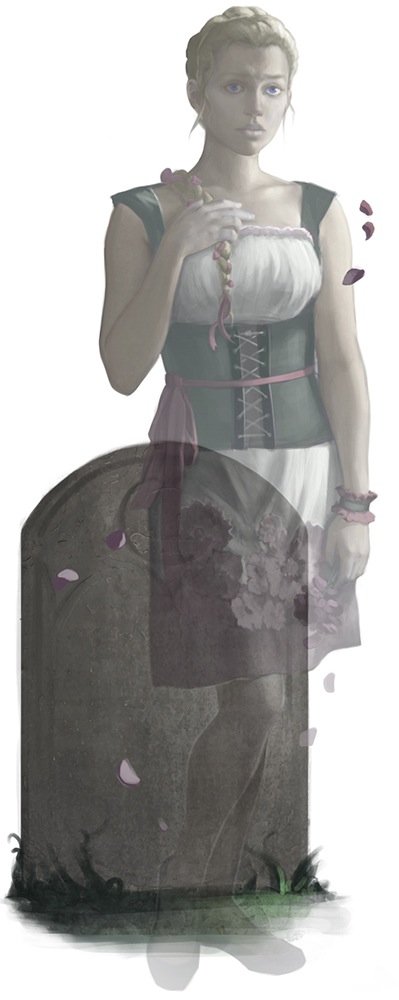
Beside us appeared a vision of loveliness, a girl of no more than sixteen summers garbed in a green and ivory festival gown, a garland of pink noisette roses plaited into her golden hair. I'd only seen my spirit guide in this world once, when I was poisoned, but necromancers had told Norret and me that spirits had an easier time appearing to the doomed or the dying, or in certain places where the veil between worlds wore thin.
I hoped it was the third possibility, or at least that "doom" was more a warning than a certainty.
"How lovely you are!" The priestess clasped my spirit guide's hands, but not quite. "How may I know you?"
"Call me Rhodel."
"It is an honor to be graced by one of the incorporeal. Lord Galdur had feared that he would be the only one here to celebrate an ashenmorn."
"Ah nae." Rhodel laughed. "Orlin slipped his grave too."
"Indeed?" said Deaconess Gentle, blinking at me. "I took you for a living child. Forgive me."
"No need," I said truthfully.
"You shall have the place of honor." The priestess showed me to a chair at the upper left corner of the central sarcophagus, seating Rhodel just to the right of me before taking her place at the head of the "table." It was covered with a funeral pall. Seated opposite me was a rakishly handsome young man with dark hair, pale skin, and mismatched finery. Being from Galt, I was familiar with the look. It was what happened when you raided the wardrobes of dead nobles and had no eye for taste.
"Now, Master?" asked the gravedigger groveling at his side.
"Now, Alfoun."
The gravedigger whisked away the pall like a waiter uncovering a tray. I tried not to look at what was on the slab–who was on the slab–not wanting to see another plague-ravaged corpse. But then I did and I realized that, apart from liver spots, there were no marks on the old man's naked body. The mouth was open in a death rictus. Even so, I recognized it. I had been looking at it all day. It was the face of Zharmides the Godless.
"Oh, one without the plague!" Deaconess Gentle exclaimed delightedly. "Wherever did you find it, Lord Galdur?"
The young nobleman smiled, revealing pronounced eyeteeth, and petted the gravedigger like a faithful dog. "Good Alfoun brought it to me."
"Urgathoa has truly blessed us! Much as I enjoy the fruits of the season, it's nice to have a little variety."
"Shall I have the kiss of undeath now, master?" the gravedigger begged.
"No!" cried the pretty young woman seated to his left. "You swore your next bride would be me!"
"Patience, dear ones. Go eat some rats."
He said this last just forcefully enough. They both scurried off to one of the lower tables where one of the other cultists had indeed brought rats, roasted on a stick.
"There is a chair free now, my lovely." Lord Galdur gestured.
Rhodel vanished from her chair and reappeared in the one at his side.
Deaconess Gentle made brief introductions, then told Rhodel, "I'm so embarrassed. We didn't expect any of the incorporeal. How might we feed your pain?"
"Mayhaps a li'l pinch a snuff?" Rhodel asked. "Loved it in life 'n I kin still smell it in death."
Deaconess Gentle looked perturbed, but Lord Galdur reached into his pocket and gallantly produced a snuffbox. The snuffbox. Ivory, carved with lions and lilies. Even the stylized Z on the bottom. "A nobleman never goes anywhere without it."
"Ah, how pretty!" Rhodel exclaimed. "Lemme guess yer name. Is it Zander? Zaries?"
"It's Tyrnan," he said smoothly, "the fourth of that name. But I inherited this from my great uncle, Zellin Galdur."
I realized then that the vampire was a fraud—and likely about more than just the snuffbox. I suspected that if he had any noble blood in him at all, it was only because he'd drunk it.
"I've been ta the other side. I've met Tyrnan Galdur. All four." Rhodel took the snuffbox from him—actually, physically took it—and smiled. "Yer not him."
The vampire hissed like a cat, fangs bared, but this wasn't very frightening to a ghost. "And you, milady? Who are you, appearing like a Shelynite doxy at Urgathoa's feast!?"
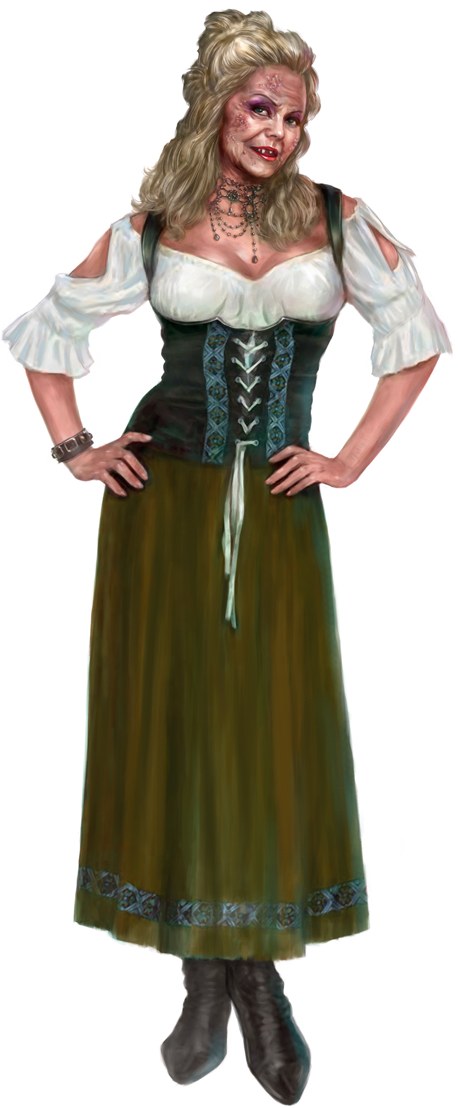
"Ah," said Rhodel, "ye found me out. 'Tis true. I loved the Rose mosta' all. But I lived a long life, an' I prayed ta the Pallid Princess there at the end." As she said this, she grew older and older, the lines of age and care appearing on her face, then the sores of hag pox, the harlot's curse. "Kith me, handsome!" she slurred, her odor of roses turning to alcohol, anise, and the stench of sulfur as she grabbed him in a clench. Then she caught fire and exploded in a flash of fireworks and ectoplasm.
The vampire shouted and stood, his chair clattering behind him.
I felt something appear in my hands. It was the snuffbox, sticky with ectoplasm. I quickly put it in my pocket.
Deaconess Gentle retrieved her wig from where it had been blown off in the explosion. Beneath it, her hair was stringy and white. "The incorporeal—always so dramatic!" she exclaimed to the assembled cultists.
"Where is she?" hissed the vampire. "Where's my snuffbox?"
The priestess tugged the edge of his coat. "Lord Galdur, please. The ritual."
The vampire sat, glaring at me.
Deaconess Gentle placed one hand on my shoulder, then addressed her congregation, "My famished ones, this is Orlin. He's brought us a special delicacy. What was it again, dear?"
"Um, unicorn bone porridge."
Appreciative sounds issued from the cultists. The pretty woman who wanted to be a vampire brought me a bowl. I tried to ignore the fact that it was made from the top of a human skull and placed the little horn spoon inside.
Thick pasty gruel welled up. Norret had tried to make it look and taste like blancmange, but it only did insomuch as blanched almond pudding looked similar to stewed unicorn bones.
I offered the bowl to the priestess. She took a delicate bite. "It... has a lovely texture," she said politely. "Like rotten brains."
I was less disturbed than I should have been. "It's a little bland," I admitted.
She smiled. "I believe Lord Galdur may have a solution." She turned to him. "Might Orlin borrow your talisman?"
The vampire set down the glass of blood he had been draining from Zharmides' arm and addressed his priestess. "Does he have any skill as a chef?"
"A little," I admitted.
"Marvelous." He greeted me with a predatory smile. "Behold this talisman, sacred to the Pallid Princess." He reached up to his neck and touched his lavalier. "It makes the blood of the dead taste as sweet as that of the living." The pendant was amethyst, dark as Hymbrian grapes, a six-sided natural crystal capped with silver filigree in the shape of flies. "In the hands of a true chef, it can also produce sugar, salt, and spice. Yet that is not its only virtue. When touched by the undead, the Princess's crystal becomes the pure purple of royalty." He unclasped the chain, and held it out, then dropped it to pool on Zharmides' dead chest. "When touched by those bereft of Her blessing, it turns pale." The crystal clouded and color leached from it, transmuting from amethyst to milky quartz, white as leprosy. "But when touched by the living, it turns as pink as a baby's cheek."
The vampire bared his fangs in a feral grin. "Although you appear alive, Orlin, you smell of vinegar, like my cousins from the east." He stared at my neck. "Tell me, does your head come off?"
So far as I knew, everybody's head came off when you applied a Final Blade. "Yes, but I'd prefer if it stayed where it is."
"Just so," said the vampire. "I've heard it's troublesome to put your head back. But as youthful as I appear, I am older than I look."
"Same here."
"Indeed," agreed the vampire, "but from what I know, my eastern cousins are all women, not men. And never children. Touch the talisman and reveal Urgathoa's truth!"
He was trying to command me like his rat-chewing lackeys. But it was a litmus test. As awful as Urgathoa was, she still followed rules. The milky quartz of the pallid crystal would turn to amethyst for the dead and rose quartz for the living.
Of course, if you contaminated your sample, a litmus test could yield a false positive or negative. "Fine." I stood up and reached for the crystal while under my breath I said, "Rhodel...."
My spirit guide knew how to take a cue. I felt the cold touch as her hand overlaid mine.
I sat back down. While my fingers were closed around the crystal, they weren't touching it. Rhodel's were. Slowly I saw it clear and change from lavender to violet to deepest amethyst.
"Blessed child of Urgathoa!" cried the priestess.
The vampire sulked, even more so when I asked, "So what do I do now? Twist it like a pepper mill?"
As I said the word "pepper," a sprinkle floated down over the bowl of unicorn bone porridge, just like it had for Dr. Orontius. "Does it do thileu bark?" As I said it, it answered my question.
"If you add some fear's breath and hatefinger, I'll take that bowl, please," said Deaconess Gentle.
I'd never heard of these herbs, but Urgathoa's lavalier had, adding a sprinkle of each.
"Just nightfog and bloodroot for my wine," "Lord Galdur" grumbled sourly, holding out his glass of wizard blood.
Orders came in. It was almost like I was back in Isarn dishing up breakfast for our boarders. I fixed myself a bowl of porridge, seasoned it with sugar, cinnamon, and ginger, and tried to pretend I wasn't eating out of the top of someone's skull. It did taste like mother's blancmange now.
The festivities proceeded. Deaconess Gentle opened some moldering tome titled Serving Your Hunger, which I'd initially taken for a cookbook, and led the congregation in a ghastly chant made more horrid by the fact that most of the cultists were off key. Then she had me sprinkle Zharmides the Godless with thileu bark, after which she proceeded to pour Korvosan tawny port over the wizard's corpse and began to dish up slices of meat.
I didn't know whether this was the fate the gods had designed for those who mocked them or whether Zharmides had foreseen it and this explained his choice in religion.
As the cultists continued their ritual, I began noticing little oddities. For all that she looked the part of a priestess, Deacon Gentle seemed to fumble her way through the divine readings, sometimes stopping and having to repeat passages. Though the other cultists ate with gusto, all bore normal human features, and one or two even seemed a little queasy over the things they were shoving into their mouths. Only the vampire was actually undead, and despite the way the humans simpered and fawned over him, he too seemed to be trying hard to play a part—that of the world-weary undead lord.
They're new at this. The realization struck me suddenly, and for a moment I felt a little sorry for them. I wondered if their conversion was the result of the plague, or if they merely hoped to be rewarded by the vampire. Either way, it was a pathetic scene.
Then one of them began gnawing at a loop of intestine, and my sympathy evaporated.
I realized that Deaconess Gentle was looking expectantly at me. She was holding an empty plate, waiting for me to request a cut.
"Um, that's not how I... serve my hunger," I said as politely as I could, hoping I was saying the right thing.
"Indeed? And what would your kind prefer?"
Alarmed, I looked for Norret. The woman followed my glance. "Oh, the artist! Of course—he'll eat first, then you'll drink from his veins. Splendid."
My brother came over and saw what he was expected to do. Fortunately there was a line of cultists, and some were going back for seconds.
I got his attention when the priestess went to pour more port over Zharmides' body. I surreptitiously slipped my brother the damned snuffbox. He put it in a pocket and handed me a vial, jerking his head towards the bottle of port.
I unstoppered the vial and gripped it tight with my spirit's hand. It glittered like a diamond as I raised it in the air, but the cultists were distracted and drunk and didn't notice the drops dripping down as I added to Zharmides' seasoning. For good measure, I made sure a few drops got into the vampire's glass as well.
Then I pulled my spirit's hand back to my physical hand and stole a glance at the empty vial, pondering the label, written in Norret's neat handwriting: Syrup of Ip.
Coming Next Week: Things get truly gross in the final chapter of "Thieves Vinegar" by Kevin Andrew Murphy!
Kevin Andrew Murphy is the author of numerous stories, poems, and novels, as well as a writer for Wild Cards, George R. R. Martin's shared-world anthology line. His previous Pathfinder Tales stories include "The Secret of the Rose and Glove" and "The Perfumer's Apprentice" (also starring Norret and Orlin), and "The Fifth River Freedom," the fourth chapter of Prodigal Sons in the Kingmaker Pathfinder's Journal. For more information, visit his website.
Newby analyzed the contents of Norret's flask, pronouncing it ninety-nine point nine percent pure will-o'-wisp essence, with the impurities mostly consisting of honeysuckle and grape. Norret nodded, and the three old men fell to talking amongst themselves.
Thieves Vinegar
by Kevin Andrew Murphy
Chapter Two: The Hall of Lies
Newby analyzed the contents of Norret's flask, pronouncing it ninety-nine point nine percent pure will-o'-wisp essence, with the impurities mostly consisting of honeysuckle and grape. Norret nodded, and the three old men fell to talking amongst themselves.
"Wizards would buy it for ink," Sage pointed out.
"Wizards don't need this degree of purity," Newby countered.
"Would be useful for underpainting secret messages," said Hessim. "Signatures and such."
Newby snorted. "Think of the holy glow of Iomedae's sword or Sarenrae's rays."
"Bit heretical, considering the origin," said Sage.
"Then the ghastly pallor of Urgathoa."
"Or the flames in Asmodeus's eyes," Hessim enthused.
"Point," admitted Sage. "Wonderful for unholy icons. We are agreed then, gentlemen?"
"Aye," said his fellow shopkeepers.
The old men were nothing if not scrupulous. They kitted Norret out with an elaborate case of oil paints and brushes, including a traveling easel, a sketch pad, and a small canvas, while I was given a similar set of watercolors. They also gave us a map of Korvosa and advice on the best bridge to take to cross the narrows en route to the mainland and the Acadamae atop Citadel Crest.
It was grand. It was imposing. It was also open only to students, faculty, and tradesmen. Frightening hellspawn guards menaced those who didn't belong.
That said, Norret and I were Galtan, and we were used to avoiding the Gray Gardeners. Hellspawn gate guards, no matter how ridiculously twisted their horns, simply did not rate. We walked past.
A plague also raged, and we'd noted any number of Korvosans who'd masked themselves like hastily deputized Gray Gardeners, neckerchiefs pulled up over their faces to keep disease-bearing spirits from flying down their throats. Ours were Vudrani silks which had belonged to Rhodel.
Perhaps the most shocking thing were the imps that perched blatanly on the shoulders of students and professors, or lounged on the lintel of the main gate. These stuck out their tongues and made evil gestures at the tiny dragons who rode on the shoulders of better-minded students and faculty. One older and elegant wizard had a cloud of multicolored gemstones orbiting her head, serving as the hoard for the rust red drakeling perched atop the jeweled comb holding up her long red hair.
We had floating pomander oranges.
The Acadamae's discipline of its familiars leaves something to be desired.
We followed her into the Acadamae's grounds. Before us lay the grandest and newest building I'd ever seen in my life.
Suddenly an imp swooped down. "Trespassers!" it shrieked. "You've no legitimate business! You're our lawful prey!"
Norret displayed Dr. Orontius's letter, including the seal at the bottom, a calligraphic O that resembled an owl's eye. "On the contrary, we're here to deliver a missive to one of your instructors, Zharmides the Godless."
The little fiend snatched the letter, fluttering higher into the air, then turned a backflip as it giggled with infernal mirth. "Didn't you know?" the creature cried. "He's dead! Not even of the plague! Choked on a fishbone!" The imp laughed as if this were the most hilarious joke in the world. "But without this letter, you've no legitimate purpose—or even with it! Ignorance of the law is no excuse!"
"Except you've no lawful right to that letter either."
"Possession is nine-tenths of the law!" the imp countered. "Care to try for the last tenth?"
It hovered above Norret, just out of arm's reach. While my brother is tall, he's not that tall. Norret jumped for it while the imp pulled it out of the way, still chortling.
Then I saw my brother get angry.
Norret angry looks a lot like Norret happy, except instead of the corners of his eyes going crinkly, his lips go white. He took off his glove, the fringed one with the ruby on the back, then reached into his pouch and took out the reefclaw pasty. He seasoned it with thieves vinegar and chewed it slowly, his teeth becoming longer and sharper, pointed like an eel's.
Then his arm shot up and his hand—well, I've seen my brother sprout claws like a wolf or a bear, and once even talons like an owl, but that was nothing compared to this. His hand changed, growing and shifting, becoming a giant crawfish pincer with the top half as big and sharp as one of the Final Blades of Galt.
The claw snapped like a guillotine. The imp's head flew one way, the body another. The letter drifted down.
Norret caught it, his hand once again its normal shape. He tucked the letter inside his jacket, put on his unicorn-skin glove, and picked up the imp's body by the tail. He stuck the stinger through the stopper of a corked vial and watched as unholy venom leaked down the sides.
"Guards! Guards!" shrieked the imps on gate.
Norret tossed the imp's body on the ground. It smoked, the little fiend dissolving into ectoplasm and ash as Norret turned to face the hellspawn guards.
"Is there a problem?" asked a lilting voice. The wizard with the rusty house drake on her comb stepped forward. "These gentlemen are with me." Hers was a beautiful smile, sweet as an icon of Shelyn. "They agreed to paint my picture before the Hall of Charms. Isn't that so, gentlemen?"
"Yes," I lied. Norret nodded.
The guard with the improbable horns snorted. "Visitors are supposed to sign in at the front gate."
"You are forgetting that the guest book was found to be a source of contagion." The wizard still smiled her sugary smile. "Please just put down that Arlunia Ehrmande, Lecturer in Charms, has two guests for the afternoon, and try to see that those in my retinue are not molested by stray imps." The house drake on her comb flicked its forked tongue for good measure.
"Of course." The horned hellspawn bowed.
Our rescuer gestured for us to follow.
We accompanied her past a rhododendron hedge and around to where a wide lawn opened onto smaller buildings. She gestured to the left to a graceful structure partially obscured by a copse of trees. All I could see above them was a marble frieze of frolicking satyrs and enticing nymphs. "The Hall of Charms is always lovely in any light, but..." she mused, tapping one finger to her painted lips, "perhaps, today, another might be more apropos...." She indicated the building directly behind her. "You're the artists. What do you think?"
What I thought was that I'd seen the building before—the House of Joy, the Calistrian temple from Isarn. The building's shape was slightly different, but otherwise it seemed a perfect copy. Then I realized that the banners of the former palace displayed the old king's crest, and instead of the usual bevy of Calistrian beauties, the balconies were thronged with pre-revolutionary coquettes, frivolous young noblewomen with impossibly high hairdos, fantastically jeweled gowns, and flirtatious glances strikingly like the sacred harlots.
I blushed and looked away.
"Behold," said the enchantress, "the Hall of Lies...."
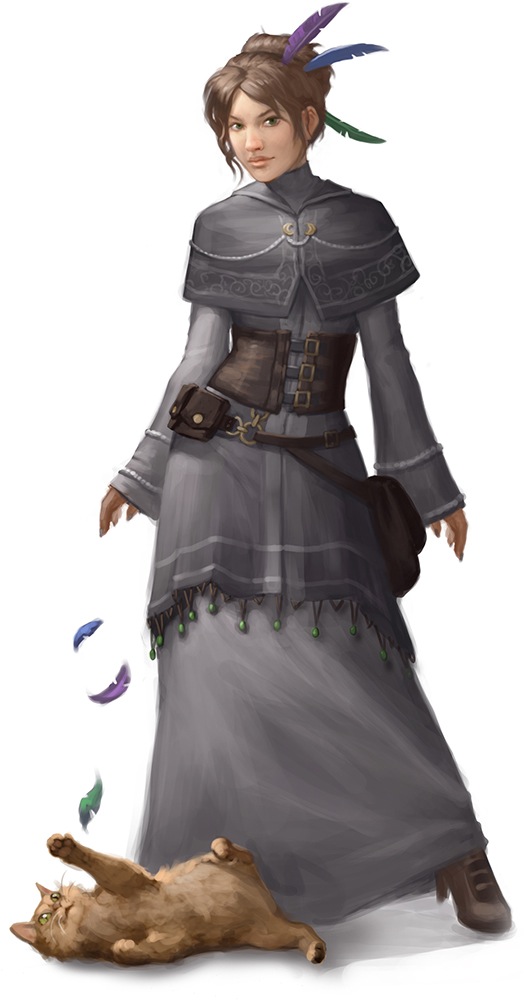
All at once she changed, like a chalk painting dissolving in rain. The woman's rich flowing gown became mouse-gray robes, her long red tresses became mouse-brown hair, the cloud of jewels vanished, and her comb became a bunch of pencils stuck in a bun. Even the haughty little house drake became a crumple-eared orange tabby cat.
It had been an illusion, I realized. The Hall of Lies had to be one too, since I didn't think it likely that the Acadamae would just happen to have a building I recognized so well.
The woman gave a lop-sided grin. "I'm not Professor Ehrmande," she admitted, "but I couldn't leave a couple Galtan boys to deal with the hellspawn. My grandfather's from Galt, and you sound just like him." She appeared decades younger than the serene enchantress. "Besides, I saw that spell with the claw. It's wicked good, and I want it."
"It wasn't a spell," Norret admitted.
"Alchemy?" she guessed. "All I'll say is I'm from Daggermark, and it's not a spell yet. Give me the page from your formulary and I'll figure out what's missing." She grinned and put her hand out. "Nella. Nella Cailean. Not the one from the puppet show and no relation to the really famous one either. And not Nellaforia or Nellali, and for Cayden's sake not Nellatirencia. Just plain Nella or Nel, Journeyman Fibber. And this," she said indicating the snub-nosed cat still perched atop her head, its eyes round and bright as two coppers, "is Lady Marcatella, or Marcat for short. You two?"
"Norret Gantier," Norret said, "and this is my brother, Orlin."
"And you have a fabulous estate back in Galt that you'll inherit once the Revolution's over?" She paused, looking at our expressions. "Wait, you're really from Galt? Not just the kids of refugees we've got crawling all over the River Kingdoms?"
I didn't know what to say. Here she was admitting that she not only knew escaped nobles but that she might even be descended from one and had even given her cat a noble title. Then I remembered that I was in Korvosa, not Galt, and the Red Revolution was half a world away.
"We're from Dabril," Norret explained.
Nella paused, glancing at Norret's glove and the ruby on the back. She chuckled. "You read Pintgarthe's Lost Jewels too, eh? Points for making it look believable. You can't imagine the sort of gaudy crap impers try to pass off when they take 'Frauds & Forgeries.' The Hero's Tankard made of solid gold chased with pearls? As if!" She gave us each a hard look. "But what's your scam? Don't try to fib a fibber."
Norret reached into his jacket. "We're just here to deliver a letter."
She looked at the letter and laughed. "You're after Zharmides' lost books too?"
"Lost books?" I was confused. I'd thought we were after a snuffbox.
"What, you really don't know? The imp told you straight: Zharmides is dead. Choked on a fishbone down at the Posh and Turtle. The professors have been accusing each other of stealing his books 'cause everyone wanted his spells. Speaking of which, you owe me one." She put out her hand.
Norret sighed and got out his formulary, his alchemical workbook. He pulled a blank page out of the back, took out his silver pencil, and began copying notes and scraps. It took a while, but at last he folded it and held it up out of Nella's reach. "A question first: Where's Zharmides' body now?"
Nella shrugged. "No great secret. The government's ordered all the dead taken to the plague pits in the Gray District and burned. The Acadamae's torched its dead in the Cube."
"And the ashes?"
She paused. "Sent to the Hall of Whispers for its columbarium."
"Columbarium?" I said.
She nodded, slightly so as to not dislodge her cat, which I realized had no tail. "Dome filled with cinerary urns: books for students, busts for instructors, full-on bronzes for headmasters, and a necromantic circle in middle so you can talk to their spirits, though it works a bit better if the urn has actual ashes in it."
I could already summon spirits–or at least one–without ashes, so I was less impressed than I might be. I heard a giggle, a bit too high-pitched and far too nasty to be Rhodel.
Nella raised her hand, adjusting her bun or her pencils or the cat who was sitting on them, but her pinkie was out at an odd angle and her cat was looking the same direction. I looked where both pointed. Norret did too, adjusting the lenses of his monocle.
Dr. Orontius once told me that three or more imps are called "an impudence." The impudence that was fluttering nearby scattered, spooked.
Norret looked back to Nella. "But Zharmides died outside the Acadamae."
"Right," she said, "and no one's wanting to search the plague carts to see if they've burned his body yet. The conjurers are pissed 'cause, if he'd had an imp, they could summon it and ask for his soul, but Zharmides, just to be contrary, had a homunculus."
"Homunculus?" I repeated, confused.
"Homunculus?" Norret said the same word delightedly.
He and she exchanged looks, and she explained, "It's an artificial imp."
"It's made out of a mandrake root," Norret continued, "and that's not quite accurate."
"It's a foot-high manikin with fangs and bat wings." Nella waved flippantly. "About the only visible difference is that an imp has a poisoned tail, while your classic homunculus has poison teeth."
"So what did Zharmides look like?"
"The spell first?"
Norret handed her the folded paper.
She opened it and almost absentmindedly stepped over to the Hall of Lies and tapped one of the statues flanking the door—that of a cavorting nymphette with precariously tall hair.
The statue's illusion flickered, feminine trading for masculine, youth for age, and hard marble for living flesh, now appearing as a stooped, thin-faced old wizard leaning on a gold-topped cane. The brocade of his waistcoat was woven over and over with stylized Zs, and the same sigil was engraved on the wax seal hanging as fob from his watch chain. I didn't see a snuffbox, but I noted a telltale bulge beneath his pocket square.
Norret took a vial from his bandolier and sipped it, flipped to a blank page in his formulary, took his silver pencil in hand, and began to sketch.
Coming Next Week: Bringing out the dead in Chapter Three of "Thieves Vinegar."
Kevin Andrew Murphy is the author of numerous stories, poems, and novels, as well as a writer for Wild Cards, George R. R. Martin's shared-world anthology line. His previous Pathfinder Tales stories include "The Secret of the Rose and Glove" and "The Perfumer's Apprentice" (also starring Norret and Orlin), and "The Fifth River Freedom," the fourth chapter of Prodigal Sons in the Kingmaker Pathfinder's Journal. For more information, visit his website.
"Observe, Orlin." Norret scooped a vial of purple cabbage water from the leaves I was blanching for the afternoon's meal. "Note how the introduction of even a weak acid transmutes the deepest amethyst to brilliant fuchsia...." He added a drop of vinegar and swirled it.
Thieves Vinegar
by Kevin Andrew Murphy
Chapter One: The Old Quay
"Observe, Orlin." Norret scooped a vial of purple cabbage water from the leaves I was blanching for the afternoon's meal. "Note how the introduction of even a weak acid transmutes the deepest amethyst to brilliant fuchsia...." He added a drop of vinegar and swirled it.
The dark purple did indeed change to bright pink, but I'd already seen this reaction when he'd ruined half my store of violet syrup, oblivious to the facts that sugar was dear in Isarn and violets troublesome to pick.
High on the kitchen wall, one of the servant's bells jangled—the one with the wire running to the Primrose Suite, occupied by Dr. Orontius, a kindly old wizard and one of our best boarders.
A whiff of ectoplasm manifested—an example of ethereal, the seventh scent, as Norret had taught me—mixed with the faint odor of roses.
Some people, when they returned from Pharasma's Boneyard, could see its denizens. Others heard ghostly voices. Me? I was raised in Dabril, famous for its perfumes and gloves, so I only smelled the dead and sometimes felt their touch.
The violet syrup levitated. It emptied itself into a jug of water, dying it the same color, then changed this to pink as a cut lemon squeezed itself over it.
"You see?" Norret beamed. "Even Rhodel can work a litmus test!"
My ghostly spirit guide also knew how to make pink lemonade. "Go stall." I handed him the jug. "I'll bring lunch up as soon as I can."
As Norret left, words appeared on the kitchen slate, written in a woman's hand: Careful what you wish for.
"I know." I had hoped that, after our last adventure, my brother would stop treating me like a child. I had not expected that he, a grown man, absolved of this responsibility, would start acting like a child himself. But it was the case.
Dr. Orontius is nice enough—but a wizard is always plotting something.
It was also the case that the Revolutionary Council, rulers of Galt, had appointed Norret and me proprietors of the Eglantine House, home to some of the nation's finest scholars and magical researchers. They paid rent but expected meals. The kitchen garden provided fruits and vegetables, a few hens provided eggs, and an enchanted horn spoon provided bland unicorn bone porridge. I had become good at hiding it in other dishes. This afternoon's luncheon was cabbage rolls stuffed with "horsemeat."
What would have really helped were salt and spices.
Fortunately, Dr. Orontius had his own, or at least he could wave his fingers in the air, mumble some ancient syllables, and make a sprinkling of salt materialize over his food, followed by pepper. This he did as soon as I arrived with the tray, then sampled a bite from a silver fork. "Ah, yes, now it is perfect."
Norret adjusted the complicated series of jeweler's loupes and lead crystal lenses attached to the monocle he'd taken to wearing in place of his old eyepatch. For reasons only my brother could understand—sympathy, antipathy, planetary resonance—lead both helped divination and blocked it. This included the sense I'd picked up from some unicorn horn and a drop of philosopher's mercury, which let me detect poisons. Norret, after an alarming and thankfully temporary experiment with eyedrops that let him look through walls, had switched his optical inquiries to lens grinding and tinted glass. He'd been trying to peep through the veil into Pharasma's realm so we could see Rhodel. He still hadn't discovered the right combination of lenses to see the spirit world, but had managed the arcane spectrum.
"Is that phenomenon accomplished by means of conjuration or spontaneous generation?" he asked Orontius.
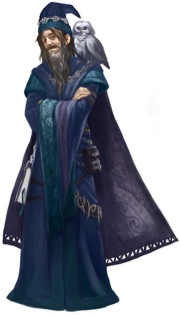
"An astute metaphysical question," said Dr. Orontius, "but a true wizard never reveals his secrets." His old blue eyes twinkled, the same color as his robes and pointed hat. "At least not without receiving another secret in trade. Perhaps that formula for 'thieves vinegar' you mentioned?"
"Not in exchange for such a trifle," said Norret. "An alchemist has his secrets as well."
"Just so," Dr. Orontius agreed, turning to me. "Your brother claims to have a formula for a fabulous antiplague, a sovereign preventative for all manner of ills. As Desna would have it, a plague currently ravages Korvosa. Zharmides, an old classmate from my Acadamae days, has recently perished therein. I desire a keepsake to remember him by, a little ivory snuffbox of which he was fond."
"Can you describe it?" Norret asked him.
"Why describe when one can simply show?" Dr. Orontius muttered arcane phrases and made mystical passes with both hands, opening one to reveal a tiny ivory chest resting on his palm. "This is merely a memory, so look but do not touch." The wizard's memory sharpened, scrimshawed lions and lilies appearing on the sides, little clasps and fittings in matching gold. It floated in the air, tumbling like a bubble, revealing a gilded sigil engraved on the bottom, looking like a stylized Z.
My brother took out his formulary and a silver pencil. The talent Norret lacks for cooking he makes up for with drawing and scientific illustration. Soon he had a passable silverpoint architectural diagram of the snuffbox.
"I expect it should be among the effects to be interred with his body." The wizard gestured with his fork and the vision of the snuffbox vanished, quickly followed by his last bite of cabbage roll. "Whether that will be in Korvosa or with his family in Alkenstar, I cannot say. But I'm certain there should be time for formal viewing at the Acadamae itself." He produced another snuffbox, this one of paueliel burl, the sacred "first trees" of the elves. Norret had taught me how to identify paueliel along with a dozen other woods with interesting alchemical properties. A matching traveler's trunk sat against one wall, swirled with whorls like owl eyes, and I swear, I had once seen it blink at me.
Muco, an actual owl and Dr. Orontius's familiar, perched atop a bust of Nethys at one end of the mantel. He swiveled his head around backward and blinked at me for real.
Dr. Orontius merely opened the smaller box, a whorl on the lid forming yet another eye with the iris wide as an O, and took a pinch of snuff in each nostril. The snuffbox disappeared back up his sleeve, replaced with a handkerchief. "I shall give you a letter for Zharmides." He blew his nose decisively. "While he of course will not be able to read it, being dead, it should at least gain you admittance to the funeral."
Where my brother would pick a dead wizard's pocket. Unless Dr. Orontius's "friend" were already interred, in which case Norret would think nothing of burgling the dead.
After all, he'd already dug up my grave. Not that I was complaining.
"He's not going alone," I stated plainly.
"Oh, surely—" said Dr. Orontius.
I cut him off. "Surely something can go wrong."
Norret only smiled with his eyes, but the one without the monocle was almost dancing with amusement. "Orlin is growing up."
"Quite," sniffed Dr. Orontius. "But if this 'thieves vinegar' is as efficacious as purported, there should be no risk to yourselves."
I had already died once of a fever, and while I had been brought back to life, I had no desire to repeat the experience. That said, it was not my brother's alchemy I was worried about.
"As Desna would also have it, tomorrow is an execution day." Dr. Orontius stood, straightening his robes and his beard. "Your boarders will be procuring viands elsewhere, and since you two have no other duties, shall we away now?"
I paused. "Wait. Isn't Korvosa rather far away? Outside of Galt?"
"In Varisia," Dr. Orontius supplied helpfully, "but really, it's no further away than that picture." He gestured to a wall crowded with old paintings. He'd shown me his collection many times, telling tales of his travels in the days before the Revolution: The Grand Opera House of Egorian, capital of devil-haunted Cheliax; or The Warlock's Walk in Nex, parade ground for its arcane arclords.
His finger indicated a smoke-yellowed painting up in one corner. A small brass plaque attached to the frame identified it as The Old Quay In Korvosa. "Are you familiar with a metaphysical process known as 'teleportation'?"
∗∗∗
I was not familiar with teleportation before Dr. Orontius cast his spell. Afterwards? I never wished to experience it again. Unfortunately, if we ever wanted to see our beloved Galt, we would rejoin him on the morrow at this spot when he would transport us back to Isarn.
I was also wondering if we'd traveled in time as well as space, for the sun hung lower in the east than it had in Isarn, but before I could ask, Dr. Orontius pronounced some ritual phrase and vanished with an inrush of air and an audible pop.
Norret and I were left on the quay, a very old dock, even older than the one in Dr. Orontius's antique painting. As I looked down at it, I realized we were standing at the same spot where the painting had been made.
"An excellent illustration of sympathetic magic," Norret remarked.
He wasn't smiling, but the corners of his eyes crinkled. He knew the pun he'd made, but wasn't going to admit it.
"But which branch? Homeopathic or contagious?"
"Homeopathic," I decided. "The Law of Similarity governs a wizard using a painting to go where it shows."
"But wouldn't it also be contagious?" My brother waved a gloved hand. "Surely it was painted from this exact vista."
The boards of the quay were spotted with pigment. A short distance away were two easels with artists behind them. No pun intended, we'd teleported to the most picturesque spot in Korvosa.
"Both then. It falls under the Law of Contact too."
The Law of Contact, or Contagion, stated that things that had once been in contact remained in contact. That meant that anything that touched evil could become evil, so if you put on a ring that had been to the Worldwound, for example, you could be possessed by a demon. If you touched something that had been touched by a plague victim? You could catch the plague.
It was alarming to think about. Before, I had thought that sickness was carried by tiny pixies so small as to be invisible, who flew over the river from Kyonin on mosquitoes and shot people with poison darts. At least that's what the doctor told my mother. While I'm sure she put out a bowl of milk and honey to make them take my fever away, that obviously didn't work.
Norret's solution, rather than milk and honey to bribe capricious fey, was vinegar to drive them off. Thieves vinegar was perfumed with a bouquet of magical herbs–sage, mint, tansy, thyme, rosemary, lavender, wormwood, and rue–but it took an alchemist to know how to decoct them so what you got was an antiplague instead of salad dressing. Besides driving away evil pixies, thieves vinegar was said to ward off fever spirits, purge foul humours, and repel the flies that were the eyes of Urgathoa, at least if you believed the nursery rhyme:
I met a pale lady in a tattered spattered gown.
Her hair was black. Her face was white. Her dress was red and brown.
She said the flies were all her eyes and she saw near and far.
I drove her off with salad and a splash of vinegar!
That was a lot to expect from salad dressing.
That said, I had faith in my brother. He had faith in Citizen Cedrine who'd taught him the formula. She in turn had had faith in the graverobbers who'd used the perfumed vinegar to safely plunder plague pits and battlefields before they were sent to the guillotine for their crimes.
We'd washed with it, gargled with it, and for good measure carried hollowed-out pomander oranges studded with cloves, wreathed in frilly ribbons, and filled with sponges soaked with thieves vinegar. "Carried" is probably not the right word. They were floating, and not just because Rhodel was playing with them or because I'd forgot and reached for something with my soul's hand instead of my regular hand like I sometimes did. They were floating because Norret's only sponge came from a deceased will-o'-wisp, which he'd prepared specially so that it would retain its ability to float. It glowed, too, or at least would come nightfall.
So there we were, standing on the oldest quay in Korvosa with pomander oranges circling our heads.
Strange as it may sound, we were not the strangest people there. Two men walked down the quay wearing perfectly ordinary tricorne hats, but below them they had the faces of storks. Occasionally they stopped at a shop, looked in, and marked an X on the door with chalk. At first I was thinking they had stork men in Korvosa like I'd heard lived in Osirion, but then I realized that they were wearing masks.
"Plague doctors," Norret explained. "Those are doctors' masks."
"Wouldn't storks make more sense for midwives?"
"If they wore them for fashion, yes," explained Norret, "but the beaks hold herbs that work like our pomanders. Powdermaster Davin once helped us rig up similar masks for the battlefield. But he'd been to Korvosa before the Revolution and said it's illegal to wear a doctor's mask if you're not a doctor. Besides, we don't want to see patients. We just need to find Zharmides the Godless—or his body. He is, or at least was, a professor at the Acadamae."
"Where's the Acadamae?"
It was a reasonable question, and I was completely skipping the fact that I'd missed the honorific and "Zharmides the Godless" didn't sound like anyone you wanted to deal with, even if he was dead.
Especially if he was dead. I didn't know what the gods did with atheists, but it couldn't be pleasant. And I'm saying this as someone who met a couple of them.
Gods, I mean. Not atheists. Or, if I hadn't met them, at least I dreamed about Shelyn and Pharasma talking about me when I was dying, so it sort of counts.
"I think it's on the top of a hill." Norret glanced around. Two hills were visible in the city, one nearer, one farther. "Let me ask."
He went over to one of the artists while I stood there feeling somewhere between stupid and nervous. Apart from that time when I died, I'd never been outside of Galt, and while Korvosa wasn't as grand as Isarn, it was still far grander than Dabril. And there was a plague, so I assumed many folk were staying in.
"Reefclaw pasty! Hot 'n tasty!"
Even plague couldn't stop barkers. A young woman wearing a patchwork scarf waved to me. Her booth's sign read Meatclaw's Feast! It showed some horrible monster with the front half of a lobster and the back half of an eel, a giant wooden claw grasping a doll in the shape of a terrified fisherman.
Behind the young woman was an older one tending a cauldron of boiling oil. She used a wire mesh scoop to fish out balls of fried meat that looked like the salmon croquettes. One of them floated in the air, took a second to dip itself in what looked like cameline sauce, and popped itself in my open mouth.
I didn't know whether to thank Rhodel or be annoyed at her, so I just ate it. The sauce did taste like cameline, with cinnamon and nutmeg, but with mint in place of the usual ginger. The pasties tasted like crayfish-and-lamprey tarts.
"For eight silver shields, I'll owe you three more pasties and another spoon of thileu bark sauce." I glanced at the menu slate. It seemed spice was as dear in Korvosa as it was in Isarn, but meat was cheaper, even if it was monster meat.
I took out a gold minted by one of Galt's previous Revolutionary Councils and tossed it to her. The young woman scrutinized it and shrugged. She handed me a paper cone with three more pasties, a waxed paper cup of dipping sauce, and a couple of the local silvers which did indeed have shields on them.
I went back over to Norret, who was talking with one of the artists. "And they still make Newby Violet? Excellent!" He noted the reefclaw pasties and the dipping sauce. He took one, sampling both. "Thileu bark? Some interesting alchemical properties there. And... reefclaw?" He glanced over at the sign. "That could come in useful."
He took a second pasty and munched it. Then he confiscated the last pasty and the dipping sauce, placing the pasty in a pouch and the sauce in a stoppered vial. "Intriguing stuff, thileu bark. Only the Varisians know the trick of harvesting it." He chewed, considering. "Said to be one of the few spices potent enough to be tasted by the dead."
"Did you find the Acadamae?"
"Oh, yes, it's on that hill over there." He pointed to the farther one. "But I also found out where we could buy a map."
My brother had that dreamy look he sometimes gets. He led us up a couple streets and around a corner. There he stopped and stared with an expression like he'd seen Shelyn combing out her rainbow-streaked hair.
I saw a sagging old shop with a quilt of little diamond-paned windows displaying pots and jars, easels and brushes, and a signboard that looked like an artist's palette sized for a giant. The multicolored splotches spelled out Hessim, Newby, & Sage Paint Manufactory.
"Powdermaster Davin told me about this place."
I followed my brother inside. The shop reeked of turpentine and linseed oil. And poison. My unicorn senses were almost overwhelmed: arsenic in the familiar Isarn green, quicksilver in the Tian red, and white lead in the flake white. That was everywhere, in gallon jars and penny pots and covering all the pre-painted canvases.
They also, indeed, had maps, whimsical illustrated ones with points of interest drawn to a larger scale. But the pigments and poisons were everything an alchemist could dream of, which explained my brother's glazed expression. "I want your deluxe set. The one with everything—including the special pigments..."
Three old men stood behind the counter. When I say "old," I mean you could picture them patting liches on the head and calling them "sonny." When I say "men," I'm meaning men shorter than me, like tall no-nonsense gnomes. On the wall behind the counter hung three masterful portraits labeled with helpful brass plaques: Hessim, Newby, and Sage.
Sage spoke first: "You couldn't afford it."
Hessim spoke second: "Who told you to ask?"
Newby simply took off his thick spectacles, polished them with a velvet pocket square, and named a figure that would have made Abadar check his vault.
Norret did not drop his monocle. He reached into his pack and pulled out a beautiful cut crystal flask that had formerly belonged to Dabril's duchess and had until recently held honeysuckle absolute. Now it was glowing with an eerie light. "Perhaps we could work out a trade."
Coming Next Week: Adventures at the Acadamae with Norret and Orlin in Chapter Two of "Thieves Vinegar."
Kevin Andrew Murphy is the author of numerous stories, poems, and novels, as well as a writer for Wild Cards, George R. R. Martin's shared-world anthology line. His previous Pathfinder Tales stories include "The Secret of the Rose and Glove" and "The Perfumer's Apprentice" (also starring Norret and Orlin), and "The Fifth River Freedom," the fourth chapter of Prodigal Sons in the Kingmaker Pathfinder's Journal. For more information, visit his website.
The Perfumer's Apprentice—Chapter Four: The Scent of Honeysuckle
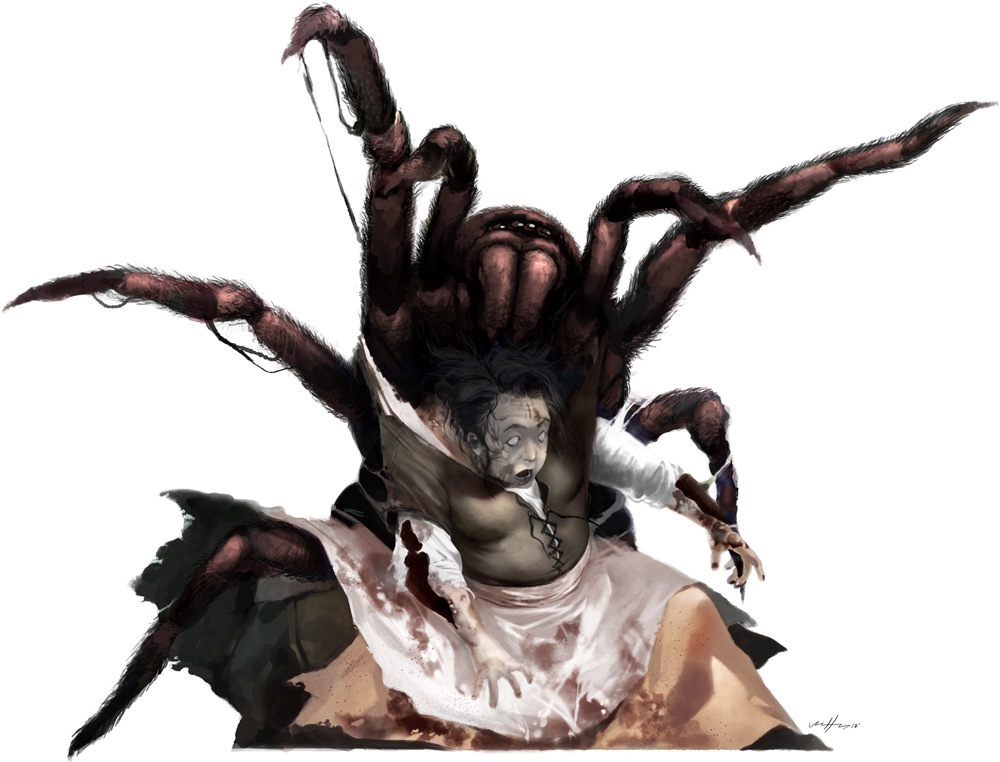
The Perfumer's Apprenticeby Kevin Andrew Murphy ... Chapter Four: The Scent of HoneysuckleThe hag or ogre wife or whatever she was stepped into the room, still looking like a sweet grandmother with her knitting bag and little spectacles. Then she saw the dead spider lying on the hearthrug. ... She screamed in horror, rushing over. “You fiendish little pig! What have you done?” She picked up the corpse. “My baby! My poor precious one! Speak to me!” ... Her knitting bag fell to the floor,...
The Perfumer's Apprentice
by Kevin Andrew Murphy
Chapter Four: The Scent of Honeysuckle
The hag or ogre wife or whatever she was stepped into the room, still looking like a sweet grandmother with her knitting bag and little spectacles. Then she saw the dead spider lying on the hearthrug.
She screamed in horror, rushing over. “You fiendish little pig! What have you done?” She picked up the corpse. “My baby! My poor precious one! Speak to me!”
Her knitting bag fell to the floor, Norret’s glove on top. While I was frozen with fear, my spirit wasn’t. It grabbed the glove and pulled it on.
The unicorn’s jewel shone on the back, glowing with ruby light.
But I wasn’t the only one using more hands than he rightfully should. “Oh no, none of that,” snapped Madame Eglantine. Just like she sometimes seemed to have more eyes, she now definitely had more arms. While two were cradling the dead spider, two more appeared and wove a magic pattern in the air. Then I was looking at not one Madame Eglantine but five, each as monstrous as the last.
I swung the poker at the nearest one and she shattered like a soap bubble. The rest laughed mockingly like a chorus of schoolgirls. My spirit swung at another. The glove’s jewel blazed with light as that illusion vanished as well.
“What are you, you horrid brat?” snarled the three remaining Eglantines. “A sorcerer? An oracle? Some halfling wizard masquerading as a child?”
I swung again, but missed. “I’m the one who’s going to stop you, you cannibal witch!”
A ghostly wind began to blow. The cobwebs fluttered and another bell jar toppled from the mantel, its head bowling across the floor.
“Oh, I’m not the cannibal,” laughed Madame Eglantine. “I have never eaten my own kind. All my husbands were human, and while I ate every last one after he violated my private sanctum, the only true cannibal here is you...”
As she said this, she became fatter and squatter, her body becoming more hunched and spidery, until all that was left was a garden spider the size of a woman, a cross-shaped marking on her back big enough to protect a wedding cake from a whole troop of dancing pixies. It was the mother of the horrible little spider I’d killed, mirrored three times, moving around one another like walnut shells shuffled by a charlatan hiding a pea.
I screamed and ran at them, hitting one with the poker while my spirit swung at another. The illusion before me popped on contact with the iron bar, but my spirit felt the glove slap the spider’s flesh, burning it, antitoxin meeting toxin.
Madame Eglantine hissed and reared. Then the sound of ladylike laughter issued from her horrible spidery maw and webbing shot from her abdomen, a great net like you’d throw to snare songbirds for a pie, thick and sticky as bird lime.
It covered me and I was stuck fast, both me and the fireplace poker, her web pulling taut against the walls as it dried. But my spirit’s hand was still free and I slapped at her again with the glove.
The last illusion vanished with a flare of ruby light. Then the spider shifted back to the form of the spider-armed woman. She reached into her bag and drew forth one of her knitting needles, ebony capped with silver. She waved it about like a wand, weaving magical patterns in the air and clicking her tongue like a Mwangi witch out of a story. A gray ray shot from the tip, hitting the glove.
The light of the unicorn’s jewel died, the spider woman smothering its good Galtan magic with her evil foreign spell. I felt my soul’s hand slapped back as the glove fell to the floor.
She picked the glove up with the tip of her knitting needle as if it were a dead rat. “Just what are you?” She flipped the glove into her knitting bag, stuffing it down to the bottom with the wand. “I’m curious to find out...”
She shifted back to the form of the giant spider. Then she crawled over me, her huge bloated mass avoiding the sticky strands the web. She leaned close, her horrible fangs dripping venom, and bit me.
I felt pain, and then nothing, the poison numbing, putting my limbs to sleep and freezing them, like when you wake from a nightmare but still can’t move.
But the nightmare was not over. The spider woman tenderly, carefully, bit through the strands holding me on the left and the right. She freed the fireplace poker and threw it to the floor. Then she put her claws on me and began to spin me, like a woman twirls a drop spindle. Webbing flew from her abdomen, smooth and soft as silk, wrapping around me, cocooning me as she had Norret.
At last she stopped spinning me. I was terribly dizzy, but my eyes focused as she turned back into a woman. But not all the way. She still had eight eyes and six arms. Then the most horrible thing—her bottommost pair of arms reached into her bag, pulled out a half-finished stocking, and began to knit as if nothing were odd at all.
“Now what are we going to do with you, Orlin?” she mused. “You’re a bit young for husband material, though your brother’s comely enough, if a trifle thin.” She poked Norret’s middle with one long-fingered hand. “Yes, too thin for my tastes. But I’ll plump him up once I have the right charms brewed...”
She picked up the two heads tumbled on the floor, placing them back on the mantel. Norret moaned. Madame Eglantine paid no mind. She looked into her bag and selected a different knitting needle. She mumbled a charm and waved it over a pile of broken glass. Half the pieces flew up and reformed into a bell jar. She repeated the charm and the other was restored as well.
Norret opened his eyes halfway and saw me. “Orlin...” he whispered. “Her bag... bottle... spiderbane...”
He was delirious, but my body was paralyzed by poison, and my spirit as well. A fine time for it to be properly tethered to my body.
But I was not the only spirit about. While I couldn’t feel my jaw, I could sense it opening. “Rhodel...” I croaked.
"Galt’s people don’t take kindly to monsters in their midst."
Madame Eglantine fussed with her dead husbands’ hair and so didn’t see the knitting bag behind her tip on its side. One by one the balls of yarn rolled out, as if an invisible kitten were investigating them. She replaced one of the jars as Norret’s glove appeared, the unicorn’s jewel still dead from the spell. Then as the second jar was being replaced, a crystal flask rolled free. Pretty and faceted, it was a treasure that once belonged to the duchess of Dabril. It was filled with a golden liquid.
“There, much better.” Madame Eglantine looked at her husbands’ heads, now back in their places. Then she looked mournfully at the dead spider. “Poor little dear. I’ll have to put her in the garden and plant a fruit tree. Maybe a sour cherry.” She turned. “That would be nice, wouldn’t it?”
Then she saw the bottle floating up.
She dropped both the dead spider and the half-finished sock as she sprang forward, grabbing the flask with all her hands before Rhodel could work the stopper free.
“Oh, tricky,” she said admiringly. “Very tricky. But not tricky enough. Your brother said this held my doom, but he talks too much. I got the jump on him, and the same with you, Orlin. But I do wonder what it is. A poison for spiders, perhaps? Maybe some grand mithridate like the glove, or an antivenin to sour my venom in its sacks? I suppose I—”
A girl appeared next to her, a beautiful young woman dressed in the livery of a page of House Devore.
“Who are you?” asked Madame Eglantine, shocked.
“Death,” replied Rhodel. She ripped the bottle from the spider woman’s hands with the strength only the dead could possess and pulled the stopper free. “Never trouble a child of Dabril!” She threw the contents into the witch’s face.
Rhodel disappeared, the empty bottle and stopper clattering to the floor as Madame Eglantine screamed, clawing her eight eyes with all six hands. Then she stopped screaming as the room became filled with the overwhelming scent of honeysuckle.
“Perfume?” Madame Eglantine gasped. “Perfume? That’s all you have?” She exploded into gales of laughter. “Oh, that’s rich! That’s the cream of the jest! Two riddles solved for the price of one! You, my child, are nothing more than a baby bone oracle! And your brother? Not even an alchemist! A mere puffer who thought to bluff me with a bottle of perfume!”
With that, the windows began to spring open, one by one, the cobwebs ripping free as Rhodel let in the fresh air of the garden outside.
The fresh air—and the wasps and bees from the garlands of eglantine that hung about the house.
Madame Eglantine screamed as the insects swarmed her, stinging her as she shifted into her monstrous spider form. She sprayed webbing as quickly as a magician conjures scarves, but still more came, drawn by the pure scent of honeysuckle absolute.
Then came a droning buzz loud enough to be a roar. Bumblebees the size of lapdogs and wasps the size of small ponies came through the windows, the pets of Calistria, goddess of trickery and vengeance.
The spider woman played her own tricks, multiplying her form with one illusion, turning herself invisible with another. But the swarm was too great for the decoys to last, and the scent of Norret’s perfume unerringly guided the wasps to their prey. Madame Eglantine was stung again and again, until at last she was as paralyzed as Norret and I, trapped as a bloated spider with a woman’s head.
It was then that the wasps did as they always do when they win a battle: They returned to their nest with their prey, as well as the bodies of their fallen comrades—for to a wasp, meat is meat—and any other meat they can find.
The corpse on the table was carried off. The heads of Madame Eglantine’s husbands as well. Even the slab of half-smoked man-bacon from the hook at the back of the hob.
Lastly, the wasps looked at Norret and myself, still paralyzed and caught in the spider’s webs. They bit us free, picked us up in their claws, and carried us back to the nest as well.
Meat is meat, after all.
∗∗∗
Fortunately for us, their nest was the temple of Calistria, and Mistress Philomela knew us.
We were cut free from the webs with Calistrian daggers, had the poison neutralized with one spell and our wounds healed with another.
There was no balm for the horrors I’d seen save holding my brother’s hand. I knew he must have seen worse during the wars, and I understood why he had to bring me back.
Family is worth more than any gold, even if you come back wrong.
“Gingerbread?” offered Mistress Philomela. We were back on her balcony, sitting beside each other on the yellow divan. She held out a plate. On it were three gilded figures: a wasp, a dagger, and a beautiful elven woman.
I took the dagger. I didn’t want to have anything to do with cannibalism, even in the form of gingerbread.
Norret must have felt the same, since he took the wasp.
Mistress Philomela took the one in the shape of her goddess and delicately nibbled her ear. “The only thing sweeter than the cakes of Calistria is the taste of revenge.”
A great cry of exultation came up from the crowd. Rather than a load of fresh prisoners being delivered by tumbrel cart, there was only one late arrival, but arriving in style: a gilded, magical chariot borne by giant wasps hove into view, driven by one of the priests of Calistria, dressed in a golden loincloth that left little to the imagination, especially when it flapped aside. But hanging from the back of the chariot was what truly captured the interest of the crowd: a horrible monster, half woman, half spider, paralyzed by wasp venom, a look of terror on her eight-eyed face because she knew what her fate would be.
The priest did three laps of the street, to greater cries of bloodlust each time, until at last the Gray Gardener on the guillotine’s platform signaled for him to land. He did.
There was then the usual dry speech about the values of Liberty and the enemies of the people, as well as the thanks of the people for those who’d apprehended the enemies of the Revolution, especially fiends and monsters. It was then that I realized I was supposed to stand.
Norret squeezed my hand and I stood next to him. Mistress Philomela stepped aside and applauded us and the rest of the crowd below followed suit. I also realized I was still holding the barely nibbled gingerbread dagger. I raised it over my head. “Victory!” I cried.
“Liberty! Equality! Fraternity!” responded the crowd.
“Vengeance,” added Mistress Philomela with an amused smile.
The execution of Madame Eglantine was very much like any other. Madame Margaery’s blade was hoisted up. Madame Margaery’s blade came down. A woman’s head bounced into the basket. A giant spider’s body lay on the stage. The crowd cheered, all except a group of women in the front row who for once stopped their knitting, looking at the head in the basket, then at each other with expressions of mute horror. The Gray Gardener standing on the stage looked down at them with his gray mask.
You know he was thinking exactly what they were thinking.
There would be questions for Madame Eglantine’s head. Questions for the heads of her husbands. Questions for myself and Norret.
I already knew my answers. We had rehearsed them before.
We were two brothers from Dabril. My brother was a veteran who had returned from the war. My father and brother had died, so my mother remarried, and my brother had taken me with him to be his apprentice when he returned to the capital. Any peculiarities about me were likely just a bit of sorcery unlocked when I was ill. Nothing more.
Norret squeezed my hand. I looked at him. He smiled and bit off the wings of his gingerbread wasp. I smiled back.
Mistress Philomela was wrong. Revenge was sweet, but the sweetest thing was fraternity—having a brother there for you.
Coming Next Week: A sample chapter from Hugh Matthews’ upcoming Pathfinder Tales novel, Song of the Serpent, plus a fantastic new illustration from Eric Belisle!
Kevin Andrew Murphy is the author of numerous stories, poems, and novels, as well as a writer for Wild Cards, George R. R. Martin's shared-world anthology line. His previous Pathfinder Tales stories include "The Secret of the Rose and Glove" (also starring Norret) and "The Fifth River Freedom," the fourth chapter of Prodigal Sons in the Kingmaker Pathfinder's Journal. For more information, visit his website.
The Perfumer's Apprentice—Chapter Three: The Garland of Eglantine
The Perfumer's Apprenticeby Kevin Andrew Murphy ... Chapter Three: The Garland of EglantineThe innwife woke me at dawn. I’d spent the night beside the fire. Someone had picked my pocket during the night, so the gold Norret had given me was gone. All I had left was the little horn spoon. ... The innwife made it clear that if I bought breakfast or even ale, I could stay, but if not, I should go. I left, stepping out into the cold morning. ... Cries of “Gardyloo!” came from up and down the...
The Perfumer's Apprentice
by Kevin Andrew Murphy
Chapter Three: The Garland of Eglantine
The innwife woke me at dawn. I’d spent the night beside the fire. Someone had picked my pocket during the night, so the gold Norret had given me was gone. All I had left was the little horn spoon.
The innwife made it clear that if I bought breakfast or even ale, I could stay, but if not, I should go. I left, stepping out into the cold morning.
Cries of “Gardyloo!” came from up and down the street. Maids and goodwives threw open windows, emptying chamber pots. Piss and night soil spattered the cobbles, running down to the grate that led to the sewers below. Horrible stories were told about those sewers, but nothing could be more awful than the stench. I wished I had one of the paper nosegays Norret and I had spent hours making, but had to make do with the woodsmoke on my clothes.
A moment later, I realized I was crying.
I bit my lip and forced the tears back. Life in Galt was harsh, and I had no illusions. Madame Eglantine was a witch, and she’d warned us not to pry into her business. What that business was, I could only guess. Summoning devils like the vile Chelaxians? Worshiping nightmares from beyond the stars? Smuggling nobles out of Galt?
Whatever it was, it was awful enough that my brother had decided to do something about it. But the witch had won.
How she had won was the question. My brother could be injured, dead, drugged, or even turned into a toad for the witch to feed flies and taunt.
Given Madame Eglantine’s ties with the Revolutionary Council, the cruelest possibility was that he would join the next cart of condemned to feed the guillotine.
The window of the uppermost gable of the house at the top of the street popped open and a familiar female voice cried out a warning. The night soil flew down and the window snapped shut, the little diamond panes frosted from the inside to ensure the old woman’s privacy.
She was unusually late. Normally Madame Eglantine would have done this before dawn, giving her time to go down to the kitchen and fix breakfast for the guests.
I steeled my courage and made my way back to the familiar house. I slipped in as one of the other boarders stepped out—the old wizard Norret had got the manuscript from, off to take his morning constitutional before returning for breakfast.
The rooms Norret and I had shared were bare as when we moved in. The only change was a pile of ashes in the grate. The air smelled strongly of irises and alchemist’s fire.
I made my way to the dining room. The other boarders greeted me kindly, inquiring as to when Norret would be by and how his research was going. I shrugged. The old wizard returned shortly, reeking of cherry tobacco and snuff.
A half-hour late, Madame Eglantine came in, bearing a tray heavy with pork pies and mirabelle plums. “My pardon, gentlemen. There will be no croissants this morning. I missed the baker’s boy when—”
“Where’s my brother?”
The old witch looked at me, shocked, but quickly regained her composure. “My dear child, you’re still here? I thought you left with him last night. Your brother gave notice and cleaned out all his things.”
“I waited at the tavern. He never came.”
A look passed among the guests, a sad one, and the old wizard turned to me and said, “Did he leave you no money?”
“A little. My pocket was picked.”
There were more sad looks and tut-tutting. The old wizard produced a few silver coins and pressed them into my hand. “You must take care of yourself now, Orlin.”
Madame agreed. “I’m not in the business of charity. You’re welcome to stay for breakfast, but you’re almost a grown man. Inquire at the workhouse, or perhaps with the army.”
“My brother would not abandon me.”
She looked very sad, but it was an actress’s look from a melodrama, a practiced expression of grief that had nothing to do with the cold glittering little black eyes behind the half-moon spectacles. “I’m sorry, but you are not the first child in Isarn to believe that, nor will you be the last.”
“People are only human,” the old wizard agreed sadly.
I did not mention that my brother had given up a fortune to bring me back to life. I only burst into tears and ran from that house, unable to think how to save Norret.
I had no way of knowing that he was not already dead. But if you’re from Galt, you know that the only truly final death comes from one of the Final Blades.
No one knows that better than myself. Even coming back wrong is better than not coming back at all.
My handkerchief fluttered out of my pocket, drying my tears without me touching it.
“Th-thank you, Rhodel,” I snuffled, retrieving it. I blew my nose and put it away.
I still had hope. The witch had gone with the lie that Norret had abandoned me, not that he’d pried into whatever awful thing went on in her attic. That meant that she’d have trouble having him arrested and sent off to meet Madame Margaery.
The Gray Gardeners always asked questions, sometimes even after people died.
I thought about what I knew of Madame Eglantine. The only way into her apartment was the door at the end of the upstairs hall, set with many locks and charms. Once I’d glimpsed a spiral stair beyond it, thick with cobwebs. I could only guess that there would be another door with far more dangerous locks at the top of the stair. All the windows locked from the inside. To get up to the gables would mean scaling three stories and a slate roof. The boarding house also had a climbing rose—an eglantine, like its owner. The vine was heavy with little white blossoms, thick with thorns, and infested with famished bees, the fat little garden spiders that preyed upon them, and the wasps that preyed upon them in turn.
Madame only left her attic to fix breakfast and supper, meet with tradesmen, and tend her beloved garden. The only time she left the house was to attend an execution, which was a general holiday. That was also the only time the cook fires were banked.
I saw a halfling walking down the street. He was wearing a short cap and a pair of heavy gloves, and had a wire brush over his shoulder. The only parts of him that weren’t covered with soot were the gilded buttons on his coat.
I stepped into his path. “Teach me your trade.”
The halfling looked up at me and laughed. “Not that I ain’t always lookin’ fer apprentices, but ye’re too tall, lad, and y’look like ye’re gonna get a dem site bigger before ye’re done.” He then turned more serious. “Parents tossed ye out? Tell y’wot. Y’can touch me buttons fer luck fer free and be on yer way with me best wishes. Sound right?”
“How about I buy you a glass of wine and you tell me about your trade?”
“Halfling size or human size?”
“Your choice.”
He grinned. “That’d be halfling size. It’s bigger.”
I ended up buying the whole bottle with a couple of the wizard’s silver pieces, but found I what I needed to know. Most of what I needed I already had—a cap and a pair of stout gloves. What I didn’t have, I didn’t need either. I had no interest in cleaning Madame Eglantine’s chimney, with or without a wire brush.
The halfling did an excellent impression of the mistress of the boarding house: “‘Yes, citizen, I am quite aware of the perils of chimney fires. Be that as it may, I have spells to clean my chimney, and I’m more limber than I appear. Indeed, I think you’d be quite surprised at how small a space I can fit into...’” He snorted. “Nasty old harridan. Lost a few snakesmen to her back in the day. Steer clear of that one if’n y’know what’s good.”
“Snakesmen?”
“Burglars,” the halfling confessed drunkenly. “Second-story men. Never seen hide nor hair of ’em ag’in. Bet she turned ’em inta mice an’ fed ’em to the cat.”
Feeding someone to a familiar was awful magic, but Madame Eglantine did not have a cat that I knew of. The only pets Madame appeared to have were garden spiders.
There were a great many of them in the garlands of eglantine that twined around the boarding house. I climbed the rose the next day, after watching Madame and half her boarders leave for the executions. I couldn’t believe my luck—the windows of Norret’s and my old rooms had been left open to air. They still smelled very strongly of iris.
I brushed the little spiders from my clothes, then went to the fireplace. It was still warm. The hearth fire had been banked in the kitchen. But not for long.
I took the wine bottle from the inn, reached up the flue, and dropped it down the chimney.
There was dim tinkle and the sound of a small explosion. Norret had taught me the formula for extinguisher grenades. It had taken the last of the wizard’s silver at the apothecary, but was worth it.
I waited for the fumes to clear, then stuck my head up the flue. It was dark, and soot drifted down over my face. I did as the chimneysweep had told me. I tied my scarf over my face and pulled my cap low over my eyes, then worked my way up slowly.
There were handholds in the brick, but the safest way up was bracing my back against the back of the chimney and my feet against the front. I wormed my way upward, higher and higher, until I found the next flue, the one that led to Madame Eglantine’s attic apartment.
I came down carefully, expecting that I might step directly into a cauldron, but her fireplace only had an iron hook at the back. It held a slab of Madame’s delicious bacon smoking over the hob. Another hook held a kettle for Madame’s tea. The fire was out save for a few banked coals, but the ashes smelled of applewood.
"Madame Eglantine is more than she appears."
I moved the fire screen aside and ducked out into the apartment, shaking the soot off onto the hearthrug. The apartment was the most cobwebbed place I’d ever seen. Madame might want her guests to tidy up after themselves, but had clearly never seen fit to clean her own rooms. What I had taken for frosted glass was a thick film of cobwebs on the inside of all the windows. It made the light far dimmer than day, but still brighter than it had been in the chimney.
There were cases of books and bric-a-brac, shelves containing the oddments and curios of a lifetime. Then I turned and saw the mantel. My heart stopped cold.
Where a scholar might keep the bust of a great philosopher, or an artist might place a single skull for still lifes, Madame Eglantine had done them one better. On the mantel was a row of bell jars like you’d use for growing vegetables or protecting mantel clocks. But under each jar was a severed head, preserved by magic or alchemy, fresh as they day they were chopped. Their eyes were wide and staring, their mouths half open. I expected them to start speaking any moment.
They did not, but as I stumbled away, I wished they had, for they could have warned me not to look at what I saw next.
Stretched out on a table was a corpse—without its head, without its hands, without a great many parts. At first I thought Madame Eglantine must be an anatomy student or necromancer, but then I saw the chart, like a doctor might use, but marked like a butcher’s with notes like brisket and good for paté. I realized that Madame Eglantine must be some horrible hag or ogre wife like in the stories. Suddenly the bacon hanging on the hob didn’t seem so appealing.
Then I saw Norret.
He was poisoned. I sensed it immediately. He was hanging in a great spiderweb strung in one corner. I rushed to him, but before I touched him, I stopped, remembering the terrible stickiness of such webs from the bard’s stories. I ran and got the fireplace poker and used it to rip the webs away.
He was still alive, but paralyzed and poisoned. And it was then that I sensed poison again. But this poison was moving.
It was a spider. A garden spider like the little ones in the roses outside, squat and brown and marked with a cross like a festival cake frosted to keep pixies from dancing on it. But this spider was the size of a crab.
It scuttled toward me. I smashed it with the fireplace poker, hitting it with the hook. It hissed like a pastry dropped into hot fat and scuttled away. I stepped back. Then the hearth broom levitated, swatting at it—Rhodel trying to help, but only swatting it on the backside.
It leapt at me.
I swung the poker, but it went wild. I lost my grip, the iron bar striking one of the bell jars.
It shattered. The head bowled across the floor, eyes blinking.
I caught the spider. It bit at me, drooling poison, but my gloves were stout. I shoved it against the mantel with one hand. With the other, I reached for my belt knife, hoping to stab it. My hand closed around something smaller than expected, and I realized that I had grabbed the little horn spoon instead.
It didn’t matter. The handle was ivory and pointed, and had come from a unicorn. I jammed it in, point first, again and again, stabbing it over and over until the horrible monster vomited blancmange. It died with a shudder.
I was crying again. I went and got the poker and used it to rip the webs away from Norret. Somewhere in his gear he had a jewel that had once belonged to Dabril’s duke, a magic ruby set in a glove that could neutralize poison. If I could just find it, I might heal him, and we could both escape this chamber of horrors.
“I believe,” said a voice behind me, “you are looking for this.”
I turned. Madame Eglantine stood framed in the doorway, taking Norret’s jeweled glove out of her knitting bag.
Coming Next Week: Further horrors in the final chapter of Kevin Andrew Murphy’s “The Perfumer’s Apprentice.”
Kevin Andrew Murphy is the author of numerous stories, poems, and novels, as well as a writer for Wild Cards, George R. R. Martin's shared-world anthology line. His previous Pathfinder Tales stories include "The Secret of the Rose and Glove" (also starring Norret) and "The Fifth River Freedom," the fourth chapter of Prodigal Sons in the Kingmaker Pathfinder's Journal. For more information, visit his website.
The Perfumer's Apprentice—Chapter Two: The Iris of Isarn
The Perfumer's Apprenticeby Kevin Andrew Murphy ... Chapter Two: The Iris of IsarnNorret had theories, but then my brother always had theories. It’s part of an alchemist’s job. He’d heard some story about assassins wanting to kill an ancient king, and rather than do something obvious like stab him, they got a girl and slowly fed her poison until she was immune but it oozed out her pores. The plan was that once the king made love to this girl, he’d die. ... It seemed rather unlikely to me,...
The Perfumer's Apprentice
by Kevin Andrew Murphy
Chapter Two: The Iris of Isarn
Norret had theories, but then my brother always had theories. It’s part of an alchemist’s job. He’d heard some story about assassins wanting to kill an ancient king, and rather than do something obvious like stab him, they got a girl and slowly fed her poison until she was immune but it oozed out her pores. The plan was that once the king made love to this girl, he’d die.
It seemed rather unlikely to me, since it hinged on the king actually wanting this one girl, but the assassins in bards' stories were never the ones who came up with practical plans. In any case, Norret wondered what happened to the “poison maiden” after that. It might also explain how Madame Eglantine’s husbands died.
He also mentioned something called an upas tree, a poisonous mulberry travelers said grew in Tian Xia. The perfume from its branches was supposedly so deadly that it would kill everything in fourteen miles. Were such a tree to have a dryad, that fey woman would undoubtedly be just as toxic.
This was a rather frightening thought, but as I remarked, if there were an upas tree growing somewhere in Isarn, someone would have noticed by now.
Norret’s third theory was that maybe Madame Eglantine was a toad witch like the legendary Crapaudine, mother of Coco the cockatrice, who everyone sang dirty songs about back in Dabril. If she’d used witchcraft to turn herself human, she still might detect as poison to my unicorn-horn senses.
I didn’t think Madame Eglantine had enough warts to be a toad. I also couldn’t picture a toad knitting. But being a witch and brewing so many poisons that some of them stuck to her? That seemed likely.
In any case, her food wasn’t poisoned and she was quite a good cook. It was hard to get food in Isarn, especially meat, but evidently proximity to the Revolutionary Council had its benefits. For our first supper there, there was a beautiful pork roast with gravy, fresh bread to sop it up, and baked apples. After months eating at second-rate inns or choking down my brother’s cooking, it was the sweetest meal I’d ever tasted.
My brother is a very good man and a good alchemist, but not a good cook. It’s a horrible thing to say about a Galtan, but it’s true. If you gave Norret a chicken, he’d be more likely to blow it up or bring it back to life than turn it into anything decent to eat.
The other boarders were mostly scholars, and while they were also appreciative of Madame’s cooking, they told us to get used to pork. There was occasionally goose for holidays, but meat mainly consisted of pork roasts, stews, dumplings, sausages, and even wonderful things like smoked ham and bacon and pork-liver paté, all accompanied by bread from the baker and fresh produce from the garden. The working theory was that Madame Eglantine had a longstanding affair with a high-ranking member of the hog butcher’s guild. There were also jokes about sympathetic magic and Madame using witchcraft to turn men into pigs, but the resident wizards all agreed there was no more magic in the meat than good Galtan cooking, and the only way anyone was going to turn into a pig was through gluttony.
Norret was a bit more worried because the elixir that brought me back from the dead was philosophic mercury, the same magic quicksilver that had gotten into his eye when he cracked the philosopher’s stone hidden in the duchess’s basement. “It’s an amalgam,” Norret explained. “The philosophic mercury mixes with natural magic and enhances it. I used eyebright to heal my eye, so the mercury fumes bonded with the residue. The unicorn’s horn is suffused with healing magic, so it brought you back to life and also let you detect poison. If the mercury were to alloy with other substances...”
I was horrified. “You mean if I eat enough pork I’m going to turn into a pig?”
Norret looked thoughtful. We were back in our chambers with the door locked, so he had his eye patch flipped up. The iris of his left eye was shimmering and silver like a mirror. “Probably not all at once,” he said at last. “You’d probably just grow orc tusks first. They’d actually be boar tusks, but everyone would think you were a half-orc, so it would still come to much the same thing.” I was even more horrified until he tousled my hair and I realized he was making fun of me. “Relax. I’ve got a present for you. I know you’ve been complaining about my cooking, and there was trouble getting food before, so I made this...”
He reached into his pocket and took out a silver nutmeg grater. He flipped the catch and inside it were little ivory nuts. They were part of the unicorn horn that had resurrected me. There was also a longer bit, the tip of a spiraled horn. Norret had shaved it down even further. As he took it out, I realized that he’d carved it into a horn spoon like you’d use to eat eggs.
“Watch.” Norret took one of his alchemist’s bowls and placed the spoon inside. All at once it began to leak white fluid. It rose up, higher and higher, thick and pasty until it threatened to overflow the sides, at which point Norret removed the spoon and pushed the bowl toward me. “Here, taste it.” He handed me the spoon.
I half expected it to crawl out of the bowl, some horrible animate pudding or jelly like they told nightmare stories about late at night in the taverns, but while it quivered, it stayed where it was. At last I put the spoon in and took a taste of the white pudding. It tasted... like paper maché, with maybe a bit of goat’s milk.
“Do you like it?” my brother asked proudly. “It’s blancmange. Your favorite!”
I remembered. Our mother used to make blancmange for Crystalhue. It was a pudding of rice and almonds with maybe a bit of shredded white chicken breast if we were lucky, flavored with rosewater and once a pinch of cinnamon smuggled in from Katapesh. “It could maybe use a little rosewater...”
Norret gave a wry smile. “I tried to add that, but it wouldn’t take. But at least we do have plenty of rose oil on hand.”
While my brother couldn’t cook, he could make rosewater. It made the pudding taste better, if not much.
That said, the ivory spoon was a very thoughtful gift, and amazing magic besides. “How does it work?”
“Spontaneous generation.” Norret said this as if it were the most obvious thing in the world. “The same way that barnacles drop into the sea to become geese, the alicorn produces unicorn milk and bone porridge.” He grinned proudly. “It should be very nourishing. My friend Melzec once told me about a dwarf whose son was suckled by a unicorn and grew to become a giant.”
I stopped eating. “So if I eat this I’m going to turn into a giant?”
“Well, probably not all at once.” My brother looked thoughtful. “I’m tall so you’ll probably be tall anyway, and you could always stoop. And it’s better than boar’s tusks.”
All at once the bowl levitated into the air and the spoon flew out of my hand. Norret opened his mouth to say something more, but the spoon flew in, feeding him a spoonful of bland blancmange like he was a very large baby.
Sometimes being haunted by a dead strumpet isn’t that bad.
“Maybe you could find a way for us to see Rhodel,” I suggested.
Norret opened his mouth again, but every time he did, he got another spoonful of pudding. Eventually he just nodded.
Another thing you should know about my brother is that when he’s given a task or a puzzle, he sets to it with a single-minded passion. He’d already talked to enough necromancers about my condition, so he knew about folk who could see into Pharasma’s realm. Finding an alchemical formula to do that, however, was the trick.
As much as I love my country, I also have to admit that many of Galt’s best wizards died or fled during the Revolution and took their books with them. What’s left are fragments, but fortunately Madame Eglantine’s boarding house had a number of residents with some of these fragments, and Norret was able to trade secrets. One wizard sold him a formula for a costly ointment that was supposed to allow one to see through illusions and deceptions. A bard told a story about another salve that allowed a midwife to peer into the First World of the fey.
There was no recipe for that second salve, but while inquiring about it, Norret was able to bargain for a copy of a manuscript the wizard claimed had come all the way from the Library of Leng.
I’d never heard of Leng, but Norret was certainly excited about it, so I guessed Leng was some dead noble.
In any case, the manuscript was partially burned and written in strange runes, but Norret was able to translate the most important bit: a method to see through the doors of reality into the chambers beyond.
There were pages of complicated illustrations showing rays coming out of eyes like Calistria’s daggers, pictures of all sorts of undead—horrible things like glowing skeletons and men flayed alive—and requirements for everything from alchemically purified pitchblende to the perfume of “the flower of the messengers.” There were even partial instructions for forging a magic ring.
Norret thought that wizards were always overcomplicating things with rings, which he thought they used for status more than anything else. Beyond that, the iris of the eye was a ring already. The “flower of the messengers,” it turned out, was another iris, as “a message” is what an iris meant in the language of flowers.
The iris was also the flower of Isarn, the ancient crest of the city. Set into the curve of the river, Isarn had a huge number of the flowers fluttering along her banks like yellow flags. Before the Revolution, the royal irises could only be picked with the king’s permission, on penalty of death. After the Revolution, there was no king, but the penalty was the same.
It was a deed that could have cost us our heads many times over, so Norret and I gathered the armloads we needed in the dead of night. Dodging the city watch and patrols of the Gray Gardeners, we took the flowers back to the boarding house. We wrapped them in greased cloths so they would breathe their perfume into the fat as they died, then cleaned ourselves up and went and ate the leftovers from Madame Eglantine’s excellent supper.
Three days later, the iris pomade was washed with alcohol, then evaporated down to a golden perfume absolute. Norret mixed this with the yellow powder he’d extracted from the pitchblende. “All right,” my brother said, holding up the few precious golden drops, “let’s see if the librarians of Leng had their manuscripts in order...”
"Orlin is no ordinary child."
He tilted his head back and dripped the drops into his left eye, blinked a few times, then looked at me. His left eye changed from quicksilver to gold and began to glow. “Orlin, are you all right?” He took a step back, a shocked expression on his face.
“I’m fine, Norret.”
He continued to look disturbed, then looked at the door. He stepped toward it, then bumped into it. “Is there a door here?”
“Uh, yes...”
He began to look at his hand then, clearly fascinated, looking at it as if he’d never seen it before. “I’m... not undead now, am I, Orlin?”
“I hope not.” Honestly, my brother’s left eye was glowing like they say the eyes of liches do in all the stories.
He stepped back toward the worktable, bumping into it. “Fetch me the lead foil. It’s right there.” He pointed at his backpack, but I had to sort through several inner pouches before I found the one he wanted. Norret took it from me quickly and held it up, covering his eye, then breathed a sigh of relief. “There, that’s better...”
“What’s better?” I asked.
“Those old wizards, they weren’t as foolish as I thought. This phenomenon would be much better with a ring you could take off...” He took the lead sheet away from his glowing eye and looked at me, then moved it back. “Hand me the tin snips, would you?”
I found them, and the metal punch too, and Norret quickly fashioned an eye patch from the lead, which he placed over his regular eye patch.
“So you’re not seeing Rhodel?”
Norret chuckled darkly. “No. Very much not so. I’m so used to looking at alchemical allegories and metaphors that I failed to read the literal meaning. The wizard’s method for looking through doors into the chambers beyond? It’s not for looking into Pharasma’s realm, or the First World either. It’s for looking through actual doors into literal chambers beyond. It also lets you see bones through flesh, or even look through walls.”
He paused then, glancing at the ceiling. Our rooms were on the uppermost story of the boarding house, and on the other side of the ceiling was Madame Eglantine’s attic apartment.
Norret flipped his lead eye patch up, then went pale. He stepped about, looking, then looked back at me. “We can’t stay here, Orlin. We have to go.” He covered his eye back up, almost as an afterthought.
“What?” I said. “And miss supper? Madame said she was serving croque-monsieur with ham!”
Norret looked like he might never want supper again. “No. We won’t be having supper here. Gather your things and go wait for me at the tavern at the bottom of the street. There is something I must do here first.”
“What’s going on? What did you see?”
“I can’t tell you.”
“What? I’m not a child. I’m almost twelve! I’ve even been dead!”
“Yes,” Norret said, “but I’ve been to war and you have not.” He took me by the shoulders and looked me squarely in the eyes. “Trust me, there are some things you see that can never be unseen, and will haunt you worse than any spirit.” He glanced apologetically to the air. “Present company excepted.”
The last time I had seen my older brother this serious was when I asked what had become of our father and our brother Ceron. I knew he was trying to protect me. I trusted that he’d give me an answer in his own time, so I went to the tavern at the bottom of the street and waited.
He never came.
Coming Next Week: Mysterious disappearances in Chapter Three of Kevin Andrew Murphy’s “The Perfumer’s Apprentice.”
Kevin Andrew Murphy is the author of numerous stories, poems, and novels, as well as a writer for Wild Cards, George R. R. Martin's shared-world anthology line. His previous Pathfinder Tales stories include "The Secret of the Rose and Glove" (also starring Norret) and "The Fifth River Freedom," the fourth chapter of Prodigal Sons in the Kingmaker Pathfinder's Journal. For more information, visit his website.
The Perfumer's Apprentice—Chapter One: The Flowers of Calistria
The Perfumer's Apprenticeby Kevin Andrew Murphy ... Chapter One: The Flowers of CalistriaThey say the wickedest thing about the old nobles was that they were always coming back from the dead, 'cause folk never came back quite right. ... They don't know the half of it. ... I swore. ... None of that, Orlin, my brother corrected. We're in Isarn now. Remember your manners. ... But Norret! I pointed. Look! She's at it again! ... Indeed she was. One of the little bouquets from my tray had floated...
The Perfumer's Apprentice
by Kevin Andrew Murphy
Chapter One: The Flowers of Calistria
They say the wickedest thing about the old nobles was that they were always coming back from the dead, 'cause folk never came back quite right.
They don't know the half of it.
I swore.
"None of that, Orlin," my brother corrected. "We're in Isarn now. Remember your manners."
"But Norret!" I pointed. "Look! She's at it again!"
Indeed she was. One of the little bouquets from my tray had floated in the air, high over the crowd waiting for the executions, and up to one of the windows of the House of Joy.
That's what they call the temple of Calistria in Isarn. Back in Dabril, Calistria's temple was just the beekeeper's house, and no one besides him did much in the way of worship. In Isarn it was one of the old palaces. But instead of nobles, each window had a beautiful woman or a half-dressed man.
Each also had a window box of carrots instead of flowers, since the Revolutionary Council had recently declared that everyone, even the temple of Calistria, had to grow vegetables, and use horse manure besides.
It made the city stink even worse than usual. That's why we were selling nosegays.
Norret swore too, an expression I'd never heard before. I guessed he'd picked it up soldiering. He followed it with a growl: "Rhodel..."
That was the name of the old strumpet back in our town before I died. Before she died, too, and went off to serve Dabril's patron goddess, Shelyn.
I should probably have mentioned the dying bit.
I died, I guess. All I know is I had a fever and I had this dream. There was a beautiful lady who wanted me to come with her, and a grave lady who said that I couldn't because there was someone else coming for me. Then the beautiful lady made me a bed of roses, told me to sleep, and I did.
I swear they were Shelyn and Pharasma, the actual goddesses. I mean, who else could they be?
The next thing I knew, I was being woken up by a pretty girl a little older than me, maybe sixteen summers, and she definitely wasn't Shelyn or Pharasma. She said she was Rhodel, and she looked sort of like the old Dabril prostitute, only young and pretty. Rhodel told me she was a friend of my brother's, and I should come because he was waiting for me.
So Rhodel took my hand, and next thing I'm standing in the town graveyard, it's winter, and Norret's there, but he's all grown up. Last I saw him, he was barely older than I am.
He used to be fun, too, but now he's all learned and trained in alchemy, which is what he used to bring me back. Of course my brother doesn't know everything, since he didn't expect he'd get Rhodel in the bargain.
He spent what coin we had to talk to some necromancers, and they told him stuff about "psychopomps" and "spirit guides." Even Norret was confused by all of it, which is saying something. Me? All I know is that I came back from the dead and now I'm being haunted by a dead harlot.
A dead harlot, I should add, who was currently taking one of our boquets to a living one. Not that you're supposed to call the priestesses of Calistria that, since they're "sacred prostitutes," and when they're not turning tricks or playing them, they're getting revenge, and they ride around on wasps the size of ponies. This one was tarted up in a gown of yellow-and-black oiled silk, and even had a fuzzy black-and-gold-striped muff to match. Except that it wasn't. It took wing, and I realized the muff was a bumblebee the size of a lapdog.
The bumblebee bumbled around the nosegay, caught it with its claws, then brought it back to its mistress. She took a whiff, smiled, then looked down from her balcony and gestured for Norret and me to come up.
The guards let us use the outside stair, and next thing the sacred dollymop was rising from her divan. Excepting my dream-Shelyn, she was the most beautiful woman I'd ever seen, with honey-blonde hair done up in patriotic Galtan braids and three patches shaped like daggers rayed around her right eye. She was dressed a lot sluttier, too.
"What a delightful tussie-mussie." She smelled the flowers again. "These blossoms are mere tissue paper, but their scent is fair enough to fool a bee." Hers sat on her shoulder, eyeing the bouquet with eyes like perfume-bottle stoppers. "How can this be?"
I half expected Norret to explain how he'd found the secrets of the perfumers' guild hidden in the diary of the Duke of Dabril, and how we'd been using them to make fake flowers, but all he said was, "Ah, fair lady, the flowers are false but the scents are true. Floral essences from the fields of Dabril..."
She laughed lightly. "I've heard tell of the legendary artisans of some Mwangi queen, able to craft false blossoms so lifelike that they fooled all but Calistria's bees. You, it seems, have done them one better. But I wonder... can your false flowers be used to encode a message like a true tussie-mussie?" She looked at the bouquet, inspecting the blossoms. "Ah yes, here's honeysuckle, for ‘the bonds of love'... And vervain—that's ‘sorcery,' yes?" She looked at Norret and then at me. Rhodel had picked up another of the nosegays, and it was floating. I reached out and grabbed it back. "Ah yes, definitely ‘sorcery.' Your assistant is far too young to be a wizard, but definitely has the mage's hand."
She was wrong on both counts, but not by much as I realized both of my actual hands were still steadying the tray, while my spirit's hand was on the tussie-mussie and was playing tug-of-war for it with Rhodel. It must have looked like two invisible bridesmaids wrestling for the right to be the next one married.
Like I said, people never come back from the dead quite right. The overpriced necromancers told Norret stuff about spectral hands and phantom limbs. All I know is that my soul isn't tied to my body as tightly as it should be and that's not good.
The Calistrian dollymop sniffed her bouquet. "And lavender... That's either ‘devotion' or ‘distrust'... I forget which. I'd have to check my floral dictionary." She looked closer. "Or is this sea lavender? And what is that?"
"‘Sympathy,'" Norret supplied quickly. "And you are correct. It is sea lavender."
"The ‘sympathy' that's used by sorcerers or the type that goes with tea?"
"Does it matter?"
She dimpled. "Always." She tucked the nosegay into the front of her bodice, between breasts each bigger than her giant bee. "A worshiper of Blackfingers, I take it?"
"What makes you say that?"
She winked and gestured to Norret's face. "It's not a mask, but a patched eyed gives an air of mystery..."
"Just a war wound," my brother explained self-consciously, leaving important bits out, like the fact that he'd since used alchemy to heal it, or that he'd also got some magic mercury in it, making it look a bit odd. And in Galt, odd was not good unless you were looking for a place in one of the tumbrel carts headed for the guillotine.
One of those was finally headed through the crowd now, and a cheer went up.
"Oh come, join me," the woman said. "Only the tricoteuses have a better seat..."
"The knitters," Norret explained to my baffled expression. "The market women there."
I looked. Right in front of the Monolith, Isarn's prison and Hall of Justice, was the guillotine with its famous Final Blade known as Madame Margaery. And right there before Margaery's basket with the very best front-row seats was a group of women like you'd see at any market, with aprons and white caps fitted with ribbons. Every last one of them was knitting.
"How might we address our hostess, O beauteous demimondaine?"
Norret liked big words and flowery talk, but from the way she laughed and smiled, I guessed that this was a really nice word for ‘dollymop.' "You may call me ‘Mistress Philomela.' And this," she said gesturing to her giant bumblebee, "is Honeybun."
"A pleasure to make your acquaintance, Mistress Philomela. I am Norret Gantier and this is my brother and apprentice, Orlin."
"A Calistrian priestess can be a good friend to have, but you don't want to get on her bad side."
I tugged my forelock. "Pleased to meet you."
She made space for us on the divan, which was feathery soft and upholstered in yellow silk, the brocade done with a pattern of vines and blossoms and what looked like skulls. "The fell and fabled creeper," Mistress Philomela explained, seeing Norret's interest in the floral theme. "The pollen produces the most fabulous yellow dye and is of great use in charms of passion and fascination."
"Truly?" asked Norret, touching the silk.
"So I've been told," the dollymondaine admitted. "It's from before the Revolution. It might be saffron from Jalmeray or just common dyer's weld." She smiled conspiratorially. "I've also been told that if you can obtain honey from that particular vine, you can make a mead that acts as a love philtre." She reached for a decanter filled with a pale golden liquid and poured each of us a crystal flute full, as well as a shallow dish for Honeybun. The bee crawled off her shoulder and began to lap it up. "This hydromel comes from the flowers of Calistria, the honeysuckle that we... used to grow here," she finished lamely, looking at the window boxes filled with carrots and horse apples.
Her look continued beyond. Ever heard the expression "to look daggers" at someone? Well, these weren't just normal daggers, but Calistria's, tipped with all of the revenge goddess's wasp venom, and they were aimed straight at the line of knitting women in front of the guillotine. I half expected the three little patches on Mistress Philomela's face to go flying after them.
"A toast," she said, raising her glass, "to the wisdom of the market wives who convinced the Revolutionary Council that every citizen, regardless of station or vows, should grow a victory garden of vegetables, to feed themselves and the hungry folk of Isarn..."
"To victory," said Norret, raising his glass.
"And horse apples," I said, raising mine.
Mistress Philomela nearly choked, then added smoothly, "Yes, and to the wisdom to use the effluence of the streets to fertilize our gardens..."
She and Norret both drank, and I did too, after checking for poison.
I don't quite understand it, but Norret said he used unicorn horn in the potion to bring me back to life, so some of the unicorn's magic must have stuck to me. Which means I can tell if there's poison in something.
There wasn't any poison in the hydromel beyond a bit of alcohol, so I drank it. Then I drank some more. And a little more after that. It was good. I was only able to watch a couple beheadings before my own head hit the pillow at the top of the divan and I fell sound asleep.
I awoke in a room that was definitely not the balcony of the temple of Calistria. Instead of soft silk and swansdown, my pillow was linen over bedstraw, and the room was plain and a little cobwebbed. My brother was there as well, talking to one of the market women. She had her knitting put away, but the bag was by her feet, and she looked very old—at least fifty.
"So who told you I had a room for let?" the woman asked.
"Someone in the crowd," Norret lied. I know when my brother lies—the corners of his eyes go all crinkly. "I gave them a nosegay and they gave me some advice. Said you ran a boarding house with good food and weren't averse to alchemy or magic since you had some skill yourself."
The woman clicked her front teeth together. "Well, that much is true, but—" She paused, and then her small black eyes met mine, magnified and multiplied by little half-moon spectacles that made her look like she had four or more eyes. "Ah, he's awake."
She turned to me and I became acutely aware that my bed was in the corner of the room. "Young citizen, your brother informs me you're called ‘Orlin.' You may address me as ‘Madame Eglantine' or ‘Grandmother Eglantine,' as you prefer, or just as ‘Madame' or ‘Grandmother.' I will not answer to ‘Eglantine' by itself, for only my husbands addressed me as such, and they are all now dead." She smoothed her skirts. "Aside from that, a few other rules: I serve breakfast a half hour after sunrise and supper an hour before sundown. If you arrive at other times, you must make do with what's on the sideboard. The only exception is on days when there is an execution, when I shall be joining my fellow ladies for our knitting circle. On execution days, I set out a cold buffet. Take what you need but leave the rest for the other guests. Don't be greedy but don't expect there will be anything left by suppertime either."
She placed her hands on her hips, her long fingers digging into the fabric of her apron. "As you're from Dabril, I also expect you to be of great help to me in the garden." She fixed me with a steely glare. "Beyond that, both I and my guests value our privacy. That means that locked doors are to be respected and keyholes are not to be peeped through. This goes especially true for my private apartments in the attic. If you pry, you may get what you deserve. That said, if someone breaks into your chambers and blows themselves up with, say, an exploding book, you are responsible for both the damage and the cleaning."
She paused then, placing a finger to her lips, then added, "As for cleaning, I expect you to tidy up after yourselves. The only thing I forbid is harming the spiders, both in the garden and in the house. They are here to catch the dirty flies and those nasty wasps. Leave their webs alone and let the little darlings do their work. Any questions?"
I could only shake my head dumbly.
"Good," she said. "Welcome to my house. I expect to see you tomorrow at breakfast."
With that, she left, and the door latch clicked shut behind her.
Norret turned to me and I said one word. "Poison."
"What?" said Norret.
"Poison," I repeated. "I'm detecting poison."
Norret didn't normally question the new sense I'd picked up, but he glanced to the door and then back. "The old lady? She has poison, or she's been poisoned?"
"Neither," I said. "She is poison."
Coming Next Week: Magical investigations gone awry in Chapter Two of Kevin Andrew Murphy's "The Perfumer's Apprentice."
Kevin Andrew Murphy is the author of numerous stories, poems, and novels, as well as a writer for Wild Cards, George R. R. Martin's shared-world anthology line. His previous Pathfinder Tales stories include "The Secret of the Rose and Glove" (also starring Norret) and "The Fifth River Freedom," the fourth chapter of Prodigal Sons in the Kingmaker Pathfinder's Journal. For more information, visit his website.
Stop flyting, you two! Friday, March 18, 2011 ... As you may recall, last month Pathfinder fiction author Kevin Andrew Murphy temporarily lost his mind and wrote us a full heroic crown of sonnets featuring 15 of our iconic characters, then sent it to us as a Valentine's Day present. We posted it on the blog, and folks seemed to enjoy it. Perhaps too much. ... Never one to back away from a challenge, Kevin has now written another poem dealing with the Pathfinder iconics and posted it on the...
Stop flyting, you two!
Friday, March 18, 2011
As you may recall, last month Pathfinder fiction author Kevin Andrew Murphy temporarily lost his mind and wrote us a full heroic crown of sonnets featuring 15 of our iconic characters, then sent it to us as a Valentine's Day present. We posted it on the blog, and folks seemed to enjoy it. Perhaps too much.
Never one to back away from a challenge, Kevin has now written another poem dealing with the Pathfinder iconics and posted it on the messageboards, this time in honor of St. Patrick's Day. The poem—made up of linked limericks—is of a tradition known as "flyting," a very old practice in which two parties exchange over-the-top and often lewd insults in verse. (Think of it as a medieval rap battle.) In this case, the two competitors are Alain and Lem—apparently, nobody told the cavalier that it's unwise to take on a bard in an insult contest.
While things get a bit bawdier than we can post on the blog, those who don't mind a little crudity in their poetry may want to head over to the thread and read it for themselves. Having such a thriving fan fiction community is always fun and flattering, but this... well, this is definitely a new sort of animal!
Kudos to Kevin, and let us all hope they continue to offer internet access in his padded cell....
Iconic Love Monday, February 14, 2011 For some of us, Valentine's Day is just another day. We go to work, come home, maybe hang out with our significant others a bit or send the kids off to the sitter for a rare night out. For other people, however, Valentine's Day carries more significance, and flat-out demands acknowledgement. They see it as an excuse to truly cut loose, to go all-out with the romance and treat it like a real holiday. ... And then, apparently, there's a third type of...
Iconic Love
Monday, February 14, 2011
For some of us, Valentine's Day is just another day. We go to work, come home, maybe hang out with our significant others a bit or send the kids off to the sitter for a rare night out. For other people, however, Valentine's Day carries more significance, and flat-out demands acknowledgement. They see it as an excuse to truly cut loose, to go all-out with the romance and treat it like a real holiday.
And then, apparently, there's a third type of person: the type for whom Valentine's Day means a chance to go totally insane. Such appears to be the case with Pathfinder Tales author Kevin Andrew Murphy. How else can you explain the fact that he chose the occasion to, without any prompting or warning, write us an entire heroic crown of sonnets immortalizing the iconic characters' backgrounds in prose. (For those of you who've forgotten your 400-level literature classes, a "heroic crown of sonnets" is a specialized form of poetry in which you have 14 sonnets, each linked by their first and last lines, plus a fifteenth which is made up exclusively of the previous sonnets' linking lines, in order. Needless to say, it's incredibly difficult to do well.)
I'd say more, but I'm still processing the whole thing, so I think it's better to just post the sonnets in their entirety. Happy Valentine's Day!
The Fifteen Loves of Golarion
A Heroic Crown of Sonnets for Valentine's Day 2011
by Kevin Andrew Murphy
1. Alain, the Cavalier, "For Love of Glory" I am the one who lives to tell the tale.
The victor is the braggart of his fame,
The first to know the glory of his name
But not the last. The bards now all regale
The common folk with ballads of my deeds,
The battles won by force of my prowess,
The ransomed kings who've bowed to my duress,
And Donahan, the noblest of steeds.
Sometimes I think he is my only friend.
The men I ride with? Those I can replace.
The maids I bed? Each just a pretty face.
Yet Donahan is mine till journey's end.
If he falls first, then part of me is dead.
I've said the words that needed to be said.
2. Alahazra, the Oracle, "For Love of Truth" I've said the words that needed to be said,
For Truth is blind, and I am blind in truth.
My clouded eyes see little but forsooth
My inner eye sees clearly. I have read
The fates of men with but the barest glance.
I know the future as I know the past,
Which seeds will sprout and which of them will last,
For Destiny leaves nothing up to Chance.
It was not Chance that burned me with its fire.
The simoom's breath is but the Wind of Fate
That claimed me with its Flame. I now relate
The Fate of Love, if that is your desire:
All present loves become in days ahead
Mementos kept in memory of the dead.
3. Seelah, the Paladin, "For Love of Those Now Gone" Mementos kept in memory of the dead,
Reminders of what nothing can restore.
The wingéd helm that dead Acemi wore
Now hides my face and my unworthy head.
I feel its weight: part guilt, part gift, part theft.
Part love. She saw and yet forgave her thief,
The child who stole her helm. Ergo, my grief.
Acemi is still dead and I am left.
I have no words to say in my defense.
I know my deeds. I must have faith in grace
So now I wear her helm and take her place.
What Iomedae learned: Inheritance,
A gift of trust from those you must not fail
Now silent in the realm beyond the pale.
4. Harsk, the Ranger, "For Love of Solitude" Now silent in the realm beyond the pale,
My brother lies–and those who took his life.
I ended theirs with crossbow quarrel and knife.
The giants dead, now I alone prevail.
My kin who dwell below with bended backs
To toil at the forge or in the mines,
Or worshiping our gods at dwarven shrines,
Have my regard, and yet my brother's axe
Is all I bear away from whence I hail.
A hunter's life is love of solitude.
A Spartan camp, a pot of tea fresh-brewed
Will keep him more alert than mugs of ale.
My quarry's tracks are runes left for the sage.
I know the letters written on this page.
5. Ezren, the Wizard, "For Love of Scholarship" I know the letters written on this page,
My father charged with some impiety
Against our god, some awful blasphemy
Too dire for words, and nothing can assuage
The gossips' tongues, for rumor needs no proof.
And Abadar? The merchant god cares not
Who prospers or who fails nor what is bought.
The Golden One stays in his Vault, aloof.
I spent my youth to clear my father's name,
In quest to save the business that he built,
But in the end I only proved his guilt.
Now scholarship's the only love I claim.
Yet law for arcane law can be exchanged.
Old orders sometimes must be rearranged.
6. Sajan, the Monk, "For Love of a Sister" "Old orders sometimes must be rearranged."
So said the monks when taking twin from twin.
My sister Sajni's gone. I should begin
Describing how we came to be estranged.
We were conceived. Our lives were intertwined
Like threads of web and woof strung on a loom,
So were our limbs locked in our mother's womb.
Though born as two, we're more when we're combined.
We trained with temple swords and so time passed
Till at twelve years we each were sent away
And battle woes lost her to Jalmeray.
I left, deserting all I knew, my caste,
To seek my sister. Far too far I've ranged.
I've changed some facts which never should be changed.
7. Damiel, the Alchemist, "For Love of Change" I've changed some facts which never should be changed
And yet that is the goal of alchemy:
Quicksilver shifting, mutability.
The philosophic art just seems deranged
To those too dull to grasp aetheric heights
Or dream of fixing one's perfected form,
Not living with the dull and banal norm.
You reach out when the stars are in your sights,
Yet what you grasp may be the fulgent dark
For nightmares ride as well between the stars.
Like Shelyn's smile can hide Zon-Kuthon's scars,
The bright quicksilver sea conceals a shark,
And from the left the villain steps onstage
To let men feel the battle fury's rage.
8. Amiri, the Barbarian, "For Love of Oneself" To let men feel the battle fury's rage,
The Six Bears tribesmen donned the skins of bears
They'd taken from our totems in their lairs.
Each boy was sent to do it at an age.
We girls were told to sit inside and spin,
Awaiting a barbarian's return.
This never was a name that women earn.
I brought a she-bear's hide back to my kin.
The time came that a warband of my clan
All dared me to bring back a giant's blade.
When I returned, they mocked me as a maid.
The blood rage came. I slew them to a man.
That bastard blade I bear with me. Beware
To taste the kiss of malice and despair.
9. Seltyiel, the Magus, "For Lack of Love" To taste the kiss of malice and despair,
One needn't know the touch of love or hope–
At very least, not of an equal scope–
And pain is seldom more than one can bear,
And when it is? Well, there is always death.
My mother died the moment I was born.
My sister's cries, those spared my life that morn.
I often think she should have saved her breath.
Sioria, oh how could you divine
The babe you saved would still be here alive
Or on a feast of wormwood one could thrive.
I'll kill your father once I first kill mine.
Foul Lairsaph was a fool to teach his spawn
To walk the road with weapons sheathed or drawn....
10. Valeros, the Fighter, "For Love of Adventure" To walk the road with weapons sheathed or drawn
Is how a sellsword passes most his days.
That much at least is truthful in bards' lays.
The rest? Well yes, there is a need for brawn–
The same goes for an ox that pulls a plow–
But when your sword-arm makes some villain yield,
That's better than some plowshare in a field.
At least it's more exciting anyhow.
One day I may retire to a farm,
Grow beans and beets or brew a bit of beer,
But now I love my freedom and I hear
A distant village sounding the alarm.
If there's adventure calling, I'll be gone
To greet the hope that rises with the dawn.
11. Kyra, the Cleric, "For Love of Hope" To greet the hope that rises with the dawn,
The Crown of Our Beloved Sarenrae
Who cast the Beast below to Asmodae,
Is how a priestess prays for I'm Her pawn.
Whate'er the Dawnflower wishes I will do.
When bandits burned my village and Her shrine,
That's when I saw the face of the divine.
Through streaming tears the sun shone and I knew
The Everlight had filled me with Her power
To heal the sick and ailing with Her light
And cleanse those past redemption of their blight
By scimitar, like Dawn's Eternal Flower.
One day I'll join my goddess in the air
To live a life of joy and forswear care.
12. Merisiel, the Rogue, "For Love of Freedom" To live a life of joy and forswear care
Is what I always felt the world should be.
See something that you like? Then take it. Free!
If you don't like your lot, then folk should share.
They call it thievery, who gives a fig?
My knives can teach their tongues to be polite,
And while some think I could be more contrite
It's not like they're not working the same gig.
This knife I got from some Azlanti queen.
This one? From Galt. Belonged to some coquette
And these? From Geb. But most I just forget.
I only care if I can keep them keen.
You make life up like some bard's folderol.
I sing the songs that rise up from my soul.
13. Seoni, the Sorcerer, "For Love of Magic" I sing the songs that rise up from my soul
And write the runes appearing in my dreams.
The ones I walk with talk about my "schemes,"
If schemes they are, or just an unknown goal.
I'd like to say I like just who I am,
Yet who can say just who they are? Not I.
Or what I am, or how I am, or why.
That statement just might be my epigram.
I only know when spells wish to be wrought,
The way they say that love pulls at the heart.
Just so I feel the call of arcane art.
It springs to mind like any other thought.
I'd work alone, but I lack that control
For love and friendship are what make one whole.
14. Lini, the Druid, "For Love of a True Companion" "For love and friendship are what make one whole."
So spake the norn who whispered in the wood.
She vanished but her fey advice is good
And with it I can talk to mouse or mole.
The purest love is love you get from beasts.
My friend Droogami taught me this is true.
It's something though that I already knew.
I never bought the nonsense from the priests
About the love of gods as the most pure.
Who can believe a love you never see?
My love is for the leopard next to me
And she for me and that's what shall endure.
She's great and strong where I am small and frail.
I am the one who lives to tell the tale.
15. Lem, the Bard, "For Love of Happy Endings" I am the one who lives to tell the tale.
I've said the words that needed to be said,
Mementos kept in memory of the dead
Now silent in the realm beyond the pale.
I know the letters written on this page.
Old orders sometimes must be rearranged.
I've changed some facts which never should be changed
To let men feel the battle fury's rage,
To taste the kiss of malice and despair,
To walk the road with weapons sheathed or drawn,
To greet the hope that rises with the dawn,
To live a life of joy and forswear care.
I sing the songs that rise up from my soul
For love and friendship are what make one whole.
The Secret of the Rose and Glove—Chapter Four: The Silver Maiden's Key
The Secret of the Rose and Gloveby Kevin Andrew Murphy ... Chapter Four: The Silver Maiden's KeyThe wheel of the year had begun again and with it the month of Abadius. Abadar, Master of the First Vault, did as he had always done, and politely but firmly informed the spirits of the dead the Night of the Pale was over. ... In other lands and other times, New Year's Day was an occasion for market fairs and festivals, but in Galt forty years after the Red Revolution, the holiday was more often a...
The Secret of the Rose and Glove
by Kevin Andrew Murphy
Chapter Four: The Silver Maiden's Key
The wheel of the year had begun again and with it the month of Abadius. Abadar, Master of the First Vault, did as he had always done, and politely but firmly informed the spirits of the dead the Night of the Pale was over.
In other lands and other times, New Year's Day was an occasion for market fairs and festivals, but in Galt forty years after the Red Revolution, the holiday was more often a time for cleaning, putting things in order, and general tidying.
Norret Gantier kept this custom better than he ever had, bandaging his injured hand, decanting the will-o'-wisp's luminous ichor into pre-revolutionary champagne magnums, preserving the strange sponge-like body for future study, writing notes about the curious behavior of the lightning in the elevator cage, and telling the other inhabitants of the Liberty Hostel repeatedly that he was as mystified as they were at the miraculous restoration of the unicorn-and-cockatrice statue in the reflecting pool, the sudden appearance of the siren in the dolphin fountain, the reappearance of all the frescoes about the Liberty Hostel, and whatever that glowing mess was in the elevator.
Flauric called a mandatory household meeting for all the guests to discuss these issues—which is to say, when he served up the New Year's luncheon of Liberty Cabbage, the goose confit and sauerkraut he had left simmering since the night before, he sprang it on everyone.
Of course, those gathered in the banquet hall were already discussing it, starting with the fresco that now adorned that chamber, something between a royal wedding feast and a menagerie. Here was the duke, there was the duchess, there was Crapaudine the giant toad dressed like an old witch with a lace collar and a pointed beaver hat festooned with ribbons, alongside her horrid son, Coco the cockatrice. Further along, standing on his hind legs and dressed as a court fop, was Patapouf the unicorn, flirting with a camelopard dressed as a houri from Katapesh. The chamber depicted the alchemical process of Dissolution, not just because the wedding reception looked like a remarkably genteel afternoon tea in honor of the Mother of Monsters, but because at one end of the table sat the Green Dragon with his ward, the Green Lion, in the process of eating one of the solid gold wedding plates, the allegory for royal water dissolving gold. Not that Norret was explaining this.
There was particular consternation about the fresco in the front hall, as the image of Liberty had lost her liberty cap and the banner of the revolution but otherwise remained untouched, making her look much more like Duchess Devore—especially since her husband had appeared on the wall opposite. Norret privately surmised this was because Tintinetto had sealed his works with an alchemical overglaze derived from copal that allowed objects to resist the passage of time, and the patriotic overpainter had not been privy to this trade secret. Thus, when the fog containing the last of Norret's universal solvent had drifted through, it stripped the additions but left the originals intact.
Nowhere was this more apparent than the grand ballroom, where three and a half stories of whitewash had vanished overnight, replaced with Tintinetto's masterpiece, a glorious mural of the Mountain of the Alchemists with the Tree of Knowledge at the summit.
All the wedding guests were there, garbed as the various planetary emissaries and ambassadors of the elements, from the six-year-old Rhodel with her hobby horse to the duke and duchess representing the Sun and the Moon, wearing planetary symbols on their bodies and not much else. The Tree of Knowledge was a great ash, with silver branches, golden leaves, and every symbol from the requisite mole nibbling the deepest roots to the poetic birds of Katapeshi alchemy nestling in philosophic eggs where the uppermost twigs extended into the lunette at the top.
There were two main schools of thought among the inhabitants of the Liberty Hostel as to what to make of all this. The majority, led by Joringel, the gardener, who had spent the Night of the Pale at the Tabernacle of Shelyn along with most of the village, were of the opinion that the sudden appearance of so much beautiful artwork featuring so many lovely roses could only be a sign of Shelyn's divine favor—and the weird kinky stuff was probably just a peace offering from the Eternal Rose to her misguided brother, Zon-Kuthon. Indeed, Joringel explained excitedly, she had wept tears of joy to see so much beauty, and at this point began to spout utter gibberish. Older inhabitants of the Liberty Hostel explained that he was speaking in tongues, specifically the celestial language of the angels, as Joringel went to the elevator cage and began to ecstatically smear himself with glowing will-o'-wisp ichor, gesturing for others to join him. Some did.
The minority opinion, led by Flauric—which Norret found himself expected to go along with, as he also claimed to have spent the entire night drunk at the Transfixed Chanticleer and no one had contradicted him yet—was that since the Liberty Hostel reeked of vinegar, this could only be a sign of Cayden Cailean's divine displeasure, in no way related to the fact that Flauric had possibly overcooked the sauerkraut, or maybe confitted enchanted geese (even if this would also explain the smell of goose grease and garlic in the ballroom). Besides which, his sauerkraut had been nowhere near the tavern when Coco the cockatrice's statue had come to life and everyone had chased the monster out into the snow—even Lutin, the blessed tavern cat, who had come back two hours later, bedraggled and cold. But as everyone could see now, the brave cat had chased the monster all the way back to the Liberty Hostel, where it hopped back onto the unicorn's head—because as everyone knows, water is the one thing even the bravest cat will not touch.
Tantif the falconer, the household's sole worshiper of Erastil, usually stayed in the mews but had spent the Night of the Pale in Old Deadeye's lonely shrine—a folly in the shape of a hunter's hut at the edge of the snow-filled gardens. She suggested that the two interpretations were not mutually exclusive: Perhaps the Accidental Hero had helped the cat chase the metal cockatrice back onto the unicorn's head, and then the Eternal Rose had decided that since one bit of pretty artwork had been restored, she might as well restore the rest of it. Maybe the time had come for the art to be seen again, for what could the grand mural be but the Liberty Tree itself? Indeed, there was now even a liberty cap atop it!
There was indeed a liberty cap atop the Liberty Tree, or at least Norret's cap caught in the chandelier nearest the mural of the Tree of Life where it had landed when the grenade exploded. Tantif sent her favorite falcon up, and it returned a moment later with the cap, looking at her disappointedly as if it had expected a dead rabbit. She rewarded it regardless, then shared a significant look with Norret.
He tried to work out whether the reflecting pool was visible from the garden folly, but it didn't matter. The road certainly was, and a man with a crutch made a distinctive silhouette and track.
Dissembling quickly, Norret claimed that when he was at the tavern, he threw his cap at the cockatrice, and it stuck on the horn coming out of the monster's chest. He then collected it from Tantif, showing the hole conveniently made by the falcon's claws, and opined that perhaps the vinegar smell was from Cayden's displeasure at Coco as the god's blessed cat chased the cockatrice around the Liberty Hostel?
Everyone looked like they bought this except Tantif, but she held her tongue. Norret put his cap back on.
The birds in the top of the tree then began to sing:
The summit of our mount have ye
Yet what to choose now from the tree?
Everyone looked at the painted birds, then Norret, then back as the birds continued in order.
The phoenix: Eternal Youth?
A pelican pecking blood from her breast: Unending Health?
A clever-looking raven: Infernal Wit?
A halcyon floating atop a sea of mercury: Undying Wealth?
A cockatrice: The Baleful Sting of Poison's Feast?
Finally, a griffin: Or Every Strength of Every Beast?
It was the riddle of the alchemists: what to choose once the great work was complete, for while there were six known prizes at the end of the alchemist's quest, an individual could pick only one. Or at most two, if united in an alchymical wedding.
Or one could die en route, as had Arjan, or get distracted by petty things like revolutions, like Anais. Or...
Norret wasn't certain what the "or" was for him, but suspected it might end with his head meeting a Final Blade like his brother and father, despite the fact that he was currently a slight favorite of the village council, his fireworks having lined their coffers nicely last All Kings Day.
Someone then remarked how strange this was, for earlier that day they had played a game in the billiards room and the great shark that had appeared on the wall had spoken a rhyme as well. Others then revealed similar experiences, and it was put to the test by Norret being asked to doff his cap and put it back on again. Norret did, and again the birds sang their rhyme.
Most were mystified, but a few posited that this was some arcane wizardry or fey sorcery, like the talking mirrors and snuffboxes in the bards' tales—illusion rather than necromancy.
Norret took out his formulary, opened to a completely blank page, and wrote down the rhyme, then asked the others what the frescoes had said in the other chambers and what the good citizens of the Liberty Hostel had been doing just before they did.
This explained everything except why Coco's statue was still wearing his own liberty cap.
Tantif then remarked that if a metal cockatrice was smart enough to remember that cats hate water, he was probably smart enough to keep his liberty cap on, given the opinion of crowns in Galt.
Everybody laughed, although Norret's was forced.
The citizens then agreed, by unanimous vote, that as this was the Liberty Hostel, the mural must now officially be the Liberty Tree, for it would be seditious to call it anything else, and all the other artwork might be similarly patriotic with just a little imagination. Indeed, there was even a portrait of the Gray Gardeners in the crypt, and the unseen armonica often played the Litranaise as well. If that wasn't patriotic, what was?
Norret bit his tongue. After reading The Alchymical Wedding, he knew that the Litranaise was just a slowed reprise of the Silver Maiden's song, the girlish minuet the accursed armonica also played at times.
Rhodel was also right. Darl Jubannich was a hack. In the libretto, under the title of the Silver Maiden's song, was a note: Sung to the tune of "The Seven Merry Maids of Westcrown."
Regardless, everyone thanked Tantif for imparting Erastil's wisdom, some more than most.
As part of the celebration of New Year's Day, local custom was to sort through the unwanted clutter from one's life and give away what one could not use. Norret offered Tantif all of Rhodel's old clothes, which he thought she might get some use out of, and in the middle of the bundle was the pouch with Rhodel's savings, which she certainly could.
Tantif smiled and thanked him.
Over the course of the next few days, Norret set about gathering the rest of the rhymes and triggering actions, recording the various mathematical patterns of the dancing lights, as well as scavenging ingredients to concoct more of the universal solvent so he could properly clean the changing maiden.
As a rule, alchemists did not trust wizardry. Not because it was not efficacious, but because it was not efficacious enough. If one wished to hide something from divination, for example, a wizard would cast various abjurations and illusions that were neither foolproof nor permanent, and even if made permanent, could still be suppressed or dispelled. An alchemist faced with the same task would rely on natural magic, specifically the fact that lead was the metal symbolic of Eox, the dead planet, and deadened divinatory magic accordingly. Thus, all that was necessary was a thin sheet of the metal and a thinner application of sovereign glue.
Norret had composed his latest solvent from the various citrus oils used in Dabril's perfumes, primarily bergamot and neroli, fresh from the orangery, and as he applied it, the lead sheeting peeled back like the rind of a bitter orange.
Soon Madame Devore's changing maiden stood there in all her silvery glory. Where there was once plain lead with poor silvering, she was now a masterpiece of occult engraving over purest mithral, the wondrously light planetary metal symbolic of Liavara, the Dreamer. The mirror's back was cut into the diamond quadrants of a horoscope, the tray into a horary circle, the table was a map of the constellations, and even the maiden's head was now no mere stand for hat or wig but a phrenological head with the face marked with the signs of astrological physiognomy: on the chin, the Hammer; by the right side of the mouth, the Key; on the left of the nose, the eight-pointed Star of Wisdom; on the right cheek, the Shield; by the left eye, the Book; and on the brow, the mark of the constellation the Revolution had rechristened the Liberty Cap, but properly known as the Crown.
Norret was out of fern seed, so mixed another of Citizen Cedrine's signature extracts, a tincture of pimpernel to clear the eyes, plus two drops of eyebright to sharpen them. He applied this prescription to his good eye and blinked twice, but only once he looked under the table did he see the secret drawer. The central pillar appeared affixed by a knob, but his preternatural acuity showed this to be false. Around it were three bands marked with the sigils for the sun, the moon, and the constellations. Norret then found that the maiden's arms were now free. Moving the mirror moved the moon's dial. Moving the tray, the sun's. The constellations were fixed in their zodiacal houses.
Norret tried a number of combinations to no avail. Norret whispered a prayer to Abadar, Master of Keys, then looked to the wall of his room and noticed the lunar and solar patches on the faces of Anais and Arjan Devore, then back to the map of physiognomy on the face of the mithral maiden.
Norret moved the moon and sun to one position, then another, the horoscopes of Anais and Arjan. Nothing happened. Then his good eye came to rest on The Alchymical Wedding. Norret opened it, and after a moment's calculation added a third date.
The drawer dropped open.
Norret used tongs to retrieve a cylindrical leaden casket, a final protection against divination. He placed it on the table, then put on the mask he wore when dealing with toxic fumes. There were none, and when he opened the casket, the ivory leather inside tested negative for contact poison.
He unrolled it, revealing a glove of fine kidskin. Then he realized it was something far finer: unicornskin, for the cuff was fringed with silken beard below the palm and snowy forelock at the top, and the back was set with nothing less than the Carbuncle itself, a ruby cabochon lobed like a heraldic rose or the base of a unicorn's horn. Once he had taken off his mask in wonder, he noticed the whole was softly perfumed: Duchess Devore, the rose of mystery. It was the glove the elderly Arjan wore here, perfumed with his wife's signature scent.
Norret unwound the bandage from his left hand. His scars now had more scars, but the wounds were mostly healed. He pulled the old duke's glove over his hand. The duke had been a smaller man, but the glove expanded to fit. This was magic, and not just the natural magic of alchemy, but a product of wizardry or sorcery. The Carbuncle shone on the back of his hand, glowing softly with an inner light which grew brighter and began to pulse with the beat of his heart.
He remembered something from a tale Melzec told once after a battle, of a gloved assassin who had but to snap his fingers to have a flask of poison appear. Norret had thought this exceptionally silly, and said as much, since poison could be hidden in anything from rings to fan mounts with no magic required. Even so....
Norret snapped his fingers. A book appeared in his hand, and from the stains and scorches, Norret knew exactly what he was holding: the formulary of Anais or Arjan Devore.
He opened it and began to page through. This was Arjan's, but with copious notes and annotations in a ladylike hand. This was the backup Anais left when she fled the Revolution.
It was a treasure for any alchemist, but especially for Norret. There were formulae for powders and tinctures, dust and unguents, alchemically infused bath bombs and clever methods of reducing potions so they could be used as patches and beauty marks. Yet most important of all, there were formulae for extracts, the prescriptions an alchemist mixed to take advantage of his own natural magic, far cheaper than potions and able to be prepared on the fly. As one might expect of an old man, Arjan D'Ivore's formulary included healing balms of all different strengths and purposes, swabs to mend a deaf ear, drops to clear a clouded eye....
The tinctures of pimpernel and eyebright were already to hand, so Norret healed his eye first, almost throwing the patch away in delight, then on second thought, simply left it flipped up, still attached by a bit of spirit gum.
His ear was next, and with a brief popping sound, the volume of the music drifting down the hall doubled. It was the accursed armonica playing the Litranaise again, but for once, no sound could be more welcome.
Last came the healing balm. Norret composed it as ointment, smearing down his left side where the bomb went off almost a year ago. It sank in and soothed, then all at once began to itch terribly. Norret scratched and clawed at himself, then gazed in wonderment as sheets of dead skin fell away, leaving fresh pink flesh and the ability to feel once again.
Norret closed the formulary and would have kissed it, save that he would not even do that with his own given the number of powders and tinctures it had absorbed over the years. Instead, he removed the unicornskin glove and applied the last of the healing balm to his scarred hand. The formula worked as it was meant to, scarred skin flaking away like winter's snow, and he then replaced the glove and set to perusing the rest of the formulary.
There were a dozen recipes he wished to try, and a dozen more he knew he would, but soon he found the information he both suspected and sought: the glove was the key he needed, but only half. The other half was still locked beneath Dabril's snows.
Norret then glanced up and blessed old Rhodel. She may have been a slattern and dollymop, but she was a true daughter of Dabril. Rhodel had gathered the flowers from the Liberty Hostel's gardens and dried them herself, blending her own sachets and potpourri, and as any child of Dabril would, she had kept the varieties separate for when she chose to blend more.
Norret fished through the jar until he found a bloom that was still intact, if dried, then said the word written in the formulary: "Anais."
The duchess's rose shrank away to nothing, vanishing from sight, but Norret knew it was still there.
He gathered up the formularies and stowed them in his pack along with The Alchymical Wedding, added the glowing bottles of will-o'-wisp ichor, kicked the scraps of lead under the bed, then took a few minutes to figure out how to release the catches to disassemble the changing maiden. It came apart, a marvel of engineering, able to be reconfigured to anything from an astrolabe to a spinning jenny according to the instructions in the formulary, even an armonica using a series of nested crystal bowls stored inside the skull, though Norret was more interested in configuring it as a portable alchemy lab. All the components stowed save the tabletop, which he wrapped with his grenadier's blanket to give the appearance of a round shield.
Norret then flipped down his unnecessary eyepatch and picked up his unneeded crutch. Unnecessary and unneeded did not mean they were no longer useful, and even the scabbed bandage still served a purpose, disguising the duke's glove and the Carbuncle.
Norret proceeded to the pump room, hurrying a bit at the end because his two good ears now heard the finale of Jubannich's masque, and to operate the water clock, it was necessary to start at the beginning.
In what he had formerly thought of as the blessed silence between performances, Norret reset all the baths and fountains and even the heating ducts for the various floors, allowing the pressure in the spring to build until he heard the first haunting sounds of the glass armonica drifting down the stairs with the opening notes of the prelude.
It was more tedious than difficult: this valve turned here, that pipe diverted there, a bath drained, a fountain filled, and patience. He heard the sounds of the chateau shifting, the siren lowering and raising, the geyser shooting out of the reflecting pool, a dozen small bits of choreography that would have been observed by the masquers as they went about grounds while the inventor—perhaps Alysande Benedict herself—stayed here behind the scenes with perhaps her greatest invention, the steam-powered waterworks of the Devore residence.
At last it was done and Norret proceeded to the ballroom.
It was a while before he could get it to himself, as Joringel had taken it as a divine mission from Shelyn to repair the beautiful things that had been broken, and so was enlisting folk to help rehang the fallen chandelier, repair the floor, and possibly use the smashed casks and bottles in the winecellars as materials to mend the shattered doors. Norret was exactly the man that he'd been wanting to speak to, especially since the alchemist had been doing such a fine job repairing the fountains. No one had ever seen the geyser before!
Norret talked pleasantly about the chandelier, trying to figure out how to rehang it while time was wasting, as the window of opportunity was only so long. But then Flauric came in to announce that his famous cassoulet that had been simmering since Crystalhue was at last done!
Norret silently blessed Flauric. His cassoulet was even more effective than the Night of the Pale for clearing the ballroom. Norret told Joringel to run on ahead and save a seat for him; he would be along momentarily.
Norret entered the elevator car, the will-o'-wisp's ichor now dried to an irridescent shimmer. He shut the door, then looked about until he found the ormolu flames in the shape of a hand. In the middle was a raised design in the shape of a rose. Norret unwound the bandage and placed the glove over the flaming hand, then with his free hand, pushed the control lever down.
The mechanism engaged and the elevator began its descent, at first into darkness lit only by the warm glow of the Carbuncle but then into brilliant illumination.
The alchemical laboratories Norret was used to were grubby affairs, at best back rooms of former apothecary shops with dusty stuffed crocodiles or house drakes dangling from the rafters. This was bright as day, with clean white marble and the cold light of a hundred ensorcelled flambeaux set in untarnished alchemical silver sconces never looted by the Revolution.
There were apothecary cabinets on the walls, drawers clearly and neatly labeled, cabinets full of tinctures and reagents, bottles of acid and jars of mineral salts, and specimens preserved in oil, wine, or the fluids of Osirian alchemy. In the middle of all this was a great table stacked with a veritable mountain of alchemical glassware: alembics, retorts, cucurbits, crucibles, pelicans, and even a philosophic egg in the center.
Some grand experiment had been left to run while the duchess had fled, but now the burners beneath the crucibles had gone out, the fluids in the pelicans had clouded or sedimented, and in the philosophic egg, rather than the snowy white of albification or the beauteous iridescence of the stage of the great work known as the peacock's tail, all that was left was an ugly charred lump that looked like a black rock.
Norret looked again.
In all of the illustrations, the philosopher's stone was shown as a gleaming golden nugget shining forth with radiance and power, with all the figures seeing it being awed by its majesty or capering about in attitudes of joy. Certainly that's how the grand finale of Darl Jubannich's masque The Alchymical Wedding had ended.
The reality was somewhat less and ever so much more. Just as silver tarnished, so did the stone.
Norret took his mineral hammer out of his pack, delicately cracking the philosophic egg until the charred black lump fell out the hole at the bottom.
He then began to tap at the stone itself until a piece cracked off. It was like a geode, but instead of being filled with jewels or mineral crystals, in the hollow all that could be seen was a bit of shimmering mercury. The mercury of the philosophers.
Norret's breath stilled. This was a treasure beyond price. Not because it could be used to purify base lead into gold, or even iron into silver for that matter, but because it had a higher use, one Norret had not even thought to hope for. Yet it was still incomplete.
Norret blessed a third person that day, Anais Devore, the duchess of Dabril, for she had left her secret laboratory in a state of organization only a woman could. Even Citizen Cedrine would have approved. In the first drawer of the apothecary cabinet, alphabetically, was A for alicorn.
Inside was not a full horn, but a silver nutmeg grater, like a noblewoman would use to spice her food, or carry on her chatelaine as she had for her portrait. Inside were fragments of horn, ground down to little ivory nuts. Alicorn was unequaled for healing, and Norret would need nothing more than this.
That said, creating the potion still took hours, and there was only so long after being exposed to air before the philosophic mercury spoiled. Yet at last, it was done and the two were mixed. A golden oil formed in the flask, glowing with a soft radiance.
Norret stoppered it and gathered up his things, then stepped back into the elevator and ascended. It was night, so he was not troubled as he left the chateau, and while the gravedigger may have seen the will-o'-wisp glow from Norret's bottles or the rosy light of the Carbuncle, he was too fearful or knew better than to trouble with such lights.
Orlin's grave was undisturbed, but only for the moment. Norret took off his glove and put it in his pocket, then mixed tincture of tulip with lupin, creating a mutagenic tonic which gave him the strength and claws of a wolf. The ground was frozen, but at last his nails rasped on rotten wood.
Much has been written about the alchemical stage of putrefaction, but even winter's cold and Dabril's perfumes could only mask so much. Once the body was out of the coffin and resting on the snow, Norret shook off the wolfen mutagen and held the perfumed glove to his nose as he slit the winding sheet.
He did not want to look at the corruption, the worms, the decay, but he did. Then he unstoppered the flask and shook the liquid over the skeleton, starting with the worm-eaten husk that had once been his brother's heart.
"Every alchemist must decide for himself what great end he strives for. I've already found mine."
The wheel of the year ran in reverse, but only for this part. The heart healed, skin knit over bones, the bloom of mold melted away like frost on windowpanes, after a moment leaving nothing but the body of a child. A golden glow spread from Orlin's healed heart, and he slowly opened his eyes and sat up, looking about himself, Then his gaze rose.
"Norret?" he asked. "Ye—ye got old...."
"Just twenty summers." Norret smiled. "Hardly anything. But I'm back, and so are you."
"I's cold."
"It's winter is all." Norret took his cloak and wrapped it around the boy, helping him to stand, then cut a bit of the winding sheet, wrapping and knotting it about Orlin's feet. He tossed the rest down into the grave along with his eyepatch, then took his hated crutch and used it to shovel in dirt before tossing it in and kicking in the last soil with his boots.
Orlin watched him in shocked wonderment.
"Here," said Norret. "Let me show you a trick. Something Powerdermaster Davin taught us to cover our tracks." He took a snuffbox out of his bandolier and tossed a pinch of dust on the grave.
The ground smoothed over, then the snow reappeared. As a final touch, the grave marker collapsed and decayed. The grave looked as if it had been neglected ten more years than it had existed.
"'Tis magic..." Orlin breathed.
"No," Norret corrected. "Alchemy." He grinned. "What do you say to visiting Isarn? I have friends there."
Orlin looked confused, but nodded.
Norret hugged his brother. They could not stay in Dabril, but it did not matter. He had already claimed its greatest treasure.
Coming Next Week: The subtle relationship between religion and organized crime on Absalom's Avenue of the Hopeful, laid bare in the first chapter of Richard Lee Byers's "Lord of Penance."
Kevin Andrew Murphy is the author of numerous stories, poems, and novels, as well as a writer for Wild Cards, George R. R. Martin's shared-world anthology line, with his next contribution coming in 2011 with Fort Freak. His most recent short stories include "Tea for Hecate" in the upcoming anthology Fangs for the Mammaries and "The Fifth River Freedom," the fourth chapter of Prodigal Sons in the Kingmaker Pathfinder's Journal. For more information, visit his website.
The Secret of the Rose and Glove—Chapter Three: The Feaster in the Dark
The Secret of the Rose and Gloveby Kevin Andrew Murphy ... Chapter Three: The Feaster in the DarkThe wheel of the year had given a quarter turn and reached its end, the final day of Kuthona, the last month, ruled by the twisted god Zon-Kuthon. Winter, the Season of the Black Dragoness, the watery drake who embodied the phlegmatic humor, had begun but nine days before with the solstice, which the Midnight Lord's sister Shelyn, in her infinite kindness, had declared Crystalhue. The Eternal...
The Secret of the Rose and Glove
by Kevin Andrew Murphy
Chapter Three: The Feaster in the Dark
The wheel of the year had given a quarter turn and reached its end, the final day of Kuthona, the last month, ruled by the twisted god Zon-Kuthon. Winter, the Season of the Black Dragoness, the watery drake who embodied the phlegmatic humor, had begun but nine days before with the solstice, which the Midnight Lord's sister Shelyn, in her infinite kindness, had declared Crystalhue. The Eternal Rose's warm heart warded the days and nights afterwards and they were filled with feasting and merriment—all save the last. Once the sun had set on the final day, the Dark Prince flung open the gates to Pharasma's Boneyard and reminded the people of all they had lost. The Night of the Pale had begun.
This night was not named for the Pallid Princess, Urgathoa, although it was said that she relished it. Nor was it so named for the fearful faces of the living who huddled indoors and made a show of merriment, lest they encounter the spirits of the previous year's dead. Rather it was named for a simple thing, the pole or piling which marked the boundary of a temple yard. For on this night only a fool or one with some fell errand would venture beyond the pale.
Norret was not certain which applied to him—probably both—but he had left the outmost gatepost of the beer garden of the Transfixed Chanticleer half a mile behind, stumping along with his crutch through the snow, having committed he didn't know how many sacrileges against the tavern's patron god, Cayden Cailean.
The first had been staying sober. The third had been volunteering to tend bar, and in the guise of getting a bottle of rare liqueur from the top shelf, taking down the shining ormolu form of Coco the cockatrice and slipping it into his soldier's pack. The second? Lutin, the tavern cat, was also fond of the top shelf, sleeping in front of the cross-stitch sampler that composed the Accidental God's shrine. Norret had sprinkled an alchemical preparation of powdered herring scales over him, camouflaging the cat as Coco.
Norret hoped that Lutin would continue to sleep, or at least that the devotees of the Drunken Hero would write off the sight of an impaled gilded meowing cockatrice as an ecstatic vision from the god himself.
The Night of the Pale was clear and freezing, lit only by the stars and Norret's bullseye lantern. He quaffed an extract of coltsfoot, giving himself the endurance of a horse and some of its surefootedness to offset his limping, and at last arrived back at the Liberty Hostel.
Sulfurous steam curled from the unfrozen end of reflecting pool as Patapouf the unicorn stood over its wellspring, glaring at Norret accusingly as if he were the one responsible for the creature's missing horn.
Norret sighed, leaned his crutch against the carriage porch, and unlaced his boots. If the worst horror the Night of the Pale held was wet feet, he would be a lucky man.
He unstopped a flask, applying a drop of viscous golden fluid to the thick end of the alicorn, taking a moment to open another phial and slick the stopper with an unguent of goose grease and eel liver before replacing it. He had heard the Katapeshi alchemists used the peels of some yellow Mwangi fruit to the same effect with a more pleasant scent, but an alchemist in Galt couldn't hope for imports.
Norret then stepped into the pool. The water barely covered his calves but the warmth made his half-frozen feet feel like knives were being applied. It had been years since he had done this, a frightened boy with a rose and a simple wish, whereas he was now a crippled man with a complicated one. Yet like a rose, the complications were simple when you thought of them: After a great deal of research and revelation, Norret had realized that the interconnected baths and fountains of the Liberty Hostel formed a giant water clock, and while it might be possible to jury-rig some means to open any hidden chambers, that would be like sticking a fork in a broken Brastlewark timepiece hoping the bat would fly out the belfry while the little wooden devils came out to do the dance of the hours. But if one could obtain the original parts....
Before the glue set, Norret lifted Coco the cockatrice—who the sculptor had actually skewered above tail, not beneath, though with the way it twisted around the spiraled unicorn horn, this was not immediately obvious—and fit Patapouf's horn back into its empty socket.
The unicorn said nothing. No thanks for the return of his alicorn or complaints about the still missing carbuncle.
Norret stood there for a long minute, freezing and frozen, looking at the statue, repaired but useless.
Then Coco's beak opened:
No chicken laid this royal egg.
What hand shall hatch it now, I beg?
Norret stood stock still for another minute, unmoving, as if the cockatrice had petrified him. Coco repeated his rhyme. Norret nodded, then hobbled his way back to the icy lip of the reflecting pool. He took out his formulary and used a lead stylus to write down Coco's verse, then got his feet out of the pool, slipping and rolling through a snowdrift until he collected his crutch and his boots, stuffing his wet feet inside before they could freeze to the ice. Teeth chattering, he gathered his lantern and staggered inside the Liberty Hostel. The sad fact was that he feared his own countrymen more than he feared the unknown horrors of the Night of the Pale, and this was the only night he was likely to have the chateau to himself.
Despite its haunted reputation—the lights in the corridors, the whispers from inside the walls, the unfortunate deaths and unexplained disappearances—the duchess's former chateau had a number of permanent residents, and Norret was only one. Another had been Rhodel.
As was the custom, any room was free to any guest to stay in as long as he liked so long as he worked for the good of the household. Rhodel had chosen the duchess's boudoir, and since no one else had stepped forward to claim it after the old dollymop's flamboyant death, it was now Norret's.
So were its heated floors, and as much as his countrymen might decry the late duke's extravagant remodeling, at the moment Norret thought the geothermal piping beneath the tiles was worth every last copper. He stripped off his damp boots and snow-dusted clothes and left them steaming on the floor.
As for the rest of the chamber, Rhodel had turned it into a fantastic magpie's nest of oddments scavenged from about the chateau: here a scrap of tapestry, there a swag of lace. A mangy hobby horse sized for a halfling or a human child lay propped in one corner, button eyes staring sadly, and beside that stood a changing maiden, a curious appurtenance that resembled a mad wizard's golem more than a furnishing one might expect to see in a noblewoman's dressing room. On the bottom was an unremarkable three-legged round table, but a pillar spiraled from the center with two arms, one holding a mirror, the other a tray, and at the top was the head of a beautiful, if bald, woman.
This one appeared to be ebonized wood, but appearances could be deceiving. Norret had quickly recognized the black as silver sulfide—or more prosaically, tarnish. Of course, if it were pure silver, the maiden would have been smelted for coins years ago, but scratches in the wash revealed the galena gray of poor-quality pewter. Like the pinchbeck and paste jewels once favored by the nobility when traveling, the odd vanity-cum-wig-stand was nothing more than gaudy trash meant to be stolen by highwaymen or dim-witted monsters.
Even so, she still proved useful. The maiden's tray worked as a fireproof stand for Norret's lantern while her mirror acted as an excellent reflector, providing both light and additional heat, for the Night of the Pale was as dark and cold as Zon-Kuthon's heart.
Far more valuable than the maiden but even less saleable in current-day Galt was the grand bed where Norret now crawled between the worn duvets and decaying featherbeds. Carved of costly Qadiran rosewood, the decorations depicted some unfamiliar eastern legend involving courtiers and concubines with pipes chasing a gold dragon through fields filled with poppies, at last coming to a poppy-themed palace where they smoked more pipes as the good dragon imparted his wisdom. Norret's only dealings with dragons to date, thankfully, had been the draconic system of alchemy favored by Powdermaster Davin. While that dealt with the cruel chromatic dragons, it only did so in the metaphorical and symbolic sense, and there mostly only with the four—the green, the red, the blue, and the black—that corresponded with the four elements, the four humors, and the four seasons. The white was reserved for the quintessence. Metallic dragons were more of a mystery, and while Norret suspected the bed's carvings depicted some alchemical metaphor from Tian Xia, it could just as easily be a historical record of the great gold dragon Mengkare and the founding of the fabled nation of Hermea.
Regardless, it was also the place where Rhodel had plied her trade for the past forty years. Norret had of course rummaged beneath the mattress for anything of value, finding a small stash of silver and a large cache of negligees, but after imbibing Cedrine's decoction of fern seeds, his attention had focused on the carvings. One of the pipes in a courtier's hand could be pushed in like a peg. One of the concubine's bound feet could be twisted like a knob. And once Norret had moved both of those, he impulsively tweaked the sun disk at the tip of the dragon's tail.
Like a gnome puzzle box, the hidden panel in the headboard slid aside, revealing its treasure: a book.
"It seems that Rhodel was telling the truth all along."
It had not been, as he had hoped, Duchess Devore's alchemical formulary, or even that of her late husband, but it was something hidden since the Revolution, and a final present from old Rhodel.
Norret opened the panel again on this, the coldest and darkest of nights, retrieving the book, and reread the title: The Alchymical Wedding: A Masque of Allegory. And below that, in grandiose script: By Darl Jubannich.
The Revolution's poet and co-instigator had even signed the manuscript with a signature even larger and more vainglorious than the typeface, and added a personal dedication: For Rhodel, our little Horse.
Norret had read it cover to cover. It was a masque of the sort no longer seen in Galt but still beloved by Shelyn, a grand flowering of art and science, artifice and architecture, and no little wit. It was also a piece of contraband which could send anyone to the guillotine, for rather than the chromatic dragons favored by Powdermaster Davin, or the poetic tree of birds of Katapeshi alchemy, or the mountain of the philosophers or whatever exotic metaphor the alchemists used in Tian Xia, the manuscript referred to the philosopher's quest and the alchemist's great work by means of the worst possible metaphor in post-revolutionary Galt: a royal wedding.
The masque's plot was relatively simple: The youngest daughter of the King of the Moon—symbolic of silver and womanhood and played by Anais Peperelle-née-Devore—had come to wed the Golden Youth, the son of the Golden Sovereign, the Sun King, both symbolic of gold and manhood and both played by the elderly Duke Arjan Devore, using a magic hat to make the former role credible. Assorted ambassadors and emissaries of the planets and elements arrive, bringing with them nuptial gifts of alchemical significance, each more fantastic and valuable than the last, until at last the Silver Maiden and Golden Youth exchange betrothal gifts, the Carbuncle and the Crapaudine, the fabled ruby and diamond periapts of House Devore—the Carbuncle returning after centuries as part of Anais's dowry, as the Peperelles were not old nobility but a family of wealthy spice merchants who had managed to obtain the stone in Taldor, using it as the sovereign glue to cement a splendid match for their brilliant young daughter.
Just when the treasures could not get more ostentatious, the Golden Sovereign reveals his own gift for the happy couple: the philosopher's stone, the jewel in the crown of the royal art and the substance which could not only transmute lead to gold and resurrect the dead, but could also restore the aged to youth.
At this point the Golden Youth removes his disguise, revealing that he and the Golden Sovereign are one and the same, and confessing the other sad fact: his philosopher's stone is broken and useless without the Silver Maiden's aid.
Here alchemical metaphor began to cross into alchemical fact, for as amazing as the fabled artifact was, it shared the flaw of the least extract of the alchemist's art: when exposed to air, the philosophic mercury in its center quickly decayed, and quickly tarnished into uselessness. This had occurred with the Golden Sovereign's broken stone.
However, useless does not mean worthless, and an artifact is not so easily destroyed. Just as tarnish can be turned back into silver with the application of a bath of soda ash and foil of a lesser metal—the alchemical reaction to remove sulfur from silver—Duke Arjan Devore hoped, with the help of his clever young bride and the purifying radiance of the toad stone and the unicorn's jewel, to discover a process to separate the philosophic mercury from the philosophic sulfur, thus recreating the White and Red Elixirs, the penultimate stages of the great work.
At this point alchemical theory moved back to poetic metaphor and the conventions of the theater: The White Queen and the Red King combined, singing a particularly passionate duet, then merged into the Divine Hermaphrodite and gave birth to their magical child, the Golden Heir. For the masque's finale, all the wedding guests reappeared, ascending the mount of the alchemists to attend the christening, singing the praises of the heir who was one and the same with the philosopher's stone, and also praising the proud parents, the King and Queen, not only separate once again but both now blessed with the glory of eternal youth for achieving the alchemist's quest, and even the birds in the tree of knowledge at the summit joined in the song.
That was the theory, at least. In reality, Duke Arjan died of old age and his bride ended up fleeing a revolution.
Of course, very few lives go according to plan. Norret paged back through the book to the part where Aballon, the Horse, fastest of the planets and symbolic of quicksilver, sends the youngest filly from his herd as both herald and wedding gift, there to act as page and messenger in the happy couple's hall. Rather than being played by the child of some nobleman or other powerful friend, this part was given to the daughter of the duke's stable master, a remarkably pretty child with her hair braided with ribbons, a happy smile on her face, a hobby horse in one hand, and dreams of one day being a great bard or entertainer.
It had taken Norret almost a minute of staring at the hand-tinted etching to realize he was looking at Rhodel, ten years before the Revolution. Ten years before she had slept with the revolutionaries who came for her former mistress and every soldier since, taking up a rather different form of entertainment than she had originally planned, successfully saving her neck, if not her dignity.
Norret closed the book. Rhodel had taken that dignity back at the end. Say what you would about the old slattern, but despite madness, drunkenness, disease, and desperation, she had not chosen a coward's fate and would face the Lady of Graves with her head held high.
That said, the credits and thank-you notes of Darl Jubannich's masque explained a great deal more. Formerly, all Norret had known about the Liberty Hostel's design was that Duke Arjan Devore had bankrupted the village creating ostentatious expansions to his ancestral manse and redecorating to please his vain young bride. The text of masque did not dispute that, but explained that the entire chateau was not only rigged up like an immense steam-driven musical waterclock, the baths and fountains forming the mechanism, but was also an alchemical allegory on a grand scale, each and every chamber symbolizing a different stage of the great work, like interconnected vessels in an alchemist's laboratory.
Tintinetto, the famous halfling muralist, had painted frescoes. A wizard had then placed magic upon the figures' mouths, creating as he called them "philosophic eggs"—a pun on the actual egg of the philosophers, an ovoid glass vessel—such that they would speak when certain actions were taken or certain words said, but it was up to the wedding guests to divine what triggered each, and there would be a prize for the one who discovered the most!
This amusing party game explained why the chateau was now haunted by indistinct mumblings, since when the Revolution came to Dabril, the priestess of Shelyn, faced with the displeasure of her goddess if she allowed the destruction of priceless works of art and the even greater displeasure of the Red Council if she did not, was inspired to a divine solution. Specifically, a solution of slake lime and water, commonly known as whitewash.
Of course, Norret had his own solution: concentrated champagne vinegar mixed with his last drops of the universal solvent. He got out of the bed and got his clothes back on, now mostly dry. The Liberty Hostel was abandoned by every resident save himself, and if he wanted to hear what the frescoes were muttering about beneath the whitewash, the Night of the Pale was the safest night for it, ironic as that might be.
Norret moved the changing maiden's mirror so that his lantern illuminated the blank wall of the boudoir, then picked up one of the duchess's perfume atomizers that had somehow survived the years. He squeezed the bulb.
The slake lime hissed and bubbled away, revealing Anais dressed as a royal bride facing a regal young man. In her right hand she bore a spiraled ivory horn, but was using it like a fencing foil, spearing the youth through the back of his left hand and causing a gout of blood to well up like a jewel on the white glove he wore. To be fair, he had already unlaced the front of her gown, but instead of grabbing a bit of flesh like any normal groom, he was instead holding up a large toad to nurse. Either milk or poison flew from the suckling toad, spattering the back of the green glove his bride wore on her left hand, glittering like a crazed diamond.
It was an allegorical illustration of the exchange of the Carbuncle for the Crapaudine, but Norret was certain the priestess of Shelyn had understood none of that, only that it appeared monstrous, perhaps related to Lamashtu. As such, she would have had no qualms about covering any of it up.
A few more spritzes revealed an old king pointing at the younger man's back, his left hand wearing a white glove fringed with unicorn mane, the back adorned with a ruby cabochon—clearly the Carbuncle again. Norret was certain he was looking at Duke Arjan Devore.
Norret took the perfume atomizer and set it deliberately on the maiden's tray. The figure then spoke:
Though I seem age and he seems youth
Both he and I are one in truth.
A nice reminder from an old duke to his young bride, but as Norret knew from reading the masque, it possessed a great deal more significance.
Norret recorded the rhyme and confirmation of its trigger in his formulary, then picked up the atomizer and hung his lantern from its belt clip. A soldier was nothing without gear fasteners, and an alchemist doubly so. Being lame made the necessity triple.
He opened the door of his room and glanced out. The hall was deserted save for a magical light drifting lazily along to the tune of the phantom minstrels. So far, the Night of the Pale was turning out somewhat less than horrifying. While a ball of blue witchfire might frighten some, Norret had read Jubannich's masque and so knew that a long-forgotten illusionist had placed dancing lights in the gallery—lights which would be less frightening if there were actual dancers—and occasionally one spun off and went drifting down the corridors, presumably to illuminate portraits that no longer hung there.
Norret, however, had only so much solution, so it would be best to start with the most promising chambers first. Lame as he was, he decided to go with Powdermaster Davin's advice: Begin at the bottom.
Norret avoided the various wine cellars for the moment, as they were a sea of broken bottles and smashed casks, their noble vintages long since drunk by reveling revolutionaries. The pump room he would save for last. Yet soon the open drawers of the Devore family crypt gaped before him like empty sockets in a toothless skull, the coffins removed long ago to fuel pyres or resurrections, and even the coins from the corpses' eyes were now likely in some soldier's pocket or harlot's purse.
He turned to the whitewashed wall opposite the shattered sepulchers and, as the strains of the spectral armonica drifted down the stairs, applied his solution, watching as streaks of charcoal and drops of blood began to appear. The bard who had enchanted the chateau with the phantom minstrels had cued them to play various songs at different intervals so as to not become tiresome, but Norret was already quite tired of the Litranaise, the familiar lyrics clear in his head: O royal guards on your patrols / Each of your crimes we will repay / We whippoorwills will catch your souls / We are the Gardeners in Gray....
The familiar masks of Galt's executioners appeared on the wall, the Gray Gardeners holding the duchess's mysterious red-and-white rose to their lips with skeletal hands like angels of silence or hooded wraiths. Of course, having read the masque's libretto, Norret knew the Gardeners' leitmotif properly belonged to the shades of the frost, allegorical figures of putrefaction, come for the rose of mystery, another symbol of the great work given form by a literal-minded druid: We come to blight the blooming rose / We shades of frost, we fateful fey / We mourning doves, we hoodie crows / We are the gardeners in gray....
Doves and crows were common alchemical symbols, the colors of their feathers corresponding to the hues seen within the philosophic egg, but whippoorwills were little mottled brown soul-stealing nightjars favored by necromancers who liked cute familiars, and the colors of their plumage would only indicate that the alchemist had screwed up.
Screw, however, was the operative phrase. When Norret had asked about the Liberty Hostel for phrases the inhabitants had heard from the ghosts in the walls or actions that might disturb the spirits, Flauric had cautioned him to never drink in the crypt, for doing so incurred the horrible, disapproving whispers of teetotaling spinster ghosts!
Norret was a soldier, however, and knew that libations for the dead were an ancient sacrifice. He uncorked a bottle of claret he had requisitioned from the Transfixed Chanticleer and compounded his sins against the Accidental God by pouring the first taste on the floor.
The shades whispered in chorus:
Divine the figures of death's dance.
Unlock the secrets of our manse.
Norret wrote the rhyme in his formulary, considering, then recorked the bottle and made his way back upstairs.
The ceiling of the grand ballroom rose three and a half stories with two galleries. Two ormolu chandeliers still hung in the vault while the third had crashed through the parquet floor. All had been stripped of their ensorcelled flambeaux and most of their crystals, but Norret still had his lantern. There were also magical lights in the uppermost gallery, currently moving through the figures of a sprightly gavotte. He quirked a smile as he recognized the tune: "The Caged Phoenix," the aria sung by Pharadae, ambassador of the salamanders, as she presents her nuptial gift.
Norret was not a phoenix, but he was not going to climb two flights of stairs with a crutch when the original phoenix's cage was still there, its ormolu bars cast in the form of a nest of Osirian palm fronds and flames. And moreover, he had repaired the mechanism.
The elevator door clanged shut, cables and counterweights engaged, the whole powered by the ancient hydraulic technology sometimes called the Azlanti Screw. Norret ascended, feeling not so much like a phoenix arising from his pyre as a crippled alchemist about to make a crucial discovery.
A walkway bridged the vault, opposite the largest, whitest wall in the chateau—and likely the greatest mural—but what Norret was interested in at the moment was the dancing lights. They moved like lanterns carried by capering ghosts, in and out the patterns of a figure, multiplied by the mirrors of the gallery into a sea of constellations.
Norret shuttered his own lantern so he could observe them more clearly. Thankfully, he was tall and so could look down on them slightly, seeing the shapes they traced in the darkness repeated to infinity in the mirrors, slightly angled, like bones landing in a spiral. The patterns were not just choreography, but mathematical figures, combinations spun clockwise and widdershins.
The wheels of the valves in the pump room formed a similar line, and Norret realized that, just as the dances of the masque ran in sequence, so could the valves be turned in the same pattern.
There was one troublesome light, however. One that moved through the constellations like a wandering star or bobbed at the corner of the set like a wallflower at a dance. Norret looked at it in the darkness a long while, pondering its meaning, before at last speaking aloud. "What are you doing here?"
"I could ask the same," said the light. It was an inhuman voice, like the voice of the armonica, its tone too pure, too clear, too cold. "Why is there no terror?"
Norret recognized it. A will-o'-wisp, one of the death-fires that followed armies, feeding on the fear of dying soldiers.
"Everyone I loved is dead. I've no time for terror."
"How tragic," the corpse light said, and vanished, swallowed up by the darkness. "Perhaps now? I can see you but you cannot see me...."
There was a virtue to being blind in one eye: Despite being half deaf as well, Norret had learned to use his hearing that much more, and could sense vaguely where the voice had drifted, near one of the dead chandeliers. He reached to his bandolier, retrieving a small metal tube like a child's tin whistle. He raised it to his lips and blew a blast, but instead of sound, what issued from the end was shimmering glitter.
Twinkling, it dusted down, a preparation of powdered mica, luminescent phosphorus, and crushed moon moth wings.
The will-o'-wisp reappeared, now glowing a ghastly greenish-white rather than witchy blue like the rest of the lights. The chandelier's remaining crystals winked and glittered with the illumination and a faint odor of garlic filled the air, a curious property of phosphorus.
The corpse light screamed, an unearthly howl like all of an armonica's crystal bowls touched at once, and launched itself at Norret.
Norret held up a hand to ward it off, his numb hand, still clutching the duchess's perfume atomizer. A bolt of pure voltaic energy sparked from the will-o'-wisp, but glass was an insulator, proof against any and all galvanic power. Unfortunately, brass and silver were not, and the fittings drew the electricity inside, bottling the lightning and volatilizing the mixture of acids.
The atomizer atomized.
Norret felt the pressure rather than pain as the explosion drove splinters of glass through his gauntlet into his hand and slammed him back into the railing. The garlic scent of phosphorus was replaced by that of vinegar—searing, eye-watering, and caustic. Vinegar was said to be the sign of Cayden Cailean's displeasure, but the god of Accidents and Ale was either sending mixed messages or else equally displeased at everyone, for the expanding force of the acid gas also flung the death-fire back into the elevator car.
Norret held his breath. If the will-o'-wisp had wanted fear, it had done the wrong thing, for he was a soldier, and beyond panic lay the battle calm. He took stock of the angles, the placement, the lines of railings and chandelier, then lobbed a bomb, a soft underhanded toss with a short fuse.
The concussive grenade exploded, loud and deafening, but this time Norret was prepared for it. He grabbed the ormolu railing with both hands, the brass strong beneath the gold as the blast knocked his cap and crutch flying. Like frames in a zoetrope, crystals shattered in slow motion, and he saw rather than heard the glittering golden door of the elevator slam shut, the latch close.
With all his might, he hurled a tanglefoot bag directly at that latch, falling to the walkway and taking deep ragged lungfuls of the clean winter air that had replaced the vaporized vinegar and solvent.
A surge of electrical energy flew from the wisp but arced back from the bars, bouncing about inside the cage with a brilliant blue-white light. Again the creature launched lightning and again the bars caged it. Then again.
Norret was intrigued. An alchemical property of ormolu? Some elemental abjuration on the phoenix's cage? Outright divine intervention?
It made no matter. The tanglefoot glue was smoking. Norret hauled himself up by the railing, using it to limp along.
"You wanted terror." He pulled a flask from his bandolier. "Have some!"
Norret hurled it over the railing, his aim precise. The flask burst, the goose-and-eel-liver salve coating the cables and over-greasing the gears. The next moment, they slipped, the elevator plummeting to the floor with the will-o'-wisp inside.
One fall was not sufficient to kill the monster, but five were. Once Norret hobbled down the stairs and collected his crutch, he jiggered the mechanism and smashed Pharadae's cage up and down until at last luminous ichor of the sort wizards use to pen secret missives leaked between the gilded bars.
With the will-o'-wisp's death, a last crackle of galvanism crept up the cables, arcing back and forth between them in the phenomenon known as Sarenrae's Ladder. Between that and the alchemical lubricant, another mechanism activated.
Norret heard a beautiful sound outside, like a siren singing, which was not surprising given that such was exactly what was rising from the dolphin fountain. Astride another fearsome dolphin, green with verdigris, sat the shining ormolu figure of the siren of the philosophers, diadem of stars upon her brow, milk or possibly coffee spurting from her breasts.
The fountain had not been cleaned since All Kings Day.
As soon as Norret approached, the statue paused her wordless song for spoken rhyme:
If you would solve my mystery
The silver maiden holds the key.
Norret knew exactly the maiden of which she spoke.
Coming Next Week: The astounding final chapter of "The Secret of the Rose and Glove."
Kevin Andrew Murphy is the author of numerous stories, poems, and novels, as well as a writer for Wild Cards, George R. R. Martin's shared-world anthology line, with his next contribution coming in 2011 with Fort Freak. His most recent short stories include "Tea for Hecate" in the upcoming anthology Fangs for the Mammaries and "The Fifth River Freedom," the fourth chapter of Prodigal Sons in the Kingmaker Pathfinder's Journal. For more information, visit his website.
The Secret of the Rose and Glove—Chapter Two: The Torching of the Traitoresses
The Secret of the Rose and Gloveby Kevin Andrew Murphy ... Chapter Two: The Torching of the TraitoressesHalf the wheel of the year had turned since Norret's return to Dabril. The ruddy firedrake who ruled summer, salamanders, fire mephits, and tinderbox imps had at last spent his rash choler and ceded his place to autumn, the Season of the Blue Dragoness, the earthen drake who embodied the melancholy humor and was thus honored by carbuncles, gnomes, jewelers, and those who harvest the fruits...
The Secret of the Rose and Glove
by Kevin Andrew Murphy
Chapter Two: The Torching of the Traitoresses
Half the wheel of the year had turned since Norret's return to Dabril. The ruddy firedrake who ruled summer, salamanders, fire mephits, and tinderbox imps had at last spent his rash choler and ceded his place to autumn, the Season of the Blue Dragoness, the earthen drake who embodied the melancholy humor and was thus honored by carbuncles, gnomes, jewelers, and those who harvest the fruits of the earth. It was also the Fifth of Neth, fortieth anniversary of Galt's independence. In Dabril, that also meant time for the Torching of the Traitoresses.
When he was nine, Norret remembered Mad Maudine, who swore that she had uncovered a nest of nobles who had secretly drowned themselves to escape the justice of the Final Blades and were then reincarnated by a royalist druid. Dabril's council was less than pleased to find that the purported nobles were now a flock of wild geese, and were even less amused when Maudine referred to a particularly pretty and friendly goose she had tamed as 'Lady Gemerel,' especially since it was well accepted that the infamously empty-headed ingénue still had her soul residing in Bloody Jaine.
The geese were beheaded with normal blades and roasted, and Maudine's fate was somewhat similar. Dabril was too small to warrant a permanent guillotine, so rather than transporting her down the Sellen to Jaine—inviting questions from the Woodsedgeans as to what constituted a felony in Dabril and jokes about foolish provincials—Dabril's council declared Maudine's crime a misdemeanor. Thus she would suffer the same fate as scolds, gossips, innwives who watered their wine, and those who consorted with monsters or gave birth to them. She was placed in a farthingale woven from osiers, covered with a gown of straw, and had her head locked into a gossip's mask, a monstrous piece of ironwork inspired by Lamashtu with the ears of foolish donkey, the snout of a truffle-hunting pig, and the voice of a silly goose. This last was created by means of a razor-edged kazoo forced down the condemned's throat so that she gurgled blood and made absurd sounds as she begged for mercy.
Of course, it was a mercy. Once she was placed on a raft packed with stakes, a few fellow traitoresses, a lit torch, and a hayrick, Maudine's foolish soul was free to journey to the Boneyard and whatever fate the Lady of Graves decreed thereafter.
Norret still did not know what crimes his father or Ceron had committed to warrant a Final Blade, but knew better than to ask.
Thankfully, this year Dabril's traitoresses were mere wicker and straw, effigies of the hag Traxyla and her cronies who had once disastrously usurped the Revolutionary Council, packed with fireworks so they would burn more brilliantly. Those who wished forgiveness for small transgressions, wished to appear patriotic, or just liked to blow things up could purchase a council-approved firework to add to the pyre. As an alchemist and former apprentice to Powdermaster Davin, Norret had found gainful employment.
The boy clutched a coin purse, his fingers pink in the crisp autumn air, and eyed Norret's tray greedily. The formula for thunderstones, when cut, yielded pouches of popping pebbles. Sunrod amalgam, instead of tipping iron crows, could also be applied to thin wire to create sparklers. The receipt which created smokesticks sufficient to fog a battlefield could be diluted and adulterated with salts and essential oils so as to create wands of incense which left trails of pleasantly colored smoke, the most popular being the patriotic punks Norret had triple-dipped such that first they would release blue smoke scented with heliotrope, then white scented with jessamine, and finally red perfumed with Dabril's own roses. Similarly, the formulae used for creating alchemist's fire and explosive petards could be used to create what Powdermaster Davin had termed "the fires of joy"—hop-frogs, dragonfly rockets, crackers, squibs, a pretty wheel called Shelyn's Rose, goblin brands, siren fountains, and witch's candles.
"Why they be called 'witch candles'?" asked the boy. "'ese cast hexes?"
"They burn blue and scream when you light them."
"Ma granmere's a witch. Candles only burn blue when she cackles." The boy looked to the hop-frogs, which Norret had given scintillating incense pastilles for the jewels in their foreheads rather than the fuming arsenide pills he would use for venomous toads, adding, "Knows a hex that kin make toads hop outta yer mouth too." He paused. "Only uses it on those the Council marks, mind ye."
"Do the toads make noise when they hop, then explode into swarms of fireflies?"
"No," the boy admitted dubiously. "What sorta hex be that?"
"No hexery," Norret corrected. "Alchemy. Natural magic, the art of the philosophers."
The boy was suitably impressed, emptying the purse of coppers and even a few well-worn silvers for an assortment of hop-frogs, rockets, sparklers, squibs and small fountains. Norret added a witch's candle as lagniappe, and the boy smiled and took it. "Gonna slip this inna granmere's hex bag when she ain't lookin'...."
Norret was deaf in one ear and could pretend he had missed that. "Thank you for your patriotism, citizen." He watched as the boy ran down the stairs to the dock and proceeded to stuff rockets up the wicker witches' skirts. "Joyous independence!"
The gardens of the Liberty Hostel were filled with colored smoke, pops and whistles, and sparkling flashes from those who could not wait for nightfall. The chateau itself might be haunted, plagued with inexplicable lights in the corridors, mysterious whisperings from the walls, ghostly music in the grand ballroom, and the occasional unfortunate death or disappearance of those who went poking about too deeply for undiscovered treasures, but the grottos and garden follies, and indeed the rest of the grounds, were blissfully unaffected and treated as the people's park.
A few intrepid souls who were not desperate or brave enough to live there already snuck up onto the dolphin terrace and stole a glance through the shattered panes of the ballroom doors, shivering with delight at their daring since the music sounded like no earthly instrument save the accursed armonica, the glass organ so much in fashion with the nobility before the Revolution. Created by the Andoran inventrix Alysande Benedict, its rotating bowls were tuned to the resonant frequencies of the celestial spheres, said to mimic the voices of angels, the wails of the damned, and all spirits in between, and performances of the infernal device could induce madness or even death. Even so, some declared the unseen minstrels to be the ghosts of patriots since the tune of the spectral armonica at times sounded like the Litraniase, the Chant of the Gray Gardeners.
Norret didn't know about the madness or death, but considerable annoyance was possible. He also personally thought the invisible armonica players were counter-revolutionaries, since half the time he had heard the revolutionary march echoing down the halls, it was played up-tempo, turning the tune into a mocking minuet. He could even hear a slight echo of it now, the merry timing completely at odds with the lyrics: Cruel tyrants, hear the widows weep! / The beggars howl like starving trolls! / Galt's children in the Boneyard sleep / But Mercy's Blade will hold your souls!
Still, the terrace commanded the best view of the river, and there was a comfortable bench by the fountain where, thanks to Norret's handiwork, the dire dolphins were spouting and gargling for the first time since the Revolution.
It had not been intentional.
Like many guests of the Liberty Hostel, Norret had gone exploring, discovering garrets and wine cellars, attics and crypts, parlors, pantries, the buttery, the scullery, and even a still room presided over by a fresco of Patapouf the unicorn in a field of flowers. There, where the duchess and her servants had once prepared the simples, preserves, medicaments, soaps, and of course perfumes a large household required, Norret had unslung his bedroll and now used the old marble mortars and tables to compound fireworks.
That said, while the duchess's still room was the most lavish work area Norret had ever had the privilege to use, the alembics he had cobbled together from jam jars and jelly pots were a far cry from the grand alchemical laboratory a duke and duchess obsessed with alchemy must have had. Flauric, the gnomish chef who made the kitchens his personal domain, claimed in a rare bout of sobriety that the stench of sulfur beneath the chateau came not from the magical dungheap of a cockatrice-hatching toad but from a great lake of brimstone where the duke and duchess stewed to this day, for the duke's laboratory was in Hell itself!
Norret personally doubted this. Not the bit about the ultimate fate of Arjan Devore's soul, but the idea that Anais Devore had already joined him and that the chateau's cellars contained a portal to the underworld. However, the laboratory had to be somewhere, and forty years of propaganda could easily confuse a secret alchemical workshop with Hell itself.
Consequently, Norret had compounded one of Cedrine's formulae—a vegetative extract composed of fern, the puckish herb even illiterate witches knew could grant both invisibility and the ability to sense the hidden—and an exploration of the cellars led him to the pump room, a tangled mass of broken pipes and frozen valves, rusted gears and corroded machinery.
Fortunately what man and time could break, alchemy and art could repair. Unfortunately, when he managed to turn a series of valves he was certain would open a passage to a secret laboratory—or at least a lost ducal treasury—Norret instead diverted the hot springs to the dolphin fountain which had long ago been planted with sugar beets, causing an eruption of molten mud and molasses on the back terrace.
Norret was reeking of sulfur like a parboiled steam mephit when he was brought before Dabril's council. It did not help that rumors were circulating that he was the lost heir of Duchess Devore, here to reclaim his mother's legacy.
Men had been sent to the final blades for less. However, Norret made a pitiable sight and pled his case: His real mother had disowned him, the rest of his family was dead save for one sister, and despite his father and brother's crimes against the state, he was a child of Dabril and patriot of Galt, a decorated veteran with an honorable discharge. Also, while hot mud baths were said to be therapeutic, he had just been trying to open a pipe to one of the Liberty Hostel's other baths so he could soothe his war injuries. As for brimstone, while he could not summon fiends with it, he did know how to turn it into fireworks.
The truths were true and the lies and fabrications were relatively slight, so aside from making fireworks for the council to sell for All Kings Day, Norret was tasked with cleaning out the fountain and then using his alchemical arts to tint the waters red, for this was the Red Revolution's Ruby Anniversary and the council thought it would be festive.
Norret accomplished this by installing a mercury drip in the pump room. Combined with the sulfur already present in the water, and adjustments so as to not create metacinnabar, the rarer black form of mercuric sulfide, this precipitated cinnabar's beautiful red form, vermilion, also known as the limner's pigment Tien red.
Norret thought the water looked like fine claret and was quite proud of himself until one of the older citizens of Dabril came to purchase fireworks and took a moment to praise his verisimilitude, saying the fountain looked just like it had when Bloody Jaine stood on the bench where Norret now sat.
The old timer regaled him with memories of that great day, how the stone basin had caught the spurting blood and the fantastically fanged maws of the dire dolphins had spat it back just as the basket caught the heads! Just imagine—the line of the condemned had stretched all the way down the wide marble stairs to the boathouse which had once housed the vain duchess's swan boats but was now filled with the council of Dabril, currently judging the knitting contest for Coco the cockatrice's new liberty cap.
Norret dully tallied up the old man's purchases and smiled as best he could as he received the council's money along with the man's praise of how patriotic he was to restore such a fine reminder of Dabril's glorious past!
Norret sat there for a long while, listening to the gurgling of the fountain and the ghostly armonica echoing from the ballroom until they were drowned out by another tune, a woman's voice singing: "There was an inn, oh long ago. Its cockerel would crow and crow. Now comes the time ye all should know"—the singer sustained the note masterfully, a rich dramatic contralto, before concluding the verse—"the Tale of the Cockerel...."
This was followed by hacking and sputtering and a loud slurp. "Pfah, thish izh rosewater," slurred the same voice next to him, no longer singing. Norret looked.
A woman, laced into a gown that would have been more becoming when it was fifty years less moth-eaten but still displaying an attractive figure, had come out of the chateau in her salvaged finery and now leaned over the bloody red water, cup in one hand.
The council had also asked him to do something about the fountain's scent, but had thankfully made no preference beyond that. Attar of roses was common in Dabril, one of the few perfumes strong enough to mask brimstone, and Norret had just thought it would be nice. "You were hoping for some other flavor?" he asked querulously.
"Was hopin' fer a tipple fer me gout," the woman confessed. "Looksh like wine...." From the aroma of anise and alcohol wafting from her, Norret assumed she had already tippled quite a bit, anisette being a potent if poor imitation of elven absinthe.
Healing elixirs were not Norret's strong suit either, more the pity, but he knew from the doctrine of signatures that the shape of a plant indicated the malady it treated. "'The bulb of an autumn crocus resembles a gouty toe,'" Norret quoted, retreating to pedantry. "If you could find one, I could attempt a stronger tonic than... mineral water."
"Rhodel may not be the prettiest doxy in town, but she's by far the bravest."
"'s'not gout," the woman admitted, staggering, then turned and abruptly sat down on the edge of the fountain. Norret realized with some horror that the owner of the attractive figure, impressive singing voice, and salvaged pre-Revolutionary gown was Dabril's oldest piece of laced mutton, Rhodel, her weathered breasts corseted high. "Got anythin' fer hag pox?"
She used the vulgar term rather than the seditious "Galtan pox" or the flowery elven "syphilis," which sounded more like some frolicking shepherd from a pastoral lay than a malady that resembled a hag's curse, able to take a hundred evil forms, from sores to deformity to outright madness, and thus utterly defeat the doctrine of signatures.
Fortunately that doctrine was subset to the law of sympathy and names still held power. "Wild pansies," Norret declared. "Halflings call them 'heartsease' and the elves call them 'love-in-idleness.'"
"D'they work?"
"Citizen Cedrine swore by them, but only shared her formula to turn them into a love philtre." Norret shrugged. "I haven't any sure healing receipt save thieves' vinegar, and that's just an antiplague, not a panacea."
Rhodel leered at him, taking in his crippled form slumped on a bench with a tray of fireworks in his lap and his crutch at his side until a smile came over her scab-encrusted lips. "An' if ye had one a those, ye'd have already taken it...."
Norret nodded. "I can't even compound a decent mithridate. Powerdermaster Davin commended the curative properties of pure mercury, but he took that with mithridate to belay the poison. The best I can concoct is antitoxin."
"Fewmets..." Rhodel swore. "Fine sort of alchemist ye are!" She reached into her ample cleavage and produced a flask from the depths of her bodice. "Ye're sure no duchess!"
"What do you mean?"
"Back when the duchess threw a ball, she really threw a ball! She tossed a bash bomb big as a pomander into thish fountain 'n' all at once the water started frothin' 'n' bubblin'." Rhodel uncorked the flask and took a swig, the air filling with the odor of badly aged anisette. "When it cleared, it were filled wid champagne cold as a midwinter mornin' and nicer t'an anythin' ye're likely ta taste in yer lifetime—an' it could cure ev'ry ill, even ma turned ankle!"
"'Bash bomb'?" echoed Norret. "What's that? A concussive grenade?"
"No, I shed 'bash bomb,'" Rhodel corrected. "Like the duchess used ta take a bath." She pointed to the fountain. "She had a pink one 'at made healin' champagne ' an' a white one 'at made a beauty bath a' ass's milk." She took another drink and looked at the bottle, then at Norret. "Y'know this was when I were a parlor slave here an' the wicked duchess weren't beatin' me wid 'er ridin' crop while kickin' da turnspit dogs wid 'er fancy boots. Because, y'know, she did."
"Of course," said Norret.
Rhodel looked back. "Eh, I know men, an' I know ye know that last were a crock." She took another swig of anisette. "Care for a nip?"
Norret looked at her poxy lips. "No, thank you."
Rhodel took another swig of liquid courage, stowed the flask in her cleavage, and seemed to come to a decision. "Let me help ye wid dat," she breathed, reeking of anise, alcohol, and decay, like Urgathoa on a bender. Norret recoiled in horror as the harlot leaned over and expertly unlaced the fireworks tray from his waist, then took it and put it on herself.
"I've already said too much, might as well say a bit more," she declared. She stood, witch's candles and siren fountains bowing away from her bosom. "Follow me, Young Norret."
Norret got to his feet and grabbed his crutch, but it was a sad testament to his state that an aged drunken dollymop driven mad by hag pox still moved faster than he did, staggering down the steps and continuing her song, skipping a few verses along: "Down in the dung there lived a crone! A warty toad with a precious stone! Upon her brow, a diamond shone!"
Rhodel stopped and sustained the note, having found the spot on the landing where the belvedere of the chateau behind her and the hills of Kyonin before combined to amplify her already impressive pipes. Norret had almost caught up when she concluded the phrase: "The Cap of Crapaudine!" drawing applause and causing the revelers on the stairs to part for her as she flounced down with all the joie de vivre of a maiden who has made up her mind.
By the time Norret got down to the dock, Rhodel had climbed atop the dais and lit a goblin brand. It fired shells with a series of loud reports: blue, white, and red flew into the air, the colors of Galt, followed by green, gold, and rose, the colors of Dabril. "Now that I have yer attention," Rhodel declared, "I would like ta address this meetin' a the Council a Dabril!"
There were murmurs in the crowd and words like "mad" and "drunk."
"Thatsh right," Rhodel agreed. "I may be mad, I may be drunk, but I'm the one with the bombs, so ye all get ta listen ta me fer a change!" She held the smoldering remains of the goblin brand over her tray. A few of the wiser and faster ran in terror, but others, underestimating the explosive capacity, foolishly thinking that the fires of joy could only be used for joy, or just as trapped as Norret was by his crutch and the press of the crowd, simply stayed, petrified as if by a cockatrice's touch.
"This is our independenshe!" declared Rhodel. "Independenshe from what? Truth? Common sense? Fear? Well I'm dyin' so I'm done wid the last, so I'll tell ya a few things the old don't wanna admit an' the young only suspect. Our duchess? She were a good duchess! An' she worked her ass harder'n I ever worked mine on these streets! Ye all think perfume 'n' gloves sell themselves? She pimped 'em hard at court, an' our guilds got rich. An' if she took some fer herself, so what? She earned it! An' her husband, old Arjan, the 'bad' duke? He were a scared old man too busy snorting mercury 'n' tryin' ta make the elixir of youth ta have time ta whip peasants! Yeah, he taxed us an' spent too much on his weddin'. Boo hoo. We still got taxes! And death too, an' a lot more o' that! An' shpeakin' a death, maybe the duchess poisoned old Arjan and bribed the priests ta say he weren't comin' back, or maybe he just were too old like she said. Who cares? That be the truth!"
Rhodel was just getting wound up. "Want another bit a truth? Half a ye are are smugglers selling perfume 'n' brandy ta the elves so we kin have food, an' half are spies fer the Gray Gardeners, an' that be a joke right there because ye know yer Litranaise? Yer 'March a' the Revolution'? Darl Jubannich were a hack! He recycled shtuff from his operas! That started as the 'Silver Maidens' Song' he wrote fer the masque fer our duchess's weddin', an' I know 'cause I were only six but I got ta play the Horse! Then Jubannich reused it for his 'Tales of— Oh bugger..." Rhodel trailed off, looking down at her tray where a stray spark from her goblin brand had ignited several fuses. "I was gonna shay more...."
Whatever she was going to add was silenced by the witch's candles, which began to scream, and the siren fountains, which sang like sopranos at the top of their range, their blue flames and waterfall of sparks setting fire to the shreds of Rhodel's tattered gown.
Corsetry, however, is a form of armor, and with icy dignity the old slattern marched forward, hop-frogs hopping from her tray and scintillating as she stepped onto the raft tied at the end of the dock. She embraced the effigies of Traxyla and her cronies like sisters, setting fire to the Shelyn's roses on their breasts which began to twirl like red windmills as she cast off, the raft drifting into the Sellen as the blaze began in earnest.
Then a voice rose up, defiantly echoing off the hills of Kyonin: "But up in the air flew King Coco! The unicorn's horn, where could it go? Then Patapouf found a hole below...." Rhodel sustained the note, harmonizing with the siren fountains until at last concluding with a flourish, "The tail of the cockatrice!"
With that, the dragonfly rockets Norret had bound to Traxyla's broomstick went off in sequence as he had hoped, bearing her effigy high over the river before exploding in a brilliant blue flash of witchfire and brimstone.
He had not thought she would have a passenger.
Coming Next Week: Mysterious clues and the dark clouds of suspicion in the third chapter of "The Secret of the Rose and Glove."
Kevin Andrew Murphy is the author of numerous stories, poems, and novels, as well as a writer for Wild Cards, George R. R. Martin's shared-world anthology line, with his next contribution coming in 2011 with Fort Freak. His most recent short stories include "Tea for Hecate" in the upcoming anthology Fangs for the Mammaries and "The Fifth River Freedom," the fourth chapter of Prodigal Sons in the Kingmaker Pathfinder's Journal. For more information, visit his website.
The Secret of the Rose and Glove—Chapter One: The Roses of Dabril
The Secret of the Rose and Gloveby Kevin Andrew Murphy ... Chapter One: The Roses of DabrilIt was spring like the day he had left, the Season of the Green Dragon, the aerial drake who embodied the sanguine humor and led his retinue of floral fey in a gay procession. Hyacinths and narcissi dotted the meadows where they had passed, the blossoms' soft perfume filling the cool air, and then a breeze came up from the river, bringing with it an indescribable fragrance, something Norret Gantier had...
The Secret of the Rose and Glove
by Kevin Andrew Murphy
Chapter One: The Roses of Dabril
It was spring like the day he had left, the Season of the Green Dragon, the aerial drake who embodied the sanguine humor and led his retinue of floral fey in a gay procession. Hyacinths and narcissi dotted the meadows where they had passed, the blossoms' soft perfume filling the cool air, and then a breeze came up from the river, bringing with it an indescribable fragrance, something Norret Gantier had taken for granted all the days of his boyhood and had only smelled traces of since, on musty scent bottles and moldering boudoirs from before the Red Revolution: the wonderful bouquet of the rose fields of Dabril.
He took a moment to breathe it all in, closing both eyes even though only the right still functioned, the left hidden beneath a patch. The wars had also cost him an ear, an arm and a leg. They were still there, after a fashion, as was he, a mixture of pain and numbness, courtesy of a concussive grenade. His grenade? Another's? Did it matter? No. At the end of the day, all that mattered was that a half-blind, half-deaf lame alchemist was as good as dead and so, to save the Red Grenadiers of Galt the expense of a funeral and a bereavement purse, it was judged cheaper to simply send him home with a few trinkets of gilded tin, some snippets of ribbon, and a pretty piece of paper.
He had had to pay for the crutch himself.
"Every soldier leaves a part of himself behind on the battlefield. Sometimes several."
The road meandered down to the village at the river's bend. Across the water to the west lay Kyonin, its meadows bright with elven starlilies, while to the north the bogs and fens of the Sellen's many tributaries were held by the River Kingdoms.
Norret limped down the dusty lane, past the ancient rows of roses which still bore the names of noblewomen and beauties of ages past: Lady Gemerel, a pretty pink cabbage rose, simple but sweet and a once great favorite at court; Viscountess Vavarin, a ruby damask temptress, rich with intoxicating musk; and Duchess Devore, an unassuming apothecary rose of great strength and subtlety that he smelled before he saw. A light blush tinted the arsenic-pale petals like a touch of rouge across a noblewoman's cheeks and led to a drop of blood at her center like the infamous moue of Anais Devore's carmine lips. Tales were told of her pomading them with everything from love philters to the water of death, but as with everything from before the Revolution, Norret was certain the legends were half fabrications and half wishful thinking. Poisoning her aged husband, the legendarily cruel Duke Arjan who had taxed Dabril into penury redecorating his ancestral home to suit his wife's extravagant taste? Conspiring to become the royal mistress? Seducing the Chelish ambassador, conceiving his love child, and then aborting the devilspawn abomination with a solution of pennyroyal and alkanet?
It was possible, certainly. Every alchemist favored a different starting point, or "first matter," for use in his or her formulations. Some, particularly dwarves like Powdermaster Davin, preferred mineral compounds, such as arsenic and antimony. Others went the bloody route of animal tinctures, from as common as doe's heartblood to as rare as the teeth of winter wolves. Still others like Citizen Cedrine, former confectioner to a disappeared lord, favored vegetative matter, and could in one moment concoct an aniseed comfit to soothe a wounded soldier and in the next use a violet pastille to blow off an enemy's head. If Anais Devore had used herbs in her alchemical dabblings, she would hardly be the first.
Poisons were not Norret's strong suit, let alone selective banes that could slay one creature while leaving another unscathed, but like tansy and rue, pennyroyal and alkanet were classic abortifacients, and catalyzed by the royal art...?
Norret bit his tongue mentally. In Galt, such thoughts could get you killed. Alchemy was still welcome after the Revolution, its bombs having played a rather large part, but solely as the philosopher's craft. Royal water, the acid that dissolved gold, was now euphemistically termed "the blood of the green lion," and even pennyroyal was too monarchist. A careful speaker referred to the herb as flea mint.
Nor did it do to remind folk that the acme of the alchemist's quest, the great work, allowed the seeker to perfect himself and thereby bring about many wonders, one of them being the philosopher's stone, an artifact which could transmute base metal to gold or resurrect the dead. With the so-called "Revenant Princes" in the River Kingdoms currently resurrecting every noble corpse that might support their mad plan to retake their former Galtan holdings, such an artifact was about the last thing the Revolutionary Council wanted to exist.
Yet as for the roses, keeping the old names was less seditious than it might seem: Like the beauties for which they were named, the roses of Dabril all lost their heads. Snip, Lady Gemerel! Snap, Viscountess Vavarin! Here's a basket to catch you!
Of course, the metaphor broke down in the case of Duchess Devore. Unlike the flower bearing her name, the crafty duchess had evaded the Gray Gardeners and their Final Blades.
Madame Devore—duchess no longer—was still a person of interest forty years hence. Norret shook his head. That was twice as many years as he himself had been alive, and the broadsides were still using a woodblock that had been ten years out of date when the Red Revolution began. Unless Anais Devore, born Anais Peperelle, had achieved the pinnacle of the metaphorical mountain of the alchemists and elected to taste the elixir of eternal youth, she was unlikely to resemble the coy coquette in her wanted poster. Norret had better things to do with his shattered life than accuse random beldames of being Dabril's former duchess.
Tattered bunting straggled over the city gates: blue for fidelity, white for virtue, red for the blood of patriots—and everyone else, for that matter. Below the dusty blue, dirty gray, and faded rose madder lay another rose, this one carved in bas relief, held by a stone glove, the combined signs of the Perfumers and Glovers Guilds, together the arms of Dabril.
When the Revolution came, there had been an unfortunate dilemma: The Revolutionary Council demanded that all noble crests and related imagery be destroyed, whereas Shelyn, goddess of beauty and Dabril's patron, forbade the destruction of any beautiful thing unless it were replaced by even greater loveliness. Accordingly the crown that had once surmounted the town's shield had been chiseled out, replaced with a liberty cap that everyone agreed was far prettier. Publicly. Privately, Norret thought the shapeless pit resembled a puckered wound.
He adjusted his own cap, the same style that the twisted forest gnomes sometimes dyed with the blood of their victims. Norret had achieved the proper red via an admixture of sulfur and mercury, creating vermilion, also known as cinnabar—a formula taught by Powdermaster Davin. The answer to the seditious question of why the Revolution had adopted a style of hat most popular among bloodthirsty and toadstool-addled fey was taught by painful experience: If you were going to be lobbing bombs, it paid to wear a high hat with a curved point and no projecting brim.
A tricorne, on the other hand, was a hat almost perfectly designed to catch bombs.
Norret was a casualty of poor uniform design. He limped along painfully with his crutch. Oh well. Everyone was a casualty of something, and the fool who had thought he was giving the grenadiers nice new hats had made a date with Madame Margaery, the Final Blade of Isarn.
Norret had left Dabril at thirteen, conscripted with no protest from his parents lest they appear unpatriotic. He'd left no bride behind to widow, and if he could have left orphans, the earliest would have been at a farm west of Edme a couple years later. But Dabril still had her roses, and nothing could compare to their scent, except maybe the scent of a woman, his nose to her neck in the morning after making love, both still grateful to still be alive.
It would be a while before he enjoyed that again.
Grisettes and dollymops were still willing, of course, but not for what little coin he had left, and the ones in Dabril looked even older and more haggard than he remembered them. Well, all save for one who had always looked that way. "Rhodel, isn't it?"
The woman looked, then after a moment exclaimed, "Young Norret, hardly recognized ye! Ye sound like a citizen a' Isarn. Ye lost yer Dabrilaise!"
"Along with a few other things," he admitted wryly, touching his gloved hand to his patched eye.
"Eh, time be not kind ta any of us." She smiled up at him, showing the remnants of three teeth just below an unpatched sore. Once, vain noblewomen and foppish men had covered such blemishes with artfully cut bits of black taffeta, but since the Revolution, such beauty marks were considered unpatriotic in Dabril, and bards now extolled the fresh, unpainted Galtan beauty such as Rhodel displayed. In theory.
At least patches were still allowed for soldiers' eyes.
The old dollymop's lashes fluttered like tattered butterflies. "Always knew ye'd end up taller than yer da." Her scabbed lips drew over her gums then and she looked about warily.
Norret knew the look. "When?"
"Five years last autumn," she said softly. "Sent to Woodsedge t'meet Jaine."
She left off the "Bloody" that usually described the guillotine that still awaited Darl Jubannich, former poet of the Revolution. "Best I don't know." Norret sighed. "My mother?"
"Married t'Baker Gentz." The old slattern looked him up appraisingly. "Know I'm not what ye're lookin' fer nowabouts, but ye were a fine lookin' boy and ye're still half a fine lookin' man, 'n' comfort is comfort...."
"I'm down to my last copper."
"I'm a patriot." She gave a rotten-toothed grin. "Soldiers get one free. Always have."
"I'm not a soldier anymore."
"Eh, my rules. Vet'rans count too, 'n' honest men more so. My bed's open whene'er ye want, fer mem'ry's sake if naught else."
It was a kindness, and another that she didn't press. She just laid a gentle hand on his arm. "Let me show ye ta yer ma's...."
Norret scarcely recognized the woman who opened the door. She was smaller than he remembered, and fatter, and had one fussing baby held in one arm and another peering out from behind her skirts. Norret would have knelt down if he still could, if his legs and the crutch would allow it, but he looked at his mother's face to see if she still recognized him. She did, but what he could see even more clearly was that she recognized that he was not the bereavement purse her new family could have used.
Norret barely remembered the grenade that burst, robbing him of half his hearing, half his sight, and the use of a whole body. He knew he would never remember all of that conversation with his mother, either, but it cost him half his heart.
He remembered some. Raw fragments: His younger brother, Orlin, dead. A fever six summers past. His only sister, Kerril? Married to a charcoal burner somewhere. Three years since anyone had seen either.
When he asked of Ceron, his older brother, his mother pronounced a single syllable: "Jaine." Then she shut the door.
Norret was not told his half-siblings' names or even number.
He somehow found his way to the village cemetery. The gravedigger eventually decided Norret was not some shambling ghoul or other undead staggering around dazed in the noonday sun and at last took pity on him.
The gravemarker had fallen over, eaten by worms at the base, but once righted, the name was still legible: Orlin Gantier. Crude scratches were twined around, meant to represent the blooms of Shelyn, the Eternal Rose, guardian of the innocent.
Norret could not mourn Ceron or his father, their bodies burnt to ash and cast to the four winds, their souls trapped in Jaine's bloody steel, but at least Orlin's soul was free and his body here. The grave of a child was something even the poorest necromancer would not bother with, and so its desecration had been relegated to the lowliest fiend, Neglect.
Norret tended the grave as best he could. He trimmed the grass with his belt knife, heaved himself back up with his crutch, and gathered Shelyn's wild roses from the graveyard fence, fashioning a garland. The thorns pricked his fingers, but at least his left hand could not feel pain. He made what prayers he could and watered the grave with his tears.
It was near nightfall when the gravedigger fetched him, offering to show him the way to the Liberty Hostel, the place the village council had set aside for the homeless and itinerant. Norret had slept by roadsides and in battlefield trenches and would have slept by his brother's grave, but one did not question the decrees of any authority in Galt if one valued one's life.
Even so, when he saw the building, he could not help but let out a dark laugh. Cayden Cailean, God of Accidents and Ale, had played his finest jest. The hostel was none other than the former duchess's chateau.
Norret turned and asked bluntly, "Is it still haunted?"
The gravedigger's pale face told Norret that yes indeed, it still was, but he was a man who buried corpses for a living. "I'll accompany ye as far as the front hall."
The carriage porch, where nobles would have once alit, lay shadowed save for the moonlight illuminating the statue of the old ducal arms. Its inverse shimmered in the chateau's reflecting pool. Melzec, the fife and tabor player of Norret's old company, had taught him that, in blazon, the language of heraldry, the arms of the late Duke of Dabril were properly termed vert, a cockatrice in his majesty displayed and inverted tergant regardant or issuant a fountain and transfixed by a unicorn incensant argent. Or, more prosaically: a green field with a crowned golden cockatrice flying out of a pool, only to get stabbed in the back by an angry white unicorn.
Of course, the cockatrice was not actual gold but alchemically gilded bronze, was informally known as Coco, and had long ago been removed along with the alchemically silvered steel horn to become the mascot of Dabril's tavern, known variously as the Transfixed Chanticleer, the Goosed Goose, or the Chicken-on-a-Stick. The unicorn horn—properly termed an alicorn and exceedingly useful for healing physics—was lovingly polished, as were Coco's gilded bat wings and serpent's tail, usually while singing "The Tale of the Cockerel," a bawdy and increasingly improbable Dabrilaise song Norret had learned as a boy. He'd taught all his fellow soldiers, singing of how Coco's father was a cockerel who, after a night of debauchery with a cross-dressing peacock (likely the Mother of Monsters disguised), laid an egg that he hid in a dunghill. It was there adopted by the lady toad Crapaudine, who fancied herself royalty as she was crowned with a diamond periapt of the same name, an actual magic gem commonly referred to as toadstone, and a natural mithridate. The toad queen's monstrous son then hatched bearing a crown of his own—though unless the singers were exceptionally drunk, this was changed to "liberty cap," which neither rhymed nor scanned—and every All Kings Day there was a contest among the village women to celebrate Galt's glorious independence by knitting a new cap to cover the crown worn by Coco's gilded effigy.
After kissing his mother goodbye and subsequently turning her to stone, the song went, Coco flew off to seek a bride, only to instead find Patapouf, a bumbling unicorn looking for a pure-hearted virgin's lap in which to lay his horn, but who instead sticks it up Coco's bung. After a verse about the alicorn itself and how it sprung from another wondrous jewel, the legendary carbuncle—not the enigmatic lizard which wears a ruby in its forehead like one of the fabled houris of Katapesh, but a blood red cabochon on the unicorn's brow akin to the bud of a stag's antler—Crapaudine's dungheap somehow becomes a well. The petrified Patapouf then falls in, the screeching Coco still buggered on his horn, all of which explained why to this day the waters of the village still reeked like the bad egg while possessing the alicorn's healthful purity.
Less romantically, a sulfur spring flowed beneath the chateau, feeding the baths and fountains, and as every alchemist knew, the mineral possessed properties both baleful and beneficent without additional assistance from dead monsters and lost jewels.
Bereft of his horn, the statue of Patapouf looked like an angry white marble horse with a goatee, but instead of a gem, the hole in his head held a single wilting red rose. Norret grinned wryly. There was a village superstition that if a pure-hearted virgin waded across the pool and brought a replacement for his lost carbuncle, the unicorn would grant a wish.
Then again, it was also said that Patapouf did this about as well as he'd slain the cockatrice. Norret sighed and shook his head; he could not complain. After all, he had lived to return to Dabril and seen his family again. Half a wish was better than some of his comrades' fates.
He touched his cap in respect to the statue, then looked to the frightened gravedigger.
The great doors to the Liberty Hostel were unlocked and opened easily. Once there would have once been beeswax tapers, if not flambeaux ensorcelled with cold flame, but now the foyer was lit by a single rushlight unable to produce more than shadows and greasy smoke.
That said, even a crippled alchemist was not without his resources. Norret took a snuff mull out of his bandolier, uncapped the little horn, and sprinkled a pinch of one of Powdermaster Davin's formulations onto the tallow-soaked rush. The stench of sulfur did nothing to improve the smell of rancid mutton fat, but the luminosity increased a hundredfold, the dip burning with the brilliant blue-white radiance of a magnesium torch.
Cracked and blotched mirrors sprang alight, still able to catch the illumination and send it back, and chandeliers hanging askew and missing half their crystals multiplied it further, spawning rainbows. The humble rushlight shone brighter than day and illumed the life-size fresco of a woman, a black patch in the shape of a crescent moon by her left eye, one in the shape of the sun on her right cheek. Her overskirt was beribboned with a thousand ivory rosettes, a single garnet bead studded into the center of each, and on her left hand she wore an ornate, lace-cuffed green glove with a diamond cabochon set in the back, its fingers holding a single white rose with a red heart surrounded by rays like the sun. Around her waist she wore a golden chatelaine from which depended all the accoutrements of the alchemist's trade—phials and vinaigrettes, ampoules and flaskets, snuffboxes and comfit cases, touchstone, quizzing glass, bodkin, powder horn, miniature mortar and pestle, patch box, cricket cage, a pair of gilded scissors in the shape of a stork, and more. Above, her elaborate coiffure had been ridiculously covered by a crude liberty cap, and her opposite hand, instead of being open in a gesture of welcome, now awkwardly held the banner of the Revolution.
One mindful of his words would say that this was an image of Liberty leading Her people, but anyone with half a sense of history would know that this was Anais Devore, the Dowager Duchess of Dabril, in the full flower of her youth. There was no mistaking that arsenic-powdered face, those dainty painted lips or their artful pout.
Then they spoke:
Who stands before I do not care.
My secret's gold awaits my heir.
Norret would have listened more except his shock and amazement were interrupted by the shrieks of the gravedigger, who ran from the hall as if Urgathoa and all her ghoulish minions were after him.
He looked back, only to see Duchess Devore's mouth once again forming its infamous moue, looking coquettishly down at him as if they both shared a secret.
Coming Next Week: Blasts from the past and a grisly celebration of Galtan independence in the second installment of "The Secret of the Rose and Glove."
Kevin Andrew Murphy is the author of numerous stories, poems, and novels, as well as a writer for Wild Cards, George R. R. Martin's shared-world anthology line, with his next contribution coming in 2011 with Fort Freak. His most recent short stories include "Tea for Hecate" in the upcoming anthology Fangs for the Mammaries and "The Fifth River Freedom," the fourth chapter of Prodigal Sons in the Kingmaker Pathfinder's Journal. For more information, visit his website.