Thieves Vinegarby Kevin Andrew Murphy ... Chapter Four: The Hall of Whispers You might think that watching cultists devour a corpse would be the most horrible sight one could witness. ... You'd be wrong. ... The most horrible sight is watching those cultists throwing the corpse back up while a vampire vomits. This latter is particularly bad when you remember who the priestess seated me opposite. If I ever hear a bard say the words bathed in blood again, I swear I'll kick him. ... I wanted to...
Thieves Vinegar
by Kevin Andrew Murphy
Chapter Four: The Hall of Whispers
You might think that watching cultists devour a corpse would be the most horrible sight one could witness.
You'd be wrong.
The most horrible sight is watching those cultists throwing the corpse back up while a vampire vomits. This latter is particularly bad when you remember who the priestess seated me opposite. If I ever hear a bard say the words "bathed in blood" again, I swear I'll kick him.
I wanted to kick my brother, but he'd saved us. While the cultists dealt with their unexpected illness, he'd located a secret side door and unlocked it with a mithral chime, then bustled us through. When the door was safely latched behind us again, he began to explain about harmonics and sympathetic vibrations, but I really didn't care. I was covered with the blood of Zharmides the Godless while Norret didn't have a speck on him. He'd been standing safely out of range, painting the portrait.
Norret was actually quite pleased with how it had turned out, and I had to admit that it was well done, assuming one likes portraits of cultists slicing up dead naked wizards. I was in the back, holding the unicorn horn spoon in one hand and the vampire's lavalier in the other. Rhodel was there as well, holding Zharmides' damned snuffbox with the lions and lilies, like a treasure chest for a pixie pirate queen.
Norret was happy that he'd found such a good use for the canvas, while I was upset because Urgathoa's pepper mill was still amethyst even though Rhodel wasn't touching it.
"Hmm, interesting." Norret took it, holding it by the chain as it went white. He touched it with his bare fingers, watching it change to rose quartz.
He handed it back. While it was pink for a moment, it swiftly purpled. "But I'm not undead!"
"Probably another false positive," Norret speculated. "It may test for some other property. Perhaps Urgathoa's approval."
I was about to protest that I didn't know why Urgathoa, goddess of sickness and escaping your grave, might approve of me, but I bit my tongue. Plus I'd just had a vampire get sick all over me. "What was in that vial?"
"Syrup of ipecac," Norret replied, "a powerful emetic. It's made from the root of the ipecacuanha plant. Didn't I tell you?"
He hadn't, nor had he told me we'd be traveling through Korvosa's sewers.
He was still holding the map he'd purchased before, tracing imaginary lines on it as we made turn after turn through the stinking—but admittedly rather spacious—tunnels beneath the streets. I didn't like to think about why folks would need to build them so large.
Norret was mumbling to himself, counting his paces. Each time I started to breach the silence, he waved my questions away, lest I interrupt his rapidly expanding total. At last he said, "If we went left there, then we should be under it right about..."
We turned a corner, and found a wall with an unmarked iron door set into it.
"Perfect!" Norret said. He opened his box labeled Hessim, Newby, & Sage Paint Manufactory's Complete Pigment Panoply. He selected the smallest pot of paint—already half empty—took a nip of some elixir, and set to painting an intricate key on a page of his formulary. He blew on it to dry, then held up the book and shook it.
A complicated iron key fell into his hand.
Norret corked the tiny sample pot, cleaned the brush, and put away the set.
The key fit the lock like it was made for it.
Nella is a tricky one, that's for sure.
An iron staircase wound upward. Occasionally passageways branched off. Terrible screams and moans echoed from those halls. We passed a silver mirror, and in it I glimpsed Rhodel talking with two men dressed as guards. No one stood on the stairs.
At last we came to another door with a keyhole. Norret inserted the iron key. It turned.
It opened out into a library—an unusually round one—with the door a hidden panel disguised as a shelf of books. A moment later I realized that all the books were false. They were made out of bronze, the same as the busts of the dead wizards and the statues of the past headmasters of the Acadamae. The floor was black marble inlaid with silver circles and arcane diagrams, and the dome above was painted midnight blue and spangled with stars. In the middle hung a great glass lantern painted to look like the moon, but from this angle, it looked more like a skull.
"It's the columbarium," I breathed. "The Hall of Whispers...."
As I said the words, they were repeated, ghostly echoes whispering around the room.
"Oh!" exclaimed Norret. "A whispering gallery! I've read about these! Some interesting acoustical properties here...."
His words echoed around the room as well, hissing and whispering as they passed the bronze books and the effigies of wizards past. Then they were followed by other words, repeated whispers not spoken by my brother: "Ya thievin' packrats! Give back what ya stole!"
There, before an alcove with his bust, stood Zharmides the Godless–completely transparent. But this time, thankfully, with his clothes.
Something was wrong, subtly wrong, but I couldn't quite say what.
"Give it back!" he wailed. "Give back my iv'ry chest or I'll curse ya ta–"
Suddenly the scent of ectoplasm and roses manifested as another ghost appeared—one I knew—and I realized what was wrong. Zharmides looked like a ghost, but didn't smell like one. Ever since I'd died and come back, I'd had the ability to sense ghosts by smell. And this one didn't smell at all.
Rhodel stared eye to eye with her fellow ghost. "Boo!" she said as she reached up and flicked his hat.
Zharmides' bowler raised in the air, hissing, while lines of blood appeared, trickling down his face. His hat flew atop his bronze bust and turned into a pug-nosed orange tabby. "Marcat! No!" the dead wizard cried in a feminine voice.
Rhodel disappeared, smirking.
The ghost of Zharmides the Godless turned toward us.
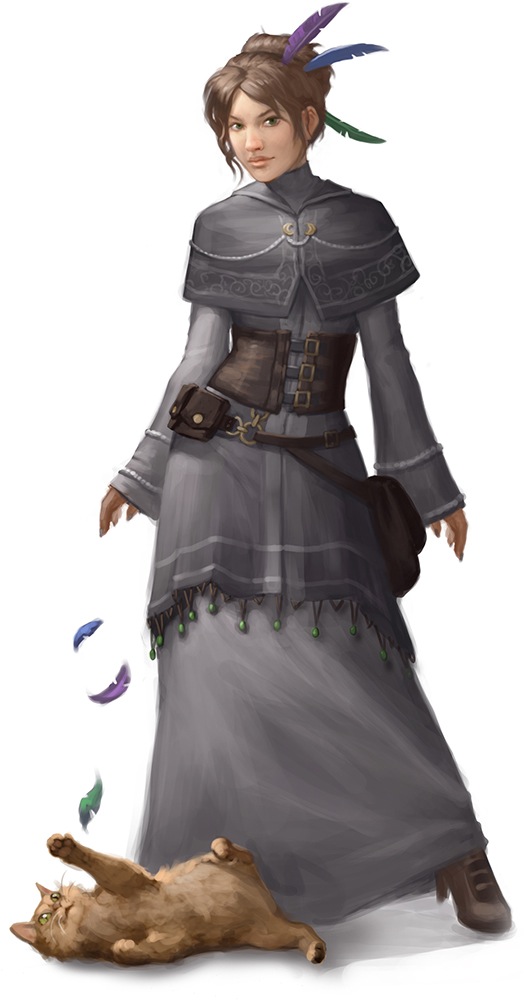
"My mistake." Nella Cailean's illusion melted. "Never pick drama over believability. I should have just impersonated Headmaster Ornelos." She shrugged. "Anyway, I still want the little ivory chest." She held out her hand.
"Why?" I almost screamed. "Are all wizards mad? What's so important about a snuffbox?"
"Sivanah only knows!" she laughed. "But all the older instructors have them, so I intend to find out."
"And how'd you know we'd be here?"
"My main field of study is illusion, but I dabble in divination as well. I spy with my little scry..." She produced a sheet of paper and grinned at Norret. "I still haven't figured out your claw spell, but a page from an alchemist's formulary and a handwriting sample? Can't ask for better sympathy than that."
"I thought I felt someone was watching me," said Norret.
"And a whole lot more will be if you don't give me Zharmides' snuffbox." She paused. "And the vault key. I only reserved the columbarium for an hour, and you must have alerted half the spectral spies."
A knock sounded at a door on the other side of the chamber.
"Reserved!" Nella cried. "Summoning!"
"Acadamae security!"
Nella looked at Norret. "Give me the goods, and I'll get you out. Refuse, and you deal with the guards."
"So will you."
"I'm a student. I'm used to it. You?" She cocked her head. "Did you hear the screams in the halls below?"
"Fine," he agreed. "Just be quick." He placed the key and the snuffbox in her hand.
They disappeared up her sleeve. "Understood." Nella wove her hands in the air, muttering arcane syllables. My brother's appearance melted, reforming into the image of Arlunia Ehrmande, Lecturer in Charms.
The door opened and three hellspawn entered the chamber.
"You fools!" Nella screamed. "I summoned a drekavac, and now it's out of its circle!" She pointed at me.
"What's a drekavac?" the first hellspawn asked.
The second stared at me in horror. "You summoned a plague spirit?" He turned to Nella. "Are you insane?"
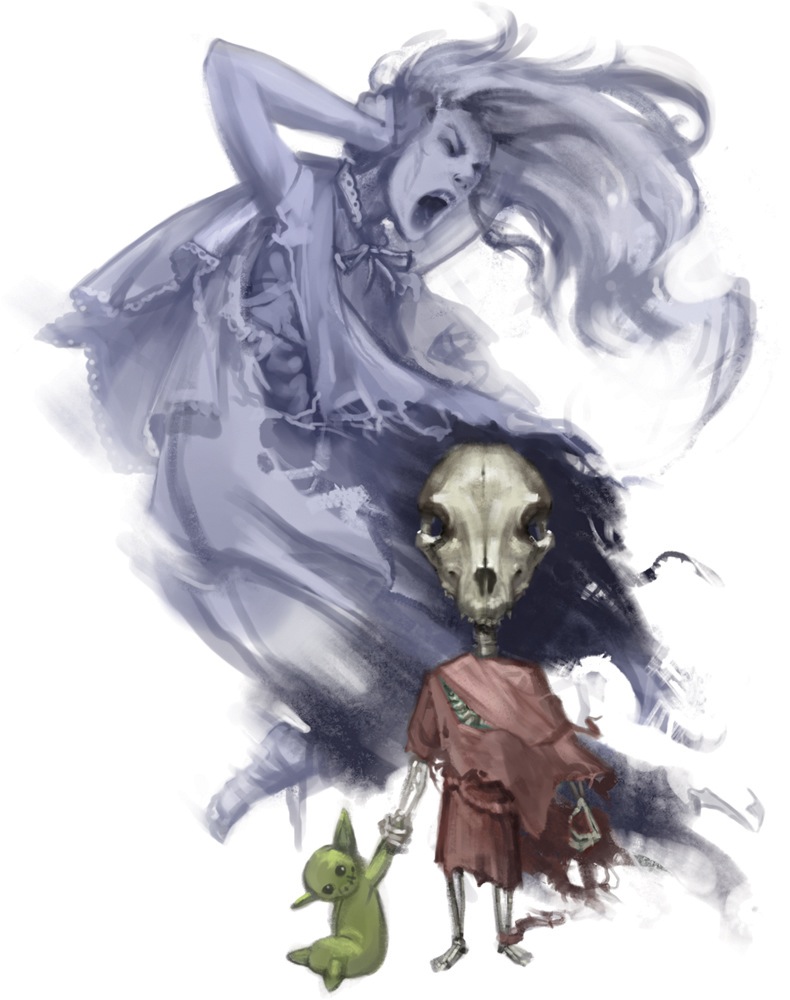
The third remarked, "Don't drekavacs have animal heads?"
"It's a greater drekavac!" Nella improvised. "A bloody drekavac! A child who died of the plague!"
So far as I knew, I'd only died of a fever, but Nella's lies were uncomfortably close to the truth. I was also acutely aware that I was still drenched in the blood of Zharmides the Godless.
"Professor Ehrmande, do you think you can hold it?" Nella asked breathily.
"I think so," said Norret in his normal, masculine voice.
The hellspawn stared at him. "Does she have the plague?"
Norret coughed.
"Save yourselves!" cried Nella.
The hellspawn ran out the door.
Nella produced a wand. "Hold hands and run for the Acadamae gates. This won't last long." She touched me with the wand and said a single word: "Fernseed." Then she touched Norret. "Fernseed," she pronounced again and he vanished.
We were invisible. We ran for the open door and out into the Hall of Whispers. We found the main entrance by following the cries of "Drekavac! Drekavac! Run!"
We were out on the lawn, out the front gates, and halfway down a side street before the spell wore off. The illusion of Arlunia Ehrmande lasted a little longer, but was gone by the time we found a bridge to cross the Narrows of Saint Alika.
By the time we got to the Old Quay, I was staggering. Norret covered me with his cloak, and I finally slept.
∗∗∗
Teleportation is an awful way to wake up, but it was followed by the realization that we were back in Galt, in the Primrose Suite.
Sweet Galt. How I'd missed her.
"Blue Liberty!" Dr. Orontius swore. "What happened, Orlin? You look like you were in the front row at a particularly spectacular beheading!"
I wanted to say, "No, a vampire got sick on me," then found that I already had. Before I hardly knew what I was doing, the whole story came out. Norret even had pictures, including his painting of the cult's feast just before they all threw up.
Dr. Orontius worked a small spell, making all the blood that covered me vanish, then Norret told the rest of the tale, including how he'd lost the snuffbox.
"'Nella Cailean,' you say?" asked Dr. Orontius. "Saucy little minx. Well, two can play at the scrying game...."
"Unless there's lead in the way."
"Well, yes," admitted Dr. Orontius, "but it's not that common."
"White lead is also the primary ingredient in flake white, which I used to gesso my canvas." Norret opened his case of pigments, revealing a full jar of white paint. "I used to be a soldier, so I'm familiar with the feeling of being scried on." Norret reached into the jar and removed a tiny chest. "I assumed you could clean this off."
"Splendid!" cried Dr. Orontius. "You painted the snuffbox in the portrait twice, once with mundane pigments, once with the marvelous ones?"
"Yes," said Norret.
Dr. Orontius chuckled heartily. "Knowing what I do, Nella should be heartily surprised when she discovers that her prize is a fake!" He repeated the blood-removing charm, but this time it stripped paint, leaving a pretty little ivory snuffbox, complete with gilded scrimshaw lions and lilies.
He opened the tiny chest, bringing it to his nose and sniffing. "Ah yes, dear Zharmides always favored Peshpetal Blend." He snapped it shut and held it to his heart. "I will cherish this memento and think of him always."
"You could cherish that and think of him too." I pointed to the portrait of the cultists devouring Zharmides' corpse.
Dr. Orontius looked uncomfortable. "Yes, well, perhaps I might use that to retrieve some fragment of his body."
"So what's the snuffbox for?"
"Clever boy." He pinched my cheek. "Perhaps one day, if you are clever enough, you might attend the Acadamae and learn that secret." He patted me on the head for good measure. "But presently, you must work. Breakfast won't fix itself!"
There is something wrong with a world where ghouls and vampires are more polite and grateful than a houseful of scholars. I went out to the garden, let out the chickens that had been cooped up all day, and took in a double helping of eggs.
The post-execution day omelets were late the next morning, but they were seasoned with thileu bark. I declared them "Omelets Korvosa." If I didn't need to tell the boarders about unicorn bone porridge, I didn't need to tell them about Urgathoa's pepper mill either.
I was beginning to fix lunch when the bell for the Primrose Suite began jangling. Dr. Orontius had some nerve. But when the wire pulled the spring out of the wall and slammed the bell into the ceiling, I realized something was seriously wrong.
"Rhodel, get Norret!" I raced for the Primrose Suite.
Norret was already there, staring at the door, his monocle pushed up on his forehead. A horrible banging and cursing came from the suite, mixed with the screeching of an owl. Norret was half-shaven, holding a mug and shaving brush.
He pushed the monocle back in place, spat in his shaving mug, and painted the doorframe with the resulting lather.
Norret pushed me down on the floor. The lather sizzled and exploded, the entire door and doorframe falling out into the hall. Plaster dust swirled through the air like smoke.
Through the new arch into the Primrose Suite, I saw Dr. Orontius being beaten over the head with a gold-topped cane by Zharmides the Godless. Meanwhile, a green winged monkey-gremlin-thing attempted to garrote our boarder with the bell pull while an owl clawed at it.
Norret still had his pomander orbiting his head. He hurled it at the gremlin, angling the opening just so. The thing screeched, blinded by thieves vinegar. It looked like a beribboned, clove-studded orange-peel hat had been pulled down over its eyes.
"Get the homunculus," Norret said. "I'll get the wizard."
I wasn't certain how I was supposed capture a flying manikin, but then I spotted a bell jar on the mantel. It was covering a clock the same size as the homunculus.
I used my spirit's hand to tweak its nose. The homunculus flew up as I caught it in the jar, clapping the open end down to the surface of Dr. Orontius's traveler's trunk. The thing raged against the glass, but it was too heavy for it to lift.
With a terrific thundering that rattled the windows and knocked all the pictures askew, Zharmides the Godless blew up—fortunately into flecks of shaving cream and shadows rather than blood and gore like the last time he'd been ripped apart. A torn scrap of parchment fluttered down, and Dr. Orontius's owl familiar caught it. He dropped it in my hands before taking his customary perch atop the bust of Nethys and looking at me expectantly.
I examined the parchment. It was half of a magical figure—half a circle, half a square, and the upper half of Zharmides the Godless, holding his cane in one hand, his arms shown in two positions, like an architectural diagram for a jumping jack. More sympathetic magic.
I turned. The lower half of the symbol was pasted inside the open lid of another large chest, an ivory one. But it was still possible to see that this one was scrimshawed with lions and lilies and filled with books.
"Thank you," Dr. Orontius wheezed, loosening the bell pull from his throat. "Your assistance is appreciated but was not strictly–"
"It's Zharmides' trunk," I said. "The real one. The little snuffbox is just a focus, isn't it?"
Dr. Orontius harrumphed, but he couldn't hide the guilty expression. "How was I to know—"
I cut him off. "You use the paintings when you teleport somewhere. By the same principles, you use your snuffbox to teleport your traveler's trunk to you later when you want it. Why go back to your library when you can have your library brought to you? Zharmides knew the same trick, but to get his books, you needed his snuffbox. Which would have all worked out fine, except he left his homunculus inside the larger chest along with a trap."
"A symbol," Dr. Orontius said, feeling the lumps on his head. "I'm not certain which one...."
I handed Dr. Orontius the upper half of the torn piece of paper.
Norret beamed like a proud parent. But he was actually just my brother, and someone had to have a head for business. "I don't know what deal you had with Norret," I said, "but I'll be making up a bill."
I stepped out over the rubble, adding, "There will be no further room service."
Coming Next Week: A sample chapter from Richard Lee Byers' new Pathfinder Tales novel Called to Darkness, starring the Kellid warrior Kagur and her quest for vengeance against the frost giant that killed her family!
Kevin Andrew Murphy is the author of numerous stories, poems, and novels, as well as a writer for Wild Cards, George R. R. Martin's shared-world anthology line. His previous Pathfinder Tales stories include "The Secret of the Rose and Glove" and "The Perfumer's Apprentice" (also starring Norret and Orlin), and "The Fifth River Freedom," the fourth chapter of Prodigal Sons in the Kingmaker Pathfinder's Journal. For more information, visit his website.
We were in the Gray District, the necropolis in the southeastern corner of Korvosa. More specifically, we were in Potter's Ward, the southeastern corner of that, used for the graves of the poor. The air was filled with greasy smoke. It smelled like someone was cooking rotting pork and it had caught fire. Except that in this case it was long pork. The only thing that smelled worse than the burning corpses were the ones that weren't yet burnt.
Thieves Vinegar
by Kevin Andrew Murphy
Chapter Three: Still Life with Snuffbox
I have never been so grateful for vinegar in my life.
Norret had taught me, as part of the science of perfumery, that there were seven basic scents. One of them, putrescence, was necessary in any truly fine perfume, but only the faintest note.
Putrescence was found in stinkhorn fungi and the carrion flowers of the Mwangi Expanse, but most commonly in putrescine and cadaverine, alchemical substances that came from corpses.
We were in the Gray District, the necropolis in the southeastern corner of Korvosa. More specifically, we were in Potter's Ward, the southeastern corner of that, used for the graves of the poor. The air was filled with greasy smoke. It smelled like someone was cooking rotting pork and it had caught fire. Except that in this case it was long pork. The only thing that smelled worse than the burning corpses were the ones that weren't yet burnt.
Some of those even stumbled around. I think they were zombies–I hope they were zombies–because the other alternative was that gravediggers and priestesses of Pharasma were beating still-living plague victims with shovels and setting them on fire.
I clutched my pomander orange and inhaled the floral notes of tansy and thyme, the camphoraceous notes of rosemary and lavender, the minty note of mint, and the sweet pungency of apple cider vinegar.
"Wizards are utterly mad, Rhodel," I told my spirit guide, or possibly the empty air. "Even crazier than alchemists." I held the pomander against the stench. "A 'keepsake,' Dr. Orontius said. A memento to remember his beloved school chum.…" I snorted and was immediately sorry because I'd snorted vinegar. Then I was less sorry because, once my eyes stopped watering, I realized I couldn't smell anything.
I glanced at another corpse and checked Norret's picture of Zharmides the Godless.
Nella had told us more about Zharmides, a convert to the Rahadoum heresies who spiced his divination lectures with tart comments on the gods, calling Blackfingers a two-bit snake-oil salesman and Pharasma a schoolmarm with an attendance fetish.
Nella wouldn't repeat what he said about Asmodeus other than mentioning that one particular string of blasphemies had reportedly made an imp faint.
I was sorry that he was dead, and even more sorry I wasn't finding his body. That was my job while Norret ran interference, helping the priests and priestesses of Pharasma blow up the zombies that seemed to be rising with some regularity. Our story was that we'd been sent to help by the temple of Shelyn, not that anyone seemed inclined to check.
When I wasn't looking at corpses, I amused myself—if that's the right word—by examining the potsherds the Potter's Ward was named for. Norret's art tourists' map noted that some believed the bits of broken crockery littering the soil went back to the time of the Shoanti.
I assumed this was a more relaxing pastime when there weren't zombies lurching around. Someone else with wild hair and glassy eyes lurched toward me, except this man had a wheelbarrow filled with fresh bodies. I was about to examine them when I took note of the gravedigger's brocade waistcoat. Not only was it too fine a garment for gravedigging, but it was covered with stylized Zs. Unfortunately, the pockets were all flat. Even the pocket square was gone.
"Where'd you get your waistcoat?" I asked.
The gravedigger beamed. "The master gave it to me."
"Who's your master?"
He paused, then said swiftly, "I have no master."
"Then whom do you work for?"
"I work for the Church of Pharasma. I am a simple fellow. I dig graves." His voice was as flat as a zombie's, assuming zombies could speak. He attempted to push past me with the barrow full of plague-raddled corpses. "Please move. I must bury these bodies."
To say that he was acting strange was an understatement. "Did you by any chance find a snuffbox? A little ivory one with gold fittings, same monogram on the bottom as you've got on your vest?"
"Oh yes. The— He was very pleased to get it. Said every nobleman should have one."
"So where's your master?"
"I have no master."
"Could you take me to your master?"
The gravedigger looked puzzled, then tortured. At last he whispered, "Only if you're one of the faithful?" His eyebrows rose hopefully.
"If I said that I was?"
"Then I would ask you for the password."
"What's the password?"
Rhodel certainly makes an attractive ghost.
"I'm not allowed to say." He looked frightened. "I am a simple fellow. I dig graves. Please move. I must bury these bodies."
I stepped aside. My skin prickled as if a whole gaggle of geese were walking over my grave, and I've been dead so I know what that feels like. I went to Norret and told him about my conversation.
"Drugged or enchanted," he concluded. "Duke Devore's formulary has a recipe for hypnotic perfume, but..." My brother flipped one of his monocles down and peered at the gravedigger. "Definitely enchanted. Mind-controlled—I've seen it on the battlefield. Give someone too many contradictory orders and the mind starts to break."
I didn't know if he was talking military orders or magical ones, or if there was much of a difference. "How do we find his 'master'?"
"We keep an eye on him and an ear out for this 'password.'"
When my brother said "keep an ear out," he meant this literally. He swigged some tincture of wolfsbane and grew ears as long and pointed as a wolf's. A bit of eavesdropping and spying on the addled gravedigger later, he said, "I am famished."
"You're hungry?" I gasped, still holding my pomander against the stench.
"No, 'I am famished.' That's the password."
It certainly wasn't one that easily sprang to mind, especially with how I'd lost any trace of my appetite, given the reeking corpses. But with that last clue, everything about the strange man fell into place. "I guess that tells us what he meant by a 'one of the faithful,' then?"
Norret nodded. "It would seem that the grave digger—or whoever's controlling him—is a worshiper of Urgathoa, goddess of gluttony and undeath."
I shuddered, but it made sense. Who else would be hungry in a graveyard?
Once the sun had set, our pomander oranges began to glow with will-o'-wisp light like little moons. We dodged one last patrol of Pharasmins as the priests swept the necropolis before locking the gates for the night–plague or no plague, even priests of the goddess of death needed sleep, especially after the day they'd had. Norret and I, on the other hand, would get no sleep, not just because of where we were but because Norret had prepared a pot of coffee Woodsedge-style—half coffee, half roasted chicory root.
We picked our way across the Potter's Ward, trailing the gravedigger and a cortege of figures we presumed were cultists. We hopped a low fence into Everyman's Ward, and finally slipped past a loose bar in the spike-tipped iron fence that led to the Gold Ward where the nobility were interred. Being a Galtan, it soothed my soul somewhat to know that the Urgathoans were desecrating the tombs of the nobility rather prying into graves of the common man, not that I think they were making that distinction.
Most of the mausoleums in the Gold Ward were grand affairs, with polished brass knobs, cypress wreaths, and even freshly cut flowers placed in urns outside. One mausoleum looked decidedly seedy and unkempt, neglected for many years, the doors falling off their hinges and the only flowers being weeds and lichen growing through cracks in the marble façade. The name Galdur was carved above the doors, and the last cultist was disappearing down the steps.
We followed and were greeted at the bottom by a lady in a tattered spattered gown like from the nursery rhyme. Her black hair was an obvious wig, though her ghoulish teeth were real enough, having been filed to points. The cultist smiled, letting us get an even better look.
"I am famished," I said, and Norret did as well.
"Then you are welcome in Urgathoa's Hall!" She smiled as if welcoming us to a holiday party. "You must call me Deaconess Gentle. How should I know you?"
"I'm Orlin, and this is my brother, Norret."
"Oh, an artist!" She took delighted note of Norret's folding easel and the multicolored alchemical stains on his clothes. "You must paint a portrait to immortalize this celebration."
Norret nodded in hasty agreement.
"So, what have you brought for Urgathoa's feast?"
"Brought?" I repeated.
"An offering to share! An unholy delicacy for us to consume for the delight of the Pallid Princess!"
I thought, then remembered my little horn spoon. "How about unicorn bone porridge?"
"Delightful!" exclaimed the cultist. "Did the beast scream as it was butchered?"
"I don't know. It died a long time ago."
"Well aged, then." She turned to Norret.
"I brought coffee."
She rolled her eyes but merely said, "Mistress Kissim brought funeral biscuits. I'm certain they will go well together." She gestured to one corner of the crypt. "I think you might set your easel up there. It will have the best view of the festivities. Do we need more candles?"
"No, the shadows are just right," Norret said.
"Well," the deaconess allowed, "none of them are hungry, but I'm certain that can be remedied later. I'm just so pleased we have an artist. Please, come in."
Norret nodded and did.
I might have expected many things of the cult of Urgathoa, but one thing I did not expect was a demented potluck. Cultists were milling about, placing food on the old sarcophagi like they were artists arranging still lifes—should the skull go beside the cheese tray or on top of it?—and everyone was chatting as if they'd gathered in some Isarn salon for a Crystalhue feast rather than in an abandoned Korvosan crypt for the blasphemous rites of the Pallid Princess.
Deaconess Gentle peered up the stairs. "Is there anyone else?"
"One more." The scent of roses and ectoplasm replaced the musty odor of the crypt.
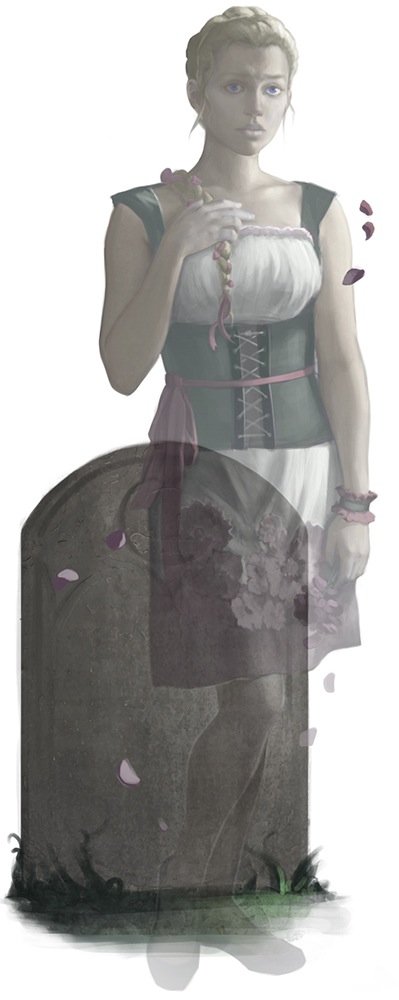
Beside us appeared a vision of loveliness, a girl of no more than sixteen summers garbed in a green and ivory festival gown, a garland of pink noisette roses plaited into her golden hair. I'd only seen my spirit guide in this world once, when I was poisoned, but necromancers had told Norret and me that spirits had an easier time appearing to the doomed or the dying, or in certain places where the veil between worlds wore thin.
I hoped it was the third possibility, or at least that "doom" was more a warning than a certainty.
"How lovely you are!" The priestess clasped my spirit guide's hands, but not quite. "How may I know you?"
"Call me Rhodel."
"It is an honor to be graced by one of the incorporeal. Lord Galdur had feared that he would be the only one here to celebrate an ashenmorn."
"Ah nae." Rhodel laughed. "Orlin slipped his grave too."
"Indeed?" said Deaconess Gentle, blinking at me. "I took you for a living child. Forgive me."
"No need," I said truthfully.
"You shall have the place of honor." The priestess showed me to a chair at the upper left corner of the central sarcophagus, seating Rhodel just to the right of me before taking her place at the head of the "table." It was covered with a funeral pall. Seated opposite me was a rakishly handsome young man with dark hair, pale skin, and mismatched finery. Being from Galt, I was familiar with the look. It was what happened when you raided the wardrobes of dead nobles and had no eye for taste.
"Now, Master?" asked the gravedigger groveling at his side.
"Now, Alfoun."
The gravedigger whisked away the pall like a waiter uncovering a tray. I tried not to look at what was on the slab–who was on the slab–not wanting to see another plague-ravaged corpse. But then I did and I realized that, apart from liver spots, there were no marks on the old man's naked body. The mouth was open in a death rictus. Even so, I recognized it. I had been looking at it all day. It was the face of Zharmides the Godless.
"Oh, one without the plague!" Deaconess Gentle exclaimed delightedly. "Wherever did you find it, Lord Galdur?"
The young nobleman smiled, revealing pronounced eyeteeth, and petted the gravedigger like a faithful dog. "Good Alfoun brought it to me."
"Urgathoa has truly blessed us! Much as I enjoy the fruits of the season, it's nice to have a little variety."
"Shall I have the kiss of undeath now, master?" the gravedigger begged.
"No!" cried the pretty young woman seated to his left. "You swore your next bride would be me!"
"Patience, dear ones. Go eat some rats."
He said this last just forcefully enough. They both scurried off to one of the lower tables where one of the other cultists had indeed brought rats, roasted on a stick.
"There is a chair free now, my lovely." Lord Galdur gestured.
Rhodel vanished from her chair and reappeared in the one at his side.
Deaconess Gentle made brief introductions, then told Rhodel, "I'm so embarrassed. We didn't expect any of the incorporeal. How might we feed your pain?"
"Mayhaps a li'l pinch a snuff?" Rhodel asked. "Loved it in life 'n I kin still smell it in death."
Deaconess Gentle looked perturbed, but Lord Galdur reached into his pocket and gallantly produced a snuffbox. The snuffbox. Ivory, carved with lions and lilies. Even the stylized Z on the bottom. "A nobleman never goes anywhere without it."
"Ah, how pretty!" Rhodel exclaimed. "Lemme guess yer name. Is it Zander? Zaries?"
"It's Tyrnan," he said smoothly, "the fourth of that name. But I inherited this from my great uncle, Zellin Galdur."
I realized then that the vampire was a fraud—and likely about more than just the snuffbox. I suspected that if he had any noble blood in him at all, it was only because he'd drunk it.
"I've been ta the other side. I've met Tyrnan Galdur. All four." Rhodel took the snuffbox from him—actually, physically took it—and smiled. "Yer not him."
The vampire hissed like a cat, fangs bared, but this wasn't very frightening to a ghost. "And you, milady? Who are you, appearing like a Shelynite doxy at Urgathoa's feast!?"
"Ah," said Rhodel, "ye found me out. 'Tis true. I loved the Rose mosta' all. But I lived a long life, an' I prayed ta the Pallid Princess there at the end." As she said this, she grew older and older, the lines of age and care appearing on her face, then the sores of hag pox, the harlot's curse. "Kith me, handsome!" she slurred, her odor of roses turning to alcohol, anise, and the stench of sulfur as she grabbed him in a clench. Then she caught fire and exploded in a flash of fireworks and ectoplasm.
The vampire shouted and stood, his chair clattering behind him.
I felt something appear in my hands. It was the snuffbox, sticky with ectoplasm. I quickly put it in my pocket.
Deaconess Gentle retrieved her wig from where it had been blown off in the explosion. Beneath it, her hair was stringy and white. "The incorporeal—always so dramatic!" she exclaimed to the assembled cultists.
"Where is she?" hissed the vampire. "Where's my snuffbox?"
The priestess tugged the edge of his coat. "Lord Galdur, please. The ritual."
The vampire sat, glaring at me.
Deaconess Gentle placed one hand on my shoulder, then addressed her congregation, "My famished ones, this is Orlin. He's brought us a special delicacy. What was it again, dear?"
"Um, unicorn bone porridge."
Appreciative sounds issued from the cultists. The pretty woman who wanted to be a vampire brought me a bowl. I tried to ignore the fact that it was made from the top of a human skull and placed the little horn spoon inside.
Thick pasty gruel welled up. Norret had tried to make it look and taste like blancmange, but it only did insomuch as blanched almond pudding looked similar to stewed unicorn bones.
I offered the bowl to the priestess. She took a delicate bite. "It... has a lovely texture," she said politely. "Like rotten brains."
I was less disturbed than I should have been. "It's a little bland," I admitted.
She smiled. "I believe Lord Galdur may have a solution." She turned to him. "Might Orlin borrow your talisman?"
The vampire set down the glass of blood he had been draining from Zharmides' arm and addressed his priestess. "Does he have any skill as a chef?"
"A little," I admitted.
"Marvelous." He greeted me with a predatory smile. "Behold this talisman, sacred to the Pallid Princess." He reached up to his neck and touched his lavalier. "It makes the blood of the dead taste as sweet as that of the living." The pendant was amethyst, dark as Hymbrian grapes, a six-sided natural crystal capped with silver filigree in the shape of flies. "In the hands of a true chef, it can also produce sugar, salt, and spice. Yet that is not its only virtue. When touched by the undead, the Princess's crystal becomes the pure purple of royalty." He unclasped the chain, and held it out, then dropped it to pool on Zharmides' dead chest. "When touched by those bereft of Her blessing, it turns pale." The crystal clouded and color leached from it, transmuting from amethyst to milky quartz, white as leprosy. "But when touched by the living, it turns as pink as a baby's cheek."
The vampire bared his fangs in a feral grin. "Although you appear alive, Orlin, you smell of vinegar, like my cousins from the east." He stared at my neck. "Tell me, does your head come off?"
So far as I knew, everybody's head came off when you applied a Final Blade. "Yes, but I'd prefer if it stayed where it is."
"Just so," said the vampire. "I've heard it's troublesome to put your head back. But as youthful as I appear, I am older than I look."
"Same here."
"Indeed," agreed the vampire, "but from what I know, my eastern cousins are all women, not men. And never children. Touch the talisman and reveal Urgathoa's truth!"
He was trying to command me like his rat-chewing lackeys. But it was a litmus test. As awful as Urgathoa was, she still followed rules. The milky quartz of the pallid crystal would turn to amethyst for the dead and rose quartz for the living.
Of course, if you contaminated your sample, a litmus test could yield a false positive or negative. "Fine." I stood up and reached for the crystal while under my breath I said, "Rhodel...."
My spirit guide knew how to take a cue. I felt the cold touch as her hand overlaid mine.
I sat back down. While my fingers were closed around the crystal, they weren't touching it. Rhodel's were. Slowly I saw it clear and change from lavender to violet to deepest amethyst.
"Blessed child of Urgathoa!" cried the priestess.
The vampire sulked, even more so when I asked, "So what do I do now? Twist it like a pepper mill?"
As I said the word "pepper," a sprinkle floated down over the bowl of unicorn bone porridge, just like it had for Dr. Orontius. "Does it do thileu bark?" As I said it, it answered my question.
"If you add some fear's breath and hatefinger, I'll take that bowl, please," said Deaconess Gentle.
I'd never heard of these herbs, but Urgathoa's lavalier had, adding a sprinkle of each.
"Just nightfog and bloodroot for my wine," "Lord Galdur" grumbled sourly, holding out his glass of wizard blood.
Orders came in. It was almost like I was back in Isarn dishing up breakfast for our boarders. I fixed myself a bowl of porridge, seasoned it with sugar, cinnamon, and ginger, and tried to pretend I wasn't eating out of the top of someone's skull. It did taste like mother's blancmange now.
The festivities proceeded. Deaconess Gentle opened some moldering tome titled Serving Your Hunger, which I'd initially taken for a cookbook, and led the congregation in a ghastly chant made more horrid by the fact that most of the cultists were off key. Then she had me sprinkle Zharmides the Godless with thileu bark, after which she proceeded to pour Korvosan tawny port over the wizard's corpse and began to dish up slices of meat.
I didn't know whether this was the fate the gods had designed for those who mocked them or whether Zharmides had foreseen it and this explained his choice in religion.
As the cultists continued their ritual, I began noticing little oddities. For all that she looked the part of a priestess, Deacon Gentle seemed to fumble her way through the divine readings, sometimes stopping and having to repeat passages. Though the other cultists ate with gusto, all bore normal human features, and one or two even seemed a little queasy over the things they were shoving into their mouths. Only the vampire was actually undead, and despite the way the humans simpered and fawned over him, he too seemed to be trying hard to play a part—that of the world-weary undead lord.
They're new at this. The realization struck me suddenly, and for a moment I felt a little sorry for them. I wondered if their conversion was the result of the plague, or if they merely hoped to be rewarded by the vampire. Either way, it was a pathetic scene.
Then one of them began gnawing at a loop of intestine, and my sympathy evaporated.
I realized that Deaconess Gentle was looking expectantly at me. She was holding an empty plate, waiting for me to request a cut.
"Um, that's not how I... serve my hunger," I said as politely as I could, hoping I was saying the right thing.
"Indeed? And what would your kind prefer?"
Alarmed, I looked for Norret. The woman followed my glance. "Oh, the artist! Of course—he'll eat first, then you'll drink from his veins. Splendid."
My brother came over and saw what he was expected to do. Fortunately there was a line of cultists, and some were going back for seconds.
I got his attention when the priestess went to pour more port over Zharmides' body. I surreptitiously slipped my brother the damned snuffbox. He put it in a pocket and handed me a vial, jerking his head towards the bottle of port.
I unstoppered the vial and gripped it tight with my spirit's hand. It glittered like a diamond as I raised it in the air, but the cultists were distracted and drunk and didn't notice the drops dripping down as I added to Zharmides' seasoning. For good measure, I made sure a few drops got into the vampire's glass as well.
Then I pulled my spirit's hand back to my physical hand and stole a glance at the empty vial, pondering the label, written in Norret's neat handwriting: Syrup of Ip.
Coming Next Week: Things get truly gross in the final chapter of "Thieves Vinegar" by Kevin Andrew Murphy!
Kevin Andrew Murphy is the author of numerous stories, poems, and novels, as well as a writer for Wild Cards, George R. R. Martin's shared-world anthology line. His previous Pathfinder Tales stories include "The Secret of the Rose and Glove" and "The Perfumer's Apprentice" (also starring Norret and Orlin), and "The Fifth River Freedom," the fourth chapter of Prodigal Sons in the Kingmaker Pathfinder's Journal. For more information, visit his website.
"Observe, Orlin." Norret scooped a vial of purple cabbage water from the leaves I was blanching for the afternoon's meal. "Note how the introduction of even a weak acid transmutes the deepest amethyst to brilliant fuchsia...." He added a drop of vinegar and swirled it.
Thieves Vinegar
by Kevin Andrew Murphy
Chapter One: The Old Quay
"Observe, Orlin." Norret scooped a vial of purple cabbage water from the leaves I was blanching for the afternoon's meal. "Note how the introduction of even a weak acid transmutes the deepest amethyst to brilliant fuchsia...." He added a drop of vinegar and swirled it.
The dark purple did indeed change to bright pink, but I'd already seen this reaction when he'd ruined half my store of violet syrup, oblivious to the facts that sugar was dear in Isarn and violets troublesome to pick.
High on the kitchen wall, one of the servant's bells jangled—the one with the wire running to the Primrose Suite, occupied by Dr. Orontius, a kindly old wizard and one of our best boarders.
A whiff of ectoplasm manifested—an example of ethereal, the seventh scent, as Norret had taught me—mixed with the faint odor of roses.
Some people, when they returned from Pharasma's Boneyard, could see its denizens. Others heard ghostly voices. Me? I was raised in Dabril, famous for its perfumes and gloves, so I only smelled the dead and sometimes felt their touch.
The violet syrup levitated. It emptied itself into a jug of water, dying it the same color, then changed this to pink as a cut lemon squeezed itself over it.
"You see?" Norret beamed. "Even Rhodel can work a litmus test!"
My ghostly spirit guide also knew how to make pink lemonade. "Go stall." I handed him the jug. "I'll bring lunch up as soon as I can."
As Norret left, words appeared on the kitchen slate, written in a woman's hand: Careful what you wish for.
"I know." I had hoped that, after our last adventure, my brother would stop treating me like a child. I had not expected that he, a grown man, absolved of this responsibility, would start acting like a child himself. But it was the case.
Dr. Orontius is nice enough—but a wizard is always plotting something.
It was also the case that the Revolutionary Council, rulers of Galt, had appointed Norret and me proprietors of the Eglantine House, home to some of the nation's finest scholars and magical researchers. They paid rent but expected meals. The kitchen garden provided fruits and vegetables, a few hens provided eggs, and an enchanted horn spoon provided bland unicorn bone porridge. I had become good at hiding it in other dishes. This afternoon's luncheon was cabbage rolls stuffed with "horsemeat."
What would have really helped were salt and spices.
Fortunately, Dr. Orontius had his own, or at least he could wave his fingers in the air, mumble some ancient syllables, and make a sprinkling of salt materialize over his food, followed by pepper. This he did as soon as I arrived with the tray, then sampled a bite from a silver fork. "Ah, yes, now it is perfect."
Norret adjusted the complicated series of jeweler's loupes and lead crystal lenses attached to the monocle he'd taken to wearing in place of his old eyepatch. For reasons only my brother could understand—sympathy, antipathy, planetary resonance—lead both helped divination and blocked it. This included the sense I'd picked up from some unicorn horn and a drop of philosopher's mercury, which let me detect poisons. Norret, after an alarming and thankfully temporary experiment with eyedrops that let him look through walls, had switched his optical inquiries to lens grinding and tinted glass. He'd been trying to peep through the veil into Pharasma's realm so we could see Rhodel. He still hadn't discovered the right combination of lenses to see the spirit world, but had managed the arcane spectrum.
"Is that phenomenon accomplished by means of conjuration or spontaneous generation?" he asked Orontius.
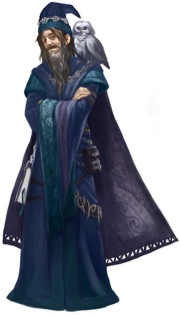
"An astute metaphysical question," said Dr. Orontius, "but a true wizard never reveals his secrets." His old blue eyes twinkled, the same color as his robes and pointed hat. "At least not without receiving another secret in trade. Perhaps that formula for 'thieves vinegar' you mentioned?"
"Not in exchange for such a trifle," said Norret. "An alchemist has his secrets as well."
"Just so," Dr. Orontius agreed, turning to me. "Your brother claims to have a formula for a fabulous antiplague, a sovereign preventative for all manner of ills. As Desna would have it, a plague currently ravages Korvosa. Zharmides, an old classmate from my Acadamae days, has recently perished therein. I desire a keepsake to remember him by, a little ivory snuffbox of which he was fond."
"Can you describe it?" Norret asked him.
"Why describe when one can simply show?" Dr. Orontius muttered arcane phrases and made mystical passes with both hands, opening one to reveal a tiny ivory chest resting on his palm. "This is merely a memory, so look but do not touch." The wizard's memory sharpened, scrimshawed lions and lilies appearing on the sides, little clasps and fittings in matching gold. It floated in the air, tumbling like a bubble, revealing a gilded sigil engraved on the bottom, looking like a stylized Z.
My brother took out his formulary and a silver pencil. The talent Norret lacks for cooking he makes up for with drawing and scientific illustration. Soon he had a passable silverpoint architectural diagram of the snuffbox.
"I expect it should be among the effects to be interred with his body." The wizard gestured with his fork and the vision of the snuffbox vanished, quickly followed by his last bite of cabbage roll. "Whether that will be in Korvosa or with his family in Alkenstar, I cannot say. But I'm certain there should be time for formal viewing at the Acadamae itself." He produced another snuffbox, this one of paueliel burl, the sacred "first trees" of the elves. Norret had taught me how to identify paueliel along with a dozen other woods with interesting alchemical properties. A matching traveler's trunk sat against one wall, swirled with whorls like owl eyes, and I swear, I had once seen it blink at me.
Muco, an actual owl and Dr. Orontius's familiar, perched atop a bust of Nethys at one end of the mantel. He swiveled his head around backward and blinked at me for real.
Dr. Orontius merely opened the smaller box, a whorl on the lid forming yet another eye with the iris wide as an O, and took a pinch of snuff in each nostril. The snuffbox disappeared back up his sleeve, replaced with a handkerchief. "I shall give you a letter for Zharmides." He blew his nose decisively. "While he of course will not be able to read it, being dead, it should at least gain you admittance to the funeral."
Where my brother would pick a dead wizard's pocket. Unless Dr. Orontius's "friend" were already interred, in which case Norret would think nothing of burgling the dead.
After all, he'd already dug up my grave. Not that I was complaining.
"He's not going alone," I stated plainly.
"Oh, surely—" said Dr. Orontius.
I cut him off. "Surely something can go wrong."
Norret only smiled with his eyes, but the one without the monocle was almost dancing with amusement. "Orlin is growing up."
"Quite," sniffed Dr. Orontius. "But if this 'thieves vinegar' is as efficacious as purported, there should be no risk to yourselves."
I had already died once of a fever, and while I had been brought back to life, I had no desire to repeat the experience. That said, it was not my brother's alchemy I was worried about.
"As Desna would also have it, tomorrow is an execution day." Dr. Orontius stood, straightening his robes and his beard. "Your boarders will be procuring viands elsewhere, and since you two have no other duties, shall we away now?"
I paused. "Wait. Isn't Korvosa rather far away? Outside of Galt?"
"In Varisia," Dr. Orontius supplied helpfully, "but really, it's no further away than that picture." He gestured to a wall crowded with old paintings. He'd shown me his collection many times, telling tales of his travels in the days before the Revolution: The Grand Opera House of Egorian, capital of devil-haunted Cheliax; or The Warlock's Walk in Nex, parade ground for its arcane arclords.
His finger indicated a smoke-yellowed painting up in one corner. A small brass plaque attached to the frame identified it as The Old Quay In Korvosa. "Are you familiar with a metaphysical process known as 'teleportation'?"
∗∗∗
I was not familiar with teleportation before Dr. Orontius cast his spell. Afterwards? I never wished to experience it again. Unfortunately, if we ever wanted to see our beloved Galt, we would rejoin him on the morrow at this spot when he would transport us back to Isarn.
I was also wondering if we'd traveled in time as well as space, for the sun hung lower in the east than it had in Isarn, but before I could ask, Dr. Orontius pronounced some ritual phrase and vanished with an inrush of air and an audible pop.
Norret and I were left on the quay, a very old dock, even older than the one in Dr. Orontius's antique painting. As I looked down at it, I realized we were standing at the same spot where the painting had been made.
"An excellent illustration of sympathetic magic," Norret remarked.
He wasn't smiling, but the corners of his eyes crinkled. He knew the pun he'd made, but wasn't going to admit it.
"But which branch? Homeopathic or contagious?"
"Homeopathic," I decided. "The Law of Similarity governs a wizard using a painting to go where it shows."
"But wouldn't it also be contagious?" My brother waved a gloved hand. "Surely it was painted from this exact vista."
The boards of the quay were spotted with pigment. A short distance away were two easels with artists behind them. No pun intended, we'd teleported to the most picturesque spot in Korvosa.
"Both then. It falls under the Law of Contact too."
The Law of Contact, or Contagion, stated that things that had once been in contact remained in contact. That meant that anything that touched evil could become evil, so if you put on a ring that had been to the Worldwound, for example, you could be possessed by a demon. If you touched something that had been touched by a plague victim? You could catch the plague.
It was alarming to think about. Before, I had thought that sickness was carried by tiny pixies so small as to be invisible, who flew over the river from Kyonin on mosquitoes and shot people with poison darts. At least that's what the doctor told my mother. While I'm sure she put out a bowl of milk and honey to make them take my fever away, that obviously didn't work.
Norret's solution, rather than milk and honey to bribe capricious fey, was vinegar to drive them off. Thieves vinegar was perfumed with a bouquet of magical herbs–sage, mint, tansy, thyme, rosemary, lavender, wormwood, and rue–but it took an alchemist to know how to decoct them so what you got was an antiplague instead of salad dressing. Besides driving away evil pixies, thieves vinegar was said to ward off fever spirits, purge foul humours, and repel the flies that were the eyes of Urgathoa, at least if you believed the nursery rhyme:
I met a pale lady in a tattered spattered gown.
Her hair was black. Her face was white. Her dress was red and brown.
She said the flies were all her eyes and she saw near and far.
I drove her off with salad and a splash of vinegar!
That was a lot to expect from salad dressing.
That said, I had faith in my brother. He had faith in Citizen Cedrine who'd taught him the formula. She in turn had had faith in the graverobbers who'd used the perfumed vinegar to safely plunder plague pits and battlefields before they were sent to the guillotine for their crimes.
We'd washed with it, gargled with it, and for good measure carried hollowed-out pomander oranges studded with cloves, wreathed in frilly ribbons, and filled with sponges soaked with thieves vinegar. "Carried" is probably not the right word. They were floating, and not just because Rhodel was playing with them or because I'd forgot and reached for something with my soul's hand instead of my regular hand like I sometimes did. They were floating because Norret's only sponge came from a deceased will-o'-wisp, which he'd prepared specially so that it would retain its ability to float. It glowed, too, or at least would come nightfall.
So there we were, standing on the oldest quay in Korvosa with pomander oranges circling our heads.
Strange as it may sound, we were not the strangest people there. Two men walked down the quay wearing perfectly ordinary tricorne hats, but below them they had the faces of storks. Occasionally they stopped at a shop, looked in, and marked an X on the door with chalk. At first I was thinking they had stork men in Korvosa like I'd heard lived in Osirion, but then I realized that they were wearing masks.
"Plague doctors," Norret explained. "Those are doctors' masks."
"Wouldn't storks make more sense for midwives?"
"If they wore them for fashion, yes," explained Norret, "but the beaks hold herbs that work like our pomanders. Powdermaster Davin once helped us rig up similar masks for the battlefield. But he'd been to Korvosa before the Revolution and said it's illegal to wear a doctor's mask if you're not a doctor. Besides, we don't want to see patients. We just need to find Zharmides the Godless—or his body. He is, or at least was, a professor at the Acadamae."
"Where's the Acadamae?"
It was a reasonable question, and I was completely skipping the fact that I'd missed the honorific and "Zharmides the Godless" didn't sound like anyone you wanted to deal with, even if he was dead.
Especially if he was dead. I didn't know what the gods did with atheists, but it couldn't be pleasant. And I'm saying this as someone who met a couple of them.
Gods, I mean. Not atheists. Or, if I hadn't met them, at least I dreamed about Shelyn and Pharasma talking about me when I was dying, so it sort of counts.
"I think it's on the top of a hill." Norret glanced around. Two hills were visible in the city, one nearer, one farther. "Let me ask."
He went over to one of the artists while I stood there feeling somewhere between stupid and nervous. Apart from that time when I died, I'd never been outside of Galt, and while Korvosa wasn't as grand as Isarn, it was still far grander than Dabril. And there was a plague, so I assumed many folk were staying in.
"Reefclaw pasty! Hot 'n tasty!"
Even plague couldn't stop barkers. A young woman wearing a patchwork scarf waved to me. Her booth's sign read Meatclaw's Feast! It showed some horrible monster with the front half of a lobster and the back half of an eel, a giant wooden claw grasping a doll in the shape of a terrified fisherman.
Behind the young woman was an older one tending a cauldron of boiling oil. She used a wire mesh scoop to fish out balls of fried meat that looked like the salmon croquettes. One of them floated in the air, took a second to dip itself in what looked like cameline sauce, and popped itself in my open mouth.
I didn't know whether to thank Rhodel or be annoyed at her, so I just ate it. The sauce did taste like cameline, with cinnamon and nutmeg, but with mint in place of the usual ginger. The pasties tasted like crayfish-and-lamprey tarts.
"For eight silver shields, I'll owe you three more pasties and another spoon of thileu bark sauce." I glanced at the menu slate. It seemed spice was as dear in Korvosa as it was in Isarn, but meat was cheaper, even if it was monster meat.
I took out a gold minted by one of Galt's previous Revolutionary Councils and tossed it to her. The young woman scrutinized it and shrugged. She handed me a paper cone with three more pasties, a waxed paper cup of dipping sauce, and a couple of the local silvers which did indeed have shields on them.
I went back over to Norret, who was talking with one of the artists. "And they still make Newby Violet? Excellent!" He noted the reefclaw pasties and the dipping sauce. He took one, sampling both. "Thileu bark? Some interesting alchemical properties there. And... reefclaw?" He glanced over at the sign. "That could come in useful."
He took a second pasty and munched it. Then he confiscated the last pasty and the dipping sauce, placing the pasty in a pouch and the sauce in a stoppered vial. "Intriguing stuff, thileu bark. Only the Varisians know the trick of harvesting it." He chewed, considering. "Said to be one of the few spices potent enough to be tasted by the dead."
"Did you find the Acadamae?"
"Oh, yes, it's on that hill over there." He pointed to the farther one. "But I also found out where we could buy a map."
My brother had that dreamy look he sometimes gets. He led us up a couple streets and around a corner. There he stopped and stared with an expression like he'd seen Shelyn combing out her rainbow-streaked hair.
I saw a sagging old shop with a quilt of little diamond-paned windows displaying pots and jars, easels and brushes, and a signboard that looked like an artist's palette sized for a giant. The multicolored splotches spelled out Hessim, Newby, & Sage Paint Manufactory.
"Powdermaster Davin told me about this place."
I followed my brother inside. The shop reeked of turpentine and linseed oil. And poison. My unicorn senses were almost overwhelmed: arsenic in the familiar Isarn green, quicksilver in the Tian red, and white lead in the flake white. That was everywhere, in gallon jars and penny pots and covering all the pre-painted canvases.
They also, indeed, had maps, whimsical illustrated ones with points of interest drawn to a larger scale. But the pigments and poisons were everything an alchemist could dream of, which explained my brother's glazed expression. "I want your deluxe set. The one with everything—including the special pigments..."
Three old men stood behind the counter. When I say "old," I mean you could picture them patting liches on the head and calling them "sonny." When I say "men," I'm meaning men shorter than me, like tall no-nonsense gnomes. On the wall behind the counter hung three masterful portraits labeled with helpful brass plaques: Hessim, Newby, and Sage.
Sage spoke first: "You couldn't afford it."
Hessim spoke second: "Who told you to ask?"
Newby simply took off his thick spectacles, polished them with a velvet pocket square, and named a figure that would have made Abadar check his vault.
Norret did not drop his monocle. He reached into his pack and pulled out a beautiful cut crystal flask that had formerly belonged to Dabril's duchess and had until recently held honeysuckle absolute. Now it was glowing with an eerie light. "Perhaps we could work out a trade."
Coming Next Week: Adventures at the Acadamae with Norret and Orlin in Chapter Two of "Thieves Vinegar."
Kevin Andrew Murphy is the author of numerous stories, poems, and novels, as well as a writer for Wild Cards, George R. R. Martin's shared-world anthology line. His previous Pathfinder Tales stories include "The Secret of the Rose and Glove" and "The Perfumer's Apprentice" (also starring Norret and Orlin), and "The Fifth River Freedom," the fourth chapter of Prodigal Sons in the Kingmaker Pathfinder's Journal. For more information, visit his website.
... Faithful Servantsby James L. Sutter ... Chapter Four: The Greatest GiftSalim slipped through the pools of shadow cast by branches and shrubs, trusting to his robes to break up his outline and make him invisible. Around him, the sounds of the night creatures were sporadic and tense. Expectant. ... Connell slid along beside him, still wearing his peasant disguise. Salim had to give him credit—the eidolon was surprisingly graceful. Ahead, the manor house stood huge and whitewashed at...
Faithful Servants
by James L. Sutter
Chapter Four: The Greatest Gift
Salim slipped through the pools of shadow cast by branches and shrubs, trusting to his robes to break up his outline and make him invisible. Around him, the sounds of the night creatures were sporadic and tense. Expectant.
Connell slid along beside him, still wearing his peasant disguise. Salim had to give him credit—the eidolon was surprisingly graceful. Ahead, the manor house stood huge and whitewashed at the end of the drive, its windows cavernous and dark save for three in an upper corner, which glowed with dim red light.
As welcome as the shadows were in hiding their approach, Salim would have preferred to come during daylight. Yet he had wasted too much time trying to convince Father Adibold that Salim and Connell would do better alone than with his assistance.
It was utterly stupid. The priest's little mob of peasants would likely scatter at the first sign of a walking corpse, and those who stayed would be slaughtered. Worse, if this Lord Mirosoy had advanced to making ghouls, then every farmhand who fell would rise again shortly to add to his army.
The old priest and his son might have been more useful—the man claimed to have some magic yet, and the boy's armor was solid. Yet Salim had seen enough in the priest's eyes to know that it wasn't worth it. For all that Adibold talked of the Pharasmin Penitence, that hopeless splinter sect of ascetics and self-deniers, it wasn't religious fervor that made Adibold cut himself, or so eagerly throw himself and his only son into harm's way. It was grief for his dead wife. Perhaps even a desire to join her early.
Salim understood that all too well. But the boy still had plenty of years left, and suicidal warriors were a liability.
In frustration, Salim had even attempted telling the old priest part of the truth: that Lord Mirosoy wasn't acting of his own accord, but rather had been enchanted by a cursed magic item.
The priest would have none of it. "I've seen souls corrupted by a shiny coin, or a bit of bare thigh. The nature of the temptation is unimportant."
At last, once it became clear that even the prospect of killing a potentially innocent man wasn't enough to dissuade the priest—"sorting good from evil is the Lady's job, not ours"—Salim had given in and agreed to join them in their attack at dawn.
Which is why he and Connell were out here in the dark, with the sun still hours below the horizon.
Salim caught the eidolon's eye and nodded. The eidolon had given him the layout of the house, and they'd decided on the servants' entrance around the side rather than the grand double doors that faced the drive. It was time to break with the road and circle left.
Something shot out from the brush near Salim's feet.
Without thinking—because in combat, acting was always faster than thinking—Salim drew his sword and slammed it down, pinning the scurrying shape to the earth. The creature squeaked once and expired.
"Mouse," he whispered, and withdrew his blade, rodent still clinging to its tip. He started to scrape it off against his boot, then stopped.
The thing's ribcage was hollowed out, the flesh rotted away from tiny bones. Salim's sword had spitted it neatly, yet its back legs still kicked feebly.
Another tiny form catapulted itself from the bushes. Before Salim could move, Connell leaped, springing forward with the grace of a cat and coming up an the undead rat in his hands. The eidolon popped it into his mouth, bones crunching, then looked back at Salim and smiled.
Perhaps the eidolon would be more useful than Salim had expected. Connell swallowed and asked, "Scouts?"
Salim nodded. It seemed Mirosoy wasn't totally without defenses. He slipped the twice-expired mouse from his blade and ground it under his boot heel before continuing on.
The servants' entrance was unguarded. From the tree line, it was a solid hundred feet of open lawn to the steps up to the back porch, and then the door. Salim covered it at a run, body bent almost double, sword under his robes to avoid reflecting the moonlight. Connell paced him. At the door, they paused for a moment, listening. When nothing revealed itself, Salim nodded to Connell and thumbed the latch.
Beyond lay a long hall, its wood-paneled walls lit only by the feeble shaft of moonlight from the open door, quickly disappearing into utter black.
Salim smelled it first—the charnel stench of putrefaction. He thrust out an arm to stop Connell, but the eager eidolon had already bounded into the corridor.
A hand reached from the darkness.
Salim moved. There was no time to let his eyes adjust, so he closed them and let his ears and nose guide him past the struggling eidolon, deeper into the dark.
Something rose up in front of him, grave-wet and stinking, and he brought his sword out and down, feeling it cleave through cheese-soft flesh. The thing gave a sigh and fell heavily into him, knocking him back into the wall and what felt like a tall table or stool. His free hand closed on a smooth, heavy object, and he brought it down hard on the thing in front of him, then spun to skewer a new attacker to his right. Back toward the entrance, Connell shouted something.
They were stuck. Salim might be able to keep this up indefinitely, but there was no telling about the eidolon, and they needed to move fast if they wanted to retain the element of surprise. Gritting his teeth, Salim reached out and touched the goddess.
It was only a second, but it was enough. The Lady of Graves flowed through him in a black rush, as grotesque and violating in its own way as the creature putrefying on his feet. The energy passed through him and into the blade of his sword, and cold steel flared with ghostly incandescence, lighting the hallway.
There were only three zombies, all dressed in the rotting finery that had probably once been the best clothes the little town could offer. Two lay at Salim's feet, his sword having severed the fragile magic that kept them animated. Down the hall, Connell struggled with the third. The eidolon had dropped his disguise, and the long neck of his true form snaked around the back of the zombie's futilely chomping head, wrapping it like a boa constrictor. Long jaws locked around the undead creature's skull. There was a twist and a pop, and the last corpse dropped to the floor and lay still.
Salim looked down at his off hand. The object he held was a stone bust of a young man, handsome in a vaguely arrogant and pupilless sort of way. He held it out toward the eidolon. "Your boss?"
Connell nodded.
Salim let the stone drop onto the corpse it had clubbed, then wiped his sword on the tattered linen shirt. He gestured down the hall.
"You know the house," he said, "but don't leave my side unless I tell you to. Are we clear?"
Connell bobbed his head in what appeared to be genuine contrition and led the way deeper into the house.
The manor was a shell. Though the pair passed several well-appointed sitting rooms, with plush armchairs and walls of bookshelves or big bay windows overlooking the moonlit grounds, the layer of dust at the entrance to each argued that no one had bothered with them in some time. Connell avoided the showy front half of the house, with its hangings and sculptures like the one Salim had appreciated, and instead led them through a series of narrow, more utilitarian corridors and staircases. Salim kept the light from the sword carefully banked and focused by a fold in his cloak, yet nothing stirred in the dead house. If it weren't for the slight but ever-present scent of decay, Salim might have thought the place a summer home, packed away for storage while the lord was away.
At last they came to a door whose bottom edge was limned with the same red light they'd seen from the road. The eidolon's barely existent lips moved, and after a second Salim realized Connell was attempting to mouth the word "workshop." Salim nodded, and the eidolon turned the knob. The door swung open.
The room was large, the kind other lords might put to use as a ballroom or formal dining room for parties. The huge set of windows they'd observed earlier cast moonlight on the hardwood floor, yet this illumination was overpowered by red lights that floated like swamp fire at the room's far end. The glow from these flying lanterns was soft, and cast a flattering glow over the guests. No doubt that generous lighting would have kindled more than one midnight romance among the figures standing in a knot on the dance floor. Except that the guests were dead.
As one, the corpses turned to observe the newcomers. These, too, were still dressed in their funeral finery, some in the clothes of peasants and merchants, others in simple shrouds marked with the symbol of Pharasma. There was no pattern to their features—young and old, male and female all stood with the awkward stances or constricted limbs of rigor mortis. A few had clearly been magically preserved for their funerals, and even now were only beginning to show the first signs of decomposition. Others were little more than fleshy skeletons, their bones tied crudely together with twine where tendons had fallen away.
Behind them all, a man stood in the center of the lights, obscured from the chest down by a long dining table repurposed as a workbench. Stacks of books and bubbling alembics cluttered every surface, along with stranger implements and silvery surgical tools with whose use Salim was thankfully unfamiliar. Though the man's face was the same as that on the stone head in the servants' hall, this version was older, and so drawn and haggard as to resemble his zombie subjects. Above the face, a black crown of long thorns and vertical spikes pierced and pricked at his brow, holding back long, dark hair.
Lord Mirosoy looked up from the book he'd been studying, yet his face barely registered the newcomers' presence. With one finger still marking his place in the text, he flicked his hand toward his uninvited guests.
"Lord Mirosoy appears to have embarked on some significant life changes of late."
"Kill them," he said, and went back to reading.
The undead convocation shuffled forward.
Connell growled—a deep, resonant rumble in surprising contrast to his usual excited tenor. Three-fingered talons flexed.
"No," Salim said, and put a hand on the eidolon's shoulder.
Connell looked at him in puzzlement, but Salim simply squeezed once and then released him. He stepped forward and drew his sword.
The eidolon might be better in a fight than he let on, but that wasn't the point. Salim had seen enough to tell that these people were no ghouls, no vampire spawn or vengeful wraiths. These were just farmers, their corpses denied the slow transition into the same dirt they worked, forced to walk again at the whim of some spoiled lord.
This wasn't a fight. Nor even an execution.
It was a funeral rite.
The zombies approached, and Salim flowed like a river to meet them.
The undead fought silently, and Salim did the same, the only sounds the swirl of his robes and the wine-glass ring of steel sliding free of flesh, punctuated by the thumps of corpses hitting the floor. They moved to surround him, and he let them, whirling like a dervish, blade kissing them lightly in the only blessing he knew how to give.
Rest, he thought as a child's body slid from his sword, crumpling to the fouled floor. Rest.
And then he stood alone. Around him, the hardwood was covered with bodies, splayed once more in the posture of death that, while undignified, was so much more than they'd had a moment before. He looked down at the corpses and wished them well.
At last they had Mirosoy's attention. The lord looked at them as if dazed, struggling to understand the mess of bodies staining his ballroom floor. "Who are you?" he asked.
"It's me, Master!" The eidolon's voice was the whining, eager tone of a dog hoping to regain its master's good graces. "I've come back to help you! Please don't be angry!"
Mirosoy ignored his creation, instead focusing on the dark-eyed man moving toward him, sword drawn. The lord's voice didn't waver. "And you?"
"Just a friend," Salim said. "One who's come to do you a favor."
His sword lashed out.
"No!" Connell's scream was grief bordering on pain. The eidolon leaped for Salim's back, talons outstretched, but it was already too late. Salim's upward slash carved a shining arc toward Mirosoy's face.
The blade missed the man's cheek by inches. With a tiny clink of metal on metal, Salim's sword caught one of the black, curving thorns of the crown and tore it free from the summoner's head. Mirosoy gasped at the sudden absence, or perhaps at the furrows the embedded thorns carved through his scalp. The crown fell to the table, and Salim followed it down, sword hilt gripped in both hands. Blade met crown with Salim's full weight behind it.
There was a flash that wasn't so much light as its absence, and a high, keening wail that might have been a word, or a name. Then there were only two halves of a crown, the metal seeming to shrivel and fold in on itself like burning briars. The newly rusted slag clattered to the floor and lay still.
"Master!" Connell was past Salim and gripping Lord Mirosoy's shoulders. The noble stood with head hung on his chest, looking ready to fall face-first into his workbench. Slowly, he raised his eyes. "Connell?"
"Yes. Yes, Master." The eidolon was weeping in earnest now, huge tears rolling down the reptilian face. Above them, the rune on his forehead glowed brighter than ever. "I'm back now. I knew it was the crown that sent me away, not you. And now you're free!"
Mirosoy straightened, shrugging off the eidolon's steadying hands. "Yes. Well." He looked over to Salim. "You do realize that's a priceless artifact you just destroyed?"
Salim marveled. Even half-dead and surrounded by his own failure, the man exuded entitlement. Salim looked down at the corpses on the floor, then back at the noble.
"I'm sure we can arrange an accounting of debts." His voice was soft.
The summoner followed Salim's gaze down, then swallowed. "No, that won't be necessary. Clearly, the crown needed to be destroyed. You have my thanks."
Salim inclined his head, unconvinced. Perhaps the crown wasn't as responsible for these atrocities as Connell wanted to think. He opened his mouth to say something—then stopped.
There was a new sound. Salim saw the other two pick up on it as well: a low, muttering hum.
Voices.
Salim moved swiftly to the window. Out in the darkness, a line of torches snaked down the manor house's long drive.
"Damn." Apparently Father Adibold was no longer interested in waiting until dawn.
Salim turned back to Mirosoy. "We need to get out of here. In two minutes, their families"—he gestured to the corpses on the floor—"are going to burn this place to the ground. And you're going to let them."
"Oh?" The noble's lip twitched toward a sneer.
Salim raised his sword suggestively.
"Oh," Lord Mirosoy said again, this time with considerably less vigor. "Well, you see, that may be something of a problem." He raised a hand and gestured to his waist.
"Oh, Master!" Connell's voice was horrified. "What have you done?"
And now Salim saw it. The various beakers and sealed containers on the worktable didn't stand alone. Below the rumpled blouse, several thick tubes snaked out of Mirosoy's abdomen and into the vessels and retorts on the table, steady streams of black and red fluids cycling through them.
Once more, the summoner ignored his servant and spoke to Salim. This time he looked almost embarrassed.
"The crown," he said. "It had several suggestions as to how I might...improve my longevity."
"Lichdom." Salim understood now why the man looked so hollow. He almost spat, but stopped himself for fear of hitting one of the corpses. "You were trying to turn yourself undead."
"Not me—the crown!"
Salim didn't care. "Can you stop it? Reverse it?"
"Almost certainly," Mirosoy said. "But it'll take time. Days."
Behind Salim, the villagers were drawing closer. He could hear individual voices in the rumble of the mob. "We don't have days."
Lord Mirosoy ventured a tentative smile, greasy and anxious. "If you'll allow it, my manor has certain defenses which—"
"No. You've done these people enough harm already." Salim thought hard. "Can you teleport? Move this whole setup somewhere else with magic?"
The noble grimaced. "My studies of late have been focused on other matters."
"Clearly." Salim sized up the various tubes that nosed into Mirosoy's clothing like hungry worms. "And I were to just pull those out?"
"Then I would die. Likely in excruciating pain."
Works for me, thought Salim, but he knew the eidolon would never stand for it. Besides, there was no telling what sort of backlash the expiring spell might generate.
Beyond the window, dozens of feet crunched on gravel.
"I have a suggestion."
Both Mirosoy and Salim turned to look at Connell. The eidolon was holding up a hand, as if waiting to be called on. Salim nodded.
"I have a suggestion," the eidolon said again. With one three-fingered hand, he reached up and touched the amulet hanging from his serpentine neck.
And then there was no Connell. Only a second Mirosoy.
Salim understood immediately. "Connell—" he began.
"They're looking for the master," the eidolon said firmly. "If we give them one, maybe they'll go home."
"They're a mob," Salim pressed, throat suddenly tight. "Even if they think Mirosoy's gone, they'll burn this place down anyway."
"Then you'll have to stop them." The eidolon held out a hand. "Goodbye, Salim. Thank you."
The hand hung there, unmoving. After an eternity, Salim stepped forward and took it. They shook.
Connell looked to Mirosoy.
"It's good to have you back, Master."
Then the eidolon walked out of the room and was gone.
Silence reigned as the two men stood looking at the door where the second Mirosoy had disappeared. Finally Salim spoke.
"If you lived a thousand years," he said slowly, "you would still be unworthy of that love."
"What?"
Salim's glance flicked sideways to the noble.
"That sacrifice. For you."
Mirosoy seemed genuinely puzzled. "It's an eidolon," he said. "I made it to protect me. When it's gone, I'll make another."
Salim stared at him.
Outside, the crowd roared.
∗∗∗
Three empty cups stood at parade rest on the wooden table. A fourth, only halfway drained, stood before them, the officer addressing its troops.
Salim took another drink. Around him, the familiar buzz of the Clever Endeavor continued as usual, a dozen conversations that never happened, between people who were never here and had never met. This time, no one was looking at Salim. That suited him fine.
The wood between his elbows was stained dark with spilled wine. Salim grimaced and set his mug down on top of the splotch, but the cup wasn't quite big enough to hide it from view.
Connell hadn't screamed. He hadn't made a sound at all. By the time Salim reached the front door of the manor house, passing corpses which lay motionless without the crown's animating touch, the worst was over. The bravest of the mob was still hacking away with hoes and scythes, while others shouted encouragement. At some point, someone tore away the amulet to reveal the eidolon's true form, which Father Adibold loudly proclaimed a sign that the noble had been a monster all along.
And then, finally, it was over. With a last gasp from the crowd, the eidolon's body disappeared. Only the bloody stain on the gravel drive remained.
Still giddy with the ease of their victory, the mob might have indeed charged the manor, had Salim not chosen that point to reveal himself. Stepping forth to address Father Adibold by name, Salim announced that the evening's festivities were over, and that he'd dealt with the rest of the lord's creatures himself.
A few of the mob, drunk on blood, had yelled abuse. Salim raised his still-glowing sword, and the newfound bravery dissipated. With Father Adibold at its head, the crowd turned and made its way back toward town. In no time at all, Salim was alone on the driveway. Just him and the stain Connell had left behind.
A single torch, dropped by a villager, still sputtered in the dirt. Salim bent down and picked it up. He looked up toward the manor window, where the red lights still played.
He could finish things. Mirosoy had perverted the corpses of innocents, and attempted to do the same to himself. Salim had executed men for less. He could set the torch against one of the tapestries in the entrance hall and let the whole place disappear.
Instead, he had opened his hand and let the torch drop.
And now he was here.
Salim drank deep, draining the last of the mug. The wine at the bottom had an unpleasant copper taste, and he looked down to see blood pooling there, mixing with the dregs. He put fingers to his nose, and they came away red. He sighed.
"You have a terrible way of announcing yourself, Ceyanan."
The creature across the table was neither male nor female, its pale skin as smooth and inhuman as an alabaster statue. Behind its shoulders, great wings that were half feathers, half shadow flexed once and then furled tightly in the dingy confines of the bar. Gray cloth like funeral shrouds wrapped its waist and chest.
Salim wiped his bloody upper lip with the back of his hand. "You want to tell me why you sent him to me?"
The angel smiled. "What do you mean?"
"Don't play coy." Salim put down his empty mug and leaned back, crossing his arms. "Your boss deals with more complex judgments than Mirosoy's little change of heart on a daily basis. If you hadn't sent me in, the mob would eventually have made it through those zombies and killed him, thus removing any reason for the Lady of Graves to take an interest."
"Many innocents would have died," the angel observed.
"And since when does your mistress give a flying fig about that?" Salim held up two fingers to the barman, who appeared almost immediately with two more mugs.
"Thank you," said Ceyanan, "but I don't drink."
"Who said one of these was for you?" Salim pulled both drinks close.
The angel watched him. "You're an excellent hunter, Salim. Your skill does you credit. But you still have much to learn." White lips twitched higher, the smile becoming almost beatific. "Connell did something very brave today. Out of love and devotion to his friend."
"Who didn't deserve it," Salim growled.
"Does it matter?" The angel's big eyes bored into Salim's. "Is the eidolon's sacrifice any less admirable because of it?"
Salim laughed sharply.
"Is that what this is all about? Teaching me to take pride in my work, even if I don't have any choice in the matter?" He showed his teeth. "Haven't I learned enough about duty? About sacrifice?"
Ceyanan shook its head, half sad, half bemused.
"Maybe not," it said at last. "But don't worry. You will."
"Just what—" Salim began.
But the angel was gone.
Salim stared at the chair where the angel had been. Then down at the stain on the table.
A mug in either hand, he began to drink in earnest.
Coming Next Week: A brand new romp exploring the perils of bragging in Lucien Soulban's "Fingers of Death—No, Doom!"
James L. Sutter is the Fiction Editor for Paizo Publishing, author of the novel Death's Heretic (also starring Salim), and co-creator of the Pathfinder Roleplaying Game campaign setting. His short stories have appeared in such publications as Escape Pod, Starship Sofa, Apex Magazine, and the #1 Amazon bestseller Machine of Death, and his anthology Before They Were Giants pairs the first published stories of SF luminaries with new interviews and writing advice from the authors themselves. In addition, James has written numerous Pathfinder supplements, including City of Strangers and Distant Worlds. For more information, check out jameslsutter.com or follow him on Twitter at @jameslsutter.
... Faithful Servantsby James L. Sutter ... Chapter Three: The Penitent ManThere was the usual moment of darkness and cold, the terrible feeling of being drawn through space like a fish on a line, and then the light was back and the amulet deposited them safely. ... Right in the middle of an angry mob. ... Salim looked quickly to Connell, but the eidolon was already holding his own pendant. Before Salim could say anything, the eidolon’s disguise as an axiomite melted into something less...
Faithful Servants
by James L. Sutter
Chapter Three: The Penitent Man
There was the usual moment of darkness and cold, the terrible feeling of being drawn through space like a fish on a line, and then the light was back and the amulet deposited them safely.
Right in the middle of an angry mob.
Salim looked quickly to Connell, but the eidolon was already holding his own pendant. Before Salim could say anything, the eidolon’s disguise as an axiomite melted into something less suspicious. The pointed ears were still there, but shorter. Gone was the inhumanly perfect skin, replaced by a moonscape of old pockmarks. The cowl of the robe he wore—now old and tattered, stained as much by the road as any dye—came up to cover the glowing forehead rune.
It was a good job. The peasant closest to the new arrivals blinked, peered at the two of them as if he trying to remember something, then visibly gave up and returned his attention to the shouting man at the front.
They were in the central green of a modest town, a ring of shops and public houses encircling a muddy patch of grass long since chewed into submission by the hooves and jaws of livestock. Beyond, Salim recognized the dark and craggy peaks of the Hungry Mountains rising ominously on all sides. Even now, at midday, the fog that shrouded their dark forests was thick, and moved in strange ways just beyond the valley’s last farmsteads.
The mob was barely worthy of the name—perhaps forty men and women in varying states of disrepair—yet Salim had seen such groups before. The deciding factor for mobs wasn’t in their muscles, or their makeshift weapons, but in their eyes. These folk were afraid. And where there was enough fear, something could break, and turn even the most timid housewife into a killer.
The man trying to catalyze that change stood at the focal point of the loose semicircle, perched precariously on an overturned wheelbarrow. He was middle-aged and almost completely bald, with only a few wisps of white hair scrambling to cling to and cover his shining pate. From beneath voluminous black robes similar to Salim’s own poked stick-thin arms, gesticulating wildly. At his throat hung a large silver spiral on a chain—the holy symbol of Pharasma.
"Too long have we suffered the monster to remain in our midst!" the priest cried. "Far too long! You, Silva," he pointed at one of the women near the front, "was not your husband’s grave torn up, just weeks after his passing? And you, Tam"—this time a fat man in a flour-stained apron—"your uncle’s grave as well. No wolf digs so deep, or so thoroughly."
He returned to addressing the whole crowd.
"Suffering is our lot! Yet that doesn’t mean the Goddess desires us to lie down and let monsters roam the night, taking our loved ones. As your priest, I should be leading you—yet I am old, and my hands shake with the palsy." He raised the offending appendages high. "Thus I must pass the burden to my son, Sir Percinov. It is he who will lead you to glory."
The crowd shifted slightly, and Salim glimpsed the figure that stood at the old priest’s knee. The plates of its armor were all in black and silver, the chest embossed with Pharasma’s spiral, and a businesslike bucket of a helm obscured the face. At the figure’s waist rested a long sword in a matching scabbard. All in all, a suitably imposing sight. Yet something about the way the warrior stood gave Salim pause.
"When?" a voice from the crowd cried.
"At dawn," the priest said. "Mirosoy and his creatures are things of darkness. We will bring them the cleansing light."
"That’s my master," Connell hissed, and Salim tapped his arm to quiet him.
The crowd shouted its ragged approval, and then the church bells began chiming. In twos and threes, the people shuffled off to be about their errands, or perhaps just to rest up before the lynching.
The priest had stepped down from his wheelbarrow and was talking with the knight. Salim approached.
"Excuse me, Father. May I have a word?"
The priest turned. Above his beak of a nose, hard little rat eyes crawled up and down Salim’s length, taking in the black robes and sun-darkened skin, the short beard and strangely melted-looking sword hilt. His eyes lit upon the amulet, which Salim had left hanging prominently against his chest, and the hard mouth softened almost imperceptibly.
"A fellow clergyman?"
"Something like that." Salim drew the spiral of Pharasma in the air between them.
"Yet not from around here." Salim’s southern skin, so much darker than the sickly pale Ustalavs, kept the words from being a question.
"No," Salim agreed. "My companion and I have traveled far to offer our assistance. It seems others in the church have learned of your situation."
"Hum," the priest said, a sound that wasn’t altogether pleased. "Very well, then. My name is Father Adibold, and this is Sir Percinov. My rectory is just over here—please, allow me to welcome you properly." Without bothering to wait for a reply, the man turned and began stalking toward a little house attached to the church, the armored warrior just behind him. Salim and Connell followed.
"A child in armor is still a child."
The house might better have been called a cell. Though the walls were still painted white, they’d clearly been neglected for some time. The outlines of less-faded regions suggested that, at one point, there had been more furniture in here—a bureau, a couch—yet now the room contained only a stove, a cupboard, the roughest of wooden tables, and two chairs. Salim accepted the priest’s invitation and sat in the nearer chair, then immediately wished he hadn’t. He’d interrogated men in more comfortable chairs than this.
Father Adibold took the opposite chair. Connell remained standing next to the door, while the armored figure took up a respectful position behind the priest’s left shoulder. For the first time, the metal mountain spoke.
"Da, may I—?"
"Yes, fine!" The priest waved a hand. With an audible sigh of relief, the warrior removed his gauntlets, then reached up and pulled off his helmet.
It was a boy, brown-haired and skinny. His bobbing larynx didn’t even come close to touching the steel gorget meant to protect his throat. Salim bet that if he struck the breastplate, the teenager would rattle around inside the armor like the clapper in a bell.
The old man spoke first. "You’re not a priest," he said bluntly. "The sword tells me that much. So what are you?"
"A hunter," Salim said. "A problem-solver for the church, specializing in the sort of thing you now face. Or have I heard wrong? It’s undead creations that your people fear, is it not?"
The priest grunted. "Indeed." Reluctantly, he got to his feet and went to the cupboard. He returned with two cups of water and a cob of bread, which he set between them. "Please," he said, gesturing. "Eat."
Salim tore off a chunk of bread and bit into it. It was hard, and old, but blessedly weevil-free.
"I’d apologize for not offering better fare," the old man continued, not sounding the least bit apologetic, "but we of the Kavapestan branch don’t believe in southern niceties."
Aha. Suddenly both the ostentatiously poor hospitality and the deliberately uncomfortable furniture made more sense. Salim’s eyes twitched toward the man’s sleeves, which had fallen back when he proffered the food. The priest caught the look and deliberately pulled the cloth back down, but not before Salim caught the telltale lines of dozens of thin white scars on his forearms.
"So you follow the Penitence, then."
The old priest thrust his jaw out pugnaciously. "The Lady of Graves judges us not only on what we do, but what we endure. Those who suffer in this life are rewarded in the next. We Ustalavs have known this for generations."
"Very admirable," Salim said.
The priest searched for any sign that he was being mocked, and upon finding none, slowly nodded. "Yes, well. It’s rare to find a southerner who understands the value of forsaking worldly pleasures."
"Believe me," Salim said, "I’ve forsaken plenty. But I didn’t come here to discuss theology. Tell me of Mirosoy."
"Bah!" the priest said, and spat on his own floor. "A magician and minor noble who lives in a manse at the far end of the valley. He’s been there for years."
"It’s disgusting," the armored boy put in helpfully. "Using magic to avoid honest sweat and labor."
"Shut up, Percy," the priest said, yet he nodded at the sentiment. "It’s true, we have no love of wizards and witches here. Yet it’s still not a crime, and his business helps keep the village alive through hard times. Of late, however, the lord has turned to darker arts. Graves have been disturbed, even within the grounds of the church."
Now it was Salim’s turn to grunt. Grave robbing from a church of Pharasma was bold, if not outright suicidal. "And his creatures. You’ve seen them?"
"Not personally. But the villagers who cart out his provisions or used to work in his house speak of moans, and shambling forms, and the stench of death."
Salim nodded. "And you’d send a mob of villagers to handle things?"
The priest bristled. "Not alone! I would offer what magics I have, and my son would lead them!"
"Ah yes, your son." Salim turned to the would-be warrior. "Show me your hands, boy."
Confused, Percinov did as he was told, holding them palms out. Salim nodded.
"That’s a fine suit of armor, boy. It’ll serve you well one day. But not yet."
"Now wait just a minute—!" the priest began.
Salim silenced him with a raised finger. "Calluses."
"Pardon?"
"You may know penance, Father, but I know war. And the calluses on this boy’s hands are from chopping wood, not a sword hilt. The pattern’s all wrong." He glanced back at Percinov. "You can put your hands down now, boy."
Percinov did. His father glowered. "The boy will be fine," the old priest growled. "Any wounds he suffers, I’ll heal. And his pain will buy credit with the Goddess."
As it happened, Salim knew precisely how little credit such suffering earned. Yet he set that sentiment aside and decided to test out a suspicion that had been building.
"And what would the boy’s mother think if he were killed?" he asked.
"Don’t you talk about his mother!" Tiny drops of spit flew from the priest’s lips to land halfway across the table. "Serafina is with the Lady now, assisting in the judgment of souls. We should all be so fortunate."
"But, Da—" Percinov began.
"Shut up, Percy!"
The priest put his head in hands. For a moment, no one said anything. At last, the priest looked up, his lined face appearing older than ever.
"What do you propose?" he asked.
Coming Next Week: Confrontations with a summoner gone bad in the final chapter of "Faithful Servants."
James L. Sutter is the Fiction Editor for Paizo Publishing, author of the novel Death's Heretic (also starring Salim), and co-creator of the Pathfinder Roleplaying Game campaign setting. His short stories have appeared in such publications as Escape Pod, Starship Sofa, Apex Magazine, and the #1 Amazon bestseller Machine of Death, and his anthology Before They Were Giants pairs the first published stories of SF luminaries with new interviews and writing advice from the authors themselves. In addition, James has written numerous Pathfinder supplements, including City of Strangers and Distant Worlds. For more information, check out jameslsutter.com or follow him on Twitter at @jameslsutter.
Faithful Servants—Chapter One: Down at the Clever Endeavor
... Faithful Servantsby James L. Sutter ... Chapter One: Down at the Clever EndeavorThe Clever Endeavor wasn't the best bar on Axis. Nor was it the cleanest, or the cheapest—and definitely not the friendliest. It was a bar you went to when you didn't want to be seen. ... Not that there weren't always customers. The place had a pretty decent crowd of regulars, and new folks stumbled in from time to time as situations warranted. But everyone there knew the first rule of the Clever Endeavor:...
Faithful Servants
by James L. Sutter
Chapter One: Down at the Clever Endeavor
The Clever Endeavor wasn't the best bar on Axis. Nor was it the cleanest, or the cheapest—and definitely not the friendliest. It was a bar you went to when you didn't want to be seen.
Not that there weren't always customers. The place had a pretty decent crowd of regulars, and new folks stumbled in from time to time as situations warranted. But everyone there knew the first rule of the Clever Endeavor: even if you saw someone you recognized—you didn't see them.
Which is why it was so immediately obvious that Salim was being followed.
The bar was roughly half full, which meant that it was as full as it ever got. Wrought-iron lanterns filled not with flickering flame but with smooth phosphorescence glowed softly between tables, casting enough light to see by but not so much as to make anyone feel exposed. The bar's shape was different than most, with a wide-open center and tables positioned around the twisting outer wall, each set in its own scalloped hollow. It was hardly the best use of space, but the sort of folk that frequented the Clever Endeavor appreciated the fact that the odd layout gave every table a wall to put one's back to, plus a clear view of the entrance and the stairs leading up to the street. Directly across from the doorway stood a long wooden bar without any stools, and behind it lurked a rack of hundreds of bottles of all shapes and sizes—some clear, some opaque, and some jumping and jittering of their own accord.
The bar's unusual shape, however, was nothing compared to its clientele. As far as Salim could tell—and such things weren't always obvious—he was the only human present. To his right, a cluster of hive people—this particular group composed almost entirely of the flying variety, which resembled seven-foot-tall, black-shelled wasps—used deft proboscises to scrape thick red fluid from long, fluted glasses. Thanks to their telepathy, the only sound from their alcove was the steady brush of feathery appendages on crystal, yet the way they occasionally whirred their wings or crooked their limbs suggested an argument. Or as close to an argument as creatures with a hive mind ever got.
To Salim's left, several of the plane's native axiomites were going over documents with a winged, green-skinned man that Salim had pegged as an angel, hammering out some sort of agreement. Each time one of the elflike axiomites moved to point out a particular clause, the illusion of its flesh broke and scattered, revealing the cloud of glowing symbols that was its true form.
Across the room, another axiomite pulled her companion, one of the fox-headed vulpinals, as deep into the shadows of her alcove as she could. Salim couldn't say whether the gesture was one of modesty or fear of judgment by her fellows, but it had little effect either way. Each time the fox-man touched the flawless skin of her thigh, a blaze of runes drifted up from the caress like golden dust, broadcasting her excitement to the room. The axiomites were living mathematical abstractions, but apparently even abstractions had needs.
And those were just the groups. Far more common in the Clever Endeavor were the singletons—folks who didn't care to bring companions, and were even less interested in making new ones. These solitary drinkers were scattered around the place, each lost in his or her own thoughts. A flame-haired ifrit, the half-breed offspring of some genie and a mortal, sat nursing a brass goblet at one of the flame-retardant tables. Beyond him, a contract devil with a pointed beard and wire-rimmed spectacles which were almost certainly just for show sorted through a pile of scrolls. Closest to the bar was a blurry, vaguely humanoid distortion in the air which Salim took to be one of the shae, the aristocratic residents of the Shadow Plane. The shadow people had long ago traded physical forms for regions of coherent probability, and had been insufferably smug about it ever since.
In other words, nothing out of the ordinary.
Salim shifted so that his back was to his uninvited guest. He leaned over the table, propping his head on his hand and looking down as if staring into his drink. In reality, it was the glass that concerned him. In its warped reflection, the rest of the room behind him was clearly visible.
The solitary axiomite two tables down was staring at him. Not the careful, peripheral-vision study of someone used to the Clever Endeavor's rules. The eyes fixed on Salim's back were blatant in their gaze. Though the man's nondescript robes, pointed ears, and inhumanly perfect features were no different from any of a thousand other axiomites, a large rune that glimmered with its own light sat between his eyebrows.
A glowing forehead tattoo was an interesting choice for someone trying to pass unnoticed. But then, this was Axis. As it was, the rune told Salim nothing except that he'd never seen the man before.
Salim set down his glass and looked to the bartender. Lahan was standing in his usual place behind the counter, a rag over one narrow shoulder and a vacant expression on his face as he stared off into the distance. As Salim's hand twitched up in the three-fingered signal, however, the barman's eyes snapped into focus. He met Salim's gaze and nodded slightly.
Good. Placing one hand on the battered surface of the table, Salim shoved himself to his feet. He stood there for a moment, wobbling slightly as if from too much drink, then began weaving his way toward the back of the establishment. Past the bar, he turned left and staggered into the hallway leading to the jakes.
As soon as he was around the corner and out of sight of the rest of the bar, Salim flattened himself against the near wall, willing his black robes to blend into the shadows. His right hand crept to the twisted hilt of his sword, then moved away. Lahan wouldn't want any blood if he could help it. Salim waited.
The axiomite came around the corner. Salim sprang. One hand wrapping around the man's neck, the other forearm hitting sideways across his chest, Salim slammed into his follower, jamming him up against the far wall of the hallway.
Instead of flying apart into a cloud of symbols, the man hit the bricks with a meaty slap. Not a true axiomite, then—a disguise. The fake axiomite's mouth opened, and Salim squeezed his windpipe shut before he could make a sound.
A hand came up, crabbing toward the man's chest, and Salim batted it away easily. Searching within his opponent's tunic, he found the hard knot of the pendant the man had been reaching for. Salim closed his hand around it and pulled, snapping the thong easily.
The man shifted. Where one moment Salim had been holding an axiomite, now he was holding something else entirely. Gone were the axiomite's lithe limbs, replaced by green scales and clawed, three-fingered hands. A pair of stumpy wings, ludicrously small for such a large creature, fluttered ineffectually from slits in the shirt's shoulders. The biggest difference, however, was the head: a cross between a dinosaur and the long, toothy grin of a dolphin. The creature's new face rose on a serpentine neck that was suddenly several feet longer than it had been. The glowing rune that had emblazoned the man's forehead was still there, but now it sat between two eyebrow ridges of thick horn.
"Whoever made this particular eidolon had a weird sense of humor."
A nice trick, but it made little difference. Salim choked up on the ludicrous neck until his fist rested just beneath the overlong snout, then pulled the head back down to eye level.
"What are you?" he asked, loosening his hold on the creature's windpipe.
The creature coughed and sputtered. "I...I don—"
Salim squeezed a warning. "You don't know? I find that unlikely."
The creature shook its head, gasping, and tried again. This time it managed to rasp out a single word.
"Eidolon."
An eidolon. Interesting. That explained the glowing tattoo—eidolons were created creatures, and the rune would undoubtedly be a sign of its master. The thought of a third party made Salim suddenly aware that his back was exposed, and he dragged the creature farther down the hall toward the privies. He trusted Lahan to give him a signal if someone else came their direction, but there was no guarantee that the eidolon's summoner couldn't turn invisible.
"Who do you work for?" Salim demanded. "And why is he looking for me?"
The creature shook its head again. Though Salim still had it pressed up against the wall, he could feel its body relax.
"He's not. I came on my own."
That didn't make sense—eidolons didn't do anything without their masters' consent—but Salim left it alone for the time being. He was starting to get irritated. Before he could ask another question, the eidolon answered it.
"Ceyanan told me you could help me."
Ceyanan. The name was like magic—as soon as Salim heard it, everything became clear. He sighed and released the creature, stepping back as it stretched out its serpentine neck, curling and corkscrewing it to work out kinks.
"So the angel sent you."
The creature nodded, a more expressive move than any human could hope to make. "He told me how to find you."
"Of course he did." Salim's black-winged chaperone was fond of jokes. Never mind that the angel's sense of humor had nearly gotten this particular emissary killed. What did a single life matter to a herald of the death goddess?
Salim turned back toward the bar, motioning for the snake-man to follow. "Come on."
"So you'll help me?" the eidolon asked. Its muzzle was still frozen in the idiot smile that seemed more appropriate now than when it was a just a breath away from being choked to death.
"I didn't say that," Salim said. "First we'll talk. But not here." He glanced back over his shoulder.
"Now are you coming, or aren't you?"
Coming Next Week: The lamentations of a servant betrayed in Chapter Two of “Faithful Servants.”
James L. Sutter is the Fiction Editor for Paizo Publishing, author of the novel Death's Heretic (also starring Salim), and co-creator of the Pathfinder Roleplaying Game campaign setting. His short stories have appeared in such publications as Escape Pod, Starship Sofa, Apex Magazine, and the #1 Amazon bestseller Machine of Death, and his anthology Before They Were Giants pairs the first published stories of SF luminaries with new interviews and writing advice from the authors themselves. In addition, James has written numerous Pathfinder supplements, including City of Strangers and Distant Worlds. For more information, check out jameslsutter.com or follow him on Twitter at @jameslsutter.