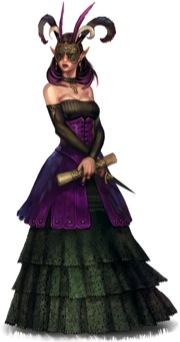
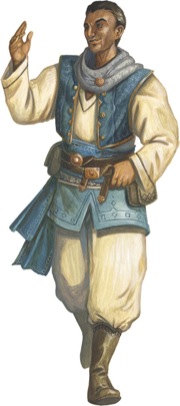
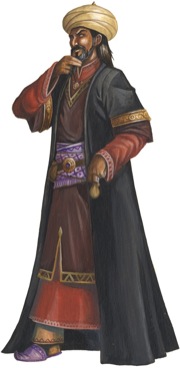
The Clever Endeavor wasn't the best bar on Axis. Nor was it the cleanest, or the cheapest—and definitely not the friendliest. It was a bar you went to when you didn't want to be seen.
Not that there weren't always customers. The place had a pretty decent crowd of regulars, and new folks stumbled in from time to time as situations warranted. But everyone there knew the first rule of the Clever Endeavor: even if you saw someone you recognized—you didn't see them.
Which is why it was so immediately obvious that Salim was being followed.
The bar was roughly half full, which meant that it was as full as it ever got. Wrought-iron lanterns filled not with flickering flame but with smooth phosphorescence glowed softly between tables, casting enough light to see by but not so much as to make anyone feel exposed. The bar's shape was different than most, with a wide-open center and tables positioned around the twisting outer wall, each set in its own scalloped hollow. It was hardly the best use of space, but the sort of folk that frequented the Clever Endeavor appreciated the fact that the odd layout gave every table a wall to put one's back to, plus a clear view of the entrance and the stairs leading up to the street. Directly across from the doorway stood a long wooden bar without any stools, and behind it lurked a rack of hundreds of bottles of all shapes and sizes—some clear, some opaque, and some jumping and jittering of their own accord.
The bar's unusual shape, however, was nothing compared to its clientele. As far as Salim could tell—and such things weren't always obvious—he was the only human present. To his right, a cluster of hive people—this particular group composed almost entirely of the flying variety, which resembled seven-foot-tall, black-shelled wasps—used deft proboscises to scrape thick red fluid from long, fluted glasses. Thanks to their telepathy, the only sound from their alcove was the steady brush of feathery appendages on crystal, yet the way they occasionally whirred their wings or crooked their limbs suggested an argument. Or as close to an argument as creatures with a hive mind ever got.
To Salim's left, several of the plane's native axiomites were going over documents with a winged, green-skinned man that Salim had pegged as an angel, hammering out some sort of agreement. Each time one of the elflike axiomites moved to point out a particular clause, the illusion of its flesh broke and scattered, revealing the cloud of glowing symbols that was its true form.
Across the room, another axiomite pulled her companion, one of the fox-headed vulpinals, as deep into the shadows of her alcove as she could. Salim couldn't say whether the gesture was one of modesty or fear of judgment by her fellows, but it had little effect either way. Each time the fox-man touched the flawless skin of her thigh, a blaze of runes drifted up from the caress like golden dust, broadcasting her excitement to the room. The axiomites were living mathematical abstractions, but apparently even abstractions had needs.
And those were just the groups. Far more common in the Clever Endeavor were the singletons—folks who didn't care to bring companions, and were even less interested in making new ones. These solitary drinkers were scattered around the place, each lost in his or her own thoughts. A flame-haired ifrit, the half-breed offspring of some genie and a mortal, sat nursing a brass goblet at one of the flame-retardant tables. Beyond him, a contract devil with a pointed beard and wire-rimmed spectacles which were almost certainly just for show sorted through a pile of scrolls. Closest to the bar was a blurry, vaguely humanoid distortion in the air which Salim took to be one of the shae, the aristocratic residents of the Shadow Plane. The shadow people had long ago traded physical forms for regions of coherent probability, and had been insufferably smug about it ever since.
In other words, nothing out of the ordinary.
Salim shifted so that his back was to his uninvited guest. He leaned over the table, propping his head on his hand and looking down as if staring into his drink. In reality, it was the glass that concerned him. In its warped reflection, the rest of the room behind him was clearly visible.
The solitary axiomite two tables down was staring at him. Not the careful, peripheral-vision study of someone used to the Clever Endeavor's rules. The eyes fixed on Salim's back were blatant in their gaze. Though the man's nondescript robes, pointed ears, and inhumanly perfect features were no different from any of a thousand other axiomites, a large rune that glimmered with its own light sat between his eyebrows.
A glowing forehead tattoo was an interesting choice for someone trying to pass unnoticed. But then, this was Axis. As it was, the rune told Salim nothing except that he'd never seen the man before.
Salim set down his glass and looked to the bartender. Lahan was standing in his usual place behind the counter, a rag over one narrow shoulder and a vacant expression on his face as he stared off into the distance. As Salim's hand twitched up in the three-fingered signal, however, the barman's eyes snapped into focus. He met Salim's gaze and nodded slightly.
Good. Placing one hand on the battered surface of the table, Salim shoved himself to his feet. He stood there for a moment, wobbling slightly as if from too much drink, then began weaving his way toward the back of the establishment. Past the bar, he turned left and staggered into the hallway leading to the jakes.
As soon as he was around the corner and out of sight of the rest of the bar, Salim flattened himself against the near wall, willing his black robes to blend into the shadows. His right hand crept to the twisted hilt of his sword, then moved away. Lahan wouldn't want any blood if he could help it. Salim waited.
The axiomite came around the corner. Salim sprang. One hand wrapping around the man's neck, the other forearm hitting sideways across his chest, Salim slammed into his follower, jamming him up against the far wall of the hallway.
Instead of flying apart into a cloud of symbols, the man hit the bricks with a meaty slap. Not a true axiomite, then—a disguise. The fake axiomite's mouth opened, and Salim squeezed his windpipe shut before he could make a sound.
A hand came up, crabbing toward the man's chest, and Salim batted it away easily. Searching within his opponent's tunic, he found the hard knot of the pendant the man had been reaching for. Salim closed his hand around it and pulled, snapping the thong easily.
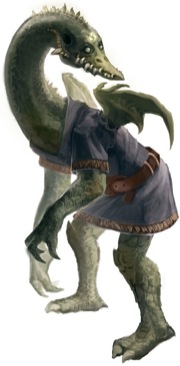
The man shifted. Where one moment Salim had been holding an axiomite, now he was holding something else entirely. Gone were the axiomite's lithe limbs, replaced by green scales and clawed, three-fingered hands. A pair of stumpy wings, ludicrously small for such a large creature, fluttered ineffectually from slits in the shirt's shoulders. The biggest difference, however, was the head: a cross between a dinosaur and the long, toothy grin of a dolphin. The creature's new face rose on a serpentine neck that was suddenly several feet longer than it had been. The glowing rune that had emblazoned the man's forehead was still there, but now it sat between two eyebrow ridges of thick horn.
"Whoever made this particular eidolon had a weird sense of humor."
A nice trick, but it made little difference. Salim choked up on the ludicrous neck until his fist rested just beneath the overlong snout, then pulled the head back down to eye level.
"What are you?" he asked, loosening his hold on the creature's windpipe.
The creature coughed and sputtered. "I...I don—"
Salim squeezed a warning. "You don't know? I find that unlikely."
The creature shook its head, gasping, and tried again. This time it managed to rasp out a single word.
"Eidolon."
An eidolon. Interesting. That explained the glowing tattoo—eidolons were created creatures, and the rune would undoubtedly be a sign of its master. The thought of a third party made Salim suddenly aware that his back was exposed, and he dragged the creature farther down the hall toward the privies. He trusted Lahan to give him a signal if someone else came their direction, but there was no guarantee that the eidolon's summoner couldn't turn invisible.
"Who do you work for?" Salim demanded. "And why is he looking for me?"
The creature shook its head again. Though Salim still had it pressed up against the wall, he could feel its body relax.
"He's not. I came on my own."
That didn't make sense—eidolons didn't do anything without their masters' consent—but Salim left it alone for the time being. He was starting to get irritated. Before he could ask another question, the eidolon answered it.
"Ceyanan told me you could help me."
Ceyanan. The name was like magic—as soon as Salim heard it, everything became clear. He sighed and released the creature, stepping back as it stretched out its serpentine neck, curling and corkscrewing it to work out kinks.
"So the angel sent you."
The creature nodded, a more expressive move than any human could hope to make. "He told me how to find you."
"Of course he did." Salim's black-winged chaperone was fond of jokes. Never mind that the angel's sense of humor had nearly gotten this particular emissary killed. What did a single life matter to a herald of the death goddess?
Salim turned back toward the bar, motioning for the snake-man to follow. "Come on."
"So you'll help me?" the eidolon asked. Its muzzle was still frozen in the idiot smile that seemed more appropriate now than when it was a just a breath away from being choked to death.
"I didn't say that," Salim said. "First we'll talk. But not here." He glanced back over his shoulder.
"Now are you coming, or aren't you?"
Coming Next Week: The lamentations of a servant betrayed in Chapter Two of “Faithful Servants.”
James L. Sutter is the Fiction Editor for Paizo Publishing, author of the novel Death's Heretic (also starring Salim), and co-creator of the Pathfinder Roleplaying Game campaign setting. His short stories have appeared in such publications as Escape Pod, Starship Sofa, Apex Magazine, and the #1 Amazon bestseller Machine of Death, and his anthology Before They Were Giants pairs the first published stories of SF luminaries with new interviews and writing advice from the authors themselves. In addition, James has written numerous Pathfinder supplements, including City of Strangers and Distant Worlds. For more information, check out jameslsutter.com or follow him on Twitter at @jameslsutter.
Shhhhh... Don’t tell anyone, but here at Paizo we love our classic and misfit monsters. There is a tendency to look back at some of the oddball monsters that popped up in the sources of our youth and lament on how strange or even dumb they are. We take a different tact. Instead we revel in their strange and iconic natures. Any chance we get, we look for reason why even the most inexplicable monsters might exist in a fantasy world.
If you’re a fan of our Misfit Monsters Redeemed, you will like how many of those monsters show up in Bestiary 3. From the strangely philosophical flail snail, to those inexplicable fan favorites, the flumphs, to the downright creepy wolf-in-sheep’s-clothing, let’s just say this book is full of some strange old friends. But wait, there’s more!
Misfit Monsters Redeemed is not the only source of inspiration for the classic and misfit monsters that made the cut for Bestiary 3. Many Bonus Bestiary monsters found their way into Bestiary 3—from the axe beak, to the caryatid column, to the unholy huecuva—old favorites abound in this tome.
Now for those of you who buy nearly all of Paizo’s products, and are maybe becoming worried that you’ve seen many of the classic monsters that are appearing in Bestiary 3, don’t worry. While most of the monsters see updates, new information, and maybe some streamlining of mechanics, there are also some old favorites that show up for the first time in a Paizo product. Some of those highlights include the penanggalen, the vodyanoi, and one of my favorite old monsters, the kamadan, which is previewed below, along with its two variants: the dusk and polar kamadan.
Illustration by Eric Belisle
Kamadan CR 4
XP 1,200
NE Large magical beast Init +2; Senses darkvision 60 ft., low-light vision, scent; Perception +8
Defense
AC 17, touch 12, flat-footed 14 (+2 Dex, +1 dodge, +5 natural, –1 size) hp 42 (5d10+15) Fort +7, Ref +6, Will +2
Offense
Speed 40 ft. Melee bite +7 (1d6+3), 2 claws +7 (1d3+3), snakes +2 (1d4+1) Space 10 ft.; Reach 5 ft. (10 ft. with snakes) Special Attacks breath weapon (30-ft. cone, sleep, Fortitude DC 15 negates, usable every 1d4 rounds), pounce
Statistics
Str 17, Dex 15, Con 16, Int 5, Wis 12, Cha 9 Base Atk +5; CMB +9; CMD 22 (26 vs. trip) Feats Combat Reflexes, Dodge, Mobility Skills Acrobatics +6 (+10 when jumping), Perception +8, Stealth +6; Racial Modifiers +4 Stealth Languages Aklo
Ecology
Environment temperate or warm plains Organization solitary, pair, or pack (3–9) Treasure standard
Special Abilities
Breath Weapon (Su) A kamadan can exhale a cone of gas that makes living creatures fall asleep for 5 minutes (Fortitude DC 15 negates). Slapping or wounding awakens a creature put to sleep by this attack, but normal noise does not. This is a sleep effect. The save DC is Constitution-based. Snakes (Ex) A kamadan’s snakes attack simultaneously; this is always a secondary attack.
Dusk Kamadan (CR +1): A dusk kamadan has midnight black fur and snakes bearing black and red ring patterns on their bodies. A dusk kamadan has the advanced creature template, and its snakes have a poisonous bite: Snakes—injury; save Fort DC 17; frequency 1/round for 6 rounds; effect 1d2 Con; cure 2 consecutive saves.
Polar Kamadan (CR +2): A polar kamadan has white fur with black spots like a snow leopard. Its snakes are furred as well. A polar kamadan has the advanced creature template and batlike wings that grant it a fly speed of 60 ft. (average). The breath weapon of a polar kamadan is particularly cold—those who succumb to it also suffer 1d4 points of Dexterity damage from numbness.
Well, that’s it for this week. Come back next week when we unleash more monsters that will make their appearance in Bestiary 3!
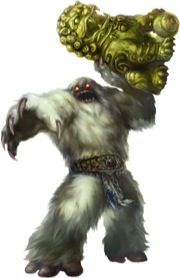
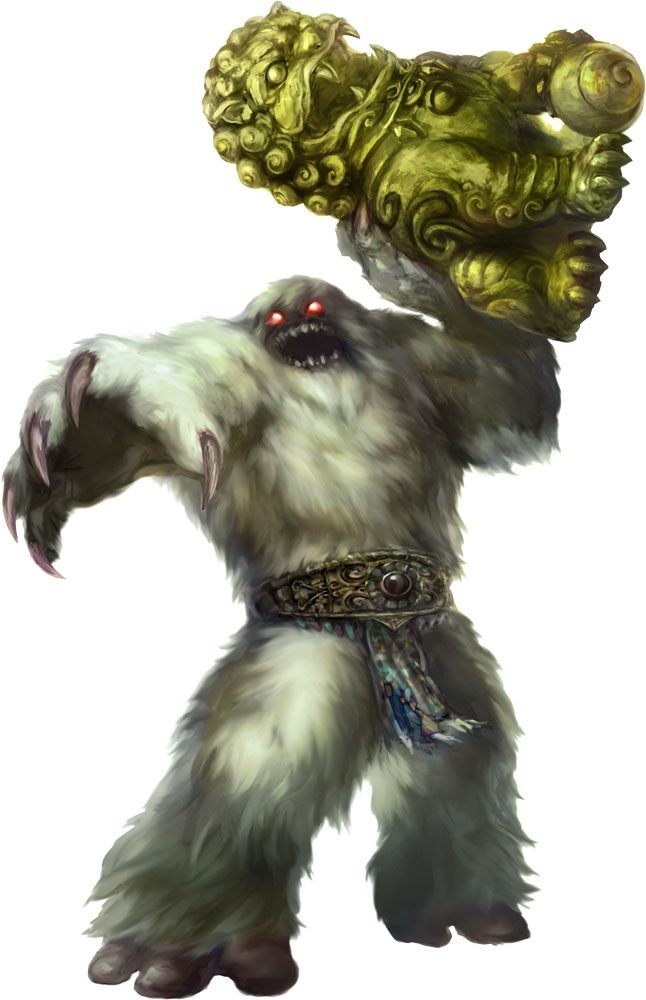
In just a few days, the Pathfinder Society Organized Play campaign will take its first steps into the Dragon Empires of Tian Xia, as the Pathfinder Society pursues ways to ensure victory in the forthcoming Ruby Phoenix Tournament. The premiere Tian adventure for Pathfinder Society players is RPG Superstar 2011 finalist Jerall Toi's The Edge of Heaven, which kicks off the three-part series The Quest for Perfection. Adventuring high in reaches of the Wall of Heaven (Golarion's equivalent of the Himalayas), it's no surprise the PCs may run into a yeti or two. Just watch out for falling foo dog statues.
Pathfinder Battles Preview: A Frosty Black Friday!
Friday, November 17, 2011
The Paizo offices may be closed for the Thanksgiving holiday, but nothing can stop the relentless march of preview images for the upcoming Heroes & Monsters set!
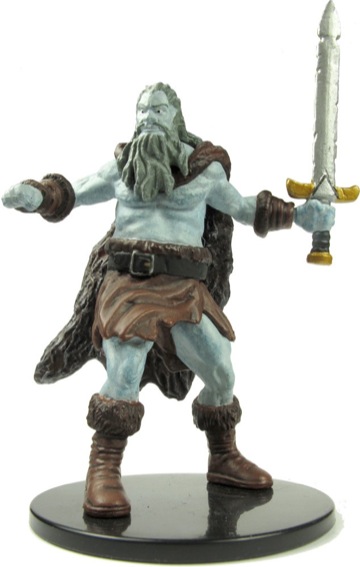
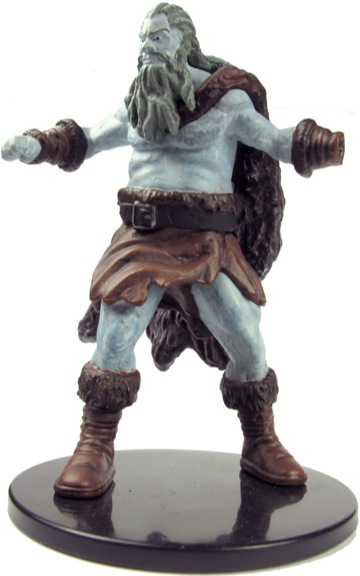
This week’s preview blog is a special treat in that it features only one miniature. But for my money, I think it’s the coolest miniature in the entire set! I’m talking about the Frost Giant!
The Frost Giant towers over the other miniatures in the set, raising his nasty axe high for a deadly blow to the head of any player character within his considerable reach. The larger size of the miniature really helps to accentuate the fine details of the sculpt, and this figure looks great standing next to his kin from other companies miniature sets.
But his “look” isn’t the only thing that makes the Frost Giant stand out. He’s got a trick up his sleeve. Literally.
Look closely and you’ll notice that this version of the Frost Giant holds a different weapon in his left hand, a mighty sword! Given the difference, you might think that Heroes & Monsters contains two different Frost Giant miniatures, but you’d be wrong!
The Frost Giant comes complete with two different left hands, each holding a different weapon!
WizKids sculpted the Frost Giant with an empty socket at its left wrist. The miniature comes with a choice of two different weapons, which you can snap in and out with ease. I’ve seen prepainted plastic miniatures with different parts before (a necklace here, a chain there), but I’ve never seen anything like the versatility of this mini before, and I think it bodes very well for future sets, which could hold similar surprises of their own.
Making big miniatures like this more modular is a nice way to diversify your doubles, and I’ll confess that it’s simply cool to play with this thing, changing one weapon for the other or adjusting the wrist to pull off the coolest pose.
So if you’re lucky enough to find the Frost Giant in your Heroes & Monsters booster and a friend asks “Did you get the one with the sword or the one with the axe?” you can answer:
“I got them both!”
That’s it for this week. We’re back to at least three previews next week, and we’re getting close to a complete set reveal! Happy Black Friday, everyone!
Pathfinder Reference Document: Now 20% Cooler with Indexes
Thursday, November 24, 2011
The new PRD has been out for a while now, but a new feature may have gone unnoticed by some. Recently, we've added a set of indices to the PRD (look toward the bottom of the menu on the left-hand side of the page). These indices were originally created as mobile content so that anyone trying to look up a single reference on their phones would have an easier time doing it. It quickly became obvious that we should also give the people on their desktops and iPads similar capabilities. We had all of the data right there, but we just needed to apply it a little differently. At first we only offered feats and spells, but eventually we were able to add magic items and spell lists. Each addition has been a little more complicated than the last.
The first two, feats and spells, are alphabetical indices with filters that allow the user to sort data by book. Originally, this was the only data really available to us and was sufficient for those lists, but the magic item index gave us reason to develop that a little further. Knowing that people often like to browse through the magic item index looking for a particular type of item—such hunting for a new suit of armor or filling in an empty ring slot—we created our index filters for that page with this in mind.
After that, most of our requests for these types of indices came in two forms: spell lists and monsters. And though we've not yet created a monster index, this is certainly something we’re considering for the future. Spell lists, however, have been tackled, and you can now pick from any class and then filter spells by book and spell level. This has become a valuable resource and probably useful for a lot of people, especially those not as familiar with spells in the more recent books, like Ultimate Magic and Ultimate Combat, but who would like to give them a try.
The indices are still evolving, and we appreciate all of your feedback and hope that everyone gets a lot of use out of them!
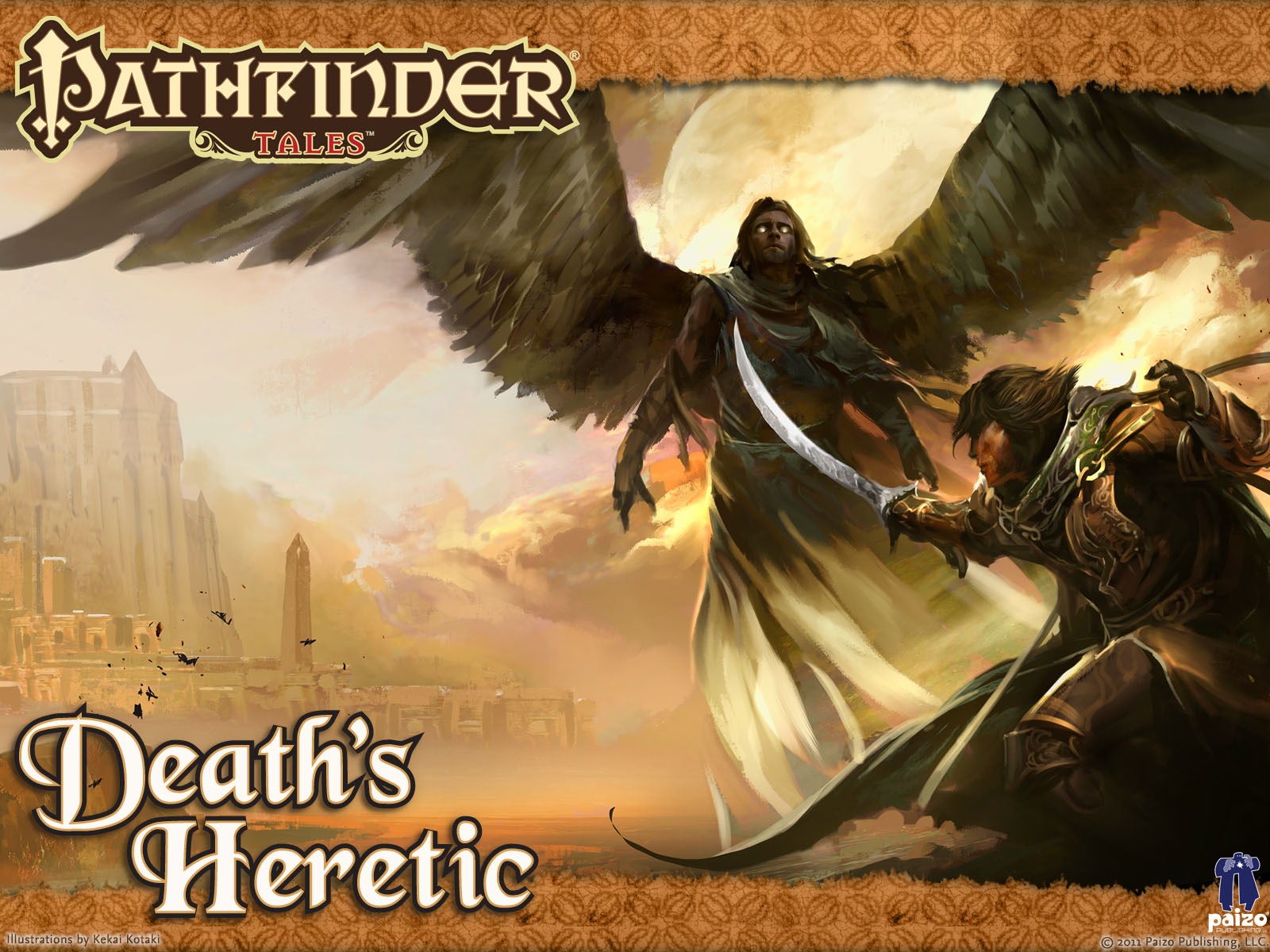
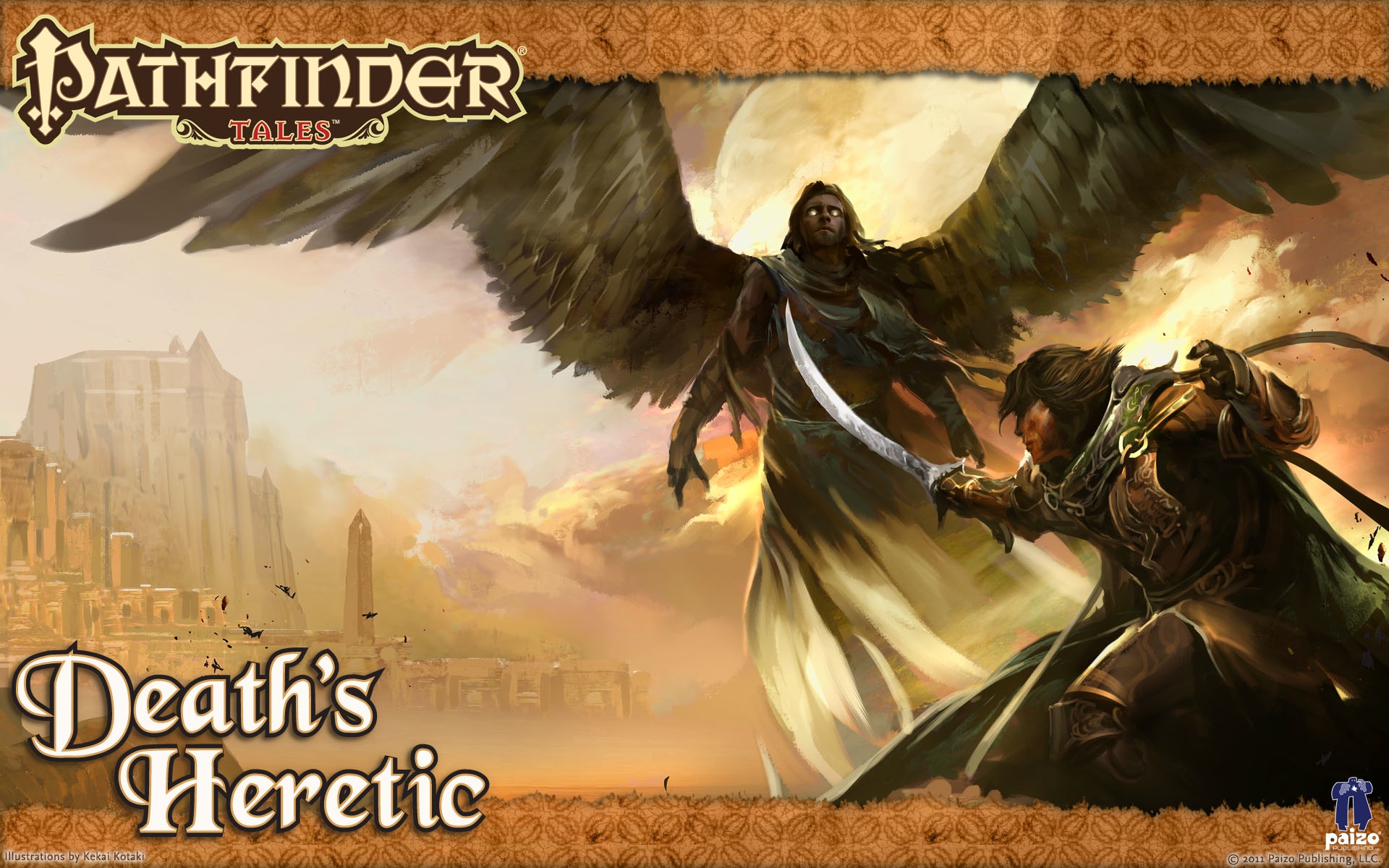
InDeath's Heretic, Salim Ghadafar is a problem-solver for a church he hates, bound by the death goddess to hunt down those who would rob her of her due. Presented below is the first chapter of the new Pathfinder Tales novel by Paizo Fiction Editor James L. Sutter!
Death always smelled the same.
After all this time, it wasn’t the stink that got to him—the reek of excrement, of putrefying flesh and organs never meant to see daylight. That was expected, easily imaginable by even the greenest killer. No, what stuck with Salim was the insufferable sweetness of it, the fact that behind the stomach-churning stench was the saccharine ghost of fermentation, cloying and coating the insides of his nostrils. It was impossible not to respond to it. Somewhere in the back of his brain, the part that was little more than animal, he knew that smell meant a kill, and that a kill meant success. That part of him wanted to crow, to roll in the filth until it covered him like a badge. On its own, the stink was tolerable. Combined with that sweetness, it made him want to vomit.
The undead had that smell, too. With some it was musty and old, others mixed with the heavy scent of wet earth, and still others—those that walked among the living without notice—so faint that the lightest perfume could cover it. Yet it was always there.
The ghouls had it in abundance, their dry, stretched flesh never quite sure if it wanted to heal or slough off completely. Without looking down, Salim stepped carefully over the nearest corpse and pressed up against the wall, studying the doorway.
He’d killed most of the pack, though not before they’d glutted themselves on the parishioners. It hadn’t been difficult. These weren’t civilized horrors like the monstrous citizens of Nemret Noktoria, but rather the newly risen dead, as naive in their own way as the rural farmers they fed upon. They were strong, and hungry, but knew nothing else. They’d never been hunted. Fear was something they inspired in others, and by the time Salim taught them otherwise, it was too late.
Still, it was the easy prey that surprised you, and there was no point in taking chances. There were still three of them beyond the door, waiting like cornered rats to rend and tear. It would only take one scratch from a poisoned finger-turned-claw to stiffen his limbs and leave him paralyzed, helpless while they fed—or, worse yet, let the infection in their bite spread through his veins like wildfire, burning out his flesh until he became one of them. No, this was no time to get cocky. Taking the ghouls might be easy, but there was no room for error. The execution had to be flawless.
The glow of his torch was barely enough to light the antechamber in which he stood, its flickers seemingly swallowed up by the black void beyond the archway. Fixing that was the first order of business. If they went for his light—and they certainly would—the burns they’d get trying to take it would be nothing compared to the disadvantage his human eyes would be in the tomb’s darkness.
Salim glanced around the crypt, silent save for the crackling of burning pitch. It was humble, little more than a brick-walled pit with steps leading up to the church, but it was this village’s holy of holies. Each of a dozen narrow wall niches held a cloth-wrapped form, most still thick with dust—the ghouls hadn’t bothered feeding on these mummified husks when the church graveyard bore riper, more putrescent fruit. Hands folded, covered with the withered threads of what were once flowers, the honored dead might have continued their dreamless sleep undisturbed, were it not for the two ghoul corpses that fouled the gray stone floor.
They were exactly what he needed. Without a second thought, Salim moved to the nearest niche and took hold of the corpse’s homespun burial shroud. A single pull sent its contents spinning to the floor, leaving Salim holding several yards of cloth, which he promptly put to the torch.
Flame caught the simple embroidery and raced up its edges. As he let the flickering tongues writhe over the sheet, Salim glanced down at its former occupant. A young man, and not recently dead by the look of him—tendons showed through withered flesh, but they still held the sack of bones in the rough shape of a man. The body’s relative cohesion gave Salim an idea, and he set down the torch, wrapped the now merrily blazing cloth around the blade of his sword, then leaned down to scoop up the corpse with his other arm. With the grisly parcel clutched to his chest like a lover, he moved along the wall toward the doorway.
No time like the present. With a flick of his sword, Salim sent the burning shroud sailing into the room, the fabric flapping open to light the sepulcher. Something hissed in the darkness, and he followed the light with his other prize, swinging the corpse around the corner and into the room at shoulder height.
The ruse worked. Thinking Salim had charged in after the blazing blanket, two of the ghouls pounced, dropping from the walls and ceiling to rend the corpse’s brittle flesh. In the second it took them to realize their mistake, the real Salim was among them, sword flashing.
The ghouls’ leathery hide was stronger than human skin, but it still parted easily under the edge of his blade. Salim’s initial thrust caught the first one in the center of its back and slid in smoothly, the flat of the blade kept parallel to the ground to avoid getting stuck between the creature’s ribs. His recovery gave the second ghoul time to face him, but not enough to get its glistening claws up. Salim’s swing didn’t take its head clean off—his sword was light, and that sort of thing was more for storybooks and campfire tales than real battles—but it did the job, sending the creature slumping backward, head lolling to one side on a thin strand of flesh. Salim ignored it, withdrawing to a defensive posture with his back to the wall next to the archway, waiting for the third ghoul’s attack.
It didn’t come. Heartbeat after heartbeat went by as Salim’s eyes darted back and forth, but the expected attack failed to manifest. The room was silent, save for his own heavy breathing. Then the blood pounding in his ears calmed, and he heard a new sound—a low, dry whimpering. Sword at the ready, he stepped forward and kicked the crackling shroud farther into the room.
The third ghoul was curled up in the back of the burial chamber, hunched over into a fetal position in order to pull itself as far as it could into an empty wall niche. It clutched its knees and moaned again as Salim advanced.
“Please,” it whined. Coming from the twisted form, the voice was shockingly human. It strained to shape the words with its grotesquely overlong tongue. “Please don’t kill. I’ll go. No more hunting. No more brothers. Just graves. Please.”
In its fear, the ghoul came closest to resembling the man it had once been. Had the creature’s previous incarnation made a similar plea, as farmer to ghoul? Salim said nothing, but the ghoul nodded anyway. Chin to knee, it curled tighter and closed its eyes.
“Hungry,” it whispered. From behind bruised-black eyelids, a tear welled and slid down the creature’s face. “So hungry.”
This time Salim did respond.
“I understand,” he said.
Then, with both hands, he lifted his sword and brought it down.
In the aftermath, Salim recovered his torch and let the light of it and the blackened, sputtering shroud show him the room in all its meager glory. It was as humble as the outer chamber, but it was clear that the room had been both crypt and funereal preparation chamber. A long stone slab that was almost an altar sat to one end, surrounded by the mundane implements of embalming, while the walls held more spaces for bodies, unlit lanterns, and fine tapestries showing the glory of various gods, from stag-headed Erastil to the Lady of Graves herself. Clearly, these villagers worshiped an array of divine beings, pooling their resources into a single church.
And hedging their bets, Salim thought.
Setting his torch down on the altar, Salim moved over to the baptismal font in the corner and looked down into its shallow basin. The holy water was still clear and unsullied—either the ghouls hadn’t had time to soil it properly, or one of them had accidentally been splashed and the rest had learned to keep their distance. Salim’s eyes, hooded and tired, stared back at him from the water’s reflection. The rest of his face—dark hair, dark skin, and thin, dark beard—all blended together into the chamber’s gloom. The splashes of black ghoul blood didn’t help, either. Balancing his sword along the stone where the font emerged from the wall, he leaned over and splashed his face, then began scrubbing his hands vigorously, setting clouds of black filth blooming like ink through the water.
And not just black, he realized. There was red in the water as well. He glanced quickly down at his robes. Had one of the ghouls managed a lucky scratch without him realizing it? If so, he needed to move quickly to avoid sharing their fate.
But no—he was unharmed. Looking down at the basin, he realized that the blood was welling up from beneath his fingernails, his hands slowly weeping red into the baptismal font. The realization was followed immediately by a telltale tickle on his upper lip.
Oh. Of course. Salim dipped his hands back into the icy water. From behind him came the soft flutter of wings, as of a flock of doves suddenly startled into flight.
“Hello, Salim.”
"Ceyanan has an interesting way of announcing itself."
“Ceyanan.” Salim waited a moment, hands gripping the font’s stone lip, then collected himself and turned.
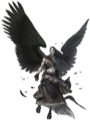
The angel was floating in the chamber’s center, its toes pointed like a dancer two feet above the floor. The robes that flowed around it in an undetectable breeze were gray against worm-pale skin, and combined with the black hair they made the figure look like a charcoal sketch. Its features were too perfect to be truly beautiful, like a marble statue, and androgynous enough that not even the sheer fabric revealed a gender.
More arresting than all of these were the black-feathered wings that sprang from its back. Even half-folded, they were clearly not normal appendages. More shadow than form, they gave the impression that if they spread, they would not so much unfurl as bloom, the way the ghoul’s filth had expanded in the water of the font. Yet the angel’s floating seemed to have little to do with them, and they remained still, the individual feathers flickering in and out of visibility. It looked around the room.
“I love what you’ve done with the place,” Ceyanan said.
Salim ignored the apparition and instead located a clean patch of sleeve, which he used to wipe his nose, succeeding only in smearing the blood around.
“Is this really necessary?” he asked, gesturing at bloody lips. “Every time?”
The angel laughed, as innocent as a child, and spread its hands.
“Consider it a gift, Salim. What better way to know that you’re still alive?”
Salim let that one pass, but the angel wasn’t finished.
“Besides,” it said, motioning toward the floor, “was that necessary?”
Salim looked down. He was almost standing on the corpse that had acted as his decoy. The young man’s arms and legs, once locked tight in the stately constriction of the dead, were now sacks of shattered bone, flesh tattered by ghoul claws and the rough landing. Salim shrugged.
“He didn’t object,” he said, but he was still careful not to kick the corpse as he stepped over to one of the ornate tapestries and began systematically cleaning his sword. Ghoul blood had already dried along its length, crusting both the shining blade and the twisted, melted-looking hilt with filth.
“They rarely do,” the angel acknowledged. “But that’s neither here nor there. You know that I come bearing tidings.”
“And here I thought this was a purely social visit.” Salim sheathed the blade. “But please, Ceyanan, don’t keep me in suspense—pray tell me what the bitch-goddess wants from me now.” He turned to lock eyes with the angel. “Is there a vampiric orgy in Caliphas that I’m to break up? A mummy that needs unwrapping? Or did someone forget to dig a grave deep enough, and a coyote ran away with some bones?”
The angel frowned.
“You should learn to show proper respect,” it said.
“And you should know by now that I only give it where it’s due.” The mocking politesse was gone now, replaced by a cool, smooth anger. “If your lady wants to win my love, she’s got a long road ahead of her.”
The angel waved its hand as if shooing a fly, refusing to be baited. It was an old game.
“Have it your way,” it said. “You have the opportunity to work great justice in this world, but you’re welcome to see it as an order if it pleases you.”
Salim waited.
Ceyanan sighed. “No undead this time. Rather the opposite, actually—something uniquely suited to your skills. A kidnapping.”
“Kidnapping?” Despite his resentment, Salim couldn’t quite keep the curiosity out of his voice. “That’s hardly my usual fare. Or yours, for that matter. How do I factor in?”
“In this case, the victim is already dead.”
The angel paused a moment to see if Salim would say anything. He didn’t.
“The merchant in question,” Ceyanan continued, “was the target of a routine assassination—nothing special there. But after his death, his soul was stolen from the Boneyard before it could pass on to its final reward. Not destroyed—stolen. The local clerics have been unable to raise the body, and now the kidnappers are offering to sell back the man’s spirit. Naturally, the church is more than a little upset. We’ve already got the local clergy working on the problem, but we’d like you to step in and handle things. You might consider it a nice change of pace.” The angel’s hand swung to encompass the crypt and the already decaying ghouls.
“Makes sense,” Salim said. “Letting a soul go missing hardly reflects well on the church. But why me? And why don’t they just pay the ransom and be done?”
“The situation is in Thuvia.”
Thuvia. The name hit Salim like a blow. That was too close. Far too close. But if the kidnapping were in Thuvia—
“The sun orchid elixir,” he said.
“Precisely.” The angel looked pleased.
“Stealing a soul and selling it back for a shot at immortality. No wonder the Gray Lady’s pissed.”
“Now you understand,” Ceyanan said. “You’ll depart immediately.”
Salim gritted his teeth. “You know I don’t like being that close.”
“As you so eloquently pointed out, winning your affection is not my first priority. Your familiarity with the region and its customs will make you that much more efficient. And you might even enjoy your time there.”
“Not that I have a choice.”
The angel smiled down at him again.
“You did, once.”
Salim opened his mouth to respond, but the angel had already grown transparent, its voice a whisper that receded into the distance.
Coming Next Week: A brand new, standalone adventure featuring Salim, Ceyanan, and even stranger characters!
James L. Sutter is the Fiction Editor for Paizo Publishing, author of the novel Death's Heretic, and co-creator of the Pathfinder Roleplaying Game campaign setting. His short stories have appeared in such publications as Escape Pod, Starship Sofa, Apex Magazine, and the #1 Amazon bestseller Machine of Death, and his anthology Before They Were Giants pairs the first published stories of SF luminaries with new interviews and writing advice from the authors themselves. In addition, James has written numerous Pathfinder supplements and City of Strangers and Distant Worlds. For more information, check out jameslsutter.com or follow him on Twitter at @jameslsutter.
Not many people would guess this, but my love of roleplaying actually started because of a computer game. In 1980, I discovered one of the first computer roleplaying games, Akalabeth: World of Doom. It had very simple graphics, and gameplay amounted largely to wandering through computer-generated dungeons, killing things, and taking their loot. But I was hooked! I used to go down to my local computer store—Computer World, in Appleton, Wisconsin—and I'd play the game on their Apple II demo setup for hours. (The Computer World staff tolerated my incessant play because it attracted lots of attention to the computer!)
In 1981, I went off to St. Olaf College, leaving Computer World—and Akalabeth—behind. I soon needed to scratch my adventuring itch, so put I up a message on the bulletin boards asking if anybody at St. Olaf was playing Akalabeth. That didn't pan out, but it did lead someone to contact me about a game that was new to me: Dungeons & Dragons. Of course, I fell in love with D&D, eventually leading me to a career of more than 25 years in the gaming business, including working at Wizards of the Coast on the launch of D&D's third edition in 2000!
My boss on that 3E team was Ryan Dancey, and when I left Wizards, I told Ryan that I'd love to work with him again someday. But our lives diverged; I started Paizo, and Ryan went to CCP in Iceland to be the Chief Marketing Officer for the EVE Online MMO. We stayed in touch over the years, and after Ryan left CCP earlier this year, I asked him what he was going to do next. His answer: "How about a Pathfinder MMO?"
Visit goblinworks.com for more information about Pathfinder Online!
At first I was skeptical. I'd heard horror stories about hundreds of millions of dollars lost developing games that were never released. Or games that launched with a big splash only to become zombies within months, their subscriber base dwindled down to a barely sustainable number. But this was Ryan, and I really wanted to work with him again. So I challenged him to convince me—to make me a believer. Over the next few months, Ryan started developing a plan for this Pathfinder MMO, and I started to believe. The plan wasn't 100%, though, so I brought the resources of Paizo to bear on it. Erik Mona, Vic Wertz, James Jacobs, Jeff Alvarez, Gary Teter, Wes Schneider, Sarah Robinson, and more each contributed unique insight to help us come up with a plan for the game—now christened Pathfinder Online—that we could all believe in. What we are announcing today is the result of that work.
Pathfinder Online's journey is just beginning. We've started a brand-new company called Goblinworks to create the game. At the moment, it's owned by myself, Ryan, Paizo, and Mark Kalmes. Mark is one of the top tech guys in the MMO field, and he'll be Goblinworks' Chief Technical Officer. (And we're currently looking for additional investors to help us move forward with Pathfinder Online.)
Traditionally, projects like this are developed in secrecy, with information leaking out in whispers for months before a formal announcement. But we don't want our loyal customers to find out about Pathfinder Online through rumored half-truths; we want you in on the ground floor.
A lot of big picture work has already been done on Pathfinder Online, and it's going to be a bit different from your traditional fantasy MMO. It's going to focus around the characters you create, in a world that will grow out of your interactions, developing the way you choose to develop it. It takes place in the River Kingdoms of Golarion, with our own Kingmaker Adventure Path providing some of the inspiration. There will be an overarching storyline, and dungeons aplenty to explore, but where Pathfinder Online is going to thrive is in the ability of each of you to leave your mark on the world. Do you want to build a castle that you own and control? Go for it. Want to start a town and rally folks to your banner? Do that. Do you want to ally with the neighboring villages to form a new nation—or perhaps wage war on them instead? The choice is yours. Want to become the most feared bandit in the River Kingdoms? The path is available. Want to become the greatest armorer that Golarion has ever seen? All it takes is hard work. If you can imagine doing something in the world of Golarion, we want you to be able to do that in Pathfinder Online.
The fun is just starting! Please use the discussion thread here on paizo.com to interact with Ryan, Mark, myself, and the rest of the Goblinworks crew as we start this new adventure. We're going to be very interactive with you, the Pathfinder community, because we want this game to be YOURS. Stay tuned for blogs, trailers, and other teasers as we move forward. In true Paizo fashion, we will keep you guys in the loop, and listen to your feedback as we progress.
Things have come a long way since Akalabeth. Join me for the ride and help make Pathfinder Online the best MMORPG ever!
Lisa Stevens CEO, Paizo Publishing
COO, Goblinworks
The Jestercap blog and boon seemed well received last month so I decided to try out another holiday this month.
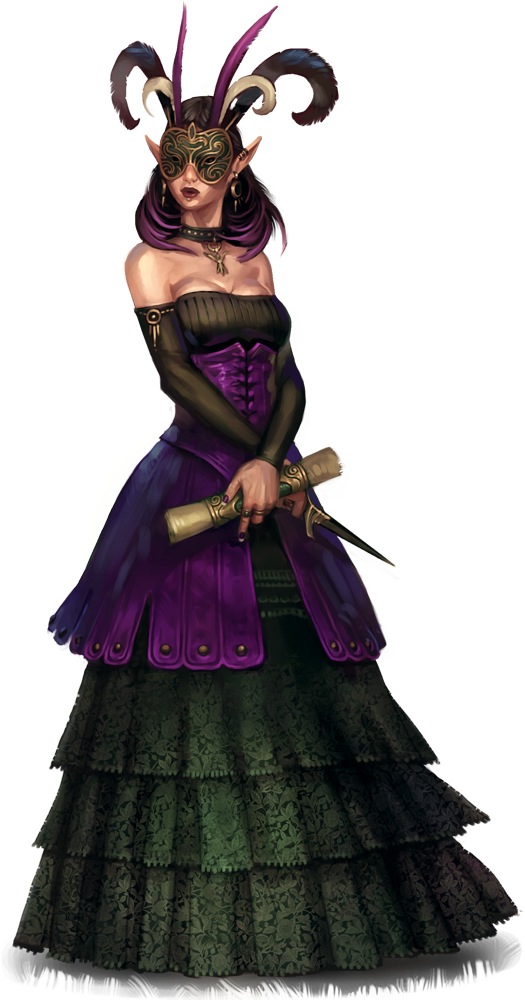
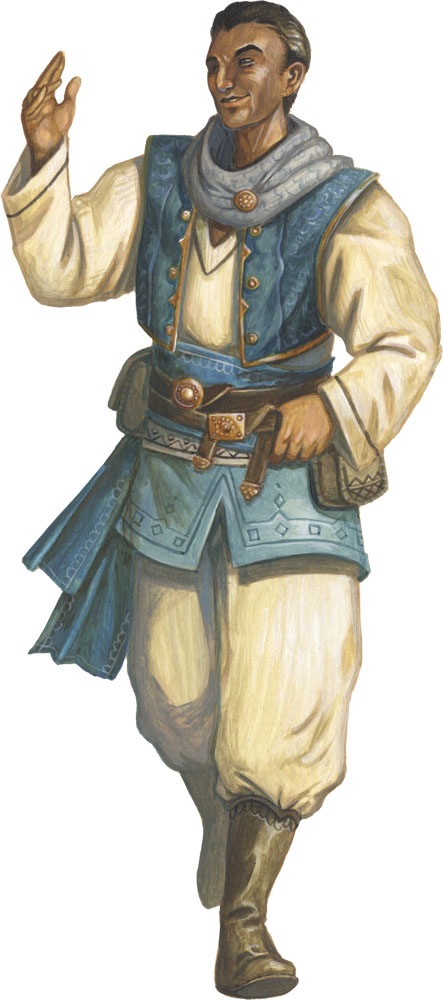
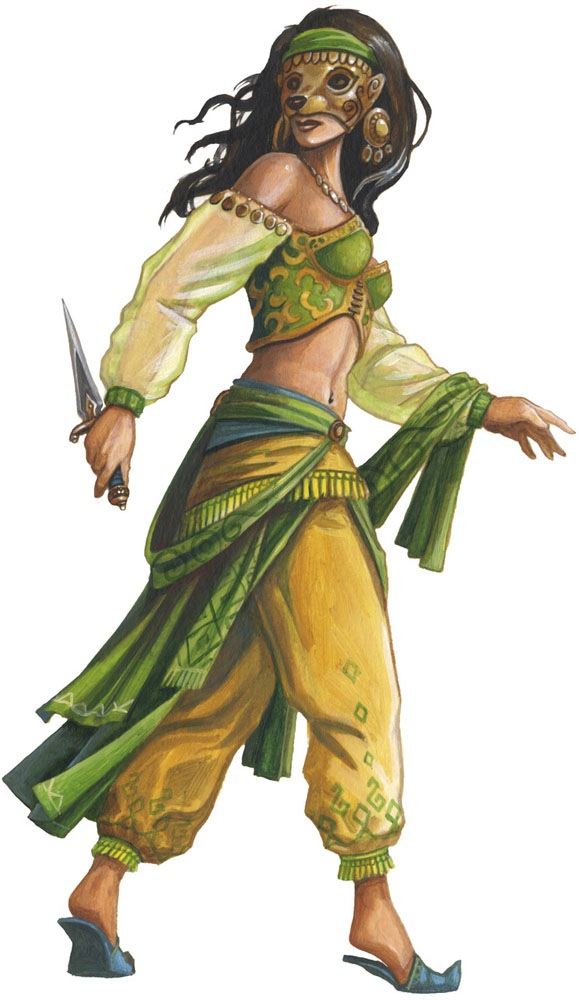
Seven Veils is mentioned on page 249 of Pathfinder Campaign Setting: The Inner Sea World Guide. We are advised it is a celebration of brotherhood between all civilized races, marked by interracial masquerade balls. I thought this seemed like a neat holiday and decided it should be expanded upon.
Once again, creative Director James Jacobs wrote the description the holiday, and you will find a special Pathfinder Society Chronicle sheet you can download and apply to a Pathfinder Society character.
Illustration by Eric Belisle
Diversity is a fact of life in the Inner Sea region—not only do numerous human ethnicities mix and live among each other throughout the area, but races entirely separate from humanity dwell there as well. It’s not uncommon to see elves brushing shoulders with humans in marketplaces, gnomes working as merchants in dwarven settlements, or tengus serving aboard ships mostly helmed by humans. Indeed, two of the more widespread races in the Inner Sea region—the half-orc and the half-elf—are the specific results of diverse unions.
The holiday known as Seven Veils, which takes place on the 23rd of Neth in most realms found in the Inner Sea region, is a celebration of this diversity—a time when social boundaries break down even further in a day-long event filled with dancing, feasting, and courting. The evening traditionally closes out with the Seven Veil masquerade, a ball wherein the participants wear disguises that either hide their actual race and/or gender (often using minor magical trinkets and spells) or specifically disguise these features as entirely new characteristics. At the end of the ball, the participants remove their disguises to their partners, often with unpredictable and sometimes delightfully awkward results. Traditionalists and conservative minds often find the Seven Veils masquerades to be scandalous or off-putting, yet they remain particularly popular in most of the larger cities of the land.
Historians note that the original "Dance of the Seven Veils" has a much different genesis than one promoting diversity—the mysterious cult of Sivanah, goddess of illusions, mystery, and reflections, is generally cited as the source of this festival, and indeed, worshipers of the goddess (herself known as the Seventh Veil) count the 23rd of Neth as one of their most sacred of days. What rituals the church of Sivanah performs on this date, however, are unknown to outsiders, for the cult enjoys its secrets. This secrecy has, unsurprisingly, given rise to all manner of sinister rumor, yet when Seven Veils rolls around each year, its eager participants are quick to set aside rumor in preference for the night’s fun and games.
I am interested in reading your thoughts, not only on Jestercap and Seven Veils, but also on future holiday write-ups and boons. This is especially true in regard to the various equinoxes and solstices.
Download the Seven Veils Boon! - (111 KB zip/PDF)This Boon is no longer available as of 12/12/11.
P.S. Don't forget to check out the Pathfinder Tales author chats on tonight, November 21, hosted by Master of Ceremonies Dave Gross!
Mike Brock Pathfinder Society Campaign Coordinator
With the very first Pathfinder prepainted miniatures, Pathfinder Beginner Box Heroes, in stores now, interest in the Pathfinder Battles miniatures line has really heated up. Now that many of you have our first four miniatures in hand, it should be clear that WizKids is shooting for very high quality sculpts and paint jobs on all of the Pathfinder Battles miniatures. I think Heroes & Monsters keeps up (and in some cases exceeds) the high quality standards set by Beginner Box Heroes, and in a few short weeks, you’ll be able to see what I’m talking about with your own eyes.
Until then, we’ve got more previews to reveal! The early January release date for Pathfinder Battles Heroes & Monsters is fast approaching, and I find that we’ve pretty much announced all of the 40 miniatures in the set. I wanted to include at least one complete surprise this week, and this penultimate look brings us a single miniature away from a complete set reveal. We’ll get to that last one next week or beyond, but for now, let’s look at some creepy critters from Heroes & Monsters!
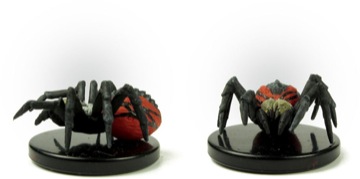
First up we have the Giant Spider, a nasty, poisonous fellow who clocks in at the common rarity. Bright red coloration is nature’s way of saying “I’m going to kill you,” and in this regard the Giant Spider is just as deadly as the bright red Venomous Snake we showed off a couple of weeks ago. Don’t forget your antivenom!
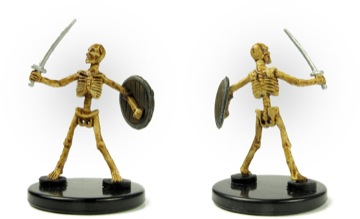
This Skeleton makes a good buddy for the Giant Spider, in that they’d both probably feel at home in the same sort of desolate dungeon environments. They also both make excellent adversaries for low-level adventurers. Both of them are commons. Many of the folks here in the office who see the Skeleton say, “wow, he looks just like he stepped out of a Ray Harryhausen movie!” Which is nice to hear, as it’s exactly what we were going for. If you look closely you can see a nice inking effect that WizKids added to the Skeleton’s shield to better sell the wood grain. It looks wonderful in person.
Sure, a Medium Giant Spider is cool, but take it from me. A Large Giant Caveweaver Spider is much, much cooler. This guy absolutely towers over lesser spiders, and he’s even been useful in scaring a few of our “adult” employees who have a very childish reaction to spiders (I’m looking at you, Bulmahn). Heh, heh, heh. Though you can’t quite see it in these photographs, the Giant Caveweaver Spider has a really cool red design on its back that is sure to have your player characters (and Jason Bulmahn) scampering for the exit. Everyone will be glad to hear that this is a rare miniature, so it’ll thankfully be a long time before these guys overrun the Earth.
Lastly, I wanted to provide a group photo of this week’s previews, so you can get a sense of just how huge that Giant Caveweaver Spider really is. Imagine that the Skeleton is the same height as a normal man, and you’ll get a strong idea that messing around with the Giant Caveweaver is a really, really bad idea!
Ok, ok, ok. I hear the skeptics already. There’s nothing terribly revolutionary about spiders and skeletons, no matter how cool they might look.
To which I say, fair enough. So next week, I’m going to show you a Heroes & Monsters figure with a feature unlike anything you’ve seen before in a prepainted miniature! I still can’t believe how awesome and innovative it is, and it’s been sitting on my desk for a month!
As usual, I’ll try to monitor the discussion thread here on the blog. Let me know if there’s anything in particular you’d like to see from the set, and I will make sure we cover it shortly!
This Saturday and Monday, the Paizo chat room will be hosting a free-for-all discussion with a smorgasbord of authors from Pathfinder Tales—the novels, the journals, and the web fiction! If you thought last time was fun with just the novel authors, this one's going to be even bigger and crazier, with a ton of authors stopping by to hang out, answer questions, and wax philosophical about whatever they feel like. Unlike an in-person author event, there's no waiting to have your voice heard, so come prepared to toss out your questions and comments and hear our team of all-star authors take them on in a literary free-for-all!
Since we know folks have busy schedules, Master of Ceremonies Dave Gross has set up two sessions. Pick the one that works for you, or drop in for both!
Pathfinder Tales Web Fiction I
Saturday, November 19
12:00 PM PST (20:00 GMT)
Pathfinder Tales Web Fiction II
Monday, November 21
6:00 PM PST (02:00 GMT on 22/11)
Blind optimism wasn’t a particularly useful trait for an assassin. Isra was neither blind nor optimistic. He knew full well that Faris could not be trusted, no matter how generous an offer his own skin was.
Isra knew people, be they the rich and greedy of one tier of society or the guttersnipes and backstabbing thieves of another. He lived in both worlds. He was surrounded on all sides by the best and the worst, and the worst always outnumbered the best. That was just the way of things. He knew full well his sister's husband wasn’t going to be true to his word. Nevertheless, he had decided to give the weasel a chance to prove him wrong. He owed Sana that much. Still, he was angry with himself for giving Faris the opening in the first place. He had known he couldn’t trust him with his secret, but had desperately wanted to believe he could. The old adage held that blood was thicker than water, with family being blood. But Faris was not blood. He was scum.
Had Faris been anyone else in the world, he would not have left the fortune-teller’s tent alive. That Isra had allowed Faris to plot murder and walk back out into the Nightstalls without sporting a second smile cut into his throat from ear to ear was testimony to the fact that Isra was as capable of being willfully naive as the next man.
But that didn’t make him stupid.
He followed in shadows, slipping between stalls and tents. When their cover ceased to be available, he climbed higher, working his way onto another roof, never letting his traitorous brother-in-law out of sight for even a moment on the long walk back to the home the man shared with Isra’s sister.
Faris kept glancing back over his shoulder to see if he was being followed. The movements were nervous, scared. But like a fool, he never looked up. This was not the behavior of a man grateful to be given his life and about to keep his end of a bargain. Far from it. This was the furtive, shiftless behavior of a man who trusted no one because no one had reason to trust him. It was the circle of lies. Faris was afraid for his life because, in Isra’s position, he would have been planning the exact moment to slip the knife in between his brother-in-law’s third and fourth ribs, ending his problem. So right now, even as he pushed and bullied his way through the crowded streets, Faris would be scheming, trying to find an angle, a way to gain some sort of advantage even as he ran for his life. That was just the nature of the beast.
Isra had to give Faris credit, though—he was at least doing his best to make shadowing him interesting, slipping into a hovel and out the back door, climbing garden walls and cutting through one of the bathhouses. Had he just looked up he would have saved himself a lot of sweat and trouble, given the baking sun, but as it was dark stains ringed the loose white shirt that clung to him as he moved, while Isra matched him step for step.
From his rooftop vantage, the assassin could see everything, Katapesh laid out like a doll theater beneath him. The height of the midday sun meant that he cast no shadow down onto the streets below.
Faris showed no sign of being in a hurry to go home. Rather, he was making a tour of the city, visiting certain establishments, very particular houses and places of business. These were all places where messages could be left for the kinds of people who do not want to be found easily, those magicians and alchemists who did not wish to treat with the masses, but dabbled in unsavory concoctions to gain whatever effect they so desired.
He was going to have to be on his guard for whatever nasty surprise Faris in mind.
Another hour of this, and then Isra realized that Faris had retraced his steps, returning to a shop that had already benefited from his patronage. Only it wasn’t a shop, it was a pesh den. The one where he had first slipped out through the rear door and made off over the wall. And suddenly it all became clear: the fool still thought he was being followed, but that the eyes watching him belonged to a bigger fool than him. His little detour was supposed to have gone unnoticed, with Isra tricked into thinking that Faris had been inside losing himself in some narcotic haze all this time. Perhaps the revelation of Isra’s second life hadn’t been enough to dispel the illusions he’d woven around his first one after all?
He watched Faris walk tall, happy to be seen on his journey back to his home.
The man was whistling.
He deserved to die just for that.
∗ ∗ ∗
"Every face is a mask."
Night fell fast. That was the twin curse and boon of living in a desert land.
Isra visited the house he had bought for his sister and her family. He was an unwelcome guest. He had never resented the gift, nor even considered it an act of generosity. She had married for love instead of money, and that had always made him happy.
The bargain he had struck with himself was simple enough: if Faris treated her well, then he would make sure sufficient money came in from investments for them to live well. And despite his duplicity, Faris at least loved and cared for her and wanted to provide for his family, just like any man would, even if no amount of money would be enough.
They weren’t going to be on any boat tonight, meaning Isra was about to make a widow of her. For all his arguments to the contrary, Faris was right in one thing: Isra was quite capable of being a cold-hearted bastard.
Under cover of darkness, Isra wore yet another mask, this one transforming him into the Nightwalker.
In the unlikely event that he was seen, people would walk away. That was the beauty of being one of the most renowned and feared men in a city. Even though the chances that he was hunting them were slim, no one was willing to take the risk when the alternative was to run and live.
Faris would be waiting for him. That was inevitable. Isra could only hope the man had the good grace to do it somewhere private. He had no wish to kill the merchant in front of his sister, and especially not the boy. The trauma of watching his father die would scar Munir for life, turning him into the real victim tonight. No, Isra wouldn’t let that happen.
The house was larger than they needed, the gardens far more ornate than was practical, with a huge fishpond that looked like a knife scar in the moonlight. The main house was three stories high; the top floor taken up with the sleeping quarters, the middle floor with Faris’s study and work rooms, and the ground with kitchens and artisanal spaces. The huge gabled roof was weighed down by overhanging eaves.
From his hiding place, Isra could see Faris pacing back and forth before the study window. He appeared to be alone, but Isra wasn’t about to risk taking anything at face value. He made sure his mask was in place. Appearances could always be deceptive.
He had a decision to make. Or, more accurately, he had the first of many decisions to make. He couldn’t go into the house through the front doors, that was a given. He had already planned out a relatively simple traverse up and across a vine-covered wall that would take him up onto the roof. From there he’d swing down again, coming into the house though the open window of the room where Faris had chosen to make his stand. There was every chance that Faris was both hoping and expecting him to enter the house by that route, and had planned for it. Poison on the windowsill, a needle in the shutter to deliver it straight into his bloodstream, or a crossbow bolt lined up ready to punch through his heart and push him out of the window to a tragic death... or any of many other scenarios. But the truth was any other way could be just as dangerous, if not more so, because they entailed having to move through the house from room to room without dragging his sister and her boy into the middle of things.
Of course it all hinged on whether Faris had decided to make his stand or not.
∗ ∗ ∗
Faris was ready for him; he must have heard Isra's footsteps on the roof.
There was a moment when Isra was vulnerable, as he slipped in through the window. Faris could have lunged then—he had a dagger gripped in his hand—but something made him step back.
He waved the knife, motioning for Isra to stay back. It was as though he’d completely blocked the death of his two bodyguards from his mind. Perhaps it was a coping mechanism?
“I've decided to stay,” he said.
The mask covered Isra’s disappointment. “Unfortunately, that isn't your decision to make. I was quite clear when I told you what would happen if you tried to stay here. We both know you can’t be trusted, and you’ve had all the choices I’m ever going to offer you. You made the wrong one. And now I won’t trust you with anything, least of all my sister.”
“Trust!” Faris spat. “You talk about trust when all you do is lie? Everything about you is a lie, Isra. You pretend to be one thing when you’re really another. You offer me everything I want, but without actually giving anything away. You are a liar, plain and simple. I could kill you now and no one would blame me.”
“No one?”
“Look at where you are, who you are. You’re not my brother-in-law here; you’re an assassin. You’re the Nightwalker. You've broken into my home. I don’t know it’s you beneath that mask, Isra. I have a right to protect my family.” His grin was cruel. In his headl, he was already making all of the excuses he would need to cover himself with the Pactmasters.
“I didn't want to have to do this,” said Isra, closing the gap between them.
Before he could get within striking distance, Faris hurled a high-backed chair into his path.
Isra danced back a step, staying out of reach.
“What's the matter?” called a voice from the other side of the door. Sana.
Isra wanted to call out to her, to tell her not to come in, but he knew her well enough to know that that would only bring her into the room. She was contrary like that.
“Quickly,” Faris cried, a fake note of panic in his voice. It was ludicrous pantomime, and no one in her right mind would have been taken in by it. His eyes were bright with bitter mirth. There was no smile.
Sana didn't get help.
She opened the door just as both men knew she would.
“What’s wrong?” she started to say, but then caught sight of the Nightwalker standing by the window.
Isra held out a hand, trying to calm his sister before she could panic, but he knew the sight of him there, in her house, was a terrifying one. He should have left then and there, just taken two steps back and jumped out of the window. But he didn’t. Instead, he remained rooted to the spot, while she moved closer to her husband.
That solidarity cut deeper than any knife possibly could. Even though there was no way that she could recognize him, it hurt Isra that she would go to this snake for protection.
Instead of pushing her behind him, though, Faris put her between him and Isra, using Sana as a human shield.
It took her a moment to grasp that all was not as it had seemed, and then a note of genuine fear crept into her voice. “What are you doing?”
Faris ignored her. “Put down your knife,” he said.
“This is between you and me,” Isra said flatly. “There’s no need for her to be dragged into this.”
“Please Faris,” Sana cut across them. “What’s this about? What’s happening? Who is this man?”
“So many questions, dear wife,” Faris rasped in her ear. “All you need to know is that this is the man who wants your husband dead.”
She wasn’t satisfied. Panic was slowly being replaced by anger. The fear remained, kept in check by some very basic survival instinct. “You’re hurting me, Faris.” She didn’t try to break free of his grasp.
“He will not attack a woman. He only kills those he’s paid to kill. He’s honorable like that. He won’t kill someone who simply gets in the way. Don't you know who he is?”
No. Please, no. Don't tell her. Isra gritted his teeth. He could only make the plea in his mind. She would recognize his voice. Maybe not instantly, but it would come to her eventually. He didn’t want Sana to know what he had become. The extent of his folly was driven home in that one moment of clarity.
“Do you want her death on your hands Nightwalker?”
Mute, Isra remained motionless, fighting every single muscle in his body as they tensed, ready to explode with brutal force.
Any lingering hope that this might resolve itself peacefully died then.
This wasn’t going to end well for Faris.
“Do you know where I’ve been today, Nightwalker?” Faris raised an eyebrow. His ugliness seemed to become more physical with every breath he took, as though the blackness inside was manifesting itself on his skin. “I have been to see the alchemists, apothecaries, and every practitioner of tainted magic I could track down. And can you think why?” It was a rhetorical question. “No? Then let me tell you, brother.” Isra winced, hoping Sana would miss the familiarity in the taunt. “I’ve coated the runnels along the edge of this blade with a poison so toxic that I need only touch the steel to flesh for it to take effect. It’s a very particular poison. It will paralyze in moments, but not kill. That will only happen if I break the skin. There is no antidote. Nothing that can be done to reverse the process. Do you take my meaning, Nightwalker?”
Until that moment, Isra hadn’t noticed that Faris was wearing gloves, but now it made sense. The man held the blade only inches from Sana's throat. His words had the desired effect: she stopped struggling against him. The first tears broke and ran down her cheeks as her world was turned upside down. She was a feisty woman, always had been, but she wasn’t physically strong enough to free herself. Certainly not without her bastard of a husband touching the poisoned dagger to her cheek. She knew it and he knew it.
“Better not cut yourself, then.” Isra said.
“This blade was meant for you, Nightwalker.”
“Did you really believe I’d let you close enough to prick me with it, Faris? You’re a bigger fool than I took you for. Put it down and let her go. It doesn’t have to end like this.”
“Oh, but it does,” Faris said.
There was movement on the other side of the door. Both men heard it.
Faris’s grip around his wife’s throat tightened, an element of panic stealing into his face as the boy, Munir, appeared in the doorway. “Father?”
The boy caught sight of Isra then, but rather than being frightened by the black-clad assassin, he didn’t seem to be concerned at all. Isra remembered the moment back at the ball when he thought the boy had seen him. Did he know? Or was he just too young to understand what was happening here?
“Get out of here, Munir. Back to bed. Now.”
“You’re hurting her.”
“Don’t argue with me, boy. Bed.”
Faris turned his head. It was the smallest of movements, but Isra sensed this might be his only chance to end this well. He closed half of the distance between them before Faris realized he was on the move.
A look between rage and disbelief flashed across the merchant’s face. Then, coldly and deliberately, Faris yanked Sana’s head back and drew the blade across his wife's throat.
Arterial blood pulsed, the first spray describing a huge arc that spattered down Isra’s face and chest, the second and third smaller, until the blood barely bubbled from the wound.
“I might not be able to fight you, brother dearest, but I can take someone you love.”
Rage like nothing he had ever experienced surged through Isra. It was thunder in his blood. Lightning in his veins. It was a desert khamsin inside his skull, pounding relentlessly against his temples, trying to shatter the plates of bone. It was a djinn whipping up sand to blast his skull to dust.
Isra had never killed in rage. Ever. The Nightwalker was always in total control of mind and body. Death was clean and swift, delivered with one eye on escape. Control meant no mistakes, no unnecessary suffering.
But Isra wanted Faris to suffer. He wanted him to scream and beg and plead for his life. He wanted to break him and every bone in his worthless body. A thousand cuts could never be enough. He wanted to flay the skin from his back, to shred the flesh as he peeled it away from his bones. And he wanted Faris to feel it all.
He pulled twin daggers from the sheathes on his hips, blades flashing in a blur of motion. He cut high, across Faris’ cheek, and low across his belly, opening the gut up. Faris dropped the poison-tainted blade, falling to his knees and clutching his stomach as a rope of intestine slowly began to unravel through his fingers. He tried desperately to force his guts back inside his body. He was dead, but didn’t realize it.
Isra could have left him then. It would have taken days for the murderer to finally die.
But that wasn’t enough.
Faris’s screams curdled in his throat as Isra opened a second cut on his face, matching the first. “Smile,” the assassin said coldly, and cut again, scraping the knife across Faris’ forehead. Blood streamed down into the man’s eyes.
The assassin walked around the dead man, grasping a tangle of hair and wrenching his hand back, scalping Faris. It was brutal and ugly. His hands were slick with his brother-in-law’s blood, but it was his sister’s that burned him.
He pushed the man to the floor. Blood soaked the boards.
Isra walked around him again, then pulled Faris over onto his back and went to work once more.
Faris’ body was so far lost to shock that he almost certainly couldn’t feel a thing.
Isra didn’t care.
Heavy footsteps sounded on the bottom stairs. Two men, Faris’s help, came rushing up the stairs, too late to save anyone.
The assassin’s blades peeled away layers of skin and meat, scraping down to the ribs. He reached in, snapping two of the bones so that he could reach in and tear out the heart. Isra wanted to feel it stop beating in his fist, but Faris was already gone.
Isra was so blind to his surroundings that he missed Munir bending to grip the poisoned knife in both hands. The first he heard was the slap of bare feet on bloody floorboards as the boy ran at him, blade gripped thrust out before him.
Isra looked up a fraction of a second before the boy could plunge the knife into his throat and reacted instinctively, slapping the boy’s wrists so hard his hands sprang open and the poisoned blade spun away, clattering to the floor. The force of the blow sent the boy sprawling through his parents’ blood. Isra picked up Faris's knife and plunged it into the man’s corpse.
It was over.
The footsteps pounded reached the top of the stairs, dragging him back to the present.
He had to get out, and quickly.
Isra snatched up his knives, and with one backward glance to check on the boy, slipped through the window again just as two men burst into the room. They were muscle-bound thugs built for intimidation, not for running across rooftops, and they knew it. Neither made a move to follow as Isra leaped from the window ledge and disappeared into the night.
∗ ∗ ∗
Half an hour later, he was cleaned up and changed into his normal attire, and had the reek of alcohol back on his breath; he was Isra the merchant prince once again, though today all the cares of the world had come home to roost. He would never be the same again. He was grateful that he could enter his sister's home by the front door this time.
There was no need to climb the stairs. He knew what was up there.
He was shaking as he listened to the bodyguard describe what had happened, and how he had caught a glimpse of the bastard Nightwalker disappearing through the window. The man made himself sound like a hero. He had given chase, but the assassin had used black spells to throw him off the roof and he’d barely escaped with his life.
It was all rubbish. Isra didn’t care. Let the man pretend.
“I’ve sent word to the Pactmasters,” the bodyguard said, “but there’s not much they can do for Master Faris or your sister. Do you want to see the bodies?”
Isra shook his head. “No.”
“Young master Munir is in his playroom. I fear he saw everything.”
“I’ll take him with me. Then, when I’m gone, I want you to burn this house to the ground. I don’t want him to have to see it ever again. Will you do that?”
“I don’t think—”
“I’m not asking you to think. I’m asking you to do one thing for me. I’ll see you are well paid for it. Can I trust you?”
The man nodded.
“Good. Trust’s so important.” Isra meant it on levels the bodyguard couldn’t possibly grasp.
He went through to the boy’s playroom, hesitating at the doorway to put on yet another mask, though this was the most difficult one of all to draw down. He had just made the boy an orphan. He didn’t know if he was going to be able to look the child in the eye and lie—or worse, if he wasn’t going to have to. He wasn’t sure what he would do if the boy knew... But he’d find out soon enough.
He knocked once on the door and opened it.
Munir lay on a cot-seat, his face turned away from the door. Isra wondered if Munir had consciously chosen to lie facing his parents’ bodies on the other side of the wall, or if it was coincidence.
He sat on the edge of the bed and rested a hand on Munir’s arm.
The boy didn’t react.
Isra made a promise to himself and to his sister in the room beyond: he would take the boy under his wing and be the father he deserved.
He spoke softly, saying anything that came into his head, but the boy didn’t seem to hear any of it.
The one thing Isra didn’t say was that everything was going to be all right.
Isra gathered Munir into his arms.
“Is there anything you want to bring? A toy? Something special to you?”
Munir didn’t answer. He pressed his face into Isra’s chest.
Isra could feel their blood on his skin. No amount of scrubbing had been able to cleanse him. Surely the boy could smell it on him? Surely he knew who Isra was? What he had done?
Munir didn’t fight him as Isra carried him out of the house for the last time.
Tomorrow it would be a ghost, just like the boy’s parents.
The only ghost Isra had ever intended to create was the Nightwalker’s. But something else had happened in that room. Instead of dying, the Nightwalker had become immortal.
That side of him, the killer, would live forever.
Coming Next Week: Ghouls and goddesses in a sample chapter from James L. Sutter’s new Pathfinder Tales novel, Death’s Heretic!
Steven Savile is the internationally best-selling author of almost twenty novels and many more short stories, set in both original worlds and those of Primeval, Stargate SG-1, Warhammer, Torchwood, Dr. Who, and more. He won Writers of the Future in 2002, has been a runner-up for the British Fantasy Award and short listed for the Scribe Award for Best Adapted Novel, and won the Scribe Award for Best Young Adult Original Novel. For more information, visit his website at www.stevensavile.com.
Unless you’ve been trapped in jotund troll’s lair for the past few months, you’ve probably noticed that here at Paizo we’ve been exploring a number of Asian themes for the Pathfinder RPG. From the release of the ninja and samurai alternate classes in Ultimate Combat to the Jade Regent Adventure Path, we’ve definitely had the myths and monstrous challenges of the East on our minds.
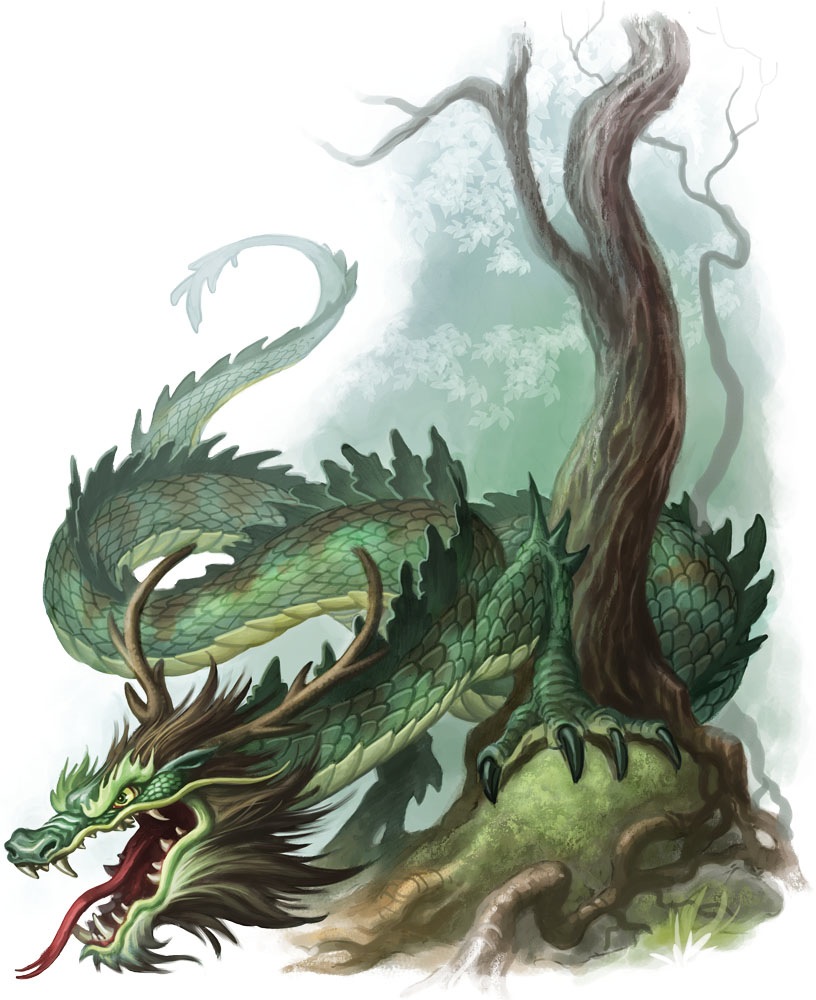
To kick off our preview of the soon-to-be-released Pathfinder RPG Bestiary 3, we are going to continue on with that theme and unleash one of the great challenges of the Dragon Empires—the forest dragon!
Just one of a suite of new imperial dragons—serpentine agents of ancient lands and cosmic balance—these fickle and malevolent creatures wind their way through the forest mists. And while they are capable of the wingless flight common to dragons of their ilk, they prefer to hunt on the forest floor, waylaying those foolish enough to trespass upon their emerald domain.
Illustration by Jim Nelson
Young Forest Dragon CR 10
XP 9,600
CE Large dragon (earth) Init +5; Senses dragon senses, tremorsense 60 ft.; Perception +15
Defense
AC 22, touch 10, flat-footed 21 (+1 Dex, +12 natural, –1 size) hp 126 (11d12+55) Fort +11, Ref +8, Will +8 Immune paralysis, poison, sleep
Offense
Speed 40 ft., burrow 20 ft., climb 30 ft., fly 200 ft. (poor) Melee bite +17 (2d6+9), 2 claws +16 (1d8+6), gore +16 (1d8+9), tail slap +14 (1d8+9) Space 10 ft.; Reach 5 ft. (10 ft. with bite and gore) Special Attacks breath weapon (40-ft. cone, 6d6 piercing damage, DC 19) Spell-Like Abilities (CL 11th; concentration +12)
At will—pass without trace Spells Known (CL 1st; concentration +12)
1st (4/day)—obscuring mist, shield
0 (at-will)—ghost sound, read magic, resistance, touch of fatigue
Statistics
Str 23, Dex 12, Con 18, Int 12, Wis 13, Cha 12 Base Atk +11; CMB +18; CMD 29 (33 vs. trip) Feats Improved Initiative, Multiattack, Power Attack, Skill Focus (Stealth), Toughness, Weapon Focus (bite) Skills Acrobatics +10 (+14 when jumping), Bluff +15, Climb +28, Fly –3, Intimidate +15, Knowledge (arcana, nature) +9, Perception +15, Stealth +17, Survival +10 Languages Common, Draconic SQ sound imitation, woodland stride
Bestiary 3 features adult and ancient versions of this dragon and three versions of the other imperial dragons—sea dragons, sky dragons, sovereign dragons, and underworld dragons—as well as rules for you to make your own imperial dragon menace. This monstrous supplement also features a host of other, similarly themed monsters. From a template for the noble guardian foo creatures, to the treacherous spidery jorogumos, to the ancient and otherworldly kami, and a host of new deadly oni, Bestiary 3 has enough monsters to stock an entire Dragon Empires campaign!
Not planning on adventuring in that part of Golarion for a while? Don’t fret. Next week we will be looking at a host of other monsters in Bestiary 3 that we’re sure can find a place in any one of your upcoming adventures. Until then, beware the twisting trail and cunning tactics of the forest dragon!
As we continue to expand Pathfinder Society to areas where players are looking for organization, it is important to me to find the right people to serve as ambassadors of the game, to present a positive light for new players, and to try to bring veteran players who have left back into the fold. Three more Venture-Captains have been chosen to fill those roles.
The Venture-Lieutenant program was established just a few weeks ago but we are already seeing the positive results from it. One of these is the promotion of Tracy Windeknecht. She served a short time under Mark Garringer when he was a Venture-Captain of Indiana. Since Mark has stepped down, I have chatted with Tracy and have utmost confidence she will pick up right where Mark left off and continue to grow Pathfinder Society in Indiana.
I am also excited to add two new areas to our Venture-Captain regions. The first is Virginia. Paul Rees has a unique region due to the high population of military in his area. Pathfinder Society is a perfect mesh for gaming interest due to deployment schedules and transfers. But Paul is not just taking care of the coast. He is there to help all of Virginia.
It also is exciting to add our third Canadian Venture-Captain, Brent Jans. Edmonton already has a strong core of Pathfinder Society players. In truth, Brent and several other people were already doing a terrific job organizing Pathfinder Society in that area. After talking with Brent, and hearing some of his ideas, I am excited to see how much more Pathfinder Society can grow in this area of Canada.
In addition to the three Venture-Captains above, we have added the following Venture-Lieutenants to help some of our current Venture-Captains reach out to areas in their regions that are either too far away to cover on a regular basis or where there are too many locations in a region to cover at all. They include the following:
Chicago – Brad Ruby
Connecticut/New York – William Wadhams
Los Angeles – Brian Darnell
Minnesota – Andrew Christian
New York/New Jersey – David Santana
New York/New Jersey – Vincent Colon-Roine
San Francisco – Joshua Archer
United Kingdom – Rob Silk
Vermont – Myles Crocker
Washington D.C. – Bruce Chang
We are still in need of additional Venture-Captains in some regions and you can find the list right here. If you’re interested in applying, please contact me after reviewing the application process in the previous link.
Welcome aboard to all my new captains and lieutenants!
Mike Brock Pathfinder Society Campaign Coordinator
The Paizo offices are closed for Veterans Day and I’m slammed with more meetings than you can imagine, but those are not good reasons to deprive you guys of awesome preview images from our upcoming Pathfinder Battles Heroes & Monsters set! So I’ve slipped away from my meeting to sneak you this special blog!
First up we have this menacing Ogre, one of my absolute favorite figures from the set. With a heavy heave he’s ready to pound your head into your shoulders with his trusty club. Just don’t ask what he plans to do with your body afterward. It’s nasty.
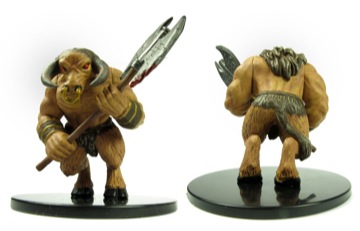
Next up is the malevolent Minotaur, a wonderful sculpt that towers over your player characters. WizKids did a magnificent job with this miniature, even getting some grisly blood on the bad guy’s blade!
Last up for this week we’ve got the Manticore, a nasty beast of myth and legend. WizKids’ sculptors did a great job translating the image of this creature from the Bestiary into three dimensions, and I’m guessing he will be responsible for the deaths of many player characters in the years to come. Watch out for those tail barbs!
All three of these miniatures are Large, and all three of them are rare. We’re only a few months away from the official Heroes & Monsters release, so these monsters are roaring your way soon!
Happy Veterans Day, and we’ll see you next week. Now I’m headed back to that meeting!
We’re coming up on the release of Bestiary 3 in the near future, and as readers of the Jade Regent Adventure Path have noticed, we’re already using monsters from that book in the adventures! This is more or less a necessity, since when you travel to the far side of the world, you expect to see brand-new creatures and monsters, after all. We’ve been filling the Jade Regent bestiaries with all sorts of monsters inspired from Asian mythology and folklore, but we need more—and that’s where Bestiary 3 comes in.
One of the new types of monsters introduced in Bestiary 3 and the Jade Regent Adventure Path are the kami—usually (but not always) benevolent native outsiders who exist to protect that which cannot really protect itself from the advance of humanity and civilization. Pathfinder #52 and Bestiary 3 present several kami, ranging from CR 2 all the way up to CR 20.
Presented below are two of the kami who have roles to play in “Forest of Spirits.” We’re simply presenting their statistics here—what roles they play in the adventure must remain a secret until you play it or run it for your group!
Kami Subtype: Kami are a race of native outsiders who serve to protect what they refer to as “wards”—animals, plants, objects, and even locations—from being harmed or dishonored. All kami are outsiders with the native subtype. A kami possesses the following traits unless otherwise noted in a creature’s entry.
Immune to bleed, mind-affecting effects, petrification, and polymorph effects.
Resist acid 10, electricity 10, fire 10
Although they are native outsiders, kami do not eat, drink, or breathe.
Telepathy.
Fast Healing (Ex) As long as a kami is within 120 feet of its ward, it gains fast healing. The amount of fast healing it gains depends on the type of kami.
Merge with Ward (Su) As a standard action, a kami can merge its body and mind with its ward. When merged, the kami can observe the surrounding region with its senses as if it were using its own body, as well as via any senses its ward might have. It has no control over its ward, nor can it communicate or otherwise take any action other than to emerge from its ward as a standard action. A kami must be adjacent to its ward to merge with or emerge from it. If its ward is a creature, plant, or object, the kami can emerge mounted on the creature provided the kami’s body is at least one size category smaller than the creature. If its ward is a location, the kami may emerge at any point within that location.
Ward (Su) A kami has a specific ward—a creature with an Intelligence score of 2 or lower (usually an animal or vermin), a plant (not a plant creature), an object, or a location. The type of ward is listed in parentheses in the kami’s stat block. Several of a kami’s abilities function only when it is either merged with its ward or within 120 feet of it. If a kami’s ward is portable and travels with the kami to another plane, the kami does not gain the extraplanar subtype on that other plane as long as its ward remains within 120 feet. If a ward is destroyed while a kami is merged with it, the kami dies (no save). If a ward is destroyed while a kami is not merged with it, the kami loses its merge with ward ability and its fast healing, and becomes permanently sickened.
AC 15, touch 13, flat-footed 14 (+1 Dex, +2 natural, +2 size) hp 19 (3d10+3); fast healing 2 Fort +4, Ref +2, Will +8 DR 5/cold iron; Immune bleed, mind-affecting effects, petrification, polymorph; Resist acid 10, electricity 10, fire 10
Offense
Speed 30 ft. Melee improvised weapon +4 (1d4+2/x3) Ranged improvised weapon +6 (1d3+2/x3) Space 2-1/2 ft.; Reach 0 ft. Spell-Like Abilities (CL 6th; concentration +8)
At will—invisibility (self only), statue (self only)
3/day—hide from animals, purify food and drink
1/week—commune with nature (CL 12th)
Statistics
Str 8, Dex 13, Con 12, Int 11, Wis 17, Cha 14 Base Atk +3; CMB +2; CMD 11 Feats Alertness, Catch Off-GuardB, Iron Will, Throw AnythingB Skills Heal +9, Knowledge (nature) +6, Perception +11, Sense Motive +11, Stealth +15, Survival +9 Languages Common SQ improvised weapon mastery, merge with ward, ward (minor works of civilization)
Ecology
Environment any Organization solitary, pair, or gang (3–8) Treasure standard
Special Abilities
Improvised Weapon Mastery (Ex) A shikigami gains Catch Off-Guard and Throw Anything as bonus feats, and adds its Charisma modifier instead of its Strength modifier to damage done with any improvised weapon, as attacks it makes with such weapons seem supernaturally lucky in landing damaging blows. Although a shikigami is Tiny, it never provokes attacks of opportunity when it attacks an adjacent foe with a melee weapon. If a shikigami critically hits an opponent with an improvised weapon, it deals x3 damage.
Illustration by Mariusz Gandzel
Zuishin CR 10
XP 9,600
LG Medium outsider (kami, native) Init +9; Senses darkvision 60 ft., detect evil, see invisibility; Perception +20
Defense
AC 23, touch 13, flat-footed 20 (+6 armor, +3 Dex, +4 natural) hp 123 (13d10+52); fast healing 5 Fort +8, Ref +13, Will +14 DR 10/cold iron; Immune bleed, mind-affecting effects, petrification, polymorph; Resist acid 10, electricity 10, fire 10; SR 21
Offense
Speed fly 30 ft. (perfect, 40 ft. without armor) Melee +1 holy halberd +18/+13/+8 (1d10+7/x3) Ranged +1 holy composite longbow +20/+15/+10 (1d8+5/x3) Special Attacks healing arrow, holy weapons Spell-Like Abilities (CL 13th; concentration +18)
Constant—detect evil, see invisibility
At will—cure light wounds, dimension door
3/day—alarm, breath of life, dispel magic, neutralize poison, remove curse, remove disease, restoration
1/day—dispel evil (DC 20), heal, true seeing
Statistics
Str 18, Dex 21, Con 18, Int 11, Wis 18, Cha 21 Base Atk +13; CMB +17; CMD 34 (can’t be tripped) Feats Improved Initiative, Improved Precise Shot, Iron Will, Point-Blank Shot, Precise Shot, Rapid Shot, Weapon Focus (longbow) Skills Fly +10, Heal +20, Intimidate +18, Knowledge (nature) +16, Perception +20, Sense Motive +20, Stealth +18 Languages Common; telepathy 100 ft. SQ merge with ward, ward (gate, doorway, or shrine)
Ecology
Environment any Organization solitary, pair, or warband (3–8) Treasure double (+1 composite longbow [+4 Str], +1 halberd, masterwork breastplate, other treasure)
Special Abilities
Healing Arrow (Su) As a swift action, a zuishin can infuse an arrow it fires to carry any of the following effects: breath of life, cure light wounds, heal, neutralize poison, remove curse, remove disease, or restoration. Using one of these effects consumes a use of the same spell-like ability. The zuishin must make a touch attack to deliver the effect to the target—the target takes no damage from the arrow. Holy Weapons (Su) Any weapon wielded by a zuishin is treated as if it had the holy special ability. A zuishin creates arrows out of nothing as part of its attacks with any bow it wields.
For Isra to claim that he was a master of disguise was akin to saying cash was king down in the Nightstalls, capable of buying everything from rare strains of poison to souls, either figuratively or literally depending on which gossip you listened to. It was well known that commerce was the only god worth praying to. That was the essence of the Golden City.
It went without saying.
But it was also wonderfully understated.
Disguise wasn’t simply an essential talent given the Nightwalker’s line of work; it was something the assassin took peculiar delight in. Isra Darzi had always been fascinated with masks, and how a man might be one thing and appear quite another. The greatest mask of all was the one he wore every day when he pretended to be himself, and that one required no mask at all.
Passing himself off as the would-be assassin had been deceptively simple. All he had needed to do was switch animal heads and adjust his gait slightly. It was the most basic of physical theatrics, but people were easily fooled, especially when they saw what they expected to see. Faris expected his brother-in-law to be the one doing the dying, so Isra gave the man what he needed. He made sure his brother-in-law caught a glimpse of him making his escape, then discarded the mask and moved quickly to retrieve and dispose of the body he’d thrown from the balcony. It suited his purpose for Faris to believe that his assassin was still alive. Isra was confident, almost arrogant as he walked through a room, because if he didn’t already own it, he almost certainly could if he so desired. The new walk gave the impression of someone with far less confidence and a more furtive nature.
Part of him still refused to believe that Faris was behind the contract. After all, they were close.
Friends.
Isra dredged his memory for things that had transpired between them, trying to recall any possible slight, but coming up with nothing. Was it money? Jealousy? Some half-assed notion of prestige? Did Faris expect to inherit everything—the house, the businesses, the network of contacts and traders spread out across the kingdom—after his brother-in-law’s death?
Isra barked out a bitter laugh. Faris was going to be in for one hell of rude awakening when the will was read and named the boy, Munir, as Isra’s heir, with Mirza as his agent, acting as trustee to ensure his interests were looked after until the boy was of an age to assume control himself.
The assassin had never expected this to be a permanent arrangement, assuming that he would have a son of his own eventually. He had wanted to ensure that the family wealth would not only remain within the family, but be tied to it by blood, rather than by something as ephemeral as lust.
Isra’s head was full of treachery as he walked through the bazaar.
The Obari winds blew unfettered through the tents and stalls. The sea breeze offered blessed relief from the hot winds that had been blowing in off the Mwangi Expanse.
The bazaar was full of bustling life. Everything they said about the Emporium was true: everything was for sale here, no matter how esoteric or exotic. Isra made his way to a less familiar part of the tent city, the air rich with heady spices that in no way masked the redolent tang of narcotics. Open pitches and overflowing tables spilled out into the narrow allies between the traders’ tents. Many of the merchants had traveled far from Katapesh to bring back the toys and trinkets of distant lands. The further, the rarer, the most costly.
Representatives of the trade guilds walked the aisles, making sure that their pay masters weren’t being cheated out of their due. More often than not they looked like grubby-faced urchins and downtrodden souls. Without official emblems, their affiliations were impossible to tell.
Over the belling tops of the tents, one of the many minarets of Katapesh pierced the clear blue sky. This one was part of Abadar’s temple. It was also the tower from which Hashim Rakhman’s guard captain had taken his swan dive.
A shock of white hair cut across Isra’s path, the sharp-nosed Garundi turning to look him straight in the eye, then turning away. There was a moment, when their eyes locked, that Isra thought the Garundi was another one of his brother-in-law’s pets, but the man seemed to realize he was staring and broke eye contact without so much as twitching, never mind reaching for a hidden blade. Isra was tempted to ask for directions, just to prolong the man’s discomfort, but decided against it, primarily because he didn’t fancy removing the scarf from his face. Why increase the risk of being recognized just for a little sport? His intention was no grander than anonymity. He wanted people to see a man lost in the maze of stalls and tents. Thousands of people a day passed through the bazaar, making the chances of being recognized slim. Pulling away the scarf, even for just a moment, took that slim possibility and raised it. How high, he had no way of knowing, but it wasn’t worth the risk.
The hook was baited. He had sent a message to Faris, supposedly from his hired knife, despite the fact that her corpse could quite happily rot in its current resting palace for months without ever being found. He didn’t need months, he only needed hours. The message had said simply: “Bara the Fortune-Teller’s tent. Sunset.”
Isra arrived early and paid the fortune-teller off, buying the tent for an hour with enough coin to almost certainly buy the pitch outright. He didn’t want to be disturbed. He had a feeling things could quickly turn ugly, especially if his brother-in-law didn’t come alone. Isra had long since learned to trust his gut instincts.
Faris sent his two bodyguards in first, then entered the tent himself.
Isra stepped in close and grabbed the first guard, twisting his wrist until the man cried out in pain, then twisted some more, pushing hard on the elbow and breaking the man’s arm in one swift, precise movement. He cast the man aside, ramming an elbow into his temple as he stumbled. The guard’s legs buckled and he went down. He wasn’t going to be getting up in a hurry.
The second guard had no more luck, despite the fact that he had drawn his knife and lunged towards Isra. The assassin’s instincts saved his life. He stepped aside from the blow, grasped the bodyguard’s arm at wrist and elbow, and turned the blade back on its wielder. The curved knife sank deep into the stunned man’s chest. A blood-red rose blossomed on his shirt. The moment of shock was all it took for Isra to finish him.
Isra hadn’t wanted this; death had never been his intention.
“Their deaths are on your hands,” Isra spat. “I hope your money’s good in the afterlife.”
"Not even family comes between Faris and profit."
Faris turned on his heel, looking to flee, but Isra hooked a foot out and dumped him on his face. The man went down with a grunt, reaching out for the tent flaps of the door to stop himself from falling and nearly pulling the entire construction down on top of them. With all the noise, there was no way the other stallholders could have failed to hear what was going on, but discretion in this case was the best way to keep trouble from their own door. The bazaar lived on a basic premise: it’s always someone else’s problem.
“Money?” Faris snapped, only hearing the one word and ignoring the rest as he blustered and struggled to rise. “You've had your money, and I've still no proof that the bastard is dead. Without his body, I cannot claim his place, so you can forget all about money.”
So, when it came down to it, this was all about money after all.
Blood and money.
Isra removed the scarf from his face. He savored the shock and fear as it crept over Faris’s own.
“How...?” The man sank back down. He looked, quite literally, as though he had seen a ghost, which of course he had. “You’re dead... I saw...”
“The question isn’t ‘how,’ brother, it’s ‘why.’ Why would you want me dead? Why did you think that you’d be able to take my place? If you had asked me for anything, I would have given it to you. Anything at all.”
“Give?” Faris spat. “I don't want your charity! I want more than that. I deserve it!”
Isra was torn. He wanted the best for his sister, Sana, and for his nephew. They were the innocents in all of this, but they were the ones that were going to pay the highest price. Killing Faris would destroy them, even if they never knew who was behind his death.
“There’s only one thing you deserve, Faris,” he said slowly. “But fortunately for you, I love my sister more than I hate you. So there has to be away out of this—some way we can both get some sort of satisfactory resolution that doesn’t involve spilling your guts all over this tent.” He thought about it for a moment. “You want to be in charge? You want control over the family interests? You’d consider that a victory?”
“Of course,” Faris said. “But that’s not going to happen now, is it?” He gestured to the two dead men.
Isra followed the direction of his movement, but his mind was elsewhere.
This was the moment. It all came down to this.
Could he trust Faris? What would happen if he gave the man the opportunity to play the part he wanted so desperately?
Suddenly, Isra wanted to laugh. They were in the middle of a fortune-teller’s tent, dead men left and right, and he was trying to look into the future. He might as well look into the crystal ball now and ask the mists to part...
“What are you thinking, Isra?” Faris suddenly sounded like Isra’s brother-in-law again, rather than the man who’d paid money for his death. “Talk to me.”
And then, as Isra knew it would, came the question he had hoped his brother-in-law wouldn’t ask.
“Where did you learn to fight like that? How did you manage to overcome...?” Faris didn’t quite finish the thought. He didn’t need to.
“The assassin you sent to kill me?” Isra said bluntly.
Faris nodded.
Isra made a decision. “I have a secret, Faris. I’m going to tell you something now that will change the course of your life, and mine; a secret that has been gnawing away at me for a long time now. It is an itch that needs to be scratched.” He locked eyes with the man on the floor. “You might say that I’m two people. There’s the Isra you know—or think you know—and there’s the other me, the other Isra that’s now consuming my life. Making money offers no thrill. There’s no pleasure in a deal well struck. Not compared to my other life.” He crouched down so that the two of them were on the same level. “You see, I am the one they call the Nightwalker.”
The cogs whirred away behind Faris’ eyes. “You? No...” The fear returned, yet as quickly as it came, a look of cunning stole in to replace it.
“Here’s what I’m thinking, Faris,” Isra said. “If you want to be the head of the family so desperately, then why not? I could disappear. It wouldn’t be difficult. I haven't been seen since the party, and it's not such a huge stretch of the imagination to pretend that your assassin succeeded.”
Faris thought about it for a moment. “What would you do?”
“I would be free of the bonds that weigh me down, free to do something that I get satisfaction out of. Something more challenging.”
“Killing people?”
“Or just starting fresh without the expectation of being a drunk with too much money and too little sense. I’m tired of this life, Faris.”
Faris looked incredulous. “And you would be out of our lives for good?”
Isra wasn’t going to lie. “No. Not for good. You’d have control of the day-to-day things, but I’d still want a hand in decisions that affect the business. You would be the public face of the family, the man everyone dealt with.”
“I’d be your puppet, you mean?” Faris’s lip curled.
“That’s not how I’d choose to see it.”
“How you’d choose? Your words are slippier than a sand eel, Isra. I’d be your puppet, dancing to whatever string you decided to pull.”
“Think about it, Faris. It's the best I can offer.”
Faris laughed. “Oh, I shall think about it. Long and hard, brother. I shall think about nothing but, but I shall bide my time. Decide in haste, repent at leisure, as they say. I have much to consider. Perhaps I should just reveal that our beloved Isra, patron of flophouses and pesh dens, is the fearsome Nightwalker? Let’s see what becomes of you then. You think you have enemies now... imagine what it’ll be like when half of Katapesh finds out you’re responsible for the death of a friend, or family member, or employer. Go on, imagine—think about what you’ve done, how your crimes have impacted their lives, and the ripples of them spreading out from person to person. Imagine how much they hate you.” Faris smiled grimly.
“I wouldn’t make threats if I were you,” Isra said.
“You wouldn't? I don’t believe that for a minute. You’re a bastard, Isra.”
The man they called the Nighwalker looked at the huddled merchant in front of him, seeing him properly for the first time, and realized that he may have made the biggest mistake in his life by sharing his secret.
It had to end here, one way or another.
“I tried to offer you a way out of this, Faris, but you’re a bigger idiot than I gave you credit for. I’m going to make you a promise now, and I want you to think very, very seriously about it before you say anything. If you so much as think the word Nightwalker, I will make sure you’re dead before the thought can reach your lips. I offered you a way out because I love my sister, not out of any kindness I feel toward you. You’ve mistaken love for weakness. Instead of taking me up on my kindness, you’ve proven I can’t trust you. So here is my final offer: leave Katapesh and live, or stay and die.”
“Leave Katapesh?” The merchant’s eyes were wide, incredulous. “Are you serious?”
“Deadly,” Isra said, and stood. “Take you wife and son and start a new life far away from here, Faris. Get on the first boat out of the city and start fresh somewhere else. Be the head of your own family, out of my shadow.
“Because if you’re still in Katapesh when the moon rises, I will find you. And I will kill you.”
Coming Next Week: A death in the family in the final chapter of "Blood and Money."
Steven Savile is the internationally best-selling author of almost twenty novels and many more short stories, set in both original worlds and those of Primeval, Stargate SG-1, Warhammer, Torchwood, Dr. Who, and more. He won Writers of the Future in 2002, has been a runner-up for the British Fantasy Award and short listed for the Scribe Award for Best Adapted Novel, and won the Scribe Award for Best Young Adult Original Novel. For more information, visit his website at www.stevensavile.com.
With the release of the Pathfinder RPG Beginner Box, there are bound to be some new folks here on the blog. One of the questions we get from time to time concerning the line of RPG products is: Where do I start and what is required for me to play? So, I thought I would take this blog to go over the existing core RPG products, telling you what you need to upgrade to the full game and what you can expect to find in each of the hardcover books.
Core Rulebook
It goes without saying that if you are looking to upgrade to the full version of the game, the first book on your radar should be the Core Rulebook. This mighty 576-page tome contains all the rules for both players and Game Masters to get started. It includes 7 races, 11 classes, over 500 spells, and a mountain of magic items. If you are coming from the Beginner Box, there is much here that you will recognize, but there is a lot of new content for you to explore as well. The classes go all the way up to 20th level and you have a lot more control when customizing a character. When making the change, be sure to do it incrementally. Much of the content in this book can be added piecemeal so you don’t have to overwhelm new players. Of all the books in the RPG line, this one is the most important. If you are coming from the Beginner Box and want more information on what you can expect to find in here, check out the free Beginner Box Player Pack.
Bestiary
The only thing the Core Rulebook does not contain is new monsters. For that we have the Bestiary. This 320-page book contains over 300 monsters, ranging from the lowly kobold to the incredibly deadly ancient dragons, with plenty of monsters to challenge a group of any level. If you are the GM, you will need this book. As a bonus, with a bit of work, many of the monsters in this book could work with a Beginner Box campaign. If you need even more monsters, we’ve got you covered there too. Check out Bestiary 2, and next month, we are releasing Bestiary 3. Each one of these beastly books contains over 300 new monsters to add to your game.
GM Screen
The Game Master keeps lots of secrets from his players, at least until they uncover them. To help keep notes and certain die rolls private, you can pick up the GM Screen. With some great art on the player side, this screen is packed with handy reference tables on the GM side to prevent you from having to flip through the Core Rulebook quite as often. While its not vital to the gaming experience, having a good GM Screen can speed up the game and keep the players in the dark about the GMs evil plans.
GameMastery Guide
Being the Game Master can be tricky. There are lots of details to juggle and the players have a tendency to mess up even the best-laid plots and plans. The GameMastery Guide gives the GM a host of tips, tricks, and tools to make life behind the screen easy. It includes a wealth of information to aid in running the game, a mountain of sample NPCs, and additional rules to handle tricky situations, like a chase through a crowded city street. If you’re new to the job of being a GM, this book contains a lot of information to help you run a successful and exciting game.
Advanced Player’s Guide
Once you’ve had a chance to play and experiment with all the Core Rulebook has to offer, its time to move on to the Advanced Player’s Guide. This book contains six new classes to play with, including the alchemist, inquisitor, and witch, as well as a ton of new options for all of the classes from the Core Rulebook. There are new feats, spells, and equipment for both players and GMs alike. While it’s called “Advanced,” most of the rules in this book are no more complicated than those in the Core Rulebook; there are just more to choose from.
Ultimate Magic and Ultimate Combat
Following up the Advanced Player’s Guide is a pair of books that explore two of the most important concepts in the game: Magic and Combat. In Ultimate Magic, you get all sorts of rules, tips, and advice for using magic in your game, as both a player and a GM. There is a new class (the magus), as well as a bunch of feats and spells related to magic and spellcasting. There are also rules for magical constructs, spellbooks, and different types of magic. In Ultimate Combat, we look at the fine art of using sharp pieces of metal to slay monsters. The book includes rules for black powder firearms and a new class, the gunslinger, as well as a bunch of new options for every character that wields a weapon or a fist. Like the Advanced Player’s Guide, these books supplement the Core Rulebook, and while not required to play, they add a number of new, exciting options.
So, What Do I Need to Get Started?
Well, if you are new to the game, you probably want to start with the Beginner Box, but after that, you might want to check out the Core Rulebook. You can even pick up a PDF of the rules for just $10 to get started. After that, it really depends. If you’re the GM, then you should probably grab the Bestiary too (also available as an inexpensive PDF). The Core Rulebook will keep you busy for a while, but when you are ready to add more to your game, check out some of the other books mentioned above. A world of adventure awaits.
We are very proud to announce PaizoCon 2012, our annual gathering of Paizo staff, special guests, Pathfinder RPG players, and members of our message board community! 2012’s event will take place on July 6–8 at the Marriot Redmond Town Center hotel in Redmond, Washington. In addition to the regular annual festivities, PaizoCon 2012 is a celebration of Paizo’s 10th anniversary, as well as 5 years of the Pathfinder Adventure Path! The entire Paizo staff as well as a community of Pathfinder gamers, artists, and designers will be on hand with special events created just for the show. If you’ve never had a chance to visit PaizoCon, 2012 is definitely the best year to start. And if you have been to the show before, we look forward to seeing you again!
This year we are pleased to announce a new location for PaizoCon: The Marriot Redmond Town Center hotel, a great facility situated along an outdoor shopping center with plenty of excellent options for local dining and quality shopping (including a game store and comic shop!). The hotel features more space for games and seminars than our previous location, an on-site bar and restaurant, and more rooms for attendees. The Marriott has extended a special offer of $85 per night for PaizoCon guests, available until June 13th. Make your hotel reservation by calling 1-425-498-4000, and don’t forget to mention PaizoCon to get the special room rate!
Stay tuned to the Paizo Blog in the coming weeks for more announcements about our Guests of Honor, special game industry guests, and events. In the meantime, please check out the PaizoCon FAQ, which answers a lot of commonly asked questions about the convention.
Please also visit paizo.com/paizocon, the official homepage of the convention, where we’ll post additional details as they become available.
We’re delighted to host this convention again, and to celebrate 10 successful years in game publishing! Please help us celebrate in July by attending PaizoCon 2012. We can’t wait to game with you!
Just yesterday, the fine folks from WizKids stopped by the Paizo offices to drop off the final batch of Pathfinder Battles Heroes & Monsters miniatures. I now have, sitting on my desk, actual production-run copies of all 41 miniatures in the set, from the lowly Goblin Warrior to the mighty Huge Black Dragon. Looking at them all lined up on my desk, I’m very impressed with the quality WizKids brought to bear on this set, and I think players are going to be absolutely thrilled with them. As much as I like sharing these images with you every Friday, there’s just something special about holding these miniatures in your hand that can never come through on a photograph.
I’ll begin revealing images of these final miniatures starting next week. This week’s batch is the last of the pre-production samples. Generally speaking, these look identical to the final versions except they haven’t yet been attached to the bases. I’ll see about showing off the bottoms of the bases next week, too, as they look a little different from prepainted plastic miniatures you’ve probably seen from other companies, in that you can actually read the name of the monster and other helpful information. More on that soon.
Today I want to focus on some of the common miniatures in the Heroes & Monsters set. When I first came into the prepainted miniature business, my understanding was that common miniatures often had very few paint steps, and were basically created as “cheaply” as possible as a way of subsidizing the more complicated miniatures pegged to the more scarce rarities. While there is some element of that in the Pathfinder Battles line (very complex minis are indeed more likely to be rarer), I was very pleasantly surprised to see the amount of quality and detail WizKids put into even the common miniatures in the set.
When I’ve showed the production samples around the office, it’s often been commons like the Orc Warrior or Lizardfolk Champion that folks identify as their favorites. With Pathfinder Battles, we let game utility dictate rarity more than things like sculpt complexity or paint steps. If you might want a ton of a certain creature in your game, we did everything we could to put that creature at the common rarity. If you only needed one, we made it a rare, and so on.
Here are preview images of three such common creatures, starting with the friendly (or not-so-friendly) fellows who tend to show up every time your player characters get into trouble in a town or city: the watch!
Here we have the lowly Watch Guard, the rank-and-file police or guard who peers through the darkness with his lantern and impales criminals with his simple spear. You can almost hear him say, “Wot’s all this, then?” as he advances toward your criminal player characters, with very little sense that they might have six or seven levels on him and weapons that cost more than he will earn in a year of cleaning up the city.
Every good gaggle of guards needs a leader, so when we were first planning this set, I asked WizKids to add a Watch Captain to the list. The guy they came back with looked pretty cool, but I thought he was a bit too regular-looking to fully pull off the “captain” rank, so I busted him down. He’s now the Watch Officer, nervously looking over his shoulder for a future set that might include his direct superior.
Or perhaps he’s nervous about an attack from this next common, the mighty Orc Brute! WizKids did an awesome job with the set’s two orcs (the Orc Warrior, taken directly from the Pathfinder Bestiary illustration, is even better than this one). This guy is ready to knock your head off with a nasty club capped with a bunch of nails. If it came down to the fight between the Orc Brute and both of the Watch figures put together, my vote goes to the orc. As Wesley Snipes once famously said: “Always bet on green.”
That’s it for this week. With a full set of finished minis to show off, next week’s preview will be the cream of the crop. Let me know what you’d like to see, and I’ll be sure to add it to the list!
Illustration by Kekai Kotaki. Widescreen version here.
Death's Heretic Wallpapers!
Thursday, November 3rd, 2011
Death’s Heretic, the planes-hopping, soul-stealing new book in the Pathfinder Tales line (and the only one written by yours truly), releases in just three weeks. To help celebrate, Crystal’s used Kekai Kotaki’s awesome cover art to make Death’s Heretic wallpapers.
As I’m sure you can imagine, these will shortly be the backgrounds on every computer I own, and maybe some that I don’t. Wes is currently out of town—perhaps his monitor could use a little sprucing up? Or better yet—he’s always complaining about the glare from his big office windows, so I’m sure he’d prefer to have all that glass covered up by some nice color printouts...
The fact that someone wanted him dead was a bitter pill for Isra to swallow, but not a particularly surprising one. Act like an idiot long enough, splashing the cash and taking it as gospel that every woman in the city had been put there for your pleasure, and you were going to incur a certain amount of jealousy. That was just part of the image he had cultivated to hide the Nightwalker from prying eyes. And he was good at it. No one in their right mind would suspect Isra Darzi was capable of anything beyond getting drunk and making passes at the lithe, long-legged ladies.
Of course there was the risk that went along with the kind of women he chased—or rather the husbands of these beautiful creatures, who had the nasty habit of thinking they owned them. But that was all just part of the game.
And Isra was rather fond of the game.
No, the thing that disturbed him was the fact that, of all the assassins in the city, the Nightwalker had been hired to carry out the kill. The Nightwalker was by far the most sought-after killer in Katapesh. His contracts commanded vast sums of money because they were always completed. Always. Like death and taxes, the Nightwalker was one of the few things that could be relied upon. Which of course made this whole thing slightly farcical. How was he supposed to kill himself and uphold the legend of the Nightwalker without actually killing himself?
At least three people knew his services had been retained: the client, his agent Mirza, and him. Mirza wouldn’t talk—it wasn’t in his interest to slay the legend, not when he lived off the commissions it brought in. So that left the client.
When someone wanted a man dead, it usually went one of three ways: One, they blustered and shouted about it drunkenly in a tavern, making idle threats. Two, they made some half-assed attempt themselves and generally botched it. Or three, they got serious about it. And the Nightwalker was very much part of option three.
So the question was twofold: who wanted him dead, and of that long list of jilted lovers, cuckolded husbands, and bankrupted merchants he’d left trailing in his wake, who could afford the price?
He felt reasonably sure he could discount the traders, given that when he was through with them they were invariably too poor to rub two coins together.
Katapesh was a thriving city. Anything and everything could be and was traded, no matter how exotic or expensive. In any mercantile hub there were rich men—lots of them. Where one man could profit at the misfortune of another, it was assured that the rich and powerful would cluster around like vultures waiting to pick off the dead and dying. Isra had rivals. He wasn’t naive enough to think otherwise. Two or three were certainly wealthy enough, but they were also the closest things he had to friends. Not that friendship meant they could be ruled out. How many times had one friend stabbed another in the back?
Then there were the jealousies that went hand-in-hand with being family. His own brother-in-law, Faris, married to his sister, Sana, made no secret of his envy. But Faris was a coward. He was the kind of man who chose option one, getting drunk and blowing hot air, listing all of the tortures he’d visit on Isra’s skin. But once the drink had worn off Faris would crawl back under his stone. Isra had very little time for the man, but his sister seemed to be taken in by his “charms.” They had a young son, Munir, who thought his father could do no wrong, though the boy’s affection was not always returned. Invariably when Isra went round to play the favorite uncle, Munir would end up with his arms wrapped around the assassin’s legs, begging him not to go.
But if it was one of this select group of suspects—friends and family—then from what he knew of them, they were all more than capable of carrying out the killing themselves, and would quite probably have enjoyed it. They certainly weren’t afraid of getting their hands dirty. So that would have put them squarely in the option two category. It all came down to means, motive, and opportunity. He couldn’t control means, but the client certainly had them, as well as a motive. What he could control was the opportunity.
Isra already had the first inklings of a plan coming together in his mind. He needed to draw the knife for his would-be killer.
It would need to be carefully orchestrated. But if he could manipulate his enemy into attacking him, and make sure it happened in front of a whole host of witnesses who would willingly testify to the seemingly unprovoked assault, full of outrage and shock that one of their own could go bad, he could kill three birds with the one proverbial stone.
Well, kill one bird—the client. Safeguarding both his identity as the Nightwalker and the assassin’s untarnished reputation were more like protecting the other two birds, if you were going to be picky about it.
Of course it would have been a lot easier if he knew who wanted him dead.
∗ ∗ ∗
The social scene was such that two days was not considered to be too short notice for a party; exclusivity demanded a certain amount of secrecy, after all. Lavish banquets could be brought together in a matter of hours. But then, with the market stalls filled to overflowing with every treat imaginable—and many unimaginable—Katapesh was a gourmand’s paradise. The cost was of no concern. Wealth necessitated a certain extravagance as far as Isra’s carefully cultivated reputation was concerned.
Invitations had been dispatched to the great and the good, the rich, the devious, the powerful and the influential—in short, anyone who was anyone in the city received the enigmatic card with the time, the date, and Isra Darzi’s crest. He liked the simplicity of it, treating the invitation as a summons rather than a request. It appealed to his sense of importance in terms of the social structure of the city. He was fairly certain that whoever wanted him dead would be there, blindly oblivious to the fact that they were the guests of honor.
Knowing the way the mind worked, Isra was fairly safe in thinking that anyone who failed to attend could be ruled out. Hosting the party—and a masquerade at that—was effectively painting a target on his own back. The masks assured a level of anonymity that would make it so much more difficult for any would-be killer to resist the chance to wield the knife himself.
It all came down to managing the opportunity. Isra had to ensure that each of his suspects had equal chance, not only to slit his throat, but to get away with it—hence the masks. They offered the illusion of facelessness, and in his experience cowards were braver when they didn’t think people could see them.
The notion of a masked ball appealed to Isra’s sense of humor. On the morning of the masquerade he had a second package delivered to each of the four men he suspected of wanting him dead: animal masks. There was a different one for each of his would-be killers, each reflecting his own thoughts on the strengths and weaknesses of the recipient’s personality: a calopus, a jackal, a lizard-skinned razorscale, and a mongrel dhabba in turn. It amused Isra to take the joke a little further, and along with each mask was a note assuring the guest that his host would be donning an ass’s head.
In fact, Isra had no intention of actually being at the gala for more than a few minutes, and certainly not in the guise of an ass. Yet such was the expectation when it came to Isra Darzi, ever the joker, and the deception could only help with his shell game. In reality, Isra would be far up above the party, lurking among the rafters or in the shadows of the eaves. Watching. He had tethered his proverbial goat as bait, now all he had to do was wait and see who came for it.
∗ ∗ ∗
"An assassin cannot afford mercy—nor expect any for herself."
Isra donned his mask. He had chosen to be a great black-feathered bird. Guests were still arriving, and the chatter as they mingled was at first muted, the music of the string orchestra swelling to fill the domed chamber, its echo giving the notes a haunting quality as they swam around the animals below.
Dragon danced with camelopard, lion with janni and sand eel. Robbed of their features, every woman was more beautiful simply by the grace of her movement, the curve of hip and thigh, and the suppleness of her limbs as she moved across the dance floor. Each man, on the other hand, seemed to take on the persona of his chosen mask, the bulls pushing through the crowd, the pugwampis skirting the edge and watching the women, the calopi prancing and the peacocks preening. Human behavior never ceased to amaze Isra, and here, playing out beneath him on the dance floor and around its skirts, was a perfect encapsulation of city life and the social strata of Katapesh. The pig and the boar, he saw, gravitated to the food, eating with their hands.
The music changed, the tempo picking up. It was reflected on the dance floor with the animals moving gracefully from partner to partner, taking hands, bowing heads, drawing bodies close in the anonymity of their masks so that they might push up against each other in ways they never would have dared without them.
The ass moved through the crowd, tossing his head back and braying every now and then, before leading a swan onto the dance floor. The ass assayed a bow, and then began a crudely amusing courtship dance. For five minutes he was very much the center of attention. Isra took the opportunity to slip down from the rafters, moving swiftly and surely to the balcony, then from the balcony down into the press of bodies below. The mask was snug. Sweat trickled down the back of his neck, mingling with the stitched feathers to make a heady musk.
Isra moved freely amongst the assembled guest without actually getting involved in conversation with anyone. After all, everyone knew the ass was the host. No one wondered or cared about the great bird flitting through their midst. He kept visual contact with his doppelganger, never letting the ass’s head out of sight. He hadn’t prepped his stand-in beyond telling the man to make sure he was seen, to play the gracious host, to flirt outrageously with the women, and to carouse and make merry—meaning the actor had no idea quite how much danger he was in. As long as he remained the centre of attention he’d be relatively safe, though of course more than one assassin used the sheer exposed nature of public gatherings and the press of the throng to cover his actions. But those were professionals. Isra was dealing with ruthless businessmen here, not ruthless killers, though they did share certain instincts. It was when Isra gave the signal for the ass to move out onto the balcony, out of prying eyes, that things could turn interesting.
Isra slipped out through the balcony doors. He had driven three metal spikes into the wall to make a ladder. Success or failure came down to preparation, and that meant controlling every variable he could possibly control. He climbed them quickly, pressing his back to the sandstone. He was gambling that any would-be assassin wouldn’t look up. It was a safe bet. The killer would want to drive the knife home and get off the balcony fast. Anything over a few seconds out there would increase the chance of discovery.
The ass’s head lingered with a small group of women for a while before making his excuses. The balcony doors opened, and the man came through. He leaned on the balcony rail, taking the night air. It was a blessed relief to be out here in the cool, and for once Isra found himself hoping it would take the killer a while to pluck up the courage to do the deed, just so that he could enjoy the relief from the sweaty heat of the ballroom.
No one else came through the doors for five minutes, and then the only visitor was a woman intent on getting him alone. She came up behind the ass’s head, wrapped her arms around his waist and whispered something into his cauliflower ear. The decoy brayed out a laugh, slapped the woman on her own ass and sent her scurrying back into the ball.
Isra’s muscles began to cramp, but he’d spent hours in worse situations. It was all about discipline and keeping the blood circulating. He flexed and relaxed his thighs, working the individual muscles one at a time.
He lingered a few minutes more, and with nothing happening was about to give up on the fishing expedition and send the decoy back inside, ready to believe that he’d been wrong, when the unmistakable head of the black jackal peered in through the balcony arch. His brother-in-law, Faris.
Isra didn’t move. He willed Faris to announce himself, to come out onto the balcony and slap the ass heartily on the back, all good friends together.
Any hope Isra still maintained was dispelled by Faris’s single furtive glance. The jackal gave a signal to someone else behind him, then disappeared back into the crowd of revelers. The music swelled again, then lowered, partygoers whooping and cheering as the belly dancers began. The bells on their hips and toes and wrists replaced the strings, creating an entirely new melody.
A woman, wearing the head of a meerkat, slipped out through the door and onto the balcony. There was nothing seductive about her movement, and she clearly had no intention of flirting with the ass. It took Isra a heartbeat to realize Faris’ game: he had bought another assassin with him.
Isra slipped down from his perch without so much as a whisper from the fabric of his clothing, and half-stepped, half-stumbled deliberately into the meerkat’s back, pushing her off balance, then grasping at her as though to hold himself up, just a moment before her blade would have plunged into his stand-in’s back. The meerkat cried out in surprise, losing her balance, but before she could react, Isra swept her feet out from beneath her and dropped onto her back, driving his knee into the base of her spine, hard. He cuffed her around the temple with the hilt of his knife with enough force to leave her reeling, and then looked up at the confused decoy.
“She's drunk,” Isra said. “I will take care of her. You’ve done well, but you can go now.”
The ass nodded, maintaining the silence he’d been paid for, and went back inside to enjoy the gyrations of the belly dancers. It was the way of things. He had done what he had been paid for, no more, no less, and no explanations were needed. After all, he had no idea that Isra been playing the part of guardian angel, nor how close the assassin’s blade had come.
Isra slipped his hands beneath the meerkat’s mask and pulled it off to get a proper look at the woman. He didn’t recognize her, but her pale complexion marked her as an outsider. The fear was only evident in her eyes, and she was quickly mastering that.
Isra bent down so that his face was only inches from her ear, and whispered, “Do you know who I am?”
The woman didn’t try to move—not that she could have with his weight pressing down on her.
“I am Isra Darzi,” he said, slipping the blackbird mask from his face. He placed it on the floor next to her mask. He saw the momentary realization flicker through her eyes. He was the mark, and she’d been fooled into showing her hand.
“Yes,” he whispered, nodding. “But I am also so much more than that. You might know me by another name. They call me the Nightwalker.”
The woman struggled desperately, wriggling around like a worm beneath him, but no matter how fiercely she fought him, she couldn’t free herself from the pressure of Isra's knee in the base of her spine.
She tried to cry out, but the assassin pressed her face so hard to the floor that she could barely spit out a muffled groan, and that was more than drowned out by the cheers for the belly dancers.
Isra grasped a tangle of the woman’s hair, yanking her head back, and then leaned in close, like a lover, wrapping his free hand around her neck and up beside her jaw. He didn’t say a word as he released her hair and brought his hand around to cup her other cheek. He gave both a sharp twist. She twitched, dead nerves giving one last command to her muscles, bucking beneath him, and lay still.
He had been taught the technique as a child, killing chickens for the kitchen table. There wasn’t much different between the physiognomy of the species when it came to their necks and the damage breaking them caused. Killing, done properly, was about ending life, not enjoying the suffering of the victim.
Isra slipped the bird mask back onto the dead woman and picked up the discarded mask that she had been wearing.
Faris would be looking for her to re-join the festivities, and despite the obvious biological differences, Isra and the woman were actually a similar build, so if he moved quickly there was every chance he might pass for her as he slipped back into the crowd of bodies.
But first he had to dispose of the corpse.
He pitched the dead woman off the balcony, wincing at the crash it made as it landed in the bushes, and turned to go back inside.
Isra caught the briefest glimpse of someone rushing away from the balcony doors. Someone who wasn’t supposed to have been at the masquerade. Someone that may well have witnessed everything. Someone who, more tellingly, might well have heard everything...
That in itself wouldn’t have been cause for undue concern. Loose ends could always be tied up. But Isra knew it wasn’t going to be that simple. He couldn’t believe the damned fool Faris had brought Munir—his own son, and Isra’s nephew—with him to the party.
Isra really didn’t want to have to kill the boy.
But, all things considered, he would happily wring his brother-in-law’s neck.
Coming Next Week: Threats and promises in Chapter Three of "Blood and Money."
Steven Savile is the internationally best-selling author of almost twenty novels and many more short stories, set in both original worlds and those of Primeval, Stargate SG-1, Warhammer, Torchwood, Dr. Who, and more. He won Writers of the Future in 2002, has been a runner-up for the British Fantasy Award and short listed for the Scribe Award for Best Adapted Novel, and won the Scribe Award for Best Young Adult Original Novel. For more information, visit his website at www.stevensavile.com.
Just a week ago we sanctioned seven new modules for use in Pathfinder Society play. With a continuing effort to strengthen the entire program, as well as to continue tying up lose ends, Prince of Wolves and Master of Devils have now been incorporated into the Pathfinder Society.
Because of the differences between reading a novel and playing a game, there are specific rules needed for using sanctioned content from a Pathfinder Tales novel during play and we'll be providing a Chronicle sheet for players to use with their characters. The Chronicle sheets are available for download on the product page for each novel.
Sanctioned novels you ask? How do you sanction a novel? Because Pathfinder Tales novels are stories first, there is no easy way to sanction items, spells, feats, or other special abilities whole cloth. Therefore, the Chronicle sheets use the following rules.
Only items, feats, boons, or abilities found on the Chronicle sheet are legal for play.
Each player must have a copy of the Chronicle sheet with his or her character at all times.
In order for the Chronicle sheet to be considered legal for play, the player must show to the GM a copy of the Pathfinder Tale novel, either in printed or digital format.
A Chronicle sheet may be applied to each character the player currently has or creates in the future.
GMs are advised to work with players to make the sanctioning of Pathfinder Tales Chronicle sheets easy and fast. As long as the player has a copy of the book, she should be able to use the Chronicle sheet just like any other.
If you would like to learn more about the Pathfinder Tales line, please visit paizo.com/pathfinder/tales or your local bookstore. Other novels in the line include Winter Witch by New York Times best-selling author Elaine Cunningham, and the forthcoming Death’s Heretic by James L. Sutter.
Mike Brock Pathfinder Society Campaign Coordinator